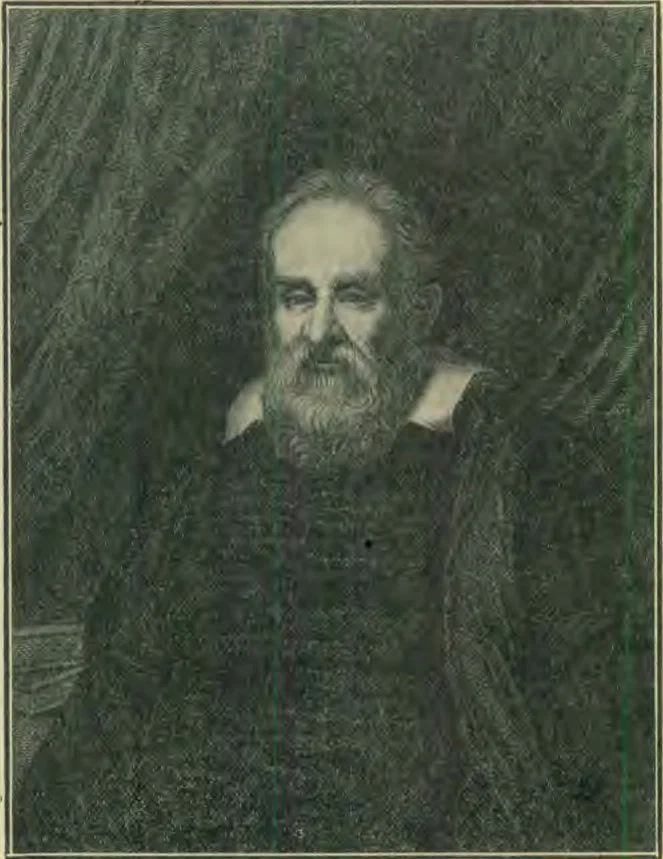
GALILEO, one of the earliest and greatest experimental philosophers, was born at Pisa, Italy, in 1564. His father was descended from a notable family which once ruled the state, but lost fame, and its descendants became impoverished when the empire declined. The father was a mathematician and was versed also in music. Inheriting some of his father's ability, the lad early displayed an intellectual aptitude for constructing mechanical toys.
GALILEO
Galileo was sent to the monastery of Vallombrosa, where he mastered the Latin and Greek languages. One of the monks tried to teach him logic, but this proved uninteresting, and was summarily abandoned. Under the influence of the monks he decided to take holy orders, but his father, not favoring the idea, and desiring him to study medicine, withdrew him from the monks' influence, and sent him to the University of Pisa when he was eighteen. Not caring for medicine, Galileo took up any line of study that seemed to please him. In music he became proficient, ranking with the best professors in Italy; he liked painting, and he had wit and eloquence that promised to the country literary glories.
When twenty years of age, he noticed a brazen lamp suspended from the chapel ceiling, swinging; he observed that the oscillations, whatever the length, were invariably executed in equal times. This important discovery led him to construct a clock fifty years later. His father, desiring that nothing should interfere with his medical work, had kept him ignorant of the study of the higher mathematics, but by chance Galileo heard a lecture on geometry, whereupon he decided that from henceforth he would devote his attention to mathematics. He was soon withdrawn from the university, and the next that we hear of him, he was lecturing before an academy in Florence. He was later elected to the chair of mathematics at Pisa, where he demonstrated to his contemporaries, by the use of the leaning tower, that bodies of unequal mass fall at the same rate. The enmity he aroused by this demonstration led to his removal from the university. His father having died, and the charge of keeping the family falling upon him as the eldest son, he was very glad when offered the same position in Padua as he had held in Pisa.
Here he remained for eighteen years, having much prosperity. Great educators from all over Europe came to hear his lectures, a hall to seat two thousand persons having been built for his express use. He here invented the proportional compass, and also the thermometer. This thermometer had an open tube; it was hermetically sealed later by another man; and later still, mercury was used instead of water, which completed the invention of the modern thermometer.
In a letter to Kepler, Galileo states his belief in the Copernican theory, which claims that the earth with the planets revolves around the sun; but to avoid ridicule, he continued teaching the Ptolemaic theory. He confirmed his opinion of the Copernican theory by the use of the telescope. Galileo was not the discoverer of the telescope, but he increased its range from threefold to thirty-two. He manufactured telescopes and sold them readily. Through his telescopic observations certain theories concerning the Milky Way were abolished, Jupiter's satellites were discovered, and the Copernican theory was given a base upon which to rest. He left Padua to go to Florence, and soon was elected head mathematician and philosopher to the nation, with the salary of one thousand dollars a year,—a fortune in those days,—and he had nothing to do but to continue his experiments. In 1610 he discovered the rings of Saturn, the phases of Venus, and the sun spots. These discoveries were the result of much laborious effort. He went to Rome, and before the pontifical majesties in the Pope's garden, gave a lecture on the Copernican theory, using his telescope to demonstrate this theory. He received encouragement from them. and was flattered by their offers; so when the question of harmonizing the Bible with this theory came up for consideration, he of course took his side, but to the astonishment of all, found the influential pontiffs against him. His writings and ideas were condemned, and he was told not to teach such absurd doctrines longer. Galileo returned to Florence, and was little heard of for eleven years. During this time, however, he wrote a treatise on comets, which, being received with favor, led to his reinstatement.
Sixteen years after the edict against his theory, he thought that the age was ripe for the edict's overthrow, so he published a renowned work concerning this theory. This work received instant recognition by the people; but the sale of the book was prohibited by church authorities, and he was ordered by the Pope to come to Rome. He pleaded his age, as he was over seventy, but the Pope persisted. He was tried before the cardinals and found guilty. The cardinals knew that he was right, but it would cause them to9lose power if they should concede, so they made him do penance by reciting once a week for three years seven penitential psalms. This sentence was signed by seven cardinals, but never received the customary ratification. He was sent away from Italy, but was allowed to return to Florence, where he lived in seclusion the remaining years of his life. His last telescopic discovery was that of the moon's diurnal and monthly librations. He was two months later stricken with absolute blindness, but his good reason and logic remained with him to his death, on the eighth of January, 1642; and the coincidence of the day of his birth with that of Michelangelo's death was paralleled by the coincidence of the year of his death with that of the birth of Sir Isaac Newton.
ARTHUR E. ROBBINS
Science Notes
THE most interesting instrument known to practical physics—a by-product of the wireless telephone, and a by-product which may overshadow the radio phone itself in the course of time—is the audion oscillion bulb. It is the work of Dr. Lee De Forest, of the De Forest wireless service. From these bulbs a succession of musical sounds can be produced, clear and sweet, of a surprising volume, the pitch and timber of which can be varied almost at will to imitate any musical tone of any orchestra. A single bulb can be made to imitate the sound of the flute, the oboe, the cornet, and various stringed instruments. Within the next year Dr. De Forest hopes to bring the instrument to a perfection sufficient to turn it over to men of fine musical talent who can develop it. Who knows but that tomorrow, perhaps, we can go to a concert hall to listen to some famous pianist playing upon the oscillion organ in his own home in Europe, and have the beautiful sounds borne to us by wireless telephone?
By means of a new device for stopping trains, the inventor claims we can ride with perfect safety. The experiments which have been tried on the Pennsylvania Railroad are declared by the railroad officials to be entirely practical. When a train is within two blocks of a preceding train, a green light shines in the engineer’s cab, and the train is reduced in speed. A red signal is given in the cab when the train is within one block of a preceding train, and automatically reduces the speed to one or two miles an hour. If a switch is open, the brakes are applied instantly and automatically. Thus if the engineer does not obey his cab signals, the device applies the brakes. Also with this device conversation can be carried on with trains by telephone.
An electrical device for the vocational guidance of students has been in use for some time in the Newton Technical High School in Massachusetts. The pupil is seated at a table, on which are two jars containing a mercury-and-salt solution. Through this passes a small-voltage electric current, which connects with the indicating apparatus in the next room. The student puts one finger of each hand in its respective jar. Different words, such as “stone cutter,” “dentist,” etc., are flashed on the screen before the student, while the doctor in the next room watches the hands of the indicator. The principle of the new machine is that the electrical resistance of the human body varies greatly under slight emotional changes by reason of the variation of bodily secretions. The emotional responses show the student’s natural aptitude and preference for a subject. Thus the word “painter” may suggest pleasure, and the indicator hand will be thrown far to the left, since we accomplish our best work under the influence of pleasure and exaltation.
January 30 to February 5
By A. B. E.
What Jesus Is to Me
During the month just past, thirty-one texts have been committed to memory,—thirty-one reminders of what Jesus is to us. He is, first of all, our Creator and Saviour; he is our Helper, Keeper, and Guide; our Leader, Commander, Example, Friend, and Elder Brother; our Mediator and Advocate; the Way, the Truth, and Bread of Life, and the Water of Life; our Strength, our Refuge, our High Tower, our Shield, and our exceeding great Reward.
But no matter how well we have learned the words of these texts, we have failed to reach the real object for which we have studied them unless they have become more truly God’s word to us personally, his special promise to us, suited to our individual need, and given for our comfort and encouragement. “Our bodies are built up from what we eat and drink; and as in the natural economy, so in the spiritual economy: it is what we meditate upon that will give tone and strength to our spiritual nature. . . . The infinite mercy and love of Jesus, the sacrifice made in our behalf, call for the most serious and solemn reflection. We should dwell upon the character of our Redeemer and Intercessor. We should meditate upon the mission of him who came to save his people from their sins. As we thus contemplate heavenly themes, our faith and love will grow stronger, and our prayers will be more and more acceptable to God.”
What Satan Is to Me
The Christian warfare is a real conflict. On the one side stands Jesus, with his loyal angels; on the other is Satan, with his evil legions. While it is true that our enemy is a “conquered foe,” he still has power to place before our minds his lying sophistries and subtle deceits. In the garb of an angel of light he causes men to believe evil good and good evil. And his power is world-wide. He who meets us as the adversary of our souls in many a solitary wilderness of temptation, is also the deceiver of the nations, and carries out his evil schemes in the council halls of the rulers of the world.
It is well to consider the power of our foe, not that we shall become hopeless and fearful, but that we may lay hold of the strength of Jesus. Today many are under the control of Satan and his angels. “All who wilfully depart from God’s commandments are placing themselves under the control of Satan. Many a man tampers with evil, thinking that he can break away at pleasure; but he is lured on and on, until he finds himself controlled by a will stronger than his own. He cannot escape its mysterious power. . . . Yet his condition is not hopeless. God does not control our minds without our consent; but every man is free to choose what power he will have to rule over him. . . . Those who consent to enter into covenant with God are not left to the power of Satan or to the infirmity of their own nature.”
Pride was the first sin that entered heaven, and it is one of the last to leave the human heart. In the face of all Jesus’ teaching, as well as his daily example of humility, the disciples came to that upper room with one supreme desire in their hearts—to be first. They wanted the highest place; to be accounted the greatest; to gain, each for himself, advantage over the others. There was a place vacant, a place that needed, according to the custom of that land and time, to be filled; but though the disciples were aware of it, and though the basin and towel and water were provided, not one made a move to fill the humble office of a servant, and bathe the dusty feet of that little company. By their silence, their averted looks, their aloofness, they plainly expressed the feeling of their hearts—that they were too good to perform this menial service. The moments passed—Jesus waited to see what they would do. Then he, Master and Lord, as he gently reminded them, took a towel and bathed their feet. He girded himself10as a servant, and performed a servant’s task, the task that his disciples had tacitly refused. Let us take the lesson home today, not simply that we shall be willing to humble ourselves for the ordinance of humility at stated times, but that we shall let the Saviour’s example of real humility flower in our lives. The unpleasant, disagreeable, servile tasks that he may allow to come to us today are our opportunities. Shall we meet them as he met that occasion, quietly, naturally, pleasantly? or shall we refuse until the time has passed, and the opportunity is forever lost?
“The strongest argument for Christianity is a clean, courageous, and useful Christian life. Creed is to be interpreted by character and conduct. On the other hand, the severest blows which Christianity has to bear are not dealt by its opponents, but by its professed friends who are false to its teachings and spirit. This puts a tremendous responsibility on every one who claims to be a friend of Jesus Christ. ‘I call you not servants,’ says the loving Saviour to us, ‘for the servant knoweth not what his Lord doeth; but I have called you friends.’ To this he adds that we are his witnesses. The lynx-eyed world never sees Jesus Christ except in the person of his followers. To us Jesus Christ gives his name. To us he intrusts the interests of his kingdom. Us he makes his witnesses before the world. What sin involves more ingratitude or works more mischief than for Christ’s blood-redeemed followers to betray their Lord? The word ‘traitor’ is a hateful word. Brethren, let us never turn traitors to our Saviour. Treason is a hateful thing; let us pray that the love of Jesus may rule in our hearts with such power, and the honor of Jesus be so dear in our eyes, that we may never betray him.”—The Independent.
Jesus was our example in wisdom and gentleness. He came to this world to win souls, he sent his disciples forth on this missionary journey to win souls; and he has made us his witnesses in these later days, that we may carry on this winning, drawing, gathering work. If we do his work, shall we not seek to do it in his way? We must study his methods, follow his plans, work according to the directions he has given. “Christ himself did not suppress one word of truth, but he spoke it always in love. He exercised the greatest tact, and thoughtful, kind attention in his intercourse with the people. He was never rude, never needlessly spoke a severe word, never gave needless pain to a sensitive soul. He did not censure human weakness. He fearlessly denounced hypocrisy, unbelief, and iniquity, but tears were in his voice as he uttered his scathing rebukes.”
Before the days of railroads and steamships and telegraphs, when even the written communication was a rare and precious thing, important matters were often intrusted to chosen men, who were sent to carry tidings from one person to another. It would be natural for the person taking the message to add to it the emphasis of his own opinion; hence the necessity of choosing trustworthy representatives. Formerly the words ambassador and messenger meant the same thing, but now the former is applied to men chosen by the sovereign or highest authority of one government to represent it in affairs of state in another, while the latter applies to matters of little importance. An unworthy ambassador not only fails to further the interests of his country, and maintain its respect and honor in the land where he is sent, but he may bring it into disgrace and disrepute. Often ambassadors are recalled, because of their unfaithfulness or inefficiency, or because of their meddling in matters in which they should not become involved. It is said that a Chinese who had been closely watching a missionary’s conduct came to him one day, and said, “I want your God to be my God.” “Why?” asked the missionary. “Because if your God is like you, he must be good.” How, as Christ’s ambassadors, are we representing him? Are we beseeching, urging, winning men to his allegiance? “Suppose he were to recall all who were not efficient, or who were disloyal to him, how many would be left to represent him in the world?” Would you? Pray that you may, each moment of today, know how to walk worthily of your high calling, and be able to speak the words fitly becoming an ambassador of the Lord Jesus.
“There is something very sweet in the thought that we may be Christ’s friends. ‘The secret of the Lord is with them that fear him.’ This means that if we are Christ’s friends, he takes us into the closest intimacy. Not many of us realize all that is possible in the way of companionship with Christ. If we are on terms of unhindered friendship with him, we can talk to him freely, as friend with friend.” And he makes these terms very plain—“do whatsoever I command you.” We cannot disobey, and know his friendship. Let us begin the day by asking if we are obeying all his commands. If we are not, this is the time to begin, to yield our wills to his, to take away the “if,” and be friends with Jesus.
“I would converse with thee from day to day,
With heart intent on what thou hast to say,
And through my pilgrim walk, whate’er befall, Consult with thee, O Lord, about it all.
Since thou art willing thus to condescend,
To be my intimate, familiar friend,
Oh, let me to the great occasion rise,
And count thy friendship life’s most glorious prize!”
It is a simple test of the genuineness of our discipleship—the simplest. We profess to be Christ’s; are we like Christ? We desire to be guided by the Spirit; are the fruits of that Spirit seen in our lives? We recognize our Lord as the True Vine; are we fruit-bearing branches? That is his will, not simply that we bear fruit, a little fruit, but much fruit. But the first essential to a fruitful life is the establishment and maintenance of union with Christ. We must abide in him. “This is no casual touch, no off-and-on connection. The branch becomes a part of the living vine. The communication of life, strength, and fruitfulness from the root to the branches is unobstructed and constant.”
This text brings to mind the prayer of Jesus for his disciples, and those who should believe on him through their word, that tender, longing expression of desire for their oneness of heart, plan, and endeavor.—“That they all may be one, . . . that the world may believe.” That was the supreme purpose of Jesus’ life,—that all men might repent, turn to God, and be saved. For that he laid aside his glory, lived the life of the lowly on earth, was tempted, suffered, and died. The early believers had the spirit of oneness: we are told they were “of one heart,” and as a result “great grace was upon them all.” And that is the condition to which we must come. Are we living as if we believed it? Are we just to all, unselfish, gentle with the weak, thoughtful of one another’s well-being and comfort and peace of mind, respectful to those in authority? Do we avoid criticism of one another as carefully as we avoid giving pain to our physical members? Pray that you, in your appointed place, no matter how humble, may cultivate the graces that make for oneness in the body, or church, of Christ on earth.
Summary
We are called to be servants, not greater than our Lord, but spending ourselves for others, willing to do anything that may come to us to do, if so be that it turn out for the furtherance of the gospel. And witnesses, at home and abroad, in little things and greater things. We are to exercise wisdom and gentleness in bringing the truth to others. As his ambassadors, we are to act faithfully, honorably, and with such discretion that no breath of reproach can be brought against our King. Moreover, we are admitted into the friendship of Jesus; he is our friend—by our own acts we prove whether or not we are his. If we are all these things to Jesus, there will be results—souls will be won to him, fruit will be borne. And in this ever-increasing family, “one body in Christ,” where so many members go to make up the whole, there will be his own spirit of unity and love and peace.
These are only a few of the lessons to be drawn from these texts; they are not intended to be exhaustive, but to help you to habits of meditation and application as you learn them. Open your heart to Jesus; let him teach you and instruct you. Then you will find the Morning Watch a blessing and refreshment to your whole day. A. B. E.
NOTE.— For helps and suggestions on this assignment, see the Review of February 3.
Done Early or Never Done
THAT which is good to be done, cannot be done too soon; and if it is neglected to be done early, it will frequently happen that it will not be done at all.— Bishop Mant
The True Story of Jimmy Lyon
The voice was childish and sweet-toned, but a little unsteady. The man glanced down from under the brim of an old felt hat that had once been white, and a pair of soft, large eyes looked up into his.
“Shine your boots, sir?”
The man shook his head as he uttered a brief No, and passed on.
But the tender face and soft, asking eyes haunted him. After walking on for a little way, trying to forget the face and eyes of the little boy, he stopped, turned, and went back, he hardly knew why.
“Shine your boots, sir?”
It was the same innocent voice, but a little firmer in tone. The man looked down at the bare feet and worn clothes, and a feeling of pity touched his heart.
“Not this morning, my lad,” answered the man, “but here is the price of a shine,” and reached him a penny.
“Have not come to that yet!” And the lad drew himself up a little proudly. “I am not a beggar, but a shoeblack. Just let me shine them, sir. Won’t keep you a minute.”
There was no resisting this appeal. So the man placed his boot on the boy’s foot rest, and in a little while its surface was like polished ebony.
“Thank you!” said the little fellow, as, on finishing the second boot, he received his fee.
The man walked away, holding in his mind very distinctly an image of the boy.
The next morning, while on his way to business, he was greeted by the same lad with: “Shine your boots, sir?” and in a voice steadier than that of the day before. The little bootblack was gaining confidence in his new calling.
The man stopped, placed his boots on the boot rest, and the boy set his brushes to work in the liveliest way.
“Where do you live, my little man?”
The boy brushed on, seeming not to have heard. As he finished one boot, and was about commencing the other, the man said, changing the form of his question:
“Where is your home?”
“Haven’t got any.”
“No home?”
“No, sir.”
“Where do you sleep?”
“Most anywhere that I can creep in,” replied the boy, as he brushed away with all his might. Then, as he rose up, he said, with a business air,—
“That is a good shine, sir!”
“First-rate,” answered the man, whose interest in the boy was increasing. “It cannot be beaten. And now what is the charge?”
“A penny, sir.”
The penny was paid.
“Sleep almost anywhere that you can creep in?” said the man. “What do you mean?”
“Well, sir, it is so. Sometimes I get a bed in a cellar, and sometimes in a garret, just as it happens.”
“Do you pay for it?”
“Oh, yes, indeed. One cannot sleep for nothing.”
“How much do you pay for a bed?”
“Threepence or fourpence, according to where it is.”
“Why don’t you stay in one place? Why do you go from cellar to garret?”
“Because, sir, they get drunk, and fight and swear so almost everywhere I get in that I do not care to go again, and so I keep moving along. Shine your boots, sir?”
And, seeing a customer, off the boy ran, for he had his living to earn, and could not stop to talk when there was business to do.
The man walked away more interested than ever in this brave little fellow, at so tender an age fighting the battle of life.
A few hours later in the day,—it was midsummer, and the air was hot and sultry,—as this man was passing the corner of a street where an apple woman had her stand, he witnessed an interesting scene.
The apple woman had fallen asleep. Two boys—a newsboy and the little bootblack just mentioned—were at the stand. The newsboy, who was larger and stouter than the bootblack, seeing a chance to get apples without paying for them, was seizing two or three of the largest, when the little bootblack pushed bravely in, and the man heard him say:—
“That is stealing, and can’t be done.”
The newsboy grew red with anger as he turned fiercely upon the little fellow, raising his fist to strike him; but his well-aimed blow did not reach the soft, yet bravely indignant face, for an arm stronger than his caught the descending fist, and held it for an instant with a firm grip. In the next moment the scared newsboy had broken away, and was scampering down the street as fast as his legs could carry him.
“That was well done, my little fellow!” exclaimed the man, turning to the young bootblack. “And now,” he added, “you must come to my warehouse.”
“Where is it, sir?” asked the boy.
“Not far away. Come,” said the man as he moved on; and the boy followed. They walked a distance of two or three blocks, and then entered a counting-house, the man moving along through the bales and boxes until he reached a counting-room at the back. Taking a chair, he turned to the lad, who now stood before him with a curious, wondering face, his foot rest, containing brushes and blacking, slung across his shoulders.
“Take that thing off, and set it out in the warehouse, or throw it into the street, I do not care which,” said the man, pointing to the dirty box.
The lad took it off and set it outside the office door, then came back and stood gazing at the man earnestly.
“What is your name?”
“Jimmy Lyon, sir,” said the boy.
“Is your father living?”12
“No, sir.”
“Your mother?”
“She is dead.”
“How long has she been dead?”
“Not long, sir.”
“And there is no one to take care of you?”
“No, sir.”
“How old are you?”
“Eleven last June, sir.”
The man thought of his own little boy at home, just eleven last June, and a shiver of pain crept through his heart.
“What are you going to do?”
“Take care of myself, sir. I have got to do it now.” And Jimmy drew himself up, and put on a brave look, which touched the man’s heart.
“Was it in this city your mother died?” inquired the man.
“Yes, sir.”
“How long ago?”
“It is only three weeks, sir.” The brave look went out of his eyes.
“Where did she die?”
“Down in Water Street. She was sick a good while, sir, and could not work. Father died last winter. But he did not do anything for us.” A shadow of pain was in the child’s face, and the man saw him shudder.
Ah! he understood too well the sad story that the little boy could tell—the story of a drunken father, and a sick, heartbroken mother, dying in want and neglect.
“Your mother was good, and you loved her?” said the man.
Instantly the large, soft eyes were filled with tears.
“What did she say to you before she died?” asked the man, speaking in a low, tender voice.
“She said,” answered the boy, sorrowfully, yet with something brave and manly in his voice, “‘Never steal, never tell a lie, never swear, Jimmy, and God will be your friend;’ and I have not done any of them, sir, and I never will.”
“Your mother taught you to pray, Jimmy?”
“Yes, sir; and I say my prayers every night. Sometimes boys make fun of me, but I do not mind it. I just think it is God I am saying them to, and then I feel all right.”
The man felt a choking in his throat, he was so moved by this, and would not trust himself to speak for some moments.
“God is our best friend, Jimmy,” he said, after a little while; “and no one trusts him in vain. He has taken care of you since your mother died, and if you will be a good boy, he will always take care of you. Do you know that it was God who led me to the apple woman’s stand just in time to see your brave and honest act?”
The boy opened his large eyes wonderingly.
“We cannot see God, but God can see us; and what is more, can look into our hearts, and knows all we think or feel,” continued the man.
“Oh, yes, sir! My mother told me that. But I do not know how he led you.”
“He leads us by ways that we know not, my child. I think I can make you understand. God sees and knows everything. He knew that you would see the wicked boy try to steal the apples, and that you would do all you could to stop him. Then he put it into my mind to go and see a man whose place I could not reach unless I went by the apple stand, and this brought me to the spot just at the right moment. I call that God leading me. Now do you understand?”
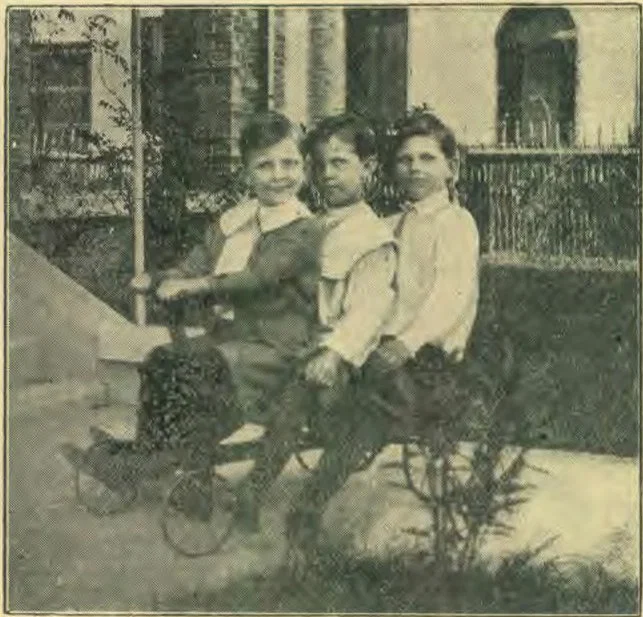
THE SONS OF ELDER JAMES SHULTZ, NOW A MISSIONARY TO CHINA
“Oh, yes, sir, I see it as clear as day!” answered Jimmy, a new light breaking over his face.
“And God, who loves you, and wants you to be good and happy, knew that if I saw how honest and brave you were, I would be your friend.”
“Oh, sir, will you?” cried out little Jimmy, his fine face lighted up suddenly with hope and joy.
“Yes, my boy,” answered the man, whose heart was feeling very tender toward the child; “I will be your friend always, if you will be honest, obedient, and truthful.”
“I shall try to be as good as I can, sir,” said Jimmy, almost losing command of his feelings.
Then the man went with him to a shop where boys’ clothing was sold, and selected everything he needed to wear. But before he let him dress up in his new garments he took him to a bathhouse, that he might wash himself clean all over, and comb the tangle out of his curly hair.
No one would have dreamed that the handsome, well-dressed boy, who, a little while afterwards, walked beside his new friend, was the same whose voice scarce an hour before had been crying in the street, “Shine your boots, sir?” God had sent the brave child, who tried to be good, a friend in need, and he is now a happy boy, studying with all his might, intending to become a good and useful man.—The Good Templars’ Watchword.
Articulation: Practice With the Letter D
By Grenville Kleiser
Articulation
No single sound so readily betrays laziness and mental dulness in a reader or speaker as the sound of d. This letter calls for strength, pressure, and rigidity. For practice in the use of final d, the following lines from Tom Hood will be helpful:—
Gold! Gold! Gold! Gold!
Bright and yellow, hard and cold;
Molten, graven, hammer'd and roll'd.
Heavy to get, and light to hold:
Hoarded, barter'd, bought and sold,
Stolen, borrow'd, squander'd, dol'd,
Spurn'd by the young, hugg'd by the old
To the very verge of the churchyard mold.
— Grenville Kleiser.