Miscellaneous Facts: Sulphur, Clay, Railways, Gold, and More
Page 2
The Youth’s Instructor
Jan 25, 1916
Review and Herald Publishing Assn. · Takoma Park Station, Washington, D. C. · Jan 25, 1916
Miscellaneous Facts: Sulphur, Clay, Railways, Gold, and More
A LOUISIANA sulphur company produces eighty per cent of the world's sulphur.
EVERY State of the Union makes clay products of some kind. Last year's production was valued at $164,986,983.
ON the steam and electric railways of the United States in the year 1913, 3,787 employees were killed, and 172,783 seriously injured.
A MORE glorious victory cannot be gained over another man than this, that when the injury began on his part, the kindness should begin on ours.—Tillotson.
IT is estimated that the world loses one ton and a quarter of gold and eighty-eight tons of silver annually, by mere waste, caused by coins rubbing together.
THE largest book in the world is on exhibition in Chicago. It is one foot thick, and the pages measure three and one-half by seven feet. It requires six men to lift it.
THE oldest newspaper in the world is the Tching-Pao of Peking, China. It is in its one thousand eleventh year. One copy of every issue is preserved in the palace of Peking.
THE German government hires photographers to take moving pictures of the war in all its phases. These pictures are studied to find the weak points in attack and defense.
A CYPRESS tree in Mexico is supposed to be the oldest living thing. Its girth is about one hundred and twenty-six feet, and it is estimated that it is between five and six thousand years old.
IT is interesting to note that the new constitution for New York, which was defeated, contained 33,000 words, whereas the Constitution of the United States with all its Amendments contains only 4,400 words.
ONE of the defensive measures against the German submarines adopted by the British Admiralty are small motor boats capable of making twenty-five knots. They are armed with three-inch rapid-fire guns. These boats are called submarine chasers.
AN old Japanese woman, who died recently, had worked for one family sixty years. During this time she had had very few days of vacation. When given a month's vacation, she returned to work in ten days. This woman received one dollar a month.
AS a result of the Federal Migratory Bird Law of 1913, migratory birds have increased from ten to several hundred per cent. Even now the number of migratory game birds existing in the United States is only about ten per cent of that found in the same area seventy-five years ago.
AN ingenious sterilizing and distilling apparatus has been invented by Major W. J. Lyster, U. S. A. This wonderful invention consists of a hemp bag and a very small quantity of hypochlorite of calcium. These bags, which are large enough to hold forty gallons of water, are suspended from a tree or a tripod and allowed to stand for ten minutes. At the end of that time all dangerous germs have been killed, and the water in the bag may be drawn off through spigots at the end of the bag and used for drinking with perfect safety.
A DISPATCH from Petrograd reads: “As a substitute for vodka shops, which have been abolished, there have been erected in the open places throughout Russia, ‘People's Palaces’ and smaller buildings, where people may meet for entertainment and instruction. In the government of Poltava alone three hundred such places have been opened or projected. They contain reading rooms, and exhibitions and other entertainments can be given in them.”
PHOTOGRAPHS which have been received from Europe show that ships, guns, and automobiles are painted with spots and splashes of different colors. At close range these objects have a weird appearance, but when seen at a considerable distance the colors blend perfectly with the waves on the surface of the ocean, or fade into the landscape, and render the objects almost invisible.
TEN prominent geologists and civil engineers of the United States sailed for Panama, December 11. They were sent by President Wilson to ascertain the facts with respect to the slides in the Gaillard Cut. All of these men are specialists in their line, and it is hoped they will be able to give some scientific suggestions for the solution of the problem of the slides.
LIEUTENANT RENE HAAS, of the French Army, recently purchased one hundred and six Alaskan dogs, for service at the front in Alsace. These dogs are famous throughout Alaska for their prowess, and are recognized as a superior draft animal. This line of dogs constitutes the largest team of dogs ever driven in the north.
IN England the number of convictions for drunkenness among women has gone up alarmingly the past year. The drink bill of the United Kingdom for the half year of war ending June 30, 1915, was $40,000,000 more than during the corresponding half year of peace preceding.
A Bird Book of Worth
THERE'S a unique bird book, one of the three volumes of the “Pocket Nature Library,” just issued by one of the leading publishing houses of the country. It is meant to be of real assistance in identifying birds, so the reading matter is technically descriptive. There is a colored illustration of every bird described. These illustrations give unusual value to the book. It is of pocket size, 3¼ by 5½ inches, and bound in limp leather, characteristics which make it a unique handbook for the bird student. It is well worth $1.25 to all who wish help in the identification of birds. Every one of our school libraries should obtain a copy.
Order of the Review and Herald Publishing Association, Takoma Park, D. C.
It Pays
By Lewellyn A. Wilcox
LEWELLYN A. WILCOX
'Tis easy to be a Christian
When all around believe,
Amid the friends that Christians are,
Where righteousness is popular,
For Christ to speak and live.
'Tis harder to be a Christian
Out in the scoffing world;
There where to love him bringeth sneers,
There where to own him only jeers
And curses loud are hurled.
'Tis harder to be a Christian
When the way is hard and long,
When ridicule and spite and shame
Attend the follower of his name,
And life is not a song.
But it pays to be a Christian!
And hardship is the thing
That proves a valiant soldier’s worth;
And bravery on this field of earth
A sure reward will bring!
The Isle of Pines
By A. N. Allen
The Isle of Pines was so named before it became known as it is today for its luscious pineapples. It was so named from the pine forests which resemble very much those of Florida. To some the name will recall land agents’ glowing descriptions of eternal summer, soft sea breezes, and wonderful opportunities to get rich quick. But to many who have made the venture, the bright coloring has faded away, and regret has taken its place. Memory still recalls too vividly the fruitless labor spent on gravel soil, the many sleepless nights spent fighting sand flies and mosquitoes, and how the funds brought to the island failed long before returns could be secured from the soil.
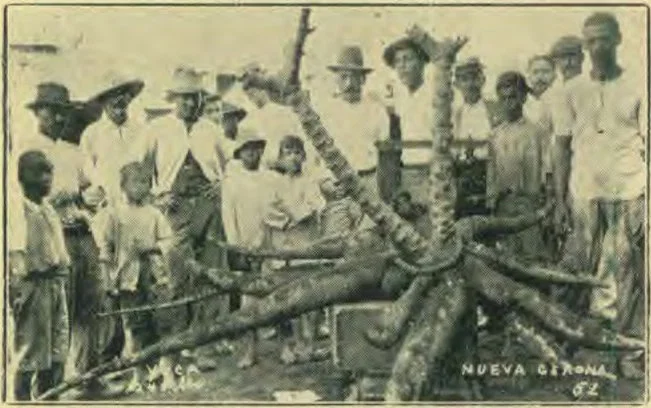
A CASSAVA ROOT, PROBABLY THE LARGEST ON RECORD.
A STAPLE ARTICLE OF DIET
But the Isle of Pines still continues to be the home of about two and one-half thousand Americans, and4as many more Cubans. Many would be only too glad to be back in the places they left to come to the island. Others have been more fortunate, and have succeeded in conquering nature, and are now enjoying the fruit of their labor. Grapefruit, oranges, pineapples, and winter vegetables are being shipped to the New York market, where they bring a good price.
Our message was first made known here by Brother W. E. Wolfgram, who only a short time before had accepted the truth in Brooklyn. A small company was raised up, and last year Elder and Mrs. H. C. Goodrich moved to Nueva Gerona to look after the interest there. Miss Grace White also has recently connected with the work in that place.
A few weeks ago, while visiting the island, Elder Goodrich and I made a trip to the south coast to hold meetings among those interested in the truth. We left Nueva Gerona, the capital of the island, going to Los Indios by auto twenty-seven miles distant, where we secured two young men with a dory, or canoe, to take us the remaining twenty-three miles.
Leaving the hotel at Los Indios, we walked with our grips about a mile to the river, and soon after sunset we were moving down the coast. Shortly after leaving the mouth of the river a good breeze came up, so the sail was set and we were under way. Our boat was open to the weather; but in the tropics this is no inconvenience as long as it does not rain. Elder Goodrich and I lay down side by side in the bottom, and succeeded in getting a little sleep.
At about nine o’clock a heavy squall formed to the east, and the wind freshened considerably, but this only put us along the faster. At ten we had covered the first thirteen miles, and had reached the point on the opposite side of the bay. As the storm was now so close, we went ashore and took refuge in a lone thatch hut used by men who burn charcoal. We had just entered the hut when the rain began, and it continued till three in the morning. As soon as it stopped, we got into the dory again, and were soon sailing up the coast with a good breeze.
AS THE PINEAPPLE GROWS IN THE ISLE OF PINES
But we were still to get wet; for soon after daybreak a heavy squall formed again. This time it was right ahead. The sail was lowered, and we prepared as well as we could to keep dry, but in such a downpour it was impossible. We were soon thoroughly drenched. The sailors had a heavy pull with the oars while the wind lasted, but in about an hour we were out of its track, and soon ran into a little cove where we were given a hearty welcome by Brother John McLaughlin and his family and neighbors.
We remained on the south coast over two Sabbaths. The last Sabbath a Sabbath school of seven members was organized, and others were much interested in the work. Every one did all in his power to make our stay among them pleasant, and in spite of the sand flies and mosquitoes, we greatly enjoyed the time spent here. One thing that especially interested us was the young coconuts. Only those who have drunk the water from the young coconuts, when in the right stage, can appreciate them. The meat at this stage is about the consistency of jelly, and is very pleasant to the taste.
While here we saw some of the effects of the hurricane which recently swept the Gulf. The great waves had washed long distances in from the shore, carrying everything before them. In some of the islands great damage and much suffering resulted. The people told us how in a previous storm a large boiler from a wrecked steamer had been raised from the bottom of the sea, and carried over a mile inland to a place where the ground was very level and low. A large anchor, probably weighing two tons, which had been lying deep in the sea for years, was cast ashore, with many fathoms of chain. Vessels caught in storms that stir the sea to such a depth and lash it into such fury, seldom escape.
ROYAL PALMS
November 1 we started on our return journey. Five men with our baggage embarked in a sixteen-foot canoe. We set the sail, and were off. For the first ten miles our journey was quite pleasant, as we had a fair wind till we reached the point again. Here we went ashore and ate the lunch which we had brought with us. At one o’clock we were off again, but with a heavy head wind and rough sea. We had a straight beat of thirteen miles to make. Had we not had implicit confidence in the ability of the sailors, we should have had reason to fear. For five hours we were soaked with the salt ocean water as the waves broke over us. First the water would come in over the bow, then over one side, then over the other. My part was to bail out the water. Once I counted the pails, and found that over twenty gallons had come in from a single wave. Being wet so long in such a wind, as the sun went out of5sight over the hills we began to feel very chilly; but fortunately we reached harbor soon after nightfall. A good night’s rest in the hotel, and we were ready for the auto in the morning to take us back to Nueva Gerona. While the trip had not been an easy one, we were satisfied, as we had seen souls freed from the power of sin and born into the kingdom of God.
The missionary society in Nueva Gerona has voted to place the Review Extra in every English-speaking home in the island during the next few months. Meetings are now being held in two places in the city to accommodate the different people who are interested. When you pray for missions, remember the Isle of Pines.
A. N. ALLEN.
A Defective Illustration
By Len G. Broughton
When I was a boy, I was very fond of stories, and that fondness followed me into my ministerial experience, and today there is scarcely a boy who is more fond of illustration and story than I. When I began to preach, I ransacked everything I could find for stories that would enable me to convey the truth that I gathered out of the Bible. At one time I stumbled upon an illustration used by the greatest man in illustration that I knew of—Henry Ward Beecher. It was an illustration of his own, depicting the fall of man in the garden of Eden, and the work of regeneration. I thought it was excellent. I was not sufficiently matured in theology to be able to dissect the story and see wherein it was defective. Today I should not think of using it.
Mr. Beecher’s illustration was drawn from a picture which he imagined hanging in his room. It had been hanging there for a number of years. At first it was a beautiful picture; but years passed, and dust and dirt accumulated until the picture was disfigured; it was ruined. No one could tell what it was intended to portray. Finally the housekeeper came along, saw the imperfections of the picture, how it was marred and blurred. She took it down, and with a cloth washed all the dust and dirt away, then dried it and hung it up again; and there was the original image as perfect and as beautiful as before, and the only thing needed to keep it in that condition was an occasional visit from the housekeeper with her cloth, water, and soap. “Now,” said Mr. Beecher, “that picture was at first illustrative of the garden of Eden—perfect, without a flaw. That framework was the original man, also perfect and without a flaw. For a time it remained perfect, but somehow the devil came in and marred the picture until it was no longer pure and beautiful. That,” said he, “is the fall of man—man in his original perfection and purity marred and blurred by sin. Now, the housekeeper washes it and restores the original, and that is the work of regeneration, in that the original perfect picture is restored,—all sin washed away,—man standing before God as he originally made him, perfect, without flaw and blemish.”
I thought that was a good illustration of regeneration. I used it one Sunday morning in my pulpit. I had a deacon who was a very acute old brother. After the service was over and I was leaving, he said to me: “I want to speak to you a minute. You may be very fond of Mr. Beecher’s illustrations, and you may tell a story ever so well, but there never was a greater bundling together of mistakes than in that one you told this morning.” I was very quick to defend my illustration, and said, “Wherein is it false?” He said, “Do you think that regeneration goes no deeper than the washing off of the accumulated sin of a man’s life? If it goes no deeper than that, it is no more than the work of reformation. And if that is the case, what is to become of the sin with which the man is born? If the mere washing off of an accumulated sin is all, what becomes of this inherited sin?” I began to see his point, and I said, “I will think about it.” I did think about it—I did some serious thinking. I got my Bible, and studied on the subject, and the next time I saw that man I said, “You were right; I ought to have looked into that story before I told it.”
Regeneration is in no sense a washing away of sins. Christianity is in no sense a washed-over Adam. Regeneration and the Christianity that follows, is a work beginning in the heart and working to the surface, and not an external work working to the heart. To make that a true illustration, regeneration would be the housekeeper taking that picture down, and with a pair of scissors cutting the canvas right out with all its dirt, the framework only remaining, and then putting in its stead a new canvas. And the new canvas, instead of being a picture of Adam, would contain a picture of Jesus Christ, the Son of God. It is Christ in you, the hope of glory, that saves; not Adam. The man who today is a saved man is saved because God, through the work of regeneration, took out of him his sin, and in its place put Christ. It is Christ enthroned that produces the life that characterizes a true child of God.—Dr. Len G. Broughton.
Young Knipstrow’s Voice
By ARTHUR L. MANOUS
MARTIN LUTHER was evidently one of those men who in their youth learned to know the value of good literature, and in his later life he believed in circulating it “over the world;” for one of his enemies, Mr. Tetzel, the indulgence peddler, in one of his theses against Luther and his writings, said:—
We should teach Christians and those who scribble so many books and waste so much paper, who dispute and preach publicly and wickedly about oral confession, the satisfaction of works, the rich and great indulgences of the Bishop of Rome, and his power; that the persons who take part with those who preach or write such things, who are pleased with their writings, and circulate them among the people and over the world; that those who speak in private of these things in a contemptuous manner—should expect to incur the penalties before mentioned [excommunication and divers chastisements], and to precipitate themselves, and others with them, into eternal condemnation of the judgment day, and into merited disgrace even in this world.—D’Aubigné’s “History of the Reformation,” Vol. I, pages 313, 314, American Tract Society’s Edition.
But in spite of all these theses, and the aid of “the three hundred monks whom Tetzel had collected” to help him in his work against Luther and his “many books” which he circulated “among the people,” the Reformation and the truth for which Luther “scribbled so many books” moved on.
In one of Tetzel’s councils everything seemed to be going his way. No one present seemed to have enough moral courage to speak a word for Luther’s writings and the truth which he advocated. But at last there “was a youth of about twenty years of age, named John Knipstrow,” of whom D’Aubigné says:—
He had read Luther’s theses, and had found them conformable to the doctrines of Scripture. Indignant at beholding the truth publicly trodden underfoot, without any one appearing in its defense, this young man raised his voice, to the great astonishment of all the assembly, and attacked the presumptuous Tetzel.—Id.
This historical incident is an illustration of the importance and value of reading and circulating literature containing present truth. There are in the world today many bright, well-educated young men, and women, too, who might become Knipstrows to raise their voice against the errors now so prevalent, if they had in their hands some of the good literature exposing these errors. But if they have not read, or had a chance to read, the literature that exposes these errors, how can they raise their voices against them? And if those of us as young people who know something of these things do not improve our time to store up these truths now, and also to help circulate them that other Knipstrows may learn of them, we are losing much.
In conclusion I quote from “Christ’s Object Lessons:”—
Our time belongs to God. Every moment is his, and we are under the most solemn obligation to improve it to his glory. Of no talent he has given will he require a more strict account than of our time.—Page 342.
ARTHUR L. MANOUS.
Baby Year and Baby Week
THE year 1916 is Baby Year. The facts about American babies, the needs of American babies, and America's responsibility to her babies, will this year be known as never before, because the first week in March will be Baby Week throughout the country. More than four hundred communities, representing every State in the Union, are already laying their plans for Baby Week, according to the Children's Bureau of the U. S. Department of Labor, in order that during those seven days the needs of the babies may be so presented that all the parents in those communities will learn a little better how to care for their babies, and all the citizens will realize that they have a special obligation to safeguard the conditions surrounding babies. And it is confidently believed by those who are interested in this nation-wide Baby Week, that the remainder of the year will be marked by a strengthening of all community activities for saving babies' lives and giving them a better chance to grow to a healthy maturity.
The Children's Bureau has prepared a special bulletin of practical suggestions for Baby Week campaigns, adapted to the varying needs of communities of different types. Copies of this bulletin may be had free of charge from the Children's Bureau at Washington.
A Worker's Prayer
By Richard Hook, Sr.
LORD, grant me grace, while here below.
To read and love thy Word,
That I may dwell with thee, and know
When thy sweet voice is heard.
Thy Word is life and liberty
And truth and righteousness:
It standeth through eternity,
To lead, instruct, and bless.
Lord, help us to believe, obey,
For those alone are blest
Who do thy will, and only they
May enter into rest.
Lord, give us wisdom now to choose
The strait and narrow way,
That we the path may never lose
That leads to heaven's day.
RICHARD HOOK, SR.
How to Talk — Edward Everett Hale's Rules
First, Tell the truth.
Second, Do not talk of your own affairs in general society.
Third, Talk to the person who is talking to you.
Fourth, Never underrate your interlocutor.
Fifth, Be short: without circumlocution; say it, stop.
Speak Gently: A Little Thing in the Heart
“SPEAK gently; ’tis a little thing Dropped in the heart’s deep well; The good, the joy, which it may bring Eternity shall tell.”
Glimpses of Burma
By R. B. Thurber
Oil
R. B. THURBER
I HAD planned to head this sketch, “The American Occupation of Burma;” but it has such a suspicious look in these warlike times that it was thought best to change. However, our good British censor here would have passed it, without fear that I have any sinister designs on this country.
There is one occupation in the “land of the pagodas” which Americans monopolize, and that is oil-well drilling. It seems strange, yet it is said to be true, that in every oil field of the world men from the United States must superintend the drilling. Mechanics of other nationalities cannot or will not learn the business. It is the only trade that I have ever heard of that all other peoples concede is not in their line. Hundreds of drillers are brought halfway around the world at great expense, are paid large salaries, and are given special concessions, as an absolute necessity to the draining of petroleum from Burma’s subterranean treasure houses.
Standard Oil has invaded Burma, as everywhere, but only in the shape of the innocent-looking five-gallon can. It is the best oil sold in the country, and is indispensable for good lamplight, but of course it is most expensive. This mighty miracle of dread American trusts is looked at askance by English capitalists; and every time a tentacle of the great octopus feels for a hold in British territory, it is promptly cut or circumscribed. So English capital works and controls this field.
The center of interest is on the bank of the Irrawaddy at Yenangyaung, about halfway up toward Mandalay. There are less-paying localities on both sides of the river for many miles up and down, but “Bad-smelling-water Valley” (the meaning of the Burmese name) is the part which is especially well-oiled and oil-welled. The field is somewhat off the beaten path, and so the world tourists miss it. There isn’t even a railway, and we approach from the south on the broad bank of the river. Huge red tanks dotting the hills first greet the view; and then there comes into the range of vision what at first appears to be a forest of tall, bare trees back among the hills. These soon resolve themselves into derricks, so numerous and close together that they seem to touch one another at the bases. Our little launch edges up to the bank at the best landing, and we are soon past the dirty Burmese village, and are bumping along in our bullock-cart conveyance by the pumping stations. On dry, bare bluffs overlooking the river are perched the well-kept and roomy bungalows of the officers of the various companies.
A few miles more, and we are in the midst of a lively scene. Many of the readers of this know too well, perhaps, the sights and sounds and odors of an oil region. I will not, therefore, attempt to describe the features common to all fields; but some of the characteristic aspects will take your attention.
This particular field is most remarkable because it is so small and yet so inexhaustible. Within an area no larger than that occupied by an ordinary village, there are hundreds of wells so close together that there is scarcely room to work them. A circle with a radius of twenty-one feet is all that can be gotten for one site. The sites of the rival companies are all intermingled, and many wells tap the territory of others. This causes much interchange of oil below—and words above—the surface before the matter is settled.
There is much ingenuity displayed by the field superintendents in getting first chance and best advantage in drawing away oil from adjacent territory. But this rivalry sometimes works to the disadvantage of all concerned, as the following will illustrate: One of the drillers told us that as usual one day he pumped some water into his well so that he could draw up in solution the sediment that had accumulated by the drilling; but as fast as it was pumped in, the water ran off into the oil sand. This makes no small trouble when working with heavy tools at a distance of two thousand feet down, and he bothered with it for two or three days before he discovered what was the matter. Then he happened to be talking to a neighboring driller, who said in the course of the conversation, “I don’t know what is the matter with my well. I struck water day before yesterday, and have been pumping it out ever since, but there is no end to it.”
The government controls the depth to which the drills shall go. When one oil sand is exhausted, permission is given to go deeper, and there is a race to penetrate the next stratum. And there is always oil below. This has been going on for a period of over twenty-five years, and millions of barrels of oil have been drawn from this one locality; yet still “gushers” are common.
Yenangyaung was worked for many years before modern machinery was used. In the olden time the Burmans dug shallow wells, and with bucket and rope drew up the product. Even now a few of these old wells are being worked, right in among the towering derricks and amid the chugging of many steam pumps. These primitive wells are now about four hundred feet deep, and about the width of an ordinary water well. A man is let down by a rope, and he fills the receptacle, which is drawn to the surface by a number of Burmese men and women pulling the rope to a certain distance from the mouth of the well and coming back by turns to get a new hold. Oil obtained in this way is usually sold to the large companies at about one dollar a barrel.
Each American driller has a number of natives to do the work while he directs it. Many of these sons of the soil can manage the drilling alone when all goes well, but none seem to learn judgment for an emergency. Accidents are common, and are costly if not met by expert knowledge.
Here are Americans who have seen the world—hardy “boys” who have made the rounds of Pennsylvania, Ohio, Illinois, Kansas, Texas, and California; who have “fished” for tools in the wells of Roumania and Russia, heard the bullets whistle in the anti-Armenian riots in Batum, and drilled for water on the arid plains of west Australia. They are stalwart men; rather rough, as drillers go, but withal good-hearted. The work and the region do not supply much that would soften character. They work on a three-year contract that provides that they must not bring wives with them. A few wives of higher-wage men are there, but few women can live there and be satisfied, for there is little to attract.7
Set down in that bleak place and compelled to pay close attention to business, with only five days in a year vacation, in the face of every temptation and vice that the Orient can bring to bear, the men do not find conditions conducive to straight living. No missionary organization is working among them. In spite of their independence and bravado they are “as sheep without a shepherd.” There is about the place an atmosphere of no-one-knows-nor-cares, and many a man goes bad and never reaches home again.
But there is a brighter side. The minimum wage is one hundred and fifty dollars a month, and each man has half a large bungalow rent free. They have a “messing allowance,” which enables many to save their whole salaries. Each man has a pony, and they frequently get out for a short hunt in the jungle. They have subscribed for and built a pleasant clubhouse, where there is plenty of reading and entertainment provided. Some of the men who have been ambitious and have been careful of their habits and health have risen to better positions, and are able, after being in the field for fifteen years, to retire on a comfortable income.
We found nearly every man we met hospitable and generous to a fault. Most of them are glad to give to any mission enterprise. A good part of the equipment of our Meiktila school stands as a monument to their liberality. These hundred or more Americans at Yenangyaung would gladly support a church and an able evangelist. A Christian pastor could do much good, and his influence would reach to the ends of the earth, wherever these roving men may go. It is most bitter to be sick and near death’s door thousands of miles from home, in an alien land, with no touch of a woman’s hand to soothe and none of the comforts of religion to strengthen. These men can be reached with messages of truth when they are down in the depths here, which might not appeal to them at all in the homeland.
Lost! The Hour That Never Returns
By S. Roxana Winge
Lost!
LOST! and you can never get it back, never make it up—that precious hour of time on which mayhap hung the issues of life.
“Lost, where the countless throng
In fashion’s mazes wind,
Where trilleth folly’s song,
Leaving a sting behind.”
Spent otherwise and elsewhere, it might have turned your feet into the path of life and set you working for God; but now where are you? What have you to show for the days, the months, the years, that your Creator has put into your hands? Not a thing worth while; not a soul saved; nothing that will count for the endless ages; and all because of that one wasted hour when your evening was spent in some gayety instead of in the house of God, and all your convictions of sin, your repentant feelings, your resolve to obey God and become a follower of Christ, were frittered away!
How different the record of a young married woman who about thirty years ago moved with her husband to a prairie in Kansas. She had wasted no hours in her youth, in ballroom or theater, but when the time for decision came, decided, not for pleasure, but for Jesus.
There was a Sunday school in the little Western town, but it was having a hard time to live. She was asked to help, and took the primary class, teaching often when she had to hold her sick baby on a pillow.
She was too busy to visit these little ones in their homes, and so had them come to visit her. There were fifteen in the Bible class, and a part of one day out of every week was given to these for mission study. She told them stories and incidents about missions, until they became interested, and then set them to raising chickens and growing vegetables, and soon they had money enough to support a Bible woman in China. Today they are all busy working for Jesus. One went as a missionary to Africa. Another as the wife of a missionary to the Philippines; another as a medical missionary to the same islands; another became the head of a great Christian association in the Far East; and still another has been laboring with her husband in Alaska.
Mr. George Henderson, superintendent for the Central District of the American Sunday School Union, told me the story in a recent letter. I could not help contrasting your life and hers, for well do I remember the very night when you lost “that gem of countless price,” turned away from a pleading Saviour, and chose the worldling’s path instead of the narrow road.
You saw with clearer vision later on, when you buried your dearest. Then you remembered your Creator, and pleaded with him. But life can never be to you what it might have been. Its most precious opportunities for bearing fruit are gone. Your lost hour is lost forever. S. ROXANA WINGE.
Behind Time
By Freeman Hunt
A CONDEMNED man was led out for execution. He had taken human life, but under circumstances of the greatest provocation, and public sympathy was active in his behalf. Thousands had signed petitions for a reprieve. A favorable answer was expected the night before, and though it had not come, even the sheriff felt confident that it would yet arrive in season. Thus the morning passed without the appearance of the messenger. The last moment was up. The prisoner took his place on the drop, the cap was drawn over his eyes, the bolt was drawn, and a lifeless body swung revolving in the wind. Just at that moment a horseman came into sight, galloping downhill, his steed covered with foam. He carried a packet in his right hand, which he waved rapidly to the crowd. He was the express rider with the reprieve; but he had come too late. A comparatively innocent man had died an ignominious death because a watch had been five minutes too slow, making its bearer arrive behind time.
The best-laid plans, the most important affairs, the fortunes of individuals, the weal of nations, honor, happiness, life itself, are daily sacrificed because somebody is “behind time.” There are men who always fail in whatever they undertake, simply because they are “behind time.” There are others who put off reformation year by year, till death seizes them, and they perish unrepentant, because forever “behind time.” Five minutes in a crisis is worth years. It is but a little period, yet it has often saved a fortune or redeemed a people. If there is one virtue that should be cultivated more than another by him who would succeed in life, it is punctuality; if there is one error that should be avoided, it is being behind time.—
Freeman Hunt.
Night Filled With Music
By Longfellow
AND the night shall be filled with music,
And the cares which infest the day
Shall fold their tents like the Arabs,
And as silently steal away.
—Longfellow.