NARCISSA, would you be willing to go with me across the mountains?”
The question was asked eagerly by stalwart Marcus Whitman, who had just returned to his home in Rushville, New York, after a venturesome exploring trip through the West to the mountains of the Oregon country. It was in 1833, when Oregon was a no man’s land, longed for by Great Britain, and despised by the United States.
But Dr. Marcus Whitman had learned enough of the new country to see that the nation which secured title to it would be fortunate. He wanted to be one of the pioneers to make a home there. It was his purpose to go out prepared to teach the Indians and to guide the settlers—whom he was sure would follow—into a self-respecting, God-fearing life.
However, he did not want to go alone. He felt that no better object-lesson could be given to the Indians than a Christian home. So he sought Narcissa Prentice, who had already promised to be his bride, and asked her if she would be willing to be his partner in making the venturesome journey and in setting up the pioneer home among the Indians.
He told her he knew what he was asking. The way was long and rough. It was only six years since the building of the first railroad in America. Where they were going they would have to use canoes or horses; many times they would have to walk. Indians would be all about them, and Indians who had learned to dread the white man might prove dangerous neighbors. Narcissa Prentice laughed at the fears of her lover, and said she would go with him, of course. But she would be lonely if there was not another woman in the party. So the marriage was postponed till Dr. Whitman could find a husband and wife willing to go with him. For a while his search was in vain. Then he heard of Dr. H. H. Spalding and his young bride, who were about to go as missionaries to the Osage Indians, on their reservation in Northern New York. He tried to reach the young people, but learned that they had already started for their new home.
Whitman jumped into his sleigh and started to find them. After a long pursuit he came up with them during a blinding snow-storm. There was no time for a lengthy introduction, so he shouted:—
“Ship ahoy! You are wanted for Oregon!”
The surprised travelers drew rein, while Whitman explained his strange words. But the day was cold, so they agreed to drive on side by side to the little inn in the village of Howard, New York, not far away. Before the log fire at the inn a hundred questions were asked and answered.
“I have promised to go back this spring,” Whitman explained. “I am to be married as soon as I return home. Then we are to go out to Missouri, where we are to join the fur traders till we are met by the Nez Perces, among whom we are to live. They will show us the way to our new home. We’ll live on buffalo and venison, we’ll travel on horseback, and we’ll spend the nights in tents or rolled in blankets on the ground. Will you go with us?”
Mr. Spalding wanted to say yes, but he feared for his wife’s health. She had recently recovered from a long sickness. So he said to her: “It is not your duty to go. Your health forbids. I shall leave it to you.”
Mrs. Spalding went off by herself to decide the question of her duty. Ten minutes later she returned, her face shining, and said, “I have made up my mind for Oregon.”
Her husband asked her if she understood what her decision involved. He reminded her of the perils of the three-thousand-mile journey, and the loneliness of the far-away home; but she was firm.
The wedding of Narcissa Prentice and Dr. Whitman followed the agreement. Then began one of the strangest wedding journeys ever taken—by rivers, across plain, and over mountains to the mysterious land “where rolls the Oregon.”
All went well till the Missouri River was reached, at the point where the fur traders who had invited the missionaries to join them said they would wait. Four days before the arrival of the party, when the traders heard that there were women with the missionaries, they decided to push on alone. They thought they had enough to attend to in protecting themselves from the Indians. They little knew the spirit of Mrs. Whitman and Mrs. Spalding.
Mr. Spalding said they must not think of going on alone; they must return home. Brave Mrs. Spalding carried the day by her determined words, “I have started for Oregon, and to Oregon I will go or leave my body on the plains.”
So the missionary party hurried on their way alone, hoping to overtake the fur traders within a week or ten days. Mrs. Spalding and Mrs. Whitman were the life of the company, encouraging the men where obstacles hindered them, and spurring them on where Mr. Spalding was tempted to say, “Let’s go back.” He didn’t say this very often; but when he was “kicked by a mule, shaken by the ague, stripped by a tornado, not only of his tent, but his blankets, and crowded off the ferry-boat by an awkward, uncivilized frontier cow,” it is not by any means strange that he was discouraged.
Dr. Whitman had provided a spring wagon for the two brides, but Mrs. Whitman preferred to ride on horseback by the side of her husband, leaving the wagon to Mrs. Spalding, who was not yet strong. On other horses rode the husbands, and Dr. W. H. Gray, who was to be the business agent of the mission station; following them came two teamsters, in charge of the wagons bearing the supplies.
At last the fur traders were overtaken. The men were sorry to see the women, but Mrs. Whitman and8Mrs. Spalding soon won all hearts. Before long they were looked on as a positive addition to the company, in spite of the dangers from Indians. For protection from the enemy, there were more than two hundred men; but the attention of many of these had to be given to the six hundred animals taken along for food. The animals tempted the Indians, and it was necessary each night to camp with the stock in the center, around these the tents and wagons, and about the whole encampment a company of vigilant sentinels.
The experienced plainsmen shook their heads when they saw the wagons, and they told Dr. Whitman that it would be impossible to take them across the mountains. But he insisted that they must go. He was not thinking merely of the comfort of those who would use them, but more of the great importance of proving to the world that a wagon could be taken to Oregon. He was looking forward to the day when there would be in that country more white people than Indians. Yet men and women would be prevented from making the journey by the statement that it was impossible to colonize Oregon by wagon. An English editor had said that American wagons could not go to the Columbia River, and Americans were believing him. It was Doctor Whitman’s purpose to show the doubters that they were wrong. So he carried a wagon through with him to the Pacific slope, and thus he did what has been called one of the most important things for the whole future of Oregon.
The traders shrugged their shoulders when “the silent Whitman” said the wagon must go through. They said, “I told you so,” when one night, in a bit of rough country, he fell behind with his beloved wagon, and came into camp “late, warm, puffing, and cheery too, for he had had only one upset.”
The Indians were much interested in the first wheeled vehicle they had ever seen. “They put into jerky syllables the sounds it made as it rose and fell and stopped in the soft grass and among the rocks, and called it: ‘Chick-chick-shani-le-kai-kash.’”
Pronounce those syllables and see if they do not remind you of the creaking of a wagon.
Through canyon, along creek beds, up rocky precipices, the wagon was pushed and hauled. Many times it was overturned, but still the doctor would not listen to those who urged him to abandon it. At last, when the way became too rough for four wheels, he made the wagon into a cart, added the extra wheels to the load, and pushed on. Further on the cart was left, but only for a little while. Then it was taken the rest of the way to the mission station. Dr. Whitman had triumphed, and those who said colonists could never go to Oregon were effectively answered. Historians have said that the journey of the wagon almost from coast to coast was a more important event for the country than the building of the twelve hundred miles of railway during the same year.
For many weeks of their journey the travelers had an abundance of food. In the buffalo country, where a single herd sometimes covered a thousand acres, the hunters could slaughter the noble animals at will. In anticipation of later days when game would be scarce, the caravan paused to jerk, or dry, the buffalo meat. The jerked meat did not seem very appetizing so long as fresh, juicy buffalo steaks were to be had, but when the herds vanished, all were glad to use it. Yet how they longed for a little bread to go with it! Once Mrs. Whitman wrote: “O, for a few crusts of mother’s bread! Girls, don’t waste the bread in the old home.”
That is the nearest to a complaint the brave woman came during all that arduous journey, in spite of “scorching sun, the clouds of alkaline dust that stung the eye and throat, the impure water they were compelled to use, the myriads of mosquitoes and buffalo gnats.”
When, on July 4, 1836, the missionaries were at last over the crest of the Rockies, twenty-five hundred miles from home, they paused, spread their blankets, unfurled the American flag, and knelt in a prayer of dedication to God of the Oregon country. The act meant more than the missionaries knew. One historian of Oregon says that it went far toward giving to the United States six thousand miles of Pacific coast.
Soon after, hardy frontiersmen were met, who had not seen a woman for years. They looked reverently on the faces of the two brides. Years later one of them said, “From that day when I took again the hand of a civilized woman, I was a better man.” And the trapper said, “There is something the royal Hudson Bay Company and its masters can’t drive out of Oregon.” He knew that the coming of women meant the dawn of civilization.
Dr. Whitman picked his location on the banks of the Walla Walla. Mr. Spalding went a hundred miles farther to a spot on the banks of the Clearwater. On these two sites the men, assisted by the Indians, built roomy log cabins. Then they sent for the brides.
Just in time for the Christmas of 1837, Mrs. Whitman reached her new home after a trip of two hundred fifty miles. The wolves in the thickets which fringed the banks of the Walla Walla were howling dolorous greeting. The brave woman, smiling as she thought of the snug shelter prepared for her, pushed on to the blazing fire in the home.
She was too weary that night to inspect the place where she was to spend a few happy, busy years. She was content to wait for the revelations of the next day. She did not fear them; for she knew that her husband, with the two teamsters, who had come with him across the mountain, and two other men, whom he had secured on the ground, had been busy clearing land of underbrush and building a house. She was content to think that they had done their best.
Six weeks the men had toiled. Then they had enclosed a house of one large room, whose open fireplace was ready to glow with the welcoming heat for the visitor, or, first of all, for the wife, without whom the house would never be anything more than a house. But when Mrs. Whitman entered the door, the house became a home.
And what a home that was—“chairs rudely made, with skins stretched across them; table made of four posts, covered with boards sawed by hand; stools made of logs sawed of proper length; pegs along the walls upon which to hang the clothing, nails being too expensive a luxury; beds fastened to the walls, and filled with dried grass and leaves!”
Mrs. Whitman’s gratitude for these blessings was so great that she found the journal which had been her companion on the journey from New York, and wrote:—
“We reached our new home December 10; found a house reared, and the lean-to enclosed, a good chimney and fireplace, and the fire laid; but no windows or doors except blankets. My heart truly leaped for joy as I alighted from my horse, entered, and seated myself before a pleasant fire; for it was night and the air was chilly.”9
Mrs. Spalding was just as happy in the cabin her husband had built for her, and she set to work at once to make it homelike. Then she began to gather the children of the Indians about her for instruction. At first the red men were suspicious, but it was not long till she found her way to the hearts of all.
Mrs. Whitman, too, gathered the Indians into her home for instruction. Her teaching and Dr. Whitman’s training worked many changes in the Indians.
For ten years they lived quietly in the lonely place they had chosen. Once Mrs. Whitman was alone for many months while her husband took his famous winter ride of thirty-five hundred miles to Washington, which historians declare had a great influence in making the Oregon country a part of the United States.
When Dr. Whitman returned, he found that everything was in fine condition, owing largely to Mrs. Whitman’s careful management during his absence. There, for several years more, husband and wife worked together, spending themselves unselfishly for the Indians.
Their work was brought to a tragic close in 1846. There was an epidemic among the Indians. Medicine-men, who were jealous of the influence of the white teachers, whispered that they were responsible for the sickness. The suspicious Indians believed the stories. They fell upon the home on the banks of the Walla Walla, and put to death not only Mr. and Mrs. Whitman, but a number of friends who were with them.
The Indians who lived about the home of the Spaldings became restless as they heard of the bloody deed done by their kinsmen. On Sunday morning, when Mr. Spalding was away from home, friendly Indians urged Mrs. Spalding to flee with them to their camp.
Mrs. Spalding longed to go. Her heart yearned for her children; but she stopped to think that it was Sunday. For years she had been teaching the Indians to keep the day holy. What impression would be made on their minds if she should be seen moving to the camp on that day? Her resolution was taken promptly. So she replied firmly, “I will not flee on this day.”
But early on Monday the Indian friends were back again. This time she went with them. And she was just in time. The aroused Indians rushed upon her house, but found it empty. In their anger at the escape of Mrs. Spalding, they carried away many articles and destroyed many others.
As Mr. Spalding returned he feared the worst, but when he found his loved ones safe at the Nez Perces camp, his heart overflowed with joy. The reunited family returned to their home, only to be driven from it once more when the Cayuse war, brought on by the Whitman massacre, broke up the mission stations in the region. Then, under guard of forty faithful Indians, he took his family to Fort Walla Walla. It was his joy to return to his work after many years’ absence, but Mrs. Spalding died four years later. Her most lasting monument was built in the hearts of the Indians.
Mrs. Whitman’s monument stands on the site of the home to which she went as a bride. And in the town of Walla Walla, only a few miles away, admirers have built to her memory and the memory of her husband, Whitman College, where young men and young women are trained to follow the example set them by the courageous brides who cheerfully left comfortable homes in the East to face hardships in the West because they thought this was their duty.—John T. Faris, in Service.
What I Have Observed Recently
By Ethel Le Baron
A LEADER of a Sabbath-school division standing with feet eighteen or twenty inches apart during his attempt to review the lesson. Just why this unusual base was deemed necessary to properly support him during the effort, I can not say. If it had been lessened by one half, his personal appearance would have been considerably enhanced, and I can hardly believe it would have interfered materially with his equilibrium.
A group of girls giggling effusively just because some soldier boys happened to pass by. Perhaps the girls observed something that was a trifle amusing; but no one else near by saw enough to provoke even a wholesome laugh, much less a prolonged giggle. The sensible girl eschews giggling.
A young man hesitating and apologizing for attempting to tell a really funny story because the fun was based upon a text of Scripture that had been given an unusual setting. It was a praiseworthy act; but there are many who do not hesitate to quote Scripture lightly whenever opportunity permits.
A mother caressing and kissing her daughter of seven during church service. Parental affection is sacred and beautiful, but a public display of it under ordinary circumstances is undignified.
Young people, members of the junior division of the Sabbath-school, engaged in a prolonged conversation during the review. This is discourteous, and is quite likely to rob one of spiritual blessing.
A young girl of ten or twelve years of age on roller skates had fallen in the street. She doubtless felt piqued at herself for doing so; therefore, instead of getting up as quickly as possible, she sat for some moments on the ground with her legs and feet stretched out in front of her at full length. This attitude in a public highway might have been overlooked in a very little girl, but was unpardonable in one of her size and age. Good form demands special modesty and quietness of girls on the street.
An Adventist young man who had recently lost his position in one of our institutions smoking cigarettes. Some seem to think as soon as they become lax or discouraged religiously, the next thing to do is to take up some vile habit. One can hardly believe they previously refrained from principle, the only worthy thing upon which to base life's habits. Tobacco and liquor work ill to the health and well-being of the sinner as well as to the believer. Why sell the body, even if one does the soul, to the evil one? Does one need to eschew every principle of true manhood because he is disconnected from some religious institution?
ETHEL LE BARON.
Write Your Name Plainly
Why are your letters
Carefully penned
Only to jumble
Right at the end?
Words in a sentence,
If we're in doubt,
Just by the context
May be made out;
But a man's signature,
One lonely scrawl—
That is the craziest
Writing of all!
Are you like Roosevelt,
So known to fame
That “T. R.” will answer
For your full name?
—Christian Endeavor World.
What Children Can Do
THE following is from the mother of a five-year-old boy, a very successful periodical worker. It reveals the possibilities within the reach of many boys and girls who are now doing nothing toward assisting in disseminating the publications containing the gospel message for this time: —
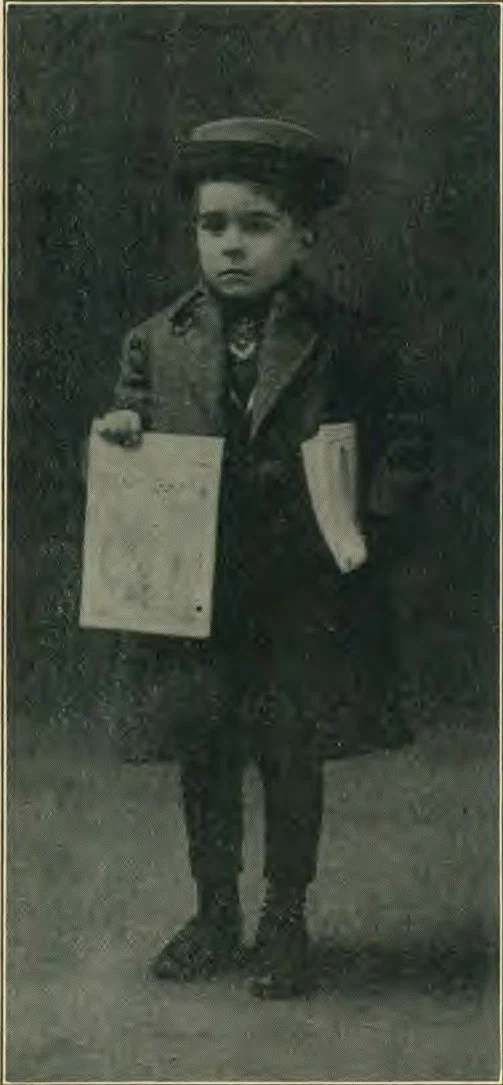
“Perhaps you would like to have a report of paper work done by my little five-year-old boy. In two weeks’ time he sold 301 papers. He had never sold papers before. Though two weeks’ time was covered in the report, the time actually worked would not make a full week of eight hours a day. He received $30.10 on sales, and made a net profit of $18.06. He can sell from 20 to 35 copies an hour. He gives a fine description of his papers. As he has about all kinds of people to deal with, he11has learned how to meet many hard questions. I am sure, with God’s help, he was able to place the papers in many hands that I could not have reached. I go on the streets with him, and watch that he goes into proper places, and that he does not get lost.”
THIS IS THE BOY WHO CAN SELL PAPERS
We hope this boy, together with hundreds of others, will go to work with the Temperance number of the INSTRUCTOR. Any boy or girl ought to dispose of five hundred in a few weeks’ time.
Going Abroad
It was on a rainy Saturday that the Chapin children begged Aunt Ruth for a new game.
“Give us something that will make us think hard,” said Carl.
“We might play going abroad,” she proposed.
“O, what is that?” cried Alice. “Let’s!”
“It is good training for the memory,” Aunt Ruth said. “I will begin with Norton.
“Where did you go last summer? You must answer, ‘I went abroad.’
“What did you see? Tell me anything you choose.”
“A cathedral,” replied Norton.
“Now Norton must ask Alice the same two questions, and she will give his two answers, and add something of her own that she saw.”
Alice gave Windsor Castle besides the cathedral, and then turned to Carl.
“Where did you go last summer?” she asked.
“I went abroad,” he answered.
“What did you see?”
“I saw a cathedral, Windsor Castle, and the Tower of London.”
“O dear,” sighed Bertha, “if it keeps up very long, I know I can’t remember!”
She told the three that had been given, adding, “some gondolas.”
Mrs. Chapin said she would play, too, so Bertha questioned her.
“I saw a cathedral, Windsor Castle, the Tower of London, some gondolas, and the birthplace of Shakespeare.”
“I saw,” replied Aunt Ruth, “a cathedral, Windsor Castle, the Tower of London, some gondolas, the birthplace of Shakespeare, and a cricket-match.”
“I saw,” began Norton, slowly, “a cathedral, the Tower of —”
“No, no!” his sisters cried. “You’ve skipped one!”
Norton thought scowlingly. “Gondolas,” he went on, “and a cricket-match, and —”
“You’re a little mixed up,” mother said.
“Well, cut me out!” he exclaimed. “I can’t remember, of course!”
“This is to help you learn to remember,” replied his aunt. “Begin again.”
And after two more attempts he did get them in order.
“Whew,” he cried, “but this is hard thinking enough to suit Chapin Carl!”
Alice added Buckingham Palace to the list, and then questioned Carl.
The number was now so increased that everybody was watching breathlessly for a break.
“A cathedral, Windsor Castle,” began Carl, glibly, and then frowned. He looked round, and laughed. “I’ve forgotten what comes next!”
“It’s your own,” Alice reminded him; but that did not bring the missing words.
“Where were the princes?” queried Aunt Ruth.
“O, the Tower of London!” cried Carl, and then went on, “some gondolas, the birthplace of Shakespeare, a cricket-match, Mount Vesuvius, Buckingham Palace, and Oxford University.”
Bertha failed utterly, and so did Mrs. Chapin. It passed to Aunt Ruth. The rest waited eagerly to see if she could name all that had been given, there had been so many breaks.
“A cathedral, Windsor Castle, the Tower of London, some gondolas, the birthplace of Shakespeare, a cricket-match, Mount Vesuvius, Oxford University, and the pyramids.”
Norton shook his head decidedly, and Alice tried, only to fail. Carl began, but blundered, and finally had to give it up, leaving Aunt Ruth sole victor.
“I say,” cried Carl, “let’s play this again! I’m not going to be beaten by a few words!” — Youth’s Companion.
Waiting in Prayer
By Anna L. Dreyer
Two little girls said their prayers together one night. At the close one jumped right up, but the other knelt quietly by the white bed.
“What were you waiting for, sister?”
“I was listening for God to answer,” said her sister.
“Don’t you remember Miss Josepha said we mustn’t hurry over our prayers? She said that it was like the little boy that knocked at her door once, and then ran away before she could open it. So now I always wait to see if God wants to say anything to me.”
“Did he say anything to you to-night, sister?” asked the other, looking startled.
“You know,” was the answer, in a low tone, “we said, ‘God bless all my friends,’ and right away I thought of Sadie Burwel, ’cause we had a fuss to-day; and while I waited, God said, ‘Tell her you are sorry.’”—Anna L. Dreyer.
The Last Heathen Dance on Aniwa
By John G. Paton
The last heathen dance on Aniwa was intended, strange to say, in honor of our work. We had finished the burning of a large lime-kiln for our buildings, and the event was regarded as worthy of a festival. To our surprise, loud bursts of song were followed by the tramp, tramp of many feet. Men, women, and children poured past us, painted, decorated with feathers and bush twigs, and dressed in their own wildest form, though almost entirely nude so far as regards the clothing of civilization. They marched into the village public ground, and with song and shout and dance made the air hideous to me. They danced in inner and outer circles, men with men and women with women. . . . Our islanders, on becoming followers of Jesus, have always voluntarily withdrawn from all these scenes, and regard such dancings as inconsistent with the presence and fellowship of the Saviour.
On calling one of their leading men and asking him what it all meant, he said:—
“Missi, we are rejoicing for you, singing and dancing to our gods for you and your works.”
I told him that my Jehovah God would be angry at his church being so associated with heathen gods. The poor, bewildered soul looked grieved, and asked: “Is it not good, Missi? Are we not helping you?”
I said, “No; it is not good. I am shocked to see you. I come here to teach you to give up all these ways, and to please Jehovah God.”
He went and called away his wife and all his friends, and told them that Missi was displeased. But the others held on for hours, and were much disgusted that I would not make them a feast, and pay them for their dancing. No other dance was ever held near our station on Aniwa.—John G. Paton.
Faith Alone Can Interpret Life
FAITH alone can interpret life.—Longfellow.
“They That Feared the Lord Spake Often”
By Horatio Brown
THEN the children of the kingdom
Spake often of the Lord,
Sought the blessings of his wisdom
While they pondered o’er his Word.
Then their speaking to each other
Gave them courage day by day,
And the struggling, erring brother
Was made stronger in the way.
They were speaking of his coming,
And were telling of his care,
How the Spirit now is working,
And is falling everywhere.
Then the fainting hearts grew stronger,
And they said to one and all,
“Let us linger now no longer
While his blessing we recall.”
Then the angel whispered softly,
“Now, your Lord hath heard to-day,
And I’ll write it all so truly
How you feared him all the way.
Speak ye often to each other;
Do not murmur nor repine,
For such jewels will he gather,
In the nearing harvest-time.”
HORATIO BROWN.
Grouchiness
I HAPPENED to sit behind a young couple in a train the other day where I could see their faces. They apparently had not been married long, and I sincerely pitied the bride; for she had evidently married a grouchy man. She smiled upon him, but he never returned an answering smile. She would make a pleasant remark about the scenery or the passengers, and he would answer in monosyllables, never relaxing a muscle of his face. She would offer him a choice morsel from her box of candy, and he would take it without a word or a look of thanks, and swallow it as solemnly as if he were taking a pill, and a bitter one at that.
Now I may be doing that unknown fellow traveler an injustice, and he may have been suffering from some bad news, or remorse of conscience, or a toothache, which would excuse any amount of glumness.
But I think I am right, and that he was simply grouchy, and found it too much trouble to be pleasant to his pretty young wife.
At any rate, there are plenty of people who are suffering from this unpleasant disease. I am not sure that you will find “grouchy” or “grouchiness” in Webster’s Dictionary or the Century; but, if not, they ought to be there, for grouch is an onomatopoetic word that carries its own meaning, and the thing itself carries its own misery.
It makes the family hearthstone a miserable fireplace, lighted and warmed with wood or coal, but not with love. It makes the business office a place to be avoided unless necessity compels. It makes the fellow student or fellow workman or fellow traveler a boor and a bore, and is especially disagreeable in the employer or any one in authority, who can be neither reproved nor avoided.—Christian Endeavor World.
The Friend Indeed
By Edmund C. Jaeger
THAT man's thy friend indeed
Who'll lend a helping hand
In time of need;
Who'll mention oft with tend'rest care
Thy name before his God.
EDMUND C. JAEGER.
The Need.
“A heart that never hardens, a temper that never tires, and a touch that never hurts.”