The Youth’s Instructor, Vol. 33, No. 13.

APRIL

The Youth’s Instructor

Apr 15, 1885

S. D. A. Publishing Association · Battle Creek, Mich. · Apr 15, 1885

APRIL

The wild and windy March once more Has shut his gates of sleet, And given us back the April-time, So fickle and so sweet;
Now blighting with our fears our hopes, Now kindling hopes with fears, Now softly weeping through her smiles, Now smiling through her tears.
Ah, month that comes with rainbows crowned, And golden shadows dressed, Constant to her inconstancy, And faithful to unrest.
The swallows round the homestead eaves, The bluebirds in the bowers, Twitter their sweet songs for thy sake, Gay mother of the flowers.
The brooks that moaned but yesterday, Through bunches of dead grass, Climb up their banks with dimpled hands, And watch to see them pass.
The willow, for thy grace's sake, Has dressed with tender spray, And all the rivers send their mists To meet thee on the way.
I welcome thee with all my heart, Glad herald of the spring; And yet I cannot choose but think Of all thou dost not bring.
The violet opes her eyes beneath The dew-fall and the rain; But oh, the tender, drooping lids That open not again!
Thou set'st the red familiar rose Beside the household door, But oh, the friends, the sweet, sweet friends Thou bringest back no more.—Alice Cary.

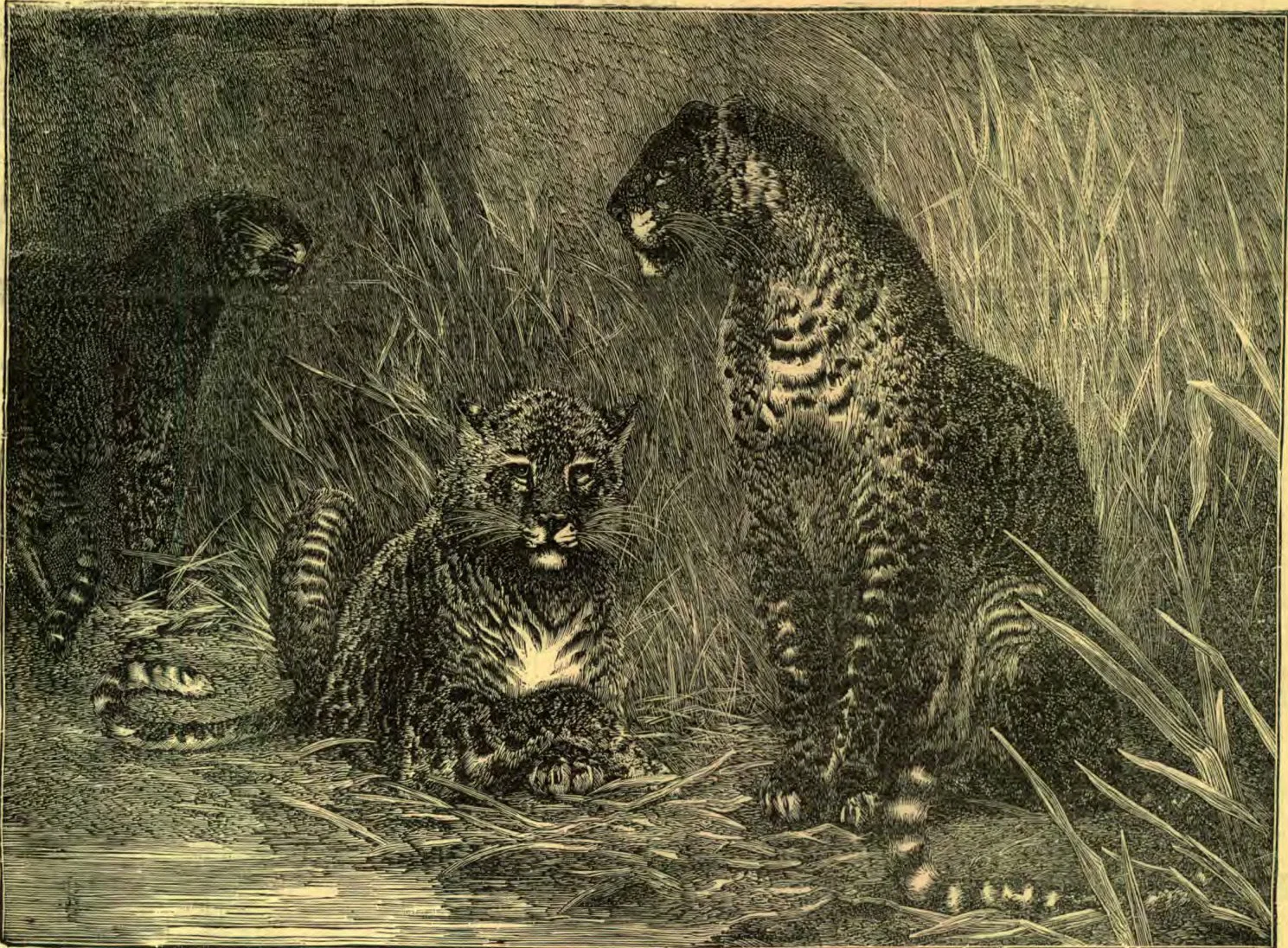
TABBY'S RELATIVES.

YOU would scarcely believe that the huge animals shown in our picture were near relatives of the domestic cat; yet such is the fact. Animals are classified in families, just as are the human race. The cat family includes the most ferocious animals known, such as the lion, tiger, leopard, panther, and wild cat.
All the members of this family seek their prey in the night, avoiding, if possible, a fair and open fight; for they are cowards. They wait in ambush for their prey, stealthily creeping near, and springing upon it suddenly. Puss displays these family traits, as you may see by watching her as she lies in wait for some luckless robin.
The leopard is of a very ferocious and blood-thirsty disposition, and attacks any animal it can overcome. In India it has been known to carry off children and old women, and has even taken up with man-eating as a regular employment. It kills more prey than it can eat, probably to satisfy its ferocity, or to gratify its thirst for fresh blood.
The leopard lives among bushes, roots, and the low branches of trees; but when pursued, it can easily climb to a safe height.
There is, in Africa, a species called the hunting leopard, that forms a connecting link between the dog and the cat. Its legs are longer than those of the common leopard, and the hair around the neck is like a mane. Although it is as swift and agile as any in the family, it has a gentle disposition. On this account, it has been tamed, and successfully employed in hunting. Some of the emperors, it has been said, went to the chase with a thousand of these leopards. They are so gentle as to live peaceably with children; and they will purr, like the cat, when caressed.
W. E. I.

EDITH'S OBJECT LESSON.

EDITH had just come in from walking; and, as usual, she had a book under her arm. For if Edith's walks did not lead her near the library building, they were apt to turn in the direction of some acquaintance, or school-mate, who was ready to lend a “perfectly splendid” book.
She hastily put off her wrappings, and was soon cozily nestled in an easy-chair, so deeply interested in the new volume, she never noticed grandma's entrance, much less thought to offer her the comfortable seat; so deeply interested, that she gave no heed to her mother's request to put Fred's rubbers and mittens on for him, until the request was twice repeated; and then, I am sorry to say, Edith closed her book, and went with very bad grace, and a decided frown on her brow, to attend to the little brother.
And all through the evening, instead of adding anything to the social enjoyment of the family, Edith sat apart, her pretty head bowed over the book in her hand. Uncle Will was visiting at the house, and had noticed how very much reading his young niece seemed to accomplish. At first, he was pleased; for Uncle Will was very fond of books, and thought Edith was developing a good literary taste.
But when he talked with her about standard works of history and fiction, he was surprised to find how very little she knew of any of his favorites. He was not long surprised when he began to examine some of the many volumes which Edith brought home with such frequency, among her school-books, borrowed from other girls, or loaned from the library.
The “Bride of the Wreck,” “Ghost of Raven's Hall,” or “Last Heir of Merton,” were not exactly the kind of reading Uncle Will thought best fitted to foster a fine, pure taste, or make a young mind and heart stronger and better.
He said nothing yet to Edith; but he thought a good deal of his bright, pretty niece, and his eyes were often fixed thoughtfully upon her, as she pored over her books, or sat dreamily gazing into the fire when the shadows grew too deep to see the pages filled with such unreal but fascinating tales.
Uncle Will was perhaps a little graver than usual this particular evening, after Edith was so ungracious in performing simple duties.
“Have you any special engagement after school to-morrow?” he asked, when Edith bade him good-night.
She looked up brightly, for Uncle Will so frequently had a nice treat on hand.
“No, sir; only to take back Fanny Merle's book, and get one Ellen Winton promised to lend me.”
“I will send back the borrowed book, and the other can wait, I am sure. I want you to go to the museum with me.”
“Oh, thank you, Uncle Will! That is so very nice.”
Edith was all ready at the appointed hour. She had been to the museum before,—yes, many times,—but going with Uncle Will was quite different from going with any one else. He had a way of telling about the beautiful pictures and statuary, and various curiosities, that made them seem something more than mere canvas and paint, or marble and bronze.
And so to-day they went slowly from one department to another, looking at the wonderful, beautiful objects; and Uncle Will talked pleasantly about many things, and answered Edith's questions clearly and patiently.
At last they paused before a case full of many strange things.
“Look, Uncle Will,” said Edith; “what is this piece of gray-looking stone with these funny marks upon it?”
“Cannot you tell? Look closely,” said Uncle Will.
“I don't think it is writing of any kind,” said Edith, peering into the case. “They look like—yes, I am sure they must be bird-tracks of some kind. But so large!”
“They are bird-tracks, my dear,—the foot-marks of some great fowl that lived ages ago, when the stone you see was a soft, miry mass, on which these claw-prints were easily impressed.”
“How very strange,” said Edith, “to think that a bird living so long ago should have left tracks behind that we can see to-day.”
“Very strange,” said Uncle Will, smiling. “But these are only a few of the many wonderful tracks of past ages written on the rocks. Did you ever think, Edith, that all of us—especially young folks like you—are making prints, which, like these bird-tracks, may live long after us?”
“Why, how, Uncle Will?” asked Edith.
“I told you this rock was once a soft substance, into which these great claws easily sank. As ages passed by, the mire hardened, hardened until that foot-print was part of the rock, never to be effaced.”
“Young people's minds and hearts are very like the soft mass; and the thoughts they think, the persons they associate with, and the books they read, are all doing something toward making foot-prints. If evil, impure images walk often through the young mind and heart, with wrong, untrue ideas about life and its duties, these things will surely leave their ugly prints growing firmer and firmer, deeper and deeper, until they can never be effaced. And so again, right, sweet, loving thoughts and endeavors will as surely leave their marks, too. Then ought we not to be very careful about the marks we are making as we go through life, careful about things that may seem very trivial in our daily lives? I know of nothing which may leave deeper marks of good or evil on young hearts than the books one may read.”
Edith's face had flushed deeply, and she listened to her uncle, with her eyes fixed upon the strange, uncouth marks before her.
Although she was overfond of foolish, unprofitable books, Edith was a bright, sensible girl, and knew directly, from the beginning of her uncle's talk, why he had brought her to the museum, and to this particular case.
She felt ashamed; but she looked up bravely, and said, with just a little tremble in her voice:—
“Uncle Will, I know what you mean, and I will try to be making better foot-prints.”—S. S. Times.

PAPER

ONE-THIRD of the paper consumed in the world is made in the United States by one thousand mills, each averaging two tons daily. The four thousand paper mills in the world make annually a million tons of paper—one-third of which is used for newspapers. Holyoke, on the Connecticut River, is called the “Paper City.” It turns out daily one hundred two-horse wagon loads of beautiful papers of various tints. At Castleton, on the Hudson River, millions of postal cards are made each day for the Government out of wood pulp.
Paper has become as great a necessity as iron, and is used in fully as many ways. Scores of railways use paper car-wheels. Stoves and chimneys, even, are made of paper. It is used for pencils, for lumber (in imitation of mahogany), for roof tiling, jewelry, bronzes, false teeth, water cans, row boats, flour barrels, powder kegs, clothing, shoes, collars, blankets, and carpets. A fashionable New York lady once gave a party at which the women wore paper dresses. A paper house was exhibited at the Sydney Exhibition, the doors, floors, and furniture being made from paper. In Sweden, paper thread is made. Thin silk paper, with tasteful designs painted in oil, pasted on common window-panes, makes an admirable imitation of stained glass. Paper dipped in chloride of cobalt makes the French “barometer flowers,” which are blue in fair weather, and turn to pink on the approach of rain.—Sel.

THE SALEM WITCHCRAFT

Written for the INSTRUCTOR.

THE SALEM WITCHCRAFT.

What child has not heard of the Salem witchcraft? As I have just visited the very spot where this terrible tragedy was enacted, I will tell you something about it. Salem is about fifteen miles north-east of Boston, and is one of the oldest cities in our country.
What is witchcraft? Look it up in the dictionary, or better, in a cyclopedia, if you can find one. Ask your parents what it is. The Bible speaks of witchcraft. Many persons have been put to death for practicing it, or for being suspected of it. In 1515, some five hundred persons were burned at Geneva, Europe, for witchcraft. In Germany, over one hundred thousand have been put to death for the same cause; and in England, about thirty thousand, some of them as late as 1716.
In America the first executions for witchcraft took place in 1650, at Boston; but the great tragedy in this deplorable affair was enacted at Salem, Mass., in 1692. It began in the house of Samuel Parris, a minister of Salem. Children were supposed to be bewitched by some other person. They fell into fits, cried out, and claimed that some person whom they named was pinching, or striking, or biting them. They became dumb and blind, ran out their tongues; their joints became dislocated, etc. They were struck speechless at the sight of holy books, but could read bad books readily.
At first, private fasts were held for these children, then public fasts, and, as the alarm spread, a fast was ordered throughout the colony. The number of the bewitched rapidly increased, and finally spread among grown people. Different persons were accused as witches. These were arrested and thrown into jail; among them were the very best and most pious people in the community. Even a little child of five years was accused. No one was safe.
The only way to escape suspicion was to accuse some one else. Scores were arrested; the jails were full; the whole country was alarmed.
As the accused were brought to trial, the most awful stories were told about them. They were said to be in league with the devil. It was claimed that they appeared to persons in all shapes, as black cats, dogs, pigs, and in other hideous forms. The devil was said to put his mark on witches. Hence a wart or a mole was often sufficient evidence to convict a person. The least error in saying the Lord's prayer would condemn a person to hanging. Persons accused their own friends, children their parents, and brothers their sisters. The only way to escape punishment was to confess guilty, and accuse some one else!
These examinations were held in what has ever since been known as “The Old Witch House.” It still stands on the corner of Essex and North streets, in Salem. It was built in 1631 by the celebrated Roger Williams. He was banished from Salem in 1636, and then founded the colony of Rhode Island. So the house is now two hundred and fifty-four years old.
It is a low, old-fashioned house, with large beams. It was occupied by Jonathan Curwin, one of the judges. As I stood in those rooms, I tried to imagine those terrible scenes of about two hundred years ago.
Some one hundred and fifty persons were accused, including children from five to fourteen years of age. They were charged with worshiping the devil, holding hellish feasts, eating blood, afflicting persons when far away, pricking them with pins, etc. Some of these identical pins are still preserved. John Bradstreet was accused of bewitching a dog. He made his escape, but the poor dog was hung!
One way of trying persons was to throw them into the river. If they swam, they were pronounced guilty, and were hung. If they sank and drowned, they were innocent. About twenty were hung on Gallows Hill. The other day I went up on the hill to the very spot where they were executed on an old tree. The tree is on a high, barren, rocky hill, overlooking the city. Here I stood, and tried to imagine the hanging of those innocent victims.
After awhile, public opinion turned against these appalling proceedings. No more persons could be condemned. Witnesses and jurors deeply repented the part they had taken in the matter. As far as possible, reparation was made to the injured parties, and all in the jails were liberated. But it has left an eternal disgrace on the city. And yet, there is a mystery about this which has never been explained, and never can be. D. M. CANRIGHT.

THE FAIRY WEAVER.

I NEVER saw the weaver, oh, no, no! And I never saw the loom, Nor the little shuttle so swift and strong, Nor the wonderful underground room; But I've seen the work, oh yes, oh yes, Silky, soft tassels I've seen, That the little fairy weaver wove Before the world was green.
All in the cold March days, she says, As the tiny shuttle she takes, “I must hurry and weave the alder-fringe Before the brook awakes.” So she draws her web in her fairy loom; But where does she get the thread, To weave the lovely alder-fringe Around the brooklet’s bed?
It snows and it blows in the upper world, But can you not hear her sing, “The times are poor, but the sun is sure To come back every spring”? So she draws the web in the fairy loom, And the tiny shuttle throws Back and forth, and back and forth, And the brown fringe grows and grows.
Down in the dark, dear children, hark! Thousands their work are pursuing. Oh, what might we hear, if we had the ear To catch what they are doing! The little weavers are weaving away, And this I have truly seen— Fairy fringe on the alder boughs Before the ground was green. —Good Cheer.

THE STORY OF BLIND MAN’S BUFF.

This story of blind man’s buff is over eight hundred years old; and as it is a true one, it is worth knowing, though it is a sad tale of cruel, warlike days.
Blind man’s buff, as a game, came over to England with William the Conqueror; but it had its origin in sunny France, when Robert the Devout ruled. In the year 999 there lived a powerful chief named Jean Colin, who was a giant in strength and size.
He was a great warrior; for fighting was the principal pastime and work in those days, and feuds were of perpetual occurrence. Jean Colin had a habit of crushing his enemies with a mallet. This brought him great glory, for the people admired a bold, daring man, whose hands were red with blood; so they gave him the title of “Maillard,” which means “of the mallet;” and to this day he is known as Jean Colin Maillard.
His name became a terror all over the country; and he soon conquered all his foes except one man, Count de Lourain, who was able to bear arms against him.
One time, when there was to be a terrible battle fought between those two great chiefs and their forces, Lourain determined to put out the Maillard’s eyes; and at the very onset, he succeeded in his plan. But though Jean was now blind, he determined on revenge; and rushing into the thickest of the fight, he laid about him so vigorously with his mallet that his enemies fell on all sides, and the blind man won the day.
His king was so filled with admiration at the spirit displayed by Jean Colin, that he ordered the stage players to prepare a pantomime of the contest for the pleasure of the court; and the court was so delighted with the play that it became very popular, and even the children played it on the streets.
Thus the play of blind man’s buff became popular in France and Normandy, though it was known under the name of “Colin Maillard,” and this name it bears on the continent of Europe to this day.
There are many ways of playing blind man’s buff, and each country has its favorite. It is a great game in England, and is always associated with the Christmas holidays. The English children have a pleasant time playing it with the blind man’s wand. In this play they form a circle round the blind man, who stands in the centre of the ring with a stick in his hand. The children move around, holding hands and singing, and at the end of the song stand still. Then the blind man points his stick at one of them, and tries to guess who it is. The person who is touched by the stick must repeat three words after the blind man, thus giving him an opportunity to guess correctly by the sound of the voice.—The Kaleidoscope.

HELP YOURSELF.

It is related of a wealthy Philadelphian, who has been dead these many years, that a young man came to him one day, and asked for help to start in business.
“Do you drink?” asked the millionaire.
“Occasionally.”
“Stop it! Stop it for one year, and then come and see me.”
The young man broke off at once, and at the end of the year again presented himself.
“Do you smoke?” asked the gentleman.
“Yes, now and then.”
“Stop it! Stop it for a year, and then come and see me.”
The young man went away, and cut loose from the habit; and after worrying through another twelve months, once more faced the philanthropist.
“Do you chew?”
“Yes.”
“Stop it! Stop it for a year, and then come and see me.”
But the young man never called again. When somebody asked him why he didn’t make one more effort, he replied, “Didn’t I know what he was driving at? He’d have told me that if I had stopped chewing, drinking, and smoking, I must have saved money enough to start myself.”—Detroit Free Press.

IMPORTANT BIBLE SUBJECTS.

LESSON 40.—INHERITANCE OF THE SAINTS.

CONTINUED.

PROMISES TO ABRAHAM.

[NOTE TO THE STUDENT.—Do not consider the lesson learned until you can give at least the substance of every text, with the correct reference for each. The references in black letters indicate those texts that should be committed to memory. A little diligent application each day will enable you to do this.]
  1. WHEN did the Lord first appear to Abraham? Acts 7:2.
  2. What did he then say to him? Verse 3.
  3. To what place did Abraham go from Mesopotamia? Verse 4.
  4. How long did he stay in Charran [Haran]? Ib.
  5. After the death of his father, where did he go? Ib.
  6. Locate, as nearly as possible, all these places on the map.
  7. Where do you find the record of these events of which Stephen speaks? Gen. 12:1-5.
  8. How old was Abram when he went into the land of Canaan? Gen. 12:4.
  9. How old was he when his father died?
  10. When the Lord told Abram to leave his native country, what promise did he make? Gen. 12:2, 3.
  11. What expression shows that this promise was not merely a local affair?
  12. How extensive was it?
  13. What will be the condition of all the world when this promise meets its fulfillment?
  14. Who are they who are blessed? Ps. 1:1, 2.
  15. Then what will all the world do when this promise is fulfilled?
  16. And when God’s will is thus followed, what will be on this earth? Matt. 6:10.

NOTES.

The promise to Abraham (Gen. 12:2, 3) embraced the whole world, for the Lord said: “In thee shall all families of the earth be blessed.” So when this promise is fulfilled, there will be no one on earth who is not blessed by the Lord. But those who are blessed are those who delight in and obey the law of God (Ps. 1:1, 2); therefore in that time all people on earth will be doing God’s will; and that state of things exists only when the kingdom of God is on this earth.

THE FREEDOM OF LONDON.

It is for one’s advantage many times to have some knowledge of the customs and laws which regulate foreign society, particularly if he should at some time visit those countries. Knowing this, our boys and girls who are gathering facts of useful information will be interested in an English custom termed “the freedom of the city.” Should this honor never be conferred upon any of the readers of the INSTRUCTOR, the information will enable them to converse intelligently about it, and help them to read English history more understandingly. One of our exchanges has the following:—
“In 1877, when Gen. Grant was making a trip around the world, he was accorded certain honors wherever he went. When he reached London, he was presented with ‘the freedom of the city,’ and all over the continent flashed the news,—for it was a high honor, and rarely bestowed upon an American.
“‘The freedom of the city’ is incased in a long, thin, gold box, ornamented with ribbons. On a certain day, Gen. Grant was advised of what was to happen, and was met by the mayor and councillors of London. The chamberlain made a speech, in which he enumerated the exploits of Gen. Grant, and then the gold box was presented. Gen. Grant then signed his name in the clerk’s book, and the others present signed their names, thus becoming responsible for his acts as a citizen.
“Among the names already in the clerk’s book were the Shah of Persia, Sultan of Turkey, Prince Leopold, Napoleon III., Gen. Blucher, Gen. Garibaldi, and George Peabody, Lord Wolseley, Sir Henry Bessemer, M. de Lesseps, Mr. Gladstone, the Earl of Shaftesbury, and the Baroness Burdett-Coutts.
“Now the meaning of this ceremony is this,—although it is really only a token of respect,—that it guarantees to the holder, and his children after him, the right to live and trade in the city without having to pay a tax on the goods brought through the gates. It exempts him from all naval and military service and tolls and duties throughout the United Kingdom. It insures to his children, in case they are left orphans, the care of the chamberlain, who takes charge of their property until they reach their majority.
“The origin of this custom can be traced to the early days of London, when there were societies of goldsmiths, weavers, etc., carrying on business; only members of the societies could carry on their trade in the city, or had the freedom of London. But gradually the power of these societies passed away, and the idea was retained as a mark of honor.”

THE PRICE OF SUCCESS.

If any one is resolved to do good to others, he may be assured that it will require hard work.
The true teacher and the good scholar must accept hard work as a condition of success. Everything really valuable costs something. By the sweat of the brow we earn daily bread, and by the sweat of the brain we gather knowledge for ourselves or for others. It is to be feared that many teachers fail to recognize hard work as an essential element to success. Hard work for the teacher points to hard study.
The Bible is a mine which must be worked patiently and perseveringly, if we would find its hidden treasures. Various methods of studying the lesson might be suggested, but not one of them is of any value, unless it calls out all the energies of the student. The careful perusal of the text; the use of such helps as are available; prayerful meditation on its true meaning and use, call for more than mere child's play. This work requires as much time as can be devoted to it through the week, and should be commenced as early in the week as possible.
No two pupils are alike in any one trait of character, and the teacher who would successfully instruct and interest each one, must make each a study. This study of the persons will demand thought, as well as calls at the homes of the scholars. There the teacher can get an insight into the character, habits, and peculiar temperament of each. As Audubon, the great naturalist, was willing to spend days in the forests, studying the habits of the birds, so must one who seeks for souls have a holy enthusiasm, which will glory in toil and sacrifice, if it only enables him to accomplish his purpose of leading souls to Christ.
To know how to adapt the lesson to the learner, and give to each his portion of meat in due season, is a task which requires scarcely less patient thought than either of the other subjects named. Many an excellent discourse utterly fails of its object, because it shoots over or wide of the mark. The lodgment of the truth in the heart requires skill as well as toil; and this skill is to be acquired largely by persistent practice.
Men work hard in order to secure worldly gains; they are content to rise early and toil late; they try every method which promises success. Much more should the Sabbath-school teacher be willing to labor diligently in his work, so that even though he sows in tears, he may bring back his sheaves, rejoicing.—Selected.

Punctuality and Welcome for Sabbath School Teachers

Be at your place at least ten minutes before the hour for opening the school, and be ready to greet the first scholar with words of welcome, inquiry, and encouragement.

HOW TO LIFT THE BURDEN.

WHEN a difficult task is given boys and girls, by parents or teachers, something to perform which requires mental or physical effort, how often we hear, “Oh, I can’t do it!” or, “It is too hard!” or, “It is too long!” or, “I don’t know how!” Too frequently these words are spoken hastily, before examining to see whether anything hard is required or not; but should the task, after looking squarely at it, seem greater than one can perform, he should not give it up until his inventive genius fails to suggest any way to do it. The following lines from an exchange have some good instruction upon this point:—
“My son, put that log on the wagon.”
“I cannot, father. It weighs many tons, and exceeds the strength of a hundred men.”
“You can put it on the wagon, and I will teach you how. Chop and split it into lengths suitable to your strength. Now let this be a lesson to you. All through life you will find heavy burdens to carry, heavy tasks to perform. Do not inspect them in bulk, and become disheartened, neither grapple nor attempt to master them with one effort. Perform what your strength will permit—a little each hour—each day. You will gradually become strong, and meet with success in the end.”
“By attempting to lift a heavy log at one effort, you might injure yourself beyond recovery. But by lifting a little at a time, you would, in a lifetime, move more logs than could be stored in a township. Great success in life is secured by knowing your strength, and lifting accordingly; by continuous and persistent effort rather than a momentary struggle.
“There is another way by which you can move heavy logs. There are many inventions designed for this purpose, the existence of which you do not suspect. In some instances you are only required to attach the grappling hooks, and the burden is borne wherever you desire. Remember that in all undertakings in life there is one way to proceed much better than all others. Investigate closely, assuring yourself that you are working by the best methods. Otherwise you will be lifting the log without appliances. Only the best methods lead to success in this progressive and competitive age. If you cannot discover these methods, you will see your rivals pushing ahead; you will be outrun in the race.”

SEVEN HUNDRED MILLIONS.

It is estimated that seven hundred millions of dollars are expended in this country every year for that which intoxicates, which means nothing less than seven hundred millions of dollars' worth of crime, poverty, disease, broken hearts, desolated homes, degradation, and death. What a startling record is being made up for all the years, to be given some day! Where will the responsibility of all this wretchedness rest? Read what the Youth's Temperance Banner has to say of this terrible liquor traffic:—
“This is a large number of dollars to squander. If we saw a man throw one dollar into the river or into the fire, we would call him a foolish fellow for deliberately parting with his money without getting anything to show for it. But if we saw a procession of seven hundred million men, each with a dollar in his hand, walk up to a furnace and throw their dollars in, we would say the whole lot were crazy.”
“Now suppose that, instead of walking away with no further damage than the loss of the dollars, each of these seven hundred millions of men should be damaged by tongues of flame darting forth from the mouth of the furnace into which so much money was tossed. One man would come away with hair and eye-brows singed off; another would lose half of his beard, leaving the remaining half to give him a very odd appearance; another would have his nose permanently reddened, while others would have their eyes bleared and their faces blackened for life. Surely somebody would call aloud for laws to stop such insane proceedings.”
“Well, this seven hundred million business is just what is going on every year in our enlightened and Christian country; for our fifty millions of people are spending seven hundred millions of dollars for strong drink. It is worse than if they simply threw all their money away; for the strong drink brings wounds, and burnings, and poverty, and misery of many kinds. Much of this misery cannot be counted by dollars nor estimated in cash. The degradation, decay, and death which result from our immense national liquor-bill find no place in the nation's census; for it is beyond the power of the census-taker to reach them. But every one who walks the world with his eyes open can see for himself at least a part of the mischief that is done. Our criminal records tell it. The wail which goes up from the poverty-stricken and disease-eaten homes of drunkards tells it. The dreadful death-record cries aloud about it; for, as in the days of Pharaoh, there is not a house in which one has not been smitten by the plague.”
“What a blessed thing it would be for this country if not one dollar were spent to curse it with strong drink; if the seven hundred million dollars now worse than wasted were spent on things to give families happy and honest homes, and to make people pure, and sober, and noble! We cannot accomplish the change all at once, but we may work for it, and hope for it, and pray for it, in the assurance that the present foolish and wicked state of things cannot go on forever.”

WHAT MAY BE LEARNED FROM THE INDIANS.

ONE would not naturally suppose that in the example of the untutored Indian would ever be found good lessons for the white man; yet it is true that he who has known the Scriptures almost from infancy, and been taught the exalted character of God as long, too often shows less reverence in his worship than does the red man of the forest, who, “when he worships, worships sincerely and devoutly.” From the Indian we may learn, too, a lesson of self-government; for it is said that “even in childhood, he has a stern control over his body.” In the following selection from the S. S. Advocate, the two lessons are plainly seen, and we may study them with profit:—
“The Indian pupils of the school in Philadelphia were removed early in the spring to a village about forty miles from the city. On the first Sunday after their arrival, they were taken to church.
“Many of them were newly arrived from the farther reservations, the children of Pueblo, Apache, or Cheyenne chiefs, unable to understand a word of English. But they were told that the church was the place where the people met to hear of the ‘Great Spirit,’ and to ask of him such things as they had need.
“They entered the house with soft steps and bowed heads, and as the teachers surveyed the rows of dusky faces, they were impressed by the expression of reverence in them all.
“Just after the clergyman had ascended the pulpit and opened his book, two dogs, one a big, burly mastiff, the other an insignificant poodle, entered the open door, and marched side by side up the aisle, until they reached the front of the pulpit, when, as if by a mutual understanding, they folded their tails under them and sat down, glancing up with an inquiring look at the preacher, as if not quite understanding what he was there for. The white children tittered, even the grave old people felt their lips twitch; but the Indian children sat immovable, their eyes gravely bent on the clergyman. There was not a smile on a single dark face.
“‘It was,’ said a gentleman who was present, ‘a remarkable instance of self-control and fine breeding.’
“‘That it was not due to stupidity was easily seen when the congregation was dismissed, and the children reached the woods which led to their home. They ran joyfully through the forests and fields, gathering flowers, and looking closely at the trees and plants, with sparkling eyes and merry laughter.”
The great God, by his Spirit, meets in the assemblies of his saints; and if your eyes cannot behold him, he is present just the same, and a careful record is kept of each one’s behavior while assembled for his worship. “Give unto the Lord the glory due unto his name,” and “serve him acceptably, with reverence and godly fear.”

STILT WALKING.

Probably there is not a boy reader of the Instructor but knows how stilt walking is done, even if he never ventured upon a pair himself. But, boys, when you have been picking your way about on them as a pleasant pastime, perhaps some of you did not once think these simple contrivances are almost a necessity in getting over the ground in some of the flooded districts of the old world. The Pansy gives an interesting description of their use in France, as follows:—
“In the south-west part of France, there are large plains called the Landes. These plains are often flooded in parts with water, but not deep enough to float a boat. So to cross and tend the sheep, that browse on the dry places, high stilts are in use, that the feet may be kept dry.
“These stilts are not held by the hands, as you are accustomed to hold yours, but are firmly strapped to the side of the leg. The person wearing stilts carries a long pole in the hand, with which to keep his balance, and aid in walking. This pole usually has a cross-piece in the upper end, like the head of a crutch; and by putting it on a stand behind, the one on stilts can sit down and rest, looking in this position like a three-legged stool.
“In a picture I saw of the watered plains a short time ago, there were women, as well as men, perched on the stilts in the middle of the water. They were industriously knitting while they watched the sheep.
“These people wear their stilts all day long, putting them on when they go out in the morning, and taking them off only when they return home at night. They are so used to this mode of walking that they can travel long distances without getting tired.”

THE MUSIC-BOX IN THE THROAT.

Perhaps you did not know that breathing made the voice. We could not speak if we did not breathe. The sound of the voice is made in the throat, in what we call the Adam’s apple. This is a sort of music-box, at the top of the windpipe. In this queer box there are two flat cords, stretching right across it. When we speak or sing, the air is forced up out of the lungs, strikes on these cords, and makes them shake, or vibrate. It is done just as the fiddle-string makes a sound when the bow is drawn over it. The chest is the bellows of that little music-box, or organ, in the throat.
Many animals have a music-box very much like ours. The lowing of the cow, the barking of the dog, and the mewing of the cat, are all done in such a box. The cat purrs in the same box where she does her mewing. If you put your finger on her Adam’s apple while she is purring you would feel a quivering motion there.
Fishes have no voice, and no musical box. If they had it, they could not use it; for the only way in which it can be used is to blow air through it, and they breathe air and water together. The frog cannot use his box when he is under water. He has to poke his head up out of water when he wants to croak.—Our Little Ones.
Continue reading: GETTING EVEN