Review and Herald Publishing Company · Battle Creek, Mich. · May 23, 1901
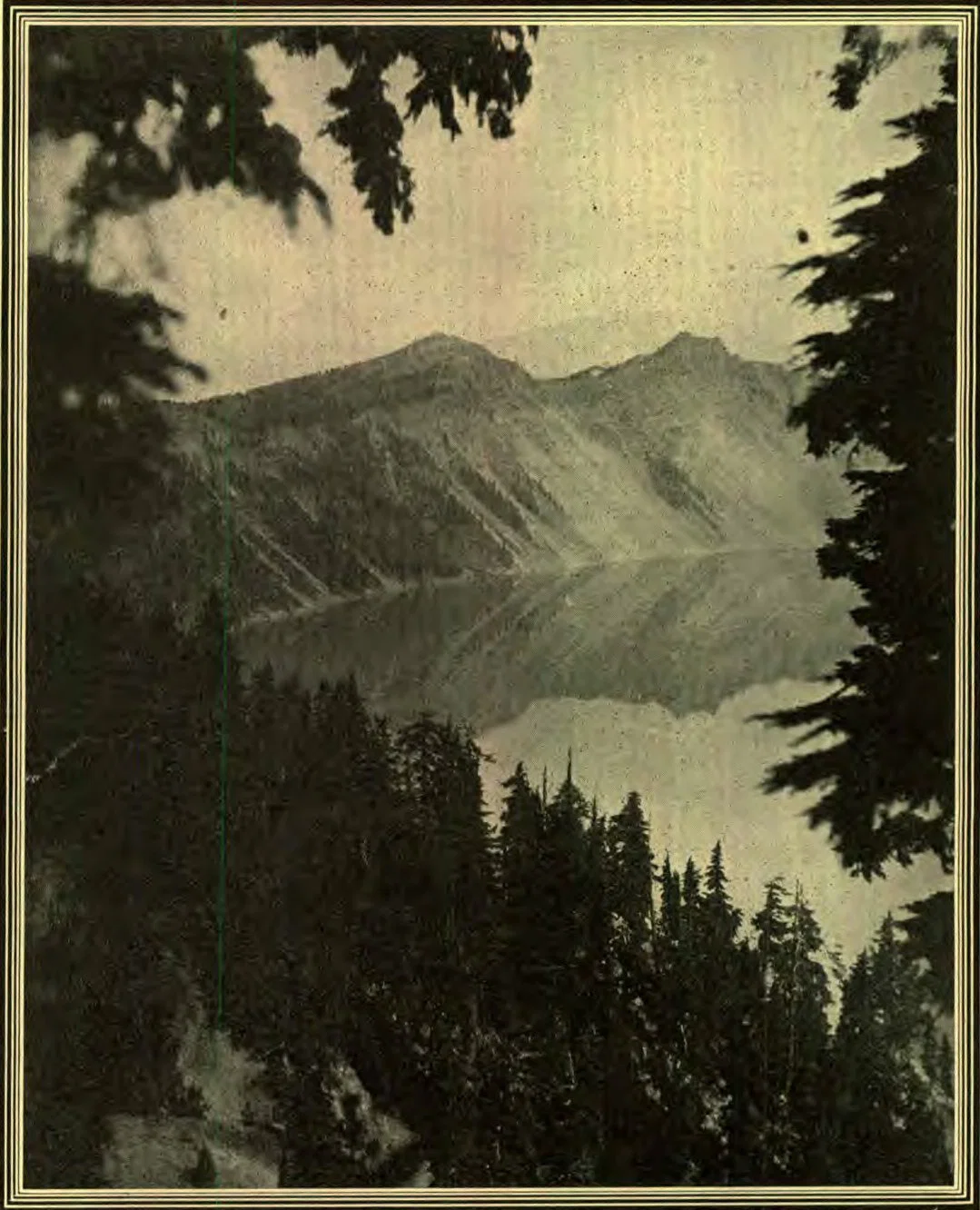
A PEEP THROUGH THE TREES FROM VICTOR POINT,—ANNA CREEK CANON
CRATER LAKE
By J. Edgar Ross
How to See It
By far the greater number of those who visit Crater Lake come from within a hundred miles in the surrounding country; for the lake is practically inaccessible during nine months of the year, and too far from the regular lines of travel to attract any considerable number of tourists during the remaining three. The majority of those who do visit the lake, drive up to the grassy plateau, where they eat their lunch, and spend a few hours admiring the placid blue waters, or climbing down the steep and winding trail to the water’s edge, to inscribe their names upon the rocks. Then they go away, thinking they have seen Crater Lake. And so they have—in a way. But that is not the best way.
If you would see Crater Lake so as to be able to appreciate its vastness, and know its rugged grandeur, you must take at least a week to it. Pitch your camp in a clump of hemlocks at the edge of the plateau, where you can see the glories of the sunrise across the serrated summit of Castle Crest, and watch the ever-changing light and shadow upon the calm, ultramarine waters of the lake. Climb down to the water’s edge, and build a raft of the scattered driftwood that you will find along the beach. With this you can paddle out to Wizzard Island, where a climb of eight hundred and fifty feet up its walls of broken pumice will bring you to the Witches’ Caldron,—the crater that saw the last of Mt. Mazama’s volcanic activity.
Another day might be spent in paddling along the southeastern shore, past the Phantom Ship, to Grotto Cove,—a diminutive bay on the eastern shore of the lake, where two little grottoes are found at the level of the water. If one can take a boat, or has the time and muscle to paddle a raft, the entire circuit of the lake ought by all means to be made. It is only about twenty miles, and in this way the topography of the lake can be studied as in no other.
The circuit of the lake can also be made by land, and in this trip one will come to many points that are not only deeply interesting in themselves, but afford an excellent view of the surrounding country. There is no trail around the lake, but I have been told that by keeping well down the mountain on the southeast and162southwest, the trip can be made with pack-horses in four days. A good climber, with a light pack, can easily make the circuit in three days, and need seldom be out of sight of the lake.
The climb up Castle Crest is not so difficult as it looks, and the summit of the rock affords a splendid view to the south. In the near foreground stands Union Peak, the remains of an extinct volcano, once much larger than at present, though it still has an altitude of about eight thousand feet. In early days it was used by the Rogue River Indians for a watch-tower, as a parapet of stone piled upon its small, flat top still bears witness. Beyond lies Mt. Pitt, a snow-capped peak, with an altitude of a little less than ten thousand feet. To the left lies Klamath Lake; and beyond that, in the dim and hazy distance, looms up the grim old giant, Mt. Shasta.
The eminence lying next to Castle Crest is Vidae Peak. This has an altitude of eight thousand two hundred feet, the highest point of Mt. Mazama, and towers two thousand feet above the water of the lake. Descending the east side of Vidae Peak, one comes to the deep, U-shaped cañon of Sun Creek. This is very hard to cross; but if you are interested in the study of geology, you will there find quite enough to repay you for the difficulties of the way. This cañon, as well as the one of Sand Creek, which lies some distance farther east, is the bed of one of Mt. Mazama’s ancient glaciers, and it still bears unmistakable evidence of its glacial origin. Beyond Sand Creek cañon the trip is a comparatively easy one. There will be no climbing to speak of until Llao Rock is reached, unless one chooses to make a detour of a few miles to climb Mt. Scott. This is a volcanic mound composed principally of loose, sliding pumice, supporting very little vegetation. It lies about two miles southeast of the lake; and as it is only about a thousand feet higher than Vidae Peak, I did not think it worth the climb.
Llao Rock affords another splendid view of sparkling lakes and grassy meadows, pumice deserts and wooded valleys, rugged peaks and deep-cut cañons. The most striking of these is Mt. Thielsen, whose sharp, needle-like point rises to an altitude of nine thousand two hundred and fifty feet. Mt. Thielsen is called “The Lightning-rod of the Cascades,” because of the fulgurite found upon its summit. Its ascent is said to be both difficult and dangerous, and possible from only one point.
The first few days of my stay the weather was delightful. Before I had finished the circuit of the lake, however, it turned cold and windy. I was very tired when I returned to camp, and would have been glad of a few days’ rest; but I suffered so much from cold that night that I decided to leave the following morning.
When my wheel was packed, I went out again to Victor Point to take a last look at the lake. The cold wind was blowing furiously, and lashing the beautiful blue waters into foam-crested billows, that chased one another across the surface of the lake. Vastly different was its appearance from what I had seen at first, when the water was as smooth as a polished mirror. The scene was so impressive that I could not help taking off my hat, and thanking God for permitting me to visit a spot so beautiful and grand.
J. EDGAR ROSS.
IN THE CRADLE OF THE PLATTE
A LITTLE stream in the cañon ran,
In the cañon deep and long,
When a stout old oak at its side began
To sing to it this song:—
“Oh, why do you laugh and leap and sing,
And why do you hurry by,
For you’re only a noisy little thing,
And a great, stout oak am I.
A hundred years I shall stand alone,
And the world will look at me.
While you will bubble and babble on,
And die at last in the sea.”
“So proud and lofty?” the stream replied,
“You’re a king of the forest, true,
But your roots were dead, and your leaves all dried,
Had I not watered you.”
The oak-tree rustled its leaves of green
To the little stream below:
“’Tis only a snow-bank’s tears, I ween,
Could talk to a monarch so.
But where are you going so fast, so fast,
And what do you think to do?
Is there anything in the world at last
For a babbling brook like you?”
“So fast, so fast, why should I wait,”
The hurrying water said,
“When yonder by the cañon gate
The farmer waits for bread?
Out on the rainless desert-land
My hurrying footsteps go;
I kiss the earth, I wet the sand,
I make the harvests grow.”
“And many a farmer, when the sky
Has turned to heated brass,
And all the plain is hot and dry,
Gives thanks to see me pass;
By many a sluice and ditch and lane,
They lead me left and right,
For it is I who turn the plain
To gardens of delight.”
Then hurrying on, the dashing stream
Into a river grew,
And rock and mountain made a seam
To let its torrent through;
And where the burning desert lay,
A happy river ran;
A thousand miles it coursed its way,
And blessed the homes of man.
Vain was the oak-tree’s proud conceit,
Dethroned the monarch lay;
The brook that babbled at its feet
Had washed its roots away.
Still in the cañon’s heart there springs
The desert’s diadem,
And shepherds bless the day that brings
The snow-bank’s tears to them.
— Youth’s Companion.
CANVASSING IN THE SIERRAS
By WM. YARNELL.
I
“Chico!” cried the conductor, and, a little later, standing near the station, I tried to fasten a valise to my bicycle, preparatory to riding to Prattville. The package was heavy, however, so I concluded to leave it at the stage office, and start out immediately. “Better stay to breakfast,” urged the proprietor of a lunch-stand; and when I refused, he suggested, “Then get over the summit before the sun catches you.” Although only four o’clock in the morning, the air was already oppressively sultry, but two miles of smooth road enlivened my spirits.
Soon the road became rugged, rocky, and so steep that riding was impossible. The country was dry, dusty, and barren, with nothing to break the monotony; and the road seemed interminable. As I trudged along, hoping that each new turn might be the summit, I came to a small shanty, where I obtained a breakfast of tinned goods and crackers. It was nine o’clock, and I had come only eight miles of the thirteen I must travel to the summit. On reaching the summit, I passed a cherry orchard, whose trees were bending beneath their weight of fruit. The owner being generous, cherries constituted my noonday meal.
At sunset I entered a beautiful valley containing some shanties and one large house, the Sutton House. A good supper was the last and best item on the program in my first day’s canvass of the Sierras.
The next day I spent in canvassing the Catholic neighborhood. I took no orders, but sold some small books, which I had taken as helps.
Friday morning I began to climb Big Summit. By vigorous scrambling I reached a second road, which I had seen higher up the mountain. In like manner I reached a third, and thought to gain yet another, only to lose my way in a manzanita thicket. In the distance could be seen a peak, which I concluded must be the summit. Shouldering my wheel, I started for the peak. The bushes were three feet high, their nonflexible branches being closely twined together. To make a way through them was impossible, but I chose to clamber over rather than go back. You may be sure that peak was many times farther away than it first appeared; but with clothes torn, and strength gone, at last I reached the very top—only to discover, to my dismay, that the road was far away on the other side. Two large trees seemed to be near it; but when, finally, a thirty-foot precipice had been scaled, and the trees reached, the road was still far away.
“Hello!” I cried to a man below me; “can you tell me the time?”
“Just 1:30, and twenty-four miles yet to Prattville,” he replied.
Though tired and hungry, I paused that afternoon as I came in sight of a Sierra wood. The trees were nearly two hundred feet in height. The ground was covered with pine cones, some of them fourteen inches long. Their scales were of two shades, a light-brown deepening into a very dark-brown near the edge. Suddenly there spread out before me a beautiful, long, level valley. The buildings of Prattville soon appeared. Just back of the hotel is the source of a stream four feet in depth and about thirty yards in width. Grass, flowers, and trees grew in profusion along its banks, while the borders of the stream were thickly covered with yellow pond-lilies.
WM. YARNELL.
WATER CHANGED INTO WINE
By W. S. Sadler
IV
“There Were Set There Six Waterpots of Stone.”—The waterpots were symbols of purification. “Blessed are the pure in heart: for they shall see God.” Matt. 5:8. Notice what Christ can do with earthen vessels, pure, sanctified, and meet for the Master’s use. Water is one of the symbols of the Holy Spirit. “Out of his belly shall flow rivers of living water.” John 7:38. Just as the Saviour bade the servants fill the waterpots with water, so he has bidden us to be “filled with the Spirit,” in place of selfishness, animosity, jealousy, backbiting, and faultfinding. Our souls should be filled with the water of life. The life-giving stream should flow forth from us to quench the thirst of others.
Out of the waterpots, symbolic of purification prescribed by the law, the Saviour brought the new wine of the gospel, the first miraculous blessing of the new dispensation. In doing this, he did not break the waterpots,—that is, seek to destroy the law,—but with them, and out of them, he worked the miracle that made them yet more honorable and serviceable to those present. And so the life-work of Christ was not to annul the law, but to exalt it; to remove the curse, and make the law a blessing indeed to all who would endeavor to walk in its precepts.
“Jesus Saith unto Them, Fill the Waterpots with Water.”—In the beginning God created out of nothing. On this occasion Christ created wine, not out of nothing, but out of water, which represented all that man could do to produce wine. He commanded the servants to fill the waterpots to the brim. Our fellow men all have a part to act in the making and developing of our characters, in fitting us for usefulness, in filling us to the brim. It is not important what instrument the Lord may choose to help in the work of making us what we ought to be. Many well-meaning Christians are found depreciating the value and importance of Christian education, reasoning thus: “If we have received the Holy Spirit, if he knows all things, if he was sent to teach us all things, why should we seek to learn from human teachers?”
There is a lesson in this miracle for all such. The servants, human instruments, could not pour wine into the waterpots. It was their work to pour in water; and in the process of drawing out the water, and serving it, the Saviour himself wrought the marvelous miracle of turning the water into wine. And so the Christian youth, and all Christians, for that matter, should seek to fill the empty waterpots of mind and soul, the earthen vessels, with the water of life,—living principles, truth, useful knowledge,—and then depend upon the power of God and of his Spirit to use this knowledge, this education, this training, in work for him, making it a gracious blessing to one and all with whom we come in contact.
The juice of the cluster is mysteriously made from the water which the vine takes up from the earth; and so, adhering to the natural process of wine-making, Christ commanded the servants to bring water, ordinary water, such as that from which every grape must make its juice. He did not send for any special water, and we have no record that he in any special way blessed this water before working the miracle. Could not Christ have created wine out of nothing as easily as change water into wine?—Certainly; but he did not choose so to do, and we believe163that the divine choice is infinitely the best. Therefore we learn here the lesson which he sought to teach so many times; namely, that we should co-operate with nature, at least as far as we know how.
“And They Filled Them up to the Brim.”—The waterpots were filled to the brim. Just the moment a soul is filled to the brim, God begins to draw out. “Therefore with joy shall ye draw water out of the wells of salvation.” Isa. 12:3. Converted men and women, who are consecrated to service and filled to the brim with the good graces of God, may become channels of light and truth to the world. Christ is the fountain-head of the stream of life. The Lord does not fill us merely to keep us feeling good. We are filled that we may become wells of water, sources of help to others. Faithfulness in the work of helping others will bring to our souls great peace of mind and abundant satisfaction. The Christian is a transfer station between heaven and earth. His work is to keep the streams of life flowing from above to those below. Jesus did not say we should be pools brimful of water, but that out of us should flow rivers of water,—an ever-flowing stream, an overflowing well. When a vessel is full to the brim, it is ready to overflow. We are first filled to the brim with the Spirit; then by the overflow we are baptized with its precious, heavenly influence. Small vessels can not hold as much as large ones, but they can overflow just as much, or even more. It is possible for a small vessel to overflow quickly, and in such quantities that the vessel itself knows very little of the greatness of the overflow.
Heaven’s voice to the soul must not be questioned. Divine requirements are not to be debated. Implicit obedience, in the spirit of a little child, is the portion of the children of light. Light was made to be received, to be walked in. On this occasion the servants might have questioned: “Why fill these waterpots?” or “Why fill them all?” or yet again, “Why fill them all to the brim?” To the eye of unbelief, to the one who could not recognize the hand of God, there would appear no purpose in these specific directions; but the eye of faith looked on beyond, and saw the glorious end, to which personal obedience to the Master’s voice was the chief means. Unquestioning, implicit, and immediate obedience to the voice of conscience, which is the voice of God to the soul, should ever be the motto of the person who would live a life of Christian victory.
And yet when the waterpots were full; when man had done all he could, for the Master’s instructions were willingly obeyed; when nature had contributed her share, and all things, from a human point of view, had been done, there was no more wine than before. The transforming and creating touch must be experienced, and then in still further obedience lies the discovery of the marvelous wonder wrought by the Master’s hand. When we have done our utmost to save a soul, it can not avail unless the sinless mind of Christ has been received in exchange for the sinful heart of man, unless he is born again. Our part is essential, but it is useless without the miracle of saving grace, which he alone can work. Human efforts can not save and cleanse the sinful soul, and yet Heaven has appointed to the human instrument its place of co-operation in the task of enlightening, feeding, and saving the souls of lost men and women. Christ did not change the water into wine until everything possible had been done by the servants. When humanity had done all it could, divinity finished the work.
W. S. SADLER.
(To be continued.)
BITS OF WISDOM
OUR characters are determined more by what we love than what we know.
Men never show their characters more plainly than by what they think is laughable.
No fountain is so small but that heaven may be imaged on its bosom.—Hawthorne.
How can we expect a harvest of thought who have not had a seedtime of character?
It is only the little ones that grow. As soon as we become too big, we cease to grow.—Taylor.
The everlasting longing for something we have not, ought to convince us that there are great things in store for us.
Lost somewhere yesterday, between sunrise and sunset, two golden hours, each set with sixty diamond minutes. No reward will be offered, for they are gone forever.—Horace Mann.
THE BEAUTIFUL
By B. E. Crawford
THE ability to recognize and appreciate the beautiful in both nature and art, exists to some degree in every rational human being. True, some have cultivated this ability much more than others, and just to the extent that this faculty has been developed, so far has the individual become refined, cultured, and ennobled.
We are surrounded by beauty on every side. In the ever-changing forms and shades of the clouds above us, in the gorgeous sunsets, in the loveliness of the flower-decked fields, in the sparkling cascade and silvery stream, in the mighty ocean, in majestic forests and towering mountains,—all above and around and beneath us, the earth and air and sea are filled with thousands and tens of thousands of forms of beauty.
God is the author of the beautiful. As the earth came forth from the hands of its Maker, it was perfect in beauty. Its surface presented a pleasing variety of mountains, hills, and plains, diversified with noble rivers and lovely lakes. Instead of the rough, ragged mountains as they now exist, with their terrific steeps and frightful chasms, the rough edges of earth’s rocky framework were buried beneath fruitful soil, and over all was spread a luxuriant growth of verdure. Loathsome swamps and barren deserts were unknown. “Graceful shrubs and delicate flowers greeted the eye at every turn. The heights were crowned with trees more majestic than any that now exist. . . . The entire landscape outvied in beauty the decorated grounds of the proudest palace.” Everything that God had made was the perfection of beauty.
Beauty is infinite, and can not be described in one word. It is a combination of elements, which, harmoniously arranged, make up the perfection of the plan of God in creation. In other words, it is the expression of the perfection of the divine idea. The nearer any object approaches this perfection, the more beautiful it becomes. All objects are beautiful in so far as they are in harmony with God. A pure soul in a perfect body is the highest form of beauty of which we can conceive.
True beauty can have but one source, it can be concentrated in but one being, and this is none other than God. Every beautiful thought, every beautiful idea, whether expressed in marble, in colors, in words, in tones, or in any one of its numerous manifestations, comes from the one and only source of the beautiful. The rendering of good music is not without its effect, however feeble or hidden its influence may appear. The little snowflake in its purity and beauty falls into the ocean, and is immediately swallowed up; but still it helps sweeten and increase the great body of water into which it disappeared.
The artist, though perhaps unaware of the fact, draws all his inspiration from the eternal source of the beautiful. He brings a part of the eternal beauty down to men, and this, acting like a magnet, draws men up to the source whence it came. Whenever we come in contact with anything of a divine nature, we are made better thereby. The beautiful and the good always walk hand in hand.
All true art comes from nature. The artist loves to reproduce the beauty of mountains and rivers, of flowers and trees, of the laughing rivulet and the white-crested waves. He delights in painting the gorgeous sunsets when the sunbeams melt along the horizon, and the colored clouds appear like so many steps leading the way to heaven itself. The sculptor’s delight is to portray the beauties of the human form, while the poet sings of the things that God has made.
True art brings us in contact with the divine. Its impressions upon the mind are always good, speaking rest and peace to our souls. It is the divine character of the beautiful in every true work of art that lifts us out of ourselves, above our every-day existence, and ennobles our thoughts and emotions.
The beautiful, indeed, is divine, and in all its manifestations it leads to progress. It comes from heaven, and brings its hallowed influence down to us.
The beautiful will at last triumph over the unlovely and the evil, filling the earth as the waters fill the sea. When the Lord shall purify the earth of every vestige of sin, we are told that the wilderness and the solitary place shall be glad, “and the desert shall rejoice, and blossom as the rose. It shall blossom abundantly, and rejoice even with joy and singing. . . . In the wilderness shall waters break out, and streams in the desert. And the parched ground shall become a pool, and the thirsty land springs of water: in the habitation of dragons, where each lay, shall be grass with reeds and rushes. . . . And the ransomed of the Lord shall return, and come to Zion with songs and everlasting joy upon their heads: they shall obtain joy and gladness, and sorrow and sighing shall flee away.”
B. E. CRAWFORD.
On the Delight of Trusted Presence
Few delights can equal the mere presence of one whom we trust utterly.—George Macdonald.
SHOULD I GO TO SCHOOL?
By James C. Anderson
THIS is a question that comes to each of us in one way or another. Most boys and girls have received an elementary education either in private or public schools, and to many it seems needless to go to any other. But the question for each to decide is, “Have I developed my mental faculties to such a degree as my Master desires?” Each has ability, and should develop it in a symmetrical manner, in order to do the most good in this world. While it is well to be able to plow, sow, reap, and thresh, or to sew, scrub, and cook, it is also well to attend some school of broad and deep ideas, in order to become better fitted to discharge life’s duties.
Every young person may attend an academy or college unless aged parents or helpless relatives demand his time and devotion. Now is the time to begin to prepare for entering school in the fall. Saving money for a good purpose is a laudable undertaking, and should be practiced by every one. Begin now, and save every penny that you honestly can, so that you may enter school next fall. And when you at last enter the school of your choice, do so with a firm trust in your Heavenly Father, and a strong determination to be successful in your work. Give strict attention to your studies, and take plenty of exercise, preferably at some kind of manual labor. In this way you will accomplish more with your books, and be able to remain in school longer. When you learn a thing, put it to practical use whenever possible. JAMES C. ANDERSON.
WATER-GLASS
By W. S. Chapman
GLASS, as used in commercial and for domestic purposes, made from combinations of an alkali and sand, or by burning substances containing the constituents of glass, is well known; but there is another form of glass with which few are familiar,—water-glass, made from silica, or quartz, the oxide of silicon, which is analogous to carbon, and, next to oxygen, the most abundant element in earth, and which is, in the mineral world, what carbon is in the organic world.
Water-glass, when in compact masses, looks like ordinary glass, and cold water does not affect it; but when it is powdered and boiled, it can be dissolved and boiled down to a syrup without losing any of its substance. When applied to wood or other material, it spreads like a varnish, and forms an atmospheric and fire-proof surface. It was first used as a protection from fire for the scenery in the court theater in Munich. W. S. CHAPMAN.
WE ARE DEBTORS
By Chas. T. Everson
The ministers of one of the leading denominations were assembled in conference in a certain town in Colorado a few years ago, and the subject under consideration at one of the sessions was the “moderate use of wine.” After several had spoken, giving their views, some for, and others against, one of the most eloquent and prominent ministers in the assembly arose to take part in the discussion. He was decidedly in favor of the moderate use of wine, and by his personal eloquence and forcible manner of stating his position, seemed to carry the day. But just then an old man arose, asked permission to speak, and was granted the privilege.
He said that several years before a young man had lived in a town not far from the place where this conference was held. After completing his studies at the school of the village where he lived, he went to a large city to study law. In a few years he was admitted to the bar, and had a bright future before him. But one thing stood in his way,—during his stay in the city he had contracted the liquor habit.
He resolved to return home, and there, under more favorable conditions, combat the habit, in the hope that he might overcome it. After a long and persistent struggle he did at last gain the victory over it. Then he decided to return to the city, and further pursue his practice in law; but just before leaving, he stopped to bid his pastor farewell. At the conclusion of the visit the pastor brought out some wine, and offered a glass to the young man, who remonstrated with the minister, telling him of his severe struggle and complete victory.
But the pastor insisted that wine in moderate quantities would be beneficial rather than harmful, and urged it upon him. In compliance with this earnest request he drank the wine. “This aroused his latent appetite, and from that time his course was rapidly downward, till to-day,” said the old man, “he is buried in a drunkard’s grave. That young man,” added the old gentleman, in impressive and solemn conclusion, “was my son, and the pastor who gave him the drink was the man who just now finished speaking in favor of the moderate use of wine.”
It is needless to say that in that conference the tide turned against the moderate use of wine; for while eloquence is powerful, the living example is much more powerful. The minister had continued to drink moderately, and had been able to hold his appetite under control, while the young man had succumbed to its influence, and had been buried in a drunkard’s grave. But was not the minister an accessory in destroying the life of the young lawyer? In civil law, one who is an accessory to a crime is considered equally guilty with the one who actually commits it. Will not God hold the one who is accessory to the ruin of a soul guilty of its destruction? We are responsible not only for what we say and do, but for the influence of our words and actions upon those around us. Even if we, because of superior will-power, were able to control our appetites in the moderate use of wine or other stimulants, nevertheless we are debtors to our associates totally to abstain from such evil practices. And no one knows that he is able to hold his appetite in check until he has tried it. And if he should discover, in the trial, that he is unable to stand the test, how soon is he sunk in the whirlpool of vice and sin! Why trifle with a habit that has destroyed millions of lives, and is wrecking thousands more every day?
Not only in the liquor habit, but in every other practice in life, we are debtors to our associates, to give every one of our actions an elevating instead of a demoralizing effect.
CHAS. T. EVERSON.
TALKING OF CAMPHOR
By Ralph Benton
“Where does this come from?” asked Sandy McLaurin, picking a block of camphor out of a jar that stood on the counter.
The druggist at the corner near Sandy’s home was a good friend to all the boys, and they liked to ask him questions.
“Camphor? That’s a long story.” The speaker and questioner sat down behind the prescription counter. “Have you ever noticed that row of lindens down on Fourth Street, near the grammar school? Well, the tree that produces camphor looks very much like any one of those. It grows in China, Japan, and other parts of eastern Asia. Occasionally a camphor-tree becomes so old and so large that it is a veritable landmark. In 1691, for instance, a traveler in Japan described a tree which he found that was thirty-six feet about the trunk. Almost a century and a half later the same tree was said by another traveler to be fifty feet around.
“If you take one of the shiny green leaves from a camphor-tree, and rub it gently between two stones, you smell the same odor that comes to you when you take the lid off a camphor-jar. Every part of the tree contains its part of the gum, but the bulk of it comes from the root, trunk, and branches. The first step is to reduce a tree to chips, and these are put into iron vessels having a cone-shaped cover lined with rice straw. Then the vessels are heated, and the camphor is driven out of the chips. Do you know what I mean when I use the word ‘volatile’? No? Well, a thing is volatile that seems to fly off in the air. Camphor is volatile; it is capable of being changed into vapor. When heat is applied to the iron vessels, the camphor is volatilized, but it condenses almost at once; that is, it is changed to a multitude of tiny little lumps of solid camphor, which fasten themselves on the straw that lines the cover. It is then scraped from the straw, refined, and pressed into blocks.”
“Is camphor used for anything but medicine and to keep off moths?” asked Sandy.
“I was just coming to that. Strange as it may seem, we can get a substance from it that looks almost like ivory—hard and beautifully white. Go out to the first show-case on the left, and bring me a white comb, and one of those hand-mirrors with a white back.”
Sandy looked puzzled as he obeyed.
“This material,” tapping the back of the mirror, “is called ‘celluloid,’ and it is made from camphor and cotton. It is used for hair-brushes, soap-boxes, knife-handles, and many other articles. In another field we find that it plays its part in changing the map of the world, or shaping the destiny of a nation. Camphor is used in making smokeless gunpowder.”
“Why,” Sandy ventured, “I should think, with all the big armies everywhere, that most of the camphor would be used for powder.”
“A great deal of it is. That is why camphor has been so high-priced for a number of years.”
“Couldn’t tar camphor be used?”
“Oh, no! Tar camphor is really not camphor at all, though somebody discovered, about twelve years ago, that it would take the place of camphor in preventing the ravages of moths. For many years it was thrown away; it was a puzzle to get rid of it. It comes, in a roundabout way, from bituminous coal. When this kind of coal is heated in a certain way, it is split up into gas (used for lighting), a heavy, black liquid (coal-tar), and coke; and it is from the coal-tar that tar camphor is made. I couldn’t begin to tell you all about coal-tar in one night, Sandy. Some other time we’ll talk about it again.”—Ralph Benton, in St. Nicholas.
HE SOLD HIS CHANCE
Boys who enter upon a business career little realize how closely and critically they are watched by their employers. Large business concerns have many large-salaried offices waiting for the right man. Integrity, honesty, obedience, are rare qualities, and demand to-day a higher premium than ever. In fact, all business houses are looking for the right boy.
The superintendent of one of the largest department stores in the country engaged a lad of fifteen in the most subordinate capacity, at wages of three dollars a week. The boy was at the bottom of the ladder, at the very position where the heads of departments in that store had started years before.
The head of the department where he was stationed watched him carefully day by day, and reported upon him most favorably. He said: “Here is, at last, the young fellow we have been looking for.” The next in authority took his turn in watching the lad. He became profoundly impressed with the boy’s obedience, his integrity, his loyalty, and commended him to the head of the firm.
The firm had a consultation over the boy. How could that lad suspect that gentlemen whom he hardly ever saw, who seemed so far above him, and to whom he felt that he was absolutely insignificant, would be watching him with almost as much care as if he had been the son of the senior partner? The head of the firm said:—
“We will give him six months; and if he stands the test, we will advance him rapidly.” The six months were almost up. So interested had the superintendent of the store become in the youthful prodigy, that he personally took to watching him day by day.
One morning the superintendent noticed the boy hide something in his pocket. He stopped him.
“What have you there?” he said to the lad. The boy paled and blushed.
“Oh, nothing,” he said. He was asked to turn his pockets inside out, and upon him was discovered twenty-five cents in change, which he had just pilfered.
The boy was immediately dismissed. He had lost his chance of high preferment, of honor, of dignity, of respect, and even of wealth, for a temptation so petty as to seem ridiculous. He had sold his character for twenty-five cents!—Youth’s Companion.
DIFFICULTIES
By Mary Rowles Jarvis
The people trembled by Jordan's tide.
“And how shall we bridge the flood?” they sighed;
“How reach the Canaan on yonder side?”
Ere the steps of the priests on its fringe could fall,
The waves rose up like a burnished wall,
The highway opened for each and all!
The women came to the garden lone,
Their spices mingled with tear and moan,
For “Who shall roll us away the stone?”
Behold a shining one calm their dread!
“The Lord is risen, as he hath said;
Why seek ye the living among the dead?”
An angel traversed the dungeon floor,
And Peter followed him, free once more,
Safe past the keepers that kept the door,
And out through the first and the second ward;
But what of the iron gate, locked and barred?—
It opened to them of its own accord!
And still, as our hindrances loom anon,
We, too, shall find, if we march straight on,
The highway open, the threatening gone.
When some dark barrier saith us nay,
How sweet to learn, at the dawn of day,
An angel hath rolled the stone away!
— Mary Rowles Jarvis, in the Christian.
COUNTRY LIFE
By Elizabeth Rosser
LET live who will
In town, I still
Would dwell ’mid trees and grasses;
With lambs at play
In fields of May,
And barefoot country lasses.
No houses high
Shut out the sky,
And hide the heaven’s glory;
But rock and rill,
Sky, plain, and hill
Repeat Creation’s story.
A tidy cot,
A garden plot,
To be to no man debtor;
Some chicks, a cow,
Pray tell me how
A man’s lot could be better?
ELIZABETH ROSSER.
THE WHISTLE-TREE
The whistle-tree is growing in a green and sunny
nook,
In the low and marshy meadow, where there
flows a silver brook;
You must seek it in the springtime, when
its leaves are silver-gray,
There you'll find the best of whistles almost
any sunny day.
The whistle-tree is sought for by all wise
and wary boys
When the whistles are exactly primed to
give the loudest noise;
The tree bears plenty of them, so there
never should be strife,
And all one needs to gather with is just a
pocket-knife.
Let others sing of oak and birch and all the
evergreens,
Or of the elm and maple bright, adorning
country scenes:
The best and finest of them all—at least to
all the boys—
Is this same merry whistle-tree, that grows
a crop of noise.