The Youth’s Instructor, Vol. 49, No. 21.

CRATER LAKE
Earlier text: CRATER LAKE

NATURE'S WONDER STORIES

The Sleeping Beauty
On a grassy hillside there once lived a lovely little plant named Spring Beauty. It had long, slender leaves, and its flowers grew in clusters on a delicate stalk; the petals were nearly white, with veinings of deep pink, and its whole appearance was very modest and unassuming, as are all the most lovely things in the world.
Spring Beauty had a pleasant time on the grassy hillside. The tall grass protected her from almost every danger, and she held up her head as if pleased to know that the place was made more lovely by her presence. It always makes people happy to know that they are helping make their surroundings pleasant.
The summer days passed slowly, and although Spring Beauty still kept her place, she ceased to bloom, and her slender leaves drooped a little. The days grew still shorter, and the nights cooler; and one night, when a thousand stars glittered brightly overhead, Spring Beauty felt the unwelcome breath of Jack Frost close at hand. She did not like Jack Frost, so she cuddled down among the grasses, and he soon passed on. This happened many nights.
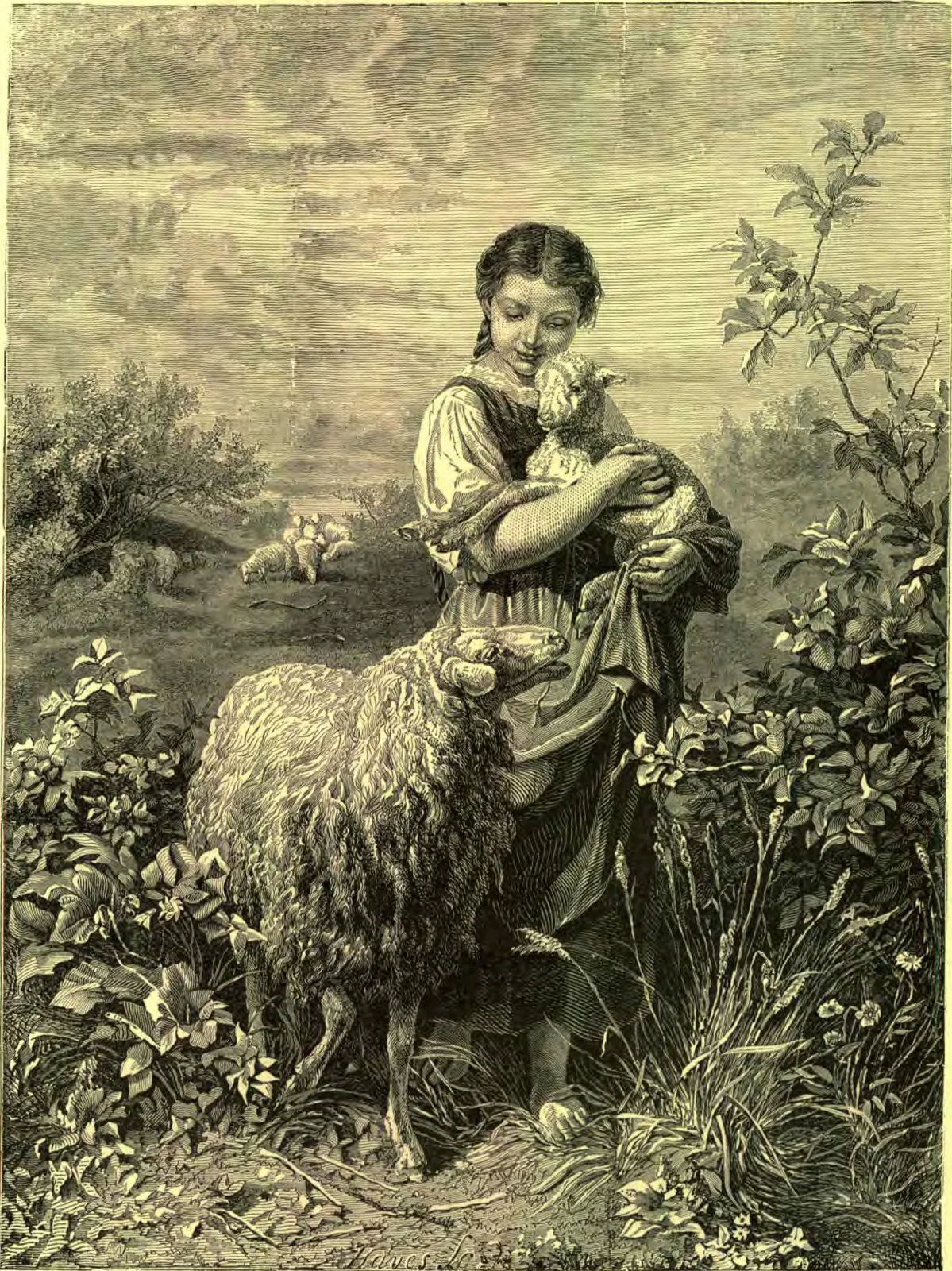
“WITH LAMBS AT PLAY IN FIELDS OF MAY”
But Jack Frost is not easily discouraged, and at last he discovered the spot where Spring Beauty was hiding, and in his sharp tongue whispered to her of the winter that was soon coming, with its cruel cold and raging storms. As she listened, Spring Beauty's head drooped, and her withered leaves sank upon the ground.
When morning dawned, the sky was gray, and the wind blew cold. Jack Frost was still roaming about the fields, and again he spoke to Spring Beauty. In the frost-language he told her to lay her pretty head down among the grasses, and the Northwind would spread a warm blanket over her, to keep her warm. When Spring Beauty was nicely settled, the Northwind blew down upon her from the clouds a bit of white, feathery substance, then another and another, until she was warmly covered with a thick, soft blanket. She soon grew warm, and so sleepy that it was not long until she was wrapped in a sound, dreamless slumber, undisturbed by winter's severest cold.
Spring Beauty slept a long time. By and by Jack Frost never stayed long in a place after Northwind had left it.
Spring Beauty's slumber was so deep that she never would have awakened of her own accord; but although she did not know it, a friend was on his way to wake her. He was called Sunbeam, and lived miles and miles away in a beautiful golden castle, which was always warm and bright. On his way he met the sweet Southwind, and together they came to the grassy hillside where Spring Beauty and many of her friends lay sleeping.
Sunbeam and Southwind resolved to see what was under the white blankets, so one by one they were tossed aside, and one by one the tender things beneath were awakened from their long sleep. The grass thrust out new blades; the hazel sprouts turned green; and the wild dandelion opened its yellow eye. When Southwind tossed Spring Beauty's blanket away, Sunbeam kissed her, and she awoke at once, and put out some fresh green leaves in his honor. Then she threw up a stem, and soon was smiling into Sunbeam's face from the loveliest little cluster of pinkish-white blossoms imaginable. When the hour came that Sunbeam must continue on his way into the far west, he left behind him the sweet Southwind, which cheered Spring Beauty, and caressed with gentle touch her pink-veined petals, now and then stirring the thick grass, and touching with loving fingers all the other tender things upon the green hillside.
MINNIE ROSILLA STEVENS.

BEREAN LIBRARY STUDY

(May 26 to June 1)
“When the students of prophecy shall set their hearts to know the truth of Revelation, they will realize what importance is attached to the search. Christ is the Alpha and Omega, the Genesis of the Old Testament, and the Revelation of the New. Both meet together in Christ.” “In Revelation all the books of the Bible meet and end. . . . In Revelation is declared the completion of the eternal plan.”

GENESIS THE ALPHA OF THE BIBLE

An account of creation. Genesis 1.
The first chapter in earth’s history. Gen. 1:1–24.
First introduction of the devil to the human family. Gen. 3:1–3.
The tree of life given to man, and removed on account of sin. Gen. 2:16; 3:24.
Man driven out from the garden of Eden on account of sin. Gen. 3:23.
Man prohibited from eating the fruit of the garden of Eden. Gen. 3:22–24.
Adam and Eve lost their garment of righteousness. Gen. 3:7.
God made Adam and Eve coats of skins, which reminded them of the blood to be shed for them. Gen. 3:21.
The first promise of the Saviour. Gen. 3:15.
The death sentence passed upon all men. Gen. 3:19.
The first death recorded. Gen. 4:8.
The body to return to dust, and remain in the grave. Gen. 3:19.
Threefold curse pronounced upon the earth. Gen. 3:17, 18; 4:11, 12; 7:11.
First death described. Gen. 3:19.
The first lie told on earth. Gen. 3:4.
Introduction of Spiritualism, the devil using the serpent as a medium. Gen. 3:1–5.
The first Sabbath kept by all then upon the earth. Gen. 2:1–3.
The first rainbow. Gen. 9:13–16.
The beginning of Babylon. Gen. 11:4–9.
Sun, moon, and stars created for signs. Gen. 1:14.
The first earthquake. Gen. 7:11.
Musical instruments, when first mentioned, used by the wicked. Gen. 4:21.
The first record of a battle. Gen. 14:7–12.
Man hid from God by sin. Gen. 3:9, 10.
First separation between the righteous and the wicked. Gen. 4:13, 14.
A mark placed on Cain, the first murderer. Gen. 4:15.
God’s people called by his name. Gen. 4:26, margin.
The fire of God’s wrath kindled on earth. Gen. 19:24, 25; Deut. 32:22; Jude 7.
The earth destroyed by a flood. Gen. 7:1–24; 2 Peter 3:5–7.

REVELATION THE OMEGA OF THE BIBLE

An account of re-creation. Rev. 21:5, 1, 2.
The last chapter in earth’s history. Rev. 20:1–15.
Last view humanity will have of the devil. Rev. 20:10.
The overcomer permitted to eat of the tree of life, and pluck its twelve varieties of fruit. Rev. 2:7; 22:1, 2.
The garden of Eden in the midst of the city, again given to man. Rev. 22:2.
Invitation to partake of all those fruits at the Marriage Supper. Rev. 19:9; “Early Writings,” page 15.
The redeemed again clothed in robes of righteousness. Rev. 19:8.
The redeemed will be clothed in robes washed and made white in the blood of the Lamb. Rev. 7:14.
The final fulfillment of the promise described. Revelation 19 to 22.
The resurrection of the whole family of Adam. Rev. 20:4–6.
There shall be no more death. Rev. 21:4.
Christ has the keys of death and the grave. Rev. 1:18.
In place of the curse will be the throne of God. Rev. 22:3.
Second death described. Rev. 20:14.
Final end of all liars. Rev. 21:8.
Full development of Spiritualism, and its final end. Rev. 16:13, 14; 19:20.
All keep the Sabbath in the city of God. Rev. 22:14; Isa. 66:22, 23.
Rainbow around the throne of God. Rev. 4:3.
Final end of all traces of Babylon. Rev. 18:20–24.
Signs given in sun, moon, and stars. Rev. 6:12, 13.
Greatest earthquake. Rev. 16:18.
The redeemed playing upon harps on Mount Zion. Rev. 14:2.
The last great battle on earth. Rev. 20:9.
The redeemed shall see the face of God. Rev. 22:4.
Final separation between the righteous and the wicked. Rev. 21:7, 8.
A mark upon the wicked in the last days. Rev. 16:2; 14:9, 10.
The Father’s name in the forehead of the 144,000. Rev. 14:1.
Final burning of all sin and sinners. Rev. 20:9–15.
Final burning of the earth by fire. Rev. 20:9; 21:1, 2.

IS IT THE CLOSE OR THE BEGINNING OF REVELATION?

We have come to the last chapter of the book of Revelation. What is it to you? Is it the close of revelations of light from God’s word, or is it the beginning of brighter revelations from the fountain of life? We trust it will be the beginning of a deeper study of the word of God by all our young people.
God grant that the past seven months’ study has been such a revelation of the beauty of the character of our Saviour, that, like John, you may hear him saying to you, “Come up hither.” Come up to greater heights of Christian experience than you have had in the past. Come up where, like Cleopas, your heart will burn within you while He talks with you as you go about your daily duties. Come up where the rainbow spanning the sky will remind you of the throne of God, and the precious blood of the everlasting covenant, and where you will ever discern traces of the Root of David and the Lion of the tribe of Judah in the face of nature around you.
May the Saviour become so precious to you that at last you will be among the one hundred and forty-four thousand upon Mount Zion.
MRS. S. N. HASKELL.

THE SIN-OFFERING

(June 1)
MEMORY VERSE.—Isa. 53:10.

QUESTIONS

1. What is sin? 1 John 3:4.
2. What two kinds of sin are spoken of in the Bible? Num. 15:29, 30; note 1.
3. When one had sinned ignorantly against the Lord, what was he told to do? Lev. 4:27, 28.
4. When he had thus brought his offering, what did he do? V. 29.
5. What was then done by the priest? Vs. 30, 31; 6:25, 26; note 2.
6. What offering for sin was made by the high priest, and by the whole congregation? Lev. 4:3, 14.
7. What was done with the blood of the bullock? Vs. 5–7; note 3.
8. What part of the offering was burned upon the altar? Vs. 8–10; note 4.
9. What was done with the remainder of the bullock? Vs. 11, 12; note 5.
10. Why is it necessary to have sin forgiven and put away? Isa. 59:2.
11. What was the result of making the sin-offerings? Lev. 4:26; note 6.
12. What offering for sin are we to make? Isa. 53:10; note 7.
13. What promise has God given to all who make this offering? 1 John 1:9.

NOTES

1. The Lord distinguishes between sins of ignorance and known sins. It is a very dangerous thing to do wrong knowingly. When one commits sin willfully, he is taking the first step in the way that leads to the sin against the Holy Spirit, which can not be forgiven. The Lord has sometimes forgiven very grievous sin; he forgave David even the sin of murder. But David himself teaches us that it is unsafe to do wrong in any way, and especially when we know. He prayed: “Cleanse thou me from secret faults. Keep back thy servant also from presumptuous sins: let them not have dominion over me: then shall I be upright, and I shall be innocent from the great transgression.” Ps. 19:12, 13. The only right way is not to sin at all. But if we sin, we have an advocate and helper in Jesus.
2. Sometimes the priest ate a part of the flesh of the sin-offering in the holy place. The reason for so doing was that the sin which had been placed upon the sin-offering might be taken in before the Lord, and be forgiven. When the one who had done wrong confessed his sin upon the head of his offering, the sin passed from him to the offering. Then when the priest carried the flesh into the sanctuary, he carried in the sin which the flesh contained.
3. The reason for carrying in the blood was the same as for carrying in the flesh; it was to take into God’s presence the sin or sins which had been confessed, that they might be forgiven. When the flesh was eaten, the blood was left outside; and when the blood was carried in and sprinkled, the flesh was not eaten. The two ways were not followed in the same case. But both ways represented the work of Jesus.
4. “All the fat is the Lord’s.” Lev. 3:16. The fat was a sweet savor unto the Lord, an offering which pleased him. With the blood it was never to be eaten. The blood represented the life of Jesus, which had been given for the world; the fat was a type, also, of the great offering made for us. As the fat burned, it went up as a precious, fragrant incense before God.
5. All the bullock, except the fat and the blood, was carried to a place outside the camp, and was there burned. This part of the service was also a type of the work of Jesus. Our Saviour was taken outside the walls of Jerusalem to be crucified; and while there, his Father’s face was turned away from him. In every way the sin-offerings of the sanctuary on earth were figures, or pictures, of the Lamb of God, who died to take away the sin of the world.
6. Sin separates and cuts us off from God. It breaks our union with him. Instead of being one with him, we are divided. But when sin is taken away by forgiveness, then the gulf is closed up, and we are no longer two, but one. So the Lord says that when the priest should carry in the blood, he would, by so doing, make an atonement, an at-one-ment, for the sinner. By taking away the sin, God and his sinning child were brought together, were at one with each other. Then the blessing of the Lord, which had been hindered from coming into the heart, would enter the life as a living stream, cleansing away all the defilement of evil. Oh, let us be sure that we allow Jesus to make an at-one-ment for us! Let us forsake the sins that have been allowed to bar the door against him.
7. We are to make an offering of the soul” of Jesus; that is, we are to exercise faith in the offering which he has made. He gave his soul, his life, for the world. The offering was great, and is sufficient to cover the sins of all. But we must each accept the offering for ourself, or it will be no blessing to us. But just as surely as we do trust God, and pray him to accept Jesus as our offering, just so surely the Lord will write our names in the book of life, and Jesus will be one with us all the way through life here, and through eternity.

Making Maple Sugar

SEARS, MICH.
DEAR YOUTH'S INSTRUCTOR: For the benefit of those who do not know how maple syrup is made, I will tell what I know about it. People who have modern conveniences for taking care of the sap have large pails with holes near the top, and tin spiles to fit the holes in the pails. They drive the spiles into the hole in the tree, and that holds the pail.
But we had nothing of the kind, so papa and I went into the woods, and gathered some elder for spiles. When we came home, we cut the elder between joints, and punched out the pith. Then papa, brother, and I went back in the woods, and bored holes in the trees, put the spiles in, and set the pails under the spiles. We had about fifty trees.
We got two logs, and hung the kettle on a pole between them. Then we built a fire under the kettle. When the sap boiled to the top of the kettle, we would get some snow or more sap, and throw in the kettle.
We boiled the sap in the woods until it began to get thick. Then it was taken to the house, and mama boiled it until it was thick enough for the table. To make the syrup clear, mama beat two eggs, and added to them half a cup of milk, stirred the milk and eggs together, and turned the mixture into the boiling syrup. Then she set the kettle on the back of the stove, and let the impurities rise to the top. JESSIE CURRIER.

Troublesome Blue Jays

HIGHLAND PARK, ILL.
DEAR YOUTH'S INSTRUCTOR: I have read the interesting account of the blue jay in the INSTRUCTOR, but my experience with this bird has not always been the same as Mr. Reed's. The jays around here have given us more trouble than hawks. For several years we have hatched chickens with an incubator, and raised them by hand. The jays would come down when we fed the chickens, and eat with them. They have also carried off the dead ones to eat. From eating dead chicks, the jays began to chase live ones, and I have often had to drive away a jay that was making trouble in the park.
One time mama, hearing an unusual commotion among the chickens, went out to see what was the matter. She found a jay chasing a chicken. A box with a board off one side was lying upside down on the ground. Seeing a jay fly out of this, mama turned it over, and found a chicken hiding there. It had been followed by the jay that was startled away by her coming. I have never seen the jay eat hen's eggs, but uncle once saw a hen's egg carried off by a jay, which stuck his bill into the shell, and carried it that way.
I think the bird spoken of in the INSTRUCTOR of April 4 was the blue jay. I have heard a sound similar to the one mentioned, which was made, I think, by this bird pecking on wood. I am very much interested in the Bird Lore department.
MARY MOORE.

COLLINS CENTER, N. Y

DEAR YOUTH'S INSTRUCTOR: I love to go to the woods in the spring, and watch the men tap the maple trees. First they bore a hole in the trees; then they put spouts in the holes, and hang the buckets on the spouts.
When the sun begins to shine, the sap runs drop by drop; sometimes when the sun shines very warm, it will run a stream. When the buckets are full, the men go around with the horses and gathering tub, and take the sap to the sugar house, where it runs into tin pans set on a brick arch, where a big fire is kept burning. After a while it becomes thick, when it is taken to the house, and boiled until it is thick enough to cake. Then it is taken off the fire, stirred, and caked in oblong-shaped tins. Sometimes I make little heart-shaped cakes, and give them to my friends.
HAZEL CLARK (11 years old).

A Curious Home

DEAR YOUTH’S INSTRUCTOR: Not long ago, near a creek not far from where we live, we found an old squirrels’ home. It was built in solid rock on a side-hill, and was as cunningly made as if done with plumb and chisel. It was quite small: I could get my hand in only one or two of the larger holes. It was old and crumbly when we found it, and part had fallen from one side. It was divided into different stories, no one story leading to the other, but all having different entrances. The halls of this house were filled with nut-shells; some of the pillars, which were only half an inch in diameter, were broken by the pressure from above.
ARTHUR L. WESTPHAL (12 years old).

A Practical Reader

ONAWA, IOWA.
DEAR YOUTH'S INSTRUCTOR: I have had the YOUTH'S INSTRUCTOR to read ever since 1897, and have saved all the papers since then. I have read all the articles on carpenter work and photography, and have learned to take pictures, and do pretty good carpenter work.
Last summer a lady gave me two small sunfish. One of them died in a day or two, because it jumped out of the water, and stayed out too long. The other one lived all winter; but this spring we were gone from the house nearly all the time for a week or two, and though we took good care of our pet, it died too.
We had several snails and a water-weed in the jar, and in about a month there were dozens of little snails in the jar. I am fifteen years old.
HARRY AUSTIN.

SELF-PRONOUNCING S.S. Teachers' Reference Bible
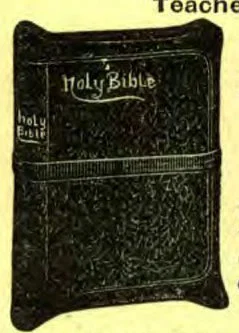
Contains the Celebrated Teachers' Helps,
Comprising nearly 400 pages. Also a complete series of fifteen new maps.

DESCRIPTION

IMPERIAL SEAL BINDING, TUCK EDGES, known as “DIVINITY CIRCUIT,” ROUNDED CORNERS, FULL RED UNDER GILT EDGES.
We offer this Bible, postpaid, for only six new yearly subscriptions at 75 cents; or twelve new six months' subscriptions at 40 cents.
We will also send it, postpaid, with the INSTRUCTOR one year for $2.25. For 20 cents extra we will stamp your name in gold upon the cover. Address—
THE YOUTH'S INSTRUCTOR, Battle Creek, Mich.

GRAND TRUNK R'Y. SYSTEM.

Taking Effect Dec. 16, 1900.
Trains leave Battle Creek.

WEST-BOUND

No. 9, Mail and Express, to Chicago.................................... 12.15 P. M. No. 1, Chicago Express, to Chicago........................................ 8.30 A. M. No. 3, Lehigh Valley Express, to Chicago................................. 3.50 P. M. No. 5, International Express................................................... 2.17 A. M. No. 75, Mixed, to South Bend................................................. 8.30 A. M. Nos. 9 and 75, daily, except Sunday. Nos. 1, 3, and 5, daily.

EAST-BOUND

No. 8, Mail and Express, East and Detroit............................. 3.45 P. M. No. 4, Lehigh Express, East and Canada................................ 8.22 P. M. No. 6, Atlantic Express, East and Detroit............................... 2.10 A. M. No. 2, Express, East and Detroit............................................. 6.50 A. M. No. 74, Mixed (starts from Nichols yard)............................... 7.15 A. M. Nos. 8 and 74, daily, except Sunday. Nos. 4, 6 and 2, daily.
W. C. CUNLIFFE, Agent
BATTLE CREEK

Letters to the Editor: Neatness, Spelling, and Clarity

Such a pile of letters! During the General Conference, you see, every one was busy, and so the letters that came in then were neglected, with many other things. But it has been a pleasure to read them, and often a pleasure just to look at them, they are so carefully written. In looking them over, I have been impressed with the general neatness and care that has been taken in writing them. That is very important. But remember that even the blackest ink and the whitest paper and the most beautifully formed letters will never make up for poor spelling or bad grammar. Let the writing of these letters be a school to you, and when you have done your best, get some one to look over your letter and criticise it. Do the same thing yourself, asking especially what you can leave out, and still make the thing quite clear and plain that you wish to tell. Perfection does not come in a moment, but we can all work toward it.

1916 Cumming St., Omaha, Neb

LADY agents wanted everywhere to sell health garments and other first-class articles. No trash. It is easy and pleasant work, for some of the goods are sold in nearly every house. I pay you for getting me agents. W. S. DANN.

1916 Cumming St., Omaha, Neb

Letters from Young Readers of the Instructor

OWING to the limited space which the INSTRUCTOR can devote to its new departments, it will not be possible to print all the letters that come—only those of the most general interest. We wish we could send a personal word of thanks to all who have written, but since this is not possible, we will thank you in this way, and tell you that all the letters are read and enjoyed here, even if they are not printed:—
Edwin Marietta, of Grand Ledge, Mich., tells about a journey to Petoskey, in the northern part of the State, and of his visit to an uncle who lives near that place. Two sisters from Lime Ridge, Wis., Elsa and Lilly Rist, tell about their pet catbirds and tame doves. Orpha Strong, only nine years old, of Hankinson, N. D., sends a beautifully written letter, telling how their church went to camp-meeting last year; and her sister Ruth gives a history of their church school since it started, four years ago. These letters are both interesting, but they are too long for the department. Ernest and Lee Mansell write from Henderson, Me., about a train wrecked not far from their home, and about going out in the woods to gather spruce gum. Both the boys have little Testaments, with their names stamped on the cover.
Continue reading: IF THOU CANST BELIEVE