EARLY in life it was my happy privilege to become acquainted with a man who was one of a large family of children whose parents were very poor. As he was many years my senior, I could learn only from his own lips the hardships and trials through which he passed in early childhood. But over and over he has repeated them to me, and they always engaged my rapt attention and enlisted my deepest sympathy.
As I have reflected upon many of the early experiences of this man, and known something of his career later in life, how he was advanced from one position of responsibility to another, it has been a source of inspiration to me; and I am growing more and more into the opinion, by actual knowledge as well as by observation, that strength of character and real usefulness are not so much the outgrowth of wealth, advantages, and opportunities, as the reverse.
“It is easy to glide with the ripples
Adown the stream of time,
To flow with the course of the river,
Like music to some old rhyme;
But ah! it takes courage and patience
Against its current to ride;
And we must have strength from heaven
When rowing against the tide.”
Yes, difficulties awaken all our dormant energies; and often in the struggle we find ourselves insufficient, and are driven to Him who is the source of all strength.
Let no one whose resources are limited, whose sphere seems narrow, become discouraged, and give up trying. Right within ourselves are grand responsibilities, while just above us, and yet within our reach, are infinite resource and power. What others have done we can do. By grappling with adversity we shall grow strong, and the obstacles in the way will become the stepping-stones to glorious success.
K. BLOSSOM WILCOX.
OUR MEN OF PURPOSE
By Frank Walcott Hutt
What has the country boy to say
Of country boys who “made their way”?
The brown lad, standing at the stile,
Nods toward the homestead with a smile,
Points to the plow, the field, the mill,
The tiny schoolhouse on the hill;
And tells with pride how from the farm
A Lincoln’s sturdy voice and arm,
A Garfield’s eloquence and might,
A Whittier’s prophetic sight,
The faith of Grant and Washington,
Our cause upheld, our battles won,
And strengthened in its trial hour
The bulwarks of our country’s power.
What has the city boy to tell
Of city boys who served us well?
He points us to a thousand strong
Renowned in story and in song,—
A thousand who have “won their way,”
Whose names shine like the stars to-day.
He tells how from the town there came
A Franklin’s never-ending fame,
An Irving’s sun that has not set,
The genius of an Everett;
Beneath the city’s roofs and domes
There sprang the peerless wit of Holmes,
The treasured power of Motley’s books,
The eloquence of Phillips Brooks.
What, then, brave toiler in the town,
Strong plowboy, in the pasture brown!
When youthful purpose clearly sees
Exemplars in such men as these,—
Join forces in their noble strife,
To seek the purest joys of life;
Join hands together, and be brave
Their legacy of faith to save.
Whatever drones and doubters say,
Be men of purpose, boys, to-day.
—Frank Walcott Hutt, in Youth’s Companion.
DOROTHY’S SERVANTS
Dorothy’s face wore a discontented look: she glanced around the plain little room that served for kitchen, dining-room, and parlor, and sighed.
“What is it, dear?” asked her mother.
“O mother! I’m so tired of being poor,” she answered. “Alice Pratt has such a beautiful house to live in, and servants to wait on her. She never has to sweep floors, or make up her bed, or even comb her own hair. I wish we were rich, too.”
“Why, girlie, I don’t think you would feel so poor if you would just count up your riches. You, too, have a beautiful house of your own, and many servants to wait on you.”
“O mother! this house is not beautiful a bit; and we never had any servants. I do not understand what you mean. Please tell me,” and Dorothy came, and leaned on the arm of her mother’s chair.
“I’ll tell you about some of your servants first. They are good, faithful servants, and you would miss any one of them very much. They have been with you always, but some of them did not begin work as soon as others. A curious thing about them is that many of them go in pairs, exactly alike.”
“Do go on, mother,” said Dorothy, as her mother paused. “It sounds just like a story.”
“Well, two who began to serve you very early are artists. The first picture they painted for you was a picture of the light. There were the window and the lamp, and there were little points of light reflected from bright articles in the room. Then they showed you a picture of mother’s face; after that, there was father; then there were flowers and birds, trees, clouds, and houses. They have painted all these things for you, and without their help you would have seen none of them.”
“The next pair are reporters. Not a sound do they hear but they tell you of it. The bird-songs, the music of the brook, the wind in the trees, mother’s voice, and the church bell,—all sounds, sweet or harsh, sad or joyous, they report faithfully to you. But they did not begin work quite as early as the artists.”
“The next pair are your jolly playmates,—workmates, too; never a game of ball or jackstones do you have but they play it with you, sharing your fun. And when you have work to do, they always turn in and help with all their might. Yet when you were little, they were very naughty: you would hardly believe it, but they actually used to scratch your dear little face until I thought I should have to tie them up.”
“One more pair I will tell you of, whose duty it is carry you around, wherever you may wish to go. When you were little, they were your favorite playthings. Alice Pratt is rich, and rides in a carriage; but she would gladly exchange it for a pair of servants as nimble and strong as yours, to carry her about.”},{
A BETTER GIFT
“Oh, there’s that Ruth Knolls and her brother again! Do you know, Miss Merton, she is just awfully dull in school, and we girls laugh at her so much. She hasn’t a particle of brilliancy.”
Viva chatted this speech out as she walked along the street beside Miss Merton.
“She has something far better than brilliancy,” said Miss Merton.
“What?” said Viva, her cheeks flushing uncomfortably; for she felt that she had made a mistake, and she was very anxious to stand well in Miss Merton’s opinion.
“She has a courteous manner,—a grace that is far too rare. I know Ruth well, and her kindness and courtesy are unfailing in company or at home. She will grow into a lovely woman.”
“I am sorry I spoke so,” said Viva. “I really don’t know anything about her except that she stumbles dreadfully in her lessons.”
“No doubt she is sorry about it. It is a fine gift to be quick and bright in understanding things; but you know, my dear, that it is far more important to be kind-hearted and gentle. When you go out in the world, no one will ever ask or know whether you got good grades in algebra and Latin. If you have done your best, it is wrought into you, whether your best is very good or only mediocre. But be sure of this: every one who meets you will know, without putting you through an examination, whether you are a gentlewoman. It isn’t practical to quote Greek or discuss psychology or read Shakespeare with every one you meet; but you can6always speak kindly and listen courteously, and quietly look out for the opportunity to do the little deeds of kindness that make our lives so much more worth living.” — Union Signal.
A PRISON-HOUSE
By Adelbert S. Caldwell
HIGH are its walls, so you can't see o'er,
And so narrow are they that one can't get in;
Nor outward swings its close-barred door
Of Love, to welcome one's kith and kin.
The shutter of Sympathy's never drawn
To send forth a message of hope and cheer;
The flag on the tower, from eve till dawn,
Reads, "I live alone; please don't come near!"
“And who is the inmate,—some witch or elf?
And the name of the house? I can not guess.”
The inmate's a shriveled-up dwarf called Self,
And the narrow house is Selfishness!
—Adelbert S. Caldwell, in S. S. Times.
BEREAN LIBRARY STUDY
Revelation 7: “Thoughts on the Revelation,” pages 435–451
NOTES ON LESSON 7
(December 9–15)
THE sealing work brought to view in the seventh chapter of Revelation takes place in the space of time intervening between the fulfillment of the thirteenth and fourteenth verses of the sixth chapter of Revelation. The thirteenth verse met its fulfillment in 1833. The fourteenth verse will not be fulfilled until the servants of God are sealed in their foreheads, and the hundred and forty-four thousand saints are numbered for eternity.
Work of the Four Angels.— “I saw four angels who had a work to do on the earth, and were on their way to accomplish it. Jesus was clothed with priestly garments. He gazed in pity on the remnant, then raised his hands upward, and with a voice of deep pity cried, ‘My blood, Father! my blood! my blood! my blood!’ Then I saw an exceeding bright light come from God, who sat upon the great white throne, and was shed all about Jesus. Then I saw an angel with a commission from Jesus, flying swiftly to the four angels who had a work to do on the earth, and waving something up and down in his hand, and crying with a loud voice, ‘HOLD! HOLD! HOLD! HOLD!’ until the servants of God are sealed in their foreheads.” I asked my accompanying angel the meaning of what I heard, and what the four angels were about to do. He said to me that it was God that restrained the powers, and that he gave his angels charge over things on the earth; that the four angels had power from God to hold the four winds, and that they were about to let them go, but while their hands were loosening, and the four winds were about to blow, the merciful eye of Jesus gazed on the remnant that were not sealed, and he raised his hands to the Father, and pleaded with him that he had spilled his blood for them. Then another angel was commissioned to fly swiftly to the four angels, and bid them hold until the servants of God were sealed with the seal of the living God in their foreheads.”—“Early Writings” (first part), pages 30, 31. “What is the seal of the living God, which is placed in the foreheads of his people?—It is a mark, which angels, but not human eyes, can read.”
Seal.— A seal is a mark attached to legal documents to make them of force. It shows the name of the person or power issuing the document; also the title, or right to exercise authority, of that person or power, and the territory governed
The Seal of the Law of God.— When the Creator of the heavens and the earth gave his law to man, he did not leave it without his signature. Earthly rulers usually place their seal, or name, at the close of their legal documents, while some place it at the head; but God’s seal, or name, is found in the center of his law,—in the fourth commandment, where it could not be removed without changing his law. “In six days the Lord made heaven and earth, the sea, and all that in them is.” Here we are given the name of the lawgiver,—the Lord Jehovah. His title is the Creator; for he made all things. His territory comprises the whole universe of God—“heaven and earth, . . . and all that in them is.”
The Sabbath the Seal.— God’s seal is in the Sabbath commandment. We keep the Sabbath to commemorate his great creative power,—that power which made the worlds, and upholds them in the heavens, and also makes new, clean hearts for his people, and is able to keep them from falling. In obeying the fourth commandment we acknowledge God’s right to rule over the sons of men, and that we are subjects of his dominion. If the Sabbath is kept with a true heart, it marks us as loyal subjects of the great Creator of the universe. A person may keep the Sabbath faultlessly in form, and be counted by men as a good Sabbath-keeper, while his heart is far from God, who alone can read the heart. He who is at heart a true Sabbath-keeper will receive the seal. Human eyes can not read the heart, and therefore will not be able to discern the seal of the living God in the forehead.
The 144,000.— This company will occupy the position in heaven once occupied by Satan and his angels, and they will follow the Lamb whithersoever he goeth. Satan points to the defective character of the remnant, and says: “Are these the people who are to take my place in heaven, and the place of the angels who united with me? . . . Look at the sins which have marked their lives. . . . But while the followers of Christ have sinned, they have not given themselves to the control of evil. They have put away their sins, and have sought the Lord in humility and contrition, and the divine Advocate pleads in their behalf. He who has been most abused by their ingratitude, who knows their sin, and also their repentance, declares, ‘The Lord rebuke thee, O Satan! I gave my life for these souls. They are graven upon the palms of my hands.’”—“Testimonies for the Church,” Vol. V, pages 473, 474.
Baby’s First Wardrobe
By Mrs. F. M. Kellogg
HYGIENIC PATTERNS
Complete outfit, based on healthful principles—22 PATTERNS, together with a beautiful booklet on the proper care of infants, sent postpaid for 50 cts. Full directions for making, showing necessary material, etc. Address—
MRS. F. M. KELLOGG.
36 Washington Ave., Battle Creek, Mich.
CHICAGO & GRAND TRUNK R'Y
E. W. Meddaugh and Henry B. Joy, Receivers.
CHICAGO & GRAND TRUNK R'Y.
Trains leave Battle Creek.
WEST-BOUND FROM BATTLE CREEK.
No. 9, Mail and Express, to Chicago — 12.15 P. M.
No. 1, Chicago Express, to Chicago — 8.30 A. M.
No. 3, Lehigh Valley Express, to Chicago — 3.50 P. M.
No. 5, International Express — 2.15 A. M.
No. 75, Mixed, to South Bend — 8.30 A. M.
Nos. 9 and 75, daily, except Sunday.
Nos. 1, 3, and 5, daily.
EAST-BOUND FROM BATTLE CREEK.
No. 8, Mail and Express, East and Detroit — 3.45 P. M.
No. 4, Lehigh Express, East and Canada — 8.27 P. M.
No. 6, Atlantic Express, East and Detroit — 2.25 A. M.
No. 2, Express, East and Detroit — 6.50 A. M.
No. 74, Mixed (starts from Nichols) — 7.15 A. M.
Nos. 8 and 74, daily, except Sunday.
Nos. 4, 6, and 2, daily.
W. C. CUNLIFFE, Agent,
G. W. VAUX, BATTLE CREEK.
G. P. A., CHICAGO.
UPON HIS SHOULDER
By Mary Rowles Jarvis
Upon his shoulder, scourged and bowed with pain,
He bore the cross along the weary road.
The scoff and scorn he braved my peace to gain;
For me he fainted ’neath the awful load.
Upon his shoulder in the desert wild,
Where souls astray in drought and darkness roam,
He laid me,— helpless as an outcast child,—
And with rejoicing brought his ransomed home.
Upon his shoulder, throned all power above,
The government of worlds is resting now.
He ruleth all things, and his rule is love—
Behold, through crowns, the thornprints on his brow!
Upon his shoulder, high, serene, and safe,
He waits to bear each life load of my soul;
And shall I dare mistrust his power, or chafe
Impatient of his choosing or control?
Upon his shoulder! In that heart’s-ease word
All care and fear and doubt are overthrown.
Remove my shoulder from the burden, Lord,
And let the government be all thine own!
— Mary Rowles Jarvis.
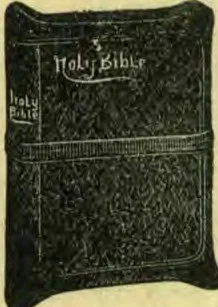
SELF-PRONOUNCING S.S. Teachers’ Reference Bible
By Editor
Contains the Celebrated Teachers’ Helps,
Comprising nearly 400 pages. Also a complete series of fifteen new maps.
DESCRIPTION
Imperial Seal Binding, Tuck Edges, known as “Divinity Circuit,” Rounded Corners, Full Red Under Gilt Edges.
We offer this Bible, postpaid, for only six new yearly subscriptions at 75 cents; or twelve new six months’ subscriptions at 40 cents.
We will also send it, postpaid, with the INSTRUCTOR one year for $2.25. For 20 cents extra we will stamp your name in gold upon the cover. Address—
THE YOUTH’S INSTRUCTOR,
Battle Creek, Mich.
Destroy the Germs; Cure the Disease!
By E. J. Worst
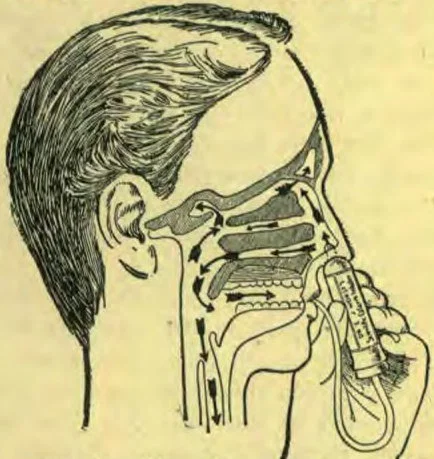
This diagram illustrates how the
The above illustration shows how the E. J. Worst Scientific Catarrh Inhaler sends the medicated air into every air passage of the head. Nothing but air can penetrate these fine air cells and reach the homes of the living germs that cause disease. No snuff, powders, douche or spray can possibly reach them. Don't be deceived—make no mistake—apply common sense, and you will find that
E. J. Worst's Catarrh Inhaler
is the only instrument that will give you quick return for a small outlay, and perfect satisfaction as a Cure for Catarrh, Colds, Pains and Roaring in the Head, Bronchitis, Sore Throat, Headache, Partial Deafness, and all Diseases of the Air Passages.
SPECIAL OFFER.
For a short time I will mail to any reader, naming this paper, one of my new Scientific Catarrh Inhalers, with medicine for one year on three days' trial, free. If it gives satisfaction, send me $1.00; if not, return it after three days' trial. Could any proposition be fairer?
E. J. WORST, 421 Main Street, ASHLAND, O.
Not Sold by Druggists. AGENTS WANTED.
PROSPECTUS NOW READY
By J. E. White
BEST STORIES FROM THE BEST BOOK
By J. E. WHITE.
In Four Languages: English, German, Danish, Swedish.
Begins with over fifty pages of charming “easy lessons,” including model nature studies for children, with fifteen beautiful colored plates, and many pen-drawings. Concludes with about 150 pages of entertaining “Bible stories” from the Old and the New Testament Scriptures, with numerous full-page engravings and other artistic illustrations.
AN EVERYDAY BIBLE COMPANION FOR THE HOME,
DEVOTIONAL AND PRACTICAL,
COMPRISING TWO HUNDRED LARGE OCTAVO PAGES.
STYLES AND PRICES IN EACH OF THE FOUR LANGUAGES:
Heavy paper edition, cloth back and corners: 75 cents
Thin paper edition, board cover: 50 cents
Thin paper edition, limp paper cover: 25 cents
“Best Stories from the Best Book” has been designed with special reference to the needs of the children. For this reason it has been profusely illustrated. The experience of years has fully demonstrated that immature minds need good illustrations to impress the truths presented in either oral or written lessons.
We have been instructed that for people of childlike minds “we should have issued books in so simple a style that a child might have understood them, for many of them are only children in understanding. Pictures and object lessons should have been used to present to the mind valuable ideas. Children and youth should have been educated in such a way that they could have been instructors and missionaries to their parents.”
The Bible stories have been prepared with special reference to teaching the truth. Many vital points of present truth are considered in a manner to cause a deeper investigation of these subjects from the Bible.
IN FOUR LANGUAGES.
“BEST STORIES” is being carefully translated from the English into the German, Danish, and Swedish languages. The Author’s profits from the sale of this book will be used in behalf of the southern missionary work.
1,000 CANVASSERS can earn $200,000 from the sale of 1,000,000 copies of “Best Stories from the Best Book.” The easiest seller ever prepared for little people. 750,000 copies of “Gospel Primer” have been sold. “Best Stories” will sell more readily. The prospectus shows all four languages and the three styles of binding. It, with printed description for agents, will be mailed, postpaid, to any address, for 35 cents. With this you can immediately begin work, taking orders in all these languages by only once passing over the ground.
This is an easy-selling canvasser’s “HELP.” Subscription book profits to agents. The English book will be ready for canvassers to deliver for the holidays. The foreign editions will immediately follow.
In this lesson and the next, you will study the subject of the two covenants, as illustrated in the experience of Abraham. In order to understand the lessons well, you will need to be familiar with the story of this experience. Read carefully Gen. 16: 1-6; 17: 15-25; Heb. 11: 11, 12. For an excellent commentary on the two covenants, read chapter thirty-two of “Patriarchs and Prophets,” from paragraph twenty-five to the close.
QUESTIONS
1. How does Paul address the Galatians? What experience does he again pass through for them? V. 19; note 1.
2. Where does he desire to be? How did he regard them? V. 20, margin; compare v. 11.
3. How does he next address them? What question does he ask them? V. 21; note 2.
4. How many sons had Abraham? Who was the mother of the first? Of the second? Gal. 4: 22.
5. How was the son of the bondwoman born? How the son of the freewoman? V. 23; note 3.
6. What are these circumstances in the life of Abraham called? What do these two women represent? Which covenant does Agar represent? This covenant genders to what? V. 24.
7. Agar represents what mountain, and answers to what city? What is her condition? What the condition of her children? V. 25; note 4.
8. What city does Sarah, the freewoman, represent? What is the condition of this city? What is our relation to the heavenly Jerusalem? V. 26. Then what is our condition?
NOTES
1. Very tenderly Paul addresses the Galatians as his children. And such, in a spiritual sense, they were. Again he suffers the soul anguish that the faithful laborer feels for those whom he would see converted to Christ. It is this suffering that causes the tears with which we sow; but we shall reap in joy. Ps. 126: 6.
2. The law was heard in thunder tones from Sinai. And it spoke only condemnation to those who heard; for all had violated it. We have seen that all who seek for righteousness by the works of the law are really under its curse; for righteousness comes not by the law except by perfect obedience. And this none have rendered. So the law proves all to be guilty before God.
3. Since Hagar was a bondwoman or slave, her children could be nothing but slaves; for children inherited their freedom or bondage from the mother, not from the father. So Ishmael never could have been Abraham’s heir, even if Isaac had not been born.
4. Notice that the women, not their sons, represent the covenants. The sons represent those who are under the covenants. Hagar stands for the old covenant made at Sinai, which genders to bondage. “The people did not realize the sinfulness of their own hearts, and that without Christ it was impossible for them to keep God’s law; and they readily entered into covenant with God. Feeling that they were able to establish their own righteousness, they declared, ‘All that the Lord hath said will we do, and be obedient.’ They had witnessed the proclamation of the law in awful majesty, and had trembled with terror before the mount; yet only a few weeks passed before they broke their covenant with God.”
A BEAUTIFUL HOLIDAY BOOK
JUST FROM THE PRESS.
— ENTITLED —
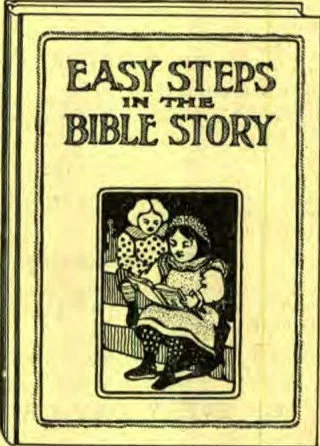
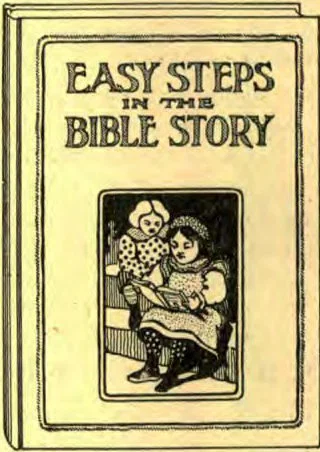
Easy Steps in the Bible Story
By ADELAIDE BEE COOPER
Introduction by ELDER STEPHEN N. HASKELL.
SOLD BY SUBSCRIPTION ONLY.
AGENTS WANTED IN EVERY CHURCH.
Profits go to General Conference Association.
The beautiful stories of the early Bible times never lose their charm. In Easy Steps in the Bible Story the author takes up the early Bible narratives in their natural order, drawing a lesson from each and showing their relation and bearing to present truth. This book will be read with interest and profit by all.
This book contains 160 pages, table of contents, and list of illustrations. Our artist has prepared 150 beautiful pen drawings, illustrating the text of the book. It also contains many full-page illustrations. Beautiful cover design. Two styles of binding.
PRICE, IN CLOTH, 50 CENTS.
PRICE, IN PAPER, 25 CENTS.
The price brings the book within the reach of all. Ready for delivery. Order at once.
For particulars address your tract society, or—
REVIEW AND HERALD PUB. CO., BATTLE CREEK, MICH.,
Or PACIFIC PRESS PUB. CO., Oakland, Cal.
FOUND! A NAME!
IN the INSTRUCTOR of November 1, page 341, was given a picture of three curious-looking birds, with a note asking who could name them, and describe their habits. The responses received all agree as to name,—the barn-owl,—but the descriptions of color, markings, etc., vary somewhat. This is easily accounted for by the fact that the barn-owl has a greater range than any other owl, being found in nearly all parts of the world; the birds, while maintaining the same general characteristics, differing widely in size, color, marking, and nesting habits.
Extracts from a few of the letters received will be of interest. The first came from a young friend in Wisconsin:—
“The name of the odd-looking birds in the picture is the barn-owl, or Strix flammea. A few years ago one of these birds was captured here, and mounted by my uncle. In color this specimen is a beautiful golden buff, of an extremely soft tint. The breast is finely dotted with small spots of dark-brown; the back is light-brown, with pencilings of white; and the tail is ornamented with four dark bars. The ruff around the face is of white, edged with brown. We think the center bird in the picture is a baby owl.”
J. W. Rambo, of Camden, N. J., says:—
“I have seen many of these birds. They are barn-owls, and are common in the eastern part of the United States. About thirty years ago a pair of them had a nest in a hole in a large chestnut tree on my father’s farm in New Jersey, and for several years raised either one or two families of young birds, from four to six each time. The year I first noticed them there were six young ones. These I distributed among friends, with the exception of one, which I had stuffed, and now have in my possession.
These owls are about fifteen inches in length, and have a comparatively broad spread of wing. The breast is white, mottled with brown. The back is brown and gray. There is a well-defined line about the face, which gives it a resemblance to a monkey. There are no ear-tufts, such as many other owls have. This bird has a peculiar habit of dropping its head on its breast, and wagging it from side to side. It feeds largely on mice.
“I well remember what a fright I had at one time while passing, after nightfall, the tree where the pair already referred to had their nest. They were out in search of their prey, and one of them flew close to my head, uttering, as it did so, an unearthly screech. I did not get over the feeling it gave me for some time.”
W. T. Ayer, postmaster at Beaver City, Neb., who has had a pair of these birds in his possession, sends the following interesting sketch:—
“On page 341 of the INSTRUCTOR I noticed a picture of some birds that are familiar to me. I had a pair of them four or five years ago, but was never able to find any one who could classify them definitely. Whatever their scientific name, however, their general make-up and characteristics entitle them to be called ‘monkey-faced owls.’ They are buff-colored, mottled with black on some parts of the body and wings, and have the characteristic large, round eyes, which they wink alternately, of the owl family; also the hawklike bill, and sharp, curved talons of a bird of prey. When annoyed, they make a squealing noise not unlike the scolding of a monkey.
“The two specimens that I owned were, I should judge, only a few days old when captured, as their round heads were covered with fine, soft hair, which later developed into feathers. They were secured from the nest by Mr. Harvey Bronhard, who lives nine miles south of Beaver City, Neb., on the banks of Sappa Creek. The creek bank near Mr. Bronhard’s home is from twenty to thirty feet high, and nearly perpendicular. The parent birds had made their nest in this bank, and here the young birds were found. Of the two that I had, one disappeared during the night; the other I had mounted when it was half-grown, and it is now in my brother’s collection in Lincoln, Neb.”
Youth's Instructor Club Renewals Due December
A LARGE number of YOUTH’S INSTRUCTOR clubs will expire during December. Please see if YOUR club needs renewing.
Catching Up on Berean Library Study
Perhaps you have fallen somewhat behind in your Berean Library study. If so, do not wait for a more convenient season to make up the lessons. A special blessing is pronounced upon those who become familiar with the truths contained in this wonderful book; and every day you put off this study, or allow other things to crowd it out, you are missing a blessing that you need. If you will follow the outlines suggested in the Review for daily study, you will be surprised to see how easily the points brought out will be fastened in the mind.