The Youth’s Instructor, Vol. 48, No. 48.

NATURE’S LABORATORY

The Youth’s Instructor

Dec 6, 1900

Review and Herald Publishing Company · Battle Creek, Mich. · Dec 6, 1900

NATURE’S LABORATORY
NO DOUBT many are more or less familiar with the chemical processes used in the laboratory to produce various medicinal substances; and all have seen the druggist’s soda-water fountain, and perhaps sometimes made the mistake of going there and drinking. As usually sold, the comparatively harmless soda-water is contaminated with infected ice-cream, or various so-called “fruit flavors,” which recent investigation has clearly shown to be in most instances simply colored chemical fluids, rather than extracts of the fruits whose names they bear.
MOSS BRAE FALLS
MOSS BRAE FALLS
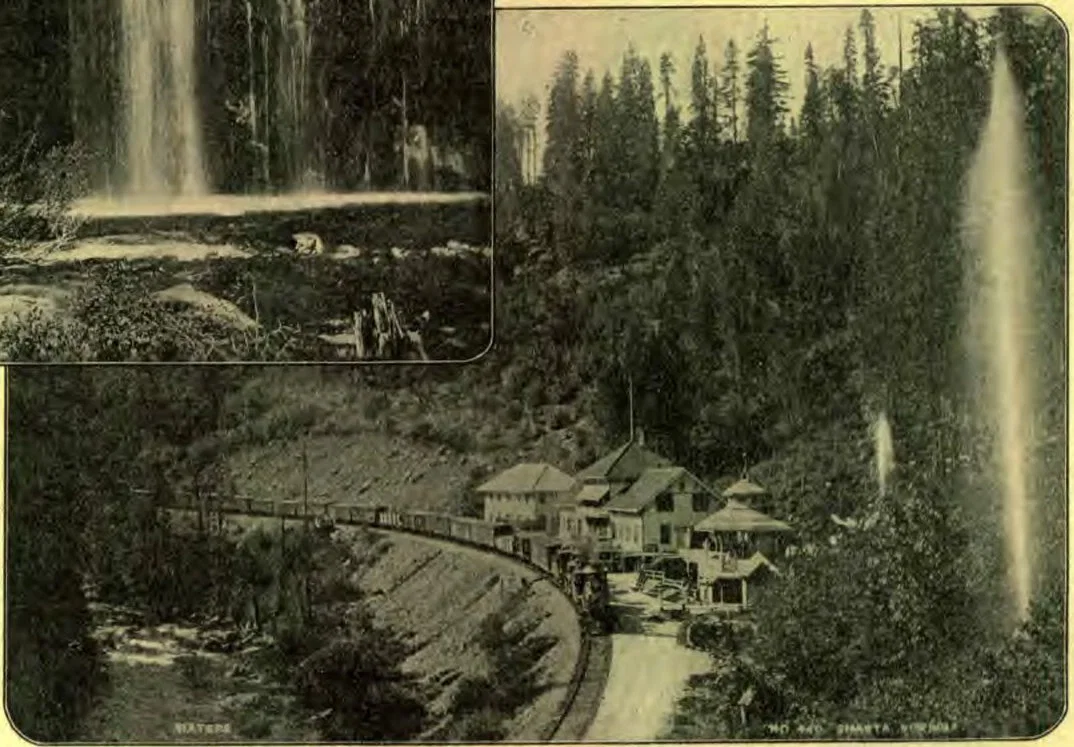
In the various chemical transformations that the chemist carries on in his laboratory, he is only imitating on a small scale what God has been doing on a large scale throughout all ages; and here and there on earth we may still catch a glimpse of the products of nature’s great chemical laboratories. One of these is the famous Shasta Springs on the Pacific Coast. Here the bubbling water comes directly out of the mountain-side, just to the rear of the buildings shown in the illustration, and is as heavily charged with carbon-dioxid gas as one could desire. It fairly bubbles out of the water when a cupful is dipped out. By bringing this water down through pipes from some distance up the mountain-side, and then allowing it to escape directly upward, artificial geysers are produced, which throw a jet of water, as shown in the illustration, almost to the tops of the trees. The wild, rushing stream on the opposite side of the railroad track is fed principally by similar springs higher up the valley.
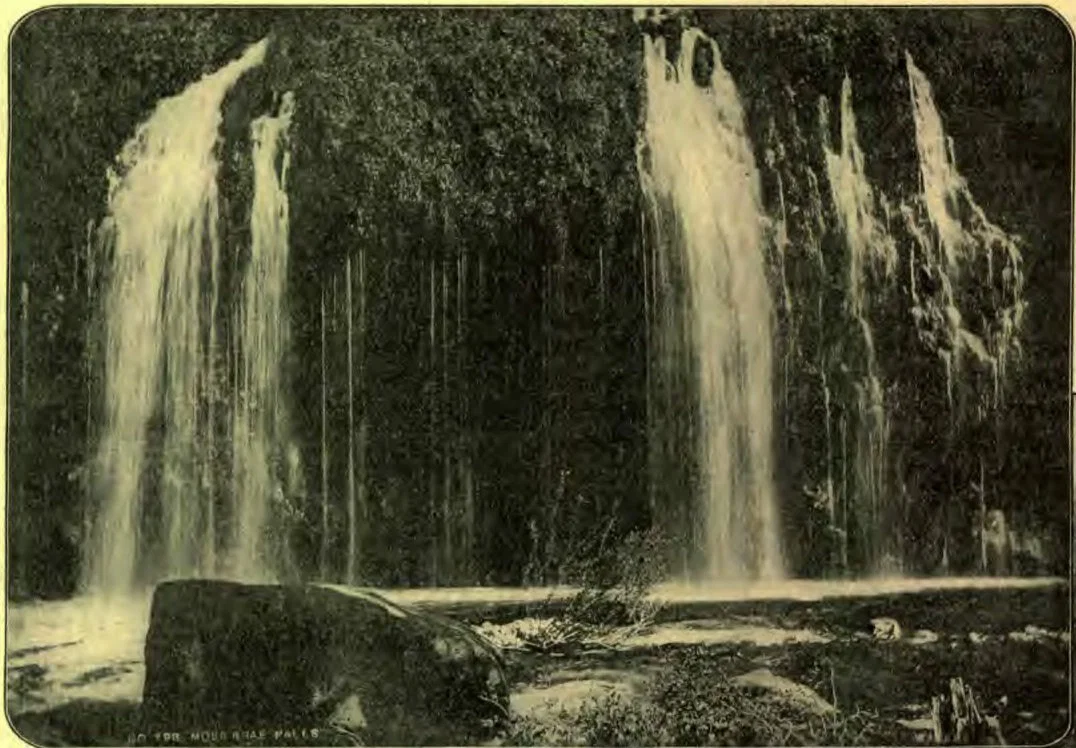
Only a few feet beyond these springs is one of the most lovely sights that the human eye often looks upon. The abundant springs bursting out of the ground produce a series of beautiful falls, known as the “Moss Brae Falls.” In some places there will be only a tiny opening in the heavy layer of moss, out of which the water escapes in tiny driblets; at others there are comparatively large openings in the moss, and a torrent of water bursts out, and is beaten into spray below.
SHASTA SPRINGS
SHASTA SPRINGS
As we view these remnants of the Edenic beauty that God has permitted to remain upon the earth, there is born in the heart a longing for that future home that is to be all beautiful. And in that home, when “the ransomed of the Lord shall return, and come to Zion with songs and everlasting joy upon their heads, they shall obtain joy and gladness, and sorrow and sighing shall flee away.” “And God shall wipe away all tears from their eyes; and there shall be no more death, neither sorrow, nor crying, neither shall there be any more pain: for the former things are passed away.” Would you have a part in this inheritance? Hear the promise: “He that overcometh shall inherit all things.”
DAVID PAULSON, M. D.

ON AN INDIAN POST CARD

THE Sunderbunds is the name of a large tract of land between the mouth of the Hugli and Ganges rivers, being really the delta of the Ganges. It is a low, swampy region, cut up by natural canals and lagoons, which, in many places, are overhung with vines and branches. The jungles are generally infested with tigers and wild beasts. Hunters and explorers have seen more or less of this region, though much of it is unknown.
They tell us that in this tract there are the ruins of a city, built in the days before British occupation, and, in fact, prior to the times of which native writers have preserved the history. One British official made his way to it, and found tigers and serpents among its marble columns and jungle overgrowth. It is supposed to have perished in some flood.
The story of the lost city was revived the other day when heavy rains flooded many streets of Calcutta, and covered surrounding villages with water to a depth of five or six feet. One authority says that if the moon had been in the phase that brings high tide, Calcutta itself would have been under eight feet of water, and might have shared the fate of the lost city of the Sunderbunds.
W. A. SPICER.

Strength Used Tyrannously: A Shakespearean Reflection

Oh, it is excellent To have a giant's strength; but it is tyrannous To use it like a giant. —Shakespeare.

Taking Pains to Learn the Will of God

“We all take pains to learn good manners. We take pains to master our daily calling. We take pains to learn music, or to acquire the mere essentials of an ordinary education. Why, then, should we not take a hundredfold more pains in learning how to do the will of Him whose will shall be our work through the endless ages?”

IN MEEKNESS AND LOWLINESS OF HEART

God desires that meekness and gentleness, the distinguishing characteristics of Christ, shall be brought into the lives of his followers. The Saviour gives to all the invitation: “Come unto me, all ye that labor and are heavy laden, and I will give you rest. Take my yoke upon you, and learn of me; for I am meek and lowly in heart: and ye shall find rest unto your souls.”
In self-love, self-exaltation, and pride there is great weakness; but in humility there is strength. True dignity is not maintained when we think most of self, but when God is in all our thoughts, and when our hearts are all aglow with love for our Redeemer and for our fellow men. In pride and separation from God we are constantly seeking to exalt self, and we forget that lowliness of mind is power. Christ’s power lay, not in sharp words that would pierce the soul, but in his gentleness. This made him a conqueror of hearts. We are invited to learn of him who was meek and lowly in heart.
The life of Christ is to be our pattern. His life and work in the world are a sample of what our life and work should be. “I receive not honor of men,” he said. In his service we need not expect ease or worldly honor; for the Majesty of heaven did not receive these things. “He was despised and rejected of men.”
The light reflected from the cross of Calvary will humble every proud thought. Those who seek God with all the heart, and accept the great salvation offered them, will open the door of the heart to Jesus. They will cease to ascribe glory to themselves. They will not pride themselves on their acquirements, or take credit to themselves for their capabilities, but will regard all their talents as God’s gifts, to be used to his glory. Every intellectual ability they will regard as precious only as it can be used in the service of Christ. “If any man be in Christ,” the apostle says, “he is a new creature: old things are passed away; behold, all things are become new.” Everything in life or character that is unlike Christ is put away. An indwelling Christ purifies the soul from selfishness and iniquity. A new life enters the dry, sapless branch, and it becomes fruit-bearing. Love, joy, peace, long-suffering, gentleness, goodness, patience, faith, meekness, are revealed in the life.
True greatness never has a tendency to exalt self. Truly great men are invariably humble. Those who have stored their minds with useful knowledge, and who possess genuine attainments and refinement, will be the most willing to admit their own weakness. They are not self-confident nor boastful; but in view of the higher attainments to which they might rise, they seem to themselves to have only begun the ascent.
The enemy of God and man takes advantage of the weak points in the characters of men and women. If men are inclined to self-esteem and self-exaltation, he makes a special effort in that direction. If one is puffed up with vain conceit, Satan says: I will set my agents to work to surround that man with temptations. I will make him believe that he is of great consequence. I will work his ruin by extolling him and seconding all his efforts. Thus I will lead him to trust to himself, and walk in the sparks of the fire of his own kindling. For a time the world is stirred with an apparently deep interest in the man whom Satan is seeking to deceive and ruin; but when he has separated himself from God, and the object of the enemy is accomplished, the world no longer interests itself in him. It has led him into difficulties, but it does not lead him out again, and Satan rejoices in the ruin of his soul.
Salvation has been brought within the reach of man at an infinite cost. It is the free gift of God. Nothing can be added to it, nothing can be taken from it. It is complete, perfect. Christ does not say to any one of us, You are complete in yourself, in your own talents, your trusted endowments; but he does say, “Ye are complete in him.” “He that believeth on me hath everlasting life.” Not the possessions of a man determine his character, but the heart purity, the steadfast purpose. The character built with good and noble deeds is a monument that the angelic hosts respect,—the character which, when life has closed, lives in the memory, perpetuated by the good deeds done for others.
The true Christian will not think of himself more highly than he ought to think. He will not be ambitious for worldly honor and esteem. A learner in the school of Christ, he will be gentle, distrustful of self. His life will be characterized by a Christlike simplicity. Luxury, ease, and wealth have no attractions for him; for he looks to the one who for his sake became a man of sorrows and acquainted with grief, who was wounded for his transgressions, bruised for his iniquities, and by whose stripes he is healed. It is “the hidden man of the heart, in that which is not corruptible, even the ornament of a meek and quiet spirit, which is in the sight of God of great price.” The meek and quiet spirit will testify of itself in good works. This is that which distinguishes the people of God from worldlings. In their sympathy for others, their tenderness, their meekness and lowliness of heart, they reveal that they wear Christ’s yoke, and are recipients of the gift of the Holy Spirit.
Mrs. E. G. White.

HE STOOD THE TEST

The Blue Line street-car stopped at the corner, and an anxious-looking young woman put a small boy inside.
"Now, Robin," she said, as she hurried out to the platform again, "don't lose that note I gave you. Don't take it out of your pocket at all."
"No'm," said the little man, looking wistfully after his mother as the conductor pulled the strap, the driver unscrewed his brake, and the horses, shaking their bells, trotted off with the car.
"What's your name, bub?" asked a mischievous-looking young man sitting beside him.
"Robert Cullen Deems," he answered.
"Where are you going?"
"To my grandma's."
"Let me see that note in your pocket."
The look of innocent surprise in the round face ought to have shamed the baby's tormentor; but he only said again, "Let me see it."
"I tan't," said Robert Cullen Deems.
"See here, if you don't, I'll scare the horses, and make them run away."
The little boy cast an apprehensive look at the belled horses, but shook his head.
"Here, I'll give you this peach if you'll pull that note half way out of your pocket."
The boy did not reply, but some of the older people looked angry.
"I say, chum, I'll give you this whole bag of peaches if you will just show me the corner of your note," said the tempter. The child turned away, as if he did not wish to hear any more; but the young man opened the bag, and held it just where he could see and smell the luscious fruit.
A look of distress came into the sweet little face. I believe Bob was afraid to trust himself; for when a man left his seat on the other side to get off the car, the little boy slid quickly down, left the temptation behind, and climbed into the vacant place.
A pair of prettily gloved hands began almost unconsciously to clap; and then everybody clapped and applauded, until it might have alarmed Robin if a young lady sitting by had not slipped her arm around him, and said, with a sweet glow on her face: "Tell your mama that we all congratulate her upon having a little man strong enough to resist temptation, and wise enough to run away from it."
I doubt if that long, hard message ever reached Robin's mother; but no matter,—the note got to his grandmother without ever coming out of his pocket on the way.—Youth's Companion.

THE BRAIN AND THE NERVES

II

The spinal cord is the nerve substance of the brain prolonged into the spinal canal. It is about sixteen inches long. The gray matter this time is inside, and the white outside. It also has a right and a left half, and from these branch other divisions called “columns.”
The brain and spinal cord send out forty-three pairs of nerve-trunks — twelve from the brain, which supply the upper half of the body, and thirty-one pairs from the spinal cord, which supply the lower half of the body. The brain, spinal cord, and nerve-trunks together make the cerebro-spinal nervous system. The nerves of this system cross one another. Nerves from the right side of the body cross, and attach to the left side of the brain and spinal cord. When the right side of the body is paralyzed, the injury is on the left side of the brain.
A row of small ganglia, in pairs, on each side of the vertebral column, are joined to one another and to the cerebro-spinal system. These ganglia and nerves are called the “sympathetic nervous system.” The stomach, intestines, liver, and blood-vessels are closely united in sympathy by these nerves, of which there are thirty pairs. The control and harmony of the entire body are due to the action of the brain and the nerves.
Nerve-trunks have two kinds of fibers: one carries impressions inwardly to the brain and spinal cord; the other conveys impressions outwardly to the muscles or other organs. So we have the two kinds of fibers — sensory and motor.
Sensory nerves control hearing, seeing, smelling, tasting, and feeling; also sensations of hunger, thirst, heat, cold, etc. There are two kinds of sensation, internal and external; and for each of these there is, in the brain, a group of cells, or ganglia, having charge of that particular sensation. These nerves end in the tissues.
Motor nerves differ in their work. Some sets control the heart; some the stomach; others the muscular contraction of the walls of the blood-vessels, causing the paling or flushing of the face, etc. These motor nerves end in the muscles. Coughing and sneezing are governed by the vasomotor nerves.
The brain is really a receptacle for cells that receive and send out messages to the entire body. These cells have power to store up energy to use as thought or action, when required by proper stimulus.
Nerve-force travels one hundred feet a second. Sensation gives rise to motion. To illustrate, you have all noticed, when burning your finger, how quickly and involuntarily it is withdrawn from the flame. This is the result of reflex action. Many movements of the body are reflex. Walking is at first voluntary, but afterward it becomes reflex. The chief function of the spinal cord is reflex action. It has power, separate from the brain, to send out impulses to the muscles, which are received through the sensory nerves.
The brain needs exercise. Reasonable study of such subjects as will bring vigor to the mind, and develop beautiful and pure ideas, is most essential. God’s word is the best study we can pursue; but all other studies that are in harmony with its teaching will be of service. Worry destroys the vitality of the brain-cells. Violent excitement or sensational reading is injurious. Sleep and muscular exercise are beneficial. If the general health is impaired, nerve tone is lowered, and nervous energy is lessened. This weakens mental capacity, and is generally followed by weak moral power. Physical health lies at the basis of our usefulness here, and, to a great degree, of our future as well. The most necessary foods for the nervous system are phosphates. These are found in whole wheat, peas, beans, and eggs. Prunes also are said to be thus nourishing.
Overeating clogs the brain, because of the close connection of the brain with the stomach nerves. There should be, however, a good supply of healthful, nourishing food. Alcohol is especially irritating to the nervous tissue. It weakens will power, reason, and judgment, and the higher faculties lose control of the lower. The brain-cells and fibers are held together by connective tissue, and, by overstimulation, this grows abnormally in the drunkard, until it falls over the cells and nerve-centers, depressing and paralyzing them. Tobacco and cigarettes also paralyze the nerve-cells; for this reason young men using this foul poison are not in possession of their full intellectual powers. Will not our girls use their influence against such a terrible bondage for their brothers and friends? Opium has a fearful result on the nervous system. Self-respect and self-control are soon gone, and lying becomes a habit. Tea and coffee are mild poisons, whose habitual use produces partial paralysis of the brain-cells. Drinkers of coffee and tea often resort to chloral or opium to relieve nervousness, and thus one sin leads to another.
To sum up these evils: Alcohol weakens the will; tobacco makes one selfish and filthy; opium makes one untruthful and unreliable, and kills moral sense; and the use of tea and coffee leads to a craving for stronger stimulants.
MRS. M. D. Mc KEE.
(Concluded next week)

MY HEIRSHIP

LITTLE store of wealth have I; Not a rod of land I own; Not a mansion far and high, Built with towers of fretted stone.
Stocks nor bonds nor title deeds, Flocks nor herds, have I to show; When I ride, no Arab steeds Toss for me their manes of snow.
I have neither pearls nor gold, Massive plate, nor jewels rare, Broidered silks of worth untold, Nor rich robes a queen might wear;
Yet to an immense estate Am I heir by grace of God — Richer, grander, than doth wait Any earthly monarch’s nod.
Heir of all the ages I — Heir of all that they have wrought; All their store of emprise high; All their wealth of precious thought;
Heir of all that they have earned By their passions and their tears; Heir of all that they have learned Through the weary, toiling years!
Heir of all the faith sublime, On whose wings they soared to heaven; Heir of every hope that time To earth’s fainting sons has given!
Aspirations pure and high, Strength to do and to endure,— Heir of all the ages I,— Lo, I am no longer poor!
— Julia C. R. Dorr.

A PARABLE FROM THE WEEDS

AUTUMN’S lessons are not all sad ones. He who looks deep enough sees in the changes that take place at that season the great power of God providing for the next summer’s growth.
True, the herbs and weeds are withering and drying in the autumnal sun and frosts; their shriveled skeletons rustle and tremble, showing to all that summer is over. Even the careless realize that the great pulse of nature’s life is throbbing more slowly and feebly.
But with the passing of the flowers and the fading of the leaves, before the stalks began to shrivel, each plant perfected its fruit, and sowed an abundance of seed for the next year’s growth.
Everywhere these seeds are scattered. They are so abundant that thousands will be eaten by birds, squirrels, and other small animals; but though many seeds will perish in this manner, an abundance will still be left. Tucked away in snug corners, they will sleep until the spring sunshine calls them forth, under the quickening influence of life.
Though the herbs and weeds are now whitening in the sun, and rustling in the autumn winds, they did not fail until, in them, God’s great purpose had been wrought. They are dead; but before their death, life’s work was completed,—they had run their appointed course, they had fulfilled their labors.
Oh, that we may do as well! What more can any one do than that,—to accomplish the end for which he was created? To fulfill the purpose for which God placed you in the earth, is to do all that you can possibly do. To do this will mean that you have so faithfully fulfilled your tasks that God is satisfied. The weeds do that much,—they fulfill the purpose for which they were placed here,—but man! how far short he comes of the plans and purposes of his Creator! And there are some who maintain that this is the best he can do. They claim that the Bible ideas of holiness and purity are ideals too high for sinful man to reach.
Indeed, of himself, man could never attain to such heights; but God can bring man up into the higher altitudes of living. Man has but to yield to the purpose of God, in order that it be fulfilled in him.
It is thus that even the weeds reach their appointed place and do their allotted work,—they yield to the will and power of God. It is God who works in them. But to man is given that higher privilege of working out what God works in. Here thousands fail. Men will not yield. They wish to use the power themselves. They are determined to think out and plan out their own lives, regardless of the counsel and co-operation of their Maker. The fact that there will be plants the coming summer depends very largely on the work that the plants have accomplished this year. They have now perfected their fruit, and sowed their crop of seed. We, too, have fruit to perfect and seed to sow; and what is to be in coming days depends largely on what we do now.
Unless Christ has been perfected in us, unless we possess him, the last dread hour of death will be all dark; there will be no light, no hope beyond. “He that hath the Son hath life; and he that hath not the Son of God hath not life.” When that life is ushered in, there will be no more a life’s winter; no more dying and lying down in the grave; never again a resting-place beneath the sod.
I suppose, too, that when that glad time comes, winter will cease to reign upon this earth of ours. Not only is the earth to be made new, but everything in connection with it is to be changed; for the promise is, “Behold, I make all things new.”
There will be no autumnal fading of the leaves, no perishing of the plants and flowers, and no such things as weeds. Everywhere and always the earth will blossom as the rose. Oh, the glory and beauty of the earth made new! Oh, the blessedness of those who shall forever dwell there!
L. A. REED.

Sometime: God's Plans Will Be Understood

Sometime

Sometime, when all life's lessons have been learned, And sun and stars forevermore have set, The things which our weak judgment here have spurned, The things o'er which we grieved with lashes wet, Will flash before us out of life's dark night, As stars shine more in deeper tints of blue; And we shall see how all God's plans were right, And how what seemed reproof was love most true.
And we shall see how, while we frown and sigh, God's plans go on as best for you and me; How, when we called, he heeded not our cry, Because his wisdom to the end could see. And even as prudent parents disallow Too much of sweet to craving babyhood, So God, perhaps, is keeping from us now Life's sweetest things, because it seemeth good.
And if sometimes, commingled with life's wine, We find the wormwood, and rebel and shrink, Be sure a wiser hand than yours or mine Pours out this portion for our lips to drink. And if some friend we love is lying low, Where human kisses can not reach his face, Oh, do not blame the loving Father so, But wear your sorrow with obedient grace.
And you shall shortly know that lengthened breath Is not the sweetest gift God sends his friend, And that, sometimes, the sable pall of death Conceals the fairest boon his love can send. If we could push ajar the gates of life, And stand within, and all God's working see, We could interpret all this doubt and strife, And for each mystery could find a key!
But not to-day. Then be content, poor heart! God's plans, like lilies pure and white, unfold; We must not tear the close-shut leaves apart, Time will reveal the calyxes of gold. And if, through patient toil, we reach the land Where tired feet, with sandals loose, may rest, When we shall clearly know and understand, I think that we shall say, “God knew the best!” — Selected.

Notes and Comments

“Be Concise, Young Man.”—The following good advice was given to a young writer who submitted to an editor a one-column article, the gist of which could have been better told in ten lines: “Young man, when a man discovers his house is ablaze, he doesn’t go to the window, and tell the passers-by that ‘half an hour ago what threatened to be a terrible conflagration broke out in the upper story of the palatial mansion occupied by Mr. Jeremiah Dickens.’ He simply rushes to the front, and shouts, ‘Fire!’ Be concise, young man.”
A Balloon Voyage by Night.—M. Jaques Faure, a member of the Aero Club of Paris, France, recently crossed by balloon from the Crystal Palace, London, to France. Starting at six o’clock in the evening, he arrived safely at Alette, near Boulogne, France, at ten minutes to eleven, the journey having occupied four hours and fifty minutes. The entire distance was traveled at a height of two thousand feet. It appears that “this is by no means an exceptional performance, since Mr. Percival Spencer, the well-known aeronaut of London, has crossed from the Crystal Palace to France on several occasions, with varied success; but the trip has never before been attempted by night. The advantage of the night journey is that the air, being condensed, does not rarefy the gas in the balloon, as is the case when the sun’s rays are directed upon the vessel during the day. So long as the temperature of the atmosphere remains at a certain point, the balloon will maintain its equilibrium at a regular altitude.”
Europe’s Ignorance of American Affairs.—Europeans know comparatively little about America, while, through Stoddard’s lectures and otherwise, Americans know a great deal about Europe. As an illustration, it is related that an English gentleman, being shown Bunker Hill Monument, and told, “Here Warren fell,” looked up at the monument, and asked, “How far did he fall?” Says Geo. T. Angell: “A friend tells us that he has met several educated young Englishmen, who, while they could tell him all about the war in the Crimea, not only had never heard of the battle of Gettysburg, but did not even know that we had ever had any war between our Northern and Southern States.” This is generally true of even the educated classes on the European continent. For instance, the writer remembers that when, as a boy, he was attending the public schools of Bienne, Switzerland, he was obliged to learn not only the number of inhabitants in each Swiss canton, but the number of persons living in each town and village, the number of churches in each, etc., etc., while very little mention was made of the great continent of America. In fact, had you asked the average schoolboy of the place how much larger was the United States than Switzerland, he would not have hesitated to tell you that his own land was the larger of the two. A. J. Bourdeau.

THE WAY TO THE PROOFROOM

For the benefit of the boy who would be a proofreader, there are a number of things to be said. First and foremost, he should start in early with the intention of making a practical printer of himself, acquiring all there is to acquire along the line of typesetting, making-up, stone work, etc. There is nothing more necessary than this in a proofreader’s career. True, there are very many in the profession who know nothing about the “case;” but they are not as successful proofreaders as they might be, and they are constantly “on the go” from one office to another. Though they may not confess it, they find themselves lacking in essentials. Therefore, boys, seize every opportunity to make yourselves proficient printers before you attempt to read a line of proof. A practical, hard-working printer, who begins at the beginning as a printer’s boy, and learns the trade thoroughly, lays the foundation for excellent work as a proofreader.
Scores of boys attempt to learn the printing business simply because they can find nothing else to do; and it is generally easy to obtain a transient job in a printing house, to discharge the ordinary duties that are the first steps in the trade. But the boys who go into the work with the intention of learning the gradual steps rapidly but carefully are the boys who make the best printers, and eventually the best proofreaders.
In the first place, the would-be printer and proofreader, the boy who intends to make a business of this work, should try to connect himself with an office that has a painstaking, thorough-going foreman, who has a great deal of sympathy and humanity in his make-up. Under such a man’s tutorship he will learn more than he ever could under a man of high-handed tyrannical methods. Of course it is understood nowadays that the boy printer should have a good grammar-school education before he attempts to go into a composing room; then he is ready for almost anything that may be required of him.
They say that the way to the proofroom is a way of thorns and briers. It is. So is the royal road to every success and every well-won profession. There is nothing equal to memory-training in any business; and if a boy has it in mind to become a successful proofreader, he will make it one of the highest aims of his life not to forget. He will keep his memory bright and shining under all circumstances, remembering where he left off in his duties the day before, and trying not to ask the same questions of printer or foreman a second time. Thus in a few months’ time a bright boy ought to find himself thorough master of the case, as well as of all the minor details of the work, such as taking galley proofs, distributing type, etc.
Outside the office there is much to learn, too. With the proofroom still in view, the boy should keep himself as nicely informed as possible with regard to the leading questions of the day, the world over. If he does not read the better class of newspapers carefully, he is not up-to-date. He must also have a taste for the best literature, so that, as he progresses, he may become familiar with the works of all the leading authors, old and new. He should obtain and study some standard work on punctuation, such as “Wilson’s Treatise on Punctuation,” and should also make a thorough study of synonyms, and their finer shades of meaning. Let him always bear in mind that the accurate proofreader is a “man of parts,” a man of knowledge of an exact and universal kind, in many different lines. The more information the serious, earnest boy acquires, the more valuable will he become to the great printing firms, that are continually on the lookout for just that sort of readers.
The proofreading profession is by no means overcrowded. Let the boy printer be satisfied with low wages when he begins. Later on, when he has thoroughly tested his powers, and finds himself ready to step into the proofroom, he will learn that good proofreaders command salaries ranging from fifteen to sixty dollars a week. Then he will find, too, that his habits of accuracy and attention will avail him profitably for life. FRANK WALCOTT HUTT.
Continue reading: SUCCESS GAINED THROUGH ADVERSITY