IN these busy days that seem to come and go with ever-increasing rapidity, and which we treat as if they were opportunities for the indulgence of carnal appetites merely, you hear men talk about “killing time.” O, better kill anything than time; better waste anything than the moments lit as yet with the light of hope; better fritter away any wealth that happens to be in your possession than these days overflowing with the grace and tenderness of God; for every day is an opportunity to choose, and each choice is the building of another stone into the foundation work, on which eternity will erect the structure,—a structure true to the character of the foundation laid.—Christian Endeavor World.
Be at War With Your Vices
By Benjamin Franklin
Be at war with your vices, at peace with your neighbors, and let every new year find you a better man.—Benjamin Franklin.
The Little Lad’s Answer
Our little lad came in one day
With dusty shoes and tired feet;
His play-time had been hard and long
Out in the summer’s noontide heat.
“I’m glad I’m home!” he cried, and hung
His torn straw hat up in the hall,
While in a corner by the door
He put away his bat and ball.
“I wonder why,” his auntie said,
“This little lad comes always here,
When there are many other homes
As nice as this, and quite as near.”
He stood a moment deep in thought;
Then, with the love-light in his eye,
He pointed where his mother sat,
And said, “She lives here; that is why!”
With beaming face the mother heard;
Her mother-heart was very glad.
A true, sweet answer he had given,
That thoughtful, loving, little lad;
And well I know that hosts of lads
Are just as loving, true, and dear;
And they would answer, as did he:
“’Tis home, for mother’s living here.”
— Selected.
The Boy Who Went to Sewing School
By Hattie M. Lummis
THE sewing school met one afternoon each week. There were twenty teachers, and each of them had as many pupils as she could look after. The little girls made patchwork, sewing the tiny squares together into quilts to cover their dolls on cold nights. The other girls made buttonholes and did hemstitching. There was even a class in embroidery.
Of course there were no boys in this sewing school, at least, not until the particular afternoon of which I am going to tell. The school had met, as usual, at three o’clock, and after the girls had sung together, they broke up into classes and went to work. The sound of their voices filled the room with a busy hum.
Presently the door was pushed open, and a boy came in, and sat down on a chair nearest the door. He was a small boy, with a freckled face and honest eyes. His hair was very damp and very smooth on top, but at the back of his head it was rough and dry, as if, being out of sight, it was also out of mind. His feet were bare, and he seemed to be trying to tuck them under his chair. Altogether, he did not look comfortable.
Miss Adkins, who was in charge of the sewing school, went up to him with a pleasant smile. “Is there anything I can do for you, my boy?” she asked.
“Yes’m,” said the boy, in a rather muffled voice. “I’ve come to belong.”
Miss Adkins was so surprised that for a moment she could not think of anything to reply. “You know this is a sewing school?” she asked, doubtfully, at last.
“Yes’m. That’s why I come,” said the boy, speaking more firmly. “I want to learn to sew.”
“Very well. Come up front, please. And what is your name?”
“John Baker.”
Miss Adkins and John Baker advanced to the front of the room amid a chorus of soft giggles. The little girls held their patchwork up before their faces, so that they could laugh behind the squares. The shoulders of the older ones were shaking till there was danger that the buttonholes would be spoiled.
“Shall I get you some patchwork to begin with?” asked Miss Adkins, placing a chair beside the organ, where John would be partly hidden from sight.
“No’m, please,” said John Baker, speaking out in a clear, decided voice. “I guess I hain’t no time for patchwork ’n’ that kind. I want to learn to make things to wear.” The giggling stopped.
“Something to wear?” repeated Miss Adkins, greatly puzzled.
John Baker drew nearer. “You see,” he explained, “there’s a woman lives down next to us, ’n’ she’s got the teentiest baby you ever seed. It cries a good deal, too, ’n’ my mother says ’tain’t no wonder, the way they just roll it up in an old shawl. She says babies want things of their own, just the same as if they was big. But the baby’s mother, she’s sick, so she can’t sew, ’n’ my mother goes out washing every day, so she hain’t no time. So I thought I’d come here, ’n’ make it some clothes myself. Sewing hain’t much but putting the needle back ’n’ forth, is it?” asked John, anxiously. “Seems as if anybody could do that.”
When John Baker had reached the end of this long speech, he suddenly grew very red. Everybody in the room was looking straight at him. Everybody was listening. He turned his head this way and that, as if he were looking for some place in which he could hide.
Then a voice spoke—such a sweet, pleasant voice that John forgot all about his uncomfortable feelings and began to listen. “O Miss Adkins!”
“Well, Eva?” said Miss Adkins, smiling.
“I’d like to help about those baby things, too,” cried Eva. “I think it would be lots of fun. And my mama has some flannel that would be just right for a little blanket, and I know she’ll let us have it.”
“I think I could crochet some baby socks,” said another of the older girls, in the same pleased, eager way. “My aunt will help me.”
Then all at once everybody in the room was talking and making suggestions. The teachers remembered pieces of cambric and flannel at home that would be just the thing for a baby’s wardrobe. The little girls clamored to know if they couldn’t sew all their patchwork squares together to make a quilt for the baby. Everybody looked pleased and happy, and was eager to go to work without delay.
They did not quiet down until the messengers Miss Adkins had sent for patterns and materials returned. Then how they worked! What interested faces bent over the long seams! With what care they set the stitches in the hems, so that every one should be just the right size, and all should point in the same direction! There was very little talking; but it was a comfortable, happy sort of stillness that brooded over the big room. John Baker sat in the chair by the organ, and took big, uneven stitches, thinking that sewing was much harder work than he had supposed, and feeling very glad that he had found such willing helpers.
When it had grown so dark they could not see to work longer, several of the older girls took home little garments, promising to bring them back finished the next week. Busy mothers and kind older sisters found quite a little time for helping, and in that way the baby’s outfit was ready in a surprisingly short time. John Baker reported later that the baby was not crying nearly so much as before. And indeed it seems very probable that a baby can realize the difference between a ragged shawl that has been the property of half a dozen people, and soft little garments made for its special use, with kindness and care put into every stitch.
This is the way John Baker began to attend166the sewing school; and they found him such a valuable member that they would have been distressed at the thought of losing him, while it would have taken a great deal to persuade John to stay away. It was he who told them of old Grandma Dillingham, who had been sick so long with rheumatism, and of the ragged covering on her bed; and then the sewing school set to work, and made a patchwork quilt for Grandma Dillingham out of the brightest pieces of gingham and calico to be found anywhere. That patchwork quilt was about the only bright thing in Grandma Dillingham’s life. She never grew tired of gazing at the pretty squares of pink and blue and red set around the white centers. As long as she lived, it kept her weary old heart warm, as well as her body.
It was John, too, who reported the case of the O’Donovan family, whose home had been burned in the middle of the night, and who had barely escaped with their lives. There were seven little O’Donovans, and it took some weeks before the sewing school had supplied their wants. As John’s mother went from house to house washing, she heard many cases of need, which John remembered and reported at the next meeting. And the more such work he brought, the larger the sewing school grew, and the more interested the girls became.
“Do you have boys in your sewing school?” said a visitor to Miss Adkins one afternoon, looking with great curiosity at John, who was working away at a pillow-slip for sick Billy Larson.
“Only one boy; but we couldn’t spare him. I wish,” added Miss Adkins, laughing a little, “that there was a John Baker in every sewing school.”
She dropped her voice as she spoke, but there was no danger of John’s overhearing her. He was too absorbed in the effort of taking short stitches in his seam. And if he had heard, he would not have understood. John knew very well how much the sewing school had done for a certain boy and the people in whom he was interested, but he had no idea that the boy had also been a blessing to the sewing school.—Hattie M. Lummis, in Children’s Visitor.
Sweet Echoes Repeat Kind Words
EVERYTHING that one does in life has a reaction, an echo, which either applauds or condemns the deed, and is ever afterward a perpetual reminder of nobility or baseness. Wherever you are, you will hear echoes of the good that you have done. Whether pleasant or disagreeable, they will be continually coming back to you in memory-waves, and will tend to make you happy or miserable.
If you have said a kind word that helped lift a life out of an uncongenial environment; if you have aroused the embers of an ambition that have been slumbering for years, and which would have gone out in darkness but for your fanning them into living flame, then will this sweet echo speak to you. “Scatter your flowers as you go, for you will never pass over the same road again.”
If, on the contrary, you kept for the dead the flowers which you should have given to the living, spared the kindly word of praise and admiration, or the expressions of love, until the ears which they would have gladdened were deaf in death, then will obnoxious echoes of condemnation haunt you. Tears and flowers at a funeral do not atone for wasted opportunities to scatter brightness or show love.
Every thought or deed sends back an echo like itself. If we have been helpful and generous, sympathetic and kind, always considerate, we shall hear echoes that will uplift, encourage, and satisfy. If we have been mean and contemptible, vicious, narrow, indolent, we shall hear echoes repeat the voices which gave them birth.—Success.
Weaving with a Needle
By J. Edgar Ross
HORSEHAIR may be woven with warp and woof, or with a needle threaded with a single strand, or thread, of hair. The former produces by far the more beautiful results; and where a large amount of the work is to be done, it is less troublesome, and can be carried on much more rapidly, than with a needle. But where only a small piece is to be covered with woven work, as, for example, the places where the braids in our watch-guard are joined, it will not be practical to weave with warp and woof, as there is too much preliminary work on each piece before the actual weaving begins. Weaving with a needle, on the contrary, requires no preliminary work to speak of, and it is in this way that unsightly ends of braids are generally covered.
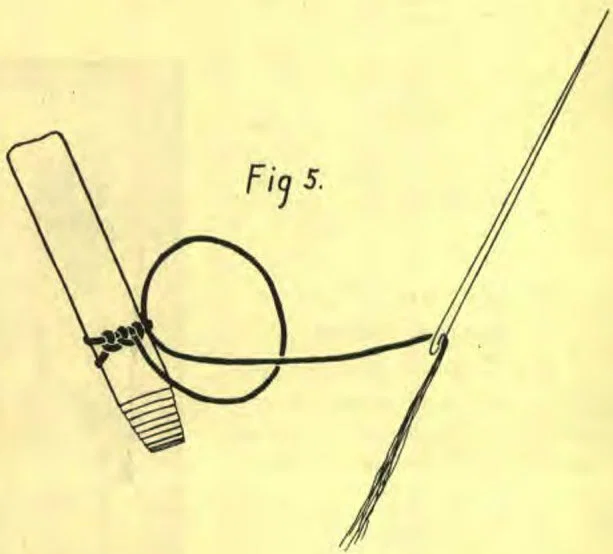
The thread used on such small work as the watch-guard should contain from eight to ten hairs. The larger end of the hair will be found much stronger than the tips; and as there is a good deal of wear at the point where the thread passes through the needle, it is best to thread it at that end. Cut the knot from the end of the thread, and pass it through the eye of a needle large enough to receive it without crowding. Do not draw it through too far, as the end, having no knot to prevent it, will soon untwist. Now with this horsehair-thread take two or three stitches through the braid at one end of the part to be covered. This will keep the thread from pulling through after the other knot is cut off, as it should be as soon as one circle of stitches has been woven around the work. Next wind the thread twice around the work, pass the needle under the ring so formed, and bring it up over the thread so as to form a loop, as shown in Fig. 5. This is similar to a buttonhole stitch, and will not be found at all difficult.
Fig 5.
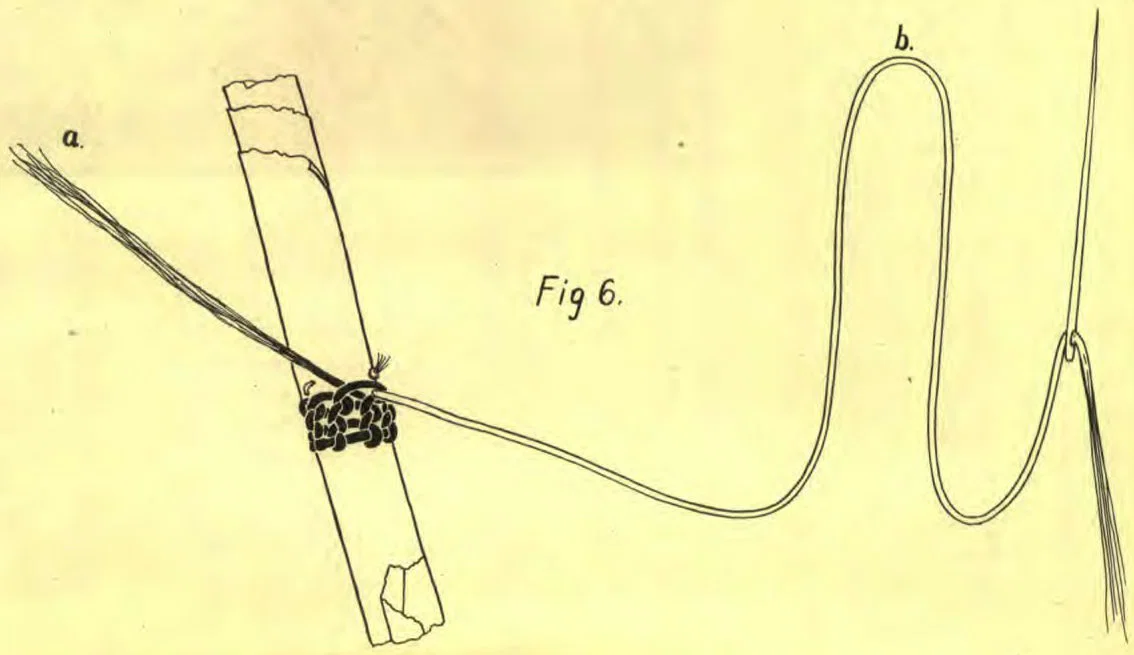
Continue to make these loops all around the work, always drawing the thread taut, so the loops will lie close together. When you have worked entirely around the braids, so that the circle of loops is complete, pass the needle through the first loop formed, and thus begin a new circle. You will now have an endless chain, and you can continue to work around and around till the work is finished, or the thread exhausted. In the latter case, when you come to the last stitch that the thread will take, do not complete the loop, but leave it as shown in a of Fig. 6, except that it should be stitched several times through the braid to prevent it from pulling out. Next place another thread in the needle, and complete the loop, as shown in b of Fig. 6. You can then continue the weaving as before.
When the ends and stitching have all been covered, it will only be necessary to sew the thread several times through the woven part, always being careful to conceal the stitches, and then cut off the remaining end. Horsehair is more or less elastic; and if the thread is drawn taut before it is cut, its elasticity will draw the severed ends back into the work, where they will not show.
Fig 6.
In the illustration of the watch-guard published last week, you will remember there was a ring of this woven work uniting the two braids in the middle of the guard. This ring is intended to slide up and down; so of course the thread of which it is made must not be permanently fastened to the braids. Instead of this it is simply wrapped twice around the braids for a foundation upon which to begin the weaving; and after the work is finished, the projecting end is cut off.
This guard is intended to be worn around the neck, and it may be attached to the watch with a snap, such as those used on watch-chains, or the ring of the watch may be sprung from its place, slipped into the loop, and then sprung into position again.
J. EDGAR ROSS.
Hurry and Speed
By Amos R. Wells
WHILE Speed is filling the bottle,
Hurry is spilling the ink;
While Speed is solving the problem,
Hurry’s beginning to think;
While Speed is hitting the bull’s-eye,
Hurry is stringing his bow;
While Hurry is marching his army,
Speed is worsting his foe.
Hurry is quick at beginning,
Speed is quick at the end;
Hurry wins many a slave,
But Speed wins many a friend.
— Amos R. Wells.
THE INTERMEDIATE LESSON
IX — The Creation of Man
(May 31)
“AND God said, Let us make man in our image, after our likeness; and let them have dominion over the fish of the sea, and over the fowl of the air, and over the cattle, and over all the earth, and over every creeping thing that creepeth upon the earth. So God created man in his own image, in the image of God created he him; male and female created he them. And God blessed them, and God said unto them, Be fruitful, and multiply, and replenish the earth, and subdue it. . . . And God said, Behold, I have given you every herb bearing seed, which is upon the face of all the earth, and every tree, in the which is the fruit of a tree yielding seed; to you it shall be for meat. And to every beast of the earth, and to every fowl of the air, and to everything that creepeth upon the earth, wherein there is life, I have given every green herb for meat: and it was so.” Gen. 1: 26-30.
“And [God] blessed them, and called their name Adam, in the day when they were created.” Gen. 5: 2.
“And the Lord God formed man of the dust of the ground, and breathed into his nostrils the breath of life; and man became a living soul.” Gen. 2: 7.
“The breath of the Almighty hath given me life.” Job 33: 4.
“Thou takest away their breath, they die, and return to their dust.” Ps. 104: 29.
Adam was the Son of God, made in the image of God, to be his dwelling-place. God did not make man’s body to be a house for the man; but he made the man to be a house for his own Holy Spirit, that through man he himself might rule the earth with the gentle sway of love.
God himself gave a name to the first man. And not to the first man only, for he created him male and female, and called their name Adam. This, then, is the family name that God has given to man. It means “earth,” and is to keep ever in our minds that we are only dust, with no more power in ourselves than the dust of the ground under our feet. The only thing that makes us any different from it is the Spirit of God, which knits our bodies together, and keeps us from crumbling into dust.
God breathed into Adam’s nostrils his own breath; so we see that the air is “the breath of the Almighty,” and his Spirit is in it to give us life. For what God did for the first man, he has done for every child of Adam.
Think of this as you draw in the life-giving breath—that the great God, your Creator and Father, is still breathing into your nostrils the breath of life, and that if he should stop doing this for a moment you would die. Strange and wonderful as it may seem to us that these bodies of ours are really formed from the little particles of the dust of the ground, this is very clearly seen when the breath of life is taken away; for they soon fall back into the dust out of which they were taken. How easily, then, we can see that we have no life of our own; but that in the breath that gives us life we are receiving life from the Fountain of life.
The blessing that God put upon all his other creatures, he put also upon man. He made him in his own image, male and female, and said, “Be fruitful, and multiply, and replenish the earth.” Every little child that has ever come into the world has been born by the power of this word of God. By it God’s wonderful work of creation is still being carried on, and the earth filled with human beings bearing his likeness.
Besides the breath that we receive from God moment by moment, we need also food to nourish and build up our bodies. This, too, reminds us that we are dust; for since God made man from the dust of the ground, it is thence that all our food must come. But God works through the plants and trees, taking up the dust of the ground, changing it into beautiful forms, putting sweet flavors into it, and lovely colors upon it, making it “pleasant to the sight, and good for food;” and he gives it to us in the form of fruits, grains, and nuts.
God told man what was to be his food—everything bearing seed; while animals might eat every green herb. It was not his plan that any of his creatures should feed upon one another, but all were to get their food from the vegetable kingdom.
You eat the food that God gives you every day, but do you ever think what a wonderful thing it is that this food should be changed into muscle, nerve, bone, brain, skin, and hair? It is the creative power of the word of God that does this work, taking the dust of the ground, and making man in God’s image. For he has said of these fruits of the ground, “To you it shall be for meat.”
Think of this every day when you eat the food he gives you, and trust in his power to create you in his likeness, not in outward form alone, but in the image of his purity and holiness.
Questions
What was the last thing that God created?
How did God say that man should be made?
Whose son was Adam?
Of what was he made?
How did God give him life?
Where did God breathe the breath of life?
What was the breath that God breathed into man’s nostrils?
Then what is the air?
By what name did God call man? What is the meaning of his name?
What dominion did he give to them?
What was given to man for his food?
What did God say about the fruits of the ground that man might eat?
Why is the food that we eat changed into flesh and blood to make our bodies?
What was to be food for the beasts?
Was any creature given permission to eat another?
How are all things kept alive?
What would take place if God should take away his Spirit and breath?
Of what are we still being formed? how?
What does God do for every child that comes into the world?
What was it that made man in God’s image? What is the word able to do for us to-day?
IX — The Law of God in the Ark and in the Heart
(May 31)
MEMORY VERSE: “For this is the covenant that I will make with the house of Israel after those days, saith the Lord; I will put my laws into their mind, and write them in their hearts: and I will be to them a God, and they shall be to me a people.” Heb. 8:10.
Synopsis
The tabernacle was built for the indwelling glory of God. Ex. 29:43. When it was reared up, a cloud of glory filled it (Ex. 40:34); fire descended from heaven upon the altar of sacrifice (Lev. 9:24), another manifestation of God’s glory (verse 6); and in fact the whole place was so full of it that at first Moses could not enter in (Ex. 40:35), and God spoke with him from the door of the tabernacle. Lev. 1:1. All this was a visible manifestation of the One who went before Israel in a cloud by day, and a fire by night (Ex. 13:21); but his glory then was not so great as that of his latter house, in which he revealed himself in person. Haggai 2:9. “In the presence of Christ, and in this only, did the second temple exceed the first in glory.” Some beheld it, the glory as of the only begotten of the Father. John 1:14.
The services of the first tabernacle were a promise and prophecy of the ministry of Christ. They were only a figure, for the time then present, of that greater service ministered by him in a greater and more perfect tabernacle,—that is to say, one not made with hands. Heb. 9:11. The tabernacle was the home of the ark (2 Sam. 7:2), and the ark was the receptacle for the law of God, the ten commandments. Deut. 10:3–6. It was regarded as the center of God’s power and glory (1 Sam. 4:22), and all the services of the tabernacle had to do with the law which it contained; for all the sacrifices and offerings were offered for sin (Heb. 5:1), and “sin is the transgression of the law.” 1 John 3:4. These services, then, were a figure of that mediatorial work of Christ through which the law is to be written in the heart of man. Heb. 8:6, 10. This was accomplished by his coming to earth, and taking the body prepared for him (Heb. 10:5), in which he performed the will of God, and in the heart of which was written God’s law. Ps. 40:8. In Christ this law became the power of eternal life. Heb. 7:16.
God raised up a nation to live and teach this law to the world (Ps. 105:44, 45), and unto them first was sent his Son Jesus to bless them in turning them away from sin. Acts 3:25. To them were committed in a special manner the truths of the gospel (Rom. 9:4), and their whole experience was a preparation for the coming Messiah and his work as a Mediator. All the prophets taught this truth, and it was wrought out in their history. Acts 3:24.
When the people hearkened to God’s commandments, they were to be the head of all nations (Deut. 28:13); but upon their refusal to observe the words of his law, came national adversity. Vs. 58, 59. And even in the men whom God raised up to deliver his people when they turned to him, he was testifying to them and to the world of the salvation through the great Deliverer, who was to reveal himself in humanity. Deut. 18:15.
Questions
For what purpose was the tabernacle declared to be built?
How was this glory manifested when it was reared?
Whose glory was it?
When did he manifest greater glory than this, and in what way?
What prophecy shows this?
What did man behold in him?
Of what were the services of the tabernacle a figure?
Of what greater tabernacle was Christ a minister?
In what place in the first tabernacle did God put a special manifestation of his glory? Lev. 16:1. How was the ark regarded?
To what did all the offerings and sacrifices pertain? What scriptures show this?
By what special ministry of Christ’s is the law to be inscribed in the heart as it was in the ark?
How has he already accomplished this?
What, then, does the law become when thus written in the heart?
What mission did God give to the nation Israel?
For what purpose was Jesus sent to them first? Who prophesied of this?
When the people hearkened to God’s law, what was the result?
What was the result of disobedience?
What testimony was borne by the men whom God raised up to deliver Israel?
Shorthand by Mail
YOUR spare time can be well improved by studying shorthand, and this may be done at small expense to you by taking a mail course at your home. We are using “The Rogers Compendium of the Graham System of Shorthand,” a method arranged especially for home study, and giving an epitome of a system of shorthand acknowledged to be the best, the briefest, and the most complete. The only presentation of Standard Phonography in which all shorthand outlines are written as first learned, thus greatly abbreviating the work on the part of the student. A complete course in thirty lessons, illustrated by facsimile notes, with key. The correction of all students’ papers given special attention by experts. Reasonable tuition rates. If interested, write for full particulars. Practicing stenographers wishing to prepare for rapid reporting work should secure the last twenty lessons.
FIRESIDE CORRESPONDENCE SCHOOL,
Battle Creek, Mich.
SOLID THROUGH TRAINS OF
WIDE VESTIBULE COACHES and PULLMAN SLEEPING CARS BETWEEN Battle Creek and Chicago, Buffalo, New York, Philadelphia, Toronto, Montreal, Boston
Toronto, Montreal, Boston
For time-tables, descriptive matter, and information, apply to any representative of the company.
What Is Going On in the World.
To Renovate the White House.—An appropriation of thirty thousand dollars has been made by Congress for the renovation and partial refurnishing of the White House.
Recent Deaths.—Rear-Admiral William T. Sampson died in Washington, May 6, after a protracted illness. At his country home near London, Francis Bret Harte, the noted writer, died on May 5; and Archbishop Corrigan, head of the Roman Catholic diocese of New York, passed away on the same day. On Sunday, May 4, Potter Palmer, the well-known business man of Chicago, died.
New Postal Card Ruling.—The latest edition of the postal regulations contains a new ruling to the effect that hereafter government postal cards which are bronzed, enameled, or in any other way defaced, lose their character as postal cards, and become subject to ordinary letter postage when containing a written message, or to third-class postage when bearing printed messages. Recent disclosures of a gigantic system of counterfeiting postal cards is supposed to have given rise to the new law.
“The Heart of the Hailstone.—If it were not for the countless trillions of dust particles that float, separately invisible, in the atmosphere, there could be no rain-drops, snow crystals, nor hailstones. From a perfectly dustless atmosphere the moisture would descend in ceaseless rain without drops. The dust particles serve as nuclei, about which the vapor gathers. The snow crystal is the most beautiful creation of the aërial moisture, and the hailstone is the most extraordinary. The heart of every hailstone, as Mr. Arthur H. Bell shows in Knowledge, is a tiny atom of dust. Such an atom, with a little moisture condensed about it, is the germ from which may grow a hailstone, capable of felling a man or smashing a window. But first it must be caught up by a current of air, and carried to the level of the lofty cirrus clouds, five or six or even ten miles high. Then, continually growing by fresh accessions of moisture, it begins its long plunge to the earth, spinning through the clouds, and flashing in the sun like a diamond bolt shot from a rainbow.”
Recent Earthquakes.—It is reported that the central cone on Mt. Vesuvius collapsed on Friday evening, May 2, “so that a large gap is now seen toward Pompeii,” and that “long and deep cracks have made their appearance along the sides of the volcano.” It is feared that this collapse will soon be followed by serious volcanic manifestations, and more or less alarm is felt by the people living in the vicinity of the mountain. During the first week in May the volcano on Mount Pelée, on the Island of Martinique, inactive since 1851, suddenly belched forth smoke, ashes, and flame; and St. Pierre, the principal town of the island, was covered with ashes to the depth of a quarter of an inch. A number of persons lost their lives, and cable communication with the island was interrupted. But all former eruptions pale into insignificance before the awful disaster that occurred here a few days later, at which time a rain of fire from the volcano swept down upon the town, completely wiping it out, and with few exceptions destroying the shipping in the harbor. At this writing it is estimated that as many as twenty-five thousand persons perished.