The Youth’s Instructor, Vol. L, No. 21

Sutro Baths

The Youth’s Instructor

May 22, 1902

Review and Herald Publishing Company · Battle Creek, Mich. · May 22, 1902

Sutro Baths
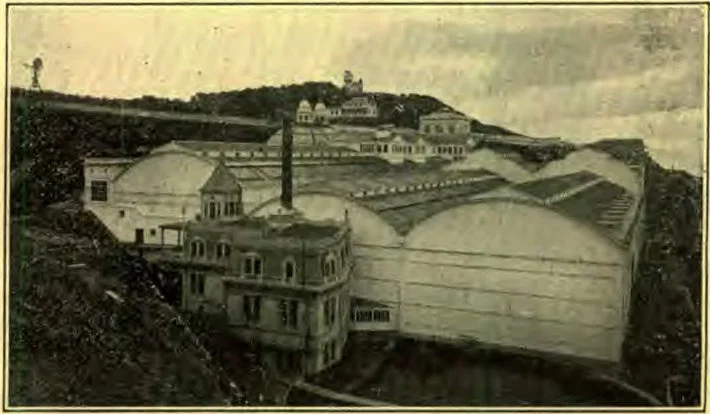
For its standing as an attractive and picturesque city, San Francisco is indebted to no one individual more, perhaps, than to the late Adolph Sutro, whose untiring efforts transformed the barren sand hills on the ocean beach into a garden of loveliness. Not the least of his great enterprises is the Sutro Baths, situated but a few steps from his famous Cliff House, and said to be the grandest bath-house in the world. The water for the bathing tanks is supplied from the ocean itself, and a lavish expenditure of money is visible in the interior surroundings. It would require a volume to describe the articles here to be seen, collected from other parts of the world, including over two thousand medallions, rare works of taxidermy, ancient proclamations and pictures, bottled reptiles, etc., etc.; also mummies from Egypt,—one a lady who “may have walked the streets of Thebes in the time of Moses.” Here, is a group of lifelike wax figures, representing Japanese musicians; there, a great polar bear; while tropical plants, rare curios, and beautiful specimens too numerous to mention bring one in touch with every zone.
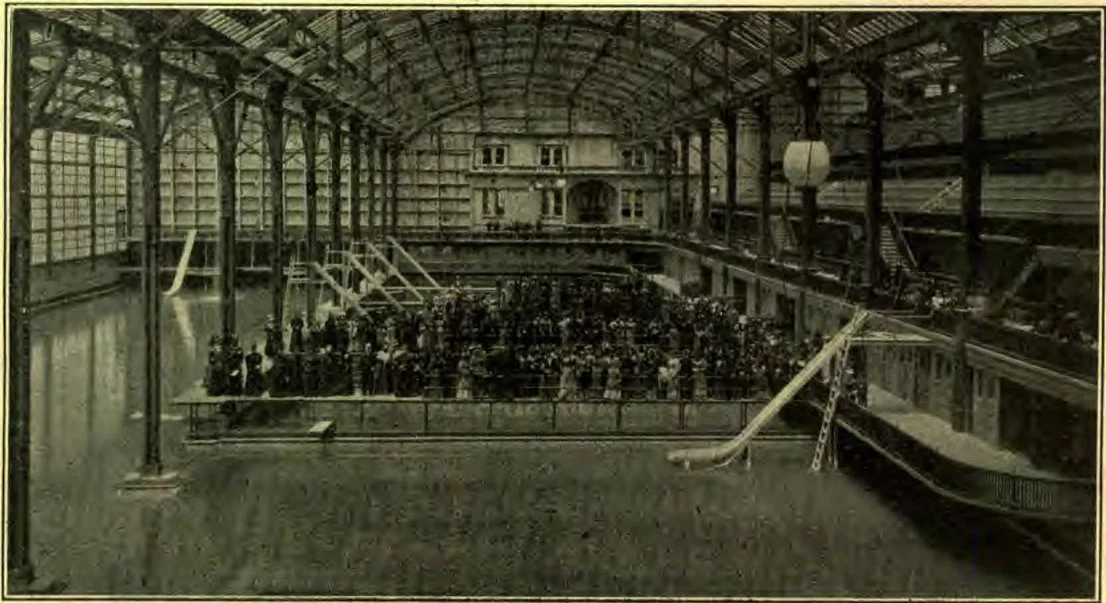
SUTRO BATHS — INTERIOR, LOOKING NORTH
The roof and sides of the building are covered with about one hundred thousand feet of glass, and it is estimated that two hundred and seventy thousand cubic feet of concrete were used for the tanks and round about the building. There are six tanks, the chief of which varies in depth from four to ten feet. This tank contains the sea-water at its natural temperature. The water in the other five tanks varies in temperature, and is not over six feet in depth. One is exclusively for women and children. There are a number of shower-baths, and also a plunge-bath. Trapezes, pendant rings, toboggan slides, spring-boards, etc., etc., add to the attractions of the place. It is interesting to watch the graceful movements of the expert performer, who is often to be seen on exhibition. There are over five hundred dressing-rooms. The baths are about five hundred feet long, about one half as wide, and are estimated to hold 1,804,962 gallons of water. The largest tank is in the form of an L, three hundred feet long, and one hundred and seventy-five feet wide at the widest end.
The seating capacity of the amphitheater is said to be thirty-seven hundred, while the promenades will accommodate about as many more.
Surely Sutro Baths is one of the points of interest to be visited by the tourist.
MRS. M. A. LOPER.

Adding Our Mite

If one happens to visit the ocean beach at Cliff House on a stormy day, he will see a sight that he will never forget. The great ocean waves, many feet in height, roll majestically toward the shore, and dash themselves into foam and spray upon the rocks. The declaration that “the wicked are like the troubled sea,” has a new significance as one gazes upon this scene.
Perhaps no one has done so much for San Francisco as the late Mr. Sutro, who built the famous Cliff House. He also took the sandy hill overlooking the beach, and expended a fortune in transforming it into one of the loveliest parks in existence. This is entirely free to the public.
Adjoining this he erected one of the most elaborate public baths in the world. The upper floors are used as museums, where there are on exhibition rare specimens collected at great expense from all parts of the globe. A mummified Egyptian prince, who died at the time when the haughty Pharaoh oppressed the chosen people of God, is in the collection. In glass cages may be seen the original copies of writings made when history was in its infancy. Lifelike stuffed animals from the icy north and from tropical jungles greet one’s eye at almost every turn.
All these advantages are open to the public for only a small admission fee.
SUTRO BATHS, LOOKING SOUTH
Mr. Sutro is dead, but thousands of his fellow citizens as well as multitudes of the rising generation have had their lives made happier because this man lived. None of us may be able to benefit humanity in such material ways, but all of us can determine that no day shall pass that we do not improve some opportunity to contribute our mite, by word or deed, to the sum total of human happiness. DAVID PAULSON, M. D.

What We Owe to the Chinese

AMERICANS and Europeans are wont to regard the Chinese as almost destitute of originality and scientific knowledge in any field of discovery and invention; and when one sees in the great cities of China everything pushed and pulled and rolled and carried along by brawn and muscle, the conclusion seems quite justifiable. Where we have railroads, electric cars, telegraphs, telephones, and a thousand and one other mechanical appliances, they have wheelbarrows, jinrikishas, and above all things the bamboo pole, by means of which the commodities of life are carried from place to place. Such facts easily lead to mistaken ideas concerning the Chinese. Having existed for centuries as a distinct nation, it would indeed be strange had they made no discoveries and no progress in the arts and sciences.
It is not attempted in this article to show the Chinese to be great inventors, but rather to indicate briefly the discoveries and inventions for which the world is indebted to China.
Gunpowder, whose ingredients are sulphur, niter, and carbon, is beyond question of Chinese origin, although the honor of the invention is contested by English, German, Arab, and Hindu. Of these the Hindus alone put forth a serious claim; but as their ancient dates are uncertain, the evidence is in favor of China. Authentic history shows that gunpowder was used by the Chinese at least a hundred years before its introduction into Europe.
The mariner’s compass is acknowledged to be a Chinese invention. Both the Greeks and the Egyptians possessed a knowledge of the magnet, but its polarity was first recognized and utilized by the Chinese, and that long before the Christian era. The first use of the magnetic needle by the Chinese was in 1100 B. C. They assert that they gave it to ambassadors from a southern country, to enable them to find their way home. These personages came by land; and since they used it in their vehicles, it came to be called “south-pointing chariot.” A trace of this practice still remains, and is seen in the use of a small compass suspended in the sedan, or cart, of a mandarin.
We are in the habit of naming Gutenberg as the inventor of printing; but for seven hundred years previously to his time, this art had been practiced in China as a great popular industry. Its origin is as follows: The books of Confucius were burned by a tyrannical emperor. They were restored, partly from memory, and in part from imperfect copies found in the wall of a house. A succeeding monarch proposed that the sacred writings should never again be thus exposed to destruction, and so caused them to be engraved on stone. It required one hundred and seventy slabs of granite, which are still preserved, to contain the writings. Upon their completion the idea was conceived of making them accessible to scholars in all parts of the country by means of rubbings, which was really printing. Nor has this method greatly changed in China during the lapse of a thousand years.
That the art of making porcelain is purely Chinese is universally admitted, since that article still bears the name chinaware.
The same may be said of silk, although the name is less certain. Our word “silk” is said to be derived from “Seres,” the Greek word for Chinese.
In the matter of paper-making, precedence must be given to China; and not only in making paper, but in its production from wood-pulp. The process was invented in China about the beginning of the Christian era, and for many centuries before that these people had books which were engraved on slips of bamboo with the point of a style. J. N. ANDERSON.

LILLIAN S. CONNERLY

Dress

It is an old saying, and a true one, that “dress does not make the man,” but upon each one of us devolves the duty of choosing what we shall wear. With the young especially this is no small responsibility; for the dress is a fairly correct index of the character, and more than once success or failure has been determined by it. We have in mind one young woman who seemed in many ways fitted to do a good work in the Lord’s cause, but who was rendered practically useless through her untidy habits of dress. To be slovenly in one’s attire is inexcusable at any time and in any place. There is no work in which the Christian may engage, where the clothing may not be neat, if that is selected which is appropriate. To all who find themselves the unhappy possessors of hereditary tendencies to untidiness, both in dress and in work, is offered the grace of Christ, by which may be overcome all hereditary and cultivated tendencies to evil.
To be overdressed is not only an exhibition of poor taste, but it also draws forth the certain contempt of all sensible people. Good taste in dress is expressed by clothes that are neat, appropriate, and that do not attract attention, either by their oddity or otherwise.
Never in the history of our country has extravagance in dress been carried to such excess as at the present day. It is a sign of the evil times. Thousands give their best thought and most earnest attention to matters of dress and fashion, while other thousands expend their time and energies in designing and fashioning unusual and elaborate garments.
Fashion has always held sway, and always will, and while we are bound to pay a certain respect to her, insomuch as not to appear singular or odd, it is still possible to render only the slightest compliance with any prevailing style, and still be well dressed. The old saying, “One may as well be dead as to be out of fashion,” has more force put thus, “One may as well be dead as to try to keep in fashion.”
If we have named the name of Christ, and have accepted the adorning of the meek and quiet spirit, which is in his sight of great price, let us see to it that we do not hide this treasure from our companions by the sham and tinsel of fashion. The adorning which Jesus recommended and valued will never go out of fashion with him, and even in this world will be valued more and more, as those who possess it become more rare.

LILLIAN S. CONNERLY

Anemone Virginiana

Tall Anemone, Thimbleweed
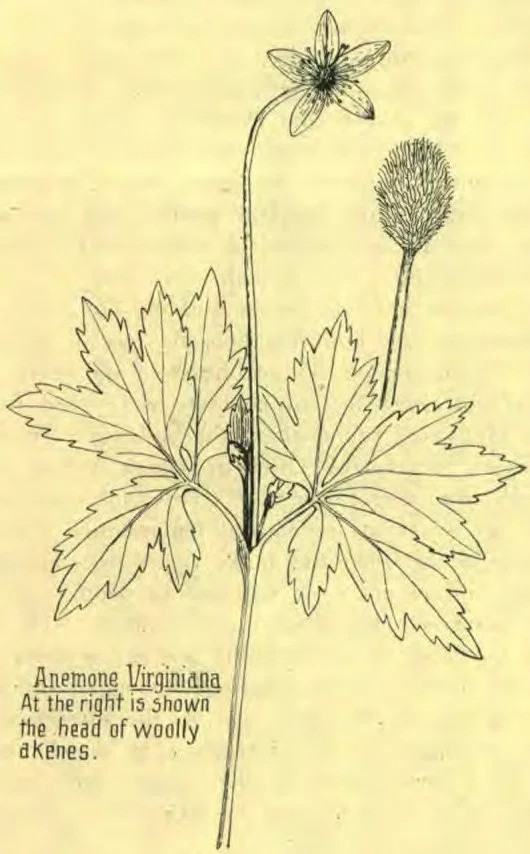
THIS is a giant sister of the delicate wood-anemone. The plant grows erect, and two or three feet high, or even more. At its upper part the stem divides into three or more long peduncles, each bearing a single flower. Just below these peduncles is an involucre of three compound leaves, with petioles from six to ten inches long. The middle peduncle is leafless, but each of the lateral ones has an involucre, or secondary involucre, of two short-petioled leaves. From the axils of these leaves other peduncles arise, each bearing an involucre and a single flower. This may continue until the branching becomes quite complicated.
The illustration shows one of the lateral peduncles with its involucre, and the young flower-stalks rising from the axils of the leaves. The flowers are borne in succession all through the summer.
The corolla is absent, but the calyx is somewhat corolla-like, consisting of five small, greenish-white sepals.
The fruit cluster consists of a large number of woolly acheniums crowded together on an oval or oblong receptacle, the cluster when ripe being about three fourths of an inch long, and having much the shape and appearance of a thimble. Because of this resemblance, the plant is commonly known as “Thimbleweed.”
Anemone Virginiana
At the right is shown
the head of woolly
akenes.
Anemone Virginiana At the right is shown the head of woolly akenes.
It is a rather common plant in woods and meadows. Though not especially beautiful, nor of economical importance, it is interesting because of its heads of woolly acheniums.
We have already learned that many of the plants belonging to the Crowfoot family bear flowers of considerable interest because of their size, beauty, or peculiar form. But there are some that do not, and of this class the Thimbleweed will serve as an example.
The season of the year has now come when those interested in botany should begin making their collections. Press two or three specimens of all the different kinds of plants you can find. Of the smaller plants retain at least a portion of the root, and whenever possible keep a specimen of both flower and fruit. Specimens of trees should include the leaves, flowers, and also the fruits if they are of such a nature that they can be conveniently kept. It is well, also, to add a small piece of the bark.
The staminate and pistillate flowers of trees will, in many cases, not be found on the same tree. This should be remembered in gathering your specimens. B. E. CRAWFORD.

The Parting of the Ways

THERE'S a path of life before us, and it reaches far away, And the welfare of our journey all depends upon to-day; For the dimly lighted future it is time to wisely choose: There is everything to gain, there is everything to lose. There are deeds to be accomplished that admit of no delays, When we reach Decision Valley at the parting of the ways.
Here the royal road is rugged, and in two is faintly cleft, With the roughness on the right hand and the smoothness on the left; Here are riches, fame, and knowledge (only folly in disguise); Pleasure looks so sweet and winning with her happy, sparkling eyes; And the path is strewn with flowers, while enticing music plays,— O, Ambition burns intensely at the parting of the ways!
Here upon the right is duty, with its trials bathed in tears, With its toils and bitter sorrows, with its faith in spite of fears; Here are fires of affliction, but a quiet peace of mind; Here may gather clouds of darkness, but with silver sunbeams lined; Here are heard His stately steppings, sung in calm and holy lays,— Still Right oft looks unattractive at the parting of the ways.
O for wisdom and discretion! Undecidedly we stand With the future all before us, and eternity at hand. O for stronger, keener vision! that behind the pleasures fair, We might see, through superficials, death, destruction, lurking there, And with pointed truth and wisdom pierce beneath the surface glaze, And expose the hollow folly at the parting of the ways!
Listen to the Voice that whispers: “This to duty is the way; Walk ye in it, for thy Pattern never leads thy feet astray.” Look, clear-eyed, beyond the present, past all pain and grief of time, To the bliss of life eternal in a holier, happier clime; Grasp by faith the precious promise, see again its glorious rays Shining on the roughest pathway at the parting of the ways!
ROBERT B. THURBER.

Room for the Eager Workman

We are seldom shut out from any service that we really desire to perform. No matter how important the service may seem, or how inadequate our power to accomplish it, there is always room for the workman who is eager to take hold. God sends strength and fitness with earnest desire and endeavor. This is no less a law of spiritual than of intellectual achievement. The growth in personal power, coincident with eager striving, is one of the marvels of life. —Well Spring.

A Few Common Errors Corrected

Do not say, “We are pleased to welcome you in our midst.” Say, “We are pleased to welcome you among us.” “In our midst,” though frequently used, is none the less open to criticism. No one owns a “midst.” Even the newspapers have stopped saying, “In our midst.”
Do not say, “He is afraid that he will miss his train.” Say, “He is afraid that he shall miss his train.” Do not say, “My brother says that he will live to see this truth triumph.” Say, “My brother says that he shall live to see this truth triumph.” If the subject of a subordinate clause is a pronoun, third person, whose antecedent is the subject of the principal clause, the same auxiliary should be used that would be required if the clause were principal, and the subject in the first person. “He says that he will persevere,” is correct. He said, “I will persevere.”
Do not say, “When the dead are resurrected.” Say, “When the dead are raised,” or “brought to life.” At the best, “resurrect” is colloquial, and certainly has no place in written English.
Second-handed, underhanded, and offhanded are barbarisms. Therefore, do not use them. Say, secondhand, underhand, and offhand.
A verse is one line of poetry. Do not say, “Please sing the first verse,” unless you mean the first line. A stanza is a group of rhymed verses.
Do not say, “A hard heart is one which truth don’t affect.” Say, “A hard heart is one which truth doesn’t affect.” Do not use “don’t” with singular subjects. “Don’t” is equivalent to “do not;” “doesn’t” to “does not.”
No one can “extend an invitation.” Invitations are sent, not extended. Extend means “to stretch;” “to prolong.”
“Like” is a proper relation word for a phrase, but not for a clause. Do not say, “The people look like they had heard a pleasant sermon,” but say, “The people look as if they had heard a pleasant sermon.”
“Enthuse” is objected to as colloquial. Therefore do not use it. Enthusiasm, however, is a good word. D. D. REES.

A Brief Sketch of the Bay Islands

From Correspondence to the Mission Board

A Brief Sketch of the Bay Islands

THE Bay Islands comprise Ruatan, Bonacca, and Utila. Ruatan, being the largest, is the capital. Its inhabitants, according to the yearly census, number about two thousand. One fifth are Spaniards, by whom the country is governed. The creoles are mostly descendants of the people from the island of Grand Cayman, and came here about one hundred years ago. Finding none of like blood but Indians, and being afraid of those who lived in the interior of the island, they settled along the shore. Another reason for this was that when vessels came from Grand Cayman, as they did every year to bring mangoes, oranges, shaddocks, and such other fruit as would keep during the passage, the people would be near the shores to sing out, “Sail, ahoy!” When a sail was sighted, an argument would begin as to what vessel it was. After this was ended,—and it sometimes resulted in a fight,—they would turn their attention to sharpening their knives to eat mangoes. After they had enjoyed the fruit brought them by the vessel, she would load with cocoanuts, and clear for the United States, bringing the people, on her return, flour, beef, pork, cloth, lumber, etc. This would be continued until December.
As the people multiplied, religion was thought of. Subscriptions were made, churches built, and ministers from England sent for. Several religious sects made converts here. To-day many denominations are represented among the people.
The Indians, once such a terror, have been driven over on the Mainland South, the lower classes of Spaniards occupying their place in the interior.
The chief trade of the islands is in cocoanuts, cattle, and horses. Cattle may be purchased for from thirty to eighty dollars a head, and horses for from twenty-five to one hundred and eighty dollars apiece.
The lower classes build their houses of cheap pine lumber purchased with their cocoanuts. The usual size of these houses is from twelve by ten to twenty by fourteen feet. Naturally they contain little furniture. The homes of the higher classes are somewhat more attractive.
Both classes engage in agriculture. The chief products are yams, cocoanuts, sweet potatoes, plantain, bananas, and sugar-cane. Yams and potatoes are sold in the markets at six cents a pound, and plantain and bananas for a trifle less. During the rainy season, rats are very destructive to sugar-cane and the young fruit of the cocoanut.
Ruatan is the home of many wild animals, including hogs, deer, and rabbits; also birds of various species. Pigeons and parrots are highly esteemed by the natives, the latter being found as pets in many homes. When young, they may be purchased for about forty-five cents in American gold. These birds lay their eggs in the hole of any convenient tree, about the middle of February, and in June the young are ready to fly. The natives seek these birds in May; and if a nest is found, the owner is as proud of his prize as a poor man who finds a gold doubloon. In the evening, parrots present a beautiful appearance as they fly overhead, usually in single pairs, but sometimes in groups. While thus assembling to their sleeping-places, the air is filled with their noise, which somewhat resembles that produced by a company of untrained singers. The pigeons, being of a quicker and wilder nature, are not so easily tamed. They resemble the dove.
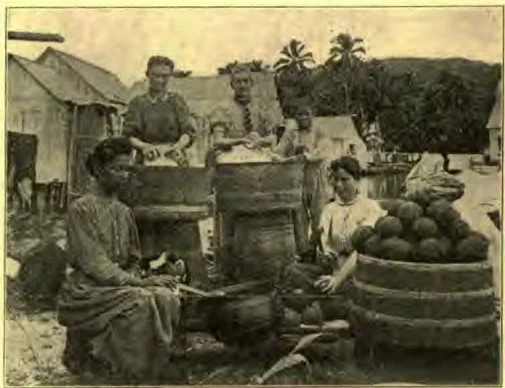
NATIVES MAKING COCOANUT OIL
This mission is in crying need of laborers. Where are those who will bear the third angel’s message to these perishing souls? Shall we save them from the “mystery of iniquity” and from the wrath of God, by faithfully giving them the truth? May the Lord of the harvest raise up laborers for this needy field.
A. W. GREEN.

A Lesson in Loving

“Miss Maynard?”
The teacher of the girls’ Bible class turned at the touch upon her arm and the sound of her name. It was Ruth Gordon, who spoke in her usually impulsive way, and stopped Miss Maynard. One never could tell what would come next with Ruth. She thought of so many things,—a dear, bright girl she was; eager, enthusiastic, and quick in speech and manner.
“I want you to help me, Miss Maynard,” she said. “It has come to me lately that I’m the most uncharitable creature I ever knew, and I hate it in myself. Have you any books that will help me? What shall I do?”
Miss Maynard smiled at the girl’s sudden arrest. “I have no books concealed about me just now,” she said, pleasantly, with sympathetic tone and manner, “and I can’t stand and deliver advice here and now, you know. Come over to-morrow, after your lesson, and we will talk it all over. I’ll have my lecture put down with heads by that time. I’m so glad you want to take lessons in loving, dear girl.” And the two stepped out from the corner where they had withdrawn, and went into church.
The next afternoon saw them in cozy conclave.
“Now tell me what I shall do, and what I must think about to make me less critical and more charitable,” said Ruth. “I suppose it was the meeting the other night that made me think of it, for that was our subject. Anyhow, I know, as I never did before, that I am an unpleasant sort, and ought to be sweeter.”
Miss Maynard wished in her heart that some more guilty were as penitent, but she would not hinder the young seeker after the best by saying aught to make her content with such things as she had, in this way.
“Now, dear,” she said, “I’ve thought of a few helpful words for you. The first is, Consider. Do you remember what it means?”
“Why, yes, Miss Maynard. You told us so lately. It is to ‘sit down by,’ just as we are sitting now, I suppose.”
“To be sure. Well, Ruth, if you will consider people, you will feel more kindly toward them. Put yourself alongside of them. Consider not only the ‘poor,’ as the Bible says, but the rich, the sorrowful, the glad, the sour, the sullen, the careless, the thoughtless, and every other sort. Sit down beside their provocations and individualities, their crotchets, their crosses, and worries, and see if every mortal has not a claim on your consideration, your tenderness, sympathy, love.
“Now for the second head under this part of my discourse: ‘Considering thyself, lest thou also be tempted.’ Remember this word. Think how it would be with you under the various conditions you find in the lot of others, and think how you would wish people to feel toward you.”
“Ah, but that is easy to know! I wish I could remember at the right time!” cried Ruth.
“Then, third and last, dear girl,” and Miss Maynard’s voice grew softer, “‘Consider Him’ who endured so much, and who loves so dearly. Get close to him, think of people with their burdens as he does, let his mind be in you, and you will be loving enough. You can’t help it.”
“Thank you for that word ‘consider,’” said Ruth, in a gentle tone.
“Then there is something else,” Miss Maynard went on. “Make allowance for people. Make allowance for shortcomings, don’t expect too much, and remember what changes they are subject to. You know how they make allowance in machinery for expansion and shrinkage in the weather-changes and the atmospheric effect upon metals. The allowance is made in the first place, and then when the expansion or contraction comes, the change takes place without doing harm. It was in the calculation. If you will only have a reserve of patience, and not look for perfection, you will not be critical and hasty in judgment. This is part of the lesson of loving.
“I’ll remember, indeed I will,” said Ruth, earnestly. “That is just what I need, Miss Maynard. I think it is horrid when folks fall short, and disappoint me, and I say it right out. I don’t stop to think that I need to have allowance made for myself.”
“But I am only half through with the lesson, dear. Remember there is a time to keep silence. If you withhold the hasty word of judgment, it will help you to control the critical thought and the unloving attitude. Unless you are positively obliged to admit something not quite pleasant about others, keep still. Smother the thought. Don’t let in the air of speech upon it, and it will perish sooner. Let the air in, and it will blaze and burn and burn.”
“I understand,” said Ruth, humbly. “The lesson of loving is not altogether easy, is it?”
“But it is worth everything, and hard things are not impossible. There is one thing more, to finish. ‘There is a time to speak.’ Somebody says there may be criminal and cowardly and cruel silence as well as cruel speech. Get in the habit of telling pleasant things, of giving commendation, of putting approval and appreciation into words. This spreads love in a wonderful way. It helps speaker and hearer. The other day I took occasion to say to the secretary of a society I belong to, ‘What a good officer you are! What perfect records you keep! I like to hear the minutes read, they are so accurate.’ I was astonished when she put out her hand, and said, ‘Thank you,’ in a way pathetic. She had been criticised, she said, and this encouraged her so much. My own heart warmed to her, you may depend. This is all for you to-day, Ruth; only, remember, He whose name is Love is not only able and willing, but longs to teach you ‘the lesson of loving, the very first lesson of all.’” — Young People’s Weekly.

A Joyless Life

MANY fail to realize that joy is distinctly moral. It is a fruit of the spiritual life. We have no more right to pray for joy, if we are not doing the things that Jesus said would bring it, than we would have to ask interest in a savings-bank in which we had never deposited money.
Joy does not happen. It is a flower that springs from roots. It is the inevitable result of certain lines followed and laws obeyed, and so a matter of character. Therefore, we can not say that joy is like a fine complexion, a distinct addition to the charm of the face, which yet would be structurally perfect without this charm.
Joy is a feature; and the face that does not have it is disfigured. The Christian life that is joyless is a discredit to God and a disgrace to itself. “These things have I spoken unto you,” said Jesus, “that my joy might remain in you, and that your joy might be full.” Study these words. Believe them. Attempt them. Steadily accomplish them, and the joy of the Lord will enter you before you hear the word, “Enter thou into the joy of thy Lord.”—Maltbie D. Babcock.

Apple Blossoms

Ah, is there else a sight so sweet In all the world's wide room, One with such tender spell replete, As apple trees in bloom? — Rev. Philip B. Strong.

Notes From the Field

FROM Mary Jacques, London, England: “A few days ago I received a letter from the secretary of the Young People’s Society at Bath, and will quote from it for you as follows: ‘Father thought it would be well for me to give you a short account of the work of our Young People’s Society. We are still holding our meetings on Friday evenings. We have at present twelve members, but we hope that others may soon be added. We are selling Good Health and the Present Truth. The profits on the sales are given to the poor. We are hoping to do some open-air gospel work as the summer comes on. We are still in the day of small things, but God has told us not to despise them.’”
Ruth H. Saxby, Charlotte, Michigan: “Our Young People’s Society has been organized about two months. We now have a membership of sixteen. We have been holding our meetings Wednesday afternoons at the different homes of the church-members, especially at the homes of the aged, who are not able to get out very often; but as it is difficult for some to attend at that time, the band will hereafter meet on Sunday afternoon. We use the studies in the INSTRUCTOR as the basis for our lessons. As yet we have no definite lines of missionary work, but the members are doing all they can in different ways, such as distributing literature, collecting food and clothing for the poor, etc. We are now especially interested in helping a poor woman who has four little boys all under ten to support by doing washing. Our band finds plenty to do, and the Lord blesses us as we work. The reports in the INSTRUCTOR are very encouraging. There is certainly a great work for us as young people to do. Souls are hungering for the truth, and we are the ones who must give it to them. Pray for the work in this place.”
Anna Myrberg, Seattle, Wash.: “The membership of our society is eleven, with an average of about fifteen visitors. We have been following the lessons in the YOUTH’S INSTRUCTOR as nearly as we could, using the Missionary Magazine, together with selections from the ‘Testimonies.’ We are all of good courage and determined to go forward, improving every opportunity we may have to work for the Lord. We know that he has promised to be with us; and as long as he is for us, and working with us, who can be against us? We have had a number of encouraging opportunities to talk on both religious and hygienic subjects. These young people’s meetings have been a great blessing to me. Pray for us, and our work here, for truly the harvest is ripe, but the laborers are few. This is a large field, and few of us are at work. Many are interested, asking questions, and wishing to know more about our religious views and our way of living. I praise God that I have the privilege of being one of his co-workers.”

The Spiritual Life Is Doing

THE spiritual life is not knowing, not hearing, but doing. We only know so far as we can do. We learn to do by doing. What we do truly, rightly, in the way of duty, that, and only that, we are.—Frederick W. Robertson.

What We May Give

If we can not give our dollars, We can surely give our dimes; And a nickel or a penny Brings a blessing oftentimes.
If we can not give our dollars, We can surely give our love To the little homeless children, Dear unto our God above.
If we can not give our dollars, We can always give our prayers; And our loving Heavenly Father Bends to listen, loves, and cares.
— Children’s Home Missions.

Battles between Truth and Falsehood

Lesson VIII—Jesus in the Sabbath

(May 25–31)
HOW TO STUDY THESE LESSONS.—(1) Read the lesson story; (2) try to recall or find scriptures in proof of each statement; (3) study the texts; (4) see how many missing links you can supply; (5) give the lesson to some one else. You will keep only what you give away.
The making of the Sabbath was simply the Lord Jesus putting himself into the seventh day. First, his rest; next, his blessing, or happiness; last, his holiness, or sanctification. It is the very same plan by which he gives himself to any person who will accept him. He invites the weary sinner to come and receive the gift of rest. If he accepts this, he then adds his blessing,—the joy of the Lord. And last he sanctifies him,—makes him holy,—and sets him apart for a holy use. In these three great characteristics — rest, blessing, and sanctification — are bound up the whole character of the Lord Jesus. When you receive them fully, then indeed is “Christ in you.” By putting these three characteristics into the seventh day, Jesus put himself into that day.

Outline

  1. Jesus calls us to him for rest. Matt. 11:28.
  2. We find rest by learning meekness. V. 29.
  3. The joy, or blessing, of the Lord is added to the meek. Isa. 29:19; Ps. 128:1, 2; 119:12.
  4. Then he sanctifies you. 1 Thess. 5:23, 24.
  5. He sets you apart for himself. Ps. 4:3.
  6. Then is “Christ in you.” Col. 1:27; Isa 57:15; 2 Cor. 6:16.
  7. In the same way Christ put himself into the seventh day.

LOUIE PEABODY

From Welsh, Louisiana

THE Young People's Society organized at Welsh, Louisiana, one year ago has about thirty members enrolled at present. We are thankful for a part in the great work to which we commit ourselves in accepting the membership cards. The regular attendance of the older members of the church is a source of great encouragement to us. Our study of the field each month is refreshing, and we wish also to express our gratitude for the studies outlined in the INSTRUCTOR by Elder Luther Warren.
Although we have a small territory to canvass, the members of the society have distributed many copies of the Gospel Herald each week, securing several permanent readers. Other lines of missionary work are also under consideration.

LOUIE PEABODY

Continue reading: Killing Time