Your ShelfYour Projects

Signs of the Times, Vol. 25, No. 42.

DO ALL TO THE GLORY OF GOD

Signs of the Times

Oct 18, 1899

Pacific Press Publishing Company · OAKLAND, CALIFORNIA · Oct 18, 1899

"DO ALL TO THE GLORY OF GOD."

All Belongs to God—No Christian Idler—Right Example in the Family.

THOSE who enter the service of God must be faithful to their Leader. If during their former lifetime they have not given the powers of mind and soul and strength to the Lord, when they are converted they will realize that every capability belongs to God. The truly converted man will bring even his thoughts into obedience to the will of God. His mental and physical powers will be laid on the altar of sacrifice. His time is the Lord's; it is not to be idled away. All are bound by the most solemn obligations to redeem the time. Waste it not; make the most of it; do your best, as long as you live in the world, to be a blessing. Christ regarded every moment as precious. Thus should His followers regard their time. Those who are not directly engaged in the work of seeking to save that which was lost, should have some work. They should use the powers of mind and body to a purpose, that they may be able to place their gifts and offerings in the Lord's treasury, and bring a faithful tithe to Him. It is the duty of all who enjoy God's bounties to engage in useful employment. To every man is given his work, and upon the faithful performance of this work depends the blessing he receives.He who wastes his precious time robs God of service due to Him. He is guilty of a neglect which God will not excuse. How can God welcome such an one into the courts above with the words, "Well done, thou good and faithful servant; . . . enter thou into the joy of thy Lord"?
The strength belongs to God. "Thou shalt love the Lord thy God with all thy heart, and with all thy soul, and with all thy strength, and with all thy mind; and thy neighbor as thyself." This statement covers the use of the physical powers. There is no reason why a man who has strength of body should not use that strength in Christ's service. Every part of the being is to be employed to the glory of God. The Lord would not have given us such a definite specification had He not designed us to study carefully how much it comprehends. If you have physical strength, that strength is Christ's property. He who has in the past looked upon himself as above labor will when converted change his habits and use his physical powers to some purpose. An indolent man can not serve God; for he gives to others an example entirely contrary to the principles of Christ. No idler can be a practical Christian. Christ is our example, and He worked at the carpenter's trade with his father Joseph. There are no gentlemen idlers in God's vineyard; for there is earnest, practical work to be done.
After the precious message of truth is heard and received, the heart is touched and convicted; and when it turns to Jesus, the will is brought into subjection to Christ. The soul temple is cleansed from moral defilement, and made ready for Christ's indwelling. The deep moving of the Spirit fills the soul with earnest love for Christ. The receiver of truth could feast forever on the truth he hears; but he must go farther than merely receiving; he must impart the precious knowledge of the Redeemer's love; he must strive to uplift the crucified Saviour. Heart and soul are to be consecrated to God's service.
He who has a family is under obligation, as a steward of God, to set a right example to his children. He is to educate them to be intelligent and useful, to employ the strength given them by God in advancing His work in the world. By precept and example he is to train them to be faithful stewards. They are to be educated to realize that they hold in trust lent treasures, which are to be used to the very best advantage in God's service.
Teach your children that nothing is to be withheld from God, that all their gifts are to be used to promote His glory. Teach them to cherish a sense of their accountability to use wisely their intrusted capabilities, improving and perfecting them by use. They are accountable for the judicious exercise of every faculty.
God can not excuse those who have been bought by the blood of His Son, from working faithfully in His service. Every true Christian is a coworker with Christ. Nothing can be more offensive to God than to cripple or abuse the gifts lent us to be devoted to His service. The value of a soul is estimated by the price paid for it. It is written: "Whether therefore ye eat, or drink, or whatsoever ye do, do all to the glory of God," "who will render to every man according to his deeds; to them who by patient continuance in well-doing seek for glory and honor and immortality, eternal life; but unto them that are contentious, and do not obey the truth, but obey unrighteousness, indignation and wrath, tribulation and anguish, upon every soul of man that doeth evil, of the Jew first, and also of the Gentile; but glory, honor, and peace, to every man that worketh good, to the Jew first, and also to the Gentile." MRS. E. G. WHITE.

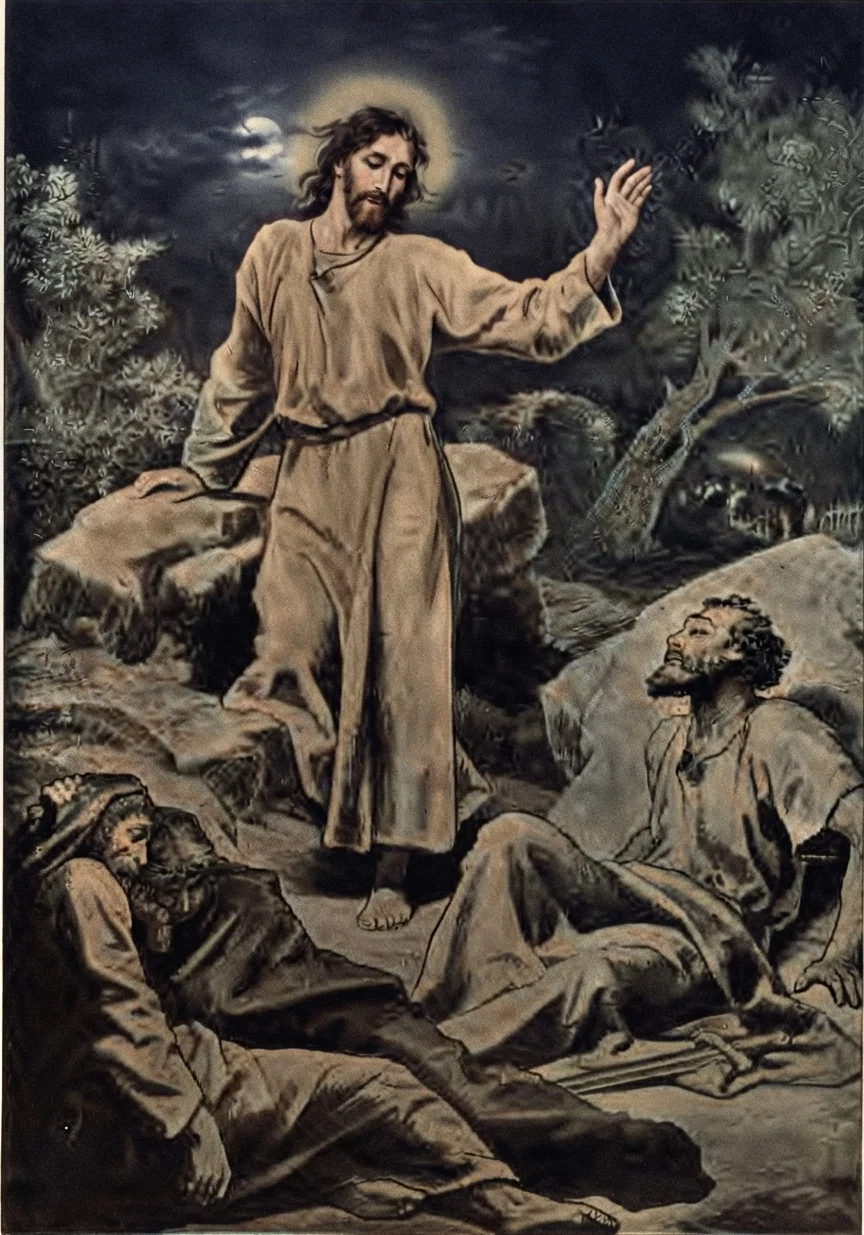
"A VISION OF GETHSEMANE."

THE ragged clouds stretch to the sunken light Like wrinkles on the careworn brow of night— O night of grand regret! A hiding moon, that vain would shun the scene, But faintly silvers the dark mass of green That mantles Olivet.
I see Him, bent beside yon olive grove, Convulsed with anguish of an outraged love, Prepay the bitter price. I see a godly impulse pent in flesh; I see a winnowed heart bleed in the thresh, Thrice pured for sacrifice.
"Father, I pray, remove this cup from Me." His face glows with a pulsing agony, The very chart of pain. The nervous arms are tossed and gesture-driven; His eyes concentrate all the sweep of heaven, But probe the depths in vain.
As Intercession's self behold Him plead; The magnitude of wayward Israel's need Appals and shrinks His soul. And wanton shames and vile opprobrium hurl'd At Him whose thoughts would nurse an ailing world, Before His mind unroll.
But yesterday He rode in palm-strewn state, "Hosanna"—greeted, through the city gate; Through the same gate must He To-morrow bear His cross, already built, And damning evidence of human guilt Shall shame eternity.
"Nevertheless, Thy will be done—not Mine." His mind compels to peace with force divine, A force that oozes blood. The tidal torment trembles in a curb That death on death can never more disturb. His Father's will stands good.
Some vague Bethesda, latent in the frame, Wells from His core to quench the fever's flame— Christ is Himself again, Save that from ebbing catches in His throat Majestic sadness thrills an aching note, Suffusing this refrain:
"But ye would not—would not, Jerusalem, Jerusalem that ever stoneth them Sent to relieve her lot; How often, as the hen doth shield her brood, Would I have sheltered you from guilt and blood, And ye would not—would not!"
He moves; I hear His voice, forlornly deep, Steal sweet refreshment from the fisher's sleep— "Could ye not watch awhile?" Then pity merged in thoughts of self doth speak: "The mind is willing, but the flesh is weak"— And soothes them with a smile.
I see, I hear the covert-skirting throng, Jeering to nerve their courage to the wrong. I see the kiss betray. Judas, the worms already writhe for thee, And hell, disdaining such foul infamy, Thine entrance shall gainsay.
The ages pass, and on this sacred sod, The Moslem shapes his earth-born soul to God, Through channels strange and weird; And, musing on the Christ with thoughts unkind, In the proud weakness of a mortal mind, He laugheth in his beard.
Yet "God is love;" round love's essential force His multitude of attributes take course, Yet secondary move; And, faithful to His plighted Word of old, His "other sheep" shall gather to the fold, Safe-shepherded by Love.
O Light of Ages! pain and passion born, Thy gleam shall quicken earth towards the dawn, And fear from death shall sever;
He moves; I hear His voice, forlornly deep, Steal sweet refreshment from the fisher's sleep— “Could ye not watch awhile?”
For, from the anguish of frail nature's throes, Poor human love to God's grand peerage rose, Quelling His wrath forever.
Boulder, Colo. FRED T. ELKIN.

God Answers His Children’s Prayers

If earthly parents hear Their children when they cry, If they, with love sincere, Their children's wants supply, Much more wilt Thou Thy love display, And answer when Thy children pray. —J. Burton.

THE SECOND COMING OF THE LORD.

Cry of Peace—Peace Congress—Swords into Plowshares or Plowshares into Swords?

FOR years the doctrine has been advocated throughout Christendom that before the coming of the Lord this world would witness a reign of universal peace, that there would be a disarmament of the nations, and that songs of praise and deliverance would take the place of the din of war and the clash of arms. Would that it might be so. Would that we might turn from the dark picture of sin, and witness one of triumph of the cross and the beauty of righteousness; but such in this world is not destined to be our lot. While it may be our heart's desire to have things otherwise than they are, we can not, as wise men and women, shut our eyes to the condition of things that exists. In this world, and with men, we must deal with things as they are, and not as they ought to be.

Signs in the Political World.

The Word of the Lord plainly shows that in the last days there will be those who will predict the disarmament of the nations and the millennial reign of peace. We have a prophecy of this in the fourth chapter of Micah, verses 1 to 8. Please observe, however, that the Lord Himself does not say that this condition will exist before He comes. He does, on the other hand, plainly say that there will be a class of people (many nations) in the last days advocating this idea. But even while they are advocating this idea, the Lord says (verse 6) that there will be some who will halt and be driven out to be afflicted.
Furthermore, in the third chapter of Joel, verses 9 to 12, we have the statement of inspiration that in the very time that some among the nations of earth are crying, "Peace and safety," and predicting the universal reign of peace, the nations will be actually preparing for war. The plowshares will be beaten into swords, and the pruning-hooks into spears. The weak shall say, "I am strong." All the nations shall assemble together and come up to the valley of Jehoshaphat, and there will take place the battle of the great day of God Almighty; and the nations of the earth will be given to the sword, and upon each will be visited the judgment and execution which he has prepared for his fellow. Then it is that the Lord shall roar out of Zion, and utter His voice from Jerusalem. The heavens and the earth shall shake; the wicked hosts shall be thrown into utter confusion, crying to the rocks and mountains to fall on them, to hide them from the face of Him that sitteth on the throne. But the Lord will be the hope of His people, and the strength of the children of Israel.
What a striking fulfilment of this prophecy of Micah and Joel do we find in the world to-day! From nearly every pulpit of the land, during the last few decades, has the prediction of the world's conversion been sounded, and men been lulled into security and sleep with the thought that before the Lord comes the world must bow in obedience to His will and wishes. And the grand culmination of this cry which has been sounding through the land is found in the Peace Congress recently assembled at The Hague, containing representatives from all the leading nations to devise some method of disarmament, according to the proposition of the czar of Russia.
Yet, notwithstanding all these protestations of friendship between the representatives of the nations, as never before in the history of the world is every country preparing for the last great conflict. The words of Micah are being strikingly fulfilled, and no less strikingly is the word of the Lord through Joel meeting its fulfilment before our very eyes to-day. Notwithstanding the czar's peace proposals, Russia is straining every nerve to push her conquests in the East. England, Germany, France, and even Italy—burdened as she is with an enormous war debt and oppressive taxation, which are threatening a civil war at home—are doing all in their power to increase the efficiency of both their land and sea forces. Last year millions of dollars were appropriated in each of these countries for the building of new war ships and the increase of their war equipment on land and sea.
The partition of Africa among the nations of the Old World is still fresh in the mind of all who have followed the political events in the Dark Continent. And now the dismemberment of China by the same powers of Europe has already begun. The nations to-day are watching each other most jealously, and vying in their attempts to place themselves in the best possible condition for home defense or aggressive warfare. And not alone this. Our own country, which in the past, from its quiet position in the Western Hemisphere, has not been a party to the intrigues of the nations of the Old World, has now entered the great political arena, and purposes to take a hand in the adjustment of the international questions which will concern the future history of the world.
The whole field of Europe to-day is like a vast military camp. In every nation are seen drilling armies, and in every harbor maneuvering fleets. The whole Eastern continent is like a vast arsenal, which at any time may be started by a single stroke into a vast conflagration.
These conditions the Word of the Lord tells us are indications that the day of the Lord's coming is greatly hastening. The world will be evangelized, but not converted. The Gospel of the kingdom shall be preached in earth's remotest parts, and out of all the nations will God gather a people for Himself. That Gospel is now rapidly doing its work. May the Lord grant we shall so admit its claims in our hearts that we shall not be engulfed in the great day of devastation, but shall recognize the claims of the Prince of Peace here, so that we may dwell under His benign rule through the endless ages of eternity.
FRANCIS M. WILCOX.

WATCHMAN, WHAT OF THE NIGHT.

[Edward A. Collier, in New York Observer.]
FROM Orient lands and islands fair, Long shrouded with the gloom of night, Breathes, through the dark and silent air, The cry of longing for the light. O Watchman, who on Zion's hill Dost search the skies with eyes intent, What of the night, so long and chill? When will the weary hours be spent?
What of the night of sin and grief, The night of ignorance and fear? Is there no dawning of relief? Doth not some morning-star appear? O, yes; lift up your longing eyes! The morning cometh swiftly on; The Sun of Righteousness doth rise; The shades of night will soon be gone.
But, soul, thou must thyself awake, And welcome His first dawning ray; Else will the light thy heart forsake, And leave thee to thy darkening way. And, Christian, thou must not forget To send afar the Gospel light, Lest, tho' "the morning cometh," yet Of thee be said—"and also night."

"THE POWERS THAT BE."

Their Limitation.

IN the thirteenth and fourteenth chapters of Romans is one of the strongest of the many strong treatises that there are in the Bible upon the total separation of religion and the State—the separation between that which is due to God and that which is due to Caesar.
First is a recognition of the right of the State to be, and to require subjection and tribute: "Let every soul be subject to the higher powers." "The powers that be are ordained of God." "For this cause pay ye tribute also." "Render therefore to all their dues; tribute to whom tribute is due; custom to whom custom; fear to whom fear; honor to whom honor."
Next is marked the sphere of men's relation to the State. "Owe no man anything, but to love one another; for he that loveth another hath fulfilled the law. For this, Thou shalt not commit adultery, Thou shalt not kill, Thou shalt not steal, Thou shalt not bear false witness, Thou shalt not covet; and if there be any other commandment, it is briefly comprehended in this saying, namely, Thou shalt love thy neighbor as thyself."
Now everybody knows, and Paul knew as well as anybody ever knew, that there are other commandments—other commandments of the very law from which he quoted these. There is the commandment: "Thou shalt have no other gods before Me. Thou shalt not make unto thee any graven image; . . . thou shalt not bow down thyself to them, nor serve them; for I the Lord thy God am a jealous God, visiting the iniquities of the fathers upon the children unto the third and fourth generation of them that hate Me; and showing mercy unto thousands of them that love Me, and keep My commandments. Thou shalt not take the name of the Lord thy God in vain." "Remember the Sabbath day, to keep it holy. Six days shalt thou labor, and do all thy work; but the seventh day is the Sabbath of the Lord thy God; in it thou shalt not do any work; . . . for in six days the Lord made heaven and earth, the sea, and all that in them is, and rested the seventh day; wherefore the Lord blessed the Sabbath day, and hallowed it."
With these commandments standing as a part, and indeed the first part, of the very law which he was citing, why did he leave these entirely out and say, "If there be any other commandment, it is briefly comprehended in this saying, namely, Thou shalt love thy neighbor as thyself"? Why?—For the simple reason that he was writing of men's relationship and responsibility to the powers that be, to the State; and he was laying down the principle that when men have recognized the right of the State to be, have paid the required tribute, and have fulfilled all obligations to their neighbors, there is nothing more for them to render to the State; there is no other commandment in that sphere, and therefore no other duty to be performed toward the powers that be.
This is made certain by the next verse, "Love worketh no ill to his neighbor; therefore love is the fulfilling of the law:" which shows conclusively that it is only the relation of man with man—of man to his neighbor—that he is considering in the passage under consideration. The passage is simply an enlargement, an exposition, indeed, of the principle announced by Jesus, "Render to Caesar the things that are Caesar's, and to God the things that are God's." When men have recognized the authority of the State, have paid their tribute, and work no ill to their fellow men, the only relationship or obligation after that is to God. The only commandments outside of that sphere are those which mark men's duty towards God.
Thus the Scripture distinctly sets the limit of the jurisdiction or the requirements of the State, at recognition of right to be, tribute, and the relationship of man to man in working no ill to his neighbor. Beyond this the State has no right to go. Outside of this there is nothing for any man to render to the powers that be.
But the Word of the Lord does not stop here; it positively prohibits the powers that be from touching the relationship or obligation of men to God. "Every one of us shall give account of himself to God." Rom. 14:12. And that the emphasis is upon the word "himself" and not upon the word "account," is certain from the context in the whole chapter. It is not that "every one of us shall give account of himself to God," nor is it "every one of us shall give account of himself to God." That is all true enough; but that is not the thought expressed in the text. The one thought particularly expressed is that "every one of us shall give account of himself to God." And thus, by the Word of God, all powers that be, all men, and all combinations of men, are positively prohibited from touching, in any way, any man's relationship to God. That rests with man alone; and for his responsibility there, he is to give account himself to God.

Duty to God, Not Men.

Again: "One man esteemeth one day above another; another esteemeth every day alike. Let every man be fully persuaded in his own mind. He that regardeth the day, regardeth it unto the Lord; and he that regardeth not the day, to the Lord he doth not regard it." Rom. 14:5, 6. The matter of the observance of a day, the duty to esteem one day above another, is not comprehended in that part of the law, nor comprised in the duties designated as marking the sphere of the powers that be. It is in that part of the law which, by the words "if there be any other commandment," is definitely excluded from all cognizance of the powers that be.
The observance of a day, the duty to esteem one day above another, is due solely to God. For "he that regardeth the day, regardeth it unto the Lord," not to men. It is comprehended in that part of the law which details man's relationship to God alone, and to God alone every one is to give account himself. Therefore, the powers that be, all men, and all combinations of men, are definitely commanded by the Lord to let every man alone in the matter of the observance of a day; on that subject to "let every man be fully persuaded in his own mind;" and that because that is a thing due solely to God, and "every one of us shall give account of himself to God."
How different are the ways of professed Christians to-day from the Christianity of the New Testament? The vast mass of professed Christians to-day, in hunting for another commandment in the sphere of the powers that be, would inevitably write it thus: If there be any other commandment, it is briefly comprehended in this saying, namely, Thou shalt do no work on the first day of the week, commonly called Sunday. But the Christianity of the New Testament, in defining the sphere of the powers that be, says, "If there be any other commandment, it is briefly comprehended in this saying, namely, Thou shalt love thy neighbor as thyself;" and then, as to the observance of a day, commands the powers that be, and all men, and all combinations of men: "Let every man be fully persuaded in his own mind. He that regardeth the day, regardeth it unto the Lord." And "every one of us shall give account of himself to God." "Who art thou that judgeth another man's servant." The day to be esteemed above others is the Sabbath of the Lord.
"Render . . . to God the things that are God's." And any man who does not esteem that day above others, who does not regard it unto the Lord, but esteems every day alike, is responsible to God alone and must render account of it himself to God, and not to man. While the thing that he does is wrong, it is a kind of wrong for which he is responsible to God and not to the powers that be.
All this also conclusively shows that any movement on the part of the powers that be, or of men or combinations of men through the powers that be, to require the observance of a day or to cause men to esteem one day above another, is a plain joining together of what is God's and what is Caesar's, is a positive union of religion and the State. It is written, "What therefore God hath joined together, let not man put asunder." And by the same token it can be authoritatively written, What God hath put asunder, let no man, nor any combination of men, join together.

Not of Faith Is Sin.

Again: This treatise in Romans 13 and 14, on the separation of religion and the State, the separation of what is due to God from what is due to the powers that be, closes with the mighty sentence, "*Whatsoever is not of faith is sin."
Whatsoever is of the Word of God is of faith; for faith comes by the Word of God; and "without faith it is impossible to please Him."
Religion is due solely to God; it is "the duty we owe to our Creator, and the manner of discharging it."
Therefore, for the powers that be, or any men by the powers that be, to require anything that is due to God, is only to subvert faith and require men to sin.
For the powers that be, or any men through the powers that be, to require of any man anything that is due to God, is, in the very act, to unite religion and the State. And as thus to require of men anything that is due to God, is to subvert faith and to require men to sin, it is certain that any connection whatever between religion and the State is sin. And, therefore, the greatest example of it that has ever been in the world is aptly and justly designated "the man of sin."
And since, to "love the Lord thy God with all thy heart, and with all thy soul, and with all thy strength, and with all thy mind; and thy neighbor as thyself"—the keeping of the first two of all the commandments—is complete separation from sin, our subject ends justwhere it began,—with the truth that the first two of all the commandments, and the keeping of them, are the basis and the surety of the universal and eternal truth of the separation of religion and the State. ALONZO T. JONES.
Continue reading: MAN'S PRIMITIVE AND BEST DIET