An interesting report comes to us from the Argentine Conference. We have read in the newspapers of the hard times in the Argentine Republic, shared by all the republics in the River Plate valley. Drought has consumed the harvests, and locusts have devastated regions, then came overflowing floods, bringing serious times generally. The great wheat plains of Argentina that ordinarily supply grain to Europe, have evidently fallen short of even the local needs, if we may judge by the news that came from Galveston, Tex., last week, reporting that an English merchantman had cleared for Buenos Aires with a cargo of wheat.
All these conditions naturally affect the business that our brethren are engaged in in Argentina. However, the acceptance of this blessed truth in South America leads believers to count the interests of the cause of God first in their hearts and in their efforts. Evidence of this comes in a letter just received from Elder B. C. Haak, president of the Argentine Conference, who writes:—
There is something about our financial condition that makes us feel that the God of Elijah is still caring for his work in the earth. We all thought that the last month would be the poorest, and that it would strain our resources to the utmost to keep things going, but to our surprise it was almost one of the best months that we have had since I have been here; and instead of its leaving our treasury empty, we still have a little on hand. This is the way it has been every month so far, and that, too, without any special call. We give God all the glory, for it is he that is doing it for us. O, if we could only trust him more and be more worthy of so much blessing! It makes us wonder where our dear people get the money, as there is almost a panic in the commercial world. Yet God's truth marches on.
Elder Haak has recently gone to South America, having accepted the call to that field from Minnesota about the first of the present year. He has been visiting churches and isolated believers out over the wide area of the conference, in order to get a personal acquaintance with all our people. “Wherever I have been,” he says, “we have had a real spiritual feast, and my soul was watered as I, with God’s help, tried to minister to others. I find our people are just as responsive as they are in the States, and I have reason to believe that we have come to a place in our work here where we shall see more of the Spirit of God among us. When I think of our great cities that are waiting for the truth, and then think of the few workers that we have, I sometimes wonder how the work will ever be done here. But I know that God is in the work, and that he will in some way care for it and bring it to a glorious close.”
Thus it is true in all the world that the fruitage of the third angel’s message is just the same. Men go to the ends of the earth, pioneering new fields where there is not a representative of the message. The word is preached, and there spring up believers with the same spirit that is found in the hearts of believers in the older fields. Churches are raised up, school enterprises are started, printing houses established, conferences and union conferences are organized, and we see duplicated in the far fields exactly what the message has built up in the homelands. It is all in the Book which the missionary carried with him across the sea. The word of God, which demanded the rise of this movement when the hour of the prophecy came in 1844, has in it all the essentials of God’s work for these last days. The preaching of the word develops every facility needed. It is the living word of the living God, with power still to bring forth that which he would have brought into being.
And it is a truth that we may base our hope upon with all assurance, that just as the word brought forth the movement when the time of the prophecy came at the opening of this generation, just so that word will accomplish the finishing of the work. W. A. S.
Encouraging Omens
By Irwin H. Evans
God is visiting his people. Marked experiences in gaining personal victories over evil habits have come to many. Some have received rich spiritual blessings from the Lord, while others are seeking the fullness of the Spirit, promised by the Word of God. Our evangelists report good meetings in connection with their field efforts, and many are deeply stirred as they contemplate present-day conditions in the world.
As an illustration of how the work is moving in the homeland, we quote from correspondence. Elder R. D. Quinn, speaking of the work in the Atlantic Union Conference, says: “Crowds are attending the tent efforts, and inquiring, ‘What do these things mean?’ Surely we are in the time of the end; and I believe this is the harvest time for our work in America. We are told that the work here will close first. Then many can be released for the work in foreign lands.”
In writing for the North Pacific Union Conference, Elder C. W. Flaiz says: “Last week our union conference committee held a meeting to consider matters pertaining to our work. . . . It was planned to begin an active missionary campaign, beginning with the circulation of fifty thousand of the Temperance number of the Signs of the Times. This is to be followed immediately by the circulation of a hundred thousand of the Harvest Ingathering number of the REVIEW. Every possible effort will be made to raise our quota of mission funds. We are having excellent reports from our tent companies now in the field. Many are taking their stand with us. All our working force in this field, including some of our union conference men, are in tent efforts.”
A president of a local conference writes that nineteen are awaiting baptism, and adds: “There are a number of persons who are deeply interested, and who we expect will soon be ready for baptism.”
The president of another conference says that fifteen persons, where he was conducting a tent effort, had accepted the truth, and that the interest was still good.
In another conference, sixty-nine persons were already reported as obeying the truth from one tent effort; others were interested.
Forty had been converted as the result of another tent effort, and the interest was just at its best.
Thus we might go on with many interesting reports. God is surely with his people; and he will continually be with us in our labors if we seek him with all the heart.
Our colporteur work is still growing, and the results are most encouraging. Brother W. W. Eastman, writing from the North Carolina camp ground, says: “You will be interested to know that this union [Southeastern] sold $18,000 worth of books in July, which is more than three times as much as their best month last year, or more than three of their best months last year.”
Some other union conferences have broken all their past records in selling literature, and 1914 will be their banner year.
The subscriptions to and orders for our monthly magazines have come in encouragingly. Some of the magazines have reached a monthly distribution of seventy thousand copies.
The camp meetings this year are generally better attended than they have been for some time past. Many have written concerning the great blessings and power bestowed upon the people. In not a few instances, nearly every person on the grounds, and often every one in a meeting, gave himself anew to God for the finishing of the work.
A good interest is manifested in bringing the mission offerings to the full amount of twenty cents a week a member for the year. From now until January 1 is the time to bring this work to the front. We should give the mission offerings close attention during the remaining months of 1914, and do our best to reach the full amount planned for.
Every omen points to the fact that we are on the “home stretch.” The blessings of God, both spiritual and temporal, have been so abundant that every heart should take new courage, and all should give themselves to the finishing of the work.
I. H. EVANS.
A Special Mission
By R. C. Porter
In giving the messages of Revelation 14, a special mission is outlined for adherents to the messages.
“I saw another angel fly in the midst of heaven, having the everlasting gospel to preach unto them that dwell on the earth, and to every nation, and kindred, and tongue, and people.” Rev. 14:6.
The commission under the last message is to preach “the everlasting gospel” in every nation. God has ever had but one gospel by which to save men. That which made the gospel message special in the days of Christ was the fact that there had come in an apostasy from the everlasting gospel. A drift away from the same gospel in the last days, makes the proclamation of “the everlasting gospel” a special last-day message.
The Message Is Affirmative
The preaching of the gospel has always been affirmative. The object of the gospel is the salvation of sinners. Sinners are to be won, not condemned or coerced. “He that winneth souls is wise.” When Christ, the example for all true gospel teachers, entered upon his ministry, his commission was to proclaim an affirmative gospel for the sole purpose of saving men. It reads, “For God so loved the world, that he gave his only begotten Son, that
whosoever believeth in him should not perish, but have everlasting life. For God sent not his Son into the world to condemn the world; but that the world through him might be saved.” John 3:16, 17.
A more clear and well-defined declaration of a commission was never made. Its foundation is the love of God for the lost. Its mission was not to condemn, but to save. Had Christ gone to the world with a gospel of condemnation, he would have failed in the fulfillment of his commission. The scribes and Pharisees sought to turn him from his purpose to save, by endeavoring to sidetrack him into teaching the gospel in a condemnatory spirit. When they brought to him the woman taken in adultery, Christ said, “He that is without sin among you, let him first cast a stone at her.” John 8:3-7. His answer and his writing upon the ground were effectual in defeating those who sought to turn him aside from the true purpose of his mission, and one by one they went out from his presence.
“When Jesus had lifted up himself, and saw none but the woman, he said unto her, Woman, where are those thine accusers? hath no man condemned thee? She said, No man, Lord. And Jesus said unto her, Neither do I condemn thee: go, and sin no more.” John 8:10, 11.
His mission to sinners is here plainly revealed. He would not condemn them, but he would lift them to a sinless life. Only when by their pharisaical traditions they were setting aside the commandments of God, neither entering the pathway to the kingdom of God themselves nor allowing others to enter, does he turn from his affirmative gospel work for a few brief moments to lift the veil of hypocrisy behind which those Jewish Pharisees were masquerading, that the people might be undeceived as to their true character. His purpose was not to condemn, but to save. While he unveiled their hypocrisy, drove them from the temple, overthrew the tables of the money changers and the seats of them that sold doves, yet “he beheld the city, and wept over it, saying, If thou hadst known, even thou, at least in this thy day, the things which belong unto thy peace! but now they are hid from thine eyes.” Luke 19:41. “How often would I have gathered thy children together, even as a hen gathereth her chickens under her wings, and ye would not.” Then returning to his direct theme of an affirmative gospel of the kingdom, he passed from place to place on his mission of “preaching the gospel of the kingdom of God” and seeking to save the lost.
The Apostolic Commission
It is a matter of no little interest that after Christ had set the example of preaching “the kingdom of God” in the village of his nativity and at Capernaum, “he said unto them, I must preach the kingdom8
of God to other cities also: for therefore am I sent.” Luke 4:43. “Then he called his twelve disciples together, and gave them power and authority over all devils, and to cure diseases. And he sent them to preach the kingdom of God, and to heal the sick.” Luke 9:1, 2. “And he said unto another, Follow me. But he said, Lord, suffer me first to go and bury my father. Jesus said unto him, Let the dead bury the dead: but go thou and preach the kingdom of God.” Luke 9:59. “And it came to pass afterward, that he went throughout every city and village, preaching and showing the glad tidings of the kingdom of God; and the twelve were with him.” Luke 8:1.
The kingdom of God was the one absorbing topic of his teaching. All else was secondary. It was paramount to all earthly considerations. He knew no ease. He sought no earthly honor. He hoarded no earthly treasure. His eye was ever fixed on the kingdom of God. When he called the seventy, he sent them forth to preach, “The kingdom of God is come nigh unto you.” Luke 10:11. At the Last Supper his theme was “the kingdom of God,” and at the time of his ascension it was still “the things pertaining to the kingdom of God.” Acts 1:3.
In the great gospel commission he commanded his disciples to preach this same gospel to every creature until the end of the world.
The Last-Day Proclamation
Christ’s last-day announcement is, “And this gospel of the kingdom shall be preached in all the world for a witness unto all nations; and then shall the end come.” Matt. 24:14. It is still “this gospel of the kingdom.” This is its last invitation. When it is preached this time in all the world, “then shall the end come.” He makes no provision for failure. He announces it as an assured success. He counts on a loyal body of believers in every nation organized into one mighty reform movement who will, in his spirit and power, accomplish this stupendous work in this generation. Unbelief cries, Impossible. Faith, grasping the Master’s words, “If these should hold their peace, the stones would immediately cry out,” proclaims in trumpet tones: “The end of all things is at hand;” “look up, and lift up your heads; for your redemption draweth nigh.” “This generation shall not pass away, till all be fulfilled.”
As in the days of Joshua, there will be attempts to sidetrack the proclamation of this definite message by forming a league with unbelievers. The mistake of that time is our warning. A political movement will raise a false cry of establishing the kingdom of God by coercion. Federation movements will unite in this great world endeavor. Their theme will also be the kingdom of Christ. As in the days of Christ, our mission is not to condemn, but
to save. With the trumpet giving a certain sound, the message of the soon-coming kingdom of Christ, based upon the prophetic declarations and signs given from nineteen to twenty-five centuries ago, will resound throughout the world as a witness to all nations. The world will not be converted, but warned. As Christ’s first advent came in the fullness of the appointed time, so when God’s great clock of eternity marks the time for the second advent of Christ, the message will have finished its mission; and “it will surely come, it will not tarry.”
R. C. PORTER.
Look Up
By G. B. Thompson
THE way to have faith is to talk faith; the way to have courage is to talk courage. It is better to be optimistic than pessimistic. It is easy to frown, look sour, talk doubt, and get discouraged; but there is no help in this, for either ourselves or others.
This is a sad world; there is plenty to cause sadness and make the heart ache. But Christians should look up; they have an almighty God able to succor, and speak peace to troubled waters.
The command of Jesus to his waiting people at this time is, “Look up, and lift up your heads; for your redemption draweth nigh.” Luke 21:28. It is better to look upward where the rainbow of promise is circling the throne of Deity than to cast the eyes downward to the darkness of the earth. The destiny of time and eternity turns on obedience to the command to “look up.”
“A little boy playing in the streets of Baltimore came to the foot of a long ladder and looked up. He heard the sound of hammers and the voices of workmen far up on the roof above him, and his childish curiosity impelled him to climb. He set his little foot on the lower round and his hand on the next, and then pulled himself up slowly, hand over hand, round after round, till he was so high that a fall would be instant death, and yet he had not reached the top. He grew tired, and wished he had not begun to climb. He looked down to see how far he had come, and the great height made him giddy. He began to tremble, and was fast losing his strength and his hold. Just then a man passing along the street at the foot of the ladder looked up, saw him terrified and trembling, and cried out, ‘My God! that boy is going to fall.’ The man meant no harm, but it was the worst thing he could say. His words and the frightened tone in which he spoke made the poor child much nearer falling than he was before. He grew more and more giddy. He thought the ladder swayed to and fro like trees bent by the storm. He thought the house and the whole street were rocking like ships on the sea. But all at once he heard another voice, loud, cheery, and full of courage, from the roof of the house above him, ‘Boy, look up!’ He did look up; anybody would have done so, hearing such a hearty voice as that: ‘All right now. Come on.’ The boy was no longer giddy. He began to climb; and soon he reached the hand of the sensible carpenter on the roof, whose cheery word had saved him from being dashed in pieces on the pavement of the street.
“That boy became a man of genius and culture. His written thoughts went over all America and stirred strong emotions in thousands of hearts. But to the day of his death he never ceased to attribute the preservation of his life and the accomplishment of all that he ever did in the world to the timely and encouraging words of the carpenter on the roof: ‘Look up. Come on.’”
There are weary climbers all about us. They are some distance up life’s ladder. The hold of many is uncertain. By looking downward they have grown dizzy. Some are carrying a tremendous load. Some terrible sorrow perchance is breaking the heart. The cherished prospects of life have been ruthlessly crushed. But if the tear-dimmed eyes can but be lifted upward, the finger of God will be seen writing the covenant of peace on the other side of the cloud.
“That cruel disappointment
Which came, you knew not why;
But crushed were fond ambitions.
The sun in zenith sky
Seemed but to mock your sadness,
And jeer at your despair;
And moon and stars seemed leading
A far-off, vacant stare.
But count as joy the heartaches,
The shattered hopes abide,
If but a little nearer
They draw you to His side.”
G. B. THOMPSON.
Note and Comment
The High Cost of Success
WORLDLY success is oftentimes purchased at a terrible sacrifice. Men expend money and energy, and even life itself, for the attainment of some end which, after all, is of little worth when gained. This is exemplified particularly in the great world of sport. A recent number of the Christian Advocate tells of an instantaneous photograph which was taken recently just as the Yale boat crossed the finish line in the race with Harvard:—
The camera showed that no sooner was the struggle ended than, perhaps before they knew whether victory or defeat was theirs, two of the Yale contestants bent limply over their oars exhausted, while the oarsman who pulled the stroke fell back in complete collapse upon the bottom of the boat, where a comrade restored him to consciousness by dashing water in his face. The struggle had been terrific, and at its9climax the winning crew had almost succumbed to the frightful strain.
And this tremendous expenditure of nerve and energy was made, says the Advocate, to secure “a superiority over competitors which measured one fifth of a second in time and a few inches in space.” This spirit of competition and of reckless rivalry enters into practically all the great games of the present time. We see it not only in boat races, but in ball games, in horse races, and in every great competitive sport. It is a wild species of gambling. It brings no reward in the end, but a mere bauble of passing glory, while the contestants are oftentimes maimed or disabled for life.
If the followers of the Master manifested such zeal and enthusiasm in Christian service, the world would count them mad. But the Christian race should call out far more earnest effort than do the competitive tests of the world. See 1 Cor. 9: 24-27.
En Route to Szechuan, Through the Yangtze Gorges
By F. A. ALLUM
(Continued)
F. A. ALLUM
Our boat after the experience at the Tsin Tan rapid. Described in REVIEW, July 23. The Australian flag flying at the mast.
March 30. As I write this I am sitting in a Chinese inn facing the river. In the distance I can see our boat with the Australian flag still flying at the mast, and the Chinese flag at the stern. I am encouraging the captain to try again today to cross the rapid. He, poor fellow! has had his many bags of rice soaked, and is not feeling any too happy about the matter; and besides, what is worse than all, he says he has “lost face.” However, I think he will try again today. We are taking our goods off the boat and having them carried above the rapid; so if the boat goes down this time, we and our goods will be safe.
Today, no less than four boats have been wrecked at this place, and one man lost his life. The others were saved by the life-boats. In one case they also saved a dozen pigs which were thrown into the river when the boat was wrecked.
Since writing the above I have helped the trackers pull our boat up the rapid. We had more than sixty men on shore pulling, and with the men on the boat there must have been over seventy engaged in this work. These men pulled like mules to get the boat up the raging water. The whippers (leaders of the trackers) screamed, shouted, cursed, and struck the men in order to make them pull harder. We had two long bamboo towlines attached to the boat. One of these lines was thirty-six hundred feet long and was attached to a stone pillar on the shore. The other was more than one thousand feet long. Two safety lines were fastened to rocks nearer the boat. These emergency ropes save the boat from being dashed on the rocks if the two towlines part. The captain frantically shouted his commands to the first whipper, and he in turn passed the command along to the next whipper, and finally it reached the men, accompanied with curses and blows.
“Some idea of the force of this enormous volume of water may be given by mentioning the exploits of the steamship ‘Pioneer,’ which on three consecutive occasions attacked this rapid (that is, Yeh Tan rapid, which is not so fierce as the Tsin Tan) when at its worst, and, although steaming a good fourteen knots an hour, failed to pass. She was obliged to lay out a long steel hawser and heave herself over by means of her windlass, the engines working at full speed at the same time; hard and heavy was the strain, gaining foot by foot, with a tension on the hawser almost to the breaking strain—a veritable battle it seemed with the mighty dragon of the Yangtze.” I have quoted the above to give some idea of the tremendous force of the water at these rapids. However, I am glad to say that our boat crossed safely, and by 9:30 P. M. all our things were once more on board, and by 10:30 we went to bed. I was tired, very tired, and slept like a child until next morning.
April 1. We left Tsin Tan about 10 A. M., and having a strong, favorable wind, we traveled fast. During the day we passed several rapids, but they were not so dangerous. At one place our towline broke and we drifted downstream however we were not in a dangerous place, and so no harm was done. Further on we saw a number of wrecks. The poor boat people managed to save a lot of cargo from the river, and have it on the banks of the river drying in the sun.
The first place we passed after leaving Tsin Tan rapid was Hsiang Chi. Here we saw cuttings that were for the Hankow-Szechuan Railway.
We passed Yeh Tan rapid (the one referred to in the preceding quotation) at 3 P. M., and had no difficulty at this place. There we saw nearly a score of tents belonging to those who are surveying the railway line to Szechuan. Further on at a small place called Ba Dou, we saw two foreigners10and a number of Chinese surveyors engaged in surveying the route for the railway just mentioned. It seems it will not be long before our field will be connected with the rest of China by railway. Thus these men are unconsciously helping to spread the third angel’s message by preparing quick means of communication.
April 2. At 12:30 today we leave the province of Hupeh and cross into Szechuan. It is inspiring to us to realize that after a delay of five years (it is five years since I was first appointed to this field) the message is at last to go to the 88,000,000 people of West China. We read Rev. 14:6-14. Thank God his word will never fail; and this message will go to all the world in this generation, and then shall the end come.
April 3. Last night, strange to say, it snowed upon the mountain tops; so today it is very cold. The wind is still favorable, and it will not be long before we shall reach Kwei Chow Fu, a city of about 40,000 people. We have already made thirty miles today, and it is only 11 A. M. This is fast traveling for China. Truly our Lord is good.
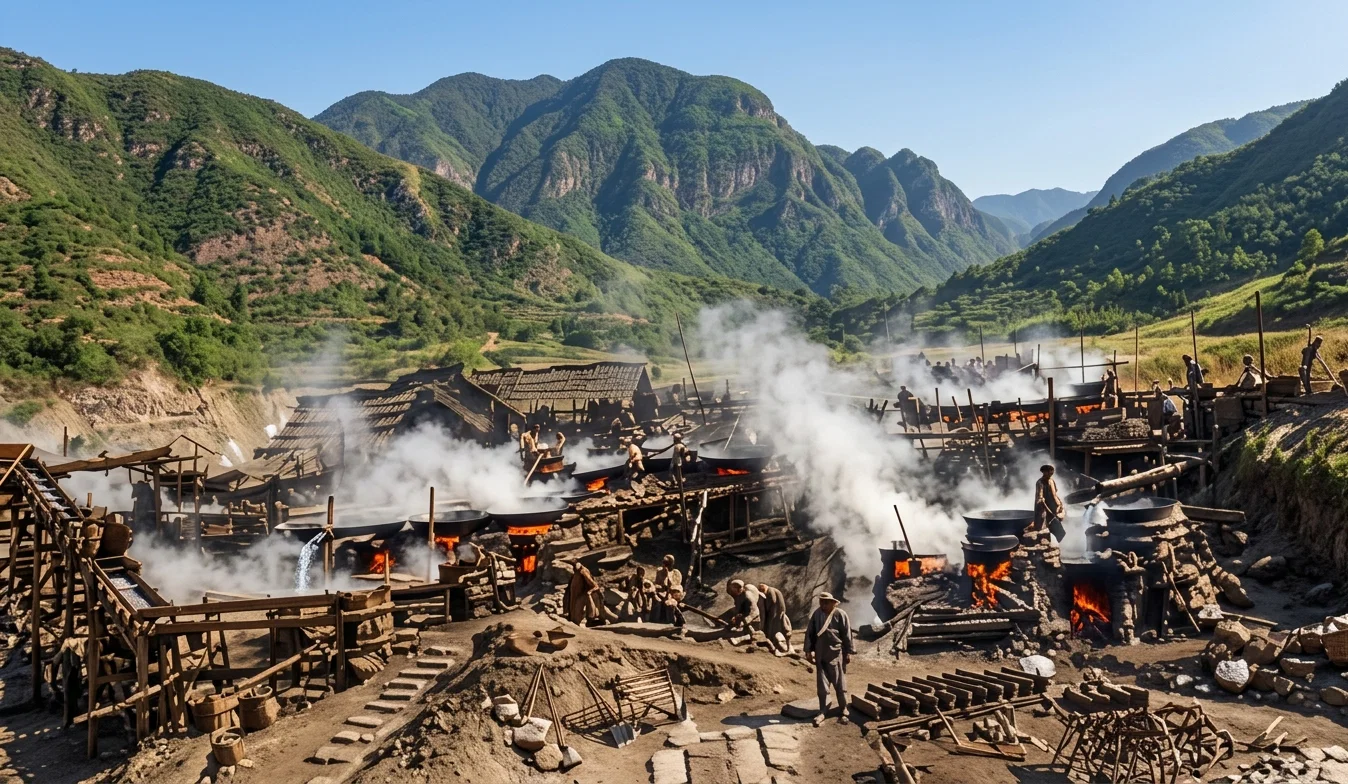
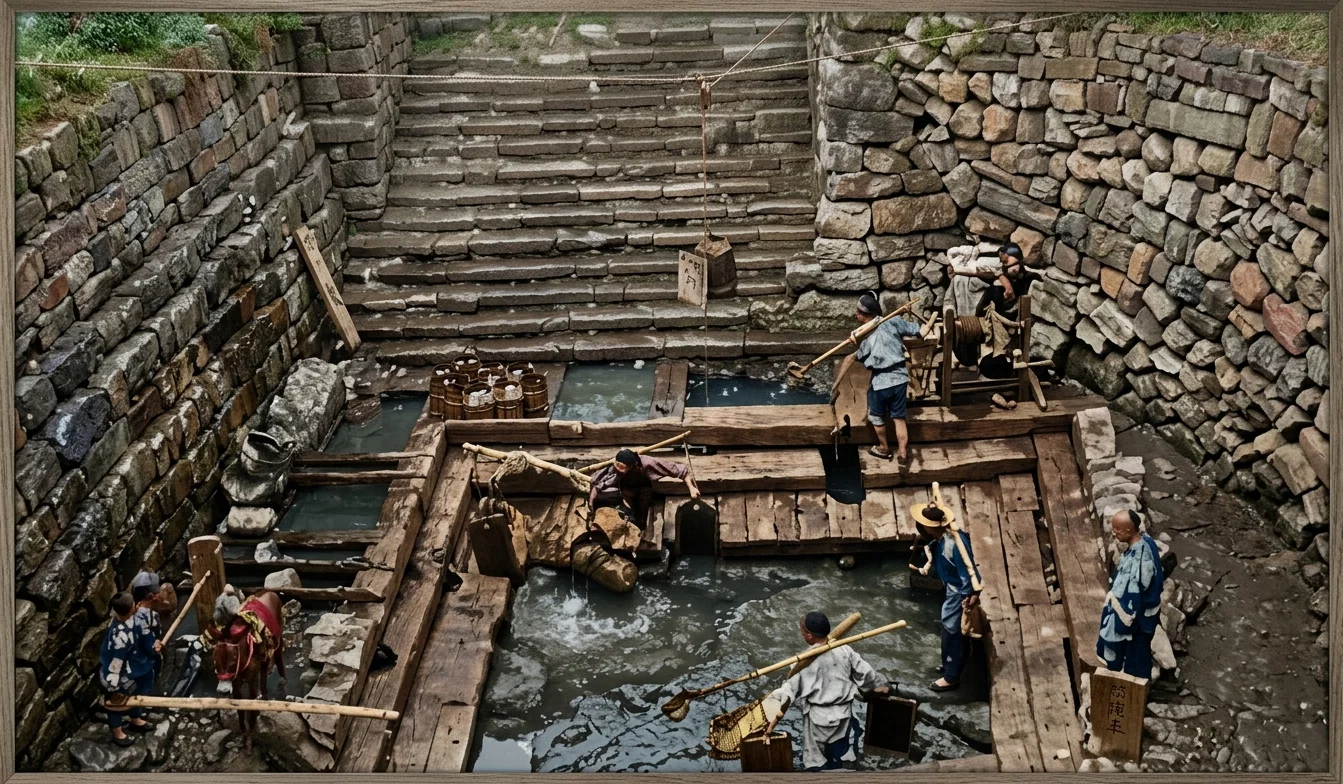
We arrived at Kwei Chow Fu about twelve o’clock. A little below this city is a celebrated brine well which is located on a small island, or sand bank. The salt water is dipped up in buckets and emptied into wooden troughs, through which it runs to large iron pans. There is enough brine to keep one hundred and twenty large pans constantly in use during the season the well is worked. One authority says that one million five hundred thousand pounds of salt are made annually. This island is above water only from January to May, and the manufacture is confined to those months.
In the city of Kwei Chow is a noted Roman Catholic church which is said to date from 1662. This shows how early the Papacy entered this part of China.
April 4. We stayed in a small market town over Sabbath. It is called An Pin, which means “rest” and “peace.”
We had Sabbath school at 11 A. M., and then organized the first Sabbath school in Szechuan. We elected Brother M. C. Warren superintendent, and Dju H. S., our Chinese evangelist, secretary. After this we entered the town, and the evangelist and I spoke to the crowd that soon gathered. The people listened well, and our own souls were refreshed by telling the story of the cross. In the afternoon I held a Bible study with a Christian from another boat, which was detained by adverse winds. We studied the three messages.
General view of salt industry at Kwei Chow Fu, showing the fires and steam arising from the large iron pans in which the salt is being refined.
April 5. We left An Pin early Sunday morning, and at 11 A. M. we passed another rapid; we finally anchored below the Shintu Lung rapid (the New Dragon rapid), which is considered the worst rapid in Szechuan, just as the Tsin Tan is considered the worst in Hupeh. This rapid constitutes the last formidable stepping-stone during low water en route to Chungking.
“It was formed by a landslip as recently as 1896, when the whole side of a hill falling into the stream reduced its breadth to less than a fourth of what it was previously, and produced this roaring rapid.
“According to Chinese myths, the landslip which produced the rapid was caused by the following circumstances: The ovum of a dragon was deposited in the bowels of the earth at this particular spot, which in due course became hatched out in some mysterious manner. The baby dragon grew and grew, but remained in a dormant state until quite full-grown, when, as is the habit of the dragon, it became active and at first awakening shook down the hillside by a mighty effort, freed itself from the bowels of the earth, and made its way downstream to the sea; hence the landslip, the rapid, and its name.”
The celebrated brine well at Kwei Chow Fu, Szechuan.
(Concluded next week)
The Passing of the Dreadnaught
It was only nine years ago, in 1905, that Great Britain started a new epoch in naval construction by the building of the first so-called dreadnaught. The appearance of this new and terrible fighting machine virtually consigned all the old battleships to the scrap heap, but it seems now that the dreadnaught itself, according to naval experts, has about served its purpose, and is no longer to be dreaded as formerly.
Admiral Sir Percy Scott, a hero of the Boer war, deals with this question in an article which was given the post of honor on the editorial page of the London Times. He argues that in the scouting aeroplanes, and particularly in the submarines, the dreadnaughts of the future will find competitors which will far outclass them in effective fighting power. Says this authority:—
In war time the scouting aeroplanes will always be high above on the lookout, and the submarines in constant readiness, as are the engines at a fire station. If an enemy is sighted, the gong sounds and the leash of a flotilla of submarines will be slipped. Whether it be night or day, fine or rough, they must go out to search for their quarry; if they find her, she is doomed, and they give no quarter; they cannot board her and take her as a prize, as in the olden days; they only wait till she sinks, then return home without even knowing the number of human beings that they have sent to the bottom of the ocean.
Will any battleship expose herself to such a dead certainty of destruction? I say No. Not only is the open sea unsafe; a battleship is not immune from attack even in a closed harbor, for the so-called protecting boom at the entrance can easily be blown up. With a flotilla of submarines commanded by dashing young officers, of whom we have plenty, I would undertake to get through any boom into any harbor, and sink or materially damage all the ships in that harbor. If a battleship is not safe either on the high seas or in harbor, what is the use of a battleship?