In the Literary Digest of Jan. 11, 1913, appears an article under the above title, which we consider worthy of reproduction entire. The importance of the Christian’s maintaining a right attitude toward that institution which is doing so much to undermine character, and turn the attention of the people away from divine things, can not be too strongly impressed. The article follows:—
A clergyman is quoted as saying that he goes to the theater occasionally, and would like to go oftener, but refrains for the sake of the young people to whom he has to act as a guide. Ministers who attend the theater from whatever motive must be more or less common in these days, for not infrequently we hear of performances at which they make up, by invitation, the entire audience. The motive of this particular one for not going oftener seems “very incongruous” to Dr. A. C. Dixon, who writes from London to the Examiner (New York). He takes the position that “if it is right and profitable for him to go to the theater at all, why should he not go often, rather than occasionally, since he frankly confesses his desire to do so?” The inconsistency of the minister’s attitude seems to Dr. Dixon to lie in his desire for his own pleasure, and his wish to guide the young into other channels for theirs. Dr. Dixon does not show himself a warm friend of the theater, but he puts an old position in a fresh light. Merely the restatement of such an old position helps us to see the question as a mile-post along the way we are traveling. He writes:—
“The minister doubtless means that he would guide them in selecting the best plays and would take them to the best theaters. Well, there may be some good plays, so far as acting a part can ever be good; but, so far as we have been able to learn by rather careful investigation, there are no good theaters. Sir Henry Irving tried to make the Lyceum a good moral theater, and failed. Edwin Booth determined to make his theater in New York such a place morally that parents might take their children to it without fear of contamination, with the result that the enterprise went into bankruptcy and the building was sold for a warehouse. Hannah Moore wrote some good plays, full of Christian sentiment, but they did not pay.
“We have been searching for a theater on earth in which a play that appeals to the baser natures of men and women is never acted, and we have not yet succeeded in finding one. The theater as an institution is bad, as is admitted by its friends, whatever may be the quality of occasional performances. When our ministerial friend leads his young people to the theater occasionally that they may enjoy together what he considers a good play, he may be assured12that he is leading them to the bait which is almost certain to allure them to the bad play also; and even if it does not, he has linked himself and them in association with an avowedly bad institution, and has violated the principle which the apostle Paul adopted in dealing with the question of eating meat offered to idols. Paul refused to do so, not because it would hurt him, but because it linked him with the great evil institution of idol-worship, and would thus lead to his loss of influence for good.”
Taking Sir Herbert Tree’s observation that “the church and the stage have now come together and are on friendly terms,” as a text, the writer retorts: “If so, it is not because the stage has been lifted to the level of the true church, but because the church has fallen to the level of the stage.” Dr. Dixon’s position is that “the difference between the church and the stage is an impassable gulf.” He goes on:—
“The purpose of the stage is to teach people how to act a part; the purpose of the church of Christ is to teach them how to be real. The purpose of the stage is to amuse; the purpose of the church is to save. The symbol of the church of Christ is the cross; the symbol of the stage may well be the baby’s rattle. The purpose of the stage is to make money, and managers are not slow to do so, even at the expense of good morals; the purpose of the church of Christ is to make character, and good morals are not for sale at any price. The stage gives what the people want, and, sad to say, the worst plays often draw the biggest crowds; the purpose of the church of Christ is to give what people need, regardless of its popularity. The stage ministers to ‘the lust of the flesh, and the lust of the eyes, and the pride of life, [which] is not of the Father;’ the purpose of the church of Christ is to crucify these things. The stage is a caterer; the church of Christ is a prophet. The stage in its tragedies glorifies revenge; the church of Christ teaches forgiveness of enemies and the patient endurance of wrong. The tendency of the stage is to make people childish in their feverish desire for diversion; the work of the church is to make people childlike in their faith and love and simplicity of character. The tendency of the stage is to keep the race in its childhood of self-gratifying amusement; the work of the church is to lead the race into the manhood of self-sacrificing achievement. The footlights are suggestive of the fact that the lower tendencies of human nature are there brought into prominence; the church of Christ would magnify the head-light and heart-light that reveal and develop the higher attributes of our being. In a word, the real church is the incarnation of the spirit of Christ, pure, humble, self-sacrificing, and forgiving; the stage is the incarnation of the spirit of the world, lustful, proud, selfish, and revengeful. And what God hath put asunder, let no man join together.”
Note and Comment
A Two-Edged Truth
THE Christian Statesman for February quotes approvingly the following statement from a recent number of the Presbyterian:—
So long as a nation or a civilization is obedient to the law which God has inwrought in the nature of things, and which he has revealed in its moral principles in the Holy Scripture, so long that nation will live and prosper. But when a nation ignores or disobeys God's laws, it violates the principles of its own life and the justice of God, and so, in time, destruction and decay overtake it, both by the way of natural consequences and by moral judgment.
But when a nation or a society or an individual not only ignores and disobeys God's law, but seeks to substitute a human law for a portion of God's law and to punish men by fine and imprisonment for choosing to obey God's law as it is rather than man's amendment of it, surely that nation or society or individual is doubly deserving of the divine displeasure. But that is the program which the National Reform Association has mapped out for itself, and that is the policy which the Christian Statesman stands for. As for us, we prefer to keep the law of God as he gave it, believing that “we ought to obey God rather than men.”
A Visit to the Abyssinian Mission
By L. R. Conradi
L. R. CONRADI
At Suez we had to wait until November 3 for the Italian boat “Etrurea,” from Naples, to take us to Massaua on the Red Sea. Although the Italian-Turkish war was in reality over, yet its restrictions were still to be felt. The Khedivial line, whose steamers touch on both sides of the Red Sea, during the blockade had not been running farther than Port Sudan, and therefore the Italian line, with its monthly service, was our only means of reaching Massaua from Suez.
OUR MISSIONARIES AT ASMARA
On the sixth, we stopped a few hours at Port Sudan, and on Friday, the eighth, we reached Massaua, where Brother P. N. Lindegren met us. There were several Italian men-of-war in the harbor, and several good-looking Turkish steamers that the Italians had captured, one of which was already doing Italian transport service. As there were several car-loads of Italian officers and soldiers on board for Asmara, a special train left Friday noon.
The distance from Massaua to Asmara is about seventy-five miles, the last thirty miles being up a grade of four thousand feet. The ascent from the coast to Asmara is over seven thousand feet. There are no less than twenty-nine tunnels, and the solidity of the road surely does credit to Italian engineering. In five and one-half hours we were transported from the hot shores of the Red Sea to the Abyssinian plateau, where a heavy overcoat is necessary to sufficiently protect one from the chilly evening air. All the workers met us at the train, and took us over to the mission, which is one and one-half miles from Asmara.
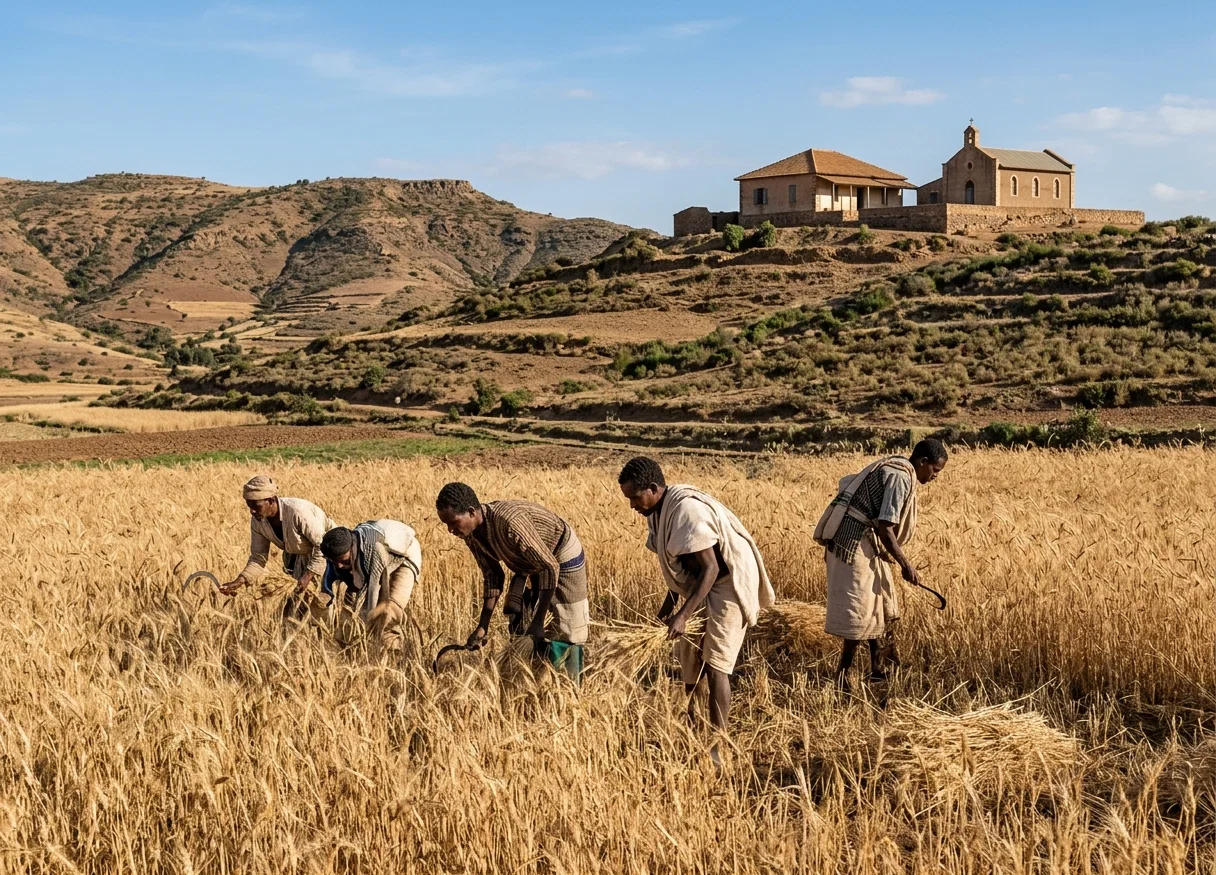
When we left Asmara three years ago, we had only secured the land and planned the buildings. Now the buildings are all complete and the land under quite good cultivation. We have about thirty acres of good wheat land, one of the best wells, a dwelling-house with lodgings for two missionary families, a schoolhouse with three rooms, and good buildings for barns, wagon sheds, storage-rooms, etc. God’s providence indeed led us in securing this property, and we should not know to-day where to secure a more favorable site for the mission.
The six days which Brother Guy Dail and I spent with the brethren were very busy ones indeed. We had councils with the workers, and laid still broader plans for the future. Our most efficient means for mission work here is the school, which has been in operation during the past two years, with from fifteen to thirty boys as pupils. Instruction is given in the Tigrinja language, which is spoken here, also in Italian and Amharic, and in the common branches and Bible. Many of the boys seem eager to attend the school, but they rather shirk heavy work. In planning the school for the coming year some important changes were made, and special stress was laid on the most efficient means of conversion, the work done with the boys in the missionary’s home. No visible results in conversion have appeared thus far, but we feel sure that if all work in unity and with due consecration and zeal, we shall soon see a change in this respect. Some time was also given to arranging for further language study for our own workers, and in preparing translations of our publications in these various languages.
HARVESTING ON THE ASMARA MISSION FARM
During our stay we had the privilege13of again calling on His Excellency, the governor of the colony, Marchese Raggi, and were received very cordially by him. He told us that an official of another European government, while visiting him, had, upon seeing our mission station, informed him that we were forbidden in his state because of trouble in the military service. This gave us a good opportunity to place the matter before him in its proper light, and at his own request we were able to present to him some of the distinguishing features of present truth.
We also called on the secretary of agriculture and upon the Swedish Lutheran Mission. This mission was established through great sacrifice on the part of those first connected with it, and has been actively at work in the colony for the past forty years. Its influence has been extending throughout Abyssinia. But trouble in the home church over higher criticism has also had its effect on the mission forces, causing a division, which surely can be only a detriment to the Protestant cause, especially where the Roman and Greek Catholics are doing their utmost to hinder the advance of Protestant missions. The Swedish missionaries have made the best progress in the Tigrinja language. Their small printing plant has produced a New Testament in that tongue, and quite a number of publications in five of the Abyssinian languages. The Roman Catholics have also recently opened a printing plant at Asmara.
Before we left Asmara, all the workers joined in the ordinances of the Lord’s house. We believe the outlook for the future is brighter. Elder Steiner, who will take charge of the mission, has a good knowledge of French. He intends soon to begin the study of Italian, and will gradually get hold of the native languages. Brethren Lindegren, Lorntz, and Öhmann will assist in the school and farm work at the station. The new school term runs from December till next autumn.
On the fifteenth of November, Brother Dail and the writer returned to Massaua, whence we sailed the next day on the Italian mail-steamer for Aden. For about thirty hours our boat followed the coast of Eritrea, touching at Assab, the second Italian seaport of the colony and of Abyssinia. This port evidently carries on a good trade with the natives of both the colony and Abyssinia. After a rough journey, we were only too glad by noon of the eighteenth to reach Aden.
From reliable sources we learn that King Menelik is still alive, but seems totally paralyzed. According to indications, there may be expected some changes in political affairs, and when they come they will surely tend toward the opening of closed Abyssinia to the truths of the everlasting gospel. Let us pray that this may soon be brought about, and that our workers may have much of God’s grace in pushing forward unitedly the work entrusted to them. Personally, we feel very grateful to God for the help he has rendered us.
The Cost of Losing One’s Temper
“He who loses his temper, loses much besides. He loses his self-respect; he loses the respect of others; he loses an element out of his character and reputation which he can not regain; he loses vital force, and stamps an impression on his whole being which time can not efface.”
Georgetown, British Guiana
By E. C. Boger
E. C. BOGER
RECENTLY we began special meetings here in Georgetown, and the interest is good. There are about twenty in the baptism class, and others are taking their stand.
The work in all parts of the field is onward, and we are of good courage in the Lord. We have some trials, but we thank the Lord for corresponding victories gained. There is great need of more workers and means to carry forward the work as it should be carried on here.
SEVENTH-DAY ADVENTIST CHURCH AT GEORGETOWN, BRITISH GUIANA
On a recent trip up the Demerara River to our mission at Bootooba, I had an interesting time. In nearly every house I visited there was sickness. We have the last church up the river, and still there are hundreds of persons living beyond this point. It is nearly impossible to reach them, however, without a launch. Then again, there are many living along the river below that can not be reached in any other way. We are praying that the Lord will open the way for us to have a launch here. After having been here over sixteen months, and having been over the field everywhere, I am convinced that the best way to reach these people in this field is with a launch.
The mission at Bootooba is looking splendid. The rubber-trees are doing well, and the teacher's husband has been planting cassava, from which we expect to receive about seventy-five dollars this coming year. There were several there to be baptized, but almost all were sick with fever.
The Protestant Magazine is doing a good work, and we hope to sell many. Life and Health also takes well. Our books are selling in spite of the drought. For a long time we have had very little rain; in fact, it has not rained much since we have been here.
We are surely living in the last days. As it now appears, it would seem that the four angels were about to let loose the winds of strife and war. We are praying that they may be held a little while longer, for there are thousands here yet to hear this message.
It does not seem that we are in the midst of winter. I am sitting in the gallery of the church writing, with my coat off and the windows open, yet I am warm.
We were glad to get the week of prayer REVIEW on time this year. After the good season of last year our people have looked forward with pleasure to this gathering, and I am sure we shall have a good time.
Since I last reported, we have reopened our church here, after adding on in front eighteen feet and putting in ceiling overhead. It has also been painted inside and out. We have a very nice building, and our people look upon the work in a different way from what they did some time ago. On the opening day many strangers were present. Just recently I presented a petition to the mayor asking for exemption from taxation. Our petition has been granted, and some good remarks are being passed about the work carried on by this people.
Pray for us that we may be faithful to Him unto the end. It is surely a great privilege to live in this age of the world's history, the age in which we have the promise that we shall see the Saviour come in his glory. There is a great work to be done here. Yours in the blessed hope.
Kolo Mission, South Africa
By E. C. Silsbee
E. C. SILSBEE
WE have been here on the mission just two months now, and it is certainly gratifying to look out and see how greatly the Lord has blessed us in the work even in that short time.
The plowing for the mission is finished and part of the planting done. We have finished sowing field mealies and oats, and have begun to plant garden vegetables. The fruit-trees have about finished134blooming, and we have the promise of a fair crop of fruit, all things considered. We have some new iron gates coming, which we plan to put in the fence wall where the old wire gates were; we have begun also to repair the fence wall itself, which, when all completed, we hope will be a successful barrier against the herds of horses, cattle, sheep, goats, swine, and flocks of fowls that swarm the country. At first we were often troubled with the mission’s being overrun with these domestic animals, and I spoke several times to our district chief Mohalefe about it. He tried to help us all he could by telling his people to herd their cattle toward the other side of the mountain.
This last Sabbath sixteen of his people, including himself and his wife, came to church services, and said that they were also coming next Sabbath, to ask us to pray for rain. Chief Mohalefe has control of a large number of villages on this side of Kolo Mountain and vicinity, and is therefore widely known. He has lived near the mission for a long time, knows much of present truth, and is quite favorable toward it, but still allows his habits and love of the world to keep him from accepting it.
It would do your heart good to be in our Friday night meetings, and hear the earnest testimonies of each and every one of the mission family, each striving to overcome his or her personal sins, and at the same time willing and anxious to help bear the burden of giving the gospel to all this nation “in this generation.” Do you think ours a small task? I am sure you would not if you could get before your mind’s eye the picture of a country with from one to five thousand villages, containing four hundred thousand people, practically all of whom must hear the message, with but two white and four native workers, with their families, to finish this work. “The harvest truly is plenteous, but the laborers are few; pray ye therefore the Lord of the harvest, that he will send forth laborers into his harvest.”
Recently I had a Bible study with a native minister, which occupied the greater part of one day before dinner. This man has charge of fourteen missions with their ministers, and he has been studying a few of the points of our faith for some time. He said he came to ask about many points that were not clear to him even when explained by the white ministers of his denomination. The most important of these were the history of Sabbath and Sunday, the state of the dead, and the significance and true method of baptism. At the end of the study he questioned me as to how much our church could allow him for his having been ordained as a minister in his church in England; and after I had answered all his questions as best I could, he took his departure, saying we must be ready to receive him, for soon he would return, and, if possible, bring all his ministers with him to be baptized into our church. Pray for the work in Basutoland.
Fuel Foods
By A. B. Olsen
Their Selection, Composition, and Preparation
A. B. OLSEN, M. D., D. P. H.
About ninety per cent of the food required by the body consists of sugar, starch, oils, and fats, which are speedily burned in the human furnace for the production of heat. The value of these fuels is usually measured by calories. The heat required to raise one gram of water one degree Centigrade is known as a lesser or gram calorie. Whether these fuels are burned outside of the body in an ordinary fire, or inside the body, they produce heat as follows:—
One gram of sugar or starch produces 4,100 calories.
One gram of fat or oil produces 9,300 calories.
A certain proportion of this heat, about fifteen to twenty per cent, is always available for work. It will be noticed that oils and fats are more than twice as valuable fuels as sugars.
Selection of Sugars
Sugar foods are obtained only from the plant kingdom, with the exception of the sugar contained in milk, and hence called milk-sugar. The flesh of animals, including birds and fish, is practically free from sugar. There are several varieties of sugar, the most important being fruit-sugars of various kinds and cane-sugar. Sugar is most abundant in fruit, and there are few varieties that do not contain at least a small percentage. Ordinary grapes contain about fifteen per cent, but some special varieties have been found to contain as much as twenty, twenty-five, and, rarely, even thirty per cent. Many of the vegetables also contain sugar, chiefly cane-sugar, which is found sufficiently abundant in the sugar-beet to make its cultivation worth while for the production of sugar. Carrots, turnips, and artichokes also contain cane-sugar. A great many nuts, especially the Italian chestnut, contain traces of sugar.
Grape-sugar is found in grapes and in many other fruits, and is generally regarded as the most delicately flavored, the sweetest, as well as the most easily digested, of all sugars. Dr. Burney Yeo tells us that grape-sugar is a predigested food, and this is also true of most fruit-sugars. Grape-sugar, as soon as it is extracted from the grapes, is ready for assimilation into the blood. We accordingly find ripe grapes an excellent natural stimulant and tonic, and the grape-cure has been found most successful in dealing with many chronic digestive disorders.
What we have said about natural sugars found in grapes and other fruits does not apply to cane-sugar, which is the ordinary sugar found on the table. Cane-sugar, unlike grape-sugar, requires special attention from the digestive organs before it is fit for assimilation by the blood. Cane-sugar is a concentrated food, and this of itself is a disadvantage, there being a great temptation to take it too freely. A diet consisting largely of fruit usually contains all the sugar that the body requires, and cane-sugar might be avoided to advantage, or at least used sparingly.
Starches
When we come to deal with starches, we find that again we must turn to the plant kingdom for these most useful and important foods. It is true that the livers of most animals contain a small amount of glycogen, a variety of starch, but the quantity is so small that for all practical purposes we can neglect it. Furthermore, we can think of no more unwholesome and undesirable starch than that found in the liver of animals. It is interesting to note in this connection that in the process of digestion all starches are changed into a sugar that is practically identical with grape-sugar, before they are fit for assimilation. Therefore, putting sugar on porridge or rice really means adding sugar to sugar. Such a combination, when milk is added, is prone to acid fermentation, with the production135of flatulence and heartburn and other digestive disturbances, and it should be avoided. In selecting the diet, one should consider the requirements of the body and the welfare of the digestive organs, and not merely the dictates of a more or less perverted appetite.
In their natural state most starches are insoluble, and therefore indigestible; hence they require the application of heat in some form, or cooking, to make the starch digestible. Were we to examine potato starch or any other form of starch with the microscope, we should find that the starch is contained in tiny, tough wooden sacs, which offer great resistance to the solvent power of the digestive juices. The heat of the cooking process causes the starch in these little sacs to swell until the sacs are broken, and then the starch is readily changed into sugar by the digestive juices. This explains why all starchy foods require cooking in order to make them wholesome and nourishing. Raw starch is of little if any value to the body, and always puts a great tax upon the digestive organs.
With very few exceptions all plant foods contain a varying quantity of starch, but the cereals are particularly rich in this foodstuff. Rice, for example, contains little in the way of nutrition except the starch; while wheat, barley, and other grains contain a very large percentage. Among the vegetables the potato is the richest in starch, and among nuts the Italian chestnut. We believe that starch should form the bulk of our food. We know that it is the least expensive of all foods, and we also know that it is one of the most wholesome and easily digested foods.
Oils and Fats
The richest and most concentrated fuel foods are the pure oils and fats, and we find that, while the human system benefits from their use, it is wise to take them sparingly. Oils can be obtained from either plants or animals. There is no controversy whatever as regards the wholesomeness and suitability of vegetable oils for the sustenance of the human body. Indeed, there is good evidence to believe that plant oils, being more pure and less likely to be associated with disease, are, as a consequence, more wholesome and better adapted to the requirements of the body than animal oils. Vegetable oils are in every sense quite as nutritious and quite as easily digested as animal oils, if not more so; and they are certainly distinguished by greater purity. Among vegetable oils one of the most acceptable and valuable is olive-oil, which, unfortunately, is rather expensive. Then there are numerous nut oils, such as coconut-oil or coconut butter, as well as various other nut butters, all rich in oil. The vast majority of nuts contain fifty per cent or more of pure nut oil. Linseed-oil is also a useful fuel food.
Milk and eggs contain a certain amount of fat. If the milk is pure, cream makes an excellent fat, but as a rule it is contaminated with more or less dangerous germs. Pure fresh butter is another fuel food, but altogether too often the butter on the market is not fresh, and many times not even pure. Rancid butter is dangerous to health, and it would be a great deal better to avoid dairy butter entirely than take it in the rancid state.
On account of the great concentration of the nuts and oils, they should be taken only in limited quantities. It is a well-known fact that too much fat or oil is very likely to cause mischief by upsetting the liver and bringing on a bilious attack, or by causing some other disturbance of the digestive organs. We think that an ounce and a half, two ounces, or two and a half ounces daily is as much as the body can use to advantage under ordinary circumstances.
The next article in this series will deal with "Tissue Builders; Their Selection, Composition, and Preparation."
Caterham, England.
Christ’s Triumph
By N. W. Vincent
N. W. VINCENT
CHRIST looks with pity on his loved ones
dead;
He yearns to come and clasp them to
his breast.
For them so long have bitter tears been
shed;
Still from their toils and pains the dear
ones rest.
How vast their numbers! Exploits they
have done;
What scoffs, what tortures, borne for
his dear name!
Christ’s righteousness for raiment white
they won;
Through faith in Jesus’ blood they
overcame.
Now in the temple of our Priest and
Lord
Their deeds and ours are into judgment brought;
Christ owns his friends. How great
their sure reward!
May such, dear reader, be our happy
lot!
The Noon-Hour Prayer
“Evening, and morning, and at noon, will I pray, and cry aloud: and he shall hear my voice.” “And the Lord turned the captivity of Job, when he prayed for his friends.”
Answered Prayer
“I HAVE been impressed to tell of God’s healing power as manifested in my own experience,” writes Elder S. A. Oberg, now laboring in Porto Rico. “Three years ago I was taken with acute neuritis. Home remedies failing to afford relief, my wife took me to the Philadelphia sanitarium. The excellent care I received there resulted in a gradual improvement, when a change of weather brought back all the old pain, and drove me with renewed consecration to God. I had been at the institution five weeks. I had promised to deliver a number of books the next week. The work had already been delayed because of my sickness, and I felt that I could not let it go longer. While seeking the Lord I was impressed to call in the elders of the church. The following day they came, and while they were praying for me the pain entirely left. Although I had hardly been able to walk, yet the next day I returned home, and the following week made the delivery, God richly blessing my work.”
Writing from Kansas, a sister who several weeks ago asked prayer that she might regain her health, says:—
“I had been suffering with spinal trouble for over a year, and much of the time was unable to get about without the aid of a cane. Physicians gave me no relief, although I spent nearly eight months at a sanitarium. Then help was sought of the divine Physician, and I am glad to tell you that he has heard our prayers. I laid aside my cane and have been walking without it. I have been slowly gaining strength, but am still weak, and ask that you join with me in praying, if it is God’s will, the healing balm of Gilead may be given me in full measure.”
Requests for Prayer
71. A pathetic plea comes from an isolated Iowa sister, who wishes us to pray that she may be healed of rheumatism, and that her sister, who has just accepted this truth, may have strength to remain steadfast in spite of the bitter opposition of her family.
72. A friend in California, who has recently identified herself with this people, makes the request that prayer be offered for the conversion of her two sisters; and for herself that she may have courage to do right in the face of opposition.
73. Another California sister writes: “Please pray that, if it is God’s will, he will restore my nerves, so that I may be able to read and teach others this truth; also that he will save my children.”
74. A brother in western Pennsylvania wishes special prayer for his eleven children, five of whom have married out of the truth.
75. A sister residing in Kansas asks that we remember her sister, who must undergo a very critical surgical operation. She wishes us to pray that the operation may be successful, and that the sick one may give her heart to Jesus and be wholly reconciled to his will.
76. From the same State (Kansas) a mother writes requesting prayer for the conversion of her daughter who has given up the truth.
77. From far-away India a sister sends the request that the members of the noon-hour prayer circle plead with God for the conversion of her husband.
78. An afflicted sister in Wyoming desires that prayer be offered for the healing of herself and daughter, and for the conversion of her three children who know and believe this truth, but make no profession of Christianity.
79. A burdened mother, writing from Texas, asks prayer for the conversion of her four children,—two sons who have never accepted this truth, and two daughters who have lost their first love and gone out into the world.
80. “I most earnestly desire the prayers of God’s people for my parents and brothers and sisters, that they may accept this blessed truth before it is too late. Please join with me in praying for them,” is the request of a Nebraska sister.
81. A sister in Oregon asks prayer that she may be willing to yield herself unreservedly to God, and make confession of sins that she knows are hindering others from accepting Christ.
82. From Missouri an anxious husband and father requests prayer that members of his family now estranged may be united in love for one another and for this blessed truth.
83. Another brother in the same State (Missouri) desires us to pray that he may be delivered from a loathsome disease and given physical and spiritual strength for God’s service; also that his son, a young man of promise, may be freed from the entanglements of political science and human philosophy, and brought into the love of this message.