The Youth’s Instructor, Vol. 31, No. 52.

THE FROZEN NORTH

The Youth’s Instructor

Dec 26, 1883

S. D. A. Publishing Association · Battle Creek, Mich. · Dec 26, 1883

THE FROZEN NORTH.
Far away to the north of us stretches a land of ice and snow of short summers, and long long winters, where the night lasts for months. For centuries no one knew that people could live in this cold country; but after a while the Scandinavian sailors began to explore the northern coast of Europe, and even to go across the Atlantic to the north-west; and among other places, they visited Greenland, where, we are told, they planted colonies.
Many years after this, the English became anxious to have a share in the far-famed riches of India; but because the Pope had assigned one of the two routes to the Portuguese and the other to the Spaniards, they had no way to get there; so they determined to find out if there was not a more direct passage to the north-west, around the northern coast of America. But the frail sailing vessels of those times were not strong enough to wrestle with the rough seas, the driving storms, and the ice that they were obliged to encounter in forcing a passage through to the Pacific; and the English failed in accomplishing their object. After a while other expeditions, with stronger ships and better preparations, succeeded in finding the north-west passage, but on account of the ice that filled it for the greater part of the year, it did not prove to be a practicable route to India. No expedition has yet been able to reach the north pole, though in the face of great difficulties and with much suffering, great efforts have been put forth to do so. One company sent out by the British government in 1875, came within four hundred miles of it, which is the most northern point that has yet been visited by the white man.
These explorers have left on record many interesting descriptions of the frozen North and its strange people, called the Esquimaux, who inhabit the Arctic coast of North America, extending from Greenland and Labrador to the extreme eastern point of Asia. A voyager, in the time of Queen Elizabeth, describes these people as “strange infidels, whose like was never seen, read, nor heard of before: with long black hair, broad faces and flat noses, and tawny in color, wearing seal-skins, the women marked in the face with blue streaks down the cheeks, and round about the eyes.”
The Esquimaux men are a little below the average height, while the women are shorter. Owing to their constant exercise in harpooning the walrus and seal, they are strong and well developed. Their hands and feet are small and well shaped. The women plait their glossy black hair in tasteful braids, and, were it not for a decided disinclination to wash their faces, would have a warm, clear complexion, but little darker than a dark brunette’s.
The dress of the men and the women is very much alike, and is made less for beauty than for comfort. It consists of two suits of fur, the inner one made of soft fur, with the fur side in; the other suit has the fur side out. The only difference in the dress of the men and women, is that the women’s jacket is a little longer, and the hood, in which they often carry their children, is larger. The women are very skillful in making neat skin boots, perfectly water-tight, and lined with the feathered skins of birds.
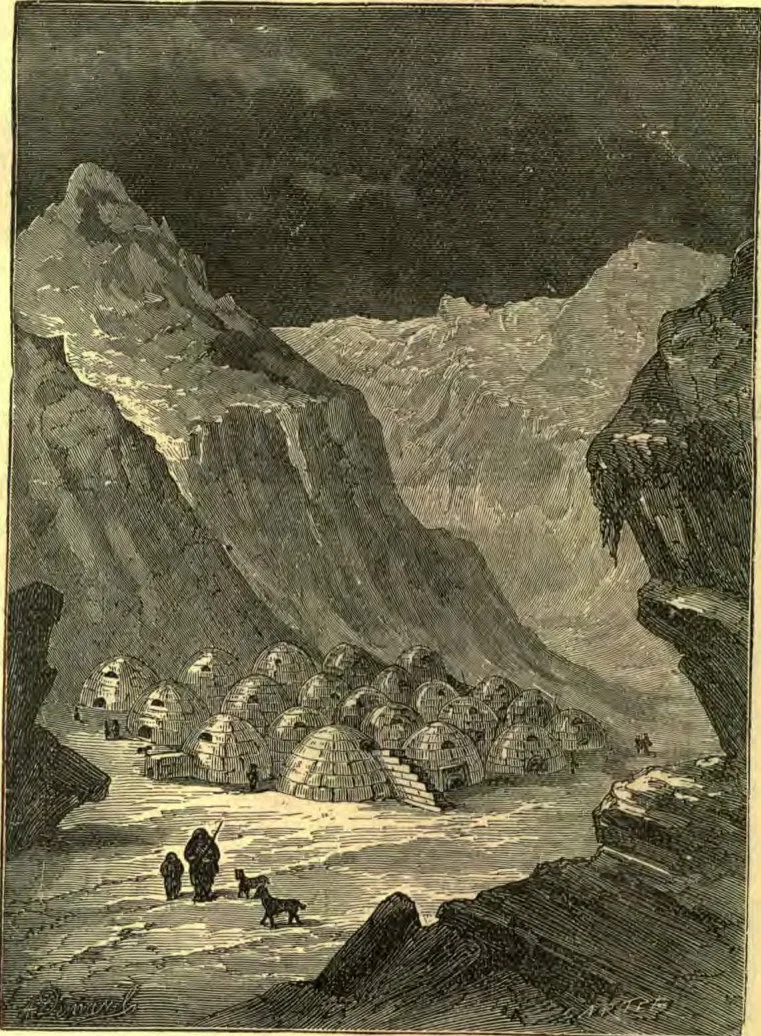
When the tribes move southward over the ice on their seal hunts, they build strange houses, never seen anywhere else in the world. They first trace a circle on the level snow; they then cut the frozen snow inside this circle into slabs to be used in building the sides of the house, the smooth level ice below forming the floor. All the crevices are closed by loose snow thrown over the house. The walls are only three or four inches thick, and admit a soft light, but a window of transparent ice is usually set in. Two men generally work together, and when the dome is completed, the man on the inside cuts a low opening, and creeps out. A passage leading to this opening is built so as to keep out the cold air, and covered passages often lead from one hut to another. Their tables, chairs, and couches are all made of snow, and the latter are covered with skins to make them more comfortable. The heat produced by the body makes the hut sufficiently warm. A lamp of walrus bone, in which oil is burned, gives all the heat needed to dry the wet boots and clothes. It takes them no longer to build one of these houses than it would to pitch a tent. One traveler, by giving a few nails, hired two Esquimaux to build him a hut eight feet long and five and a half feet high, which was finished in an hour. Our picture gives a good view of one of these snow villages, sheltered by huge icebergs. Not all the houses of the Esquimaux are made of snow. Many are made of stone, earth, or driftwood; and when in summer the sun becomes so hot as to melt their snow homes, they pitch seal-skin tents in their stead.
The Arctic lands are not wholly destitute of vegetation; in the short summer, that is only one long day, the few plants ripen rapidly, but not enough grows to sustain life. The people depend for their living mainly on hunting and fishing, and are constantly moving from place to place, as the animals are driven by the cold from north to south. They travel by means of the sledge, a sled made of the bones of animals and covered with skin. The runners are made of the polished ivory of walrus tusks. With only his rude tools, it takes the Esquimaux a long time to make a sledge, and it is carefully repaired and handed down from generation to generation. These sleds are drawn by dogs, that look very much like the wolf of these polar regions. The principal difference between them is that the dog carries his tail erect, while the wolf hangs his down. On these rude sleds the Esquimaux make long journeys over the ice and snow.
Their boats, or kayaks as they are called, have a light framework of bone, covered water tight with skins. In an opening in the center the boatman takes his seat, drawing around him a water-tight skin sack in such a manner that if the boat were upset in an open sea, no water could enter it. The oomiak, or woman’s boat, is made in the same manner as the kayak, but is large enough to hold ten or twelve persons. It is considered a disgrace for a man to row in such a boat. When they first saw Englishmen rowing together in a boat on the polar seas, they took them for women, and were anxious to know if all English women wore long beards.
The Esquimaux show to the infirm or aged the same lack of respect found among other savage tribes. If in their journeys any are too feeble to go with the rest, they are unfeelingly left behind to perish. Their children are, however, very docile and obedient, and the parents display a strong affection for them. To be called a thief is as much of a disgrace among them as among us, and they will never take anything from one another; yet they suffer no twinges of conscience in stealing from a white man.
This people have no laws, yet they are very orderly. If any fall into a quarrel, they settle the matter by boxing, or by taking their troubles to the priest. The head of the family rules only so long as he is able to hunt successfully. When his strength fails, he is made to stay with the women, and row in the oomiak. They are superstitious, and even in Greenland, where, through the efforts of missionaries, some of the tribes have professed Christianity, the old legends secretly hold full power over many. W. E. L.

THE OLD YEAR.

Last night, when all the village Was lying white and still, With starlight in the valley, And moonlight on the hill, I wakened from my dreaming, And hushed my heart to hear The old clock in the steeple Toll out the dying year.
They say that when the angels The blessed new year bring, The souls that wake to listen Can softly hear them sing The same melodious anthem Of peace and love on earth, That told to Judah’s shepherds The dear Redeemer’s birth.
No sound came through the silence, But waiting there, I thought Of all the gifts and blessings The year to me had brought, And something sang within me, “O happy heart! to-day Remember all who sorrow, And wipe their tears away.
“So, in that solemn morning, When first thy feet shall stand Where dawn in light unshadowed The years of God’s right hand, These words of benediction Thy welcome home shall be, ‘Thy deeds of love and mercy Have all been done to Me!’”
—Selected.

PRESENT DUTY

Written for the INSTRUCTOR.

PRESENT DUTY.

We often hear people make good resolutions, and express a determination to make their future life better than their past has been; and no doubt they mean what they say. Yet after a time we hear the same persons telling of failures, or expressing feelings of discouragement, and we wonder why it is. Can it be that their dreams of self-improvement place the time for beginning the work so far in the future, that present opportunities pass unnoticed?
Every day has its tasks, and every hour its duties; so there can be no time in life when any can say, “I have no duty.”
It may be that we have only a floor to sweep, a fire to build, or the dishes to wash; but if these things become our present duty, we should give them the same prompt attention that we would give to more difficult tasks. If we neglect the little things, we will soon neglect greater ones,—not intentionally, perhaps, but because we have grown so careless that we do not see them; and if we neglect ordinary duties, we shall be very likely to neglect our duty in the service of God. Our enjoyment of religion and our progress in the divine life, depend very much on our faithfulness in performing little duties. ELLA MERRY.

“WITH ALL YOUR HEART.”

ONLY FEAR THE LORD AND SERVE HIM IN TRUTH WITH ALL YOUR HEART; FOR CONSIDER HOW GREAT THINGS HE HATH DONE FOR YOU.
BEHOLD, TO OBEY IS BETTER THAN SACRIFICE.
I HAVE FOUND DAVID MY SERVANT; WITH MY HOLY OIL HAVE I ANOINTED HIM.
THE BATTLE IS THE LORD’S.
Annie Clark read the first verse over the second, even the third time, with a cloud on her face. Then she spoke to the duster in her hand,—“There are plenty of people who can serve Him, but I don’t see how I am one of them. Sweeping, and dusting, and setting tables, and cutting pie, and seasoning turnips and potatoes, and waiting on children: that is my work.”
Her lip curled a little, it looked like such mean work. There were so many things she wanted to do! For instance, on this Thanksgiving day she would like to put on her new brown suit and her new hat, and go to church, and sing in the anthem that the Sabbath-school was going to give just before the sermon; but this she could not do, for the turnips were to be peeled as well as seasoned, so were the potatoes; and Uncle John and Aunt Sarah, and all their hungry children, were to be there to dinner, all of them either a good deal older or a good deal younger than Annie, so that she did not look forward to having much pleasure in visiting with them.
The rest of her thoughts she kept to herself, and went on dusting the parlor, but with the cloud still on her face. She would not have dared to say, in words, that it did not seem to her as though “great things” had been done for her; but that is the way she felt. Thirteen years old, the oldest daughter, with a taste for drawing and a taste for study; yet she unable to do as the other girls did, and go to school, because it would “cost so much,” and “business was so poor,” and the family was so large.
There was a long streak of black on the window seat. Annie rubbed vigorously; it looked as though she would have to go for soap and water. While she worked over that spot, a carriage went by—a carriage of peculiar shape—black, with nodding plumes all about it, and drawn by white horses. The hearse! She knew whither it was going. The Morgans, who lived only a few blocks away, had not so large a family now; there would be more time in that house. Little Sadie would be carried out to-day in the hearse, and left in one of the cold receiving vaults at the cemetery. Annie shivered as she thought of it. What if it were their little Kate? She took up a great deal of time, so did Ned. What would the house be without them? How still it must be at the Morgan’s: “Consider how great things He hath done for you.” The words came back to her, as she stopped her rubbing to follow the hearse. Yes, He had; she could hear at this moment the glad shouts of Ned and little Kate.
Some way, after that, Annie’s face grew clearer. Quiet she was, for awhile, but presently she trilled a little song as she worked. “Serve him with all your heart;” she said those words over. What, by paring potatoes, and keeping up fires, and setting table! Yes, just in those things. Didn’t the Bible say, “Do with thy might whatsoever thy hands find to do”? and didn’t it say, “Whatsoever ye do, do all to the glory of God”? She would try it on this Thanksgiving day. There was much to be thankful for, even though she could not study drawing nor French. The Lord had done great things for her. The more she thought about it, the more things came trooping up to be considered. So she sang over her work.
Down in the kitchen her mother was saying with a sigh, “I suppose Annie is dreadfully disappointed about not going to church to-day and singing with the girls, but I don’t know how to get along without her.”
Just at that moment Annie’s voice rolled through the house, reaching to the kitchen. A snatch from the anthem. “Consider,” it said, “consider how great things, how great things he hath done!” Over and over the triumphant strain repeated, and the father, listening, smiled as he said, “She doesn’t seem to be very broken-hearted; that voice doesn’t sound like it.”
“Busy?” I think you would be sure of it if you could have looked on her. Uncle John and Aunt Sarah, and all the little “Johns” and “Sarahs,” had splendid appetites; besides, there were the Marshalls, aunt and cousins and friend; and, to make matters more busy and bewildering, there was a bride, quite new to the family, coming with the Marshalls. Mrs. Clark was hurried and nervous. She had only poor help in the kitchen. But there was one who had enlisted to-day with her whole heart.
“Dear me, Annie! how late it is, and they will be here in a little while, and there is the parlor in confusion.”
“Don’t say that, motherie; the parlor is spick and span. Even Aunt Sarah can’t find any dust, if she puts on two pairs of glasses.”
“O Annie! I forgot the front hall. And the rubbers and umbrellas are there from the storm, and the children’s rubber cloaks. That ought to be put in order right away.”
“Done, mother. The front hall is neat as a pin.”
“Annie, dear, do you suppose you could get time to light the fire in the back parlor?”
“Oh, I lighted it when I ran up to answer the bell a few minutes ago. I saw it was getting late.”
Now that is just a little hint of the way things went all that day. Annie had not always been on hand “with her whole heart,” and it made the greatest possible difference. At every turn were traces of those busy hands. Little Kate’s hair, that the mother nearly always had to curl because Annie hated to do it, and pulled so that Kate always cried, got itself curled as if by magic, and the two youngest children appeared in the parlor in due time, with smiling faces and perfect toilets. Then, when the mother rushed out in dismay, lest the table would be late for the dinner, she found it complete in all its appointments, not a spoon or fork lacking.
As the busy day wore on, Annie became interested in the experiment of working with all her heart. How many steps could her heart save her mother? That became the problem at which she worked. It seems almost a pity that she could not have heard the mother, as she dropped into her chair at the end of that long, exciting day for a moment’s breath, and a word with father, say, “What I should have done without that blessed child to-day, I don’t know. She has been hands, and feet, and eyes all day. I couldn’t begin to tell you of all the things she has thought of, besides the hundred I have set her at.”—The Pansy.

THE MORNING PSALM.

“READ us a psalm, my little one.” An untried day had just begun, And ere the city's rush and roar Came pressing through the closed home door, The family was hushed to hear The youngest child, in accents clear, Read from the Book. A moment's space— The morning look died from each face— The sharp, keen look that goes to meet Opposing force, nor brooks defeat.
“I will lift up mine eyes,” she read, “Unto the hills.” Who was afraid? What had that psalm of pilgrim life To do with all our modern strife? “Behold, he that doth Israel keep Shall neither slumber, nor shall sleep. The Lord thy keeper is, and he The shade on thy right hand shall be; The sun by day shall not thee smite, The moon shall hurt thee not by night.”
And the child finished the old psalm, And those who heard grew strong and calm; The music of the Hebrew words Thrilled them like sweet remembered chords, And brought the heights of yesterday Down to the lowlands of to-day, Seeming to lend to common things A mystery as of light and wings; And each one felt in gladsome mood, And life was beautiful and good.
Then forth, where duty's clarion call Was heard, the household hastened all, In crowded haunts of busy men, To toil with book, or speech, or pen, To meet the day's demand with skill, And bear and do, and dare and will, As they must who are in the strife And strain and stress of modern life, And would succeed, but who yet hold Honor of higher worth than gold.
These are the days of peace, we say, Yet fiercest fights are fought to-day; And those that formed that household band Had need of strength, that they might stand In firmness and unruffled calm; But sweetly did their morning psalm, Amid the clamor loud and long, Like echo of a once-loved song, Rise to their hearts and make them strong.
At close of day they met again, And each had known some touch of pain, Some disappointment, loss, or care, Some place of stumbling, or some snare. “And yet the psalm is true,” said they, “The Lord preserveth us alway; His own were safe in days of yore, And from this time and evermore, If skies be bright or skies be dim, He keepeth all who trust in him.”
—Marianne Farningham.

GOOD-BYE TO THE OLD YEAR

Written for the INSTRUCTOR.

GOOD-BYE TO THE OLD YEAR

We speak it very tenderly, With half a sob and half a sigh— ‘Old Year, good-bye! Old Year, good-bye!’ For what it brought and what it takes, We love it, and for loved ones’ sakes; Prized for its hour of happiness, Nor for its sacred sorrows less; For all it gave through toil and strife Of new significance to life. Accept our thanks, Old Year, for these, And for all precious memories Of love, of grief, of joy, or pain, Whose ministry was not in vain!”
Another year has almost run its sands. A few more times shall we write 1883, and then the Old Year will be laid away in memory’s grave, along with our other dead things. True, he has taken from us some things, which, stretch we our hands ever so eagerly, we can never bring back; yet, withal, he has brought us manifold blessings, for which we will not forget to render thanks. And how strange it seems that in these his last days, when death is staring him in the face, the Old Year should be so cheery and smiling. He certainly manifests a far different disposition than most of his predecessors, and one which we might all do well to imitate.
None of us can look back over the past twelve months without pain. We are sad when we see how many of our good resolutions we have failed to keep, and how poorly we have improved the golden opportunities of life; for who of us can turn three hundred and sixty-five clean pages in our life book? But all our weeping will not bring back a single day nor undo one mistake. We can only heartily repent of our failures, and leave them in the hands of the God of our years.
A new year now stands waiting just without the door to greet us. He comes bright, with the freshness of youth and of hope. And to each of us he whispers, “I have a work for you to do!” It may not be a great work, nor one that will attract any attention in the world,—only something very humble and perhaps not at all in keeping with our desires,—but if we do it just as well as we know how, it may be a good work, although not a great one. It is the spirit with which it is done rather than the amount of our work which makes it acceptable with God. One thing, though, we must remember: that our hardest work will ever be in conquering self and putting away our own sinful thoughts and desires.
Ere another closing year, some of the INSTRUCTOR band will be missing—who or how many we cannot tell. Not one of us knows but our name may be among the missing ones. Shall we not strive harder than ever before for purity of life and character? What a glorious thing it would be if the ten thousand members of our family could live together on the new earth! And with this wish, we bid the Old Year and you all a last “good-bye.” Eva Bell Giles.

NEW-TESTAMENT HISTORY.

LESSON 167.—PAUL PROVES HIS APOSTLESHIP.

Paul speaks to the Corinthians of false apostles, deceitful workers, who transform themselves into the apostles of Christ. This, he says, is no marvel, for even Satan himself has the power to appear like an angel of light; therefore it is no great thing if the ministers of Satan try to appear as ministers of righteousness.
Paul had carefully avoided everything that could give occasion for bringing reproach upon himself, or the cause of God. Even while preaching to the Corinthians, he had not allowed them to supply his temporal wants; but whatever he lacked was supplied to him by brethren that came from Macedonia.
It seems that some thought Paul unworthy to be ranked among the apostles, since he was not one of the twelve, and had been, at first, a persecutor of the church. But Paul proves that he was not a whit behind the chiefest of the apostles. He says, “Are they Hebrews? so am I. Are they Israelites? so am I. Are they the seed of Abraham? so am I. Are they ministers of Christ? I am more; in labors more abundant, in stripes above measure, in prisons more frequent, in deaths oft. Of the Jews, five times received I forty stripes save one. Thrice was I beaten with rods, once was I stoned, thrice I suffered shipwreck, a night and a day I have been in the deep; in journeyings often, in perils of waters, in perils of robbers, in perils by mine own country-men, in perils by heathen, in perils in the city, in perils in the wilderness, in perils in the sea, in perils among false brethren; in weariness, in painfulness, in watchings often, in hunger and thirst, in fastings often, in cold and in nakedness. Besides those things that are without, that which cometh upon me daily, the care of all the churches.”
Thus Paul preferred to glory in sufferings and infirmities, rather than in what he had accomplished. He then speaks of his remarkable escape from Damascus, when the governor, with a garrison of soldiers, tried to take him, but he was let down in a basket through a window by the wall, and fled to Jerusalem.
As further proof of his apostleship, Paul refers to the visions and revelations which the Lord had given him. He says: “I knew a man in Christ above fourteen years ago, (whether in the body, I cannot tell; or whether out of the body, I cannot tell; God knoweth;) such a one caught up to the third heaven. And I knew such a man, (whether in the body or out of the body, I cannot tell; God knoweth;) how he was caught up into paradise, and heard unspeakable words, which it is not lawful for a man to utter. . . . And lest I should be exalted above measure through the abundance of revelations, there was given to me a thorn in the flesh, the messenger of Satan to buffet me, lest I should be exalted above measure. For this thing I besought the Lord thrice, that it might depart from me. And he said unto me, My grace is sufficient for thee; for my strength is made perfect in weakness. Most gladly therefore will I rather glory in my infirmities, that the power of Christ may rest upon me. Therefore I take pleasure in infirmities, in reproaches, in necessities, in persecutions, in distresses, for Christ’s sake; for when I am weak, then am I strong.”
Paul finds it very humiliating to have to commend himself, but they have compelled him to do so by neglecting the duty and privilege of commending him themselves. He says, “In nothing am I behind the very chiefest apostles, though I be nothing. Truly the signs of an apostle were wrought among you in all patience, in signs, and wonders, and mighty deeds.”
Paul encourages his Corinthian brethren to expect a visit from him, but assures them he will not be burdensome to them, “for,” says he, “I seek not yours, but you; . . . and I will very gladly spend and be spent for you; though the more abundantly I love you, the less I am loved.”
He tells them that if he comes again, he will not spare those, who, despite all his admonitions, still persist in a course of wickedness. He exhorts them to examine and prove themselves, and prays God that they may do no evil, but rather do that which is honest. He then gives them this most affectionate adieu: “Finally, brethren, farewell. Be perfect, be of good comfort, be of one mind, live in peace; and the God of love and peace shall be with you. . . . The grace of the Lord Jesus Christ, and the love of God, and the communion of the Holy Ghost, be with you all, Amen.”

QUESTIONS.

1. Of what troublesome people does Paul speak? 2 Cor. 11: 13.
2. Why is it no marvel that these false teachers should appear as ministers of righteousness?
3. What had Paul carefully avoided? Verse 12.
4. To what extent had he carried this cautious conduct? Verse 9.
5. How had he obtained a livelihood while preaching to them? Acts 18: 1–3.
6. Whenever he lacked means, by whom had his wants been supplied? 2 Cor. 11: 9.
7. Why did some think Paul unworthy to be ranked among the apostles?
8. What did Paul prove to them?
9. Repeat some of his questions and answers. Verses 22, 23.
10. What cruelties had he suffered?
11. What hardships had he endured?
12. Through what perils had he passed?
13. Under what privations had he labored?
14. What burden of mind pressed upon him continually? Verse 28.
15. Of what remarkable deliverance does he speak? Verses 32, 33.
16. To what does Paul refer as further proof of his apostleship?
17. What does he say about a remarkable vision that had been given him? 2 Cor. 12: 2–4.
18. How had he been kept from being exalted?
19. When Paul besought the Lord to have this removed, how was he answered? Verse 9.
20. Why does Paul glory in his infirmities?
21. How can he take pleasure in persecutions brought upon him for Christ’s sake? Verse 10.
22. Why is Paul obliged to commend himself? Verse 11.
23. What undeniable proofs of apostleship had been given before their very eyes? Verse 12.
24. What does he encourage them to expect? Verse 14.
25. What assurance does he give them?
26. What warning does he give those who still persist in a course of wickedness? Chap. 13: 2, 3.
27. To what does he exhort them? Verse 5.
28. For what does he pray? Verse 7.
29. Repeat the kind adieu with which he closes his letter. Verses 11, 14.

THE SONG OF THE BROOK.

“Come on, Nelly!” The voices of the children grew fainter. The sunshine was still bright on leaf and tree, although it was late in the day, and the shadows were fast growing longer. There was a soft murmur in the air, of bees, hurrying homeward from their work; the birds were still loudly chattering. Again the shout arose, “Nelly! Nelly! hurry; it is time to go home!” The sound seemed to come from far off in the distance, as the little berry-pickers hurried down the hill and were lost to sight. It was very sweet here in the woods! How quiet it was alone with the bees and the butterflies, and just the faintest breath of the air among the leaves! The little brook made the most noise, as it rippled and danced over the stones and hurried on to the valley.
“I don’t want to go home!” said little Nelly, sitting down by the bank; “it is prettier here. I like to see the soft green moss, and the little brown acorns, and the birch trees,—how sweet the spearmint smells too!—and the brook is the prettiest of all!” said she, dipping her berry-stained fingers into the water. “It is ever so much nicer than helping mamma get supper, or brushing up, or washing dishes. See those shining little minnows darting about! Oh, what fun it must be to play all day! I wish I was a little fish! they never have to work any, or go to school;—or else I’d be a brook, because that seems always so happy! How fast the water rushes on! What is your hurry, little brook? And where are you going so fast?”
“Ripple, ripple, ripple,” sang the brook with a soft murmur; “I must hurry, hurry, hurry. I have no time to stay, but onward, ever onward, the livelong night and day. I wander through the forest, and then rush down the hill to reach the quiet valley where waiting stands the mill. Upon the heavy paddles with eager speed I dash. The great wheel turns in noisy whirl; with sparkle and with splash the shining drops seem laughing. ‘Tis by the help we bring this work is done,’ they whisper, as to the wheel they cling. Then on again I hurry to where, ’neath sunny skies, in all its quiet beauty the pleasant meadow lies. And here among the daisies and rushes on my brink, at morning and at evening the cattle come to drink. The miller’s little daughter, with song and laughter sweet, will stand to let my ripples kiss her small white feet; or, stooping shyly over, with childhood’s gentle grace, again she laughs to see me reflect her smiling face. Yet here I cannot tarry, pleasant though it be, I must run bravely onward, no time to play for me; with many a splash and spatter, as over stones I go, by many a bush and willow that on my margin grow. I water all their rootlets; how thirsty would they be, if I should stop to loiter, and make them wait for me! So onward, ever onward, I go from day to day, content to do each duty I find upon the way. Ah! Nelly, little Nelly, the lesson you must heed; go home and help your mother, for you she is in need. She listens for your footsteps, the supper hour has come. What can she do without you? Go, hurry to your home. And wandering by my waters some bright midsummer day, you wish all work was over, and life an endless play. Sometime you will remember, as on my face you look, the song that I have sung you,—the lesson of the Brook.”
Nelly started. The sunshine was all gone, the bees and birds and butterflies had all flown home, the quiet evening had come; only the little brook seemed to be still singing as it rippled over the pebbles. The child arose, and took up her pail with its few berries. Had she been asleep and dreaming, or was it all really true? Thinking over this question, she slowly went down the hill toward her home.—S. S. Times.

UNTO HIM.

“I would like to have been that little boy, but Jesus isn’t here any more; and I’m a girl!” Jeanie France had just been reading about the little lad who gave his loaves and fishes to Jesus, who, with them, fed five thousand people. Her mother smiled, and taking Jeanie’s Bible, said,—
“Even if Jesus had staid upon the earth, he might never have lived just where we live; while now, in heaven, he hears every word we speak to him. But he knows, dear, that we would all of us like to do something for him, and so he kindly sends some one to each of us, who stands in his place.”
“O mamma, tell me who stands in Christ’s place for me. I’ll do anything for that person.”
Mrs. France opened Jeanie’s Bible, and read: “And he took a child and set him in the midst of them, and when he had taken him in his arms he said unto them, ‘Whosoever shall receive one of such children in my name, receiveth me.’ Jeanie, is not Paul one of such children?”
Jeanie’s face grew red, and her eyes filled with tears. Paul was a little orphan cousin who had lived with them for nearly a year. At first Jeanie thought it great fun to take care of little Paul, but by and by she grew tired of washing his face so often, and mending his clothes, and, only lately, her mother had heard the little girl speak sharply to little Paul.
“I never thought,” she said, softly.
“Ah, Jeanie dear, we miss so much by not thinking!” and then Mrs. France put on her bonnet, for she was to spend the day at grandma’s.
Paul came home at noon in a great hurry for his dinner. Generally Jeanie would have teased him and kept him waiting, but she was so kind and patient that Paul did not know what to make of it. Auntie had left two little cup custards for their dessert, and Jeanie gave him the biggest! She was so kind that when she said, “Paul, I’d like to wash your face and hands, and put on a clean collar before you go back to school,” he tried very hard to stand still and not to grumble.
Jeanie found it was quite a different matter to wash and dress Paul for Jesus. She tried to be as gentle as possible, and felt so full of love and peace, that when she had tied his ribbon, she kissed him. He ran off and told Charlie Dunn that his cousin Jeanie “was as good as her mamma!” But he did not know, as we do, what kept Jeanie kind and patient. Somebody stands in Christ’s place in every home. Who is it at your house? It may be a little fretful baby, or a tired-out mother, or a sick old grandmother; but whoever it is, Jesus says to you, “Inasmuch as ye have done it unto one of the least of these my brethren, ye have done it unto me.”—Hope Ledyard.

Having Something to Love and Care For

HAVE something to love and care for. It has been wisely said, “Whatever a child takes care of, or works for, it begins to love.” And “he who loves most is happiest.”

CHRISTMAS SONG.

“Wake up! wake up! Old Santy has come With oceans of goodies and toys. Wake up! wake up! the chiming bells Proclaim our festive joys.”
From cellar to attic the riot begins; Up and down, up and down, their voices ring, Their bright eyes glance, their sweet lips meet,
And over and over the song they sing:
“Ah! jolly Old Santy, you've come once again With gifts for your girls and your boys! We greet you, we love you, we speed you away, For millions are waiting your joys!”
Shout on, happy hearts, hearts pure as the snow; Shout on, for the years their measures will bring, For the bright eyes tears, for the sweet lips sighs, But now, oh, merrily, joyfully sing:
“Santy has come again, Santy has come, The silvery bells are ringing; We’ll crown him with holly and mistletoe, And give him a joyous greeting!”
—Our Little Ones.

Progressive Series of Bible Lessons

For Sabbath-Schools.
BY G. H. BELL.
No. 1.—BIBLE LESSONS FOR LITTLE ONES.—ADAM TO MOSES. This first volume presents the story of events from the time of Adam to that of Moses, in very simple language, suited to the youngest minds. Besides its fifty-two lessons, it contains valuable notes and hints to the teacher concerning the best methods of imparting instruction to very young children. 84 pages. 15 cts.
No. 2.—BIBLE LESSONS FOR LITTLE ONES.—EGYPT TO CANAAN. This volume is a continuation of No. 1, covering the history of the children of Israel in their journeyings from Egypt to Canaan. It is adapted to older children than the preceding, and the first five lessons consist of a general review of the first book, covering briefly the historical events presented there. 120 pages. 20 cts.
No. 3.—MOSES TO SOLOMON. In this volume new features are introduced; viz., the pronunciation of all difficult Bible names, and a series of maps, with notes of explanation, both geographical and historical, adding greatly to the interest and value of the book. 132 pages. 25 cts.
No. 4.—FROM THE BEGINNING OF SOLOMON'S REIGN TO THE REBUILDING OF THE TEMPLE AFTER THE CAPTIVITY. This volume is one of the most interesting of the series, giving an account of the glorious reign of Solomon, a brief notice of all the kings of Judah and Israel, the captivity of the Jews, their return to Jerusalem, and the rebuilding of the temple. The leading prophets and their work are presented and made prominent, and the historical events which they predicted are briefly set forth. 162 pages. 25 cts.
No. 5.—FROM THE REBUILDING OF THE TEMPLE BY ZERUBBABEL TO THE SENDING OUT OF THE TWELVE DISCIPLES BY THEIR LORD. Continuing the historical narrative of the previous book, this volume embraces the work of Ezra, Nehemiah, and Malachi, the connection between the Old Testament and the New, the history of John the Baptist, the birth, childhood, baptism, and ministry of Christ to the sending out of the twelve disciples to preach the gospel. Geographical and historical descriptions are embodied in the lessons themselves, and are brought out by questions, like other parts of the lesson. 172 pages. 25 cts.
Address, REVIEW & HERALD, Battle Creek, Mich.

You have reached the end of this edition.

The Youth’s Instructor · Dec 26, 1883