MR. GEORGE W. CHILDS, of Philadelphia, is not a child, but a man—a very wealthy and successful publisher, and a public-spirited man, known all over the country for his patriotism and benevolence. But Mr. Childs was a child once—a poor boy, and a boy not afraid nor ashamed to work. This is what he says about it himself, and it ought to be a lesson to boys—and perhaps to grown-up children—never to be ashamed to do any work that is honorable.
“I was self-supporting at a very early age. In my twelfth year, when school was dismissed for the summer, I took the place of errand-boy in a book store in Baltimore, at a salary of two dollars a week, and spent the vacation in hard work. And I enjoyed it. I have never been out of employment; always found something to do, and was always eager to do it, and think I earned every cent of my first money. When first at work in Philadelphia I would get up very early in the morning, go down to the store, and wash the pavement, and put things in order before breakfast, and in the winter-time would make the fire and sweep out the store. In the same spirit, when books were bought at night at auction, I would, early the next morning, go for them with a wheelbarrow. And I have never outgrown this wholesome habit of doing things directly and in order. I would to-day as lief carry bundles up Chestnut Street as I would then. As a matter of fact, I carry bundles very often. But I understand that certain young men of the period would scorn to do as much.”—Chicago Standard.
NINE POINTS OF GOOD HUSBANDRY.
1. WHEN your wife has been busy at home all day, do not, immediately on your return, spy out some omission, but glance around and recognize her efforts by some such expression as, "This is comfort." 2. Do not refuse to pay her some pleasant little courtesies. 3. Chat with her at table, and do not be always buried in your newspaper. 4. Do not take the children's part against her, but let them realize that you and she are one in your joint care of them. 5. Take her into your confidence, and do not try to bear burdens alone. 6. If she is in trouble, do not pooh-pooh, but let her feel your sympathy. 7. Do not criticise her before strangers. 8. Be always polite to her. 9. Go sometimes for a walk or shopping with her, and as you go arm in arm, now and then give her arm a squeeze!—Selected.
BABIES IN CHINA.
A GENTLEMAN who made a tour through China on a bicycle tells of some curious things he saw in out-of-the-way districts which travelers do not usually visit. One of these was a company of babies picketed out in a field like so many goats or calves. Each baby had a belt about the waist; into this belt behind was tied a string about ten feet long, the other end of which was fastened to a stake. The stakes were set so far apart that there was no danger of the strings getting tangled up as the babies crept or ran about. Some of them were creeping on all-fours, some of them were making their first attempt at standing by balancing against the stakes, while older ones were running or playing in the grass. All seemed good-natured and happy, and though they gazed at the queer-looking stranger and his wheels with an expression of surprise, they did not cry or seem in the least frightened. Nobody seemed paying any attention to the babies, but as the mothers were seen working in a rice-field a little way off, they would of course have come to them had there been any need. The babies had plenty of fresh air and sunshine, and were perhaps as well off as some more petted ones at home.—Selected.
Health and Temperance.
DOES THE USE OF WINE PREVENT DRUNKENNESS?
THIS question is of great importance for California, where the soil, as well as the climate, is peculiarly adapted to the cultivation of the wine grape, and where there already has been paid considerable attention to wine making. It must, however, be remembered that, although some efforts have been made in this State to make the manufacture of wine a success, it is a fact that, while other varieties of fruit grown in California have yielded a profit to the producer, the wine grape has not proved itself to be profitable to the wine growers. The thousands of dollars which the State of California has expended in the interest of this industry has not, it seems, been able to make this business profitable. But in spite of this fact the devotees of Bacchus are bound to do their utmost to make California a wine-producing State.
It is very natural for those who are interested in the wine question, either as growers of the wine grape, manufacturers of fermented wine, sellers or consumers of the "stuff," to turn their eyes (which, perhaps, already have been made red by tarrying too long at the wine) to the old country, saying, "The wine-producing countries, as, for instance, France, are very sober compared with other countries." I am sure that these wine-making people wish it so to be, and that this wish is embodied in that statement; but it is one thing to make a statement and quite another to prove it. I propose to prove that that statement is not true, and that even France, one of the leading wine-producing countries, is cursed by an increasing tide of drunkenness, as well as many other countries. I will prove that the use of fermented wine does not prevent drunkenness, and that such wine is the kindling-wood by which the devil starts the fire of hell—the thirst for strong drink in those who used to put the foaming cup to their lips. Everyone who is acquainted with the manner in which alcohol is working its way onward to victory will admit that it, aided by the lighter drinks, creates a craving for stronger—for whisky and gin—and that it thus sneaks upon its victims before they are well aware of the fact that they are bound, hand and foot and heart, in the most degrading thralldom—the thralldom of strong drink. And as it is with individuals in this respect, so it is with nations, especially wine-producing nations. There is, I believe, a time for all wine-producing nations when they can congratulate themselves because the bad effects of intoxicating drinks are not so easily detected among them as among other nations who use the stronger alcoholic drinks. But how long will this state of things continue? It will only continue a few generations. In such countries both men, women, and children will drink these light fermented drinks, flattering themselves with the thought that it doesn’t hurt them, little suspecting that they are creating a thirst—a fire which will either devour the coming generation or involve it in a most desperate struggle against the inherited thirst for intoxicating drinks; and the consequence will be that such nations will sooner or later come to a fearful crisis, when they will have to grapple with that awful monster—strong drink, the fruit of the alcoholic wines which their fathers and mothers indulged in. Wine-producing has reached that point.
—Rev. Carl F. Eltzholtz, of Norwegian and Danish M. E. Church, in Christian Advocate.
A CHINESE MILLIONAIRE.
By Frank G. Carpenter
THE honesty of the Chinese in their business dealings is shown in the action of Hou Qua, the Canton millionaire, who died a few years ago, leaving at least $50,000,000. One of the Chinese firms of Canton had failed, owing a great sum to foreigners. Hou Qua got up a subscription, and paid the indebtedness. He headed the list of subscribers with $1,000,000 out of his own pocket, saying that “Chinese credit must remain untarnished.”
This is the man who, when the English were about to bombard Canton, unless their demand of $6,000,000 was paid within forty-eight hours, headed the subscription list with the sum of $1,100,000. “I give,” said he, “$800,000 as a thank-offering for the business prosperity I have had. I give $100,000 as a testimony of the fidelity of my son, and $200,000 as a mark of the affection which I bear my wife.”
This man, Hou Qua, though dead, is still greatly honored in Canton. His gardens there are among the sights of the city, and his name is synonymous with business honor.—Frank G. Carpenter.
A CHINESE FUNERAL.
AMONG the strangest customs of foreign nations are those connected with the burial of the dead. What a terrible thing death is to those who have not heard the words: "He that liveth and believeth on me shall never die"!
A little Chinese girl was buried in Evergreen Cemetery, in New York, the other day, in a way that would seem very odd to an American child. Red candles, which emitted a disagreeable odor, were burned in the house, and at the grave a fire was kindled to burn all the girl’s clothes. Into this the relatives kept throwing a white powder, which burned with a bluish light. The Chinese believe that Satan has a fashion of racing to the grave and seizing the body as soon as it arrives, so on the way there the friends keep tossing bits of paper out of the carriage window, which Satan is supposed to pick up and read, thus allowing the procession to reach the cemetery first.—Selected.
THE RULES OF ELIZABETH FRY.
1. NEVER lose any time. I do not think that lost which is spent in amusement or recreation every day; but always be in the habit of being employed.
2. Never err the least in truth.
3. Never say an ill thing of a person, when thou canst say a good thing of him. Not only speak charitably, but feel so.
4. Never be irritable or unkind to anybody.
5. Never indulge thyself in luxuries that are not necessary.
6. Do all things with consideration; and when thy path to act right is difficult, put confidence in that Power alone which is able to assist thee, and exert thine own powers as far as they go.—Express.
DISINFECTING WITH SULPHUR.
By Sanitary Volunteer
THE following is the correct method of fumigating with sulphur, and the only one of practical value in infected dwelling-houses: The house must be vacated. Heavy clothing, blankets, bedding, and other articles which cannot be treated with disinfecting solutions, should be opened and exposed during fumigation, as directed below. Close the room as tightly as possible, place the sulphur in iron pans supported by bricks placed in wash-tubs containing a little water; set the sulphur on fire by hot coals, or with the aid of a spoonful of alcohol, and allow the room to be closed for twenty-four hours. For a room about ten feet square, at least three pounds of sulphur should be used; for larger rooms, proportionally larger quantities. Heavy woolen clothing, silks, furs, stuffed bed-covers, beds, and other articles which cannot be treated with fluid disinfectants, should be hung in the room during fumigation, their surfaces thoroughly exposed, and pockets turned inside out. Afterward they should be hung in the open air, beaten and shaken. Pillows, beds, stuffed mattresses, upholstered furniture, etc., should be cut open and their contents spread out and thoroughly fumigated. Carpets are best fumigated on the floor, but they should afterward be removed to the open air and thoroughly beaten.—Sanitary Volunteer.
High and Low License Compared
THE Prohibition Voice gives some curious and instructive figures concerning the different systems of high and low license. In a careful examination of 41 high-license cities the average license fee was $665, the number of saloons over 12,000, an average of 1 saloon to 387 persons, and an average of 1 arrest out of 40 persons for drunkenness. In 38 cities where low license prevailed the average license fee was $122, the number of saloons 33,784, an average of 1 saloon to 144, and 1 person was arrested for drunkenness to 39.7 of population. It is notable that the cities of San Francisco, Troy, and Cohoes had more saloons to the population than any of the others, while in Parkersburg, West Virginia, 1 person out of every 16 is arrested for intoxication and disorderly conduct. The evidence furnished by the figures proves conclusively that high license does not diminish drunkenness, and will be used by the Prohibitionists accordingly.—Catholic Review.
Germany’s Alcohol Problem
GERMANY’S own papers and statistics refute the claim that little drunkenness exists in that beer-loving country. Witness the following current item from the German press: “Germany annually spends 430,000,000 marks for its army, but not much less for its alcoholic drinks, which cost 406,000,000 marks. Statistics show that the intemperate class furnishes thirty per cent. of all the insane, fifty per cent. of all the poor, and seventy per cent. of all the criminals.”—California Prohibitionist.
SECULAR.
—The new States have now all been admitted by proclamation of the President.
—The post-office at Santa Rosa, Cal., will be made a free-delivery office January 1.
—The National Grange, Patrons of Husbandry, demands the restriction of immigration.
—The schedule time of the new fast-mail train is 108 hours between New York and San Francisco.
—Up to the 18th ult., the present season, Riverside, Cal., had shipped 204 ten-ton car loads of raisins.
—The Chinese Government has refused to grant a concession for a telegraph line from Siberia to Pekin.
—The suffrage proclamation of the new republic of Brazil allows all Brazilians who can read and write to vote.
—The National Palace at San Salvador was burned on the night of the 19th ult. All the government archives were consumed.
—Secretary Windom contemplates withdrawing a greater part of the $47,000,000 on deposit in the United States depositories.
—The jetty partially constructed at the mouth of the Columbia River has already caused a deepening and widening of the channel.
—Sierra Madre College, at Pasadena, Cal., has been sold to a Mr. Daggett, of Kansas City, who will convert the place into a luxurious home.
—A lot of Chinese goods were recently seized by the Collector of Customs at San Francisco, on account of obscene toys found amongst them.
—Two explosions of natural gas are recorded for November 22, one at Pittsburg and the other at Braddock, Pa. Both were attended with loss of life.
—A large raisin packing house will be built in Tulare next spring, the enterprise being based on a guarantee of the product of 3,500 acres of grapes.
—Natchez, chief of the Piutes, has 160 acres of land at Big Meadows, Nev., 100 of which are under cultivation. His ranch and stock are valued at $3,000.
—There is now in session at Brussels an anti-slavery congress whose purpose is to devise ways and means for the suppression of the slave trade in Africa.
—The latest news from Samoa is that Malietoa has been re-instated as king amid great rejoicing, the British, American, and German agents recognizing him by proclamation.
—The Secretary of the Navy has advertised for propositions to build the hulls and machinery of two steel gunboats of 1,000 tons each, and a steel practice vessel of 800 tons.
—The Interior says: "The Grangers will soon be a political power in Michigan. Not less than 75,000 farmers in that State have joined the Patrons of Husbandry since last May."
—Owing to the change of government in Brazil, the war vessels Richmond and Tallapoosa have been ordered to Rio Janeiro to protect the interests of our government and her citizens.
—They say that the lightning never strikes in California, but the Vallejo Chronicle says that during the recent storm a bolt cracked the brick smoke-stack of Starr's Mills from top to bottom.
—Harriet Beecher Stowe is said to be so much demented in her old age as to be virtually a child again. She wanders around, talking to herself, humming old tunes, and picking dead leaves.
—The superintendent of streets of San Francisco is trying to draw the color line in the matter of contracts for street work, and the courts have been appealed to for protection of colored contractors' rights.
—The railroad employes of Iowa, 50,000 strong, seem disposed to work together politically for the furtherance of their own interests, which they deem to be in the main the interests of their employers.
—A project is on foot for the reclamation of the famous Death Valley, New Mexico, by the use of water from the Rio Grande River. The land is very rich, but has hitherto been a desert waste for want of water.
—One of the Samoan chiefs who was banished by the Germans when Malietoa was dethroned, died in San Francisco November 20, aged 39 years. He had been in the city only two weeks, and died of typhoid-pneumonia.
—The new European squadron of war vessels, under command of Admiral Walker, sailed out from New York on the 18th inst. The squadron consists of the flag-ship Chicago, the Boston, the Atlanta, and the Yorktown.
—Ex-President Cleveland, commenting upon the question of what to do with our ex-Presidents, says: "The best way of disposing of them is to let them alone and give them a chance to earn their daily bread in peace."
—There was a gala day at Olympia, Wash., on the 18th ult., on the occasion of the inauguration of officers of the new State, and the assembly of the State Legislature. Ex-Governor Watson Squire and John B. Allen have been elected U. S. Senators.
—The sultan has cast his lot with those opposed to the slave trade, and has issued an edict empowering the commanders of German and English men-of-war to search all Zanzibarese dhows (the name of the African merchantmen), and other boats.
—The Los Angeles Herald says: "The reports of fine ore discoveries in the San Gabriel Range are attracting a great deal of attention. The rock recently exhibited in this office was notably rich, and the only question is as to the extent of the deposits."
—The financial agent of eight Australian and Italian noblemen, travelers in a Central Pacific sleeper, lost $3,000 at Ogden, on the 13th ult. He left his coat in his bunk and went out for a wash, and on returning discovered that his pocket-book was missing.
—Permission has been granted the French Cable Company to land cables at Charleston, S. C., thus connecting this country with Cuba, San Domingo, and Hayti, and thence on the French West India colonies, connecting with Venezuela all the South American republics.
—Some of the large land owners of Tulare have hit upon an excellent scheme for securing the improvement and settlement of the county. They offer their land in tracts, at low prices and on long time, without payments down, on the sole condition that the settlers shall plant vineyards.
—Last week was truly a rainy one throughout California, being the second general storm of the season; heavy snows in the mountains are also reported. Coincident with the Pacific Coast storm come reports of heavy rainfall in New York, New Jersey, and Pennsylvania, together with unusually high water in the streams.
—A special Indian agent recently ordered a chief at Acoma pueblo to get twenty-five children ready to send to the government school at Albuquerque. The chief refused to send the children to any but a Catholic school. Of course the Catholic authorities stand by the chief, and there is a lively contest between Church and State.
—The United States Government has brought suit against the Southern Pacific Company to declare forfeited all its land grants, on the ground that the corporation is void. It is claimed that the company which was authorized to build the road never did so, and that the subsequent corporation has no legitimate claim upon the lands.
—The Volks Zeitung, a Catholic paper of Bologne, says the "pope is willing to arbitrate the Irish question if asked by the English Government or the Parnellites." Of course he is; that is just what popes are made for,—to "arbitrate" the affairs of nations. But all such arbitrations are one word for the nation and two for the church. Just now Leo's principal ambition is to have all nations recognize his importance as a factor among nations.
—A boy at Spafford Springs, Conn., recently made a balloon of wool sacks, which he lined with paper, and tied at one end with cords. Then he built a fire underneath it until it "filled" with hot air; after which he fastened a smaller boy to the balloon, as ballast, and let it go. The rude structure ascended about seventy-five feet, floated around a short time, to the great consternation of the people, and then safely landed the screaming lad on the steps of the Methodist Church.
—On November 21 the Supreme Court of California filed a decision to the effect that a husband has no right to bequeath by will the wife's share of community property. The cause at issue was one wherein a man bequeathed to his wife one-half his estate, the other half going to other heirs in equal shares. The wife set up the plea that half of the whole estate was hers in her own right, being community property, and that the will gave her half of the husband's part. The Supreme Court has affirmed the judgment in her favor.
—While all is quiet under the new order of government in Brazil, the republic has not yet asked other governments to recognize it. The emperor has left for Europe, and it is now asserted that he was aware of the plot and acquiesced in it to save anticipated trouble to his daughter, who would succeed him at his death. He is now an old man, and was conscious of a growing republican sentiment in the country. All the national obligations, it is said, will be respected, and the deposed emperor is to be allowed an annuity during his life-time.
Obituary.
McPHIE.—Died of diphtheria, November 2, 1889, at Soledad, Monterey County, Cal., Mabel Christina, daughter of A. W. and Mary A. McPhie, aged 11 years, 4 months, and 28 days. Mabel was raised in the Seventh-day Adventist faith, and though young she gave evidence of being truly a child of God. After an illness of two weeks, Mabel sweetly sleeps in Jesus. Her parents, brothers, and sister are bowed with grief, but realize the sustaining hope of the gospel. Words of comfort were spoken by Rev. Dr. Hurtell, M. E., from John 11:25, 26.
BABCOCK.—Died of dropsy of the heart, November 16, 1889, at his home in Oakland, Cal., John H. Babcock, aged 53 years, 2 months, and 28 days. The deceased was born in Augusta, Maine. When war broke out, he twice responded to his country's call, and served two terms of enlistment. It was while in the army that the foundation of the disease was laid which at last proved fatal. For the last six months he was a great sufferer. Shortly after the war he came to California. Some sixteen years ago he heard and embraced present truth, to which he adhered till his death. He died trusting and hoping in the merits and power of a risen Saviour, who, when he comes, will bring back the "prisoners of hope" from the prison house of the grave. He leaves a companion to mourn his loss, but her hope rests in Him who is the "God of the widow." Words of comfort by the writer from John 11:25, 26 and kindred texts. M. C. W.
News and Notes.
By Editor
RELIGIOUS.
—The Japanese Government has removed the tax from Christian churches, thus placing them on the same basis of Shinto and Buddhist temples.
—A congress of churches will be held in Tremont Temple, Boston, December 11 and 12, 1889, to consider the relation of the secret lodge system to civil liberty and the Christian religion.
—Rev. John Levington, of Michigan, is preparing a new book on "The Essential Oneness of All Secret Societies." It will be issued soon by the Wesleyan Publishing House, Syaracuse, N. Y.
—Rev. Mr. Noyes, of Canton, says that $200,000,000 is spent in China annually on ancestral worship alone. He found that the ratio of gifts to income, in several families, ranged from one-fifth to one-third, and in no case was so small as one-tenth.
—The American Branch of the Salvation Army advocates the observance of the ordinances of baptism and the Lord's Supper. Adjutant Frank Robinson was baptized in the Tenth Avenue Baptist Church, Oakland, Cal., November 24.
—In a recent lecture before the Y. M. C. A. of San Francisco, Dr. Dille, of Oakland, is accredited with saying that religion was not good for anything unless it made men. Instead of singing, "I want to be an angel," the convert should be taught to sing, "I want to be a man."
—The Turkish authorities have at last found it to be prospectively to their interest to discourage the persecution of Christians. So Moussa Bey, of Armenia, is to have a trial for the depredations he has been encouraging, or instigating, in his province. The government is furnishing body guards for the safe conduct of witnesses to the capital to testify in the matter.
—We find this bit of information in the Calcutta Daily News: "There is plenty of religion in the colony of Victoria. The population amounts to a million, divided among 150 sects—to say nothing of Pantheists, Fatalists, Silent Admirers, £ s. d.-ists, Saved Sinners, and Humanitarians. There are plenty of Saved Sinners and Humanitarians in the mother country who might go to Australia to keep their brethren company."
—The scheme to "evangelize" the west end of London, beginning with the Prince of Wales, will probably result in a flat failure. The workers may be politely received, but their influence will not be strong or lasting, as the British aristocracy has altogether too good an opinion of itself to imagine for a moment that it needs any help in securing salvation. The average aristocrat thinks he confers distinction upon religion by patronizing it.—S. F. Chronicle.
THE FEDERAL GOVERNMENT OF SWITZERLAND.
By Bernard Moses
By BERNARD MOSES, PH. D.,
Professor of History and Political Economy, University of California.
"Professor Moses makes his account of government in Switzerland a study of what might be called comparative politics. He discusses the antecedents of Swiss federalism, the distribution of power, the characteristics of the legislature, the executive and the judiciary, has chapters on foreign and internal relations, sketches the military status and the condition of the finances, analyzes the rights and privileges reserved under the Swiss constitution, and concludes with an interesting chapter on the common prosperity. Painstaking and elaborate in method, written from abundant knowledge, and animated by a truly philosophical spirit, this book of Professor Moses is an excellent example of what American historians are now accomplishing in all the various fields of contemporary research."—Boston Beacon.
"The introduction, which may be read in ten minutes, gives one of the clearest and best explanations of what the Swiss federation now is and how it happened to be what it is, that could possibly be condensed into as many pages. . . . The body of the work is both interesting and valuable in its analytical view of the history and the constitution of Switzerland, and the book is well worthy the attention of all students—especially of the students of Republican America."—Detroit Free Press.
"Those who desire to find a clear, concise statement of the political condition of the Swiss people cannot find a better volume than this of Professor Moses. It goes straight to its work without circumlocution."—Chicago Inter-Ocean.
"Professor Moses has rendered a most important service to the cause of scientific historical study in his clear and philosophical essay on the 'Federal Government of Switzerland.'"—Boston Evening Traveler.
"It is scholarly, thoughtful and thorough. Its political philosophy is of the soundest. These things constitute the book one of special value."—New York Examiner.
"A book that will appeal with especial force to the student of history."—Boston Commonwealth.
"It is a valuable work for students of constitutional law and for all readers interested in the science of government."—Indianapolis Journal.
"An interesting volume. . . . It will be found of great value to the student of history and of political economy, not only because its well-written pages serve to make the reader familiar with the constitutional history of Switzerland, but because the 'essay' in its careful comparison of other governments—notably republican or popular, like the United States and Great Britain—supplies much needed illustration and elucidation of governmental methods."—Boston Globe.
"Professor Moses goes at his labor with the zeal and analytical interest of the practical economist. . . . Yet more valuable than the author's analysis of government is the philosophic vein which runs through the pages. This draws equally from American and foreign constitutional history to illustrate or fortify the writer's statements."—Utica Herald.
"Dr. Moses writes with critical care and has produced a work of much value."—Magazine of American History.
"Dr. Moses has apparently studied the Swiss constitution only in books and documents, but he has studied his documents thoroughly. . . . The puzzles of legal and political sovereignty, in which writers of great reputation have been brought to confusion ere now, have no terrors for him. He takes the point quite straightforwardly and correctly: 'Since the Swiss constitution is the fundamental law of the State, its makers are recognized as the legal sovereign in Switzerland.' . . . Those who are, or who have been, compelled to use Austin's lectures, either as learners or as teachers, may well wish that he had been as clear-headed as Professor Moses when he attempted to make the Constitution of the United States fit into his theory."—Saturday Review (London).
12mo Cloth, $1.50. Sent post-paid on receipt of price.
Address all orders to PACIFIC PRESS PUBLISHING CO., OAKLAND, CAL. Or, 43 Bond Street, New York.
Publishers' Department.
By Editor
BATTLE CREEK COLLEGE,
BATTLE CREEK, MICH.
AN EDUCATIONAL INSTITUTION.
FOUNDED IN 1874.
SPECIAL ADVANTAGES.
SIX Departments of Instruction: namely, Collegiate, Theological, English, Preparatory, Manual Training, and Primary and Intermediate. A large faculty of competent teachers. Thorough instruction. A reading-room, and a well-selected library. Good school appliances, apparatus, and chemical laboratory. Healthful and desirable location. High standard of scholarship and morals, and good religious influences.
SPECIAL FEATURES.
Thorough and judicious discipline. Industrial training. Biblical instruction. A Missionary Department. Physical and moral training.
EXPENSES.
In price of board, room-rent, and tuition, this College presents as great inducements as any institution of learning in the land.
Winter term begins Wednesday, December 11, 1889.
For catalogues or further information, address,
BATTLE CREEK COLLEGE, Battle Creek, Mich.
Fresno and Merced County Lands
To Rent and For Sale.
75,000 Acres of wheat and sugar beet land in the above counties, to rent for a term of years. Also
100,000 Acres of fine raisin, fruit, alfalfa, and sugar beet land, with water for irrigation, for sale in tracts of from 20 acres to large tracts suitable for colony purposes. For particulars, apply to
E. B. PERRIN,
402 Kearny St., San Francisco.
The Folding Sawing Machine
BY ONE MAN. Write for descriptive catalogue containing testimonials from hundreds of people who have sawed from 4 to 9 cords daily. 25,000 now successfully used. Agency can be had where there is a vacancy. A NEW INVENTION for filing saws sent free with each machine, by the use of this tool everybody can file their own saws now and do it better than the greatest expert can without it. Adapted to all cross-cut saws. Every one who owns a saw should have one. Ask your dealers or write FOLDING SAWING MACHINE CO., 803 to 811 South Canal Street, Chicago, Ill.
VALUABLE BOOKS.
HAVERGAL, F. R.—Seven books by the noted writer, Miss F. R. Havergal. 18mo, cloth, 25c. each.
Kept for the Master's Use. 80th thousand.
The Royal Invitation; or, Daily Thoughts on Coming to Christ. 35th thousand.
My King; or, Daily Thoughts for the King's Children. 62d thousand.
Royal Commandments; or, Morning Thoughts for the King's Servants. 50th thousand.
Loyal Responses; or, Daily Melodies for the King's Minstrels. 40th thousand.
Starlight through the Shadows, and other Gleams from the King's Word.
The above works contain many precious thoughts regarding our relation with our Saviour.
SMITH, HANNAH WHITALL.
The Open Secret; or, the Bible Explaining Itself.—A series of choice Bible Readings. 320 pages, fine cloth, $1.00.
The Christian's Secret of a Happy Life. An entirely new edition from new plates. (Handy classic edition.) 292 pages, 18mo, cloth, gilt edges, 85c. The same in 16mo, paper, 50c; cloth, 75c.
GOLD-DUST.—A collection of golden counsels for the sanctification of daily life. Edited by Charlotte M. Yonge. 48mo, cloth, gold stamped, red edges. First and second series, 2 volumes, in cloth case, 60c.
PHILOSOPHY OF THE PLAN OF SALVATION—A book for the times. By James B. Walker, D.D. 16mo, cloth, 60c.
In view of the reasonings and facts presented in this book, every individual who reads the book intelligently, and who is in possession of a sound and unprejudiced reason, will come to the conclusion that the religion of the Bible is from God. Few American books have had a wider circulation, and none in their sphere have done more solid and abiding good.
EMANCIPATION OF MASSACHUSETTS (The)—By Brooks Adams. 12mo, cloth, gilt top, $1.50.
Gives the results of the union of Church and State in colonial times.
Address all orders to
PACIFIC PRESS PUBLISHING COMPANY, Oakland, Cal.
IMPORTANT PAPER FILE.
(PATENTED.)
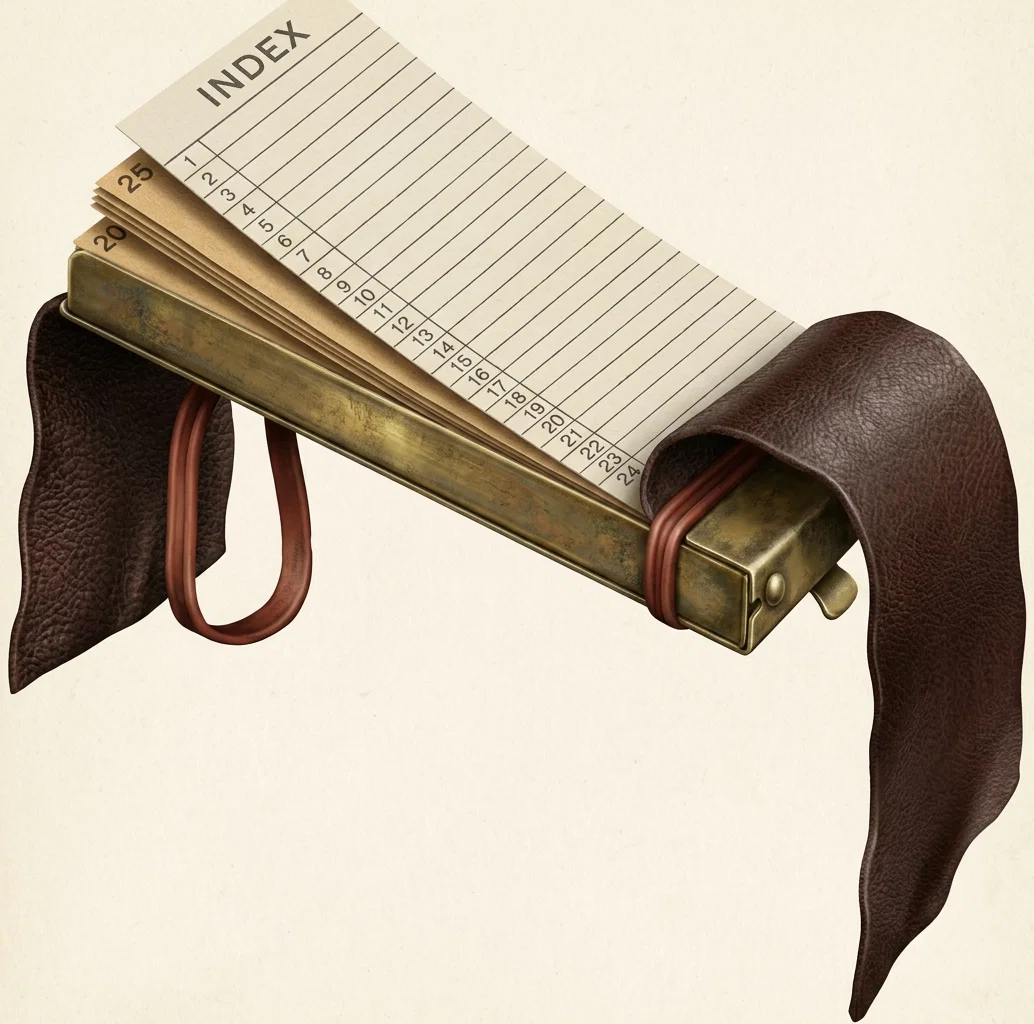
SIMPLICITY, NEATNESS AND UTILITY COMBINED. WILL SAVE TIME AND PREVENT LOSS.
THIS FILE is designed to keep Important Papers together in an orderly manner, absolutely free from dust and wear. Its system of filing, though simple, is the most satisfactory ever devised for private papers, or the miscellaneous folded papers that accumulate in the pigeon-holes of safes and desks.
DESCRIPTION.
The back of the file is constructed of handsomely finished metal, which is bent at an angle in front, forming a label holder as shown in the cut. Russia leather flaps are attached to the ends of the metal back and fold over the contents of the file.
Twenty-five document envelopes (heavy manilla) ruled for memoranda and numbered to correspond with the index, are furnished with each file. These may be removed at will, or other envelopes may be added to the file.
Two of our patent elastic band holders form a part of the back of the file. They make the common elastic bands, so much used, doubly valuable, since the bands are always in place, and cannot be dropped or mislaid. In case a band is worn out, another can be slipped into its place instantly. This file adjusts itself to the amount of matter placed in it, whether it be much or little.
SIZES AND PRICES.
No. 9 (Size 9 x 4 in.), with 25 ruled envelopes, $1.00.
No. 11 (Size 10 1/2 x 4 1/2 in.), with 25 ruled envelopes, 1.25.
This file is sent post paid on receipt of price. Address all orders to
PACIFIC PRESS PUBLISHING COMPANY,
OAKLAND, CAL.
Agents Wanted.
Blaine at the Catholic University
By Editor
THE dedication services of the Roman Catholic University at Washington, D. C., were held the 13th inst. Prominent at the banquet were President Harrison, who sat at the left of Cardinal Gibbons, Secretaries Blaine, Tracy, Noble, Windom, and Rusk, and Attorney-General Miller. Among the toasts to "His Holiness, Pope Leo XIII," "Our Sister Universities" (not Protestant), "The Hierarchy of the United States" (the Catholic only), was a toast, "Our Country and her President." To this Secretary James G. Blaine responded, as follows:—
"I come to represent the United States—not in any political sense, much less in any partisan sense, nor in connection with any church or sect; but to speak for all and the great freedom which we enjoy. I have made that statement in Protestant assemblies, and I am glad to make it in Catholic ones."
How does Secretary of State Blaine represent the United States if not in a political sense. "Political" is "pertaining to government, policy, polity, or politics;" "pertaining to a nation or State; national; public; civil." If Mr. Blaine represented the United States at all, he did it as a public or civil or political official; and this before an organization which is intensely and always partisan and political. But it might be well to query, Who gave Mr. Blaine the right to represent the United States at a distinctively Roman Catholic convention, met for the purpose of honoring the Roman Catholic system of education, which is diametrically opposed to the free public schools of America—who gave Mr. Blaine this right or privilege? Would the President or his cabinet attend the services of any other distinctively denominational institution, say the Mormons or the Jews, for instance?