The Youth’s Instructor, Vol. 43, No. 29.

JUDAH AND ISRAEL

The Youth’s Instructor

Jul 18, 1895

S. D. A. Publishing Association · Battle Creek, Mich. · Jul 18, 1895

JUDAH AND ISRAEL.

Doubtless the youthful student of the Bible has noticed the frequent repetition of these names in sacred history, and perhaps the query has arisen in his mind, What do these names signify, and why are they associated together as they are?
As stated in Gen. 32:28, Jacob was called Israel because he prevailed with God in prayer, and gained the blessing for which he sought. The nation descended from Jacob was consequently known by the name of “Israel.”
Judah was one of Jacob’s sons; the name signifies “praise.” “Judah, thou art he whom thy brethren shall praise.” Gen. 49:8. Judah being one of the twelve tribes, was really a portion of the nation of Israel. Thus the term “Israel” would include all covered by the term “Judah,” and much more.
It would not appear likely that a division would ever come in between the people called by these two names; in fact, as the one is really included in the other, it would not seem possible that a separation could ever take place. But alas! that which should have stood united and inseparable, gradually became divided in interests, till there were two distinct kingdoms, having governments and rulers independent of each other.
It is interesting to study the causes of this separation. While it may not be possible to ascertain clearly the first manifestation of this division of interests, some clue to the matter may be obtained.
It was from the tribe of Judah that the Messiah, or Christ, should come. (See Gen. 49:10; Micah 5:2.) This may have been one cause of the envy that existed on the part of Israel toward Judah. The prophet Isaiah predicted a time when that envy should cease. In Isa. 11:13 we read: “The envy also of Ephraim shall depart, and the adversaries of Judah shall be cut off; Ephraim shall not envy Judah, and Judah shall not vex Ephraim.” It is very natural for us in our sinful condition to envy others on account of their goodness or their advantages. A division into these two parties may be discovered as far back as the time of Saul; when he numbered the army, he made a distinction between the hosts of Israel and those of Judah. He found of the men of Israel three hundred thousand, and of the men of Judah thirty thousand, as stated in 1 Sam. 11:8. The division in feelings and in social relations grew till about seventy years later, as stated in 2 Sam. 19:43, when we find them contending and disputing with fierce words, in a very angry manner. The breach grew till, in the days of Rehoboam, about fifty years later, ten of the tribes completely revolted, and established the kingdom of Israel, which continued about two hundred and fifty years, till extinguished in the Assyrian captivity B. C. 721. There were frequent wars between these two divisions of Israel. The people of God, who should have stood unitedly in defense of the right and of each other, allowed the devil to get in his entering wedge by means of envy and other evil traits of character, till separate interests, fierce and angry words, and finally open war and bloodshed, seriously weakened their national strength and sapped their energies, resulting in the final overthrow of both parties. The nation of Judah maintained an independent government over a hundred years after the captivity of Israel; then in B. C. 606 the Babylonish captivity took place, and Judah also passed under the dominion of a foreign power.
What Satan did for God’s ancient church, he has endeavored to do for the church ever since. Sometimes he gets a church divided into two factions, as was the case with Israel and Judah. Where there should be union, division exists. Beware of envy. James 4:5.
F. D. STARR.

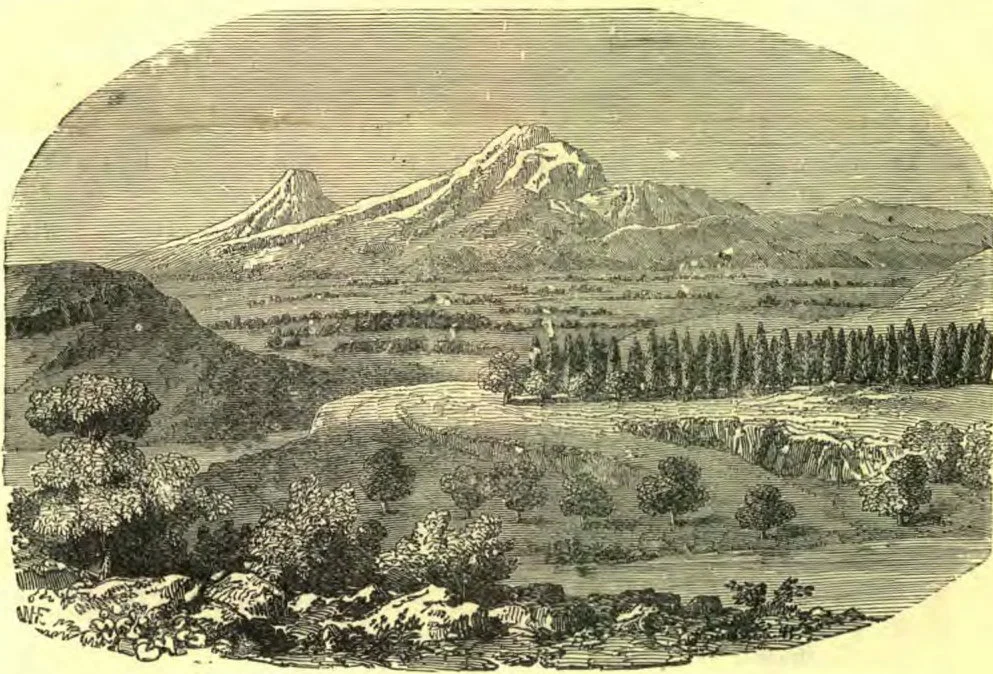
MOUNT ARARAT.

(“Ararat” means “Holy Land.”)
Mount Ararat, proud looming toward the sky, Thou art the theme of every passer-by. Thou brav'st the tempest when 't is at its height, When storm-clouds gather like the shades of night; When the rain falls in torrents from on high, And lurid lightning dazzles every eye, And the loud thunder, peal on peal, is heard, Thou standest firm, thy pillars are not stirred. Thou sayest to the waters, “Stay below,” And unto the broad rivers, “Onward flow.” Thou standest up and sayest to the plain, “I'm mightier far, and so for aye I'll reign. The broad plateau that lies beneath my feet Shall be my footstool; here with joy I'll greet The gentle breezes and the morning sun, And I will bid them welcome every one. My crown shall be the twinkling stars of night, My mantle, too, shall be of snowflakes white; My vail the fleecy clouds that oft are spread In marvelous beauty o'er my royal head; And all shall honor me with loud acclaim; Of all things here I'm most deserving fame.” But stay, forget'st thou days so long ago, When waters covered all the plain below, And how thou wast encompassed till at last Thou wast submerged? Dost thou forget the past? And, prithee, tell me true, dost thou not keep A record, of the waters fathoms deep Above thy head? Didst thou not surely feel That thou wast weak, when God had placed his seal To the decree proclaiming that this world Should be destroyed? When turbid waters swirled Above thee, when the fountains of the deep Were broken up, say, wast thou then asleep? And when the waters were assuaged at last, And thou didst lift thy head above the vast, Th' illimitable waste, wherein no sign of life Was seen save in the ark when waters rife Were slowly disappearing from the sight, And the ark rested on thy welcome height, And from its door came forth both man and beast And every creeping thing from great to least, And spread themselves abroad upon the land, And the first rainbow, fresh from God's own hand, Wrought with consummate skill then spanned the cloud, And with prismatic colors well endowed, Telling to the world God's covenant with men, His promise true, didst thou awaken then? Thou art not famed because of thy great height, Nor for the grandeur of thy peaks so white; But 't is because the ark did here abide, When the o'erwhelming waters did subside. For God here made his covenant with men, And said the deluge should not come again, And placed his bow of promise in the cloud That ne'er again should waters like a shroud Enwrap the earth, but while the world shall stand, Seed-time and harvest e'er shall bless the land. For this alone thou art so widely famed; And, rightly, Ararat, thou hast been named.
EMMA L. KELLOGG.
MOUNT ARARAT.
MOUNT ARARAT.

WHEN WILL GOD RECOMPENSE HIS PEOPLE?

THE saints are rewarded at the glorious revelation of Jesus Christ, at the last day; for then the righteous shall “shine forth as the sun in the kingdom of their Father.” Matt. 13:43. Then the Son of man shall send his mighty angels to gather the elect of God and escort them home to the heavenly kingdom. Matt. 24:30, 31. Their reward is not promised before, but what honor will be theirs when they obtain a glory more beautiful than the morning sun when it robes the eastern horizon in loveliest purple, and more brilliant than the king of day in his noon-day splendor!
Until that time the elect of God are scattered. Many sleep in the dust of the earth, and some are found here and there on the earth among the living. The mighty sound of the last trump will awake the dead, and the angels of God will gather the elect of God wherever they are found on the earth. Then why mourn, even though we may live in a lonely place, and in a poor home? The shining host can easily find you. With lightning speed on angel wings God’s dear children will quickly assemble around the beloved Saviour and faithful Shepherd who gave his life for the sheep.
“Then shall the King say unto them on his right hand, Come, ye blessed of my Father, inherit the kingdom prepared for you from the foundation of the world.” Matt. 25:31, 34. No words can tell more plainly that the righteous obtain the eternal kingdom at the glorious revelation of Jesus Christ. O how blessed then to stand on the King’s right hand and hear the joyful words, “Come, ye blessed of my Father”!
The apostle writes of the Corinthians that they were “waiting for the coming of our Lord Jesus Christ,” and he desired that they should be “blameless in the day of our Lord Jesus Christ.” 1 Cor. 1:7, 8. He said that they would be his rejoicing “in the day of the Lord Jesus.” 2 Cor. 1:14.
The Philippians were exhorted to approve the excellent things of God, that they might be “without offense till the day of Christ.” Paul was confident that God who had begun a good work in him would “perform it until the day of Jesus Christ.” He tells them to be blameless and harmless, and to shine as lights in the world, “holding forth the word of life; that he might rejoice in the day of Christ.” Phil. 1:6, 10; 2:15, 16.
The fact that this day of Christ to which they looked forward with such high expectations is the same as the day of the Lord, the second coming of Christ, is plainly seen from Phil. 3:11, 20, 21: “If by any means I might attain unto the resurrection of the dead.” “For our conversation is in heaven; from whence also we look for the Saviour, the Lord Jesus Christ: who shall change our vile body, that it may be fashioned like unto his glorious body.”
At the last trump the people of God shall all be changed in a moment, and this mortal shall put on immortality. 1 Cor. 15:51–55. Then all their sorrow shall vanish like the darkness of night before the clear light of day. “When Christ, who is our life, shall appear, then shall ye also appear with him in glory.” Col. 3:4.
Is it not a blessed thing that we may stand unblamable in holiness before God “at the coming of our Lord Jesus Christ?” Let us pray with the apostle, that our “whole spirit and soul and body be preserved blameless unto the coming of our Lord Jesus Christ.” 1 Thess. 3:13; 5:23.
The Lord Jesus shall be revealed from heaven in flaming fire with his mighty angels. “In that day” “he shall come to be glorified in his saints,” and then they are gathered to him. 2 Thess. 1:7, 10; 2:1. Paul expected that the Lord would give him a crown of righteousness at that day, and not only him, but “all them also that love his appearing.” 2 Tim. 4:8.
Peter believed that his faith should be “found unto praise and honor and glory at the appearing of Jesus Christ.” 1 Peter 1:7. He tells you to be glad when you suffer with Christ, “that when his glory shall be revealed, ye may be glad also with exceeding joy.” Chapter 4:13. “And when the chief Shepherd shall appear, ye shall receive a crown of glory that fadeth not away.” Chapter 5:4.
The beloved John says, “And now, little children, abide in him; that, when he shall appear, we may have confidence, and not be ashamed before him at his coming.” 1 John 2:28. “We know that, when he shall appear, we shall be like him; for we shall see him as he is.” Chapter 3:2. Our blessed Redeemer says: “Behold, I come quickly; and my reward is with me, to give every man according as his work shall be.” Rev. 22:12. He is the bright and morning star. When he says, “Surely I come quickly,” let us every one respond from the depth of our hearts, “Amen. Even so, come, Lord Jesus.”
J. G. MATTESON.

GOD TO BE GLORIFIED IN OUR WORK.

“Draw nigh to God, and he will draw nigh to you. Cleanse your hands, ye sinners, and purify your hearts, ye double-minded.” When the heart has a deep longing for God, when the mind contemplates the goodness and the loving kindness of God, when the soul hopes and trusts in the Lord, the Holy Spirit will be as a comforter to the soul. Jesus says, “If ye keep my commandments, ye shall abide in my love; even as I have kept my Father’s commandments, and abide in his love. These things have I spoken unto you, that my joy might remain in you, and that your joy might be full.” “Let your speech be always with grace, seasoned with salt, that ye may know how ye ought to answer every man.” Shall we be obedient to these inspired words that come sounding down the line to our time? The purpose to which we are called is an exalted one. Peter says, “But ye are a chosen generation, a royal priesthood, a holy nation, a peculiar people; that ye should show forth the praises of Him who hath called you out of darkness into his marvelous light.” How can you show forth his praises?—By the words that you utter. You can speak in such a way as to bless others,—to be a savor of life unto life in working the works of righteousness. “Dearly beloved, I beseech you as strangers and pilgrims, abstain from fleshly lusts, which war against the soul; having your conversation honest among the Gentiles: that, whereas they speak against you as evil doers, they may by your good works, which they shall behold, glorify God in the day of visitation.”
The Lord is to be honored and glorified by his people in the midst of a crooked and perverse generation, among whom they are to shine as lights in the world. “This is a faithful saying, and these things I will that thou affirm constantly, that they which have believed in God might be careful to maintain good works. These things are good and profitable unto men.” The manner in which we use the gift of speech will tell on the side of good or evil. We are to manifest Christian tact and sanctified judgment. Men will present arguments against the truth that will be inspired by Satan for the purpose of leading the advocates of truth into side issues, and to carry the minds of his hearers into the same channels. Satan’s subtlety often accomplishes this, and thus confuses and harasses those who are seeking after truth. The advocates of truth should not permit themselves to be led hither and thither after vain objections, but they should lift up the standard of truth, and from the book of inspiration crowd in the words of God. Let every soul meet the temptations of Satan in the same manner in which Christ met them when in conflict with the enemy in the wilderness. He said to the tempter, “It is written, Man shall not live by bread alone, but by every word that proceedeth out of the mouth of God.”
MRS. E. G. WHITE.

THE PREVAILING TESTIMONY.

How do men bear witness to the truth of the gospel of Christ?—By their words of confession, by their works, and by their life. When a man is on the witness stand in one of our courts, the jury judge of his testimony, not only by what he says, but by his bearing, by the manner in which he testifies; and they make up their minds from all they can learn about him what his character is, and their conclusion as to the truth of his testimony is affected by their judgment of the man himself. So it is with regard to witnesses for Christ. The testimony of the works and of the character must agree with the testimony of the mouth. If there is a disagreement, the conclusion is that he is not a true witness. It is indispensable that a witness should know. The root of our English word means “to know.” If one should bear witness to the truth of the gospel, he must know it; he must know that his sins are forgiven, that he is a new creature, that his faith in God is a living faith, and that it dominates his whole life. If he knows Christ in the forgiveness of his sins, he can testify of him; otherwise his testimony is false testimony. In speaking of the resurrection, Paul said: “If Christ be not risen, then . . . we are found false witnesses of God.” There is no doubt as to the great facts of the gospel to those who have apprehended God. Those who have not so apprehended him cannot know what the facts are, and if they presume to be witnesses, they are liable to be false witnesses.—Exchange.

Temptation and the Test of Honesty

To resist temptation once is not a sufficient proof of honesty. If a servant, indeed, were to resist the continued temptation of silver lying in a window, as some people let it lie, when he is sure his master does not know how much there is of it, he would give a strong proof of honesty. But this is a proof to which you have no right to put a man. You know, humanly speaking, there is a certain degree of temptation which will overcome any virtue. Now, in so far as you approach temptation to a man, you do him an injury; and, if he is overcome, you share his guilt. —Johnson.

RUMORS OF WAR.

A TRAVELER from the East declares that Russia has massed eighty thousand soldiers at Vladivostok, on the Japan Sea, with a large fleet, and that she is making gigantic preparations for war. If this be true, the world may soon hear of some great scheme of Russian aggression. The new Siberian railway makes it possible for Russia to concentrate a large army very quickly at that point; and movements of troops in that country cannot be known, as they would be in the more civilized countries of Europe. There can be but one reason for the moving of so large an army to Vladivostok, and that is to seize upon some territory which will furnish an open, warm port for the south-eastern terminus of the Siberian railway.
If this should be sought in the territory which Japan acquired in the late war, but let go at the demand of Russia, Germany, and France; or should Russia seek to gain a foothold in Corea for this purpose, war between Russia and Japan would seem to be inevitable. It is believed by many statesmen that Russia is much chagrined at the success of Japan in the late war, and that she will never consent to let Japan gain the ascendancy in Chinese affairs and the control in the East. But Japan has started on that line, and Russia having checked her by diplomacy, is now evidently preparing to measure arms with the young island empire. It is useless to speculate upon the results of such a war. Japan will find Russia a different antagonist from China, and Russia will find Japan more difficult to defeat than Turkey. Japan has a powerful fleet. She can both build and buy new vessels, and the battle off the Yalu shows her to be at home on the water. The people of Japan are intensely patriotic, and in a war with Japan, Russia would have the opportunity to experience some of that—
“Stern joy which warriors feel In foemen worthy of their steel.”
Reports from Bulgaria announce that a state of things almost amounting to war already exists between that country and Turkey. The latter country has set such a close watch upon the Bulgarian frontier that the Bulgarians regard it as a menace, and under the inspiration of this intrusion, Bulgarians have crossed the line and committed some depredations in Turkey. Cool counsels do not prevail in any of the Balkan states, all of those semi-barbaric countries being much like a powder magazine, wanting only a spark to start a conflagration; so small causes often lead to war. Generally these Balkan wars are incited by Russian agents, but it hardly seems possible that Russia would wish a war on her southern border, while at the same time contemplating war with Japan.
The world is full of oppression, and the thinking people of many countries see evils that should not be; and the only way that human nature knows to remedy such evils is by force. So we may expect that the remedy will be applied, but with what success can better be determined later.

THE WAR IN CUBA.

The struggle of the Cubans for independence still continues. Fortune seems to be very fickle in her smiles upon the combatants, favoring both parties with enough victories to keep their courage up, and thus stimulating them with the hope of final success. Spain finds the rebellion much more formidable than she first thought it to be, and in response to the urgent demands of General Campos, will send fourteen thousand more of her young conscripts to Cuba, when the rainy season is over. But the Cubans are not going to wait for the rainy season to pass; they are intensely active, and they keep the Spanish troops constantly exposed to the deadly climate, which thins their ranks as fast as a series of battles would do. It is said that since 1858, one hundred thousand Spanish soldiers have been buried in Cuba, the most of whom died of fever,—a costly sacrifice, when we consider that it is made to bind an unwilling people to a reactionary and often tyrannical government. And still Spain declares, through the officers of her government, that she will spend her last dollar and send her last man to Cuba, before she will allow this pearl of the Antilles to pass from under Spanish rule. Spanish pride is proverbial the world over, the very term “Spanish Don” being almost a synonym for haughtiness.
But Spanish pride has been compelled to yield in the loss of vast possessions in Central and South America, and it may be treated to another experience of the same kind. If Cuba was easy of access to those who would be glad to help her in the struggle for independence, short work would be made of Spanish misrule in that lovely island. As it is, there is fair prospect of Cuban success. Spanish gold bought the death of General Maceo, and Marti, another of the Cuban leaders, is reported a prisoner; but the Cuban ardor is not dampened, it is rather stimulated thereby. General Gomez is operating at Puerto Principe, near the center of the island, and is reported to be threatening Havana. Fear of the ultimate defeat of the Cuban party keeps many from joining the insurgents, who would otherwise join them. So each success of the Cubans draws many men into their ranks. In the beginning of the struggle it was said that only negroes and creoles were rebelling; now it is acknowledged that many men of pure Spanish blood have joined the Cubans.
The government of the United States is obliged by the laws of nations and its treaties with Spain, to remain neutral; but the sympathies of the people generally are with the Cubans, and in many secret ways they will render them assistance. Even the government reflects the sentiments of the people in this respect, and an old claim of the United States against Spain for a million and a half of dollars is now revived, and immediate payment demanded. England learned by her experience in America to treat her colonies with less rigor, and has consequently bound them to her; but Spain learns nothing by her experiences of this kind, and she will eventually be obliged to pay the price of her folly.

AFFAIRS IN COREA.

THE news from Corea is of an interesting character. Reforms are not moving very rapidly in the land of the “Morning Calm.” The Japanese have declared that they wish Corea to be perfectly free, allowing a Japanese of ability to act as the adviser of the Corean government, to direct the nation in the way of progress and civilization. That would be an easy task if the Coreans desired to reform, but unfortunately, their chief desire seems to be to be left alone to do as they have done for centuries. So Count Inonye, who was to guide Corea into the channel of national prosperity, finds his task not an easy one. The very fact that he has no certain tenure of authority makes his task exceedingly difficult. If the Chinese fleet and army were at his back, as the British army and fleet are behind Lord Cramer in the management of the affairs of Egypt, he could do differently.
The Coreans are taking advantage of Japan’s pledge of their entire independence, and are now coquetting with Russia. They can do no more unwise thing than to allow Russia any show of a control of their country; for when once the great Bear of the North gets her paws upon a country, that is the end of its independence. While Japan has denied herself the right to control Corea, she has not conceded the right of any other power to do so. Indeed, the war freed Corea from the control of China. Japan, therefore, will not be willing to allow Corea to be dominated by Russia. For this reason a growing ill feeling is rising between Russia and Japan, and statesmen are predicting that war between these powers will finally ensue.

THE RUSSIAN FRENCH ALLIANCE.

WHEN it was proposed in the French Chambers that France, in response to the invitation from Germany, should send a representation of her fleet to participate in the ceremonies connected with the opening of the great German canal at Kiel, there was quite a strong opposition to the proposal, both in the Chambers and throughout France. The discussion plainly showed that the feeling of anger and resentment against Germany for the loss of the provinces of Alsace and Lorraine has not declined since the defeat of France in 1870–71. The vote to send the ships to Kiel prevailed, however, but not until the government promised that after the celebration was over the provisions of the treaty between Russia and France would be made public.
This statement has had the effect to make an excitement, for before this it was not positively known that there was such a treaty. That there is such a treaty is now certain. It is also certain that the czar and his advisers are willing that it should be made known; for France certainly would not give it to the world without the consent of her ally. It is reported that the czar, not wishing to offend Germany, gave orders that the officers and crews of his ships at Kiel should not make any particular demonstration when they met the French fleet, but that in spite of his commands, the manifest friendliness of the Russians and the French was very apparent. Viewed from a national standpoint, nothing is more natural than this alliance between Russia and France. Not that the two nations are alike; they are very unlike. One is a military despotism, the other a free republic; but the alliance of Germany, Austria, and Italy is a threat at both Russia and France, and it would be strange indeed, if under the circumstances they should not seek each other's assistance.

M. E. K

THE Scientific American of July 6 contains a cut of a bullet-proof mail and express car, invented by a man in this State. It is a veritable fort. It is a striking commentary on our times, that in this age such inventions are necessary to protect the money carried by express! How long will it be before the whole train will need to be made in the same way to protect the passengers from robbery?

M. E. K

THE POWER OF LOVE.

WHEN Christ was in the world, he said, “And I, if I be lifted up from the earth, will draw all men unto me.” That all men are not drawn to Christ, so as to accept him, is not an evidence that these words are not true. He was lifted up, crucified for mankind, and he draws all men toward him by the exhibition of his wonderful love, and by his Spirit. If men would not brace themselves against him and refuse to be drawn, they surely would be drawn to him. But, wrapped in selfishness, men refuse to be moved by the love of Jesus. His love is poured upon them in vain, as the waters of some rivers are lost in the desert sands, and bring forth no vegetation. But if we are not brought to Jesus by his love; if we are not charmed out of our selfishness by the story of the cross and the wonderful love which is revealed by it, we cannot expect that God can in any way reach or affect our hearts, so that we will willingly and joyfully serve and obey him. God has no reserve power aside from his love, which he has shown in such a remarkable manner. In giving his Son to die for sinners, there was manifested an infinite degree of divine love. Beyond that, even deity cannot go. So in the plan of salvation God went to the uttermost of his power, that there might be nothing left undone which might be done for man’s salvation. Jesus descended to the place which man occupied, and brought with him an infinite power to save. It was love which led him to do this.
Who has not heard the story of Hannah Lamond, who rescued her babe from the eagle? It was in Scotland. She had laid her babe, wrapped in a flannel blanket, in the shade of a shock of grain, while she worked in a field near by. Suddenly an enormous eagle swooped down, thrust his talons into the blanket, and bore the sleeping child to the highest peak of the mountain. The news spread with great rapidity. “Hannah Lamond’s bairn! Hannah Lamond’s bairn! The eagle has carried off Hannah Lamond’s bairn!” was the cry. All the people of the town started for the mountain to rescue the child. There were active young shepherds who were used to scaling the rocky cliffs, and sailors back from the sea who had climbed the tallest masts; but all recoiled from the face of the rocky precipice. They could not climb it. But Hannah Lamond herself climbed to the highest peak, where the eagles had their nest, rescued the child, tied it to her bosom with her shawl, and, what was more difficult than the ascent, descended safely with her child, to the place where the people, unable to go farther, had gathered together, praying. So entirely absorbed had she been in her task that she hardly knew herself how she had rescued her child. Such is the true story of Hannah Lamond, celebrated in the annals of Scotland, and known all over the world.
What led this young mother to do what no other could do?—It was the purest love; for if there is any pure love in this world, it is maternal love. This incident may help us to gain some idea of that love of God for us, of which it is said, “God so loved the world, that he gave his only begotten Son, that whosoever believeth in him should not perish, but have everlasting life.” Jesus came to seek and to save the lost. Hannah Lamond saved her babe from the eagle, but did not lose her life, although she risked all to save her babe. Jesus gave his life willingly, freely, to save us. And as freely as he gave his own life, he offers us life. “Whosoever will, let him take the water of life freely.” Dear reader, is not your heart affected by such love? Then let Jesus draw you fully to him.

SUGGESTIONS ON STUDYING THE BIBLE.

1. CONSIDER the Bible as God’s word to you. Do not read it as you would a circular letter, but as you would a letter from a dear friend. John 15:15.
2. You are to live by faith and not by feeling. Heb. 10:38. Study the Bible daily, whether you feel like it or not.
3. God’s word is light; for it comes from God, who himself is light. He gave us the light to be used, therefore use everything he gives you. John 1:9; 8:12; Matt. 10:27.
4. The Lord does not desire to develop in you Bible knowledge only, but his word is given to fashion you into his own likeness. Seek to live the truth each day as you learn it. 2 Cor. 3:18; Luke 9:23.
5. It is not the book that educates, but God in the book; therefore we should study it thoughtfully, humbly, and prayerfully, as before God, depending upon the Holy Spirit for guidance. Love your Bible. Do not look upon the study of it as a burden, but as a pleasure. J. H. D.

THE SOUTH DAKOTA CAMP-MEETING.

This meeting was held near Madison, in a beautiful grove on the shores of Lake Herman. The sturdy oak, which in centuries past shaded the native red man in his war-dance and wild chase, now makes it pleasant for the “pale faces” who come together to worship Him who has declared that all men are made of one blood.
There was a good attendance, especially of the young people. The services were very interesting and beneficial. Elder E. G. Olsen had charge, and was assisted by Dr. Paulson. The Spirit of the Lord was present, and quite a number were converted. Some attended the meetings who were connected with families not of our faith, and a few of these were led to make a full surrender to the Lord.
Forty-five were baptized, the most of whom were youth. There was a good interest manifested in the educational work. Many would like to attend our schools, but the failure of crops the past season will hinder the larger part of those who wish to do so. However, ten or fifteen expect to enter Union College next fall. Several offered themselves for the nurse’s training class.
In all the Conferences in this district there are a large number of young men and women who have a desire to live for Christ. Many of these need a better education before they can take responsibilities. May the Lord help them to be diligent, so that they may yet be trained for the Master! A great responsibility rests upon parents and brethren in the home churches. If all our young people could be educated to work at home, it would be much easier to use them in the Conference. Too many have wasted their time, which if rightly improved, would give them a fair education. This is not because they had no disposition to work, but because they had no one to direct them. May the Lord’s Spirit stir the hearts of our young people to be industrious and Christlike! J. H. D.

WHAT GOD'S WORD IS ABLE TO DO.

IN Rom. 1:16 we read that the gospel “is the power of God unto salvation to every one that believeth.” In 1 Peter 1:25 we learn that the gospel is the word of God, by which we are born again. So the gospel is God's word, which has power to save men from sin.
The prophet says, “Is not my word like as a fire? saith the Lord; and like a hammer that breaketh the rock in pieces?” In some places where they break large stones for building purposes, the hammer alone will not accomplish the work. The hard rock receives the blows without yielding. The workman then builds a fire all around the stone, and heats it; then a few blows sever the hard stone, and it falls in pieces. After this is accomplished, the workman can soon shape the pieces so as to fit them into the building. So it is with our hard hearts. God first melts them by his Holy Spirit, and then breaks them with his word. When thus broken up, we are in a condition to be fitted for the great building of God. Eph. 2:20-22.
“And now, brethren, I commend you to God, and to the word of his grace, which is able to build you up, and to give you an inheritance among all them which are sanctified.” Acts 20:32. Here we learn that the word is able to build us up, or to place us in the great building. After we have been broken by the fire and the word of God, we are not able to put ourselves into the building. It is his word that does this.
“Wherefore lay apart all filthiness and superfluity of naughtiness, and receive with meekness the engrafted word, which is able to save your souls.” James 1:21. Here we come back to the first thought. The word, the gospel, has power to save our souls. Its creative power has not been lost. We need to be made over, re-created, and the word of God has power to do this if we believe it.
But we must submit to the process if we would realize the results. If the stone rolls out of the fire, and turns over when the hammer comes down upon it, it will never find a place in the building. Then let us submit to the fire and the hammer, that we may be built up in God's building, and saved in his everlasting kingdom. J. H. D.

THE “INSTRUCTOR” AGAIN.

PERHAPS it will not be out of place at this time to call the attention of the readers and patrons of the INSTRUCTOR to the importance of working for the circulation of the paper. Our list is nothing to what it should be; and if every one who reads the INSTRUCTOR will make an effort to increase its circulation by inducing others to subscribe for it, the number who will receive its weekly visits will be greatly increased. Times are much easier than they were awhile ago, and most any boy or girl over twelve years of age, by a little effort can earn money enough to secure the INSTRUCTOR for a year. We appeal especially to our ministers and other public laborers not to forget the INSTRUCTOR in every family and place where they labor. And now a word to our contributors: We would be glad of short, spicy articles on the various themes to which the paper is devoted. We have used quite a number of short selections, because our contributors almost invariably write lengthy articles. A short article is more likely to get into print than a long one. Come, friends, one and all, let us make the INSTRUCTOR the best we can, and raise its subscription list several thousand before 1895 is past. M. E. K.
Continue reading: LESSON 5.—CHRIST AND THE SABBATH