20. What is lawful on the Sabbath? Matt. 12: 12, last part.
21. How fully is it safe to follow Jesus? 1 John 2: 6.
NOTES.
1. The Sabbath of the Lord, properly kept when the people were devoted to God, was now, in their backslidden condition, buried under the traditions of the rabbis. Certain knots could not be tied or untied; two letters could not be written so as to be read together and so form a word; no more food than the weight of a fig could be carried; fire could neither be kindled nor extinguished; an emetic could not be given, nor a broken bone set, nor a dislocated joint righted; one kind of sandals might be worn and another kind might not be; one could not lawfully carry a loaf, yet two could. Thus were the people burdened by many foolish restrictions, while the rabbis and priests with subtle reasonings justified actual breaches in God’s law of the Sabbath on their own part.
2. In the arguments used by our Lord,—the sheep falling into the pit, and the case of David,—he did not present them to justify himself. His own deeds justified him. He said what he did to show them by their own practice, and by the scriptures which they professed to believe, that they were inconsistent, and so to help them to become willing to learn what God had so long before told them,—that he would have mercy and not sacrifice.
ADDITIONAL NOTES.
Christ is our example. No one can deny that we are to live as he lived. While he lived under the Jewish dispensation, he lived as Christians should live now. Some may say, Should we not, then, offer sacrifices?—No; for he did not. He was not a priest, and he could not be a priest on earth; for he was not of a priestly tribe. So it is certain that he did not offer sacrifices for others; and as he did no sin, why should he offer sacrifices for himself? His parents did for him “according to the law,” when they offered “a pair of turtle doves or two young pigeons,” but he was unconscious of it all. The passover of which he partook was a memorial of the deliverance from Egypt and the preservation of Israel. It was eaten as an act of faith in the great sacrifice, but it was no part of the regular propitiatory sacrifices which showed the guilt of the people. Jesus could do nothing that would imply that he was a sinner; for he was without sin. When he was baptized, he plainly stated to John the object of his baptism; it was to “fulfil all righteousness,” or to “establish every ordinance,” as some versions render this text. Matt. 3: 15.
In all the moral duties, which are the same in every age, Christ did as he wants his disciples to do. When he says, “I have kept my Father’s commandments,” it is an evidence that he wants those who would follow him to do the same. When he preached the perpetuity of the Father’s law, he laid down the obligation to all gospel preachers also to preach it. That man who comes the nearest to doing what Jesus did when he was here on the earth will be the most perfect. No one can claim that Jesus ever kept Sunday as the Sabbath. All must acknowledge that he kept the seventh day.
All who are saved will be saved by the righteousness of Jesus Christ. What he did will be imputed to them as though they did it. That righteousness was obtained by perfect obedience to the perfect law of God. “All his commandments are righteousness.” A portion of that righteousness was obtained by his obedience to the fourth commandment. He gained no righteousness by keeping Sunday; for it was not a part of the law of righteousness, so he has no righteousness obtained by Sunday-keeping to give to any one. Then whosoever is saved, must get the benefit of Christ’s Sabbath-keeping. If they do not, they cannot get a full righteousness, and without a complete righteousness they cannot be saved. The benefit of Christ’s righteousness, with all other righteousness, can be obtained by faith; but it is needless to say that to live as near as we can to the way he lived is the best evidence of our faith that we can give to the Lord.
“It is lawful to do well on the Sabbath days.” These words are in recognition of the fact that there is a law regulating the Sabbath. “It is lawful to do well.” Worship is a primary duty on the Sabbath. The Sabbath was instituted for a day of worship and praise to God. It is therefore eminently proper to attend and take part in the public worship of God on that day. Christ is our example in that respect. He also set us an example to do acts of mercy on that day. He preached the word, fed the hungry, and relieved the suffering. Should we not give as much attention to the manner of Christ’s Sabbath-keeping as to the day he kept?
As Jesus’s chief delight was to do the will of the Father, and “to finish his work,” his Sabbath days must have been days of deep and holy joy. He was “the Son, who is consecrated forevermore;” and when the consecrated Son came to the consecrated day, made holy by the joint action of the Father and the Son, what deep spiritual joy must have been experienced! “Beloved, now are we the sons of God;” and if we are sons of God, will not his day be to us a delight?—Yes; we will be able to call it from the heart the “holy of the Lord, honorable.” The observance of the Sabbath was not a burden to Jesus; it is not a burden to any who understand what the Sabbath is, and who enjoy the spirit of the author of the Sabbath. M. E. K.
RECOGNIZING GOD.
By A. B. Simpson
WHEN you meet a friend on the street, and he recognizes you, you always return the bow, unless you wish rudely and intentionally to repulse him. This is the secret of enjoying the Lord’s presence: Recognize his presence, and he will respond. Recognize him in your heart, and he will respond from your heart. Many persons are waiting for the Lord to reveal himself, but they themselves never recognize his presence in them. “Know ye not,” says the apostle Paul, “that your body is the temple of the Holy Ghost, which is within you?” Recognize this fact. Speak to him in your heart, and he will speak to you. Call his dear name; wait in silence for him to speak from within, and sweet and quick as the echo will come the answering whisper of love, “Here am I.”— Rev. A. B. Simpson.
“SHE WAS A STRANGER.”
A Sunday-school missionary, while addressing a Sunday-school, noticed a little girl shabbily dressed and barefooted, shrinking in a corner, her little sun-burned face buried in her hands, and sobbing as if her heart would break. Soon, however, another little girl about eleven years of age got up and went to her. Taking her by the hand she led her out to a brook, where she seated the little one on a log. Then kneeling beside her, this good Samaritan took off the ragged sunbonnet, and dipping her hand in the water, bathed the other’s hot eyes and tear-stained face, and smoothed the tangled hair, talking cheerily all the while. The little one brightened up, the tears vanished, and smiles came creeping around the rosy mouth. The missionary, who had followed the two, stepped forward and asked, “Is this your sister, my dear?” “No, sir,” answered the child with tender, earnest eyes; “I have no sister.” “O, one of the neighbors’ children,” replied the missionary, “a little schoolmate, perhaps?”
“No, sir, she is a stranger. I do not know where she came from. I never saw her before.”
“Then how came you to take her out and have such a care for her, if you do not know her?”
“Because she was a stranger, sir, and seemed all alone, and needed somebody to be kind to her.”—Northwestern Christian Advocate.
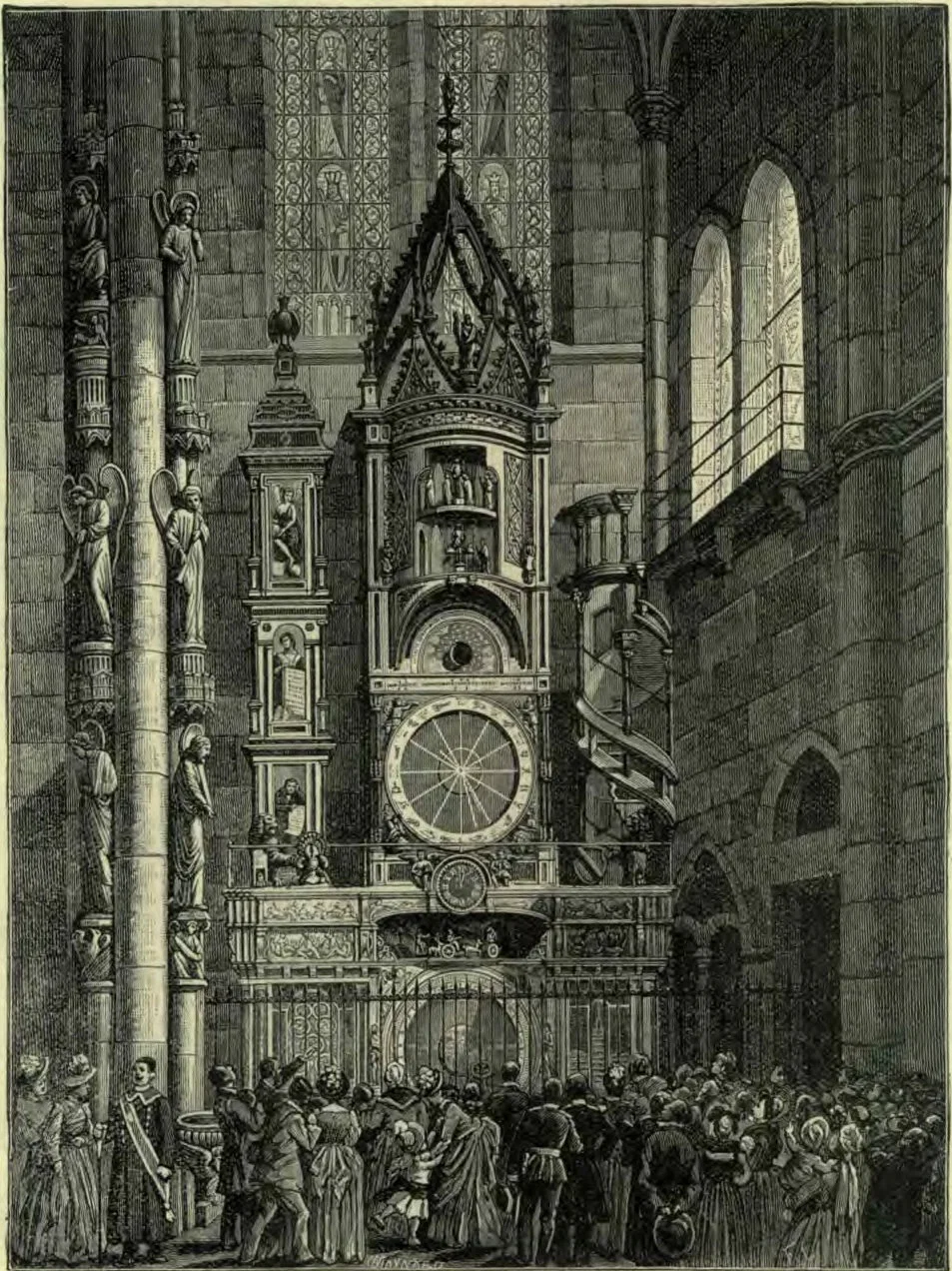
THE STRASBURG CLOCK.
By August Kunz
This clock has quite a history. The first time-piece on this plan was constructed as early as 1352, for the Strasburg Cathedral. It was called the Clock of the Three Kings, and ran two hundred years. In 1547 Conrad Dasypodius began a new clock, which was run for the first time June 24, 1574; but this clock was built on the Ptolemaic system, which taught that the sun went round the earth. In 1789 it got out of repair, and the French Revolution and later troubles prevented its being set in order again. In 1838 it was decided to attend to it; but upon investigation, it was thought best to have an entirely new clock constructed on the Copernican system. The work was begun June 24, 1838, and finished Oct. 2, 1842, by Herr Schwilgué, a mechanic and clockmaker.
THE CLOCK IN STRASBURG CATHEDRAL.
The lower part of the clock is surrounded by an iron railing, through which the entire effects of the workings of the mechanism can be seen. On the right is a neat winding staircase to enable the visitor more closely to view the tower-like top. Experts in mechanics, however, are also admitted inside the railing at the base.
The first thing to occupy our attention, as we begin our study of this wonderful contrivance, starting from the ground upward, is a copper sphere of the heavens, resting on four beautifully carved metal columns. It is made for the meridian of Strasburg, containing all the fixed stars of more than one hundred constellations that are visible with the naked eye, from Strasburg; in all there are more than six thousand stars represented, up to the sixth magnitude. This globe turns from east to west, making one entire revolution in a sidereal day, which is three minutes and fifty-six seconds less than a solar day.
Immediately in the rear of this celestial globe is the perpetual calendar, the most interesting and remarkable part of the entire clock. It consists of a wide circular metal band, nine inches broad and twenty-nine feet in circumference, bearing upon a guilded background all the signs and requisites of a perpetual calendar,—the months, days, dominical letters, etc., also the names of the saints and all the immovable feasts of the Catholic Church. This rotating band or ring advances every day the length of a day mark, the motion taking place exactly at midnight, every twenty-four hours. At the immediate right of this calendar stands a figure representing Apollo, holding an arrow in his hand, which points to the date and feast of the saint occurring on that date. The figure of Diana is on the opposite side. This calendar makes in ordinary years one complete revolution in three hundred and sixty-five days, on leap years in three hundred and sixty-six days. It even accounts for the deviation of three days within four hundred years—according to the change in the calendar introduced by Pope Gregory XIII—so that the calendar of the clock at Strasburg will tally precisely for hundreds of years with the calendars in common use from year to year. At midnight, between December 31 and January 1 of every new year, the calendar bears the inscription: “Commencement of the Common Year.” But if the new year is a leap year, the word “common,” by a special mechanism that acts but once in four years, will be left out, and instead appears the date “February 29.”
Not only the immovable, but also the movable feasts of the Catholic Church—which depend on Easter, such as Septuagesima, Ash Wednesday, Easter-Sunday, Ascension day, Pentecost, Corpus Christi—are given every year, becoming visible on the calendar January 1 of each year, each under its proper date for that year. The space within the annual calendar gives sun time and moon time. Any one, even only slightly acquainted with astronomy, knows that when the sun at noon stands over the meridian of any place, clock time and meridian time may be found to vary, sometimes as much as sixteen minutes; and since the dial of a common time-piece is set into the front of this grand mechanism, it is an easy matter to compare common time with solar time. The dial of the sun clock, if we may so call it, even though it is also driven by the complex mechanism before us, shows for each day the precise moment of sunrise and sunset; the apparent time for any moment, night or day; the visible daily motion of the moon about the earth; the various phases of the moon; and finally, every eclipse of either sun or moon.
The hours for sunrise and sunset are indicated by a movable horizon that divides the circle representing the course of the sun into two parts, which make, however, two equal halves only twice a year,—at the vernal and at the autumnal equinox, March 21 and September 20; on every other day they are unequal in size, exactly indicating the proportionate lengths of night and day.
The section immediately above the calendar is designed for the days of the week, indicated by the seven pagan divinities, after whom they were named. On a circular track are seven chariots of these gods and goddesses, drawn by symbolic animals; in these vehicles the various deities make their appearance in the proper order of their respective days. Each Sunday, Apollo, the god of the sun, appears in a resplendent sun chariot, drawn by white horses. On Monday, Diana, goddess of the chase, the moon, and night, comes to the front in a chariot drawn by stags. She is followed, on Tuesday, by Mars, the god of war, in a war chariot drawn by fiery steeds. On Wednesday Mercury is in sight, as the god of commerce, with winged staff and purse of gold. Each Thursday Jupiter, the god of thunder, rules the day, in a chariot drawn by eagles. The conveyance which appears on Friday is drawn by doves, bearing Venus, with her son Cupid. Finally, on Saturday, Saturn, the father of the gods, and god of time, comes in sight, represented as about to consume a child, a fitting symbol of all-consuming time.
If you ascend the winding stair-way of the clock, you come first to the Lions’ Gallery, so called because of the two lions represented there, one of which guards the peculiarly crested helmet, the other the escutcheon, of Strasburg. On this level is the common dial of the day clock, with a little cherub or guardian angel at either side. The one bears a scepter in his left and a hammer in his right hand; with the latter he strikes the first stroke of each quarter hour. The other angel has an hour-glass filled with red sand, which he turns very skilfully after the last stroke of every full hour.
Above the Lions’ Gallery is the planetarium, arranged on the Copernican system. The center of it consists of a sun with gilded disk, from which proceed twelve golden rays, pointing to the twelve signs of the zodiac on the dial ring. Seven small gilded globes represent as many planets of our solar system as are visible to the naked eye; they are wrapped in various colored clouds, and fixed to the points of different rods, whose length varies according to the respective distances of the planets they represent, from the sun. Their movements on the planetarium are regulated to a nicety by the clockwork. The planetary globe which represents231our earth, also registers accurately the movements of the moon about the earth.
In order to give a still more detailed view of the moon’s phases, you see immediately above the planetarium a large globe, representing the moon, behind which, upon a dark blue background, we see the starry heavens. The globe turns once in every lunar month about its axis, showing the light side of the satellite, and agreeing to a second with the date of the moon’s phases, as given by astronomers.
At length we come to that part of the clock which will probably excite the greatest attention, since it consists wholly of movable figures. In the lower niche, but above the large lunar globe, there appears every quarter of an hour one of four little figures representing respectively the four stages of human life,—boyhood, youth, manhood, and old age. At the end of the first quarter of each hour, after the cherub below has given the sign, the boy appears, and by one single stroke with a javelin upon the gong, or bell, near by, he indicates the first quarter of each hour completed. He is followed by a youth attired as a hunter, who indicates by two strokes with his arrow the half hours. The man in the strength of life appears in the garb of a knight in full armor, and tells the three quarter hours with three strokes of his sword. At the close of each hour an old man comes limping along, wrapped in warm fur, and leaning upon his crutch, with which, however, he is able to beat the four quarter strokes of every full hour. Each one of these little figures takes two steps forward in order to reach the bell in the center of the niche, and retreats again to its former position. A frightful-looking skeleton, representing death, with a scythe, stands upon a pedestal in the midst of the niche, and strikes the full hours with his bony arm on a second gong of peculiar sound, as soon as the old man who struck the full quarter hours has disappeared through the opening at the left, by which also each of the predecessors made his exit after striking his respective quarter.
In the midst of the uppermost apartment, which is elaborately adorned, the form of the divine Redeemer is seated upon a raised throne; in his left hand he holds the victorious banner of the cross, while his right hand is raised to bless. Every noon, after the figure of death has struck the twelfth hour, twelve figures, representing the twelve apostles, appear, who bow, one by one, in adoration before the Saviour, and each receives his blessing. Meanwhile the cock on the ornate column to the left, by flapping his wings repeatedly, raising his neck, stiffening the neck feathers, etc., crows three times, in remembrance of Peter’s denial of the Lord. The paneling of this column shows the pictures of the three great inventors of these mechanical contrivances: Schwilgué (the bottom one), Dasypodius, and the first originator of the first clock of the kind.
There is yet to be mentioned that, aside from all the movable figures and things pictured before us, the hands of the large dial (fifty-one feet in circumference), which is in the midst of the high tower of the Cathedral and faces the city, being visible from quite a distance, are moved by the same mechanism of this wonderful clock, standing on the floor of the cathedral. It is wound every eight days, and has but one principal motion, which is regulated by a second-hand. The pendulum moves in a regulator ornamented by precious stones. The lower works move the hands of the common clock, the hands of the large dial on the outside of the tower, the planetarium, the larger lunar globe, the seven groups of figures representing the days of the week, the dial registering solar time, the various phases of sun and moon, and the sphere of the heavens indicating sidereal time.
The other five movements are controlled by the works in the middle of the whole contrivance. Neither wood nor any other fragile substance is employed in the construction of this complicated invention, but every essential part of the mechanism proper is made of the very best and most durable metals. The whole is an unexcelled masterpiece of human skill and ingenuity,—a standing testimony of the consummate abilities and powers with which God endowed the human mind.
AUGUST KUNZ.
A DOG’S GOOD SENSE.
By J. P. Henderson
On the night of Sept. 21, 1894, a fearful cyclone passed over Kossuth county, Iowa. More than twenty-five persons were killed, and many others injured. A path of desolation was swept through a farming community, and many houses were wrecked. Among them was that of an aged couple by the name of Cassler. Their two unmarried sons were absent, and the only company was a faithful shepherd-dog, which for years had been the watchdog of the household.
The couple seem to have been in bed when the terrible monster lifted the house from its foundations and shattered it to atoms, scattering the fragments miles away, but dropping the lifeless bodies of the two victims in a field about thirty rods from where the house had stood. A married son lived only one-half mile away, and a married daughter lived a mile away, but in an opposite direction, and outside the path of the cyclone. They knew nothing of the disastrous event at their parental home, the darkness of the night obscuring the scene.
An hour later the dog made his presence known at the home of the daughter. He clawed at the door and moaned so piteously that they arose to ascertain the trouble. Being admitted he would leap upon them with his fore feet, look them in the face, and manifest the utmost feelings of distress. He would then retreat into the darkness a short distance, but he would immediately return and repeat the same thing. This he did until they prepared to go with him. The daughter and her husband then followed the dog through the rain, mud, and darkness to the home and into the field, until they stumbled over the bodies of their dead parents. Their anguish cannot be expressed. The dog then seemed satisfied, but continued to manifest distress until after the funeral, when he returned home with the daughter. Since then he cannot be induced to leave her or ever go back to the scene of desolation.
Why the dog did not first go to the son’s home, which was much nearer, is accounted for by the fact that he always manifested a special fondness for the daughter. What may have been his experience in the storm will never be known, but the distress he manifested and the good judgment exercised touches a chord of human sympathy. Could our dumb companions speak, they would oftentimes reveal to us hearts filled with suffering and anguish. “A righteous man regardeth the life of his beast!” God has planted feelings in the hearts of animals, a feeling of trust in mankind, and dependence upon him, and it is a part of purest Christianity that we should reciprocate such feelings, even in a dog.
J. P. HENDERSON.
MT. VERNON ACADEMY.
By N. W. Lawrence
It was my privilege to attend the closing days of school at this place, and knowing that our young people are interested in the progress of education, and especially in the prosperity of our own institutions of learning, I take pleasure in contributing a few words in regard to the work here.
My introduction to the place, about a week previous to the close of the school year, I would gladly have shared with my readers. Passing over the crest of a high hill, suddenly there lay out before me, in the peaceful quiet of the early evening, the Academy and grounds. Pausing but a moment to take in the natural beauty of the scene, I crossed the valley and soon found just such a welcome as the place suggested, sharing freely in the hospitalities of the students’ Home.
A few days of close association with teachers and students served to establish the first impression,—that here was a home indeed, where those who seek its shelter and its intellectual advantages might dwell in the quiet and wholesome atmosphere of real home life. Environment has much to do with the making of character and with the intellectual development of a community. So we are led to believe that the natural beauty of the place and the excellent home influences of Mt. Vernon Academy have aided much in the success it has already attained; for while a faithful corps of instructors have labored earnestly for those under their charge, nature has taught all lessons of the greatness, majesty, and love of her Creator.
It was gratifying to note the general attendance at the regular religious services of the school. It was evident from the daily conduct of the students, as well as from their testimonies in social meeting, that many had here learned to hope in the sure mercies of God, and to rejoice in his truth for these days. Baptism was administered in the afternoon of Sabbath, June 15. Three candidates signified their faith in the death and resurrection of their Lord.
School closed June 17, but as there was no graduating class, the morning session was devoted to the usual chapel exercises, a brief but practical talk by the principal, distribution of grade cards, and a few remarks concerning changes in the work for the coming year, as indicated in the new calendar.
The session closed with the singing of the hymn, “God be with You till We Meet Again.” The Academy grove was then turned into a picnic ground, to which all students with their friends had previously been invited. Swings, games, and a generous supply of well-filled lunch baskets made the few remaining hours of the day pass very quickly and pleasantly away.
In the evening a reception was given in the home parlors for the students and teachers. Formality was discountenanced, while friendly chat was frequently interrupted by music and song. The hour for parting came all too soon; and many strong ties, bound by long and happy associations, were found hard to break.
It was noticed that teachers and students alike shared in the realization of a profitable year spent together, and they now look forward to the coming school year with hopeful anticipations of still more gratifying results. Let all who may be looking toward this institution for the year just ahead be assured that they will receive a cordial welcome. And while this Academy, as all others, has its deficiencies, it may confidently be said that it is withal a good place for the young who are seeking a fitting up for the higher duties of life.
N. W. LAWRENCE.
THE “ST. LOUIS.”
The American-built ocean steamship, “St. Louis,” made her first trip from New York City to Southampton, England, in seven days, three hours, and fifty-three minutes, arriving Thursday, June 13. No effort was made to show her speed; indeed, this is never done with a new ship. The trip was in every way satisfactory, and it is unnecessary to say that she is one of the best ships on the ocean, and a credit to America. It is confidently believed that this American-built ocean liner is the first step toward the resumption of ocean traffic by American ships. In the early days of United States history, the ships of this country were seen in every part of the world, and the United States was a formidable rival with England for the carrying trade of the world; but the American merchant marine declined, until the stars and stripes were almost unknown in foreign ports.
Various causes are adduced for this change. As might be expected, each of the great political parties of this country holds that the other party is responsible for this change. It is not necessary to take a partisan view of this question to find a sufficient cause.
The real cause is not hard to find. England, with her internal resources fully developed, looks to the sea and to traffic with other countries to increase her capital. To this end the British government has granted liberal subsidies to steamboat lines. On the other hand, the United States has vast unimproved internal sources of wealth in her own country. Why should men risk money by doubtful investments at sea, when in our own growing cities of the West there was a much surer chance of increasing their wealth? Nor would the United States government grant any subsidies, so that an American line had no chance to compete with the English lines. Now the tide is turning. Our resources are more fully developed, and American capital begins to look away for investments. If our government will grant reasonable assistance, the American merchant marine will undoubtedly be restored to more than its former status.
NATURE IS WITNESS.
By L. H. Christian
On every tiny bud and leaf
There is inscribed so plain, though brief,
A precious truth; all may it see.
'Tis God is love; he cares for me.
The pretty birds, whose joyful song
Proclaim his praises all day long,
Tell in their simple, guileless lays,
That God is love in all his ways.
The lilacs, roses, violets blue,—
Yea, every flower of every hue,—
In structure, color, do declare
A heavenly Father's love and care.
The clouds, the rain, the sun, the air,—
All of dear nature's forms so fair
On earth below, in heaven above,
Repeat the story; God is love.
And should not man, of all supreme,
Himself extol this sacred theme?
Behold what manner of love is shown —
God will as children sinners own!
L. H. CHRISTIAN.
THE CZAR'S BRACELET.
GREAT rulers are human, and oftentimes as gentle and affectionate in their family relations as the humblest workman.
A pathetic story comes from Russia of the late emperor's tender regard for the wishes of his wife. Last summer the emperor and empress visited a great shop in St. Petersburg to select some jewels for their son's future bride. The empress saw a beautiful bracelet, and expressed great admiration for it, and remarked laughingly to her husband that she must purchase it sometime. Shortly after their return to the palace, the czar was seized with one of those serious attacks of illness to which he was subject, and the empress forgot the bracelet.
The emperor died, and to the empress in the early days of her widowhood came a birthday, the first anniversary which she must pass alone. On her other birthdays the czar had been wont to place a bouquet in the morning-room of the empress. Inside the flowers was always folded some rich, rare gift, chosen months beforehand.
The empress had avoided the room as too full of painful memories, but this morning, the morning of his wedding day, Nicholas requested his mother to go there as a favor to him.
The first thing she saw there was the bouquet in the usual place, and inside the flowers was a case fastened and sealed by the czar's own hands. It contained the bracelet. He had ordered it on the same day that the empress saw it, and on his death-bed had given instructions for the birthday gift, bidding his son to be near to comfort her when she received it.—Wellspring.
CARRIAGES WITHOUT HORSES.
IN the doggerel rhyme attributed to “Mother Shipton,” whoever she may have been, one line declares that “carriages without horses shall go.”
Without taking any stock in this ancient or modern rhyme, carriages are now certainly run without horses — not only railway coaches, but carriages on the public roads. Some tests of these carriages which have recently been made were so successful that the question is raised, Shall the horse go? The power of steam has taken great burdens off that faithful animal; electricity with the trolley car has come to his relief; the bicycle has relieved the poor livery horse of many an exhausting trip, to the lightening of the liveryman’s pocket; but still the old and the staid people cling to the horse and carriage of their fathers. But now it is found that the carriage can be retained, and let the horse stand in the stall, or roam the pasture at will. The test of carriages without horses referred to took place in France between Paris and Bordeaux. Sixty vehicles driven by steam or electricity raced from city to city. Some accidents took place, but on the whole the experiment showed that these machines are practical, and that with improvements they will be a success. One carriage run by steam, using petroleum for fuel, made the trip of seven hundred and twenty-seven miles in two days and fifty-three minutes, an average of over fourteen miles an hour day and night. No horse could do this. Of course the roads were better than anything we have in this country, but our roads should be better.
IGNORANCE NO EXCUSE.
A LATE decision of a high court in the United States reported by the American Lawyer, is to the effect that if a person signs a paper or document of any kind, he cannot be released from what he has bound himself to do, if he is able to read. The fact that through his carelessness he failed to read what he signed, is no legal excuse.
It will be well for all to remember this decision. The country is full of unprincipled sharpeners who try to induce people to sign for something or other. We have known people to agree to take a serial encyclopedia, when they thought they were signing for a monthly magazine for one year. Misrepresentation or fraud used in getting one to sign, however, releases the signer from obligation, but it may even then cause some trouble to get released from it.
Scan closely what you sign.
A PREHISTORIC CHICAGO.
A MAN in Chicago, Charles Dilg, has made some very remarkable discoveries of the work of a prehistoric race within the limits of the present city of Chicago. He has secured about a ton of stone implements of various kinds, some of which are different from anything ever before found. From the abundance of the “chips” found, he believes that the present site of Chicago was the location of a town or city whose inhabitants were engaged in the manufacture of these tools. He has lately given to the world, through the Chicago papers, the results of his investigations, and his work is attracting general attention. It is a remarkable fact that Mr. Dilg is a common workman and a poor man, and yet he has shown all the qualities of a genuine archaeologist. He has carried on his investigations as best he could after his work for the day is done. The time which men of his class generally employ in idleness, and many of them in dissipation, he devotes to scientific pursuits. Men of such abilities and bent of mind ought to be encouraged in their investigations by assistance from the general government, the State, or from men of wealth. America has a past history, and it is by the researches of such men as Mr. Dilg that its history can be learned.
A NEW LAKE STEAMER.
THE largest ship ever built for fresh water traffic was launched on the Calumet River, South Chicago, June 29, from the South Chicago Shipbuilding Company’s yards. Six thousand people, who had assembled to see the launch, cheered themselves hoarse as she took the water. She was christened the “Victory,” and the traditional bottle of champagne was broken on her bow as she left the land for her future element. The “Victory” is four hundred and two feet long, forty-eight feet broad, and draws twenty-eight feet of water. Her engines are of two thousand horse power, and her speed twelve knots an hour. She will be engaged in carrying iron ore, and her line of travel will be from Lake Superior to Lake Erie. She can take six thousand tons at each trip.