WHEN the world first came from the hands of the Creator, it had one spot upon it called the Garden of Eden, or Paradise, which surpassed all the rest of that beautiful new earth in loveliness and splendor. Eden was fitted up to be the home of Adam and Eve, the father and mother of the human race.
Of all the trees in that garden—beautiful to look upon and good for food, but two are named in the sacred record. These two stood near together in the midst of the garden, thus indicating their preëminent importance and value; and they were named by the Creator as the “tree of life” and the “tree of the knowledge of good and evil.” These were literal trees, bearing literal fruit, and upon the withdrawal of Paradise from the earth, they were removed. But we are led to inquire, Is there nothing on earth to take their places, to stand as their representatives, until Paradise shall again be restored to the earth made new, in that final restitution of all things spoken of by the holy prophets? We conclude that these two trees do have their prototypes remaining even in this world of sin.
The tree of life in Eden was accessible to our first parents. They had a right to partake of it, and no doubt did so, until their sin cut them off. And it stands to reason, as well as revelation, that if they had ever entertained the right relation to the trees of life and knowledge, they would be living still, and neither they nor any of their posterity would ever have needed any other source of life unalloyed and unending. But now, and ever since, all who would have life, and have it more abundantly, even eternal life, must come to Christ as unto a living stream, a living stone, a living tree. “Except ye eat the flesh of the Son of man, and drink his blood, ye have no life in you. Whoso eateth my flesh, and drinketh my blood, hath eternal8life; and I will raise him up at the last day.” John 6:53, 54. Hence Jesus, the Lord of life to a dying world, is the Tree of Life now accessible to the fallen race. Jesus is the connecting link between the original literal tree of life in Paradise lost, and the tree of life to be restored in the end of the world, to the redeemed host, when they pass through the gates into the holy city. Then they will have right to the original tree of life, which is still in the midst of the Paradise of God. Rev. 22:14.
The tree of knowledge of good and evil has ever had its prototype among men, in that holy law which emanated from the divine mind, was spoken with a voice that shook the earth, and was written with the finger of God on the two tables of stone. God is infinitely good, the source of all goodness, and the ten commandments are an expression of his goodness. Paul bears witness to the fact that “the law is good.” Rom. 7:12, 16. Anything and everything that is out of harmony with this law, is not good. Hence a knowledge of good—that which is good in the best, truest, and highest sense—is to be obtained alone from this tree. And it is only when this law is written in the heart that a soul is capable of doing good, or being good.
It is also true that by this same tree, or law, is the knowledge of evil. Sin is the synonym for all evil in this world, and the word of the Lord explicitly declares that “by the law is the knowledge of sin.” Rom. 3:20. Paul says that he had not known sin but by the law. Rom. 7:7. Indeed, there would be no knowledge of sin, nor no sin, if there were no law. Hence it follows that by the law of God is the knowledge of both good and evil. To eat, or even to touch, the fruit of the original tree of knowledge in the Garden of Eden, was to disobey the command of God. And that tree was the point, and the only point, from which temptation and transgression could come to the holy pair in Eden. In like manner the law of God is the object of Satan’s bitterest hate and opposition, and it is from this standpoint, and this only, that the same wily foe accomplishes the ruin of souls by temptation and sin. All accountable beings have partaken of this tree of the knowledge of good and evil, in that all have sinned against God by violating his law. Hence all have forfeited life. But Christ, the Tree of Life, is near to the law, the tree of knowledge, and no flaming sword of cherubim will prevent the transgressor from eating and living forever.
As the tree of life stood in the midst of the Garden of Eden, easy of access from all parts, so Christ is in the midst of the golden candlesticks,—his church,—and is always easy of access to his people.
As the tree of life bears twelve manner of fruits, and yieldeth its fruit every month, so the fruits of an indwelling Christ-life are many and perennial.
As continued access to the tree of life was necessary to the perpetuation of life, so a continual partaking of Christ is necessary to the perpetuation of spiritual life.
As to be debarred from the tree of life meant death from that very day, so to be cut off from Christ means death from the very day of separation.
As the tree of knowledge stood in the midst of the garden, so the law of God is in the most central and conspicuous of all God’s word.
As this tree was the tree of knowledge of good, so the law of God is the essence and expression of God’s goodness—the synopsis of all good.
As this tree was the tree of the knowledge of evil, so it is by the law of God that we get a knowledge of sin, the essence of all evil.
As the tree of the knowledge of good and evil was the test of loyalty to God in beautiful Eden, so the law of God is the sure and only test in this sinful world.
As the continued life and unalloyed happiness of Adam and Eve in the original Paradise depended upon their constant right relationship to the tree of life and the tree of knowledge, so the continued life and unalloyed happiness of mankind now depends upon their rightly relating themselves to the law of God and the Lord Jesus Christ. And the flaming sword of elect angels is turning every way to enable sinful man to obtain and maintain this divine relationship.
Hence we discover that, as Adam and Eve in Eden were placed on probation for eternal life, the tree of knowledge being the rule and test of loyalty to God, and the tree of life the source of continued life, so mankind is now on probation for eternal life, and the law of God is the rule and test of loyalty to God, and Jesus Christ is the only source of continued life.
“SHOWERS OF BLESSING.”
By Anna Agee
BY ANNA AGEE.
“Let good or ill befall,
It must be good for me,
Secure of having Thee in all,
Of having all in Thee.
Would we only believe these beautiful words, how like healing balm it would be to our troubled souls when tossed by storms of trial and temptation! And yet, if we believe God at all, we must take this as true, for he says, “All things work together for good to them that love God” (Rom. 8:28); and, “All things are for your sakes. . . . For our light affliction, which is but for a moment, worketh for us a far more exceeding and eternal weight of glory” (2 Cor. 4:15-17).
Without these trials and afflictions, which at the time seem very hard to bear, we would never attain to the high standard of character which a God of boundless love and wisdom sees we must reach in order to be fit for the society of heavenly beings. With even a part of the dross of earthliness about us, we could never bring happiness into the courts of the eternal city, and none but those who will bring happiness can ever enter there. So God permits strong temptations and fiery trials to come upon us, that all the dross may be consumed, leaving the pure gold only. As the gold comes from the furnace, not alone free from all refuse, but pliable and easily shaped into whatever the workman sees fit to fashion it, so we may come, if we will, from the spiritual furnace softened and subdued, ready to be molded by the divine Workman. And as the gold, formed into coin, receives the impress which marks its value, so we may be made by the Master into whatsoever he will, and receive the divine impress,—his righteous character,—which marks our value in his sight.
So he says: “My son, despise not thou the chastening of the Lord, nor faint when thou art rebuked of him; for whom the Lord loveth he chasteneth, and scourgeth every son whom he receiveth. . . . Now no chastening for the present seemeth to be joyous, but grievous; nevertheless afterward it yieldeth the peaceable fruits of righteousness unto them which are exercised thereby. Wherefore lift up the hands which hang down, and the feeble knees.” Heb. 12:5-12. And again, “Beloved, think it not strange concerning the fiery trial which is to try you, as though some strange thing happened unto you; but rejoice, inasmuch as ye are partakers of Christ’s sufferings; that, when his glory shall be revealed, ye may be glad also with exceeding joy.” 1 Peter 4:12, 13.
His glory, his character, may be revealed in us now, if we will let it; and the trial which seemed so overwhelming may be seen as a means by which a compassionate heavenly Father has sent us the greatest blessing he had then to bestow upon us, and which we would not receive in any other way. Satan stands ever ready to try us in every way, yet he can do nothing unless God, in his infinite wisdom, sees best to permit him to work for the time being. God has hedged all his children about with “angels that excel in strength” (Ps. 103:20; 34:7; Job 1:10), so that, without permission from the throne of Jehovah, Satan cannot break through; and that permission will never be given unless it is the wisest thing God can do for us under existing circumstances.
What a precious lesson we may learn from Job’s experience! The Lord saw that Job needed the very trials which came upon him, although they were so very severe, in order to lead him higher up in the building of a holy and perfect character. Therefore, God allowed Satan to work, but only to a certain extent, for he will not permit one soul to be tried above what he is able, by appropriating God’s strength to endure.
When the trials were over, what was the result?—“Then Job answered the Lord, and said, I know that thou canst do everything, and that no thought can be withholden from thee. . . . I have heard of thee by the hearing of the ear; but now mine eye seeth thee; wherefore I abhor myself, and repent in dust and ashes.” Job learned true humility and submission, and saw the Lord as he never had before; and it is written: “The Lord also accepted Job.” “The Lord gave Job twice as much as he had before.” “So the Lord blessed the latter end of Job more than his beginning.” Job 42:1-6, 9, 10, 12. Just so it will be with all those who learn in the school of Christ, as Job did.
Take also the case of Abraham. What ordeal could be more trying than the one he was called upon to pass through! Yet because he submitted his will and walked in humble obedience, trusting God to bring everything out all right, he received a blessing of incalculable value, and won the titles of “faithful Abraham,” “the friend of God.”
So we might notice other Bible characters; and in every case we would see that God designed all their trials as blessings; and so they proved to be to all who did not thwart God’s purposes by their rebellion. And they were not designed as blessings merely for the one individual, but blessings and comfort to many. How many souls have been helped by the experiences of these Bible characters eternity alone can tell.
Our trials are designed for the same purpose,—to bring blessing and comfort not only to ourselves but to others. 2 Cor. 1:3, 4. Let us, then, take heed to the admonition:9“Count it all joy when ye fall into divers temptations; knowing this that the trying of your faith worketh patience. But let patience have her perfect work, that ye may be perfect and entire, wanting nothing,” remembering “that the trial of your faith, being much more precious than of gold that perisheth, though it be tried with fire, might be found unto praise and honor and glory at the appearing of Jesus Christ.” James 1:2-4; 1 Peter 1:7.
When we truly count everything a blessing from God, we can thank him heartily that “showers of blessings” are falling all around us, for all things are blessings, and our greatest trials are our greatest blessings.
BY THE WAYSIDE.
While sitting in the railway station waiting for a belated train, a plain little woman seated herself beside me and said in a pleasant voice:—
“So you are waiting, too?”
“Yes,” I said, “we have to wait sometimes.” We had never met before, but we seemed to be acquainted at once, without formalities. With quick intuition she knew I had said more than my words expressed, and, looking full in my face, with a kindly light in her eyes, she said:—
“It is good for us to wait. Don’t you think so?”
“It is, indeed,” I replied. “We rush from one thing to another in these busy days so fast that a belated train is a blessing. It gives us time to think.”
“Well,” she said, “that is what we need, I’m sure, more time to think, and more time to talk with the Lord.” This last remark was in a half-hesitating tone, as if she were not sure I could “receive this saying,” but a smile and nod reassured her, and she went on:—
“Now I keep a little store down in B., and am busy in it from morning till night. We ought to attend to our business, oughtn’t we?”
“Certainly; we would be serving the Lord very poorly if we failed to give our daily affairs proper attention.”
“So I think,” she said. “But I do try to ‘keep the Lord always before me,’ as David said, and I find a good many things to say to him, and he says a good many things to me, right along while I’m busy about store affairs. The other day a young man came into my place to show samples; you know how they do—these drummers. Well, while he was talking, I saw he wasn’t just like the most of ’em, he seemed so considerate and fair about everything, and his manners were so pleasant. So I was quite friendly with him, and I found he was the son of a Methodist preacher. So he told me he was waiting for a call from the Lord; he wanted to be a preacher himself, but he wasn’t quite sure yet whether the Lord wanted him or not, so he was doing this business till he found out for sure. I told him he showed his good sense in that, anyway, for too many run before they’re sent, and of course they don’t amount to much. But I said, ‘How do you know but you are doing the Lord’s will just as well by being a conscientious business man, and speaking a word for him as you go along, as you would do it by being a minister?’ He said he didn’t know but it was so, but anyway he was waiting.”
“Then he told me how he had been in a place with his samples, and overheard one man say to another: ‘That woman that lives upstairs keeps telling me that she is praying for me. She might just as well save her breath, for it won’t never make any difference. I ain’t got time to think about such things. I’m too busy in this shop.’ So he said before he left that place he told the man he had heard him say this, and he wanted to ask him what he thought his ‘time’ would be worth to him if he spent it all on his shop, and finally went without anything worth having into the other world. He said the man took it kindly. I told him I thought that was preaching as much as if he had said it from the pulpit.”
Just then my train came in, and hers, going the other way, was due.
“Well, now, I’m real glad I met you this morning,” she said. “It’s a good thing to wait sometimes. We often get the best by waiting. Good-by.”—Christian Advocate.
THE GRIP AND DRUGS.
By Chas. H. Shepard
BY CHAS. H. SHEPARD, M.D.
PRIMARILY, the cause of the grip is the susceptibility of the system. This is shown by the fact that some persons enjoy entire freedom from this disease, while others succumb to its influence every time it appears.
There are many conditions that favor it. What is called a poor circulation is accompanied by an inability to throw off morbid influences, and persons in that condition are likely to suffer from every epidemic. The same applies in digestion, for when the body is not well nourished, there is but a feeble reactive force. Those having a torpid liver find the grip an added burden to the discomfort of life, and those with an inactive skin are still more likely to suffer from its baneful influence; but among the more prominent causes of susceptibility may be classed the almost universal habit of drug taking, from the mild tonics to patent medicines. Whenever one is out of order in any way, apparently the first thing to be done is to swallow something, instead of trying to find out the cause of the trouble and seeking to obviate it by regulating the habits of life. This drug habit tends continually to lower the tone of the system, and the more it is indulged in, the more apparent becomes the necessity of continuing the downhill course. A large amount of the deterioration of our people is due to the use of alcoholic tonics, or stimulants, as they are sometimes called. The majority of persons do not look beyond the fact that they seem to feel better after the use of stimulants, but this feeling comes from the benumbing action of the alcohol itself, and never from any building-up action of the drug, because it has no such action. What is supposed by some to be that action is only an irritation resulting from the efforts of the10system to get rid of the drug. It exhausts the vitality only so much quicker, and therefore alcohol should always be considered a poison to the human system, and is already so considered by some of the highest medical authorities.
The use of tobacco and of tea and coffee is injurious, and they ought not to be used by those who seek to place themselves in the best condition to resist disease, because they belong in the category of irritant drugs, which, by rousing the vital forces to get rid of the poison, provoke the action which is mistakenly supposed to be an added force, whereas this action is only one of self-preservation. It will readily be seen how much supporting or building up of the system there is in such substances by trying to live on them, to the exclusion of other things. The result would prove the absurdity of the idea.
By proper treatment at the beginning of an attack, the grip is quickly relieved; on the contrary, if not properly managed, it is liable to serious complications. . . . The remedy that does not draw upon the vitality, but rather conserves its force, and relieves the tortured body by simple elimination, is the Turkish bath. Its first effect is to quicken the circulation and render the skin active. By this means the system is brought up to its highest vigor, and the action of every function is made more acute. The beneficial effect of heat in all work of purification is too well established to admit of dispute. Its action on the human body is equally valuable, and has been demonstrated in numberless instances. During the presence of the bather in the hot room of the bath his blood is over and over again brought under the direct action of heat, until every particle is revivified. The drinking of water during the stage of perspiration, its absorption and excretion, loaded with the débris of the system, is a large factor in the work of elimination. It has even been apparent to the eye that salts have crystallized upon the body from the perspiration while in the hot room.
Those who are in a position where they cannot take advantage of the Turkish bath should bear in mind its vital principle, which is sweating produced by heat. A simple but effectual manner of securing this sweating is by means of the hot sitz bath, hot footbath, or drinking hot water and going to bed, covering the body with extra clothing. After a profuse sweating carefully bathe the body in tepid water, gradually cooling it to a normal temperature, and avoiding unnecessary exposure. By all means sleep in pure air and eat as little as possible, and that only when hungry.—Journal of Hygiene.
THOUGHTS
By Mrs. M. E. Durkee
BY MRS. M. E. DURKEE.
“They that trust in the Lord shall be as Mount Zion, which cannot be removed, but abideth forever. As the mountains are round about Jerusalem, so the Lord is round about his people from henceforth even forever.” Ps. 125:1, 2.
Jerusalem was surrounded by mountains, and, being thus protected, was not easily besieged by armies. So the Lord can create barriers to prevent his people from being overtaken by calamities. They that trust in him have a firm foundation for their feet, and a sure hope, which no earthly power can overthrow.
“Come, my people, enter thou into thy chambers, and shut thy doors about thee; hide thyself as it were for a little moment, until the indignation be overpast.” Isa. 26:20.
When great troubles threaten us outwardly, there seems to be danger threatening our lives, we may hide ourselves behind the precious promises of God, shut our doors, as it were, keep our hearts in perfect peace, realize continually the protection of good angels, as promised to those who hide under the shadow of the Almighty. Just before the Lord comes to punish the inhabitants of the earth for their iniquity, there will be a time of trouble such as never was before. Dan. 12:1. At that time it will be a most precious privilege to be hidden by the Almighty.
“Behold, I have graven thee upon the palms of my hands; thy walls are continually before me.” Isa. 49:16.
God’s people are continually before him, as the hands are before the face. He comforts his people by telling them that he will not forget them. Thus the expression, “graven upon the palms of my hands,” is a most expressive one, a continual reminder of the loving Father’s watchcare. The phylacteries which the Jews wore were a sign to them of deliverance from bondage, and were to be kept constantly in view, that they might never forget God’s tender care. Deut. 6:8; 11:18. So, using the same figure, God promises to remember his people as surely as if their names were engraven upon his palms. And when danger threatens them, if they look to him for deliverance, he is mighty to save. The Lord through Isaiah says, “Their walls are continually before me;” and in Ps. 34:7 we are told that “the angel of the Lord encampeth round about them that fear him, and delivereth them.” From these expressions we may infer that angels are a wall of protection around those who love and trust God continually.
If we make religion our business, God will make it our blessedness.—***H. G. J. Adams
By H. G. J. Adams
MOTHER LOVE.
By Mary Ware
BY MRS. MARY WARE.
Though other friends may join
To soothe life's bitter cares,
None like a mother's love
Can stay the falling tears.
No voice like hers can thrill
With music's sweetest tone,
No love like hers forgive
And bless the erring one.
From hopeless, tottering youth
To sorrowful old age
The memory of mother love
Will gild life's golden page.
The kindness that seemed
To us so very small
Will gather meaning when
She is beyond recall.
The tears we caused to flow
Will rend our hearts with pain;
Each unkind word of ours
Will seem to live again.
God pity those who learn
Too late, or fail to prize,
A mother's sympathetic love,
The truest ’neath the skies.
—Catholic Mirror.
TEMPERATURE OF THE FEET.
By Dio Lewis
BY DR. DIO LEWIS.
CONGESTION of the head, throat, or any of the organs of the chest and abdomen, is relieved by a good circulation in the feet and legs. Being far from the vital apparatus, and thus liable to become cold, they are, in addition, kept in the coldest part of the room. During the cold season the air at the floor is several degrees colder than at the ceiling. The anxious mother shows her familiarity with this fact when she says, “Children, you must not lie on the floor; you will catch cold.”
Notwithstanding this marked difference, the feet have less clothing than the body. Our chests would suffer on a cold day if they had but a single thickness of cotton and one of morocco. Warmth of the lower extremities is indispensable to health of the head and chest. Cold bathing, friction, stamping, and other exercises, with proper clothing, will generally secure the needed temperature in these parts. But in many whose vitality is low, and whose occupation compels long sitting, the feet, even with the measures suggested, will become cold. To such I advise the use of artificial means. A jug filled with warm water, and placed under a stool which is stuffed and carpeted, will diffuse a gentle heat about the feet, and secure a temperature equal to that about the head. It may be said that such measures will produce susceptibility to cold. A hot-water footbath, and other extreme measures, will produce such susceptibility, but the gentle warmth radiated from the jug, so far from creating such morbid susceptibility, will, by establishing an habitual circulation in the feet, act as a preventive of colds. A tin reservoir, which half a dollar will purchase, may be fitted between the legs of a stool, and prove more convenient than the jug. One of my neighbors has patented such a stool, but any tinman can make at small expense something which will answer nearly as well.
The practice of compelling schoolchildren to exchange their boots for slippers, during school hours, is bad. While the silence thus secured is an advantage, if the schoolroom be ventilated as a schoolroom should be, the feet of the pupils must become cold. A strong carpet shoe with a thick felt sole, and coming well up at the ankle, would prove highly satisfactory. For such a shoe the pupil may well exchange his heavy boots during school hours, particularly if the latter be kept in a warm and dry place.
Boots and shoes ought to have ventilators in the heel and between the soles to let in fresh air and drive out the foul. By such means the moisture given off by the feet will be driven off and the stockings kept dry. Dr. Jaeger, a German, has invented such a shoe. Every step taken draws in and drives out air, just enough to ventilate the space inside, and not enough to chill the feet, and helps to keep the feet healthy and the stockings clean; but I am sorry to say the invention is not in general use.—Journal of Hygiene.
AMONG THE FIJIANS.
By C. M. Snow
BY C. M. SNOW.
THERE are a great many things of interest in the life and religion of the inhabitants of the Fiji Islands, and I shall be able to bring but a very few of them before your attention in this article.
In the first place, I will speak briefly of their traditions in regard to creation. According to their belief, Ndengie was the god who brought the human being into existence, and the way he did it was this: A small kind of hawk built its nest near the dwelling of Ndengie, and laid two eggs. Ndengie looked upon these eggs, and, seeing that they were very beautiful in appearance, he took them to his abode, and resolved to hatch them himself.
In due time, as the result of his incubation, there were produced two human infants, a boy and a girl. He removed them carefully to the foot of a large tree, placing one on one side of it, and one on the other. They remained in this position until they had attained to the size of children six years old. Then the boy looked around the tree and discovered his companion, telling her that Ndengie had made them two that they might people the earth; but where he got his information the legend fails to state.
At length they became hungry, and Ndengie made bananas, yams, and taro to grow around them. The bananas they tasted and approved, but the yams and taro they did not like, until Ndengie showed them the use of fire and how to make it. In this manner they dwelt, had numerous offspring, and in process of time these peopled the earth. In this tradition you will see that the birds were man's predecessors in creation.
They also have a tradition of a deluge, and in some of their accounts it is referred to as being only partial, but in others it is represented as being universal. The deluge was brought on by the insolent acts of the people, who, when threatened for their offenses, added blasphemy to their other outrages, and defied the god to do his worst. He attempted to subdue them, and, failing, disbanded his army, and resolved on another method of11procedure. At his command the dark clouds gathered and burst, pouring raging torrents on the doomed earth. Towns, hills, and mountains were successively submerged, but the rebels looked on without concern. When the waters came up so high as to really frighten them, a certain god taught them how to build a canoe. All agree that the highest places were covered, and the remnant of the race saved in some kind of a canoe, which was at last left on the top of Mbenga, after the waters had subsided. The number saved was, according to their traditions, eight, exactly the number given in the Mosaic record.
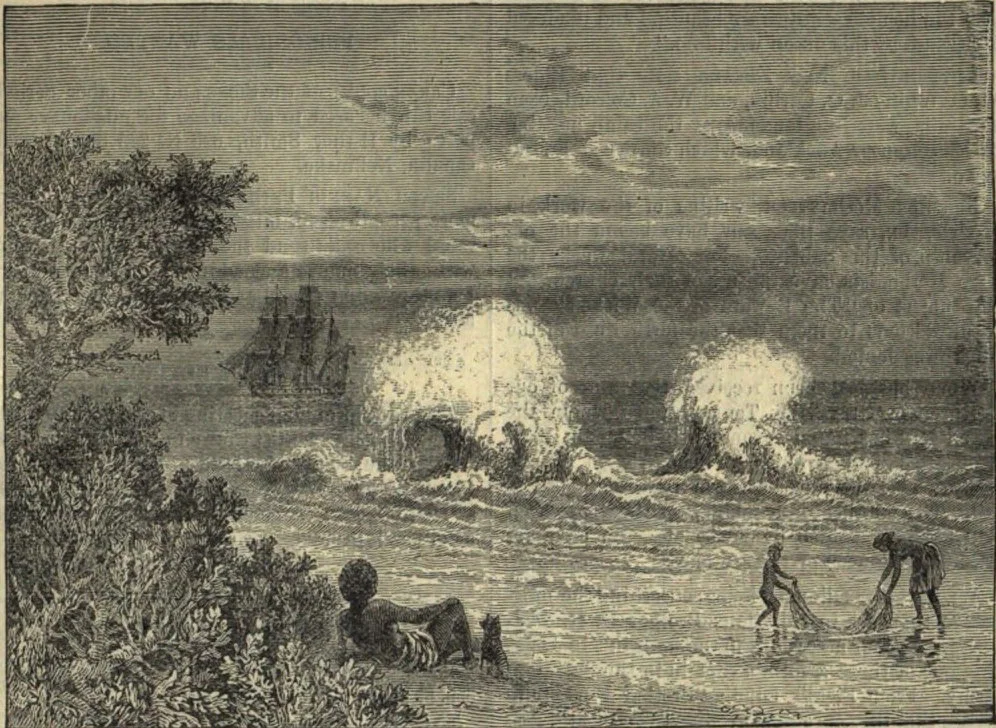
A CORAL ISLAND IN THE SOUTH PACIFIC.
Another of their traditions is in regard to a great tower, which was built in former ages by men eager for astronomic information, and who were especially anxious to decide the difficult question as to whether the moon was inhabited. To effect their purpose, they cast up a huge mound, and erected thereon a great building of timber. The tower had already risen far skyward, and the ambitious hopes of its industrious builders seemed near realization, when the lower fastenings suddenly gave way, and the workmen were scattered over every part of Fiji. It is said by missionaries to be a remarkable fact that the inhabitants of Ono, the most distant island, say that they originally belonged to this locality, and still more remarkable that there exists a dialectic similarity between these extremes. The inhabitants of each are worshipers of the same god, in virtue of which they may take from each other whatever they wish, and also swear at each other without risk of giving offense.
On hearing of the translation of Elijah, the natives of the Fijian Islands rehearse their tradition of a similar event, the chief difference being a change in the gender of the individual who was translated. Their version of the affair is that a woman by the name of Yaro, who was very good, but unkindly treated by her husband, was removed from this earth without being permitted to die.
While there seems to be in all these legends a likeness to those which the Bible records, yet the differences are so striking as to make one almost believe that they are merely creations of their imagination. And yet there is a possibility that they may have descended direct from the true narrative. If the ancestors of these people were ever connected with the worship of the true God, if they were ever connected with God's ancient people, their condition of morality, when discovered by the whites, shows as great a descension from the true morality as their legends are different from the true Scripture records. In other words, there is the same difference between their legends and the Scripture records that there was between the true morality and the social condition of these people fifty years ago.
One writer has said of them that in the entire annals of Christianity it would be difficult to find a record of any of its enterprises so remarkable, or followed by such astonishing success, as the mission to Fiji. The picture already given is very weak, and imperfect in all of its particulars. The worst deformities, the foulest stains, disfiguring and blackening all the rest, are the very parts of Fijian nature which, while the most strongly characteristic, are such as may only hurriedly be mentioned, dimly hinted at, or passed altogether in silence. The truth is just this, that within the many shores of this secluded group, every evil passion had grown up unchecked, and run riot in unheard-of abominations. Sinking lower and lower in moral degradations, the people have not fallen intellectually or physically to the level of certain stunted and brutalized races, fast falling, from mere exhaustion, from the mass of mankind. Constitutional vigor and mental force aided and fostered the development of every crime, until crime became inwrought into the very nature of the people themselves, polluted every hearth, gave form to every social and political institution, and turned religious worship into orgies of surpassing horror. The savage of Fiji broke beyond the usual limits of rapine and bloodshed, and, violating the elementary instincts of humanity, stood unrivaled as a disgrace to mankind.
This is the kind of a country and this the people among whom missionaries began their work about fifty years ago, and the first attempts of the missionaries to get on land, to give to these benighted people the Gospel which was to cleanse them from this degradation, were met by armed resistance from those on shore. It was their custom to kill and eat any foreigners landed upon their islands, and the first white sailors from the first vessel that ever reached them were disposed of in this manner, butchered before they had hardly reached the shore. An attempt was made to do the same thing to the first missionaries who sought to land there. The missionaries did land, and the islanders at once began to strip them of everything they possessed, to insult them in every way they could devise, in fact, were about to strangle them, when a cannon fired on board of the vessel so scared them that they allowed the missionaries to go back on board, happy in having escaped with their lives. It would take too long to tell how they finally succeeded in gaining a foothold; but, with persistence and the power of God, they did make an opening, they established their schools, they preached the Gospel as they knew it; and, with all the savage traits of the islanders, with all the degradation and crime into which they had sunk, the Gospel of Christ wrought a revolution in their midst. People who have looked on the picture of the Fijians as they were and as they are, are led to exclaim, “What hath God wrought!”
The change which has taken place in Fiji since missionary effort began to be put forth there, presents a phenomenon which cannot be explained except by recognizing the presence of a supernatural force, almighty and divine. Many of those points which most strongly marked the inhabitants of these islands have passed away, and a new order of things has been instituted to take their place. Cannibalism in this group of islands has become entirely extinct, polygamy is passing away, infanticide in the same proportion is diminishing, and arbitrary and despotic violence on the part of rulers is yielding to the control of justice and equity. Human life is no longer reckoned cheap, and the avenger of blood comes not now as a stealthy assassin or backed by savage warriors, but invested with the solemn dignity of established law; while other acts, once performed openly and without shame, are now recognized as crimes, and punished accordingly.
It is inconsistent and unreasonable to suppose that civilization in its entirety and as we know it, can at once be thrust upon a savage, yea, a cannibal people; but civilization has made progress, not, perhaps, as much as might be expected by those ignorant of what had to be removed and what had to be introduced, or who have viewed these things as they were softened by the light of distance. But the progress has been real, and such as may be expected to reach in due time a full development. The solid structure must be first erected, the foundations deeply laid, and then may be added the adornments and decorations of the building. The missionaries have done a noble work in the islands, and thousands who would now be groveling in the wretchedness of heathendom are enjoying the blessed sunlight of the Gospel of Christ.
RULES FOR HANDLING BOOKS.
NEVER touch a book with damp or soiled hands.
Never pull a book from a shelf by the binding at the top, but by the back.
Never open a book farther than to bring both sides of the cover into the same plane.
Always place a large book upon a table before opening it.
Always open a large book from the middle, never from the ends or cover.
Never hold a small book with the thumb pressed into the binding at the lower back, but hold it with the thumb and little finger upon the leaves and three fingers upon the back.
Never hold a book near a fire.
Never drop a book upon the floor.
Never lean or rest upon an open book.
Always mark your place with a thin book-mark.
Never close a book with a pencil, pad of paper, or anything else between the leaves.
Never rub dust from books, but brush it off with a soft dry cloth or duster.
Never touch a book with a damp cloth nor with a sponge in any form.
Never attempt to dry by a fire a book accidentally wet, but wipe off the moisture with a soft, dry cloth.
Always keep any neatly bound borrowed book covered with paper while in your possession.
Never cut the leaves of a book or magazine with a sharp knife, as the edge is sure to run into the print, nor with the finger, but with a paper cutter or ordinary table knife.
Never turn leaves with the thumb; always turn leaves from the top with the middle or forefinger.—Selected.
THE SEED FORETELLS THE HARVEST.
Fair is the field now waiting the sowers,
Barren the ground till the seed shall be cast,
Warmed by the sunshine and moistened by showers—
Hasten, O sower, ere seedtime be passed.
What is the seed ye will plant in the furrow?
What do you think at the reaping to glean?
Harvest can bring to your sickle but sorrow
If at the sowing the seed be not clean.
Winnowed of chaff and of grains that are withered,
Sifted of tares that would choke out the wheat,
Sow but the best if the best would be gathered,
For as ye sow, of its yield must ye eat.
Corn can come only from good seed provided;
Weeds can produce but of that which is sown;
He who has cast and the harvest abided,
Whether of grain or of weeds, reaps his own.
Seeding of truth will return to the reaper
Harvest in kind, with a hundred-fold gain;
Evils once sown, rooting deeper and deeper,
Yield at the last a full harvest of pain.