We send no papers from this office to individuals without pay in advance. When persons receive copies without ordering them, they are sent by other parties, and we can give no information in regard to them. Persons thus receiving copies of the SIGNS are not indebted to the office, and will not be called upon to pay for them. Please read the papers you may receive, and hand them to your friends to read.
DATE OF EXPIRATION
The SIGNS wrapper bears date of last issue due on your subscription. Unless renewed in advance, paper stops with expiration date.
If herewith is an order-blank, you will know you have overlooked sending renewal. You will not wish to miss a single issue. Back numbers often can not be furnished.
SCRIPTURE QUOTATIONS
Our authority for the doctrines we teach is the Bible. Quotations are usually from the King James Version or the American Standard Revised.
THE GREATEST GIFT TO MAN
By A. G. D.
The One in Whom Every Good Thing Dwells — This Person Is Seeking to Impart These Blessings to Man
"BLESSED be the God and Father of our Lord Jesus Christ, who hath blessed us with all spiritual blessings in heavenly things in Christ." Eph. 1:3, margin.
God has blessed us with all spiritual blessings. These blessings come through Christ. They can be received and enjoyed in their fulness only by receiving Him. Jesus Christ, then, is what men need, and all they need. Having Him, we have all. This is a saving truth to those who receive it.
ALL DWELLS IN HIM
What Christ is in the great universe of God, and what He may be to every soul in this world, is clearly set forth in the Scriptures of truth. Of Christ we read, "For it pleased the Father that in Him should all fulness dwell." Col. 1:19. The fulness that dwells in Christ is the fulness of God the Father. "For in Him dwelleth all the fulness of the Godhead bodily." Col. 2:9.
It is thus that the Father reveals Himself to men. Said Philip to Christ, "Show us the Father, and it sufficeth us." Christ replied: "He that hath seen Me hath seen the Father. . . . The words that I speak unto you I speak not of Myself: but the Father that dwelleth in Me, He doeth the works." John 14:8-10. Christ is not the Father; but He is "the brightness of His glory, and the express image of His person." Heb. 1:3. He is "the power of God, and the wisdom of God." 1 Cor. 1:24. "Neither knoweth any man the Father, save the Son, and he to whomsoever the Son will reveal Him." Matt. 11:27.
WE HAVE ACCESS THROUGH HIM
These expressions help us to understand the declaration: "No man hath seen God at any time; the only-begotten Son, which is in the bosom of the Father, He hath declared Him." John 1:18. Jehovah has never revealed Himself personally to the world. He dwells in light unapproachable by man. We have access to Him through His only-begotten Son, who is His image, and power, and wisdom. We see the Father in the Son, for in Christ "dwelleth all the fulness of the Godhead bodily."
And so it is absolutely true that Christ is "the Chiefest among ten thousand," and "altogether lovely." S. of S. 5:10, 16. He is the "light of the world." He is the "way, the truth, and the life." John 14:6. In Him "are hid all the treasures of wisdom and knowledge." Col. 2:3.
HE LONGS TO BE ALL FOR US
Now the blessedness of all this is that what Christ is in Himself, He longs to be to every soul in the universe. He tells us of the fulness of His wisdom, and power, and light, that we may be drawn to Him. He holds up these priceless treasures, that we may open our hearts and take them in. He wants every man to possess them. He has this fulness for all who are willing to receive it. John says, "Of His fulness have all we received, and grace for grace." John 1:16. He "is made unto us wisdom, and righteousness, and sanctification, and redemption." 1 Cor. 1:30. Paul prayed that all men "might be filled with all the fulness of God." Eph. 3:19. He also prayed that "Christ may dwell in your hearts by faith." Eph. 3:17.
Christ can not be separated from His light, His wisdom and power. He is light, and life, and power, and truth. Wherever He is, these are also. Hence when we take Him into our hearts by faith, we take in His fulness. "This then is the message which we have heard of Him, and declare unto you, that God is light, and in Him is no darkness at all. If we say that we have fellowship with Him, and walk in darkness, we lie, and do not the truth." 1 John 1:5, 6.
WHITE RAIMENT AND TRIED GOLD
By nature man is "wretched, and miserable, and poor, and blind, and naked." Christ counsels us to buy of Him gold, that we may be rich; and white raiment, that we may be clothed, so that the shame of our nakedness shall not appear; and to anoint our eyes with eye-salve, that we may see. And then, to show us how to obtain these blessings we so greatly need, He says: "Behold, I stand at the door, and knock: if any man hear My voice, and open the door, I will come in to him, and will sup with him, and he with Me." Rev. 3:17-20.
Christ loves fallen, sinful men. He yearns to impart to them His life, His righteousness, His power, and His peace. This He can do only by personal contact. He must abide within. And so He says, "Behold, I stand at the door, and knock: if any man hear My voice, and open the door, I will come in."
O that all would throw wide open the door of the heart, and enthrone Him, and thus receive from Him the fulness of blessing He offers to all! A. G. D.
A PRIZE ESSAY FOR SUNDAY KEEPING
By G. B. T.
A Learned Writer Makes Fatal Admissions — His Own Arguments Disclose the Weakness of His Position
THE Lord's Day Observance Committee of the Wesleyan Methodist Conference in England some years ago offered three prizes for the three best essays on "The Church's and the Ministers' Duty in Relation to the Sabbath." The first prize was awarded to the Rev. William Spiers, M. A., F. G. S., F. R. M. S., and is published in a book, entitled "The Sabbath for Man."
The writer of this prize essay is, of course, an observer of Sunday, and is supposed to be setting forth reasons why the first day of the week should be observed. He refers to Sunday as the "Lord's day," which shows he regards it as sacred, and he puts forth the usual arguments for its sanctity. He claims that "the apostles, after the example of the Lord, honored the day of the resurrection."
HIS ADMISSIONS ARE FATAL
It is interesting to note, however, in this prize essay, the admissions that are made, which upset entirely his claim for the sanctity of Sunday, and establish beyond doubt the binding obligation of the seventh-day Sabbath, which our Lord blessed in Eden, and gave to man as a memorial of His creative power. And surely if a scholarly writer, who has "examined most of the literature, ancient and modern, bearing upon the many questions involved," while endeavoring to uphold Sunday, instead of proving the sanctity of the first day of the week, puts forth arguments and makes admissions that establish the sanctity and binding obligations of another day, it must be evident that there is no Scriptural warrant for Sunday keeping, but that another day is the Sabbath.
NOT SET APART BY CHRIST
Among the statements in this prize essay, which was written to urge the better observance of the first day of the week, we read: "It is not categorically asserted in the New Testament that the Lord's day was specially set apart by Christ and ordained by10Him to be the memorial of creation and redemption." (Page 52.) By the "Lord's day" the author of this essay means Sunday. He therefore admits that the Bible does not give any command for Sunday keeping. In this he is correct. The most diligent and critical search of the Scriptures fails to reveal any authority, by either the precept or the example of Christ or of any of the apostles, for the observance of the first day of the week.
Then why should we keep it, or how does anybody know it should be kept? The Bible is the only rule of faith for Protestants. If it is silent on this question, there can be no warrant for keeping the day.
DATES FROM THE DAWN OF EXISTENCE
Further words from the prize essay declare: "It will be our endeavor to show, in the following pages, that the Sabbath dates from the very dawn of man's existence on the earth, and was an important feature in the Edenic dispensation." (Page 4.)
The author of this prize essay then proceeds to put up quite a clear argument to show that the Sabbath was in Eden. But the Sabbath that was established in the "Edenic dispensation" was the seventh day. Sunday therefore can not be the day of rest set apart by the Lord. And in proving that the Sabbath ante-dates sin, the author of this prize essay overturns completely the claim that the first day of the week is the Sabbath. God's Sabbath is the day given to man in Eden. He nowhere commands us to keep any other.
MUST SHOW A SPECIFIC DAY
Our prize essayist also says: "Now, if the Sabbath is necessary at all, it is essential that the specific day of its observance should be authoritatively fixed." (Page 11.)
This is indeed true; and because the Lord has "authoritatively fixed" the seventh day as His Sabbath, man has only to recognize this fact, and observe the day God has made holy. And the fact that the Lord has "authoritatively fixed" the seventh day, completely excludes the claims of Sunday as a holy day of rest. God has but one Sabbath; and the author of this prize essay, while endeavoring to show how Sunday should be kept, puts forth an argument which completely destroys its sanctity.
AMONG THINGS UNCHANGEABLE
He says, "The Sabbath takes rank amongst the immutable rectitudes which no local or changing circumstances can effect." (Page 65.)
Quite true; and the Sabbath being among the "immutable" things of God, the seventh-day Sabbath must therefore remain unchanged. And the essay makes this point still stronger, as follows: "The universality and permanency of the Sabbath law, as contained in the Decalogue, are evidenced by the terms in which the fourth commandment is expressed, and also by the reasons for its promulgation, which are inferred from the language in which it is framed." (Page 68.)
There is indeed a "permanency" to the "Sabbath law." The author of this prize essay admits that there is no command for Sunday keeping in the Bible. The only divine law in existence states that "the seventh day is the Sabbath of the Lord thy God." Ex. 20: 10. This law being universal and permanent, the seventh-day Sabbath is therefore, according to the author of this essay, universal and permanent, and binding on all men for all time. There is no escape from this conclusion.
HAS NEVER BEEN REPEALED
But how could he say the following and still contend for Sunday? "The Sabbath law of the Decalogue has never been repealed. All through the later developments of Jewish history it retained its vitality; notwithstanding the abrogation of the ceremonial law, the Decalogue in general, and the Sabbath in particular, were adopted and sanctioned by Jesus Christ." (Page 85.)
It should be remembered that the above is written in an essay intended to show why we should keep the first day of the week holy. But we know of no stronger argument that could be put forth to establish the binding obligation of the seventh day as the Sabbath of Jehovah.
CANDOR COMPELS HIM
The Sabbath law which the author of this essay claims has "never been repealed," says the seventh day is the Sabbath. Once this law enjoined the observance of the seventh day; and if not repealed, it must make obligatory the claims of the same day as when handed down from the top of smoking, trembling Sinai.
Thus candor compels one, though writing to set forth the claims of another day, to make admissions which not only destroy the claims of Sunday as a day of rest, but establish in its stead the Sabbath which the Lord blessed at the close of creation's week — the seventh day. G. B. T.
THEY FAILED TO COMPREHEND CHRIST
By J. O. C.
He Taught Their Own Scriptures, but They Did Not Recognize Them — We May Make the Same Mistake That the Jews Made
WHEN one notes the difference between the teachings of Christ and the limited discernment of the Jewish nation, he is not greatly surprised at the treatment the world’s Saviour received at their hands. A study of this contrast helps one to perceive the meaning of the apostolic teaching about the “spirit of slumber,” even to blindness, which overtook Israel (Rom. 11: 7-10, 25), to mold their religion into a mere national policy.
One looks through the Old Testament almost in vain for some record of confiding prayer among the Israelites, such as marked the life of our Lord. He does find, however, that their religious service was almost wholly confined to sacrificial offerings, definitely prescribed by law, and that these were made obsolete by the Saviour’s rules for holy living. Matt. 5: 27-44.
Passing again to the older records, one finds little more than veiled reference to a future life; and these would not attract much attention from the ordinary reader, except for the inspiring truths drawn from them by the Saviour’s own comments.
YET CHRIST FOUND IT IN THE WORD
Concerning the doctrine of the resurrection taught by Jesus, the Sadducees sought to confound Him by raising the question of the possession of a woman in the hereafter, who had lived with seven husbands in this life. The Saviour’s reply was that they did not understand their own Scriptures. To prove His statement, He quoted the saying, “I am the God of Abraham,” etc., and then added, “God is not the God of the dead, but of the living.” Matt. 22: 24-32.
This was said to establish what He had before taught, that one who believed in Him, though he might die, would yet live again. John 11: 25. But this did not entirely satisfy the stubborn Jews; for long afterward, the apostle Paul was arrested, by that people, and accused before King Agrippa, for preaching the resurrection of the dead. Acts 26: 1-8.
It was the same regarding nearly every doctrine which the New Testament sets forth. What then was the principal belief of the Jews? — They clung tenaciously to the one great promise of God to Abraham, that his seed should inherit the earth. Gen. 13: 14-17. But in holding to this, they saw nothing beyond prosperity in political things, so gave themselves up to ambition for earthly influence and treasure.
NOT ACCORDING TO THEIR DOCTRINE, HENCE REJECTED
To this day, that people seem to be animated by the same faith and motive. Although they viewed the miracles performed by Christ, they would not accept Him as Abraham’s promised seed, because He did not harmonize with their doctrines and customs. He told them that by faith the patriarch saw in Him the fulfilment of God’s promise, and rejoiced at the sight. John 8: 56.
So strongly, indeed, was the promise to Abraham riveted in the minds of that generation as a mere temporal engagement, that even the immediate disciples of our Lord seemed somewhat in a maze regarding the question up to a late date in their experience; for it will be remembered that after the Master’s resurrection, they asked Him, with much apparent concern, whether at that time He would restore the lost kingdom of Israel. Acts 1: 6.
An added support was given the Jewish doctrines in their strongly organized society. So rigid were its rules, that no dissenter from their tenets could abide in their fellowship. Moreover, for some forms of dissent, death was the penalty. It was this rigid discipline that demanded the immolation of Christ, and brought Him to the ignominious cross of Calvary.11
DEVOTION THAT STIFLED RELIGION
In all this, their rites of devotion were very well calculated to stifle true religion, under the pretext of preserving it. Yet Christ did not acquiesce in Jewish regulations by acting the part of priest or rabbi, in the establishment of a limited fraternity. On the other hand, He taught all to love their enemies, do good to those who would despitefully use them, and thus become the real children of their Father in heaven. Matt. 5: 43-45.
This was the placing of an eternal rock for the corner-stone of a true universal religion, which was then so greatly needed by humanity at large. To the people of that day, the founding of worship upon purity of heart, with an earnest love for the welfare of others, was an almost absolutely new idea, and was far above the common trend of thought.
MAKING THE SAME MISTAKE TO-DAY
This should not appear strange when one considers that even the professed Christian church of to-day has, in some instances, so far betrayed the Saviour's intentions in this respect as to substitute form for faith, and theory for practise, until few seem to comprehend the true spirit of Christianity. The only apparent remedy for the present manifest defect, as in the case of the Jews in the days of Christ's earthly sojourn, is to renounce some familiar ideas, which have worn away small minds with their constant discussion, and thus be rid of that which has obtruded itself between the gospel and its design for humanity, so that the quality of piety demonstrated by the world's Redeemer might be properly understood.
ONE WHO CAUGHT THE SPIRIT OF IT
While the rigidity of the Jewish forms of religion naturally deprived that people of tender emotions, and disposed them to hardness of heart in dealing with one another, there was one in those ancient days who seemed to have some perception of heavenly grace; for in one of his songs of praise he exclaimed, "Thy gentleness hath made me great." Ps. 18: 35. The secret of this expressed sentiment lay in the well-attested fact that truth becomes of value to no one except it pass to the condition of feeling, when its preciousness can be realized as an unmistakable reality. Good maxims may be written by those of indifferent morals, and men of ordinary virtue may live without impressing their integrity upon a succeeding generation. Triumph belongs only to those who have regarded truth as worth the price of self-sacrifice in behalf of others.
This, indeed, was the example set by the Lord Jesus. Had He not entered into such a plan of self-surrender, His sojourn among men would not have made so much thrilling history as now remains. As the matter stood with Him then, and yet stands, that which He said of the latter end of His earthly service has proved literally and emphatically true. By His being "lifted up" (John 12: 32), the eyes of the entire world have turned toward Him, and the adverse arguments of unbelief have fallen harmless before His holy life, even though He was doomed to the death of a malefactor. Moreover, His name will not only continue to live here among humanity, but it will be the gathering word for paeans of praise throughout endless ages in the world to come.
Question Corner
By Milton C. Wilcox
Conducted by MILTON C. WILCOX
Professor of Biblical Exegesis of the Faculty of the College of Medical Evangelists
Loma Linda, California
NOTE.—This department is for the purpose of helping Bible students. Answers must of necessity be brief, often only suggestive, never exhaustive, never infallible only as they agree with the infallible Word. Such questions only will be answered as seem to the editors to minister to the mission of the paper. Questions of the same import can not be answered repeatedly in the same volume. Name and address must be given, not for publication, but as evidence of good faith and to insure reply by letter if thought best. It is well always to enclose stamp, not stamped envelope, unless answer is desired by letter alone.
Does this scripture refer to the evening of the first day—that is, our present Sunday evening—or the first part of the second day, counting Biblically?
The day mentioned is the evening after the first day of the week, our Sunday evening. The Jews reckoned the evening of the days as beginning just as soon as the sun began to decline. Consequently we have in Ex. 12:6, margin, "between the two evenings." The true evening, however, began when the sun was set.
We know this was the first day of the week, because the chapter opens with an account of the first day of the week. The disciples had come down to the close of that day—to the evening. They had gathered together for that evening, doubtless in the closing hours of the first day. But when Jesus appeared to them, it was dark. There certainly is no claim for Sunday observance in it at all, because that whole first day had been spent in all kinds of work by the disciples. Two of them had gone to Emmaus, where Jesus made Himself known to them when the day was "far spent." They had walked back about seven miles to Jerusalem after that; and that night, while they were there with the disciples, Jesus appeared to them.
It is not reasonable to suppose that if Jesus were going to hallow that first day, He would have waited until the day was over before He met with His disciples. He did, however, wait until the day was over, showing that the day was not to be blessed at all. But He could there reveal Himself to them all. There is naught to indicate that our Lord must have risen Sabbath morning. Mark tells us very plainly that "Jesus was risen early the first day of the week." Mark 16:9. The Syriac version of this verse reads, "And in the morning of the first day of the week He arose." Rotherham renders, "And arising early on the first day of the week, He was manifested unto Mary, the Magdalene." The Baptist version, "Having risen early on the first day of the week He appeared first to Mary, the Magdalene."
This seems clearly to settle the matter as to when He arose. See "Questions and Answers," pages 28-34.
Will you please explain the fifteenth verse of the seventh chapter of 1 Corinthians? Does it mean if they were married before she accepted Christ, and then he depart, or does it mean if both were in Christ? Would she in the first case be an adulteress?
G. A. M. D.
The verse reads: "But if the unbelieving depart, let him depart. A brother or a sister is not under bondage in such cases: but God hath called us to peace."
By reading the context, we learn this from verse 11,—that a wife, if she can not live in peace with her husband, and separates, should remain unmarried or else be reconciled to the husband. The next verse tells us that if a brother has a wife who does not believe, and she is pleased to dwell with him, he is not to put her away or leave her. In verse 13, similar instruction is given regarding the wife. Then verse 15 says,
"If the unbelieving depart"—does not want to stay with the believer—let him go. A brother or a sister is not under bondage in such cases. If the unbelieving departs, the believer has no right to marry again without a legal separation, and Scripturally he would have no ground for a legal separation in a mere matter of belief or unbelief.
There is one translation of the Bible that uses the word "Sabbatize" instead of "rest" in Ex. 5: 5. Can you tell me the name of this translation? Is it in English?
We know of no translation which so renders. We have half a dozen or more at hand, but all of them give the English word "rest" or "cease." The Hebrew word, however, is Shabbath, the root from which "Sabbath" comes; and the thought of the word seems clearly to be, to Sabbatize, or observe the Sabbath. It is rendered "rested" in Gen. 2: 2, 3; Ex. 16: 30; 31: 17; and "rest" in Ex. 23: 12; 34: 21; and in Lev. 26: 34, 35. It is rendered "Sabbath" in 2 Chron. 36: 21. The teaching of Moses brought the minds of Israel back to the Sabbath. Of this Pharaoh complained.
15—HAVING WIVES AS THOUGH THEY HAD NONE
By Editor
What is the meaning in 1 Cor. 7: 29, which says that those who have wives will be as those who have none? A. K.
The context indicates that as the church of God neared the time of the Lord's coming, temptations, trials, and conflicts would be so great that men would forget the ordinary relationships of life in their earnestness and agony in seeking to be right with God. Comparing the text with Jer. 30: 6, 7 may help.
SYSTEMATIC BIBLE STUDY
MANY people who are members of the church, and are classed as Christians, yet seldom read their Bibles. The Bible is the Christian's guide-book; and every member of the church of Christ should carry through life the resolute determination to read in it systematically and constantly. In this way only can we acquaint ourselves with the great promises, the prophecies, and all that goes to make it the incomparable revelation of the Most High.
Read three chapters each week-day, and five on the Sabbath.
In War-Stricken Europe
By Editor
Word from Men in the War Zone When the Clash Came — Conditions That Demand Both Sympathy and Help
Word from Our Board, Washington, D. C.
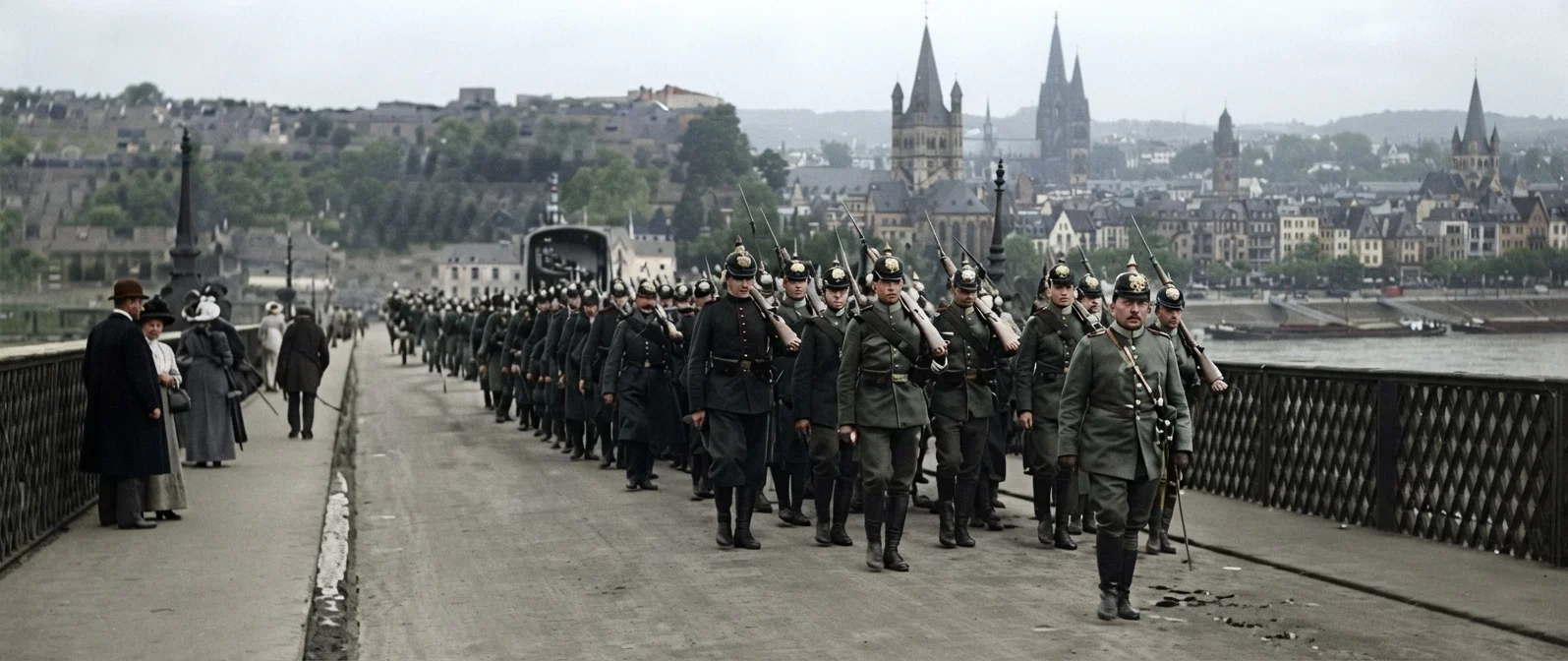
THE following statement and presentation of conditions in Europe at the outbreak of the war has just reached us from our Board, Takoma Park, Washington, D. C. In view of its importance, we present it entire to our readers. — EDITOR.
YOU will be anxious for the first news from Europe. Therefore this Friday morning's mail is passed on to you. First came the following letter from Elder N. Z. Town, who was attending the British Union Conference in London, which opened July 31. He writes:
"Battersea Town Hall,
"London, August 2.
"Dear Brother Spicer:
"These are anxious hours on this side of the water. As you have seen, Germany declared war on Russia last evening. Elder Conradi wired Hamburg two days ago to draw most of their money from the bank. This evening Brother Conradi left for Hamburg. He may have difficulty in getting through. He felt he ought not to stay here during the remaining two days of the meeting.
"There are about 2,000 of our workers and members who will have to respond to the call to arms. Nearly every ordained minister in Germany will have to march to the front. As I bade Brother Conradi good-by, he made a special request that we remember the work over here in prayer.
"I still hope to sail the sixth on the Celtic from Liverpool. We had about 1,000 of our people here on Sabbath. Raised $1,525 for missions.
"N. Z. Town."
By the same mail, the following letter came to the treasury department, from Elder L. R. Conradi:
"En Route England to Flushing,
"Holland, August 2.
"Dear Brother Knox:
"Quick as a flash of lightning, the continent has been involved in the most terrible struggle the world probably has ever witnessed. The outcome no one can foresee. We left Hamburg last Tuesday to attend the British Union Conference in London. Then there were no definite signs. Elders Raft and Tieche and I attended. We have had good meetings up to to-day; but as the war
has definitely broken out, we had to take our chances in getting home. Only Holland is open; and should England be involved, we shall be about entirely cut off. We shall have an experience that we have never really had since our denominational existence, directly involving some 25,000 of our people, and within a few days probably 2,000 of our brethren will be under arms.
"I hope to get back to Hamburg by tonight or to-morrow, and we shall have to organize our European Division work as best we can. Conference presidents, ministers, employees, etc., will be taken within a day or two, and our canvassing, etc., will probably be entirely stopped. Russia is already cut off from us, and will have to finance itself, and we shall be cut off from our colonies and work in Africa. We have supplied those mission fields with funds the last moment, and we shall send you statements; but if the war lasts two or six months, you will have to furnish money for the time being, until normal conditions return.
"All these countries ought to be notified to cut down all possible expenses to the mere outlay of living until this is over. If England keeps out, she can look after some colonies; if not, you will have to help us sustain the missions there. We sent $1,000 due you ere matters became too serious. The parties you will have to look after will be probably Brother B. B. Aldrich, in the Canary Islands; R. S. Greaves, and the workers in Sierra Leone; Elder D. C. Babcock, in Nigeria. M. W. Lewis and family, of the Gold Coast, are now on furlough in the Canary Islands, and he can delay his trip to the coast if England becomes involved. Then there will be A. A. Carscallen and the workers in British East Africa; B. Ohme, and the workers in German Victoria Nyanza; also E. Kotz, and all the workers in the Pare Mission, German East Africa.
"It may be that if Italy keeps out, the routes to East Africa will remain open; but we must prepare for the worst. Skodsborg, Denmark, has sufficient money for their new sanitarium buildings. In Gland, Switzerland, we have not commenced to build the addition. We shall let everything rest, and
cut our expenses down to the mere living. We call off all our meetings, and shall do our best to keep our members alive and doing their duty. We surely need the prayers of God's people, and wisdom to know how to arrange matters best in these trying times. Brother N. Z. Town will bring you the latest news, and I hope he can cross safely.
"Under present conditions, there is little hope of my going to the United States for the October council, or of the Division Conference meeting next July in Europe. Plans for visits to the fields from your side may have to be changed, unless war can be limited to a few European powers, and to a short time. Our boat is so packed we have to sit up. Germans and Austrians had to leave France within a few hours' notice, and leave all behind but what they could carry. Many never got away, and are held up. The United States ambassadors and consuls look after the respective foreigners, Germans in France, and French in Germany, etc. Our hope is in God, who guides the destinies of the world, and who will protect His own, and who will not allow His cause to suffer too terribly in the crucible of affliction. We know that our brethren in America will stand by our missions and brethren who are cut off from our division treasury. Remember us at the throne of grace.
"With kindest regards, your brother in Christ,
L. R. Conradi."
During the last few days, the probability of having to stand by the European work in a very material way had been considered. It would seem likely that help would have to be given from this side for the work in Spain and Portugal, and in Egypt and Turkey, as well as to the far African missions. Therefore it was felt that special effort should be made to urge our people to liberal contributions in this emergency. All will go into the Twenty-cent-a-week Fund.
It was further voted that word be sent to all the mission stations depending on the General Conference, to husband their resources, to defer plans for new extensions involving extra expenditure, and to defer all building operations not already practically completed, until it is seen how this European war affects other parts of the world. At the same time, our present appropriations provide for very little new work, and all the receipts counted upon normally will be needed even for this restricted program. And if the far East should become involved, living expenses would tremendously increase for all the workers in Asia.
The way in which countries commercially dependent upon Europe are affected, may possibly be suggested by the receipt this morning of a cable message from Elder Pohle, of La Paz, Bolivia, reading: "Distressed. Cable $500." Doubtless it means that expected steamship connections are interrupted, or banking connections cut with the union treasury in Buenos Aires, from which Bolivia should receive its funds.
Now that Europe is at war, we almost forget that at nearer points our workers and brethren are living amidst scenes of war, and looking to us for help. Elder A. F. Prieger, superintendent of our mission in the republic of Haiti, writes from Cape Haitien, under date of July 22:
"We just had a fearful battle here in the cape Sunday night, beginning at 2:30 and lasting until 5:00 A. M. No correct estimate can be gathered as to the dead and wounded;557
but some 40,000 rounds of ammunition were shot off, and it was indeed a gruesome sight to see the dead bodies in the streets the next morning. The big American gunboats are in the harbor, but they have done nothing to stop the slaughter."
Under date of July 26, Elder Prieger adds a postscript:
"Could not write more until now. A brother has just come from Grande Reviere, a town in the interior, where we have a church. It is the first time we have been able to get news from that part. The entire city is pillaged, and many homes burned. The Baptist, Catholic, and Seventh-day Adventist church buildings were pillaged, and every piece of furniture demolished and burned for fuel, including benches and doors and windows. The buildings were used as stables for the horses. Our organ was used to entertain the soldiers. We are just wondering what we can do about it, for our brethren are all very poor. None have a bed, nor so much as a mattress to lie on, and all have passed through a terrible siege. Eleven of the officers who put their horses in our church were shot by the opposing party. Twelve leading citizens of the town were shot, along with two officers of the city and some others. None of our people were killed. One of our faithful colporteurs, Brother Tertullien Mercier, was shot in the foot. When a soldier saw him wounded, he wanted to kill him, when another man stepped between and thus saved his life. We thank the Lord for His protection. We have not heard from other places, and only hope and pray that they did not fare as badly."
We must now appeal as never before to our friends in America for financial assistance. All must rally to the help of the Lord in the crisis in which we find ourselves. God still rules in the affairs of the world; and if we are faithful, and do our part, we may rest assured that even this calamity that has visited Europe will be caused by Him in some way to redound to His glory and to the furtherance of His cause.
The General Conference Committee appeals to every one now to come to the help of the Lord's work in liberal offerings, and urges that definite plans be made at once by each one to avail himself of every opportunity, such as the Harvest Ingathering campaign, to gather largely for the cause of God. The members of the committee feel confident that to this appeal there will be a general rally upon the part of all.
This fund will be known as the Emergency Fund, and will be counted as a part of the regular Twenty-cent-a-week Fund, available for Europe and all the world where it is needed most.
Money designed for this fund may be sent to treasurer Pacific Press Publishing Association, Mountain View, California, who will see that it promptly reaches its desired destination.
Photo by Paul Thompson
What does the Bible say
By Editor
ABOUT IT?
"HAVE WE COME TO ARMAGEDDON?"—A 16-page tract, just from the press. It answers this question in a conclusive way. With an abundance of Scriptural proof, it gives the meaning of Armageddon, refers to conditions that breed strife in the last days, tells of unusual preparations for war, gives credit to those men and women who have made noble but futile efforts for peace, and clearly shows that we are living in the closing days of earth's history. Price, $1.00 a hundred, post-paid; $8.50 a thousand, forwarding charges not prepaid. Our depository in your state (see page 15) will fill orders promptly. Pacific Press Publishing Association, Mountain View, California.