The Youth’s Instructor, Vol. 33, No. 25.

A SHORT SKETCH OF A NOTED MAN

The Youth’s Instructor

Jul 8, 1885

S. D. A. Publishing Association · Battle Creek, Mich. · Jul 8, 1885

A SHORT SKETCH OF A NOTED MAN.
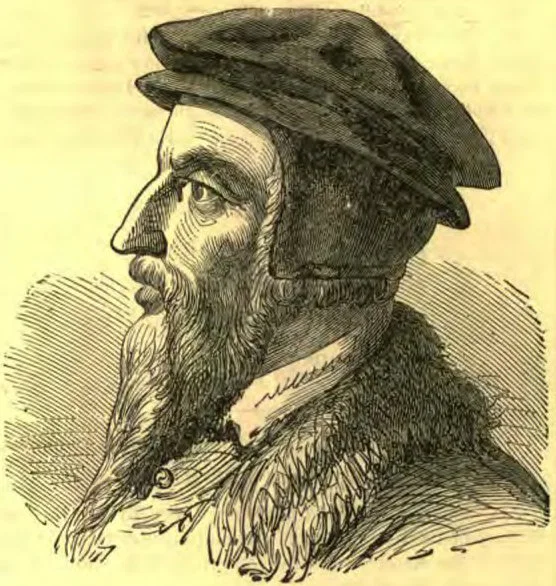
The portrait in connection with this article, is that of John Calvin, one of the prominent characters in the Great Reformation of the sixteenth century. This distinguished man was born at Noyon, in France, a short distance from Paris, July 10, 1509. The family name seems to have been spelled variously, as Cauvin, Chauve, Chauvin, Calvus, and Calvinus. The father of Calvin was a man of shrewd intelligence, and held honorable civil and ecclesiastical offices in the town in which he lived. His mother was a woman of great personal beauty and deep piety, and she left the stamp of her strict religious views upon her son John. Young Calvin’s parents, who were Catholics, intended their son for the Church, and consequently his early education was in the direction of theology. When but a young lad, twelve years of age, he was presented with a benefice in the cathedral of Noyon, and a few years later, before he was twenty years old, he had the responsible office of curé, with its titles and revenues.
About this time, Calvin’s father changed his mind in regard to his son’s being a theologian, and persuaded him to study law, as the surer road to wealth. Doubtless an overruling Providence had much to do with this change; for young Calvin himself was already convinced of many of the errors of the Romish church. While in Paris, as a student, a copy of the Holy Scriptures had been furnished him by his relative, Robert Olivetan, who first translated the Bible into French. The study of the Bible, with the help of the Latin commentaries, led him to question more and more the doctrines of the papal religion. Under the best masters, Calvin pursued the study of law through the day, and at night he would study the Scriptures by himself. Evidently God was preparing the future reformer for truths that as yet had not dawned upon his mind.
Near this time, also, he studied the Greek language under Melchoir Wolmar, one of the Reformers, who opened his eyes more and more in regard to the unscripturalness of the Romish faith. Indeed, not far from this, Calvin had become so fully persuaded in regard to the doctrines taught by Luther and Melancthon, that he began to preach them himself. His father having died, he now resigned all his church benefices, and devoted his naturally strong and well-cultivated mind entirely to the study of divinity. He also laid aside his legal profession, and devoted himself wholly to the doctrines of the Reformation, which were being widely diffused through France.
In 1529 Calvin was in Paris, struggling with other reformers to spread the doctrines of Luther, and contending with persecution. Having written an oration for his friend, Nicolas Cop, to deliver in the Sorbonne, a theological school in Paris, at the feast of All-Saints, the indignant faculty ordered it to be burned. The discourse dwelt very fully upon the doctrine of justification by faith. For this bold venture, Cop and Calvin were obliged to flee from the city, and the latter, it is said, was let down from the walls of the city by a basket.
After leaving Paris, Calvin for a time found refuge with Queen Margaret of Navarre, the sister of Frances I., and who favored the cause of the Reformers. At Angoulême he supported himself by teaching Greek, and here he also composed the greater part of his “Institutes of the Christian Religion,” which has rendered his name famous. This was written in Latin, for the benefit of the learned, and was afterward translated into French. Many editions of the work were printed in Calvin’s time. It has also been issued in the various European languages, and in Greek and Arabic. The “Institutes” contained a written declaration of the doctrines of the Reformers, as well as unanswerable arguments against the errors and corruptions of the Catholic faith.
Calvin was contemporary with Luther and Melanchthon, as well as Bucer, Farel, Viret, Beza, Bullinger, and Capita,—names that so frequently occur in connection with the cause of the Great Reformation.
Let us now, for a little, trace the varied experience of this intrepid man in the noble cause which he had espoused.
We find him at one time in Italy, at the court of the daughter of Louis XII., winning others by his persuasive words to the doctrines of the Reformers; the ever-vigilant Inquisition, already crushing out the work in Italy, compels him to leave. He then goes to his native place for the last time, to arrange his family affairs. In August, 1536, when he is twenty-seven years old, he comes, in the midst of personal peril, to Geneva. Here he preaches, and is obliged to become one of the pastors. He proceeds to organize a distracted church, and publishes in French a catechism for the children. He has a public disputation with the Anabaptists, and puts them to silence; and holds a disputation in Lausanne, and speaks against the Catholic doctrine of the real presence. With Farel, the reformer, he is banished from Geneva. He is welcomed at Strasburg by Bucer, and a church of French refugees is put under his charge. He is present at the conferences between the Romanists and Protestants at Frankfort and Worms; prepares a treatise on the Lord’s Supper; holds a conference with the Lutherans at Hagenau, in which he gives his view about the eucharist; lectures on the epistle to the Romans and John’s Gospel, crowds of students from all parts of France attending his lectures. The authorities of Geneva now urge him to return, and he reluctantly consents. He institutes a system of strict discipline in the Genevese church, and in the city. Opposers persecute him, and name their dogs after him. An apostate assails his character. Next occurs the execution of the Spanish physician, Servetus, for which Calvin is largely responsible, though Melanchthon, Farel, and the Swiss Church approve. He publishes an “Antidote” against the twenty-five new tenets of the Sorbonne College at Paris; another against the “Decrees” of the Council of Trent; helps John Lasco in his work of reform; starts an academy of learning in Geneva, and lectures to crowds from France, Scotland, Holland, and Germany. His labors are incessant and prodigious. Every other week he preaches every day, besides the Sabbath, and lectures three times a week on theology. Every Thursday he preaches at the Consistory, and every Friday is present with the congregation.
Such, in brief, are some of the labors and trials which this celebrated French reformer experienced. John Calvin will ever be regarded as far more than an ordinary man. His memory was remarkable, and his ability to reason was of the highest order. While he was banished from Geneva, the Romish cardinal, Sadolet, endeavored to entice the Geneva church back again to the fold of Rome; but Calvin, hearing of this, seized his pen, and wrote with such logic and wisdom as to extort praise from even his opponent. It was at Worms that Melanchthon gave him publicly the title of “The Theologian.” At the age of twenty-two, Joseph Scaliger pronounced him the most learned man in Europe. His knowledge of the Latin language was a marvel to scholars, and his correspondence was enormous. Men in the highest stations in Europe coveted a letter from his hand. Bishop Cranmer, of England, advised with him freely in regard to matters both in Church and State. His wise counsel was sought by the Moravians, and to Hungary he wrote letters of advice. He also befriended with purse and pen the Waldenses, in their bloody trials and banishments.
But with all his excellences, this talented man had his faults. Some of his doctrines have been a source of deep regret to the church. He was also severe to his opponents, and his temper was often impatient. He admitted that it was hard for him to control the “wild beast.” He tracked the foes who intended mischief to him or his cause. With him life was a combat. Duty was the one great thing constantly before him.
In 1564, when not yet fifty-five years of age, Calvin’s mortal frame began to sink under his multiplied cares and a complication of disorders. He could hardly take food, but still dictated letters to his friends, and comments on the book of Joshua. He began to preach a sermon, Feb. 4, but was obliged to stop. On April 27, the lesser council met at his bedside to hear his parting words. The next day, the ministers of the city, and others, listened for the last time to his faithful counsel. Farel, then eighty years of age, journeyed from Neuchâtel to grasp his hand. Prayers were offered for him by all the churches. He lingered on till May 27, in intense suffering, yet in the triumphs of faith, when he breathed his last in the arms of Beza, his faithful friend.
At his own request, no monument marks his resting-place, and no one can now tell where lie the remains of this remarkable man. His whole earthly wealth, only about two hundred and twenty-five dollars, he bequeathed to his relatives and poor foreigners. His salary was small, and he would not receive that part of it which accrued during his last illness.
In size, Calvin was of middle stature; his complexion was somewhat pallid and dark, and his eyes, to the latest, clear and lustrous. He was sparing in his diet, sometimes for years taking but one meal a day. In dress he was simple. He took but little sleep, and was capable of enduring great intellectual toil. O. W. A.

WILLING TO SHOVEL.

To be willing to begin at the bottom is the open secret of being able to come out at the top. A few years ago, a young man came to this country to take a position in a new enterprise in the south-west. He was well-bred and well-educated. He reached the scene of his proposed labors, and found, to his dismay, that the enterprise was already bankrupt, and that he was penniless, homeless, and friendless in a strange land. He worked his way back to New York, and in mid-winter found himself, without money or friends, in the great, busy metropolis. He did not stop to measure the obstacles in his path; he simply set out to find work. He would have preferred the pen, but he was willing to take the shovel; and the shovel it was to be.
Passing down Fourth Avenue on a snowy morning, he found a crowd of men at work shoveling snow from the sidewalks about a well-known locality. He applied for a position in their ranks, got it, and went to work with a hearty good will, as if shoveling were his vocation. Not long after, one of the owners of the property, a millionaire, passed along the street, saw the young man's face, was struck by its intelligence, and wondered what had brought him to such a pass. A day or two later his business took him to the same locality again, and brought him face to face with the same man, still shoveling snow. He stopped, spoke to him, received a prompt and courteous answer, talked a few minutes for the sake of getting a few facts about his history, and then asked the young man to call at his office.
That night the shovel era ended, and the next day, at the appointed time, the young man was closeted with the millionaire.
In one of the latter's many enterprises there was a vacant place, and the young man who was willing to shovel, got it. It was a small place, at a small salary, but he more than filled it. He filled it so well, indeed, that in a few months he was promoted, and at the end of three years he was at the head of the enterprise, at a large salary. Here he is to-day, with the certainty that if he lives, he will eventually fill a position second in importance to none in the field in which he is working. The story is all told in three words—willing to shovel.—Christian Union.

THE RAIN UPON THE ROOF.

WHEN the humid shadows hover Over all the starry spheres, And the melancholy darkness Gently weeps in rainy tears, What a joy to press the pillow Of the cottage chamber bed, And to listen to the patter Of the soft rain overhead.
Every tinkle on the shingles Has an echo in the heart, And a thousand dreamy fancies Into busy being start, And a thousand recollections Weave their bright hues into woof, As I listen to the patter Of the soft rain on the roof.
Now in fancy comes my mother, As she used in years agone, To survey her darling dreamers, Ere she left them for the dawn. Oh! I see her bending o’er me, As I list to the refrain, Which is played upon the shingles By the patter of the rain.
There is naught in art’s bravuras That can work with such a spell, In the spirit’s pure, deep fountains, Whence the holy passions well, As that melody of nature, That subdued, subduing strain, Which is played upon the shingles By the patter of the rain. —Selected.

MYRTLE'S VICTORY.

Myrtle Wood was in a great hurry one beautiful summer morning. She washed the dishes with speed, and sang joyously as she hastened about her morning work. The flowers perfumed the air, and the green woods looked fresh and delightful. Myrtle looked often toward them; for her mother had given her permission to go that day with Fanny Crosby, to gather violets and anemones for the sick at the hospital.
“Poor creatures!” said Myrtle; “won’t they be delighted to have some fresh wild flowers? Don’t you think wild flowers seem to mean more, and go deeper into your heart, than the garden flowers, mother?”
“Yes,” said Mrs. Wood, “it always seemed as if the wild flowers came more directly from God than cultivated flowers; but of course it’s only a fancy. I love to see them sprinkled over the green sod, as if they had felt a throb of the love of God way down in the earth, and fairly thronged up like happy thoughts. God writes sweet thoughts to us in the flowers.”
“O mother!” cried Myrtle, “I hope the flowers will make them feel that God loves them.”
Just then the bell rang, and Myrtle bounded to the door. “Here’s a letter for you,” said a neighbor boy; “I brought it from the office.”
“Thank you,” said Myrtle. “Do open it, mamma. Let’s see who it’s from.”
The handwriting was stiff and inelegant; but Mrs. Wood read:—
“Dear Sary,—
“I’m a-comin’ out to your house to spend a few weeks. My health is very poor, an’ there don’t seem to be anybody that wants me ’round. I can do odd jobs for you, an’ I know you be a Christian woman. I’ll be there Monday night.
“Yours truly, “Jane Brierhall.”
“Oh, dear!” cried Myrtle; “what does she want to come for? It will spoil everything.”
“Poor old lady,” said Mrs. Wood; “she has had a hard, loveless life. We must try and make her comfortable. Let’s see; where will we put her?”
Myrtle’s brow was dark. She was thinking to herself: “No wonder she has a hard life. She’s no business to be so queer.”
“Yes,” said Mrs. Wood, rousing from her meditation, “we’ll clear out the store-room, and have it fixed comfortable by to-night. It is quiet and sunny, and will just suit poor Aunt Jane. Now, Myrtle, if you could help me to move the things this morning—but oh! you’re going to the woods. Well, maybe I can manage it myself; I don’t want to have you disappointed.”
Myrtle’s face was very gloomy now, and her tears ready to fall. She knew her mother was not strong enough to undertake such a task. Duty certainly bade her give up her plan for flower gathering.
“I don’t care,” said Myrtle. “It’s too bad; but that’s always the way. Whenever I think of some plan for doing good, somebody has to spoil it all. Of course I can’t go to the woods, and leave you all that work to do; but I think it’s real mean she thinks she can come here whenever she takes a notion.”
“Why, Myrtle, you grieve me very much. Perhaps God had a plan for you to do good before you had made one. Instead of going away to find work, he has sent it right to your door. Remember, dear, poor Jane Brierhall is one of Christ’s little ones, and she comes in his stead. If the Saviour were coming, wouldn’t you fly to make everything beautiful for him?”
Myrtle walked silently away to her room. Tears of disappointment overflowed her eyes. But her good angel whispered to her till tears of repentance took their place; and after a while, Myrtle ran out, and threw her arms around her mother, and asked to be forgiven.
When Fanny Crosby called, Myrtle came from the store-room in dust cap and apron, and explained how a dear friend was coming, and she had to stay home to prepare for her. “And O Fanny! won’t you please bring me a bunch of flowers for her room? She’s sick, you see. I don’t know that she’ll care anything about them, but somebody will, I’m sure,” said Myrtle.
Myrtle scrubbed and polished the store-room till it shone. Then the pretty single bed was put up, and made with great care. “If He were coming to sleep here,” whispered Myrtle, “I couldn’t make it any better.” The white bed and dainty pillow looked very restful. It was really astonishing how many beautiful ornaments Myrtle found for Aunt Jane’s room. She draped the white curtains with some of her own dainty ribbons, made a bright cushion for the little rocker, and an ottoman out of a low box, spread down a bright piece of carpet for a mat, and robbed her own room of pictures for the walls. When Fanny brought the flowers, she arranged tasty bouquets for the bureau and stand. How fresh and sweet the little room looked, with a glimpse of the woods and sky through the window, and the flowers and whiteness within!
Myrtle surveyed her work with deep satisfaction. “I couldn’t do anything more, even if Jesus were really coming,” she said to herself.
Aunt Jane arrived just at sunset. Myrtle ran down the path to meet her. She felt a tender pity creep into her heart, as she saw the slow, hesitating steps, and the withered little form of the old lady. She wasn’t any relation to Myrtle, but she was known everywhere as Aunt Jane. “O child!” she exclaimed, as Myrtle implanted a hearty kiss on her withered lips, “I didn’t know’s you’d be glad to see me. It’s so seldom folks is, now-a-days. I knew your mother would. She’d be good to anybody.”
“Here’s your room, Aunt Jane. I fixed it all up for you to-day.”
“It’s like a peek into the better land,” said Aunt Jane, as she took off her spectacles and rubbed them. “O dear! and here be some violets;” and Aunt Jane sat down, and rocked to and fro, while the tears trickled down her furrowed cheeks.
“Yes,” said Myrtle, “mother says they are God’s thoughts to us.”
“How sweet they be! They make me think of home, and when I was a girl. But they’re all dead now; there’s only me left. But God’s alive yet, and he’s sent me here for comfort.”
Myrtle hung around Aunt Jane all the evening with little, kind attentions, and at bed-time folded down the snowy coverlid of her bed, and put up her fresh lips for a kiss. Aunt Jane folded her face between her hands, and said, “Bless you, child.”
Wasn’t it a sweet night for Myrtle? Her room seemed full of peace, and sweet texts thronged her mind: “Whosoever receiveth you receiveth me,” and, “Inasmuch as ye have done it unto one of the least of these my brethren, ye have done it unto me.” FANNIE BOLTON.

HOW COMBS ARE MADE.

The other day I went to Clinton, Mass., to visit the comb factory of Bartlett and Co., who employ about sixty hands. One of the hands was kindly permitted to show us how they made the combs.
The combs are made out of the horns of cattle—just such horns as you see on the cows and oxen at home. Here they had them by the wagon load; some were little, some were big. I brought home one nearly two feet long. Some are straight, but most of them are very crooked. These horns they gather up from all parts of the country where cattle are killed for beef. Some come from South America, from Texas, and from the West. These horns, you know, are hollow, just like a tin horn or a bottle. They are composed of a substance just about like your finger nail, only very much thicker and harder. This factory daily uses from three thousand to five thousand horns. Every particle is used in some way; not a bit is wasted.
First they take the horn, and saw off the little end, which is too small for combs. Perhaps this end will be three or four inches long. This tip is sold to other factories, where it is made up into knife handles, stems to pipes, and such things. The horn is now sawed in two on one side lengthwise, so that it can be made to open out flat. It is next placed in hot water, till it becomes soft, like a piece of sole leather. Then it is put through a machine which rolls it out flat. This piece is next pressed between two hot irons, so that it will remain flat. When it is boiled only in water, it retains its natural white color, and makes the toughest and best combs. That boiled in oil looks the best, as this boiling gives it different shades. Sometimes it gets burned in this process, and then the combs made from it are brittle, and break easily.
Another person now takes these pieces, and saws them up into smaller pieces, the size of the different combs. The smaller pieces make the fine combs, and the larger ones are used to make the coarser combs. Then they are passed to another man, who runs them through a machine, shaving them on both sides, so that they will be smooth, and of the same thickness. Now a man takes them, and cuts teeth on them with very fine saws. This is all done by machinery. Then they are passed to a man who lays them on a wheel covered with sand-paper; this rounds the back, and sharpens the teeth. Then they are passed to the next man, who scours them with wet ashes. Then another person takes them, and puts them into a machine that sets the large outside teeth straight. These pieces of horn are soft and pliable, so that they will bend like leather strips; you could tie them into knots. Of course they have to be dried straight, or they would be twisted in all shapes.
The next thing is to polish them very bright. This is done by holding them on a swiftly-revolving wheel made of cotton cloth. You would not suppose that the wheel could polish anything, but it does; it makes them shine nicely.
Now the combs are sent to the packing room, where they are put up in little bunches ready to ship. So you see that from the time the horn is taken from the old cow’s head, till it is ready to use on your head, it is quite a process to make a simple little comb. The shavings and fine dust, gathered from making these combs, are sold to gardeners, to enrich their ground.
A comb factory is not a very pleasant place to work in. The packing room is the nicest. Here the work is done by women. D. M. CANRIGHT.

TO-DAY

I THINK not of to-morrow, Its trials or its tasks; But still, with child-like spirit, For present mercies ask. With each returning morning, I cast all things away; Life’s journey lies before me— My prayer is for to-day.

AIM HIGH.

AIM at the highest prize; if there thou fail, Thou'll haply reach to one not far below. Strive first the goal to compass; if too slow Thy speed, the attempt may ne'er the less avail The next best post to conquer. —Bishop Mant.

“WHO ARE THESE?”

WHEN the prophet asked, “Who are these that fly as a cloud, and as doves to their windows?” it seems as if he must have been looking away down to the children of the present time, as they come trooping into the Sabbath-school. As the time draws near for the school to open, a sight of the scholars gathering from all directions to the doors of their meeting-place, is truly suggestive of the doves flying to the entrances of their house.
The prophet was not familiar with the scene; and as his eye took in the vast company, he asked, “Who are these?” We easily imagine he asked, “Who are these who manifest so much earnestness, as they assemble from week to week to learn the ways of the Lord?”
We ask, who are these whom the Lord pointed out to the prophet so many hundreds of years ago? We think the prophet was directed to a time when a special work should be done for the young; and who but believes the time has now arrived, and that the labor now being bestowed upon the youth in the Sabbath-schools and children’s meetings is the work that was foreshown?
The Lord wants this great company of children saved. Some parents and teachers feel the burden of this message; and will not you, dear young friends, take hold with them, to be benefited by their efforts? None can be saved in their sins; for not one sin or sinner will be permitted to enter heaven. But the Lord has made the way easy for you to be saved from your sins.
You all know the story of the cross,—the great price that was paid that you might be saved. And knowing this, must any of you be urged to accept of eternal life? Urged to exchange a moment of sinful pleasure for an eternity of unbounded happiness in the world to come? Were it not acted over and over every day, we could not believe any would be so blind to their own interests, as to slight the gracious invitation to “Look,” “and be saved.”
Christ asks that you shall turn from your evil ways, and make friendship with him. He says, “Ye are my friends, if ye do whatsoever I command you.” Those who really acquaint themselves with him, love him, and delight to do his commandments.
No doubt most of you really mean sometime to have fellowship with Christ, and so share with him in the glories of the future kingdom; but the danger is that you will not appreciate the infinite goodness and love of God sufficiently to break away from your sinful habits. Satan is never so well pleased as when you say, “By and by I will begin the service of Christ;” for he always improves that little “by and by” in trying to make you fast in his net.
Dear young friends, why do you serve your greatest enemy, whose purpose is to destroy you? Why not serve the One who offers you a crown of everlasting life in his kingdom, making you an equal heir with him in the new-earth riches forever? Oh! “serve the Lord with gladness.” “Be thankful unto him, and bless his name; for the Lord is good; his mercy is everlasting; and his truth endureth to all generations.” M. J. C.

Looking Forward, Not Backward in Duty

GOD hath set our eyes in our foreheads, to look forward, not backward; not to be proud of that which we have done, but diligent in that which we are to do.

Sorrow and Suffering Disarm Hostility

IF we could read the secret history of our enemies, we would find in each man's life, sorrow and suffering enough to disarm all hostility.—Longfellow.

IMPORTANT BIBLE SUBJECTS.

LESSON 52.—INHERITANCE OF THE SAINTS.

(Continued.)

AN EARTHLY KING CHOSEN.

[NOTE TO THE STUDENT.—Do not consider the lesson learned until you can give at least the substance of every text, with the correct reference for each. The references in black letters indicate those texts that should be committed to memory. A little diligent application each day will enable you to do this.]
1. GIVE two proofs that the partial possession of Canaan by the Israelites was not the fulfillment of the promise.
2. If the possession of the land had been complete, would that have been a complete fulfillment of the promise? Rom. 4:13.
3. When the Lord brought them from Egypt, what did he promise to make of them? Ex. 19:5, 6.
4. How were they governed for many years after that time? Acts 13:20.
5. Who was the last of the judges? 1 Sam. 7:15–17.
6. In his days, what did the Israelites demand? 1 Sam. 8:4, 5.
7. What did the Lord say they had done in making this demand? 1 Sam. 8:7.
8. Then under whose immediate authority must they have been up to this time?
9. What did the Lord say that Samuel should do? 1 Sam. 8:7, 9, 22.
10. Who was chosen as their first king? Acts 13:21. 1 Sam. 9:7.
11. By whom was Saul chosen as king over Israel? 1 Sam. 9:15, 16.
12. Had the Lord, then, utterly rejected his people because of their rejection of him?

NOTES.

THERE is a seeming discrepancy between Acts 13:20 and 1 Kings 6:1. The latter text says that Solomon began to build the temple in the four hundred and eightieth year after the exode, which would not allow four hundred and fifty years’ government by judges. The explanation which seems the simplest is that which connects Acts 13:20 with the first part of the seventeenth verse of the same chapter, and regards the expression, “about the space of four hundred and fifty years,” as explanatory of the words, “and after that.” Thus: The God of this people of Israel chose our fathers, . . . and about the space of four hundred and fifty years after that, he gave unto them judges until Samuel the prophet.
ALL through the history of the Israelites, even from the time of their father Abraham, we can see the guiding hand of God. Although they time and again rejected him, he did not reject them, because he would keep the promise made to their fathers. That he did not reject them when they rejected him from being their king, is shown by the fact that he himself chose Saul and many of his successors.

LEARN TO UNTIE STRINGS.

Boys and girls may sometimes think it is a small matter to save the littles; but it was the Saviour who taught to “gather the fragments, that nothing be lost.” It was he also who said, “He that is faithful in that which is least, is faithful also in much.” We quote a few paragraphs from an exchange, showing how intelligent business men view “small matters”:—
“One story of the eccentric Stephen Girard says that he once tested the quality of a boy who applied for a situation, by giving him a match loaded at both ends, and ordering him to light it. The boy struck the match, and after it had burned about half its length, threw it away. Girard dismissed him because he did not save the other end for future use. The boy’s failure to notice that the match was a double-end one was natural enough, considering how matches are generally made; but haste and heedlessness (a habit of careless observation) are responsible for a great part of the waste of property in the world.”
“Said one of the most successful merchants of Cleveland, Ohio, a day or two since, to a lad who was opening a parcel, ‘Young man, untie those strings—don’t cut them.’”
“It was the first remark he had made to a new employé. It was the first lesson the lad had to learn, and it involved the principles of success or failure in business career. Pointing to a well-dressed man behind the counter, he said,—
“There is a man who always whips out his scissors, and cuts the strings of the packages in three or four places. He is a good salesman, but will never be anything more. I presume he lives from hand to mouth, and I presume is more or less in debt. The trouble with him is that he was never taught to save.”
“I told the boy just now to untie the string, not so much for the value of the string, as to teach him that everything is to be saved, and nothing wasted. If the idea can be firmly impressed upon the mind of a beginner in life that nothing was made to be wasted, you have laid the foundation of success.”

AWAY IN THE NORTHLAND.

LIEUT. FREDERICK SCHWATKA, who has spent some time in the Arctic regions in Europe, is writing a series of entertaining articles in the St. Nicholas, entitled, “The Children of the Cold.” In speaking of the amusements of the Eskimo children, he mentions a game of ball in which three or four balls of quartz or granite, about the size of an English walnut, were kicked and knocked about on the smooth lake of ice, without any rules to govern the game. These children were very happy, however, in their sport.
The Eskimo make these balls by grinding irregular pieces of stone with their rude implements in the same way that they manufacture knives, needles, etc., out of old pieces of iron. They are a very patient people, and consider time of so little value that they are not at all disturbed even though it takes years to accomplish a little work. This gentleman relates what he noticed of their workmanship near King William’s Land. He says:—
“An Eskimo was working upon a knife that, as nearly as I could ascertain, had engaged a good part of his time some six years preceding that date. He had a flat piece of iron, which had been taken from the wreck of one of Sir John Franklin’s ships, and from this he was endeavoring to make a knife-blade, which, when completed, would be about twelve inches long. In cutting it from this iron plate, he was using for a chisel an old file, found on one of the ships, which it had taken him two or three years to sharpen by rubbing its edge against stones and rocks. His cold-chisel finished, he had been nearly as many years cutting a straight edge along the ragged sides of the irregular piece of iron; and when I discovered him, he had outlined the width of his knife on the plate, and was cutting away at it. It would probably have taken him two years to cut out this piece, and two more to fashion the knife into shape and usefulness.”
“The file which he had made into a cold-chisel was such a proof of labor and patience that it was a great curiosity to me, and I gave him a butcher’s knife in exchange for it. Thus almost the very thing he had been so long trying to make he now unexpectedly found in his possession. When I told him that our factories (or ‘big igloos,’ as I called them for his easier understanding) could make more than he could carry of such butcher-knives during the time we had spent in talking about his, he expressed his great surprise in prolonged gasps of breath at this manifest superiority of the Kod-loo-sah, as the Eskimo call the white men.”
“Among the women of this same tribe I found a number of square iron needles that they had taken months to make, slowly filing them on rough, rusty, iron plates, and occasionally using stones for the same purpose. We had with us a great number of glovers’ needles, and these we traded for the iron ones, which to us were great curiosities. The women do some wonderfully neat sewing with these needles, considering the nature of the implements and the coarse thread of reindeer sinew which they use. This sinew is stripped from the reindeer’s back in flat pieces about eighteen inches long and two inches wide. The Eskimo woman’s spool of thread consists of a bundle of these strips of sinew, hung up in the igloo, from which she strips a thread whenever she needs one. It is very strong, and will cut through the flesh of one’s fingers before it can be broken. The Eskimo braid it into fish-lines, bow-strings, whip-cord, and nearly always have a ball of it on hand in the house, braided up and ready for use.”

FOR THE SPORT OF IT.

If any who read these lines are in the habit of taking the life of God’s creatures for sport or cruelty, we wish they might feel the sting of conscience as keenly as did the Boston boy, “now an energetic business man in a Western city,” whose story is told in a late Youth’s Companion. Said this gentleman:—
“I was floating around in my boat in the lower harbor one bright day in June, when a sea-gull, which on the wing is one of the most graceful of birds, but whose flesh is not used for food, came sailing over my head.
“ ‘What a splendid shot!’ I said, and, seizing my gun, I fired at him. He fell near the boat, not dead, but mortally wounded. As I drew him into the boat, suffering much agony, he turned his dying eyes upon me, as if he said, ‘Why did you shoot me? I have done you no harm. I was enjoying myself floating in the air, as you on the water in your boat; why did you shoot me?’
“Having done what I had, it would have been merciful to end his sufferings at once, but I had no more heart for killing; and the minute that passed before he died, seemed an hour to me.
“The remorse for that wanton shooting preyed on my spirits for days; and the remembrance of it has most effectually cured me of any desire to kill, for the fun of it, any creature that God has made.”

HOW THEY ARE MANUFACTURED.

It is said that at least ten million base balls are made and sold in this country every year. It may be the boys would like to know the process by which they are made so hard and firm. The Philadelphia Times says:—
“The most expert workmen are employed. First, around a little, hard, rubber ball the wrapper winds a strong, blue, coarse yarn. When this reaches an established size, it is firmly wrapped with white Venetian yarn.
“The balls are then placed in an oven and baked until all the moisture is taken out of them, and they are reduced in size. This makes them solid. They are then coated with cement, which causes the balls to retain their shape, so that they cannot be knocked crooked; after which they are wound with fine, blue yarn, and around the whole is placed fine, white gilling twine. The balls are weighed, for each must be of certain weight. Next in order is the cover, which consists of two pieces of the best quality of horse hide, each cut in the shape of the figure ‘8.’ By bending one section one way, and the other in an opposite direction, a complete cover is obtained.
“For years the balls were covered with four pieces of leather, instead of two, as now. The present method is the invention of a college boy, and has been of great service to the manufacturers.
“A little machine, the only one of the kind in the world, is used for winding the balls, and it does its work as quickly and neatly as if it had life. The ball as made now cannot be knocked out of shape, because the cement holds it.”
Continue reading: FAITHFUL TO CONSCIENCE