The Youth’s Instructor, Vol. 33, No. 25.

A SHORT SKETCH OF A NOTED MAN
Earlier text: A SHORT SKETCH OF A NOTED MAN

FAITHFUL TO CONSCIENCE.

“Where there is a will, there is a way” to regard the convictions of an enlightened conscience. Principle should never give way to selfishness or fear in matters of right. We quote Mr. Thompson’s example as one good to follow:
“The superintendent of a large and thriving factory near Baltimore was, for many years, a man named Thompson. He was a native of Paisley, in Scotland, and had all his nation’s reverence for the Bible and its commandments. Very soon after entering on his new duties, his firmness and fidelity to conscience were put to a test.
“On the first Saturday night the mill shut down as usual, but Sunday morning brought a peremptory message from the owner, an irritable and exacting old gentleman, whom it was by no means easy to please.
“The new manager had learned something of what he would encounter in the service of the imperious rich man, and he had reason to know what the present message meant.
“Arriving at the owner’s house, he was met by the excited old gentleman, who demanded why he was not ‘repairing the mill.’ Since the day the mill was started, not a Sunday had passed but the sound of the carpenters’ and machinists’ hammers had been heard there. Now all was still. It was an unheard-of change.
“‘What does all this mean, Mr. Thompson?’
“Mr. Thompson replied that no repairs were needed. The owner angrily told him that this was impossible. Such a thing had never been known before.
“‘Get the keys, and we’ll go down and see.’
“They went and searched in every room. All was in perfect order. The old gentleman was silenced, but not satisfied.
“The next Sunday the same silence in the factory irritated him again. Again an examination was ordered, with angry protests and almost threats. From the bottom to the top story of the factory not a wheel or spindle was out of place.
“‘How in the world do you contrive to have no repairs?’ was the impatient question.
“Mr. Thompson quietly explained. A disorder soon mended is soon ended. He inspected the machinery himself early on the morning of every working-day, and any defect found was immediately remedied. As the result of the plan, the mill spoke for itself.
“The astonished owner had little more to say. He learned to let his young superintendent alone, to practice his Christian method; and before he died, he testified that ‘Thompson was the best manager he ever had.’”

PIKE-FISHING THROUGH THE FLOOR.

This feat is accomplished on the ice of Lake Huron. Hundreds of men roll rudely furnished wooden huts upon the ice, and live there while they fish. They dig a hole for the water, in the center of each hut. A live herring, fastened to a piece of pack thread, is dropped into the water, and scoots away rapidly until he is pulled back again by the thread. After him follow a number of large fish who desire to dine on him. When they reach the hole, a fisherman thrusts in a five-pronged harpoon, and brings out several at a time. Sometimes they catch two hundred fish in a day. And at night they work by the light of torches, which attract their game without the herring.—Selected.

TIME'S SONG.

“MORTALS!” thus he, weaving, sings, “Bright or dark the web shall be, As ye will it, all the tissues Blending in harmonious issues, Or discordant colorings; Time the shuttle drives, but you Give to every thread its hue, And elect your destiny.” — W. H. Burleigh.

THE TEACHER AS A PASTOR.

EVERY teacher of a class is really a pastor of a little flock, occupying a relation of exceeding closeness to the individual members, and having a responsibility and an influence corresponding to this relation. To every teacher the commission of the Chief Shepherd is, “Shepherd my lambs.” Feeding is not all; there is care required as well. The shepherd protects his sheep, guards them from danger, from wolves and robbers. He also watches over them individually. If one is missing, he seeks it till he finds it. He knows his sheep by name. He leads them from place to place. These are hints of what every teacher should do for his class. The world is full of dangers and temptations. He should watch each tender child-life as closely as it is possible, so as to know what are its peculiar dangers, and then seek to shield it from them. He should look after the individuals, not neglecting one, making a special duty of giving thought and care to each one. He should miss the absent one, and learn the reason for the absence, going to seek the careless or wandering one. The homely figure is full of suggestions to the earnest teacher, showing him that when he assumes the position of a teacher, he takes large responsibility as a spiritual care-taker of young lives.—Westminster Teacher.

Faithfulness in Small Labors Before Larger Fields

To fail, through weariness and discontent, in the narrow and despised field of present labor, is a prophecy of disastrous failure if ever the opportunity comes to enter that larger, longed-for field, which haunts the imagination of every incompetent worker. How can the strength and the ability which have shown themselves unequal to the lesser task, prove equal to the larger? The words of Holy Writ, spoken centuries ago by One who was tried and who was not found lacking, bear an impressive warning for every weak seeker after a larger career: “If thou hast run with the footmen, and they have wearied thee, then how canst thou contend with horses? And if in the land of peace, wherein thou trustedst, they wearied thee, then how wilt thou do in the swelling of Jordan?”

STACY'S BARGAIN

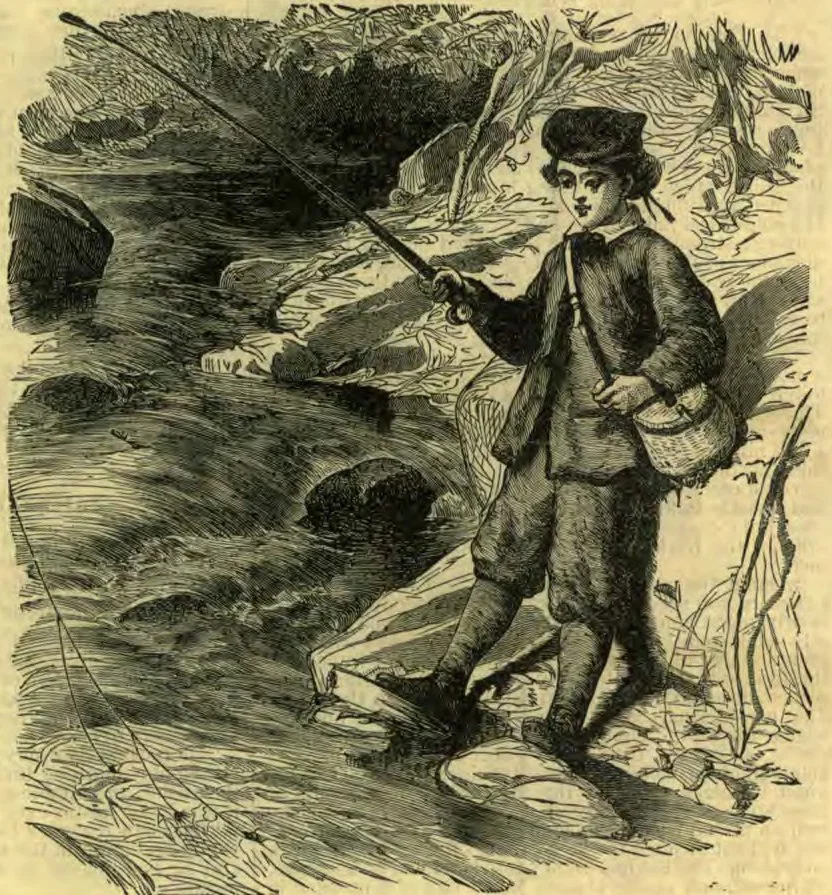
“STACY! Stacy!” called Ann from the doorway; but there was no answer. Ann went back to her washing. Stacy was not so far away that he could not hear. He was only back of the wood-house; but he did not like to answer Ann’s calls on washing day. He was digging bait, and beside him lay his fish-pole, that he had cut in the wood lot the day before.
When he had filled his bait box, he picked up his pole, and whistled to Gyp to follow. I must tell you how Gyp came there.
One stormy evening in winter time, Mr. Brown heard a faint scratching at the door, and then a pitiful moan. Looking out, he saw the sorriest little dog standing knee-deep in the snow before the door.
“Do let him in, papa,” pleaded Flossy, who had followed him.
“Well,” he replied, “we’ll keep the poor fellow to-night;” so Gyp was let in. He was a gaunt, lame, yellow, little dog. Flossy fed him, and made him a bed behind the stove. Gyp stayed that night and many more, for no one had the heart to turn him adrift.
This morning, Stacy started off through the meadow and down to the woods. When about half way there, Frank Preston, a boy about a year younger than Stacy, came up the path.
“Hello, I say!” called Stacy, running to catch up with him; “hold on a minute.” Frank turned around.
“My! what a beauty!” said Stacy, as he eyed Frank’s bamboo fishing-pole. “Where did you get it?”
“Uncle John gave it to me when he was here last fall,” Frank replied. “Is that your dog?”
“Yes,” said Stacy.
“I wish I had a dog,” said Frank. “Say, what’ll you take for him?”
“I don’t know,” returned Stacy, “as I want to sell him.” But Frank kept on urging.
“Well,” he replied, “if you’ll give me your fish-pole and basket, I will.”
Frank looked regretfully at the pole, and then longingly at the dog. “He’s lame,” he said.
“But he’ll get over it,” returned Stacy, who coveted the pole, though he knew the dog was not worth so much.
“All right,” Frank finally said, “I’ll trade.” So the pole and basket and the dog exchanged owners.
Stacy went on to the creek. He found a cool, shady place, where a great maple bough overhung the water.
“That’s a bargain,” he said to himself, as he flung out the line, and leaned back against the steep bank.
Then he waited. A little nibble, then another, then a long silence. The boughs sighed in the breeze, and the brook foamed and fretted over the stones. Then there came a tug at the end of the line, and Stacy landed a fine fish on the bank. Then another time of waiting.
The sun rose higher and higher, and at last the fishes refused to bite. So he gathered up his tackle, and taking the three fish he had caught, started for home. He was just in time to have them fried for dinner. Ann had the washing done when he got to the house. She readily forgave him for running off, since he had brought back such nice fish.
At noon, Mr. Brown came home. “Gyp! Gyp!” he called, and gave a shrill whistle as he entered the gate. But no Gyp came to greet him; he was two miles up the road, contentedly gnawing a bone in Mr. Preston’s woodshed.
“Where’s the dog?” Mr. Brown asked Stacy, as they sat down to the table.
Stacy’s face flushed, and he hesitated. “I traded him,” he said at length.
“Traded him?” laughed Mr. Brown. “Who would want such a dog as that?” For, to tell the truth, Gyp had not grown much better looking than he was the first night he came there.
“Well,” said Stacy, hopefully, feeling sure his father would think he had made a good bargain, “I let Frank Preston have him, and he gave me his pole and basket and tackle.”
“Let me see them,” said Mr. Brown.
Stacy went out into the woodshed, and brought them in. Mr. Brown looked grave when he saw what Stacy had.
“How much do you think they are worth?” he inquired.
“I don’t know exactly,” returned Stacy; “but Johnny White’s brother has got a pole that cost five dollars.”
“Yes, I should think this one, together with the basket, was worth fully that much,” said his father.
“I think it is a pretty good bargain,” said Stacy, breathing more freely now he thought his father approved.
“And I think it is a bad one,” said Mr. Brown, looking at him sharply.
Stacy shifted over to the other foot. “He wanted to,” he urged.
“Frank is younger than you are,” his father replied, “and did not know the value of his pole. It is a mean and dishonest thing to take advantage of him in this way. A wise man once said that it was a bad day for any man when he thought there was an easier way of getting a thing than by squarely earning it. You must take these all back after dinner.”
Somehow, Stacy had lost his appetite, and the fish did not taste as good as he expected. After dinner he set out. It was a hot day, and the road was very dusty; it seemed to Stacy as if the walk would never end. But he got there at length, and returned with Gyp.
Whenever he makes a trade now, he always remembers the long, hot walk, and his father’s good advice, and is very careful to be strictly honest. W. E. L.

ON THE STAIRS.

Sewing an over-and-over seam, Sitting upon the stairs, Yellow curls, and apron white, Rosy lips puckered up tight,— Such a frown she wears!
Such a long over-and-over seam, Such a weary way; Such little fingers and kinky thread, So many shakings of wise little head, That aches to go to play.
Seventeen stairs—so seventeen pins Mark off the seam with care. For every step she has measured a space, And when her needle reaches the place, Down she slides one stair.
So she sews on to please mamma, Nor stops for anything; The cat goes to sleep in the entry way, Waiting for Bessie to come and play; Canary ceases to sing.
The long seam done, the last stair reached, Needle and thimble and thread Drop from the tired little fingers at last, Slumber closes the eyelids fast, Down drops the weary head.
Mamma, asleep in the room above, Soundly naps until She suddenly wakes, to wonder where The child has gone she left on the stair,— The house is quite too still.
Looking over the banister, She sees—what do you guess? The kitten rolled up in a little ball, And both asleep on the floor of the hall,— Pussy and tired little Bess.
—Independent.

Salt in Everything: A Lesson from Annie's Mother

“Mother, what makes you put salt in everything you cook? Everything you make you put in a little salt, and sometimes a good deal.” So spoke observing little Annie, as she stood looking on.
“Well, Annie, I'll make you a little loaf of bread without any salt, and see if you can find out.”
“O mother, it doesn't taste a bit good,” said she, after she had tasted it.
“Why not?” asked her mother.
“You didn't put any salt to it.”
“Mother,” said Annie, a day or two afterward, “Jane Wells is the worst girl I ever saw; she slaps her little brother Johnny, and pulls his hair, and acts real hateful. When I told her it was naughty to do so, and if she would be kind to her brother he would be kind to her, she only spoke roughly to me, and hit him again. Why won't she do as I told her to, mother?”
“Perhaps you didn't put any salt in what you said. Ask help of God in all you say and do, and your words, spoken in the spirit of Christ, will do good. Don't forget to put salt in, or else it won't taste good.”

Better Budget.

WILLIE CASTLE writes from Branch Co., Mich. He says: “This is my first letter to the INSTRUCTOR. I am twelve years old, and have a twin sister Lillie, and three brothers. I cannot attend Sabbath-school every Sabbath, for it is ten miles there and back. I have read Miss Morton’s letter on tithing. I am paying tithe of all I earn. I have got thirty-seven cents this year. My oldest brother went to school to Miss Morton when she taught in Battle Creek. He is now teaching in Dakota. I am trying to be a Christian, and hope to be saved when Jesus comes to gather his children home. Pray for me.”
You are right, Willie, in paying a tithe of your earnings; for it belongs to God. We cannot expect the Lord will prosper us very much when we are putting to our own use what belongs to him. Supposing it does leave us with but little; if we conscientiously give God his due, he will more than make it up to us in some way.
MYRTA TASKER, a little girl nine years old, writes from Ionia Co., Mich. She says: “I do not go to meeting, for the church is six miles away. Mamma and I recite our lessons at home. I want to go to camp-meeting this year, if mamma is well enough to go with me. We have a very good school. I have not been absent nor tardy once. My papa has a farm, and has nineteen horses and colts. Two colts and a horse died this year. My grandma and great grandma live with us. Grandma takes care of great grandma, who is sick abed. She is eighty-eight years old. I want to be saved with the INSTRUCTOR family.”
If Myrta had been heedless, or a loiterer, would she have been able to say she had not been absent nor tardy once? It is by effort that we accomplish anything of account. Would you have eternal life, young friends, you must strive for it with all the powers of your being.
CLARA EVANS writes from Grundy Co., Iowa. She says: “I have two little brothers, Cliffie and Willie, but I have no little sisters. I am eight years old, Cliffie is five, and Willie is three. We have Sabbath-school in a hall. Cliffie and I get our lessons in Book No. 2. I would like to be baptized. Cliffie and I are going out canvassing for the INSTRUCTOR some day; but we go to day school, and don’t have much time. We children keep the Sabbath with our parents. I like to read the stories in the INSTRUCTOR to Cliffie; but Willie is so little, and makes so much noise, that he won’t listen.”
May the Lord bless the lambs of the fold!
ALMA L. DAVIS, a little adopted girl nine years old, writes from Franklin Co., Vt. She says: “I can’t write very well, because I never went to school but little. We live almost two miles from school. I can read pretty well, and I love to read. My mamma is blind. She has not seen a letter for twenty years. I read to her, and I can’t tell you how it comforts her to have me read good books and papers to her. We are poor folks, and have no reading only what is given us. We have a Bible and a Testament. The first time I ever saw one of your papers was last winter, when one was given me. My own mother died when I was a week old, but I have dear parents now, who took me as soon as my own mother died. This mamma never had any children of her own. She and I keep the Sabbath, but papa don’t love God, and so don’t delight in keeping his commandments. I pray with mamma every day, and pray for papa. Will you do so too? I am going to get my big brother, Randall, to direct my letter. He and his wife keep the Sabbath. I hope to meet you all in the kingdom of heaven.”
Yes, indeed, we shall all remember you, and shall be glad to hear from you again. Maybe, if you are faithful, that sometime your father will join with you in praying to God, and keeping his commandments. Have you ever read of one who was eyes to the blind?

You have reached the end of this edition.

The Youth’s Instructor · Jul 8, 1885