The Youth’s Instructor, Vol. LII, No. 37

Formation of Caves

The Youth’s Instructor

September 13, 1904

Review and Herald Publishing Assn. · Washington, D. C. · September 13, 1904

Formation of Caves
In the beautiful Luray Valley, which forms Page County, Virginia, are found the great limestone caverns that are said to excel all other known caves of the world, surpassing in beauty and variety of ornamentation, though not equaling in size, the world-famed Mammoth Cave of Kentucky.
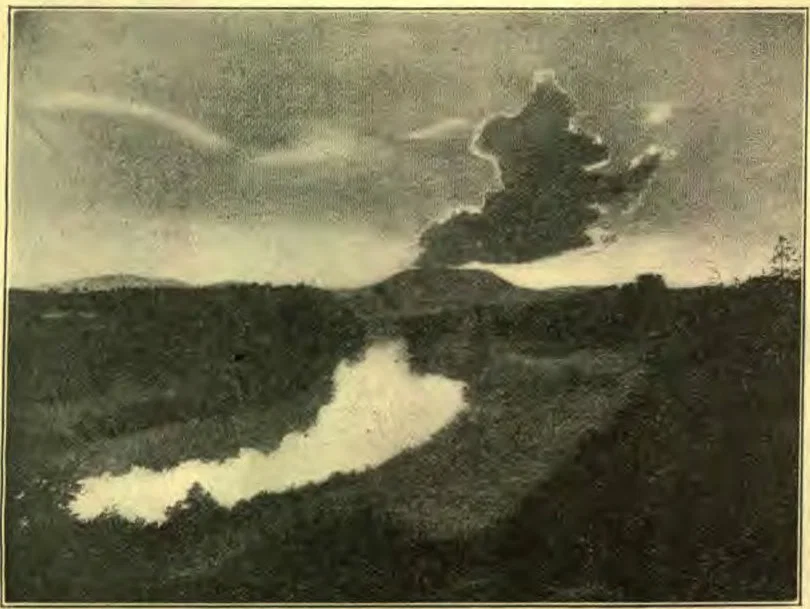
The Luray Valley is hemmed in on every side with a rim of mountains, ranging from two thousand to four thousand feet in height. The Blue Ridge begins on the north, swings completely around the valley to the west, then the Massanutten Mountains complete the circle. Adjoining the Luray Valley is the far-famed, picturesque Shenandoah—a valley “rich in soil, rich in story, rich in heroes.” Evidences of thrift and prosperity are on every hand throughout both valleys, though it is said when Sheridan left this country, a crow in flying across it would have to carry with him his rations.
EVENING IN THE SHENANDOAH
The village of Luray lies in the center of the valley bearing the same name. Here in 1878 was discovered the cave which by scientists is awarded the honor of swelling the list of the earth’s great wonders. Mr. B. P. Stebbins, who still resides in the vicinity, became convinced from surface indications that a cave existed in that locality. He persuaded two or three of the villagers to join him in the quest. Notwithstanding the good-natured ridicule which unsuccessful attempts in the search provoked, they continued until the thirteenth day of August brought them their reward—the discovery of the marvelous Luray Caverns. Mr. Stebbins at once bought the land containing the cave; it was being advertised for sale at the time of the discovery. No sooner, however, did the former owners learn of the existence of the Caverns, than they began litigation to regain the property. They failed in the lower courts, but finally succeeded in getting their claims sustained by a higher court. Mr. Stebbins lost heavily by the transaction; but later on he came into possession of the rich mine of truth embraced in the third angel’s message. Had he succeeded in realizing the anticipated profits from his discovery, perhaps he would not have been so ready to accept of the new-found truth.
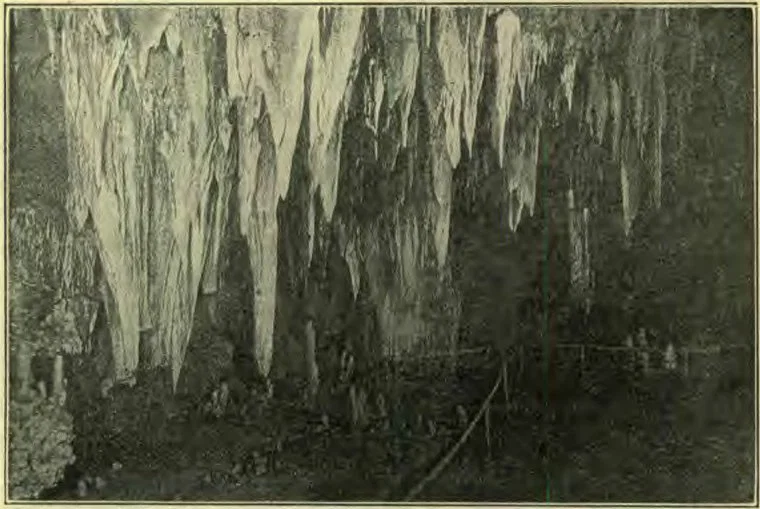
A VIEW OF THE CATHEDRAL AND ITS ORGAN
The popularity of the Luray Caverns is attested by the fact that 14,365 persons have visited them in one year, nearly 1,500 having registered in one day. A fee of one dollar is charged during regular hours, and more for night admission.

Formation of Caves

Large caves are found only in limestone regions, from the fact that such rocks are the most readily dissolved by water acidulated with carbonic acid gas. This is the gas that all living creatures are constantly breathing out into the atmosphere; it is the gas that causes the effervescence, or bubbling, when saleratus is put into a sour liquid; it is the gas that gives the sparkle and biting taste to soda-water. Rain-water usually contains a considerable amount of carbonic acid gas, which has been dissolved from the air. Such water, falling upon marbles, calcites, and other limestone rocks, weathers them very rapidly.
All, doubtless, are familiar with the fact that there exist many underground streams, rivers, and lakes, and that flowing water exerts a stupendous power in eroding, or wearing away and removing, great masses of rock.
Now a cave is but an underground valley—a system of large ravines. If the cave hill is subject to rain torrents flowing from the surrounding mountains, and if its strata are inclined, water flows through too rapidly to produce any effect other than that of simple erosion. The description of the formation of the Luray Cavern, as given by the Smithsonian Institution of Washington, may be of interest:—
“The history of its formation is, of course, divided into two periods; namely, its excavation and ornamentation. The latter was wholly produced after, and perhaps long after, the chasm was finished. The cavity was wrought by the erosion and the dissolving action of water holding carbonic acid gas in solution, and coursing through previously formed fissures in the rocks. These cavities gradually became enlarged into chambers by the falling and removal of loose material to lower levels, and even through open outlets to the general drainage of the country.
“The ornamentation of the cave with thousands of variously colored stalactites and stalagmites is a later work,—a work produced by the depositing of the lime in the form of a stalactite, or hanging rock, as the water that afterward percolated through or dripped freely from the crevices of the rocks which formed the ceiling, evaporated or flowed away.”
Some caves have the stalactites, others do not. Such ornamentation demands a condition of comparative dryness and ventilation seldom realized.

What the Visitor Sees

A CORNER OF THE BALLROOM
The exploring party, accompanied by a guide and a guard who have provided a few candles lest the electric lights should play them false at an inopportune moment, are ready to make their entrance into this wonderland in the heart of the earth. The first descent is down a broad flight of stone steps to a landing fifty feet below the surface. The dropping of the mercury from ninety-six degrees to fifty-six degrees is received by all with at least a shrug of the shoulder, and is a signal to one warmed by a generous impulse, to exchange wraps with a friend not so favorably prepared for the sudden transition.
A short walk leads to the Entrance Chamber, an irregularly shaped room thirty-five feet high, and in some places nearly two hundred feet wide. It is believed that one would feel quite satisfied with the expenditure of his money were there no other rooms beyond to explore. Washington’s column is perhaps the most attractive feature in the ornamentation of this chamber. It is a mammoth fluted pillar nearly twenty-five feet in diameter. Myriads of stalactites hang from the ceiling, and all about arise from the floor mighty stalagmites.
One who has had his imagination stimulated by the observations of exquisite, delicately tinted specimens of stalactites in the National and other noted museums, and also from reading highly colored descriptions of these natural formations, becomes conscious of a feeling of disappointment, as the majority of the formations are opaque, and of a dirty brown color from the clay and oxide of iron. The sensation of disappointment, however, is of short duration; for while the sunset skies have not left their glory everywhere in the great cavern, yet there is so much in other directions beyond what even the keenest imagination could anticipate that the visitor at once confesses himself satisfied and awed by his surroundings. Here and there, moreover, one comes upon an exquisite group of snow-white stalactites of alabaster translucence—meant, it would seem, to dissolve the last bit of dissatisfaction that might have lurked in any heart.
An avenue of one hundred feet leads from the Entrance Chamber. Do not remark about the rapid passing by of the Vegetable Garden for the Fish Market, which lies just beyond. The Washington Star says of the latter room: “The Fish Market is one of the most natural and unique sights in the Cavern. The illusion is so absolutely perfect that one almost expects them to flop and wriggle about if touched.” In a recent party there was one who pleasantly thought to put the guide’s sagacity to test by inquiring, “What kind of fish are they?” He at once received the reply, “Rock fish;” whereupon the good elder, for so he was, meekly journeyed on, while his friends enjoyed the evident surprise given him by the guide’s ready answer.
Elfin Ramble is entered next. This is a low, open room from one to ten feet high by six hundred feet long and three hundred feet in breadth. Crossing the Ramble, one stands on the edge of Pluto’s Chasm, a fissure five hundred feet long, seventy feet deep, and from ten to fifty feet wide. This is said to be the awe-inspiring spot in all the cave. Passing down the flight of steps to the bottom of the chasm, the visitor beholds a specter—a tall snow-white column looming up in the darkness. While retracing the steps to the Fish Market, Crystal Spring is passed, a beautiful body of water fully deserving its name. Its unique setting makes it doubly interesting. The basin is lined with calcite crystals, and others are still forming. The roof is studded with small stalactites. After giving each person a sip from the crystal pool, the guide leads the way to Skeleton Gorge, at the bottom of which is observed the gruesome sight of human bones, lying partly imbedded in the clay.
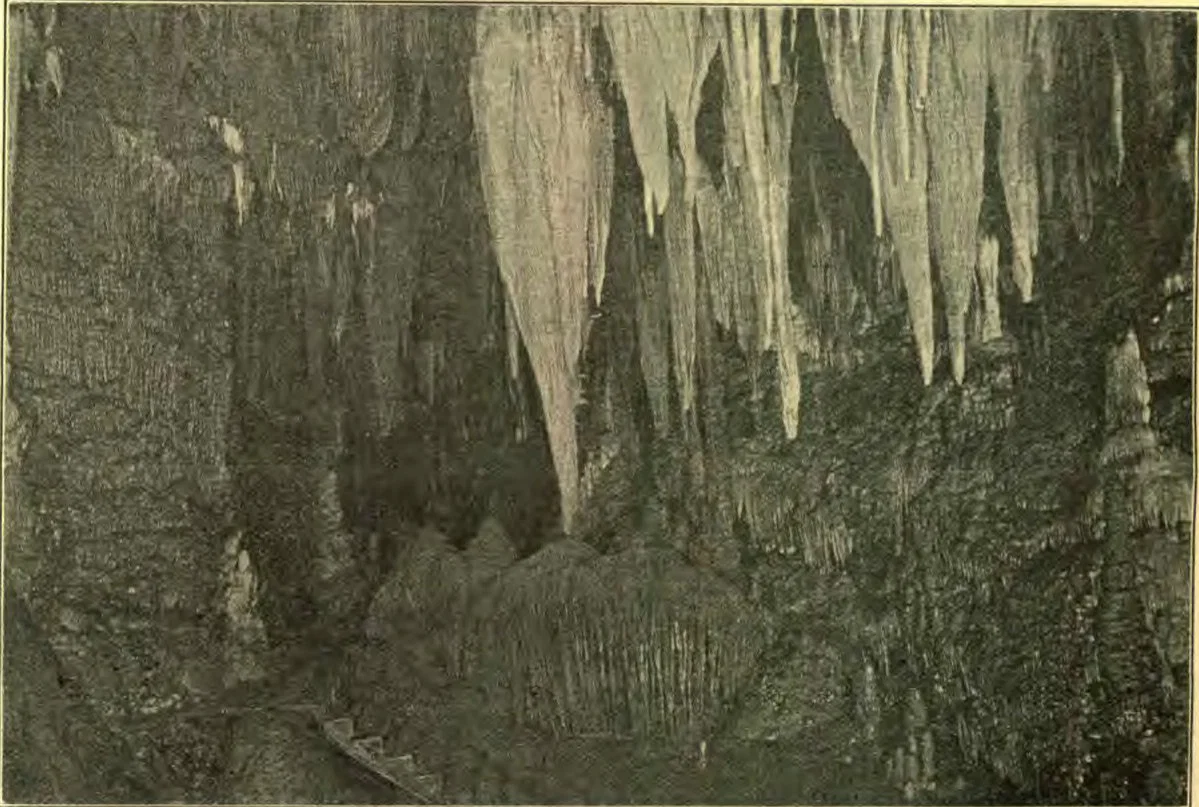
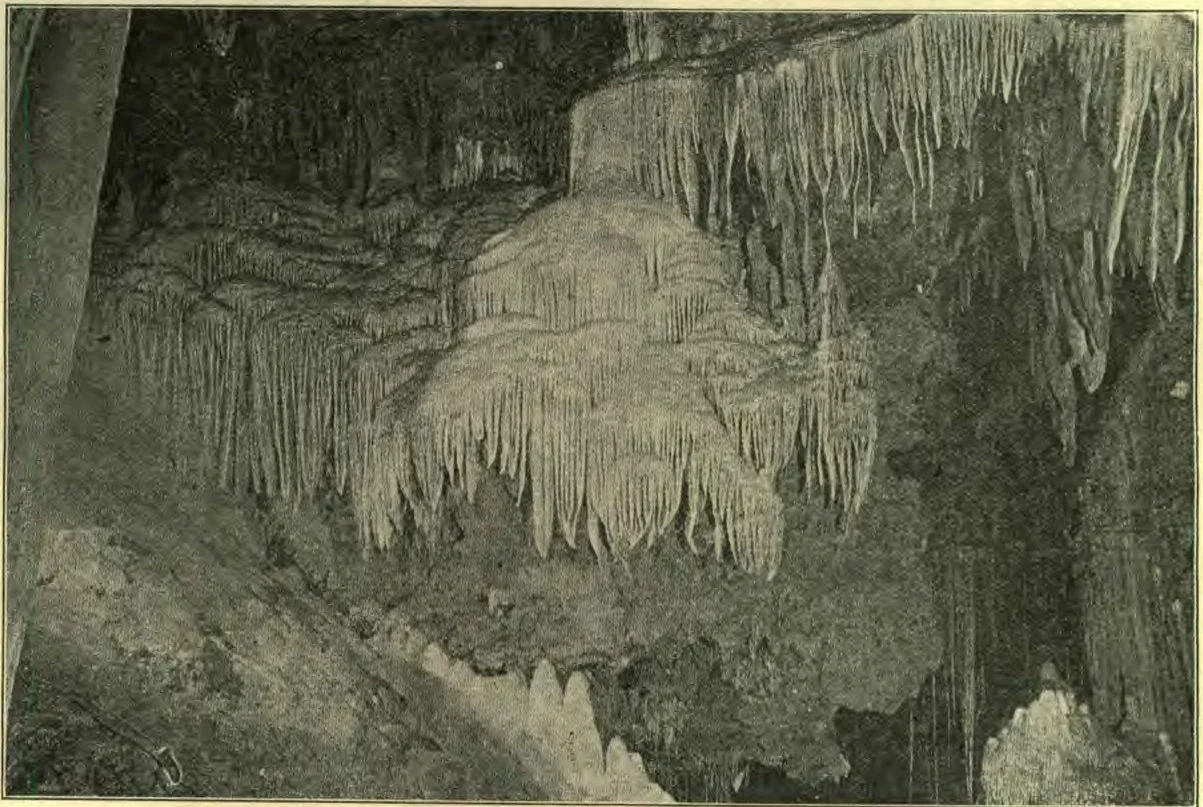
Whether some Indian boy in the distant past fell into the cave and wandered about until he unexpectedly plunged into this abyss, or whether the bones were entombed at the time of the flood, is a matter of conjecture. Not far from here is the beautiful and graceful group of stalagmites known as Titania’s Veil; its wonderful folds of snowy whiteness are very pleasing.
TITANIA’S VEIL
TITANIA’S VEIL
The guide only admits of a hasty glance at many of the interesting features; so I can hardly be expected in my description to be more generous than he. Therefore I can only call attention to the fact that among other attractions of the Caverns are: the Lady’s Riding Whip,—a stalactite simulating as perfectly the object for which it is named as if chiseled by a skilled artist,—the head of Moses, Giant’s Hall, an Angel’s Wing, statuettes, a band of monkeys climbing a rope, a camel’s head, a crouching lion, an eagle, the Natural Bridge, a cemetery, Tower of Babel, Leaning Tower of Pisa, an Indian Chief, the Madonna, a veiled lady, Blacksmith’s Shop, the Throne Room, the Theater, a base drum, a Saracen’s tent, and the wet blanket. This last was especially interesting,—a marvel in stone,—for it seemed that the threads of which it was woven, and the red and blue borders, could be plainly seen.
Recently the writer, with a number of others, had the privilege of visiting the Caverns. When we all entered the Ballroom, the largest hall of the cave, it seemed like a grand cathedral cut out of the solid rock by the living water. Prof. Frederick Griggs was one of the party, and on being asked to sing, he responded with “Rocked in the Cradle of the Deep.” Afterward the whole company sang “Nearer My God to Thee.” The soloist pronounced the room admirably fitted for a music hall. Here the people of the neighborhood have several times enjoyed the novelty of a ball.
The Cathedral is a chamber not so large as this one, yet having a charm unexcelled by anything else the Cavern offers—a remarkable group of sounding stalactites. As this great natural musical instrument responded sweetly to the touch of the musician, and as the chimes of the cathedral bells sounded forth, the listeners were spellbound, and many involuntarily pronounced it the best feature of the cavern.
The Bridal Chamber has a peculiar interest to some persons; for the guide informed us that nine marriage ceremonies had been here performed.
Easy progress is secured throughout the Cavern by the sidewalks, steps, and electric lights. The lamps are sufficiently numerous, yet the light of day, of course, is not secured. An old lady who visited the cave at night, and declared that next time she should go in the daytime in order to get a better view, hardly appreciated how far removed the cave is from the sunlight. Its roof is said to average from one hundred fifty to two hundred feet in thickness, and to consist of an immense bed of limestone rock through which the water from the surface soaks, each drop adding its mite to the building of the countless interesting forms found in this wonderland.
Owing to the purity of the air and the evenness of temperature, persons suffering from lung diseases were advised at one time to resort to caves, particularly to Mammoth Cave of Kentucky, for a brief residence. Several died there, and all died soon after leaving the cave. One heroic patient did not see the light of the sun for five months. These medical advisers must have belonged to the same order as those who attended Washington in his last illness.
Luray has instituted a wiser way of utilizing the sanitary advantages of its cave, by erecting a sanitarium upon a hill overlooking the charming valley, and near enough to the caverns so that the air can be pumped from the cave to the sanitarium. Possibly the chief recuperative value of this provision lies in the inspiration given the patient by the novelty of the affair.
However this may be, if opportunity affords, do not fail to visit the Luray Caverns. The inspiration gained from a few hours’ tour through this wonderland will certainly be worth the time and trouble. The dark corridors and chasms here and there, pleasingly contrasting with the brilliantly lighted spaces, add to the weird and peculiar feeling that must be with every visitor as he threads his way from room to room, through winding labyrinths, filled with strange figures,—in all of which “man hath had no part.”

The Lesson of the Flower

A BREATH of fragrance came to me Upon the April air. I looked around, but could not see A blossom anywhere. But, following where the fragrance led, I found beside a stone, Hidden by branches overhead, A violet newly blown.
“Dear little flower,” I said, and bent To smile into its face, “Tell me if you are quite content With this, your dwelling-place.” “Aye, quite content,” was the reply, “God wanted me to be In just this place, I know, and I Am not so wise as he.
“So why should I not be content, Since he has planned it so? He knows—not I—just what is meant. I do not care to know. But I am glad to do my part, And so, on this green sod, I always keep a happy heart, And blossom just for God.”
Dear little violet, thanks to thee For lesson all unmeant. Thy simple faith makes plain to me The secret of content. To be what God would have us be, No matter where we plod— To trust, wise little flower, like thee, And do our best for God!
—Eben E. Rexford.

Who Will Do It?

It is said that stockings were a rare luxury in the days of Good Queen Bess. As I look at the darning basket, the wish comes that stockings were a rarity nowadays. But they are not, they are plentiful as blackberries, and holes in them are as thick as the seeds.
And who is going to darn these stockings? It takes such a lot of time and patience, and after it is done, there is nothing new. If there is a grandmother in the household, she will probably work through the pile without much murmuring, because the restless feet that have made the holes are so dear to her, and because she has gathered wisdom with the years.
But if there is no grandmother? Then, you fancy, it is mother's place to do the darning. If you could just once change heads with mother, and know what a busy, anxious whirl hers is in much of the time, you would know how impossible it is for her to take her superior skill for such simple tasks without having some more important matter suffer for it. Unless some one looks to the darning basket every week, there stands that pile of discouragement. You know you ought to attack it, don't you? Then do it, without any further shirking. Confess to yourself that you have been mean about it, and settle down to repairs of both conduct and stockings. You don't know until you've tried, what a bright rainbow will be shining in your heart, nor what a bright smile on mother's face.—Selected.

One Mother's Solution

A RESOURCEFUL mother of my acquaintance has solved the problem of teaching her young daughters to cook and serve meals,—not only to do the work, but to take an interest and a pride in it, which, as a rule, is a more difficult task.
This woman, herself a capable housekeeper, has three half-grown daughters, who, like the average girl, not only did not know anything of the many duties that devolve upon the hostess at table, but evinced little desire to learn. The charm of the vacation season had lost something of its freshness, when the mother unfolded to her daughters a delightful plan by which they were, each in turn, to have the pleasure of entertaining the rest of the family at dinner, and a jolly time they all had of it, and a profitable time, too, it being an interesting way to learn things.
Not only does the young hostess of the occasion prepare and serve all the viands, but she plans the menu, and does all the buying of materials. In case of a special dinner, the mother makes it a point to go away for the day previous, this serving the double purpose of giving herself a needed holiday, and clearing the field for the experiments of the young housekeeper. She orders whatever is called for on the menu already arranged, and prepares everything possible on that day. On Sundays she assumes all responsibility for the cooking and serving of the dinner, exactly as though she were the hostess, and her parents and sisters the guests at her table. As confidence is gained, friends of the young girls are invited in to partake of their hospitality. A pleasant rivalry is thereby engendered between the sisters as to which shall serve the daintiest and most satisfactory meals, always keeping inside the limit set them by the purse-bearer.
The dinners as served are approached uncritically, or with an occasional appreciative word, with exactly the manner of a guest at the home of an acquaintance. Afterward, however, the mother goes over the details of the dinner with the young cook, praising where praises are due, and calling kindly attention to any defects that existed, with suggestions as to how any dishes might be improved. The matter of expense is also carefully considered, and hints given as to the buying of meats, vegetables, and fruits.
The mother is gaining much from this plan in the even occasional freedom from responsibilities of the table; while enjoying the satisfaction of knowing that she is not neglecting a most important branch of her daughter's education. The girls admit that their vacation is being both pleasantly and profitably spent.—Maude E. Smith-Hymers.

Fix It to Stay

Two sisters were putting away some of their belongings in a large drawer that his mother had set apart for them.
“Here are so many things,” said Lulu, “we can’t take time to put them in as we want to. Tumble them in anyhow to-day, and we’ll put them in order some other time.”
“No, no,” said wiser Mary. “Let’s fix them to stay now, while they are going in. That’ll be better, I’m sure.”
It is much better in every way to put away things we want to keep, whether in drawers or in our heads, in such good order that we can keep them and find them. Do a thing right, once for all, and it will not have to be done over again. Isn’t that sensible and right? Then do it.—Girls’ Companion.

We Must Watch Ourselves

THERE are few persons who are not subject to some little, disagreeable, often unconscious habit, which annoys their friends, but which is probably incurable by expostulation. One acquaintance is always biting her finger-nails. Mary beats a “tattoo” on the window-pane or table. Florence is consistently and disagreeably curious about little things that do not concern her. Susan puts the lead pencil in her mouth whenever she uses it. Lizzie can not turn over the leaves of a book without wetting her fingers at her lips. Jane — well, Jane would have a beautiful mouth if she did not keep it open, to the peril of her respiratory passages. These are but instances of petty bad habits, which friends observe in helplessness. The moral is clear — we must watch ourselves. As a rule the only person one can cure of bad habits, great or small, is himself.— Girls’ Companion.

What to Teach a Daughter

TEACH her that one hundred cents make one dollar.
Teach her to say “no” and mean it, and to say “yes” and stick to it.
Teach her to wear a calico dress, and wear it like a queen.
Teach her how to dress for health and comfort, as well as for appearance.
Teach her to regard morals and habits, and not money, in selecting her associates.
Teach her to have nothing to do with intemperate or dissolute young men.
Teach her to observe the old rule—a place for everything, and everything in its place.
Teach her to embrace every opportunity for reading, and to select such books as will give her the most practical information.—Selected.

Ten Poor Boys

WILLIAM MCKINLEY'S early home was plain and comfortable, and his father was able to keep him at school.
Millard Filmore was a son of a New York farmer, and his home was a humble one. He learned the business of a clothier.
Andrew Jackson was born in a log hut in North Carolina, and was reared in the pine woods for which his State is famous.
John Adams, second president, was the son of a grocer of very moderate means. The only start he had was a good education.
Grover Cleveland's father was a Presbyterian minister with a small salary and a large family. The boys had to earn their living.
Ulysses S. Grant lived the life of a village boy, in a plain house on the banks of the Ohio River, until he was seventeen years of age.
Abraham Lincoln was the son of a wretchedly poor farmer in Kentucky, and lived in a log cabin until he was twenty-one years old.
James K. Polk spent the earlier years of his life helping to dig a living out of a farm in North Carolina. He was afterward clerk in a country store.
Andrew Johnson was apprenticed to a tailor at the age of ten years by his widowed mother. He was never able to attend school, and picked up all the education he ever had.
James A. Garfield was born in a log cabin. He worked on a farm until he was strong enough to use carpenter's tools, when he learned the trade. He afterward worked on a canal.—Saturday Evening Post.

A Practical Plan — Interesting

THERE are many earnest young persons among Seventh-day Adventists who have consecrated themselves to the Lord’s service. They sincerely wish to do something for him, but scarcely know where or how to begin. Some may have thought that they must have a society formed, with president, vice-president, secretary, assistant secretary, treasurer, committees, and departments, and that without these there was small prospect of their being successful in service. It is for the benefit of such, and for any others who desire to serve the Master, that the following true experience is related:—
A young man, whom we will call Allen Brown, was an earnest Christian. He became connected with one of our publishing houses, where he was employed to do clerical work. He knew he was serving the Lord in this, but still he felt an earnest longing to come into contact personally with the people, and bring the light of present truth to them. He had no time except after office hours, and might have said that he was then too weary, or that he needed the time which was his own for rest or recreation; but he made no such plea, not even in his own mind.
He finally decided upon a plan which he immediately proceeded to execute. Taking about twenty-five copies of The Signs of the Times, he walked down a busy business street the evening after the Sabbath, entered stores and other places of business, and offered his papers for sale. His pleasant face and courteous manners won the confidence of the people; a paper was sold at most of the places visited, and before nine o’clock he had disposed of all he had with him.
This experience was repeated with ever-increasing success for two or three weeks, and then Allen invited George Risley to go with him, told him what he had been doing, invited him to join him in the work, and gave him a practical illustration of how it could be done. Thus helped and encouraged, George became an interested and successful worker, and he soon agreed to deliver papers each week to the customers Allen had secured, and kept adding new ones to the list.
Allen then went to another part of the city, taking with him Albert Forbes. The same instruction was given him as George had received, and soon these young men were selling several hundred papers each week. Albert’s sister became so interested as he related his experiences in meeting the people, that she went with him one evening, and did not return till she had sold more than a dozen copies of the paper. She invited another young lady to go with her the next week, and these two took two more the week following, and thus the number of workers increased till there were more than twenty of the young people in the church engaged in the sale of papers, and about one thousand copies were circulated weekly. The experiences of these youthful workers became an inspiration to the whole church, and as they told of the blessings they had received, it brought new life and power into the missionary meetings. All this was accomplished without organization of any kind, but one young man “had a mind to work,” and the Lord greatly blessed his efforts.
What this young man did, other young men and women can do. Perhaps all may not do just as he did, nor what he did, but if there is “first a willing mind,” some avenue of usefulness will open up which will be a blessing to the workers as well as to others. Let any young person who desires to be the Lord’s helping hand begin by seeking him earnestly to know what he will have him do. Let the heart melt with tenderness and humility, and then take up the first work that presents itself. It may be nursing the sick, helping the poor, reading to the aged, distributing tracts, selling periodicals, or praying for the unconverted. The Lord is speaking to the youth among Seventh-day Adventists, saying, “Why stand ye here all the day idle?” The eleventh hour has come. The shadows of night are already falling. Do something for God, and do it quickly.
Where there is even one in any place who will consecrate his service to the Master, let him begin without delay. First he should seek the Lord in secret for himself. Then another may be invited to join in prayer. Unitedly let them offer their petitions for another who may be unconverted or indifferent, and so let there be an ever-increasing, ever-widening circle of influence. The promise may be claimed in faith that “if any man see his brother sin a sin which is not unto death, he shall ask, and He shall give him life for them that sin not unto death.” 1 John 5:16. Now, just now, is the time when young people may do a great work for God if they will. None should hesitate or delay.
Will you not do something, and do it now?
MRS. V. J. FARNSWORTH.

Paul Begins His Public Ministry

PERSONAL INSTRUCTION:—
The commission. Matt. 28:18-20; Mark 16:15-18.
Who are called. Mark 13:34.
Reward. Ps. 126:5, 6.
SCRIPTURE FOR STUDY: Acts 9:10-31; 13:1-3.
REFERENCE STUDY: “Sketches from the Life of Paul,” pages 32-44.
OUTLINE OF TOPICS:—
Baptized by Ananias.
Labors in Damascus. Acts 26:19, 20.
Goes to Arabia. Gal. 1:17.
Returns to Damascus.
Plot to assassinate him. Acts 9:23, 24.
Delivered. Verse 25; 2 Cor. 11:32, 33.
Goes to Jerusalem. Acts 9:26; Gal. 1:18.
Remains fifteen days. Gal. 1:18.
Disciples suspicious of him.
Received by Barnabas. Acts 9:27.
Labors in Jerusalem. Acts 22:17-21.
Plot to kill him.
Leaves Jerusalem. Acts 22:17-21.
Returns home. Verse 30.
Goes to Antioch. Acts 11:25, 26.
Ordained.

Notes

The notes, save the last two, are quotations from “Sketches from the Life of Paul,” by Mrs. E. G. White.
Paul’s life was in peril, and he received a commission from God to leave Damascus for a time. He went into Arabia; and there, in comparative solitude, he had ample opportunity for communion with God, and for contemplation.
While in Arabia he did not communicate with the apostles; he sought God earnestly with all his heart, determined not to rest till he knew for a certainty that his repentance was accepted, and his great sin pardoned. . . . He was ever to carry about with him in the body the marks of Christ’s glory, in his eyes, which had been blinded by the heavenly light.
Paul now returned to Damascus, and preached boldly in the name of Jesus. . . . They [the Jews] conceived a plan to assassinate him. The anxiety of the disciples drew them to God in prayer; there was little sleeping among them, as they were busy in devising ways and means for the escape of the chosen apostle. Finally they conceived a plan by which he was let down from a window, and lowered over the wall in a basket at night. In this humiliating manner Paul made his escape from Damascus.
He now proceeded to Jerusalem, wishing to become acquainted with the apostles there, and especially with Peter. He was very anxious to meet the Galilean fisherman who had lived, and prayed, and conversed with Christ upon earth.
Following these events, the conversion of the Ethiopian eunuch under the preaching of Philip, the vision of Peter at Joppa, and the outpouring of the Holy Spirit upon Cornelius and his household, served to convince the apostles and leading brethren at Jerusalem that God had granted to the Gentiles repentance unto life. Thus was the way prepared for Paul to enter upon his gospel mission.
And the hand of the Lord was with them; and a great number believed, and turned unto the Lord. When the believers in Jerusalem heard the good tidings, they rejoiced; and Barnabas, a good man, and full of the Holy Ghost and of faith, was sent to Antioch, the metropolis of Syria, to help the church there. He labored with great success. As the work increased, he solicited and obtained the help of Paul; and the two disciples labored together in that city for a year, teaching the people, and adding to the numbers of the church.
Both Paul and Barnabas had been laboring as ministers of Christ, and God had abundantly blessed their efforts; but neither of them had previously been formally ordained to the gospel ministry by prayer and the laying on of hands. They were now authorized by the church, not only to teach the truth, but to baptize, and to organize churches, being invested with full ecclesiastical authority.
Paul tells us that he “came into the regions of Syria and Cilicia.” Gal. 1:21. Churches were also established in these regions. Acts 15:23, 41. These churches were perhaps established during the time he was at Tarsus. “Within the limits of this region Saul’s activities were now exercised in studying and in teaching at Tarsus, or in founding those churches which were afterward greeted in the apostolic letter from Jerusalem, as the brethren in Antioch, and Syria, and Cilicia, and which Paul himself confirmed after his separation from Barnabas, traveling through Syria and Cilicia.”—Conybeare and Howson.
It is difficult in some instances to trace in chronological order with certainty from the different narratives given the movements of the great apostle. It is not the design of these studies to settle technical controversies. The principal object is to study the work of Paul, that, if possible, we may be animated by the same missionary zeal, and be led to go forth in the closing work to save souls. Let this be the central thought in each weekly meeting.
Note how Barnabas assisted Paul to enter the work. It pays to come in contact with men of experience in the work of God, and be molded by their Christian influence. G. B. T.

Where the Sunshine Goes: A Children's Verse

“O, I wonder if any one knows On a cloudy day where the sunshine goes! I have heard that it hides in the strangest places,— The hearts of good children, and shines in their faces.”
Continue reading: Frank Darrel’s “Color Scheme”