“FIVE yards of brush braid and a spool of silk to match this sample.”
The blood rose beatingly to Frank Darrel’s temples as he took the small piece of cloth held out to him by a woman who stood at the other side of the counter. A lump that threatened to choke him rose in his throat, and for a moment the shades upon which he looked were blurred before his eyes.
Was this the end?—the end of all his dreams of high school, and, perhaps, college? of the future to which he had looked forward so hopefully, that, at fourteen, he found himself behind the notion counter—that lowest rung of the ladder—in a department store?
For the first three months after his father’s death there had been room for nothing but grief in Frank’s mind. Then came the conviction that he, as the second eldest and only boy in a family of five, must get to work without further delay. But employment for a lad not too robust in health was not easy to find; and, when the position in Briggs & Barnard’s store was offered him, he accepted it gladly.
Yet, only now, as he bunglingly waited on his first customer, did the realization of how hopelessly far, how at the very antipodes, all this was from that upon which he had set his heart, come over him like an engulfing wave. That same boyish heart felt sinking before the barrenness of the prospect opening ahead of it, as his eyes swept the crowded, ill-ventilated store. The whir of cash boxes overhead confused his brain. He felt stifled and choked as he stood at bay amid the wreck of his broken hopes, battling with the fierce despair which was upon him.
In a veritable daze of despondency he took his cap at noon, and left to get his meager lunch. All the ways of the store were new. He laid hold upon the door leading to the street and tried to pull it inward. Then, as it resisted his efforts, he raised his eyes, and saw printed on a brass plate, just on a level with them, the word “Push.”
Frank put his shoulder against the door and was soon in the street, drawing in deep breaths of the fresh air. But, as he passed along, those four letters still seemed suspended before his gaze. Push! What was the use of pushing? If it were anywhere—anything—but a dry-goods store! At best he could only hope to be transferred to another department. And a life spent in that overcrowded atmosphere seemed, just then, too blighting to contemplate.
Nevertheless the word had unconsciously awakened the germ of resoluteness in the boy’s character, and, once roused, it clamored for mastery,—to put his shoulder against the difficulties in his path, to work his own way out into the air and sunshine of success. Something began to stir in Frank—a determination to do this thing that was being asked of him, and to do it well. And, as the resolution strengthened, there flashed through his mind, like a bright shaft of encouragement, some words he had heard the Sunday before: “Faithful in little—faithful also in much.”
It was a different boy who returned to Briggs & Barnard’s store. His quick eyes selected those in the crowd of customers who seemed to have difficulty in getting served, and upon these he waited with an alacrity and cheerfulness which transformed the weary detail of matching silks and braids into something approaching pleasure.
“As a rule I object to being served by a new clerk,” a dressmaker, whose patronage was important, said to the floor-walker near Frank’s department as she passed from the store, “but that young fellow over there has won my heart, and made me forget that his fingers are bungling. He’ll make a good salesman in the end.”
Mr. Maynard, to whom she spoke, turned and looked at Frank, and, had the boy but known it, that look was the first step upward—a step honestly earned by his strict attention to the duties given him to do.
“We need another hand at the men’s furnishing counter,” the manager said to Mr. Maynard, a few months later. “Isn’t there any one over here that could be spared?”
“There’s a boy here whom I’d like to see get on,” Mr. Maynard answered. “There’s isn’t a lazy bone in his body. Somehow, when all the others at his counter are idle, he seems to have a customer.”
“That’s the kind we want. Send him over at once;” and the manager hurried away.
Frank went home that night as if he trod on air, his joyous whistle waking the echoes as he swung along the street. His salary was doubled. He was in a less crowded part of the store, near an entrance, where he got many whiffs of fresh air and occasional glimpses of the street, and his customers were mostly men and boys.
All these were related with a boy’s enthusiasm when he got home, to the mother who gazed at him with moist eyes of love, and to the little sisters whose idol he was.
There was one thing about which Frank never spoke—had never spoken—to any one; a broken hope hidden deep in his own heart, upon which even now he dared not look, that one day he might have been an artist or designer. A love of color-blending was the passion of his life. It led him to stop one day on his way to lunch, to watch Mr. Witter, the window-trimmer, at work.
“Well, how do you like it?” the latter asked, pleasantly, noticing Frank’s absorbed face.
“It’s—it’s very pretty.”
But the tone held a reservation which the quick ear of the decorator was not slow to catch.
“Speak out, boy! What’s wrong with it?” he said, briskly.
“Well, sir, if I were doing it,”—Frank’s gray eyes looked up, mirthful with a sense of his own audacity—“I’d take out that blotch of red.”
“That blotch of red! that’s a thirty-five dollar imported hat!”
“But—but doesn’t it spoil the color scheme?”
“What do you know about color scheme?” And Mr. Witter looked at Frank more intently.
“My father was a wall-paper designer, sir.”
“Humph!”
Frank passed on his way, but, when he was gone, Mr. Witter stood back and surveyed the window, first with his head held critically on one side and then on the other. Finally he went away, and, after a few minutes, came back, as if to get a totally fresh impression.
“The lad is right,” he muttered; and out came the “blotch of red” to which Frank had objected.
He stopped at the men’s furnishing counter the next day.
“See here, young man, you’ve got the making of a good window trimmer in you. Why don’t you learn the trade?” he said, briskly.
Frank’s eyes gleamed.
“How could I learn it, sir?”
“Come round to my house in the evenings, and I’ll teach you all I can.”
“I’m at evening high-school now, but that closes next month, and then——”
“All right! Come along after that. You have too artistic an eye to be wasted on collars and neckties;” and Mr. Witter passed on.
A series of evenings began after that which were a delight to Frank. On an improvised frame he was shown, with the aid of small squares of tissue paper, how to arrange handkerchiefs in every conceivable and artistic design. And whenever Mr. Witter had decorated an especially good window in the store, he always called his pupil to come and look at it, not infrequently acting upon a suggestion given by the lad.
So two years passed for Frank Darrel. He was graduated from evening high school. His salary had been raised more than once, and his mother, looking back on the dark prospect of two years before, thanked God for her boy.
Then came many changes at Briggs & Barnard’s. A new store had been opened in the next block, in order to compete with which improvements and expenditure were necessary. Among these were four enlarged and beautiful show windows. No pains or expense were spared to make the coming opening a success.
Everything was ready for Mr. Witter to begin work, when the news came that he had been taken suddenly ill. In a fume of worry the manager drove to the window trimmer’s house that evening.
“You can telegraph to New York for a man, of course,” the latter said, with his hand at his fevered head, “but there’s a lad in the store—Frank Darrel—who can do it, and do it well.”
Frank was sent for to come to the manager’s private office next morning, and went with his heart pounding against his ribs.
“You know that the firm has been at a great deal of expense in order to make this opening the biggest thing we have ever done,” his superior began. “Much depends on the window display, and Mr. Witter is too ill to leave his house. He tells me you can do it. Can you?”
The manager drummed impatiently with his fingers on the arms of the chair during the minute that it took Frank to decide. But he stopped when the steady gray eyes were lifted to his. There was a force he liked in the young face.
“I think I can, sir.”
“Then get to work at once, Darrel. You can6have what help you want. And remember—you have only two days.”
Until midnight that day and the next, Frank worked behind his green baize curtain. All his artistic taste came into play. With flushed face and shining eyes he draped costly fabrics, blending shades and colors until the whole was a work of art. Never had the goods of the establishment been so displayed. Each separate window was decorated after an original design of his own. His heart throbbed with delight in his work, as he skilfully arranged imported rugs and draperies so as to get the very best light and effect. And through all his toil there ran, like a bright thread, the thought that perhaps, after all, the dream of his life was not wholly shattered; that if this gift, this talent which he felt was in him, did not find an outlet in the direction he had once hoped, it might yet do so in a way which would mean congenial occupation to him and substantial help for his mother and sisters.
Frank’s limbs fairly trembled under him as he entered the store on the morning of the opening. Would they think his work well done? The manager was too absorbed to speak to him then, but congratulations began to pour in on him from every department in the house. And the crowd which gathered around the windows as the day wore on testified to the young artist’s success. With kindling eyes and quickly beating heart, Frank heard the involuntary exclamations of admiration as people passed in and out.
But the great moment of that day came for Frank when, late in the afternoon, he stood in the manager’s office and received the thanks of no less a person than the gray-haired senior member of the firm, Mr. Briggs himself.
“You have done well, my boy, and the firm is indebted to you,” he said, heartily, with his hand on Frank’s shoulder.
“Thank you, sir,” said Frank. There was a mist before his eyes, and something in his throat made speech difficult. “I—I’m proud—to have been of use—to the house,” he jerked out at last.
“That’s the right spirit, my lad. By the way, stop at the cashier’s desk on your way down-stairs.”
The envelope which Frank carried home to his mother that evening—and he walked the whole three miles from the store to the house, for no street-car could contain his feelings just then; it needed the whole, clear vault of heaven—held a new twenty-dollar gold-piece. And that was apart from his week’s salary.
“What do you mean by it?” Mr. Witter held him off at arm’s length, gazing over his glasses with mock severity, when Frank, hearing he was convalescent, called a week later. “What’s this I hear about your work causing such a furore and throwing mine in the shade? Frank, my boy,” he took his pupil by the arms, growing suddenly grave, “I’m getting to be an old fellow, and my day of ambition is almost past, but, with your youth and talent, it will be your own fault if you do not become an expert window decorator; and that would mean what I know lies near your heart—an end to hard work for your mother; in fact, comparative ease for her and the little sisters. But, son, if I get you a good position,—and I think I can,—there’s one thing I want you to do; keep the color scheme of your life right. Don’t let anything come in to mar the clear, fresh tints which prevail there now.”
“Mr. Witter,”—Frank raised clear, gray eyes, into which it was a joy to look, to his friend’s face—“I have not spent so many evenings with you without learning something besides window trimming. And, anyhow, the color scheme is in safer hands than my own.”—M. L. Cummings, in Young People’s Weekly.
Simple Experiments in Science
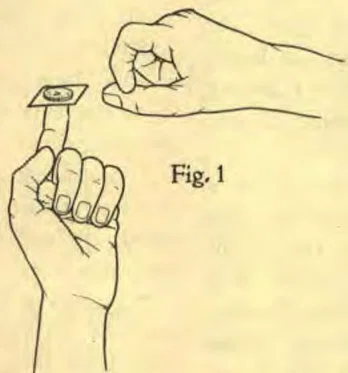
See, children, here is a nickel on the tip of my finger, with a tiny square of cardboard underneath it. Now can I remove the card without in the slightest degree moving the coin? It seems impossible, doesn’t it? And yet just a little snap of the edge of the card, and it disappears, leaving the money there.
Fig. 4
Fig. 1
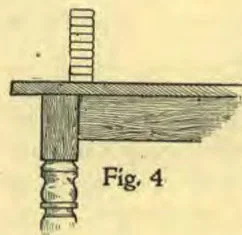
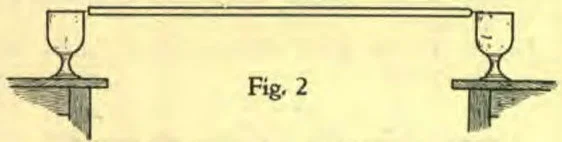
The following performance has long been a favorite with magicians and jugglers the world over: A thick broomstick is supported at the ends on two little bands of paper held up by children’s fingers. With a heavy stick the juggler strikes the broomstick a quick, strong blow in the middle, and behold! it breaks squarely in two, without tearing the paper bands at all. Instead of children’s fingers supporting the rod, the bands are often held up by the keen edge of razor blades, and still they are neither cut nor torn by the shock. Another form of the same experiment is shown in the illustration. A needle or pin is driven into each end of the stick, and rested on the edges of glasses brimming full of water. In this position the stick may be broken without spilling a drop of the liquid.
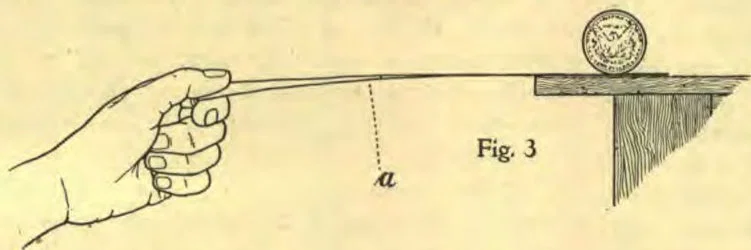
If we take a strip of paper, half an inch or so wide and a foot long, and on one end of it balance a dollar edgewise, we shall find that by striking a quick blow at the point marked a, the paper will be pulled out, leaving the dollar still balanced on its edge.
Fig. 3
Fig. 2
These experiments show us something of what is called inertia. It might just as well be called stubbornness, for that is exactly what it is. We snap the card from under the coin, before it will make up its mind to move; we break the stick without any of the shock being communicated to the paper bands or glasses; and we draw the slip from under the dollar, leaving it all oblivious to our action. In the same way we can shoot a clean round hole through a window pane with a swift-shooting rifle, and a man can hurt his foot severely by kicking an old plug hat with a brick under it. The force he puts into his kick would easily send the brick across the street if it were applied more slowly; but being applied thus swiftly, the stubborn substance of the brick will not respond, and the force expends itself in a reaction on his foot.
THE FLYING TOP
When we come to look for examples of inertia, we find multitudes of them. Watch a man standing in the aisle of a car as the train starts. He behaves exactly as the coin did on my finger tip. He tries to stay still and let the train go on, and so tips backward. When the train stops suddenly, he tries to keep on going, and so runs up the aisle a bit. Have you not wondered what kept a stone moving after it left your hand? Well, it is simply that unknowable, not-understood stubbornness. You put the stone in motion, and it will stay in motion forever so far as it is concerned, just as it would stay still forever if not disturbed. A swiftly moving train can not come to a stop, no matter what air-brakes are used, in less than a hundred yards or more. If anything outside of itself forces it to stop, all the force of the steam stored up in the weight of the train reacts on itself instantly, many thousands of tons, and it is no wonder that iron bends, and timbers splinter.
Continuing our experiments, we pile up a stack of dominoes or blocks on the worktable, and with a heavy ruler strike the stack quickly. One block will be removed without disturbing the rest.
Now air, which seems so light and vapory, is really possessed of many of the same properties as other and heavier substances, and among them is inertia. A bird’s wing striking backward quickly and powerfully, beats against the air as against a hard substance, for the air absolutely will not move out of the way so quickly, and thus the force of the stroke reacts on the bird’s body to carry it on and up.
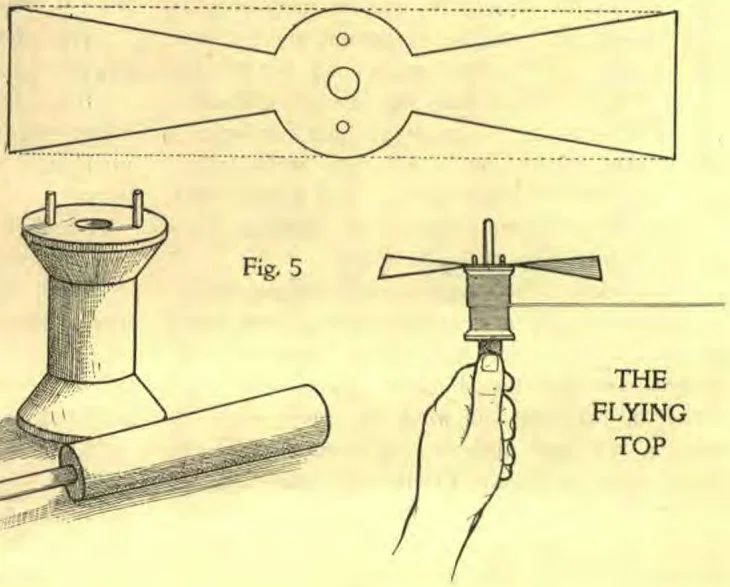
Another good example of air inertia is seen in the flying top, illustrated herewith, and which any boy can make. The top itself is cut out of common tin, and the fans bent like those of a windmill. The spool has in its top two small nails with heads cut off. These pins fit into the holes in the top, and set it whirling swiftly when a string is unwound from the spool. The nail on which the spool turns should be about an inch longer than the spool, so as to guide the top fan upward as it leaves the whirlers. With a quick, strong pull on the string this little flyer will rise one or two hundred feet. Its action is just like that of a screw in wood, the air with its immobility affording a substance through which it can screw its way. These experiments illustrate some of the great universal laws of nature.
EDISON DRIVER.
INTERMEDIATE LESSON
XIII—Review
(September 24)
Questions
1. Who was Naaman? What little girl lived in his house? Tell how Naaman was healed of the leprosy. 2 Kings 5:1-17.
2. Of what great sin was Gehazi, Elisha’s servant, guilty? Tell the story. What was his punishment? Where did the sons of the prophets invite Elisha to go? What happened to the ax, as the men were felling a beam? Tell how it was rescued. 2 Kings 5:20-27; 6:1-7.
3. Who told the king of Israel the plans of the king of Syria? To what city did the king of Syria send to take Elisha? When Elisha and his servant saw the soldiers, how did the servant feel? Tell what Elisha said to him, and how his fear was taken away. To what city did Elisha lead the host? How was he able to do this? When he had them in the city, what did he tell the king of Israel to do to them? 2 Kings 6:9-23.
4. How great was the famine when Ben-hadad came up and besieged Samaria? What was done by some of the women of the city? What did the king do when he heard of this? To whom did he go? What did Elisha say would be sold in the city the next day? What haughty answer was made to the prophet by a man who was with the king? What did Elisha say to this man? Tell how the Syrians were made to go away, and how the word of the Lord was fulfilled. 2 Kings 7.
5. Tell how Hazael became king of Syria. What did Elisha say that he would do to Israel? Who was Jehu? How was he anointed king? What wicked family did he destroy? What idol worship did he put away from the land? What kind of men were all the kings of Israel? What nation did the Lord finally allow to carry the ten tribes away into captivity? 2 Kings 8 and 9; chapter 15:29.
6. Name the kings of Israel, from Jeroboam to Jehu, and relate one incident in the life of each. Who was the first king of Judah? When he had fully established his kingdom, what did he and his people do? What king came against Jerusalem in the fifth year of the reign of Rehoboam? What did he carry away from the house of the Lord, and from the palace that Solomon had built? How much was left? How long did Rehoboam reign? Who was the next king of Judah?
7. Name the first four kings of Judah. What did Asa do for Judah? From what king did the Lord deliver him? What encouraging promises were made to Asa? Whom did Jehoshaphat send through the cities of Judah? What fell upon the heathen nations around Judah? What had the Lord said, long before, would happen if his people obeyed him? Read Deut. 11:25. Whom did Jehoshaphat send with the soldiers on one occasion when the army was going to battle? What did they sing? What was the result? 2 Chronicles 25 to 30.
8. Name the next seven rulers of Judah. (Jehoram, Ahaziah, Athaliah, Joash, Amaziah, Uzziah, Jotham.) Tell something about each one. See 2 Chronicles 21 to 28.
9. What kind of king was Ahaz? What did he worship? How did he desecrate the temple? Tell how Hezekiah cleansed and repaired the temple, and restored the worship of the Lord in Judah and in Israel. 2 Chronicles 28 to 31. What is said about this king? 2 Chron. 31:21.
10. Describe the seige of Sennacherib, king of Assyria, against Jerusalem. Against whom did he speak? Tell how the Lord saved his city and people out of the hand of this wicked king. 2 Chronicles 32; Isaiah 36 and 37.
11. What did the nations around Judah do when they heard how the Lord had delivered them from the king of Assyria? 2 Chron. 32:23. Tell about Hezekiah’s sickness and recovery. Who heard of it? What did he send to Hezekiah? What did the king show the messengers? Why was this so displeasing to the Lord? What message was sent to Hezekiah by the prophet Isaiah? 2 Kings 20; 2 Chron. 32:22-31.
12. Who was Manasseh? How many years was he king? Tell about the first part of his reign. Describe the second part. What caused Manasseh to change his evil way? Who was the next king of Judah? How old was Josiah when the people made him king? What work did he begin while he was still young? 2 Chronicles 33 and 34:1-7.
God and a Friend
By W. W. Story
LIVE not without a friend; the Alpine rock must own
Its mossy grace, or else be nothing but a stone.
Live not without a God, however low or high.
In every house should be a window toward the sky.
—W. W. Story.
My Wish
By Viola E. Smith
I WOULD not be
Set up aloft where all may see,—
Enthroned in solitary state,
While many on my bidding wait;
Around such heights
The lightnings play, and cold air blights
The fragrant flowers that richly blow
In common gardens far below.
I do not plead
To do some grand and glorious deed,
That so my praises may resound
From land to land, the world around;
For he who wears
Fame’s wreath, is oft bowed down with cares,
His aching, disappointed heart,
A mark for cruel envy’s dart.
But I would pray
That God would let me spend life’s day
In helping to make somewhat less
Earth’s heavy weight of wretchedness;
’Twere sweet to know,
When from these scenes I’m called to go,
That from some eye I’d wiped the tear,
Made some dark places brighter here.
VIOLA E. SMITH.
Wait Patiently for Him
By Frances R. Havergal
God doth not bid thee wait
To disappoint at last;
A golden promise, fair and great,
In precept-mold is cast.
Soon shall the morning gild
The dark horizon-rim,
Thy heart’s desire shall be fulfilled:
“Wait patiently for him.”
The weary, waiting times
Are but the muffled peals
Low preluding celestial chimes,
That hail his chariot wheels.
Trust him to tune thy voice
To blend with seraphim;
His “Wait” shall issue in “Rejoice!”
“Wait patiently for him.”
He doth not bid thee wait,
Like driftwood on the wave,
Nor fickle chance or fixed fate
To ruin or to save;
Thine eyes shall surely see,
No distant hope or dim,
The Lord thy God arise for thee:
“Wait patiently for him.”
— Frances R. Havergal.
Beauty of God's Sunset Colors
“But beauty seen is never lost,
God’s colors all are fast;
The glory of this sunset heaven
Into my soul has passed—
A sense of gladness unconfined
To mortal date or clime.”
18. Who are to enter the city and have a right to the tree of life? Rev. 22:14.
19. What precious invitation is extended to all? Verse 17.
Notes
1. It is not stated that there will be no temple in the new earth, but only that there will be none in the city. It appears from Rev. 7:15 that there will be a temple, located perhaps outside of the city. The 144,000 only will enter this temple. See “Early Writings,” pages 14, 15.
2. The city will be so resplendent with the glory of the Lord that it will need no light of sun or moon; for the glory of the Lord is brighter than the sun. Acts 26:12, 13. The sun and moon will exist to lighten the earth, shining with increased brilliancy. Isa. 30:26.
3. “Out of the throne came a pure river of water, and on either side of the river was the tree of life. On one side of the river was a trunk of a tree, and a trunk on the other side of the river, both of pure, transparent gold. At first I thought I saw two trees. I looked again, and saw that they were united at the top in one tree.”—“Early Writings,” pages 12, 13.
FLETA WOODRUFF
KEENE, TEXAS, Aug. 8, 1904.
DEAR EDITOR: I have long been a reader of the INSTRUCTOR and have often thought of writing, but I never could gather courage enough till to-day. I am of better courage in the Lord than ever before. I am determined to do the Lord’s will. I want to help send the third angel’s message to all the world.
Our Texas camp-meeting closed last night. Twenty-six were buried with Christ in baptism yesterday evening. The Lord came very near and blessed us in many ways during the meeting. I want to do my duty here, and be ready to meet my Lord when he shall come. I close with best wishes to the INSTRUCTOR and its many readers.
FLETA WOODRUFF
We are glad to hear from Fleta, and we sincerely hope that her determination to serve the Lord and have a part in bearing the truth to the world may be fully realized.
ASHLAND, ALA., Aug. 15, 1904.
DEAR EDITOR: We get the YOUTH’S INSTRUCTOR every week, and the Little Friend nearly all the time. We have a pair of twins, a boy and a girl; they are more than a year old. I am eleven years of age.
I love the Lord and his soon-coming. I have never seen any Adventists excepting my four sisters. Please excuse all mistakes, and I will close for this time. Your friend in Jesus,
ETHEL MAY JOHNSON.
What an opportunity you have, Ethel, of lightening your mother’s cares; for two babies, however sweet and good they may be, make many added duties for the mother. I sincerely wish you could visit one of our good Sabbath-schools, for I know it would be a treat to you as you have seen so few Adventists.
STEWARDSON, ILL., July 15, 1904.
DEAR EDITOR: We live about four miles from Sabbath-school, but go every Sabbath when the weather will permit. There are ten pupils in my class. Our teacher is Miss Nettie Eaton. I like her very much. The church had a Sabbath-school picnic at our home, July 3. There was not a large crowd here, but we all enjoyed the day. We had a short program in the afternoon. I read a piece from the YOUTH’S INSTRUCTOR entitled, “Handsome is That Handsome Does.”
I was fourteen years old last June. Well, I close with the hope that this letter will not crowd out others.
MANDA TRUEBLOOD
A Sabbath-school picnic properly conducted is a model way of celebrating the Fourth of July—infinitely better is this than the world’s way. Fifty million dollars was the estimated amount burned up this year in “celebrating.” What would not this vast sum have accomplished in the hands of a true church!
ASHLAND, ALA., Aug. 14, 1904.
DEAR EDITOR: We get the YOUTH’S INSTRUCTOR every week, and we are always glad to get it. I have been especially interested in the articles by Mr. L. A. Reed.
I have four sisters that keep the Sabbath. We live on a farm one mile from Ashland. We have Sabbath-school at home, as there is no church near here. We distribute literature on the Sabbath. I hope to attend our Southern Training School in the fall. I am sixteen years old. I would like to have some one about my age write to me. I was converted three years ago. I have never had an opportunity to be baptized, but hope to have before long.
BOMMA JOHNSTON.
I am glad Miss Bomma is interested in the study of nature. God delights to have us appreciate the beautiful things about us; for every one of them is especially designed by him to tell us of his loving thought for us. I am glad that you are to have the privilege of attending the Southern Training School, and I trust you have already purposed to fit yourself for some definite part in the work of carrying the third angel’s message to the world. If you are thoroughly loyal and true to the school while in attendance, you will be a real strength to the school, and your own life will be enriched by your faithfulness.
DEAR EDITOR:—
Do not the Testimonies and books on etiquette teach that one should enter the church or place of worship quietly and reverently?
“To the humble, believing soul, the house of God on earth is the gate of heaven. When the worshipers enter the place of meeting, they should do so with decorum, passing quietly to their seats. Common talking, whispering, and laughing should not be permitted in the house of worship, either before or after service. If some have to wait a few minutes before the meeting begins, let them maintain a true spirit of devotion by silent meditation and prayer. Sometimes young men and women have so little reverence that they keep up a continual communication with each other during the sermon. Could these see the angels of God looking upon them, they would be filled with shame.
“When the benediction is pronounced, all should still be quiet, as if fearful of losing the peace of God. Let there be no stopping in the aisles to visit or gossip.”—“Testimonies for the Church,” Vol. V.
Books of etiquette make the same demand for quiet, thoughtful, reverent deportment in the house of God.