The Youth’s Instructor, Vol. 27, No. 49.

The Traveler’s Tree

The Youth’s Instructor

Dec 10, 1879

S. D. A. Publishing Association · Battle Creek, Mich. · Dec 10, 1879

The Traveler’s Tree.
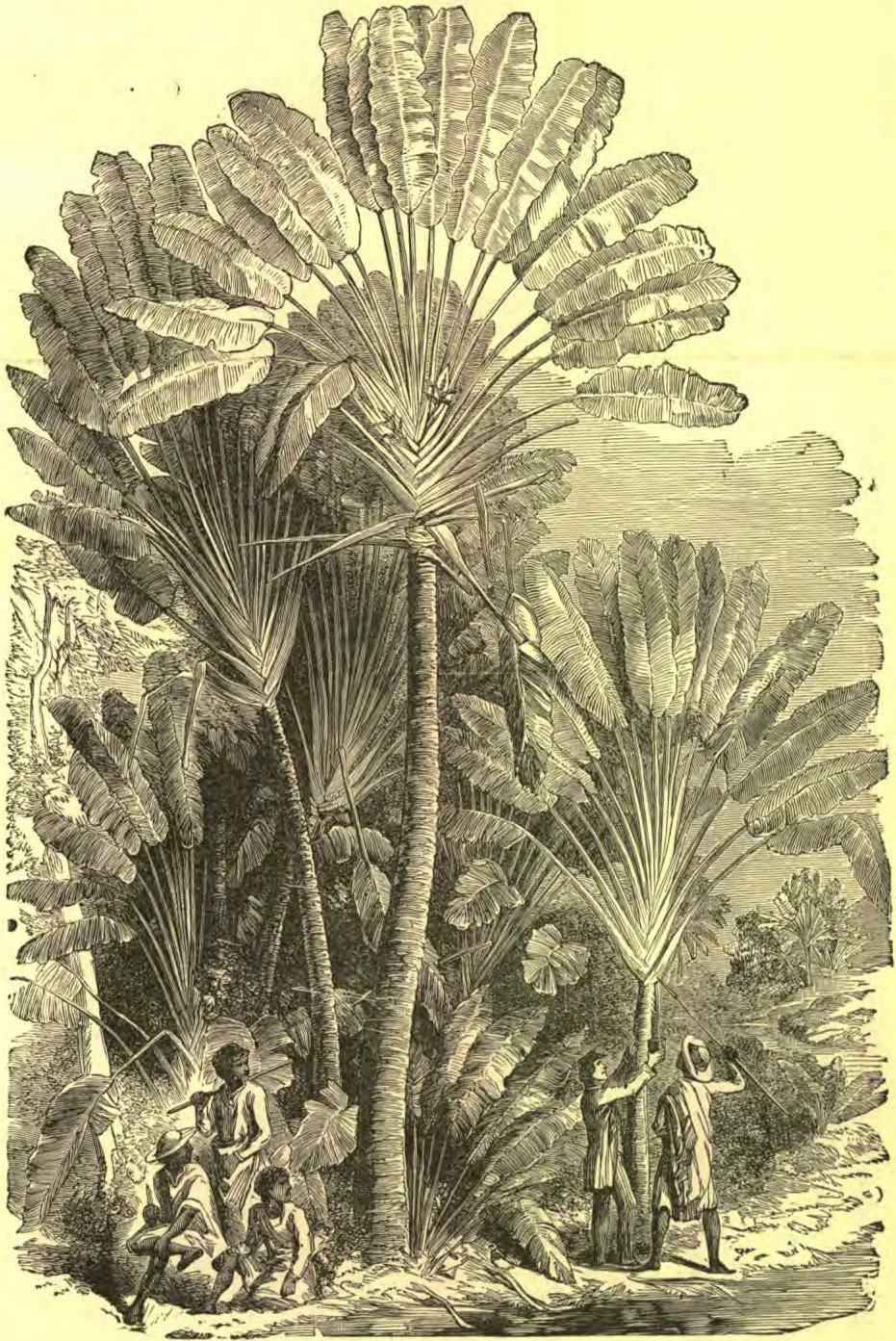
Among the plants peculiar to the island of Madagascar is the “traveler’s tree.” By looking at the picture, you will see that it is rather a curious looking tree. It does not resemble our maples, oaks, elms, or poplars in the least. It certainly is not an American tree.
The leaves of this tree are from six to eight feet long, and look as if they might be fastened on the top. The tree loves a dry and sandy soil, and grows most beautifully even in the dryest weather. Each leaf contains a quantity of pure, fresh water; and as it is very difficult for travelers to get water to drink in this dry region, these trees take the place of wells. At all seasons of the year, whenever a spear is stuck into the stalk of the leaf, and drawn out, a stream of water gushes out, affording a cool, sweet, and wholesome beverage. Its wood is often used in the construction of dwellings, and for many domestic purposes.
Our Creator has indeed arranged everything for the benefit of man, and has made everything of use.

THE TRUE COIN.

“And though I give all my goods to feed the poor, and have not charity, I am nothing.”
Two pilgrims came to a castle gate, A gate locked fast and barred; They paused aweary, for it was late, And their journey had been hard. Two pilgrims, I say, yet all unlike, For one with haughty mien And kingly step, paced up and down The little strip of green,—
The green that bordered the castle gate;— The other, meek and sweet, Leaned by a pillar, resting thus His tired and wounded feet; His soft eyes wandered o’er the fields He strove so hard to win; “And am I worthy,” he murmured low, “Worthy to enter in?”
The Warder came to the castle gate— The gate locked fast and barred; His look searched keenly the pilgrims through, And his voice was cold and hard: “Only the rich can enter here.” A struggling, hopeless sigh, And he that leaned by the castle gate Sank down as if to die.
“Here, Warder, is gold;” and the gold poured out, And rolled on the strip of grass; “Nothing is lacking; unbar the gate, Unlock it and let me pass.” The Warder stood on the other side. With measured speech and cold: “I spake of riches, yet said I Nothing to thee of gold.”
Then he that lay by the castle gate, As one lies who is dead, Felt the pulse of his heart revive, And he raised his languid head. Lo, the Warder was hard no more; His eye had the look of a dove. “Thou must be rich, but the coin,” he said, “In my master’s realm—is love.”
Then he that paced with the haughty step On the little strip of green, Gathered his gold, and went away, And never more was seen; And the gate flew open—so wide and far That a troop might freely pass— To him who lay with his wealth of love Fainting upon the grass.
—Mrs. M. F. Butts.

The Chinese in California: Opium and Gambling

THE CHINESE IN CALIFORNIA.—NO. 2.

One of the greatest vices to which the Chinese are addicted is the use of opium. In San Francisco, places are set apart for the sale and use of this drug. These are generally above the first floor, and are called “opium dens.” On the sides of these dens are arranged bunks upon which the customers recline. Any one wishing to use the drug, goes to the person in attendance, buys a pipe which has a long bamboo stem, selects his bunk, lights his opium at a small dingy lamp, and, before many whiffs are taken, finds himself in the land of dreams. Those who have tried it, say that the most beautiful thoughts pass through the mind when it is benumbed by this narcotic.
Many Americans are also becoming addicted to this habit. Especially is this true of the youth of San Francisco. At certain times during the day the dens are reserved chiefly for their use. It is stated upon good authority that smoking opium is worse than drinking liquor, for in the latter case there are hopes of reform, but in the former, reform is almost impossible. Sometimes the authorities take advantage of this weakness when they wish “John” to divulge some secret. Deprive him of his food, and the secret is still safe in his keeping; but take his opium away, and their object is gained.
Gambling is also one of their chief pastimes, and rooms are likewise set apart for this purpose. To reach these rooms, one is obliged to pass through heavy doors that can be bolted and barred in an instant. As the laws of San Francisco forbid gambling, when a game is in progress, a Chinaman sits by the street door to watch the police. When danger is near, this person gives a secret signal; in a moment the doors are securely fastened on the inside, and by the time the officers batter them down the birds have flown.
Chinamen seldom bring their wives to California. They leave their families at home expecting to return in a few years, after having acquired some property. Most of those that are brought, are bought and sold very much the same as negroes were in slavery days.
“John” usually converses in a very loud voice. To illustrate: Sometimes a number of them may be seen walking along the street in a single file, the last one carrying on a conversation with the leader. When talking with Americans they use the most simple language. They easily acquire a sufficient understanding of the English to make their thoughts known. If they wish to say that anything is like the American, it is expressed by “Alle same Melican man.” If they do not understand, they say, “Me no sabbee,” etc.
The “Celestials,” as the Chinese are sometimes called, observe no Sabbath at all; and they have but few holidays. Their chief holiday is their new year, which varies with the year, coming some time about the month of February. In their native country, a month is spent in celebrating it; but, as time is money in this country, only about one week is spent. The gambling houses, theaters, opium dens, and all such places, are in full operation during this time. As far as possible, all bills are paid, and little work is done. In short, it is a time of great rejoicing and merry-making among them. Fire-crackers and large explosives are used to make a loud noise, in order to frighten the devil away; and were such a thing possible, they would succeed.
The religion of the Chinese consists merely in ceremonies. In San Francisco they have several temples, or “Joss Houses,” containing the most hideous looking images, which they worship as gods.
Much more might be said in regard to this people, but space will not allow. Suffice it to say that there is a much stronger feeling existing against them than many suppose. Last May the State adopted a new constitution which disfranchises them, that is, deprives them of the rights of citizens. It was hoped by this act to persuade “John” to seek a more genial clime.
JOHN A. WALL.

BE HUMBLE.

Do not have too high an opinion of your own abilities. Humility is a rare and priceless virtue. Dr. Franklin once received a useful lesson from Dr. Cotton Mather which is thus related in a letter written by Franklin to the son of Dr. Mather:—
“The last time I saw your father was in 1724. On taking my leave he showed me a shorter way out of the house by a narrow passage which was crossed by a beam overhead. We were still talking as I withdrew, he accompanying me behind and I turning toward him, when he said hastily, ‘Stoop, stoop!’ I did not understand him till I felt my head hit against the beam. He was a man who never missed an opportunity of giving instruction, and upon this he said to me, ‘You are young, and have the world before you. Learn to stoop as you go through it, and you will avoid many hard thumps.’ This advice, thus beat into my head, has frequently been of use to me; and I often think of it when I see pride mortified, and misfortunes brought upon people by their carrying their heads too high.”
Humility is becoming, alike to old and young. At this time, especially, when children wish to be noticed and praised, those children who wish to be truly loved by God and men will be very modest in their opinions of themselves. God says that he resisteth the proud, but giveth grace to the humble; so if we wish the grace and favor of God, we shall seek to be truly humble and meek in spirit.
VESTA J. OLSEN.

BOOKS AS COMPANIONS.

THE books we read may be regarded as our companions. These are not always as carefully chosen as they should be. If it is true that we “are known by the company we keep,” we should feel as badly to be found in company with a book whose reputation is questionable, as if it were a person. “Be not deceived; evil communications corrupt good manners.” You cannot let a man whose life is corrupt, pour the thoughts of his heart into your mind, through his writings, without being injured by it. Be careful, then, in your selection; for books, says one; “are men on paper.” Keep the company of good books. GEO. B. STARR.

Charity Is Never Lost

CHARITY is never lost.

GREETING

Four years ago we laid down the editorial pen, never expecting to take it up again; but, in the providence of God, we once more assume an editorial position in connection with our beloved little paper.
Four years! and what a change in many things and in the INSTRUCTOR. Change is written on all things earthly.
The seasons and swift revolving years change old into new, and new into old. New friendships are made, new ties are formed, progress and decay march hand in hand, old landmarks are removed, new mile-stones are planted, and Old Father Time, waiting for nothing, continues his rapid flight, carrying with resistless force all in the current of life.
Twenty-seven years ago, when the INSTRUCTOR was first printed, it was but little larger than a sheet of note-paper, printed monthly, and its readers were numbered by hundreds; now it is enlarged, beautified by engravings, printed weekly, and numbers its readers by thousands.
A number of the first issue, one printed seven years ago when we first assumed the editorship, and the last number of the current volume, lie before us.
Many of the readers and contributors of the first mentioned are laid away to rest until the Lifegiver shall come; the rest are now heads of families, preachers, missionaries, teachers, editors, etc., filling responsible positions of honor and trust. Truly, Time’s footprints are discernible here.
To the many readers of our beautiful little paper the editors unite in sending greeting. Most earnestly we ask the former editors’ assistance, and that all former contributors will continue to write for the INSTRUCTOR, and that new ones be added to the list. Most sincerely we invoke God’s blessing upon our little paper, and his divine assistance in editing. V. A. M.

BIBLE LESSONS FOR YOUTH.

LESSON LXXV.—AHAB AND THE PROPHET ELIJAH.

  1. How long did the kingdom of Israel exist as a separate kingdom?
  2. How many successive kings ruled over this kingdom?
  3. What was the character of these kings?
  4. How did Ahab compare with the others?
  5. What was one of the chief causes of his extreme wickedness? 1 Kings 16:30-33.
  6. What did Ahab’s wife lead him to do?
  7. How long was rain withheld in the kingdom of Israel?
  8. By whose request was the rain withheld?
  9. What was the probable cause for Elijah’s making such a prayer?
  10. How did Elijah escape death at the hand of Ahab? Chap. 17.
  11. Why did Ahab wish to take his life?
  12. Where did Elijah remain during the first part of the time?
  13. Where did he conceal himself during the last part of the time?
  14. How was he sustained?
  15. What miracle did he perform upon the widow’s son?
  16. To whom did Elijah show himself at the end of the three and a half years? Chap. 18.
  17. What did he ask the king to do?
  18. Describe the course pursued by the prophets of Baal at this meeting on Mount Carmel.
  19. Tell what Elijah said and did.
  20. What decision did the people make?
  21. What was the fate of the prophets of Baal?
  22. What did Jezebel threaten, when she heard of this? Chap. 19.
  23. How did Elijah save himself?
  24. Describe the miracle in the wilderness.
  25. Describe Elijah’s vision at Mount Horeb.
  26. To whom had the Lord appeared at Horeb many years before? Ex. 3.
  27. By whom was Samaria besieged not long after this?
  28. How did Ahab try to prevent a battle?
  29. What did Ben-hadad demand?
  30. Who came to Ahab’s help in this time of distress?
  31. How were the Syrians beaten?
  32. What encouraged them to renew the war the next year?
  33. With what success did they meet in this second invasion?
  34. How should Ahab have been affected by these signal favors from God?
  35. What course did he pursue?
  36. How did he obtain possession of Naboth’s vineyard? Chap. 21.
  37. Whose counsel did he reject in regard to going out to battle against the Syrians? Chap. 22.
  38. How did he pay for this contempt of the prophet of God?

SYNOPSIS.

The kingdom of Israel existed as a separate kingdom about two hundred and fifty-four years. It was ruled by twenty successive kings, all idolaters, and bad men.
Of all these wicked kings, Ahab seems to have been the worst. His exceeding wickedness was caused, in great part, by his unwise marriage with Jezebel, daughter of Ethbaal, king of the Zidonians. She was a worshiper of Baal, and led Ahab not only to worship that god, but to build a temple for him in Samaria, and to set up his worship there.
It was probably to check the worship of this false god that, in answer to the prayer of Elijah, rain was withheld for three years and a half.
During this time, Elijah was obliged to hide himself, in order to escape the wrath of the king, who sought to slay him. He was at first miraculously fed at the brook Chereth, and afterward by a poor widow of Zarephath, whose son, having died, was raised to life in answer to the prophet’s prayer.
When the drouth had continued three and a half years, Elijah, instructed by the Lord, went to meet Ahab, and told him to gather all the people, and all the prophets of Baal, to Mount Carmel. It was here that the four hundred and fifty prophets of Baal cried all day to their god, without receiving an answer; but when Elijah, in a few simple words, called upon the Lord, fire descended from heaven, consumed the sacrifice, and licked up the twelve barrels of water that had been poured upon the altar. Then Elijah, after having slain the prophets of Baal, prayed for rain, which descended in great profusion.
Jezebel, on hearing how Baal’s prophets had fared, threatened to kill Elijah; who, to save his life, fled by the way of Beersheba to the wilderness, where he was fed by an angel. After going in the strength of that food forty days, he arrived at Mount Horeb, where he had a remarkable vision. In this vision the Lord told Elijah to go and anoint Elisha to be prophet in his room, Jehu to be king over Israel, and Hazael to be king in Syria.
Not long after this, Ben-hadad, king of Syria, raised a vast army and besieged Samaria, the capital of the kingdom of Israel. Ahab offered to surrender the city, and give up all his silver and gold; but Ben-hadad, not satisfied with this, wanted to degrade the Israelites to the last degree.
Then was Ahab in great distress, and God sent a prophet to tell him that he should be victorious over the Syrians. Ahab, following the instructions of the prophet, sent out to battle only two hundred and thirty-two men; yet the Syrians, being seized with a sudden panic, fled in great confusion.
The next year the Syrians came again to battle, supposing that the gods of the Hebrews were gods of the hills, and consequently, that if the battle were fought on the plain, victory would be more likely to turn in their favor; but they were again defeated, and returned to Syria at least one hundred and twenty-seven thousand fewer in number than when they left home.
Ahab must have known that his victories over the Syrians were due to the help of God, and this should have encouraged him to forsake his evil ways and turn to the Lord; but it had no such effect, for acts of wickedness mark his history to the very close. He took possession of Naboth’s vineyard, which Jezebel had obtained for him at the cost of the owner’s blood; refused the counsel of Elijah, and as a consequence was slain in a battle with the Syrians.

GENERAL S. S. ASSOCIATION.

At the sixth meeting of this Association, held Monday evening, Nov. 24, the following resolutions were adopted:—
Whereas, The success of the Sabbath-school at the gatherings of our people in Sabbath-school Conventions, State meetings, and camp-meetings, depends largely upon uniformity of lessons; therefore,
Resolved, That we urge the officers of the several Sabbath-school Associations, and the officers and teachers of our Sabbath-schools, to co-operate in securing such uniformity as far as practicable.
Whereas, There are many isolated families who are not connected with any Sabbath-school, and who do not have the benefit of S. S. instruction; therefore,
Resolved, That we earnestly recommend that all our ministers, S. S. officers and teachers do what they can to interest such families in the S. S. work, and to secure, as far as possible, the organization of family Sabbath-schools that shall report quarterly to their State Association.
It was then voted that W. E. Dawson, John Fulton, and Seymour Whitney, be a committee to prepare blanks for the use of isolated families and Sabbath-schools in reporting to the secretary of the State Association, also to make some suggestions, through the INSTRUCTOR, relative to the manner of sustaining such schools.
Whereas, The interest which has been awakened in the Sabbath-school work is due largely to the circulation of the Weekly INSTRUCTOR, which contains just the instruction and lessons that are adapted to the wants of our schools; therefore,
1. Resolved, That we earnestly recommend our Publishing Committee to provide for continuing the publication of such matter in the INSTRUCTOR.
2. Resolved, That we urge all our Sabbath-school workers everywhere to aid in maintaining and increasing its circulation, not only by forming clubs, but by securing individual subscriptions.
Meeting adjourned to call of Chair.
S. N. HASKELL, Pres.
C. W. STONE, Sec. pro. tem.

LESSONS FOR CHILDREN.

LESSON XLIX.—DAVID'S CHARGE TO SOLOMON.

When David became old, his son Adonijah thought to reign in his stead; but the Lord had said that Solomon should sit upon the throne of David. So Solomon's mother, and Nathan the prophet went in, and told David that Adonijah was trying to make himself king. Then David ordered that Solomon should be anointed king, and that the trumpet should be blown, and that the people should shout, “God save king Solomon.” So Solomon took the throne of his father David.
“Now the days of David drew nigh that he should die; and he charged Solomon his son, saying, I go the way of all the earth: be thou strong therefore, and show thyself a man; and keep the charge of the Lord thy God, to walk in his ways, to keep his statutes, and his commandments, and his judgments, and his testimonies, as it is written in the law of Moses, that thou mayest prosper in all that thou doest.”
David also charged Solomon to destroy Joab and Shimei, but to be kind to the sons of Barzillai, for Barzillai had brought food to David when he fled from Absalom.
“And Solomon loved the Lord, walking in the statutes of David his father.” And the king went to Gibeon to sacrifice there, and the Lord appeared to him in a dream by night, and said, “Ask what I shall give thee.” Then Solomon answered, “Give thy servant an understanding heart to judge thy people, that I may discern between good and bad; for who is able to judge this thy so great a people?” And the speech pleased the Lord, and he said to Solomon, “Because thou hast asked this thing, and hast not asked for thyself long life, neither hast asked riches for thyself, nor hast asked the life of thine enemies; but hast asked for thyself understanding to discern judgment; behold, I have done according to thy words: lo, I have given thee a wise and an understanding heart; so that there was none like thee before thee, neither after thee shall any arise like unto thee. And I have also given thee that which thou hast not asked, both riches, and honor; so that there shall not be any among the kings like unto thee all thy days. And if thou wilt walk in my ways, to keep my statutes and my commandments, as thy father David did walk, then I will lengthen thy days.”

QUESTIONS.

  1. When David became old, who tried to reign in his stead? 1 Kings 1:5-10.
  2. Who had been appointed by the Lord to sit on the throne of David?
  3. How did David find out what Adonijah was trying to do?
  4. What orders did David give?
  5. When the time drew nigh that David should die, what did he do? 1 Kings 2:1.
  6. In giving this charge, what did he say first? Repeat verse 2.
  7. What solemn admonition follows? Verse 3.
  8. What was to be the consequence of such strict obedience?
  9. What charge was given concerning Joab and Shimei?
  10. Why was Solomon to show kindness to the sons of Barzillai?
  11. What course did Solomon pursue? Chap. 3:3.
  12. Where did the Lord appear to Solomon in a dream by night?
  13. What did he tell Solomon to do?
  14. What did Solomon ask the Lord to give him? Verse 9.
  15. Why did he wish an understanding heart?
  16. How did the Lord regard Solomon's request?
  17. Did the Lord give Solomon what he desired? Verse 12.
  18. What more did he promise him? Verse 13.
  19. On what condition did he promise to lengthen his days? Verse 14.
  20. Why did the Lord give Solomon so much more than he asked? Verse 11.

Letter Budget.

We know you all felt sorry when you read in last week’s paper that your old friend, Mrs. Chapman, was not to have charge of your paper any longer. We were sorry, too, that she could not continue; but as she had so much other work to do, it seemed necessary to make the change. But she and Sister Davis have both promised that they will write to you as often as they can, and I am sure you will all join in asking them to do so soon.
M. K. W.
Summer Shade, Ky.
Dear Editors: I am thirteen years old. I take the weekly INSTRUCTOR, and like it very much. This is my first letter. I keep the Sabbath with pa and ma, and attend Sabbath-school every Sabbath. I was baptized April 27, 1878, by Eld. S. Osborn. Pray for me.
Matison Marshall.
Pleasant View, Tenn.
Dear Editors: I am a reader of the INSTRUCTOR. I go to Sabbath-school with father and mother, and try to be a good girl, to keep all of God’s commandments, that I may be saved with the rest of the INSTRUCTOR family when Jesus comes. I love God, and I think that he loves me. I pray for all my friends, that they may be found faithful. Will you pray for me. I am glad in my Saviour; he was good and kind to come to the earth to die for me. I thank God for his goodness.
Yours truly,
Mary M. Anderson.

DID HE TELL A LIE?

HOW could he have told a lie when he did not speak a word? Let me tell you what I saw him do. The teacher’s back was turned. He reached over and struck his neighbor with a pin. The teacher heard a shuffling noise and looked round. He was not out of order at all, but was studying the map of Africa very hard. Did he tell a lie?
Sister Susie lost her doll one day. She hunted high and low, but dolly could nowhere be found. He helped her hunt, and seemed as sad as she because of dolly’s loss. He had hidden that doll in an old stove-pipe up in the lumber-room. Did he tell a lie?
Uncle Joe and Aunt Mary had come to take dinner at his home. All were ready to enjoy the nice dinner, when to the great surprise and sorrow of his good mother, they found that the meat and potatoes had been sweetened, and the coffee and pudding salted. Who could be blamed but Bridget? He had that very morning carelessly emptied the sack of salt into the sugar-bucket. He saw the look of disappointment on his mother’s face, but did not explain. Did he tell a lie?
One morning Bridget rushed into the room, saying, “Sure, an’ John, the errand boy has left the gate open, an’ the cows have ate up all the garden.” He was spinning his top at the time. He heard it all, and knew very well that he had left that gate open when he came in, after trading two marbles for a top-string with Bob Summers; but he didn’t say a word. Did he tell a lie?
One night father said to mother, “I suppose the shavings were not put too near the stove, and the fire is all out, and everything is safe.” He knew the shavings were very near the hearth; he knew, too, that the fire was burning brightly when he locked the kitchen door, but he pretended to be fast asleep. That night their beautiful home was burned to the ground. Did he tell a lie?—Baptist Weekly.

TIME ENOUGH.

Two little squirrels, out in the sun, One gathered nuts, the other had none. “Time enough yet,” his constant refrain, “Summer is still only just on the wane.”
Listen, my child, while I tell you his fate; He roused him at last, but he roused him too late; Down fell the snow from the pitiless cloud, And gave little squirrel a spotless white shroud.
Two little boys in a school-room were placed; One always perfect, the other disgraced. “Time enough yet for my learning,” he said, “I will climb, by and by, from the foot to the head.”
Listen, my darling; their locks have turned gray; One as a governor is sitting to-day; The other a pauper, looks out at the door Of the alms-house, and idles his days as of yore.
Two kinds of people, we meet every day; One is at work, the other at play. Living uncared for, dying unknown— The busiest hive that ever a drone.
Tell me, my child, if the squirrels have taught The lesson I long to impart to your thought; Answer me this, and my story is done, Which of the two would you be, little one?

HOLIDAY GIFTS, AND HOW TO OBTAIN THEM.

Christmas is coming, and everybody is selecting presents for their friends; and while with many the problem is what to select, with many others, and especially the younger people, it may be how to pay for presents.
To the former we would suggest that there is nothing more useful or acceptable than a good book, and you will nowhere find better ones than those offered in last week’s INSTRUCTOR. To those who have not money to spare for as many gifts as they would like, we propose the following easy way to earn them.
If you will send us six new subscribers for the INSTRUCTOR, we will give you a beautiful little book; for ten subscribers, a larger book; and for fifteen subscribers, a book worth $1.25. See Prize List below.
Sabbath-school scholars may club together and earn maps and books for their schools. Hundreds of Sabbath-schools think the INSTRUCTOR the best and cheapest juvenile paper in the land, and by past experience we know there are thousands of families where it would be cordially received and readily subscribed for if introduced by some one of its youthful readers.
The increasing patronage this little paper has received leads the publishers to put forth additional efforts to make it the best; and the hearty response from the children last year to our call for agents, leads us to make them more liberal offers than ever before.

PUBLISHERS’ OFFER FOR 1880.

There will be two editions of the YOUTH’S INSTRUCTOR for 1880:— 1. The Monthly Edition, 8 pages. Price, 50 cents. 2. The Weekly Edition (with Sabbath-school Department), 4 pages. Price, 75 cts.
The “Child’s Poems” will be given as a premium to each new subscriber for either edition at the above prices. Those who have taken either edition and change to the other, are not new subscribers.

LIST OF PRIZES.

If you will send us six new subscribers for the INSTRUCTOR, Monthly or Weekly, or both, we will send you your choice of Sunshine Series for Little Ones, Song Anchor, or one of the three volumes of Golden Grains: Vol. 1, The Hard Way; Vol. 2, The School-Boy’s Dinner; Vol. 3, Grumbling Tommy.
For ten new subscribers, your choice of Vols. 1, 2, or 3, of Sabbath Readings; or the Game of Life.
For fifteen new subscribers, your choice of The Life of Captain Joseph Bates, Thrilling Life Sketches, or the Bible Atlas and Gazetteer.
For twenty new subscribers, your choice of No. 7 Old Testament Map of Palestine, or No. 9 New Testament Map of Palestine, size 42x28 inches, or Cruden’s Concordance, the Bible Dictionary, or Bound Volume of Weekly INSTRUCTOR for 1879.
For thirty new subscribers, your choice between one of the Double Sheet Maps of Palestine, size 58x41 inches; No. 6 Old Testament Palestine; No. 8 New Testament Palestine, or the “Bird’s Eye View of Palestine,” a beautiful chart of the Holy Land.
For fifty new subscribers, your choice of a Nonpareil Oxford Teacher’s Bible, with Index, Concordance, and Maps (an entirely new edition), size, 4½x7x1¾ inches; or Cloth Map No. 5, the Peninsula of Mt. Sinai, illustrating the wanderings of the Israelites in their journey from Egypt to Canaan.
Do not confound the Prizes with the Premiums. The prizes are given to the canvasser; the premium is given to each new subscriber.
Those living near Tract and Missionary Societies may obtain their premiums of them, and should do the business with the Office through the T. and M. officers. Those dealing directly with us must inclose the money with the subscriptions. All sums should be sent by P. O. money order or in registered letter.
If you will try this work, apply at once to the officers of your T. and M. Society for sample copies of the INSTRUCTOR and a premium book to canvass with. If you cannot procure these of the T. and M. officers, we will mail you a complete Canvasser’s Outfit, for 40 cents.
To those who were agents last year, and who have the premium, we will send the sample copies and instructions how to canvass free on application. PUBLISHERS.

You have reached the end of this edition.

The Youth’s Instructor · Dec 10, 1879