The Youth’s Instructor, Vol. 33, No. 38.

IN SEPTEMBER

The Youth’s Instructor

Oct 7, 1885

S. D. A. Publishing Association · Battle Creek, Mich. · Oct 7, 1885

IN SEPTEMBER.

MORNINGS frosty grow, and cold, Brown the grass on hill and wold; Crows are cawing sharp and clear Where the rustling corn grows sear; Mustering flocks of blackbirds call; Here and there a few leaves fall; In the meadows larks sing sweet, Chirps the cricket at our feet,— In September.
Noons are sunny, warm, and still; A golden haze o’erhangs the hill; Amber sunshine’s on the floor Just within the open door; Still the crickets call and creak,— Never found, though long we seek,— Oft comes faint report of gun; Busy flies buzz in the sun,— In September.
—September St. Nicholas.

THE BATTLE OF THE LORD.

ISRAEL was troubled and sore afraid; for their bitter enemies, the lawless Midianites, had entered the land. With their flocks, and herds, and tents they had come, “as grasshoppers for multitude,” and had entered into the land to destroy it. They pitched in the beautiful valley of Jezreel, an offshoot of the great plain of Esdraelon; and the shadows of the valley grew dark with the black tents of the oppressor.
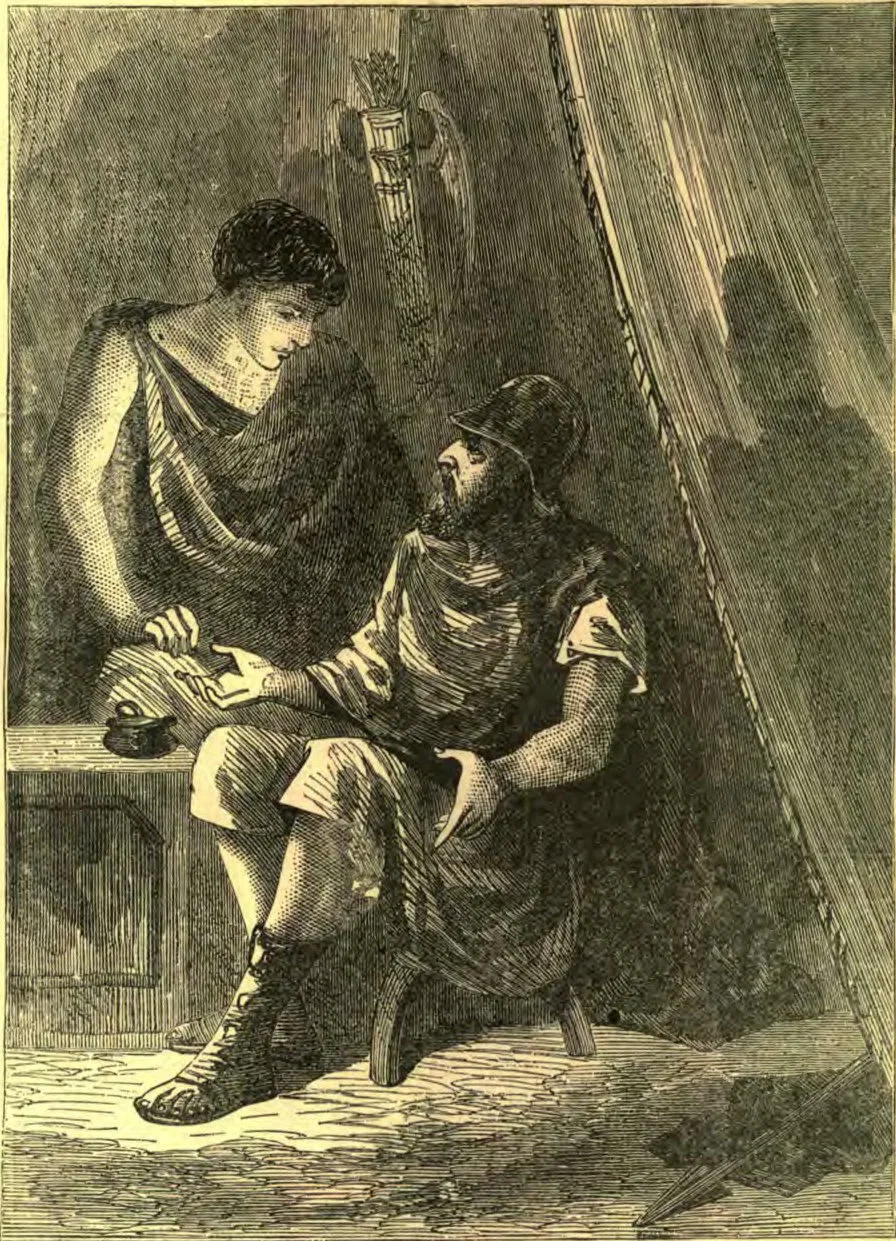
Night approached, and the twilight shadows fell over the land. In and out among the tents of the Midianites, two figures were slowly and noiselessly threading their way. On every side lay the unconscious Midianites, wrapped in slumber. Hark! what is this they hear? Voices break the stillness, and they pause to listen. Within the tent, by the bright light of the moon, one Midianite sits talking to his fellow who stands by, and telling a strange dream that has troubled him. “I dreamed a dream,” said he, “and lo, a cake of barley bread tumbled into the host of Midian, and came unto a tent, and smote it that it fell and overturned it, that the tent lay along.” Amazement and terror overspread the face of his fellow as he listened to the dream. “This is nothing else,” replied he, “than the sword of Gideon, the son of Joash, a man of Israel; for into his hand hath God delivered Midian and all his host.”
Then Gideon, and his servant, the listeners outside the tent, hastened to their own camp. Calling together his picked three hundred, and placing in their hands trumpets, and pitchers containing lighted lamps, Gideon marches down upon the enemy. Only three hundred unarmed men against the thousands upon thousands of Midianites! But they are strong in faith and the power of God. Silently dispersing, and stationing themselves by companies on all sides of the camp, they wait in breathless silence for the signal. Suddenly a shrill trumpet blast rings out on the still air. At the sound, the three hundred lift their trumpets, and wake the echoes of the hills, and three hundred voices shout, “The sword of the Lord, and Gideon!” The startled Midianites spring forth from their tents; they hear the breaking of the pitchers, and it sounds to them like clashing arms; the lighted lamps flash before their eyes, seemingly surrounding them on all sides. In their alarm they think a vast army is upon them. Terror fills the heart of every Midianite, and despair blanches their faces. Mistaking friends for enemies, they fall upon one another, and the slaughter becomes appalling. All is now confusion, and soon the vast army flees as if pursued by a mighty host.
The sword of the Lord did effective service for his oppressed people, and turned their mourning to rejoicing. When all hope of human help seemed gone, then the Lord manifested his power, that they might know that he, and he alone, had given them the victory.
We, too, have battles to fight; not such ones as they fought, but battles against sin and error and our own evil inclinations. Not by might nor by power can these victories be gained, but by the help of the Lord. How prone we are to forget him, and trust to our own strength; and what sad failures we make when we do so! He always stands ready to give us his help whenever we comply with the conditions marked out for us. “Let us therefore come boldly unto the throne of grace, that we may obtain mercy, and find grace to help in time of need.”
W. E. L.

THE LADY TEST.

“I WOULD rather be seen out with Helen Coy than any girl in school,” said Flaxie Hoffman complacently, as she stood in front of her mother, having the sash of her dress pinned.
“Why?” asked her mother, quietly,—very quietly,—for she did not like Flaxie’s thinking or caring about “being seen” with Helen Coy or anybody else.
“Oh, I don’t know, mother. She is such a thorough lady,” said Flaxie.
“More so than the other girls?” questioned Mrs. Hoffman, who for some reason had doubts of Helen’s superior ladyhood. “What are the signs of it?”
But the sash-pinning being accomplished, Flaxie hastily gave her mother a light kiss and flitted off to join this much-admired friend in an evening walk. She was not sorry to avoid the necessity of answering her mother’s last question, though she tried to answer it to herself as she approached the fine brown-stone front where Helen lived.
“I could not make mother understand what I meant,” she said to herself, as the impression of faultless gloves and shoes, well-attuned colors, pinked and polished nails, dainty appointments of every sort came back upon her in connection with Helen. But here was the stylish black man at the door, holding out a tiny silver waiter for her card.
Flaxie’s pleasant walk was somewhat marred by an unexpected encounter. As she and Helen strolled through the shady avenues of Druid Hill Park, a voice from one of the benches called out: “Flaxie—Flaxie Hoffman! come here a minute.” Flaxie turned in surprise, and saw Mrs. Winston, a young neighbor of theirs, sitting on one of the rustic seats, holding on her lap a pale, sick-looking baby. Mrs. Winston was a sweet woman, and Flaxie was very fond of her. She turned at once and went up to her side, leaving Helen swinging her lace parasol on the avenue.
“Flaxie, dear,” said Mrs. Winston, “I hated to interrupt you, but I am in so much distress that I knew you would forgive it. Mr. Winston brought me and the children out for a little fresh air, this afternoon, and left us here while he went back to attend to some business that could not be put off. While baby Jean slept on my knee, I actually dozed off (you know I have lost so much rest with her), and when I opened my eyes, Willy was nowhere to be seen. I feel so alarmed lest he should have gone to the lake. Would you mind sitting here and holding baby a minute, while I run after him?”
Flaxie’s kind heart was at once engaged. She did mind a good deal having her stylish friend kept waiting while she nursed Mrs. Winston’s fretful little baby; but she was too true to her conscience and sense of right not to respond cordially. “Certainly, I will hold Jean, or look for Willy—whichever will help you most.”
“Thank you, my dear, good child,” said Mrs. Winston; “I think I had better look for Willy—he might be troublesome about coming back for you,” and the young mother’s anxiety gave wings to her feet; in an instant she was out of sight. Miss Helen Coy then approached her friend in wide-eyed amazement. Now Helen considered herself extremely well-bred, and one of her rules was always to speak quietly—no matter what happened, never to get excited. But in this instance she found it hard to be quiet, because she was very angry with Flaxie.
“Well, really,” she began, in a tone that was almost loud, and then she stopped and bit her lip.
“I am ever so sorry, Helen,” said poor, embarrassed Flaxie, “to have you inconvenienced; but you see I could not help it. Mrs. Winston was in so much trouble, it would have been cruel in me not to do anything I could for her.”
“I wonder you allow such impertinence,” said Helen, coldly.
Flaxie’s cheeks began to flush a different red now, for much as she admired Helen, she was a loyal little girl to all her friends, and she felt that she must resent Helen’s contempt of Mrs. Winston.
But just then Helen spied acquaintances in a carriage which was nearing them, and hastily left Flaxie, saying as she sped away, “Please don’t involve me in this nursing of town-babies.” She sat down at some distance from the little nurse in charge, but the people in the carriage did not seem to observe her; and Flaxie, angry now, and hurt to the quick, devoted herself to the poor little baby, and tried to soothe its fretfulness. Mrs. Winston soon came back, relieved and happy, having found the little truant in his returning father’s charge.
“You were an angel of mercy to me, Flaxie,” she said, giving the young girl a tender kiss.
“I’m afraid wee Jean hasn’t such a good account to give of me,” she said, smiling merrily; “she didn’t approve of the change of nurses at all.”
As Flaxie went off to join Helen, Mr. and Mrs. Winston observed the distance at which that young lady had kept herself, and her clouded expression; they did not have to see through a millstone to divine how matters stood.
When the Hoffmans gathered around the tea-table that night, Mr. Hoffman said rather abruptly: “Well, Flaxie, I don’t know your friend, Miss Helen Coy, but you’ve got one thorough lady in your school, to my knowledge.”
“Who, sir?” asked his daughter, wonderingly; and then Mr. Hoffman told them that he had been riding in a full street-car that evening, so full that every gentleman was standing, when a very poor, very dirty woman got in, carrying a baby. “She looked tired,” said Mr. Hoffman, “but there seemed no chance of a seat, when a sweet-looking girl, whom I recognized as Mary Robb, got up quietly and put the woman in her seat. What pleased me particularly was that she made no fuss over it, but looked perfectly unconscious of having done a kind deed.”
“I know another high-school girl that stood the lady test this evening,” said the mother’s voice with a little tremor in it. (Flaxie did not dream that her mother had seen Mrs. Winston before dark.) Then came the Druid Hill Park story, without the names; but either Flaxie’s blushes or the mother’s shining eyes betrayed the little girl, and she had to submit to several fatherly and big-brotherly kisses; and at evening prayers Aunt Jane said,—and everybody felt why,—“Let’s sing ‘God make my life a little song.’” —The Well-Spring.

IN THE TROPICS.

Once more our good ship is plowing her way through the ocean; this time in a southerly direction, and toward a smoother sea. Each day after leaving Honolulu the weather grew steadily warmer, until all on board were glad to exchange their heavy clothing for that which was better adapted to the locality. Those were dreamy days; very little air stirring at times, and too warm even to think much. Some, however, did attempt to read, under the great awning that covered the promenade deck; while others, stretched upon reclining chairs, lazily watched the sea-birds as they circled about the ship. We met no vessels of any description between Honolulu and the Samoan Islands. Nothing was visible but the great circle of the horizon around us, and across it that long diameter of foam, that indicated the direction from which our ship had come.
As we advanced, flying fish became quite numerous, and it was interesting to watch the little creatures shoot out of the water, at the approach of our stately ship. Sometimes they would rise in shoals, and seemed to vie with each other in flying the longest distance before sinking again beneath the wave. Its flight, at times, resembles that of a quail, short and rapid; at others, it rises and falls in wave-like motion as it flies; then it will go straight as an arrow, on and on, until the eye can follow it no longer. An unfortunate one, in its flight, alighted on the deck one evening, and I had opportunity to examine the specimen. It was about eight inches long, in shape and color somewhat resembling a smelt. Its wings were no more in appearance than the ordinary fins which are just back of the gills, grown to nearly the length of a sparrow’s wing. So far as I could see, it differed in no other respect from other species of the finny tribe.
The sight of a tropical sunset is one long to be remembered. As we neared the equator, they were indeed gorgeous. No pen can well describe their beauty. One evening especially, some of our company watched the sun as it dropped behind the waves, when there seemed to arise in the far, far distance, a golden forest which appeared to tremble in the beautiful tints that touched its edges. To the south lay many clouds, which, lighted up with the glow of the departing sun, looked like clusters of bright islands rearing their forms out of the sea. Between us and the horizon the light shone aslant the clear, calm water, causing it to reflect, in a most delightful way, the colors of the purple heavens. But this richest of sights was not long continued; for in a few moments the beautiful tints had faded, and the twinkling stars were looking down upon the vast expanse clothed in the darkness of night.
The transition from daylight to darkness is very sudden in the tropics. The sun does not linger to tinge his retreating footsteps with a gentle twilight as in the more northern climes, but as soon as he reaches the horizon, his departure seems hurried, and the deep shadows of night follow immediately. The stars of the southern hemisphere shine quite clearly, however, and though at first one misses the familiar clusters that he has been accustomed to gaze upon, he finds comfort in the thought that the same God rules the lights of every clime, and has adapted them to the wants of those for whom they shine.
The north star, with its revolving dipper, gradually came nearer the horizon as we journeyed southward, until it entirely disappeared. As this constellation fixes the points of the compass for benighted travelers in northern latitudes, so the Southern Cross serves to guide the wayfarer of the southern hemisphere to his appointed haven. This group consists of four stars in the form of a cross, one of which is much inferior in brilliancy to all the others, and therefore detracts largely from the beauty of the group.
The distance from Honolulu to Tutuila, one of the Samoan group of islands, is nearly two thousand and three hundred miles, which our ship was eight days in traversing. A small sloop had been cruising about for two days near the spot we were expected to pass, awaiting our arrival. Just before daybreak we came up with her, when a little boat came alongside our steamer, bringing four passengers from the islands. After delivering up the Samoan mails and a single passenger, we were very soon on our way again toward Auckland. Although we did not have opportunity to visit the Samoan Islands, I learned some very interesting things about them, a few of which I will tell you in my next article. J. O. COLLISS.

A SHAGGY NEWSBOY.

The railroad ran along one side of a beautiful valley in the central part of the great State of New York.
I stood at the rear end of the train, looking out of the door, when the engineer gave two short, sharp blasts of the steam whistle. The conductor, who had been reading a newspaper in a seat near me, arose, and touching my shoulder, asked if I wanted to see a “real country newsboy.” I, of course, answered, “Yes.” So we stepped out on the platform of the car.
The conductor had folded up his paper in a tight roll, which he held in his right hand, while he stood on the lower step of the car, holding on by his left.
I saw him begin to wave the paper just as we swung around a curve in the track, and a neat farm-house came into view, way off across some open fields.
Suddenly the conductor flung the paper off toward the fence by the side of the railroad; and I saw a black, shaggy form leap quite over the fence from the meadow beyond it, and alight just where the newspaper, after bouncing along in the grass, had fallen beside a tall mullein stalk in an angle of the fence.
It was a big black dog. He stood beside the paper, wagging his tail, and watching us as the train moved swiftly away from him. Then he snatched the paper from the ground in his teeth, and leaping over the fence again, away he went across the fields toward the farm-house.
When we last saw him, he was a mere black speck moving over the meadows, and then the train rushed through a deep cleft in the hillside, and the whole scene passed from our view.
“What will he do with the paper?” I asked of the tall young conductor at my side.
“Carry it to the folks at the house,” he answered.
“Is that your home?” I inquired.
“Yes,” he responded; “my father lives there, and I send him an afternoon paper by Carlo every day, in the way you have seen.”
“Then they always send the dog when it is time for your train to pass?”
“No,” said he, “they never send him. He knows when it is time for the train, and comes over here to meet it of his own accord, rain or shine, summer or winter.”
“But does not Carlo go to the wrong train sometimes?” I asked, with considerable curiosity.
“Never, sir! He pays no attention to any train but this.”
“How can a dog tell what time it is, so as to know when to go to meet the train?” I asked again.
“That is more than I can tell,” answered the conductor; “but he is always there, and the engineer whistles to call my attention, for fear I should not get out on the platform till we had passed Carlo.”
“So Carlo keeps watch of the time better than the conductor himself,” I remarked, “for the dog does not need to be reminded.”
The conductor laughed, and I wondered, as he walked away, who of my young friends, of whom I have a great many, would be as faithful and watchful all the year round as Carlo, who never missed the train, though he could not “tell time by the clock.”—Golden Days.

GOOD-BY

GOOD-BY! come again, sweet summer weather; Happy times we have had, summer, together. Bugs, bees, and butterflies, robins and roses, Woods full of shady paths, bright with wild posies; Good-by; come again; gladly we'll greet you; A year older I shall be when next I meet you.
Good-by, little brook, sparkling through the meadow; Happy times we have had in the elm-tree's shadow. You were always wide awake, always bright and cheery. Don't forget your pretty song in the winter dreary. Good-by, summer clouds; be sure I shall remember Your airy, fairy beauty when the sky scowls in December.
Good-by; come again, leaves now red and yellow; In your place we'll gather fruit, spicy, ripe, and mellow. Good-by, golden-rod, fern, and purple aster; Now the winter has begun, fast it comes and faster. Good-by, summer flowers, sleep while the snow is falling; By-and-by the spring will come, calling, calling, calling.
—The Child's Paper.

THE SECRET OF GOOD MANNERS.

The secret of good manners is to forget one's own self altogether. The people of really fine breeding are the ones who never think of themselves, but only of the pleasure they can give to others. No adornment of beauty, or learning, or accomplishments, goes so far in its power to attract as the one gift of sympathy.
In all French history no woman had a stronger fascination for whoever came within her reach than Madame Récamier. She was called beautiful; but her portraits prove that her beauty was not to be compared with that of many less charming women. And when every attraction of person had long since passed away, and she was an old, old woman, her sway over the hearts of others was as powerful as ever. What was her secret?
It was this one thing solely—her genuine and unaffected interest in the good and ill fortunes of her friends. Authors came to her and read her their books; painters came to her with their pictures; statesmen with their projects. She, herself, wrote no books, painted no pictures, had no projects. She was sweet, simply and unconsciously, as a rose is sweet. She really cared for the happiness and success of others, and they felt the genuineness of her sympathy. It surrounded her with an immortal charm.
Let any girl try Madame Récamier's experiment. Let her go into society thinking nothing of the admiration she may win, but everything of the happiness she can confer. It matters little whether her face is beautiful or her toilet costly. Before the end of three months she will be a happy girl herself; for the world likes sunshine and sympathy, and turns to them as the flowers bask in the sun of June.
—Youth's Companion.

A LITTLE MOURNER.

WORDSWORTH writes of a little babe that had—
“caught the trick of grief, And sighed among its playthings.”
The reality of a sorrow does not depend upon the size of the affliction that makes it. Children mourning over their dead pets weep with as deep and serious grief as older persons at the loss of fortune or friends. Touching little scenes like the following excite slight heed in the great city, but they are worth our sympathy and remembrance:—
A common-looking dog, dead in a gutter, is a repulsive object. Past such a one people were hurrying, when a small boy, thinly clad and hobbling on a crutch, calls:— “Here, Bowser!” and then taking in the situation, dropped his crutch, and kneeling by the dead dog, cried as if his heart were broken.
“O Bowser! is you dead, and can't go home with me?”
It took but a moment to change the expression on faces from one of contempt to that of pity and sympathy. The boy was but a poor waif, but he knelt by the side of his best-loved earthly friend, and he was dead. Merchants and well-dressed ladies stopped with kind words and expressions of sympathy for the little mourner.
One gentleman, appreciating the grief of the boy, called an expressman and told him to take the boy and his dead pet to his home, or to some place where he could be buried, as the boy might direct, and call upon him for the pay.
The burying of a dog is not much, but the binding up of the wounds in the heart of that poor boy on his crutch was an act worthy of permanent record. — Chicago Inter-Ocean.

HE WASN'T ASHAMED.

A CLERK and his country father entered a restaurant Saturday evening, and took seats at a table where sat a telegraph operator and a reporter. The old man bowed his head, and was about to say grace, when a waiter flew up singing, “I have beefsteak, codfish balls, and bull-heads.” Father and son gave their orders, and the former again bowed his head. The young man turned the color of a blood-red beet, and touching his father's arm, exclaimed in a low, nervous tone:—
“Father, it isn't customary to do that in restaurants!”
“It's customary with me to return thanks to God wherever I am,” said the old man.
For the third time he bowed his head, and his son bowed his head, and the telegraph operator paused in the act of carving his beefsteak and bowed his head, and the journalist pushed back his fish ball and bowed his head, and there wasn't a man who heard the short and simple prayer that didn't feel a profounder respect for the old farmer than if he had been President of the United States.—Selected.

Zeal Without Knowledge: Why Belief Matters

PAUL, before his conversion, was zealous enough; but not according to knowledge. It does matter what we believe, and in which way we go.

IMPORTANT BIBLE SUBJECTS.

LESSON 5.—THE FOUR KINGDOMS OF DANIEL VII.

[NOTE TO THE STUDENT.—Do not consider the lesson learned until you can give at least the substance of every text, with the correct reference for each. The references in black letters indicate those texts that should be committed to memory. A little diligent application each day will enable you to do this.]
1. Of what does the seventh chapter of Daniel treat? Verse 1.
2. When was this revelation made? Ibid.
3. Who was king Belshazzar? (See note.)
4. What great commotion of the elements was shown to Daniel? Verse 2.
5. As the result of this strife, what came up out of the sea? Verse 3.
6. In prophecy, what do waters or seas denote? (See note.)
7. What is denoted by winds in commotion? (See note.)
8. In the interpretation of this vision, what were these four beasts said to represent? Verse 17.
9. Did these four beasts represent literal rulers, or the kingdoms which they governed?
10. Where else have we found the four great universal empires described in prophecy? Dan. 2:38–40.
11. Describe the first beast of Daniel 7. Verse 4, first part.
12. What change took place in this beast? Verse 4, last part.
13. Describe the second beast. Verse 5, first part.
14. What did this beast have in its mouth? Verse 5.
15. What was said to it? Ibid.
16. Describe the third beast. Verse 6.
17. Describe the fourth beast. Verse 7.
18. What change took place in this beast? Verse 8.
19. What did the ten horns of this beast denote? Verse 24. See note.
20. By what was this division of the fourth kingdom symbolized in the second chapter? Dan. 2:42.
21. What peculiarity is given of the little horn which came up last? Dan. 7:20.
22. What work of persecution and blasphemy was this horn to accomplish? Verse 25.

NOTES.

Belshazzar.—Three rulers came to the throne of Babylon between the death of Nebuchadnezzar and the ascension to the throne of Belshazzar, the grandson of Nebuchadnezzar. While Belshazzar succeeded to the rule of the great empire which had been governed by his grandfather, it seems that he inherited none of his good qualities. He was weak and pusillanimous, and did nothing to build up his kingdom or protect it from his foes. He relied simply on the impregnable nature of the walls of his city, and gave himself over to the luxury and debauchery of his court, and was there slain when the city was overthrown by Cyrus.
Four winds . . . strove upon the great sea.—All Scripture language is to be taken literally, unless there exists some good reason for supposing it to be figurative; and all that is figurative is to be interpreted by that which is literal. . . . Winds, in symbolic language, denote strife, political commotion, and war. Jer. 25:31, 32, 33: “Thus saith the Lord of hosts, Behold, evil shall go forth from nation to nation, and a great whirlwind shall be raised up from the coasts of the earth. And the slain of the Lord shall be at that day from one end of the earth even unto the other end of the earth.” Here the prophet speaks of a controversy which the Lord is said to have with all nations, when the wicked shall be given to the sword, and the slain of the Lord shall be from one end of the earth to the other; and the strife and commotion which produce all this destruction is called a great whirlwind.
That winds denote strife and war is further evident from a consideration of the vision itself; for as the result of the striving of the winds, kingdoms arise and fall, and these events are accomplished through political strife.
The Bible definition of seas, or waters, when used as a symbol, is peoples, and nations, and tongues. In proof of this, see Rev. 17:15.—Thoughts on Daniel and the Revelation.
The ten horns are ten kings.—As we proceed farther, it will be seen that the fourth universal empire is none other than the Roman; and the ten kingdoms as represented by the ten toes of chapter 2 and the ten horns of chapter 7, represent the division of this empire, which took place between the years 356 and 483, as follows: The Huns, A. D. 356; the Ostrogoths, 377; the Visigoths, 378; the Franks, 407; the Vandals, 407; the Suevi, 407; the Burgundians, 407; the Heruli, 470; the Anglo-Saxons, 476; and the Lombards, 483.

THE WALL-STREET SUB-TREASURY.

Would you like to know where the United States’ Government deposits some of its wealth, a writer in Treasure-Trove says:—
“The Government of the United States does its principal banking business at the New York Sub-Treasury, an old granite building at the north-east corner of Wall and Nassau streets. There was in this building, on the first day of the present year, a cash balance of exactly $141,284,038.88, and there has been since a still larger stock of gold, silver, and paper money on hand; and no building in the country is better adapted to the safe-keeping of this wealth. Up to the year 1863, it served as a custom-house, and since its conversion into a government treasury, has been transformed by skillful army engineers into a veritable fortress for the protection of the nation’s money.”
“Iron railings divide the main building under the rotunda into two parts, leaving the broad space between for visitors. Back of the left-hand railing are the officials who pay out Uncle Sam’s enormous revenues. On the other side are the officials whose duty it is to receive the car-loads of money which the government from all sources daily receives. All the receipts from the New York Custom-House, the New York Post-office, internal revenue offices all over the Eastern, Middle, and Atlantic States, together with about twelve hundred of the principal post-offices and custom-houses of the country, turn their cash receipts in here; and there is paid out from this branch treasury millions of dollars in pensions, for interest on bonds, and for the salaries of government officers—civil, military, and naval. In the rear portion of the building is the coin department. Here all coin received is counted, weighed, and put up in canvas bags for deposit in the vaults. The first division deals only with silver dollars and gold coin; in the second division smaller pieces of silver are carefully handled. From Texas in the South to Minnesota in the North, great packages of silver dollars arrive daily by express, for which is given in interchange silver certificates. In the offices on the right of the hallway, coin in small amounts is received, and certificates are exchanged.”
“The ‘silver vault,’ which is under the coin department, is fifty feet long, thirty feet wide, and twelve feet high. The passage-way, gained only by the opening of the tremendous steel door, leads through the vault, with twelve cells, having grated iron doors opening from it on either side. There are $35,000,000 in silver stored in this vault, the weight of which is a thousand tons. The money is put up in cotton duck bags containing $1,000 each. The gold vaults are on the floor above. Their floors consist of tempered steel, and rest upon thirty feet of solid masonry; their walls and roofs are composed of two sets of steel plates, three-eighths of an inch thick. Between these inner and outer steel walls is a space of four inches, which is filled up with round iron balls. A burglar, even though he should have abundant time for operations, would, on driving his drill through the outer steel wall, encounter a spherical mass of iron, which, when pierced, would make room for innumerable other iron balls. Each of these gold vaults is provided with 120 iron chests set into the walls. One hundred and five of these chests have a storehouse capacity each for $500,000 in gold, fifteen of them being able to accommodate $1,000,000 in gold each. A little vault on the main floor is devoted to the safe-keeping of pennies. These much-abused coins are as carefully wrapped up as their golden and silvery cousins, and there is to-day $30,000 worth of them in this repository.”
“Above the coin department is the coupon department, and also a room full of busy clerks, wherein all the accounts of the disbursing officers of the Government are written up and balanced. Such is the system maintained that it is said the official in charge in thirty seconds can lay his hand on any draft, check, or memorandum given by any government disbursing officer upon the Sub-Treasury within the past twenty years.”
“Over $500,000 worth of dirty and dilapidated bills are received here monthly. Holes are bored through them, and they are shipped to Washington for destruction. The largest bill manufactured by the Government is of the denomination of $10,000 dollars, which is no larger nor more beautiful in any respect than the dollar bill which one may see any day in the week.”
“In the top story of the building is an armory. Repeating rifles, Gatling guns, Colt’s revolvers, hand grenades, with many rounds of powder and ball, fill a fire proof room, presided over by a young man, who pointed out to us strange casements with mock shutters which, in case of necessity could be pushed from their frames out beyond the walls of the building, providing famous perches for valiant riflemen. The roof of the treasury, which is composed of solid stone blocks, is provided with iron turrets from which Gatling guns, hand grenades, and repeating rifles could be used with great efficiency.”

Teachers Who Wander Away from the Lesson

Some teachers seem to use a lesson in the class in about the same style that Rowland Hill is said on one occasion to have treated a Bible text; dividing his sermon into three parts, he added: “First, we shall go into the subject; secondly, we shall go round about the subject; and thirdly, we shall go away from the subject altogether.”

TO-DAY

TO-DAY is the summit Of duty and life, The path of endeavor, The arena of strife.
To-day is ours only; Work, work while you may; There is no to-morrow, But only to-day. —Luella Clark.

TWO WAYS OF DOING A THING.

No doubt you are often puzzled that persons who have the same opportunities for gaining an object meet with such different results; that some make a success, while others utterly fail. The secret lies in the way the work is done. If one engages in a pursuit with the whole soul, determined not to fail, he will succeed; while if another undertakes the same thing in an easy, dreamy sort of way, only doing it because he can’t get rid of it, he accomplishes nothing. The two ways with their results are well illustrated in the following from an exchange:—
“An express train, filled with listless, sleepy-looking passengers, stood in the Pennsylvania Railroad station at Jersey City the other day, on the moment of departure for Philadelphia. The locomotive had backed up to the cars and poured a volume of thick smoke into the hot, stifling air of the station. The travelers lolled in their seats, looking as though they dreaded the discomforts of the long, dusty ride, but yet were impatient to be whirling along through the open country, away from the smoke, the smell, and the noise. A slow-moving, surly-looking boy of fourteen, or thereabouts, passed through the train, calling out, ‘Fa-a-a-ns, five cents!’”
“He spoke in a dreary, disconsolate tone, which made the people feel more tired and languid than ever. He went from the smoking-car to the rear of the train, and sold just two fans.”
“A colored boy about the same age followed immediately after him with a big armful of new bamboo fans. The difference in the two lads was striking. The darkey had a cheery, business-like way with him, which appealed directly to the comfort and to the pockets of the perspiring passengers. In a peculiar, boyish voice, as mellow as a flute, he called out, ‘Keep yo’selves c-o-o-l, now, ladies and gentlemen! C-o-ney Island breezes! A big fan only five cents! Zephyrs from de billows! Buy ’em while you can!’”
“The effect was like a draft of cool air. Everybody at once wanted a fan. The darkey was as much in demand as the newsboy on an early train from the suburbs. People left their seats to avoid missing a fan. In two cars the boy sold sixty-seven. He could have sold as many more if he had had them. He jumped off the platform as the train moved from the station, with his pocket full of change, and his heart full of joy. ‘Hurrah!’ he shouted; ‘dat was quick business!’ The other boy stared in stupid astonishment, and wondered how it was done.”

HOW STONEWARE IS MADE.

It seems almost marvelous that stoneware can be turned out so rapidly with such simple machinery. Verily, “man hath sought out many inventions.” A writer in Treasure-Trove gives the process of manufacturing this article, as follows:—
“Stoneware,—crocks, jars, jugs, etc.,—is made of potter’s clay, found in many of the United States. It is of a light grayish color, very heavy, a bushel weighing about a hundred pounds. It is found in ‘veins’ or deposits near the surface, and is mined by first removing or ‘stripping’ the earth from the top of the deposit, when the clay can be dug easily. The peculiarities of the potter’s clay are its color, weight, and freedom from grit. It is conveyed to the potteries in tram cars or wagons, and ground in a large clay-mill, sometimes turned by horse-power, but at the larger potteries by steam. The mill is simply a large circular box, in which large iron knives and heavy metal wheels revolve. When the clay has been sufficiently ground, it is taken out and made into balls or blocks, sixteen or eighteen inches square, and placed in a damp cellar, ready for use.
“Each ‘turner’ has a wheel or lathe, about sixteen or eighteen inches in diameter, and which is made to run horizontally, and is operated by a treadle. A piece of the clay which has been well worked or kneaded, and from which all hard lumps or pieces of gravel have been carefully removed, is placed on the middle of the wheel, which the turner causes to revolve rapidly, while with his hands, a sponge, and a small thin piece of cedar wood, called a ‘rib,’ he succeeds, in a minute or two, in developing out of the lump of clay a shapely jar or crock. Stopping the wheel, he cuts the vessel from it with a fine wire passing under the bottom. The jar is now placed on a long board. When the board is full it is taken to the dry-room, where there are scaffolds for holding them in tiers, one above the other.
“The flowering and lettering on stoneware is usually done by hand, with a brush or stencil before the ware is fired. The inside glazing is a mixture of water and clay, called ‘slip,’ which is injected into the vessel with a force-pump. The ware is then put into large circular kilns, built of stone and lined with bricks.
“The ware is placed in circular rows, the entire space being filled, and small pieces of sanded clay being put between the vessels to prevent their sticking together. The floor and top are full of holes, so that the fire which is built underneath may pass up through. It takes from three to five days to burn a kiln thoroughly. Just before the firing process is completed, a man with a bucket of salt and a long iron spoon, goes to the top of the kiln, and throws the salt down among the ware. It is this simple operation which gives to the ware its smooth, glassy appearance, or glaze. The fire is then allowed to die out, and in a day or two the kiln is opened, and the ware taken out, assorted, and stored away for sale.”
Continue reading: ANCIENT ROADWAYS