WHEN one stops to think about it, it seems almost incredible that the prelates of Massachusetts should have deemed it their duty to wage such a relentless warfare upon Williams and his followers simply because they desired religious freedom for themselves and for all who might desire to associate with them. Nevertheless, such is the case. When the New England Confederacy was formed, Rhode Island was not permitted to join it, because her inhabitants refused to prosecute men for conscience sake. The court of Massachusetts passed a law that if any inhabitant of the Providence Plantations should come within the Bay's jurisdiction he should be apprehended, and unless he abjured his opinions as to the power and rights of the magistrates, he should be compelled to go hence. This act made hard times in Rhode Island. Williams complained that many thousand pounds would not repay the losses he had sustained by being debarred from Boston, the chief port and mart of New England, and from trading with the English and the natives. So great was the scarcity of paper from this cause among the settlers of Providence that Governor Hopkins observes, "The first of their writings that are to be found appear on small scraps of paper, wrote as thick, and crowded as full as possible."
The total unselfishness in which Williams held his principles is clearly evinced by the position which he took when he went to England in 1643. While he was there a small quarto pamphlet appeared from the pen of John Cotton which denounced Williams in round terms. Williams made answer in his usual graphic and lucid style. He charged Cotton, and through him arraigned the whole theocratic system, with the 'body-killing, soul-killing and state-killing doctrine of not permitting, but persecuting all other consciences and wayes of worship but his own in the civill State, and so consequently in the whole world if the power or Empire thereof were in his hand.' Furthermore, Cotton had made the charge against Williams as a disturber of the civil peace. This was the plea usually5urged to justify persecution and the intervention of the civil power to compel religious uniformity. In answer to this Williams made the following terse and succinct reply:—
Acknowledging the ordinance of Magistracie to be properly and adequately fitted by God, to preserve the Civill State in civill peace and order; as He hath also appointed a spirituall government and Governours in matters pertaining to His worship and the consciences of men, both which Government, Governours, Laws, Offences, Punishments are essentially distinct, and the confounding of them brings all the world in combustion.
Roger Williams loved these principles more dearly than his own life. "I shall be ready for the same grounds," he exclaimed, "not only to be bound and banished, but to die also in New England." "Persecutors of men's bodies seldom or never do these men's souls good." He ever held that forcing of conscience is a soul-rape; that Constantine and the good emperors confessed to have done more hurt to the name and crown of Christ than the bloody Neros did; that seducing teachers, either Pagan, Jewish, Turkish, or anti-christian, may yet be obedient subjects; that the forcing of men to godliness or to the worship of God was the greatest cause of the breach of the civil peace; that persons may with less sin be forced to marry whom they cannot love, than to worship where they cannot believe; and that even the very Indians abhorred to disturb any conscience at worship.
When Williams returned from England he brought with him a charter from the king. This he had in addition to the titles which he held from the Indians. This clearly proves the great respect which he had for the powers that be. Under this charter a code of laws was drawn up, the conclusion of which contains the following noble declaration:—
These are the laws that concern all men, and these are the penalties for the transgression thereof, which, by common consent, are ratified and established throughout the whole colony. And otherwise than thus, that is herein forbidden, all men may walk as their conscience persuade them, every one in the name of his God. And let the saints of the Most High walk in this colony without molestation, in the name of Jehovah, their God, forever and ever.
Williams spent much of his time during the latter years of his life in doing missionary work among the Indians. This was one of his greatest pleasures, and a work which he continued to the last. Amid all the cares and strifes of life his heart yearned toward these sons and daughters of the forest.
In 1652 he returned once more to England on business for the Rhode Island Colony. This time he remained two and one-half years. This period of his life is replete with interest. A fierce contest was raging in the mother island over the matter of religious liberty. Parliament was rent with dissension. Sir Henry Vane, with whom Williams was stopping, presented a paper containing four proposals, from which I quote the last two:—
Whether for the Civil Powers to assume a judgment in spirituals be not against the liberties given by Christ Jesus to His people.
Whether it be not the duty of the Magistrate to permit the Jews, whose conversion we look for, to live freely and peaceably amongst us.2
To these propositions were attached a note signed "R. W.," the same being written by Roger Williams. His heart of kindly affection and love was burning for liberty in England, as well as for the same blest boon across the deep, in the New World. "Oh, that it would please the Father of Spirits to affect the heart of Parliament with such a merciful sense of the soul-bars and yokes which our fathers have laid upon the neck of this nation, and at last to proclaim a true and absolute soul-freedom to all the people of the land impartially; so that no person be forced to pray or pay, otherwise than as his soul believeth or consenteth."
The Jews had suffered all sorts of indignities and persecutions at the hands of the Christian (?) English, and at this time were in banishment from the island. Williams took a prominent part in gaining for them the readmission which they so much desired. The mind of this great man was of the broadest type; he firmly believed that his principles were eternal, and he saw no reason why they should not be universal. Of suffering conscience everywhere he was the doughty champion. He was the founder of a State, the first in the New World, to shelter the homeless and countryless nation under equal laws. While yet in England, the question was up as to whether the clergy should be supported by compulsory tithes. This Williams boldly combated, and published a little pamphlet entitled "The Hierling Ministry None of Christ's."
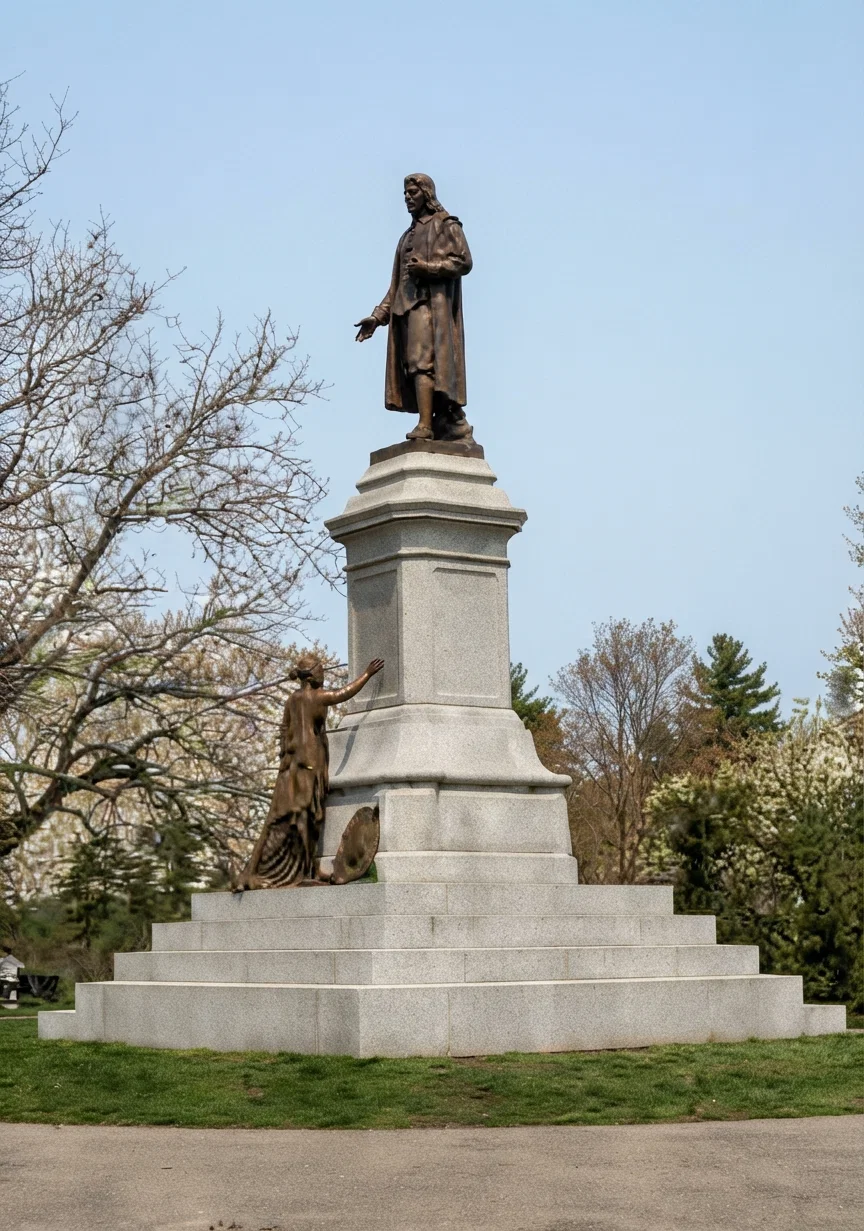
Statue of Roger Williams in Roger Williams’ Park, Providence, R. I.
He missed his poor Indians whilst in England, but his charity never staunched. There were hundreds of poor in that great city, and they were well worthy of help. All his spare time was occupied in bringing aid to this class; and with food and fuel he furnished many a home. And during all of this time it must be remembered that he was poor, very poor, himself; that he lived in a most frugal and meager way; and that never during his long life did he know what luxury or indulgence meant. He might have amassed large sums of money. He might have become wealthy, as did others who founded colonies. But he possessed a soul too great and magnanimous ever to permit him to become increased in this world's goods. Of him is true the saying of a great teacher, that this life is too short in which both to do good and to amass riches.
Rhode Island was not only a shelter for the Jews, but for the Quakers as well. This unfortunate sect was driven from New England with great cruelties. There were only two places where they could find asylum; one of these was with Roger Williams, and the other with the sultan of the Mohammedans—the Grand Turk. And it is not very much to the credit of the Puritans of these shores that they should be outdone in the matter of religious liberty by the followers of the "Prophet."
War was at this time threatening with the Redskins, but because the men of Rhode Island would not persecute the Quakers, their brethren in the other colonies would grant them no assistance against their foes. Rhode Island was in great danger. Nevertheless principle was not sacrificed for safety. "We have no law among us whereby to punish any for only declaring by words, etc., their minds and understanding concerning the things and ways of God, as to salvation and eternal condition." This was the answer hurled back by the brave little colony. "Forced worship," says Williams, "stinks in the nostrils of God; let us have naught to do with it." And God did protect those who were true to Him. New England would not furnish the people of Rhode Island with ammunition; but a greater power than that of spear and firearm was at hand. God turned the heart of the Indian, and gave Williams favor in his sight: "As for you, Brother Williams, you are a good man. You have been kind to us many years. Not a hair of your head shall be touched."
Williams lived to a ripe old age, and he died as he always lived, true to his principles of soul-liberty. American history boasts of no grander character, no kindlier soul. Self was ever sunken out of sight, and the good of his fellow beings of every creed and clime, and of millions yet unborn, was constantly uppermost in his mind. At times he almost seemed to speak with the foresight of a seer. Especially was this true on the occasion of a proposal to divide up the common lands of Providence, and distribute them among the then present inhabitants, instead of leaving them for future settlers who might be driven thence in quest of freedom. "For all experience tells us that public peace and love is better than abundance of corn and cattle. I have only one motion and petition, which I earnestly pray the town to lay to heart, as ever they look for a blessing from God upon the town, on your families, your corn and cattle, and your children after you; it is this: That after you have got over the black brook of some soul-bondage yourselves, you tear not down the bridge after you, by6leaving no small pittance for distressed souls that may come after you."
Williams sleeps, but not forever. In the resurrection morn the Lifegiver's voice will call him forth to immortality. At the bar of the Heavenly Tribunal he will stand "in the rockie strength of his convictions;" and the Judge of all the earth will there proclaim that his principles of soul-liberty are holy, just and true, founded on the everlasting Rock, Christ Jesus.
OBEDIENCE.
By D. L. Moody
"We are told that without faith it is impossible to please God, and you will find that it is impossible to please God without obedience. 'And being made perfect, He became the Author of eternal salvation unto all them that obey Him.' Eternal salvation unto all them that obey Him; not all that feel Him, talk to Him; that say, 'Lord, Lord,' but them that obey Him. Eternal salvation means eternal safety.
"Did you ever notice that all but the heart of man obeys God? If you look right through history, you will find that this is true. In the beginning God said, 'Let the waters bring forth,' and the waters brought forth abundantly. And one of the proofs that Jesus Christ is God is that He spoke to Nature, and Nature obeyed Him. At one time He spoke to the sea, and the sea recognized His voice, and obeyed Him. He spoke to the fig tree, and instantly it withered and died. It obeyed literally, and at once. He spoke to the devils, and the devils fled. He spoke to the grave, and the grave obeyed Him and gave back its dead. But when He speaks to man, man will not obey Him; that is why man is out of harmony with God, and it will never be different until men learn to obey God. God wants obedience, and He will have it, else there will be no harmony. In the first Epistle of John, we read, 'And the world passeth away, and the lust thereof; but he that doeth the will of God abideth forever.' He says in another place that if we obey His sayings we will never die.
"Suppose I send my boy to school, and he plays truant. He says, 'I don't want to go to school,' and he goes off and fishes all day. He knows I am very fond of trout, and he says: 'I know I have been disobedient, but I can sell these trout for fifty cents; but I will take them home to my father.' Do you think that will please me? Not by a good deal. I want obedience, and until my son obeys, his sacrifice is an abomination.
"Take the two Sauls. They lived about a thousand years apart. One started out well and ended poorly, and the other started out poorly and ended well. The first Saul got a kingdom and a crown; he had a lovely family—no father ever had a better son than Saul had in Jonathan; he had the friendship of Samuel, the best prophet there was on the face of the earth; and yet he lost the friendship of Samuel, lost his crown, his kingdom, and his life, all through an act of disobedience. God took the crown from his brow and put another man in his place. Why? Because he disobeyed. All his kingly dignity and power could not excuse him.
"Now take the Saul of the New Testament. When God called him he was not disobedient to the heavenly vision, and he received a heavenly kingdom! One act of obedience! One act of disobedience! The act of obedience gained all, and the act of disobedience lost everything. And so you will find, right through the Scriptures, this is taking place constantly. I believe the wretchedness and wo of our American cities to-day come from disobedience. If they won't obey God as a nation, let us begin individually. Let us make up our minds that we will do it, cost us what it will, and we will have peace and joy.
"People say, 'Well, don't you think it very unreasonable in God to punish Adam because he transgressed once?' Some years ago a superintendent telegraphed to a man not to turn the bridge over a certain river until a special train had passed. He waited and waited and stood firm until, finally, some one overpersuaded him, and he opened the bridge. He thought he would have time to let the boats pass and swing the bridge back before the train came. But he hadn't got it more than open before he heard the coming of the train. He hadn't time to get the bridge back, and there was a tremendous accident, and lives were lost. The man went out of his mind and was sent to a madhouse, and his cry for years, until death released him, was: 'If I only had! If I only had!' If he only had what? If he only had obeyed, those lives would not have been lost. In England, not long ago, a switchman just turned the switch at the wrong time, and twenty men were hurled into eternity, and a good many were maimed and hurt for life. He only disobeyed once."
ASTONISHING IGNORANCE.
By Charles P. Bollman
SOMETIME since the Youth's Companion contained the following short article relative to a lamentable but far too common ignorance of the truths of the Word of God:—
Ignorant of Its Truth.
A teacher of elocution in an American college for women told the following incident to some friends the other day as a fact: I was listening lately to a class of young ladies who were reading aloud, when one came to the expression, "The patience of Job." She pronounced the name as if it were spelled jobb, and then, pausing, said:—
"I don't understand this. Who was Job?"
"Have you never read the book of Job?" I asked in amazement. "Does the name suggest nothing to you?"
"Nothing, whatever," she replied, "except that I somehow associate it with printing. Was he a publisher?"
Other teachers who were present gave other instances of the ignorance among American girls and boys of the Bible.
"I once asked a graduating class of young men in college," said one, "why the Jews kept Saturday as the Sabbath, while Christians observe Sunday. Not one could tell me, and yet the majority of them undoubtedly belonged to church-going families."
Another teacher said: "Ignorance of the Bible is not confined to the girls and boys. I was seated at a lecture lately beside a young matron, a leader of society, especially devoted to music. The lecturer quoted from the twenty-third psalm, adding, 'As the sweet singer of Israel tells us.'"
"My neighbor looked puzzled a moment, and then, nodding cheerfully, whispered, 'He means Mendelssohn, of course.'"
It is an unwelcome fact that while the practical truths of Christianity are now taught in Christian homes, the Bible is not read or studied or committed to memory by the children as it was in past generations, not only in devout families, but in many of those where the parents were not members of Christian churches.
How can any soul travel through life by the aid of a map which it does not know?
These examples of ignorance of the Bible are all bad enough, but most remarkable of all is the ignorance of the writer of the article himself, and that of the teacher, who cited inability to tell "why the Jews keep Saturday as the Sabbath, while Christians observe Sunday," as an astonishing example of ignorance in college graduates. The fact is that while it is easy enough to tell "why the Jews keep Saturday as the Sabbath," the wisest man in all the world can give no satisfactory Bible reason why "Christians observe Sunday," and this for the simple reason that there is no such reason.
It is not the universal practise of Christians to "observe Sunday." Seventh-day Baptists and Seventh-day Adventists both "keep Saturday as the Sabbath," or, to speak more accurately, both these denominations observe the seventh day in harmony with the explicit command of the Decalogue, which says: "The seventh day is the Sabbath of the Lord thy God." Moreover, literature upon this subject has been extensively circulated, and the question has been discussed so widely in both the religious and secular press that it seems strange that every one has not heard of it, and that all do not know how impossible it is to give any satisfactory answer to the question, "Why do Christians observe the first day of the week?" Reader,
"Search the Book, and thou shalt know
There's no scripture tells them so."
C. P. BOLLMAN.
THE WEIGHT OF GLORY.
By George Matheson
THERE is a weight which is only felt in heaven, and which is heaven's glory; it is the labor of love. It has hardly begun here; it is the praise that "waiteth for God in Zion." There is a burden which has long deterred thee from lifting God's burden; it is the thought of thine own morrow. From that weight thy Lord fain would set thee free. But why? Not that thou mightest be a winged butterfly flitting from flower to flower. Nay, but that thou mightest bear a larger weight—the weight of humanity—Christ's weight of glory.
The joy of thy Lord is not a bird's song; it is a heart's enlargement. The risen Christ remains not in the garden; He must ascend to the cares of His Father. The place prepared for thee is no scene of luxurious ease, no plot of ground enclosed from mortal pain. There is a gate leading into the highways and the hedges, opening out into the far country of the prodigal son. And through this gate thy Father would have thee go—to minister, to succor, to save. This is the place prepared for thee in the mansions of thy Father. This is the ivory gate and golden, where the angels go out and in. This is the narrow way which leadeth unto life; and they who have found7that life retrace the road to bring their brother in. Thy weight of responsibility will be thy weight of glory.—George Matheson.
DIVINE CLEANSING.
By J. C. Cole
1. WHAT was David's earnest request?
"Cleanse Thou me." Ps. 19:12.
2. Can we cleanse ourselves?
"For tho thou wash thee with niter, and take thee much soap, yet thine iniquity is marked before Me, saith the Lord God." Jer. 2:22.
3. How are we cleansed?
"By the washing of regeneration." Titus 3:5.
4. How clean can the Lord make us?
"Whiter than snow." Ps. 51:7.
5. What only does the Lord ask in order to be accepted?
"A willing mind." 2 Cor. 8:12.
6. How long does it take the Lord to cleanse us?
"Immediately . . . he was cleansed." Mark 1:42.
7. If the reader has not been cleansed from sin what should he do?
"I will arise and go to my father, and will say unto him, Father, I have sinned against heaven, and before thee, and am no more worthy." Luke 15:17-24.
St. Johns, Ore. J. C. COLE.
STRANGERS AND PILGRIMS.
By Lettie E. Reed
“THESE all died in faith, not having received the promises, but having seen them afar off, and were persuaded of them, and embraced them, and confessed that they were strangers and pilgrims on the earth.” Heb. 11:13. This earth is not our home. We are pilgrims journeying to a better land; to a land that eye hath not seen nor ear heard of the beauties that await the faithful.
If we truly realize that this earth is not our home, and that a better land awaits us, it will be our daily desire for the time to hasten on when we can enter that land. We will not only be longing ourselves to be there, but will be continually telling someone else of the beautiful home to which we are going. We will be so enthused with the idea of the beauty and the glory of our heavenly home that no one can come in contact with us without being imbued with the desire to go with us and share the beauties of that country.
But what idea will those around us get of our promised home if we settle down contentedly here and show by our actions that we are satisfied with the things which this world has to offer? Suppose we keep telling people about what a beautiful country is promised us and of the joy we will have there, and yet make no especial effort to get ready to receive that inheritance, what will they soon begin to think? They will think that if it were all that we represented it to be, we would be more earnestly longing to be there. For illustration: If a stranger should come into our town and begin describing the country he had come from, telling of its beauties, what a healthful place it was, what beautiful streams and picturesque valleys, what an abundance of all kinds of delicious fruits, etc., we would greatly desire to follow him to that land. But if this stranger should begin to gather property about him and show no signs of returning to his own land, what would we think about the country he had come from? We would think, “He is an impostor; there is no truth in what he says, or he would want to return to that beautiful land.” It is just so with us in reference to the heavenly home we are preparing for. If we tell people about what a beautiful home Christ is preparing for us, and yet by our actions show that we are very well contented where we are, they will begin to think that there is no such place, and that we, ourselves, do not believe what we are preaching.
We, like the patriarchs of old, should confess that we are strangers and pilgrims, and that we are seeking a better country, even the heavenly city which Jesus is preparing for us.
When a foreigner comes into our town he is recognized by his dress, actions and speech. They are not like those of our own people, and we instantly recognize him as a foreigner. We can tell what country he comes from by his speech and dress. So should the pilgrim and stranger journeying to the heavenly country be recognized by his speech and dress. People should be able to tell by these things to what country he belongs. Of the disciples we read that their persecutors “took knowledge of them that they had been with Jesus.” How did they recognize this?—By their manner and words.
Truly, we are living in a time when every Christian should be earnestly longing for the coming of the Saviour to take him to the heavenly country. Why should we not long for Him to come. He is our Friend, our Elder Brother; He has been away for a long time, and is coming to take us to the beautiful home He is preparing. LETTIE E. REED.
Battle Creek, Mich.
HIDING IN CHRIST.
By Minnie Miller
WHEN threatening dangers move around us, our first thought is, Where can we go to escape them? We seek somewhere to hide; ofttimes while seeking we are lost; yes, lost before we can gain our hiding-place.
Christ says that in “the last days perilous times shall come.” We shall have many things to disturb our peace in this world, no matter how well cared for we are. On every hand we have disease, famine, murders, suicides, war, cyclones, and earthquakes in divers places. These things we are to expect; for we are clearly shown in God’s Word that these things will be.
We are also to expect the great and terrible day of the Lord. Now let us ask ourselves the question, Where shall I then hide? We read of that day now: “The kings of the earth, and the great men, and the rich men, and the chief captains, and the mighty men, and every bondman, and every free man, hid themselves in the dens and in the rocks of the mountains; and said to the mountains and rocks, Fall on us, and hide us from the face of Him that sitteth on the throne, and from the wrath of the Lamb; for the great day of His wrath is come; and who shall be able to stand?” Rev. 6:15-17.
Then there will be no respect of persons; the high as well as the low will take part in that scene; but it will be of no avail to call for rocks to hide us from the all-seeing eye. Our God is the only hiding-place for that terrible day: “For in the time of trouble He shall hide me in His pavilion; in the secret of His tabernacle shall He hide me.”
Even now, how good it is to be hiding in Christ, while all the world is craving for pleasure and peace, and find none: “For there is no peace, saith my God, to the wicked.” The Christian alone has that “peace that passeth understanding.” He has no fear for the future; for his Saviour has promised to be with him, even until the end. There can not a trouble or care or distress befall him that he has not a precious promise to help him through. Then, when that terrible day comes, instead of calling for rocks to hide him, he can look up and say, “Lo, this is my God, I have waited for Him, and He will save me.”
“O Rock divine, O Refuge dear,
A shelter in the time of storm!
Be Thou my helper ever near,
A shelter in the time of storm!”
Oakland, Cal. MINNIE MILLER.
TRIUMPHING TOKENS.
By A. J. Gordon
The empty tomb, the folded napkin, and the linen clothes laid by themselves, these are the tokens of the price accepted, of the prisoner’s discharge, and of the loosing of the pains of death forever, from all who died in Christ. And so to all questions of a timid or doubting conscience, the answer now is, “Who is He that overcometh? It is Christ that died, yea rather, that is risen again, who is even at the right hand of God, who also maketh intercession for us.”—A. J. Gordon.
THE REAL LIFE.
By Louis R. Ehrich
If when each season comes in turn so strangely,
Unfolding nature’s laws in beauty shrined,
Thou art not thrilled with full, profound conviction
That these are thoughts of an Eternal Mind,
Thou hast not lived.
If friendship whispered not to thee so fondly
But that thou wast a brother to thy friend,
Uplifting and enshielding him in trouble,
So far thy power and fortune might extend,
Thou hast not lived.
If duty ne’er hath called to thee so strongly
That thou would’st not have battled on its side,
And, standing bravely all alone if need be,
Defied what fortune might for thee betide,
Thou hast not lived.
If joy or grief of man hath left thee coldly,—
The pain of beast, the song of bird above,—
If thou hast not the tender heart-throb, pitying,
Proclaiming kinship of a deep world-love,
Thou hast not lived.
If thou hast schooled and trained thy soul so nobly,
Exalting it with each refining grace,
That thou might’st yield each thought and each emotion
In consecration to the human race,
Then thou hast lived.
—Louis R. Ehrich.
THE EXAMPLE OF CHRIST.
By J. B. Silcox
THE name of Jesus is above every name, because He went down lower than any other in order to reform deformed humanity. Jesus did not come into the world to save a church, or an institution, or an ordinance, or a creed, or a ceremony. He came to save men. It was men He was after. The one thing, and the only thing, under the blue vault of heaven sacred to Him was the human soul, no matter how battered and bruised, how maltreated and mutilated, that soul might be. Jesus did not want to live in lonely supremacy above His fellows. He longed to bring the whole human race up to the heights He Himself had attained.
With the teaching and example of Jesus before us, it does not become us to hold ourselves aloof from humanity on the ground that they are below us in culture, wealth, or social standing. There is a feeling abroad that people vulgarize themselves by mixing too familiarly with common folks. As people rise in wealth and culture they are disposed to separate themselves from those less fortunate. That is, as they grow better they grow worse—they become less democratic and more aristocratic. Their culture makes them cold. Their refinement makes them exclusive. It is true they practise a sort of professional philanthropy. They give an annual contribution to some benevolent institution. But they never take a personal interest in individuals or families. They never come into close fraternal contact with the victims of poverty and crime. They could not by any stretch of the imagination be called the friends of publicans and sinners. They never take the outcast by the hand and show him friendship and interest. "Bring the poor that are cast out to thine house" is a command they never undertake to obey. "When thou makest a feast call the poor, the maimed, the lame, the blind," is not included in their rules of hospitality and etiquette.
What I am contending for is that we show personal sympathy with, and take a personal interest in, men and women in need. This is what Jesus did. Again and again, in reading His life, you notice that He took this one and that one by the hand. He took the blind man by the hand and led him out of the city. He reached out His hand and touched the leper. He took the devil-possessed boy by the hand and lifted him up. Jesus took all kinds of folks by the hand. He touched the eyes of the blind. His touch meant personal interest, personal sympathy, personal help. This is what helpless humanity needs to-day. They need food and clothing for the body, but above this they need human sympathy and human love.—Rev. J. B. Silcox.