Lewis drummed with his fingers on the wet window-pane disconsolately.
“A rainy day is bad enough, but a fellow can have some fun when he can go ‘up attic’ and play bear.”
“That’s so,” sympathized Robert. “Guess to-day’ll be dull enough.”
Aunt Alice was ill, and mama had said she must remain in bed, and the boys must be very quiet.
“How doleful we do look!” exclaimed mama, coming in to look at her boys.
“Can’t help it,” said Robert.
“Oh, yes, you can. You will look gay enough when you get your programs.”
“Programs?” And two pairs of wondering eyes greeted mama’s smiling gaze.
“Yes. This is Robert’s in this envelope, and this is Lewis’s. They are a little like school programs, you will see. You are to do things separately this morning, and then meet, near dinner time, to compare notes and see what has been done. This afternoon you are to play the new game that—well, I mustn’t tell you any more.” Mama put her finger on her lips and laughed.
“Are there nice things to do on the program?” asked Lewis.
“Of course there are,” said Robert, quickly. “Mama always plans nice things.”
“If any of them seem a trifle hard, you will be glad afterward that you did them,” mama told the boys. “Now each read your program, all by yourself. Don’t speak to any one. If we meet in the hall, or anywhere, we’ll just nod and smile. There will not be any company to-day, I think.”
“I should think not,” said Robert, looking out into the wild, wet day.
Then they sat down in opposite corners to read the programs.
In a few minutes Robert went to look at the clock. It was half-past eight now.
He glanced back to exchange a smile with Lewis, who looked at the clock, too.
Then Robert went up-stairs, and Lewis went to the kitchen. For half an hour they were busy.
Lewis’s directions were to make some molasses candy from 8:30 to 9 A. M. He could do it very well indeed, and was careful always to boil it just right for pulling. He liked to make it, but thought it hard work to pull it. Robert delighted in seeing how white he could make the little braided strands look, and always took much pains with this part of the work.
From 8:30 to 9 Robert busied himself in the attic. His program had told him to go to a certain corner of a certain drawer in an old bureau, and cut into one-inch squares the strips of pretty red cardboard he would find. Mama had written that they would need one hundred and fifty-six squares for the new game. Robert was to cut all that he could cut well in the half-hour, then put everything back into the drawer.
From 9 to 9:30 Robert was to be busy in the kitchen, pulling the candy, and Lewis was to go to another drawer in another bureau and find a pile of calendar sheets, from which he was to cut twelve sets of numbers, from one to thirteen inclusive.
From 9:30 to 10 Lewis was to arrange the candy prettily on little plates for their afternoon “game-party with mama,” after rolling part of it in paraffin-paper and making up a box for papa to take to the office to-morrow.
Robert, during this half-hour, was to find Lewis’s numbers and paste as many as he could, very neatly, in the centers of the little squares of red cardboard. “Make them in sets of thirteen, and don’t hurry. You can’t do them all and do them well in the half-hour. I will plan for the others,” mama had written.
From 10 to 10:30 was a delightful half-hour. Robert was sent to the hall-table drawer to find a little luncheon, which he was to eat in the dining-room while he read his last magazine. He did not know it had come. Lewis found a luncheon similar to Robert’s in a little box in the attic, and he was to eat it there, looking over any of the papers and books that he liked in the old chest. This was always a privilege, and could not be had without special permission.
From 10:30 to 11 Robert, who was very handy with tools, was to go to his shop in the attic and try to make a brownie target. Mama had cut the directions from a paper, and put the materials ready for a rainy day. Robert was delighted. He could understand the directions easily, and the brownie he whittled out and fastened with an elastic at the top jumped comically enough. Mama told him not to paint any of it, but let Lewis do that in his next half-hour. Lewis was more skilful with his water-color tube paints than Robert. Besides, Robert would have all he could do to make the target, even with compasses and all at hand.
From 11 to 11:30 was a trying half-hour for Robert. He could not help teasing mama to let him go to watch Lewis. He promised to whisper. But mama, who had given some “suggestions” on Lewis’s program, told Robert it would be more fun to see it all afterward.
So from 11 to 11:30 Lewis painted happily the comical brownie and the rings and bull’s-eye, while Robert cleaned the air-gun and mended the broken rod of a rubber-tipped arrow.
From 11:30 to 12 the program said the boys could have a whisper-party in the kitchen with mama, and finish the game of numbers or any other incomplete work.
At noon Aunt Alice was better, for mama’s remedy and the quiet rest had done the work.
So they had a merry afternoon. Aunt Alice put on her pretty house gown and came to lie on the sitting-room sofa and watch the proceedings. The brownie target was great fun, even for mama, and so was the game of numbers.—Annie S. Perkins, in Youth’s Companion.
ELIZABETH ROSSER
By Elizabeth Rosser
Love
O MOTHER-LOVE, sweet mother-love!
On earth there is no other love,
Content, like this, to toil by day,
By night to watch and weep and pray,—
Content within four straight, bare walls
To dwell, where love and duty calls,—
Content to bear the mother's pain,
That she may reap the mother's gain.
On earth there is no other love
Like to this tender mother-love.
But higher than the mother-love
Is this, the Elder Brother-love.
Content to lay aside a crown,
To put his glittering scepter down,—
Content to leave his throne behind,
And be a servant of mankind,—
Content to live in poverty,—
Content between two thieves to die,
And with us share his home above,—
This is the Elder Brother-love.
ELIZABETH ROSSER
“Make the Saw”
THE boy stood beside his grandfather, his eager eyes intent upon the little, yellow violin which the aged man’s busy fingers were shaping and finishing.
“But you can’t finish it, grandfather!” said the lad, in despair. “You can’t make those little S pieces.”
“Why can’t I make ’em?” demanded the grandfather, crisply.
“Because you haven’t got a saw fine enough for that.”
“Then I’ll make a saw,” was the reply.
And he did make it.
Years afterward, that boy, grown to be a well-known violinist, understood that his own mastery, not only of the violin, but of many of the problems of his life, was largely due to the force with which that one sentence took possession of his mind. That tiny violin, the first he had ever owned, represented to him the overpowering of all difficulties by patient determination, and by an unflinching good courage from first to last.
It is often harder to “make the saw,” or, in other words, to conquer some new and unforeseen difficulty, at the end of our task, than it was to achieve all that came before it.—Exchange.
Insects and Their Habits, and What Harold Learned About Them
By Mrs. L. D. Avery-Stuttle
“Come, Harold, I want to tell you a little story that a friend once related to me. The family had been very much troubled with ants, which seemed able to find anything and everything eatable in the house, and especially anything sweet; for as you know ants are very fond of sweets. These insects insisted upon making raids upon the sugar bowl, and would discover it no matter where it was hidden. Finally the idea came to my friend that he would place the sugar bowl in water.”
“Mama sometimes draws a heavy line of chalk around her sugar,” said Harold, “and the little thieves get their feet all dusty; they don’t like that very well, and keep away.”
“Sometimes this will stop them, but my friend tried every device before putting the bowl into the water, but it did no good.”
“The water stopped them, all right, didn’t it, uncle? I guess they didn’t care to wet their feet.”
“One would suppose so, but their extreme fondness for sweets led the ingenious fellows to invent a way of reaching the coveted prize. They actually climbed up the ceiling, and stopping directly over the sugar, dropped down into it.”
“I should think they might have fallen into the water,” said Harold.
“This is precisely what some of them did do. And it caused a great excitement among the others; but they did not dare to plunge in after the unlucky fellows, so they sent a small detachment back to the nest for help. Finally, my friend said, eight lusty fellows separated from their comrades, and, flinging themselves into the water, swam with such skill that they finally succeeded in saving most of their drowning comrades. After getting them out of the water, they, like human nurses and physicians, actually rolled, rubbed, and brushed their half-drowned friends until most of them were quite restored.”
“It looks as if they really cared for one another, just like people; doesn’t it, Uncle Frank?”
“Certainly; I am of the opinion that these tiny creatures are capable of feeling almost all the emotions of human beings: they must hate, or they would not fight; they must be jealous of the authority of others of their kind, or they would not try to kill their rivals. They certainly have great love for their offspring and for those of the same family, or they would not risk their own lives to save them from death. So I think it ill becomes us to look with feelings of scorn even upon the humble insect that creeps at our feet,—humble it may be, but the wisest man on earth would find it quite impossible to give life even to the tiniest creature; none but an all-wise Creator can do that. But I must hasten to tell you about the strange insect wrongly named the white ant.”
“Let’s go out now, uncle, and take a walk, maybe we can find some of them.”
“No; we shall not find any here; we are too far north for them to venture, and we may well be glad. But they are found in most warm countries,—in the hot portions of our own land, in Africa, in Guiana, in France, and in some other portions of Europe. They do all sorts of damage by eating whatever they find in their path. Sometimes very valuable articles are entirely ruined by them.”
“Dear me! I’m glad none of them is here. Did you ever see any of them, uncle?”
“I have often seen them in Paris. They once caused a great deal of trouble in that busy city by creeping into one of the government buildings, and eating important records. But the queerest part of the story is that they did not touch the top leaf of paper nor the margins of any of the leaves, so that the pile of papers looked as perfect as when first placed there, really the whole box was only a mass of rubbish.”
“Do you suppose the cunning fellows left it that way on purpose to cheat the people, uncle?”
“I can not tell you that, of course, but I do know that their clever work certainly had that effect.”
“Are these the ants which build such big houses?”
“Yes, their houses are enormous. I will tell you about them. These white ants are by far the most gigantic and wonderful insects of the ant tribe. The houses which they build for themselves are certainly worthy of more than a passing notice. What would you think, Harold, to see an ant’s nest which was much higher than your head? I have myself seen them ten or twelve feet high.”
“Why, Uncle Frank! that is almost as high as men build their houses.”
“Certainly; and these nests are not only large, but they are very strongly built. The sides of the house are more than a foot thick, and are just as hard and firm as a rock. There are several different kinds, or species, of this ant, but they are all expert miners.”
“Are there any carpenters among them, uncle?”
“I am sure you would think so if you could see one of their houses. O, yes; there are architects, masons, and designers also.”
“What do they build their nest of? I don’t see how they can use sand, if it acts with them as it does with me when I try to make a sand house.”
“They quite often use little pieces of wood which they have cut with their strong pincers. Then they glue it all together with a certain sticky gum, and it becomes very hard.”
“I wonder if these nests would hold a boy up; I’d just like to climb to the top of one of them,” said Harold.
“I fear you would want to beat a hasty retreat; for the insects would surely object. They have no notion of being trampled upon by boys, or men either, for that matter.”
“Why, Uncle Frank! do you mean that they could prevent it if men chose to climb upon their houses?”
“I will tell you how the negroes in South Africa manage, and then you can judge for yourself whether you would care to venture onto one of their houses. The negroes are very fond of these ants for food. They roast them like coffee, grind and powder them, and mix them with flour, thus making a sort of bread or cake. But the negroes have learned better than to attack these pugnacious little fellows at close range; for the legs of the black men are generally quite bare, and this gives the little soldiers a good chance to use their pincers on them. So the natives carefully dig a trench a little distance from the nest and entirely surrounding it, into which they pour water. Then they shoot the houses, with their guns.”
“O Uncle Frank! how funny! to think of men shooting at little ants. I wonder what the poor insects do then.”
“Well, of course they are no match for the guns of their enemies, but still the brave little creatures sally out by the million, and soon fall into the ditch which has been dug to receive them; for they are entirely blind,—poor fellows!—and can not see the trap set for them. Then the negroes carefully fish them out of the ditch, dry, and eat them.”
“Dear me, uncle; seems as if that isn’t hardly fair, is it? But I do wonder how they taste. Ugh! the idea of eating ants—and blind ones at that!” said Harold, with a look of disgust upon his face.
“No; it doesn’t really seem fair to me; but then, war of any kind is never fair, you know; but I can tell you how they taste.”
“O, did you ever eat them, uncle?”
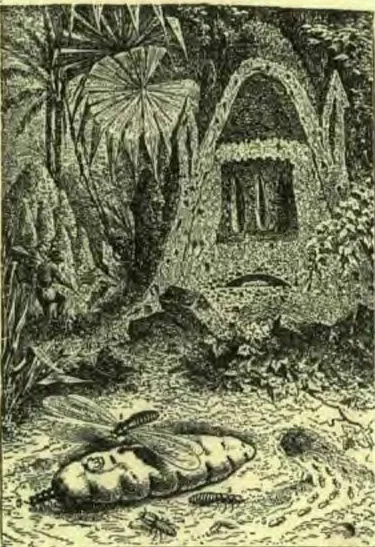
“No, but those who have, assure me that they taste much like the marrow of beef’s bone, though some kinds are sour. But see here,” said Uncle Frank, turning to his book, “I want you to see a picture of this wonderful insect and its nest.”
“O dear! is that funny looking thing the nest of an ant?”
“That is what it is, my boy; it is represented as being cut right through the center, so one can see how the inside of the nest looks.”
“But what is that odd-looking thing—like a great potato?”
“That is the female ant, the queen. You can see the workers, the soldiers, and the common ants beside her. That large fellow with wings is the male.”
“But I don’t see why the queen is so much larger than the others. Is she as large as in the picture? or is this magnified?”
“O, yes; she is much larger than she is here pictured, for she sometimes grows to be six inches in length—a perfect monster.”
“Does she lay as many eggs as the queen bee?”
“O, yes; this wonderful insect far outrivals the bee in the number of eggs she lays. Why, this ant lays as many eggs in one day as the bee produces in a year!”
“Isn’t it wonderful! wonderful!”
“O, yes, Harold; the works of the Creator are all wonderful. This insect lays an average of one egg each second, or more than eighty thousand every day.”
“I don’t see how she takes care of so many; how does she manage, uncle?”
MRS. L. D. AVERY-STUTTLE.
(To be continued)
The Book of Memory
By Hannah G. Fernald
My grandma has a curious book she often lets
me see,
When in the dusk I leave my play to sit upon
her knee.
I can not touch the book at all, but shut my
eyes up tight,
While grandma tells the pictures, and I see them
clear and bright.
I see the dear old farmhouse, where my grandma
used to play,
The barn, with all the cattle and the fragrant
mows of hay,
The pets that grandma used to have, and all her
queer old toys,
And the little country schoolhouse, full of merry
girls and boys.
And there are other pictures, too, which make
my grandma sigh;
She says I must not see them now, but wait till
by and by.
But though she thinks they're far too sad to
show to little me,
She's sure they all look brighter when I'm sitting
on her knee!
My grandma says I'm making now a book to be
my own,
And that I'll often look at it and smile, when
I am grown;
And then I'm sure the picture that I'll like the
best to see
Will be myself, a-sitting in the dusk on grandma's
knee!
MEMORY VERSE: “And whosoever shall give to drink unto one of these little ones a cup of cold water only in the name of a disciple, verily I say unto you, he shall in no wise lose his reward.” Matt. 10:42.
“And when he had called unto him his twelve disciples, he gave them power against unclean spirits, to cast them out, and to heal all manner of sickness and all manner of disease. Now the names of the twelve apostles are these; the first, Simon, who is called Peter, and Andrew his brother; James the son of Zebedee, and John his brother; Philip, and Bartholomew; Thomas, and Matthew the publican; James the son of Alpheus, and Lebbeus, whose surname was Thaddeus; Simon the Canaanite, and Judas Iscariot, who also betrayed him.
“These twelve Jesus sent forth, and commanded them, saying, Go not into the way of the Gentiles, and into any city of the Samaritans enter ye not: but go rather to the lost sheep of the house of Israel. And as ye go, preach, saying, The kingdom of heaven is at hand. Heal the sick, cleanse the lepers, raise the dead, cast out devils: freely ye have received, freely give. Provide neither gold, nor silver, nor brass in your purses, nor scrip for your journey, neither two coats, neither shoes, nor yet staves: for the workman is worthy of his meat. And into whatsoever city or town ye shall enter, inquire who in it is worthy; and there abide till ye go thence. And when ye come into an house, salute it. And if the house be worthy, let your peace come upon it: but if it be not worthy, let your peace return to you. And whosoever shall not receive you, nor hear your words, when ye depart out of that house or city, shake off the dust of your feet. Verily I say unto you, It shall be more tolerable for the land of Sodom and Gomorrah in the day of judgment, than for that city.
“Behold, I send you forth as sheep in the midst of wolves: be ye therefore wise as serpents, and harmless as doves. But beware of men: for they will deliver you up to the councils, and they will scourge you in their synagogues; and ye shall be brought before governors and kings for my sake, for a testimony against them and the Gentiles. But when they deliver you up, take no thought how or what ye shall speak: for it shall be given you in that same hour what ye shall speak. For it is not ye that speak, but the Spirit of your Father which speaketh in you.
“And the brother shall deliver up the brother to death, and the father the child: and the children shall rise up against their parents, and cause them to be put to death. And ye shall be hated of all men for my name’s sake: but he that endureth to the end shall be saved. But when they persecute you in this city, flee ye into another: for verily I say unto you, Ye shall not have gone over the cities of Israel, till the Son of man be come. The disciple is not above his master, nor the servant above his lord. It is enough for the disciple that he be as his master, and the servant as his lord. If they have called the master of the house Beelzebub, how much more shall they call them of his household?
“Fear them not therefore: for there is nothing covered, that shall not be revealed; and hid, that shall not be known. What I tell you in darkness, that speak ye in light: and what ye hear in the ear, that preach ye upon the housetops. And fear not them which kill the body, but are not able to kill the soul: but rather fear him which is able to destroy both soul and body in hell.
“Are not two sparrows sold for a farthing? and one of them shall not fall on the ground without your Father. But the very hairs of your head are all numbered. Fear ye not therefore, ye are of more value than many sparrows.
“Whosoever therefore shall confess me before men, him will I confess also before my Father which is in heaven. But whosoever shall deny me before men, him will I also deny before my Father which is in heaven.”
Questions
1. Whom did Jesus call unto him? Name them. What power did he give them? Where did he send the twelve? Into what cities were they not to enter? To whom, only, were they to go at this time? Why was this?
2. What special message were the twelve to give as they went through the cities and towns of the Jews? What mighty works were they to do? How were they to give to others? Of what had they “freely” received?
3. What provision were they to make for their own comfort during this journey? What did Jesus say of the workman? What were the disciples to do when they went into a new city or town? If the house they entered was worthy, what blessing would come upon it?
4. What was to be done when a city or a family rejected the message of light? For whom did Jesus say it would be more tolerable in the day of judgment than for these? Why?
5. How did Jesus send the disciples forth? Of whom were they to beware? Why? Before whom would they be brought? What promise did Jesus make that would be a comfort to them at such a time? When shall we need the comfort of that same promise?
6. Name some of the perils that Jesus said would beset those who follow him. Why can not his disciples have an easy time in this life? For what is it enough for the true-hearted disciples to be? Of what should they have no fear?
7. How did Jesus illustrate his love for his children? How great is his care for them? Whom will he confess as his before his Father? Whom must he deny?
Some Working Beliefs
THAT great modern psychologist, Professor James, tells us that thought, to complete itself, must pass into action, and that action, in its turn, reacts upon thought. That ancient teacher, the apostle James, insists upon the same point when he says that “faith, if it have not works, is dead, in itself.” Only a working belief is a complete belief.
A good set of every-day working beliefs, quoted from a wise, but unknown author, is this: “I believe in cleanliness of body, mind, and soul. I believe in kindness to man, woman, child, and animal. I believe in truth because it makes me free. I believe in the charity that begins at home, but does not end there. I believe in mercy as I hope for mercy. I believe in moral courage, because I have good courage. I believe in righteousness, because it is the shortest and best line between two eternities. I believe in patience because it is the swiftest way to secure results. I believe in that kind of industry that takes an occasional vacation. I believe in that sort of economy that spends money for a good purpose. I believe in honesty, not for policy’s sake, but for principle’s sake. I believe in hospitality, because it puts a roof over every man and woman’s head. I believe in obedience, because it is the only way to learn how to command. I believe in self-control, because I want to influence others. I believe in suffering, because it chastens and purifies. I believe in justice, because I believe in God.”
Each of these beliefs set in action, will react upon the believer’s thoughts, and grow stronger. Each act of faith is an act of growth. A purely intellectual belief can be easily assailed by doubt; but the young man or woman whose beliefs are daily acted out, grows daily in knowledge and faith. That is why this set of practical beliefs is cordially recommended for consideration.—The Wellspring.
(August 12)
VII—The Tithing System Was Founded Upon Moral Obligations, and Is a Part of the Gospel Plan of Salvation
(August 12)
MEMORY VERSE: “Neither is there salvation in any other: for there is none other name under heaven given among men, whereby we must be saved.” Acts 4:12.
Questions
1. Has the Lord ever had more than one plan to save man? Acts 4:12.
2. What is said of those who would preach any other gospel? Gal. 1:9.
3. In ancient days, what was the plan for the support of the gospel? Num. 18:20, 21.
4. How does that plan compare with the one for the support of the ministry at the present time? 1 Cor. 9:13, 14.
5. What is the first recorded instance of the paying of tithes? Gen. 14:18-20; 28:20-22; note .
6. Under what priesthood did these instances occur? Heb. 7:1-4.
8. When the people neglected to pay tithe in Nehemiah’s day, what message did he bear to them? Neh. 13:10-12.
9. What did Hezekiah command the people to do in his day? 2 Chron. 31:4, 5.
10. What did Jesus say in commendation of the payment of tithes? Matt. 23:23.
11. What example of sacrifice is left us in the early church? Acts 4:32-37.
12. What will be the basis of the reformation in the last days? Rev. 14:6.
13. What is included in the everlasting gospel? Rev. 14:12; note .
Notes
The Letter Box
Cambridge, Idaho, May 6, 1905. Dear Editor: I like to read the INSTRUCTOR very much. I live on a farm. We have Sabbath-school and meeting every Sabbath. I am secretary of the Sabbath-school. Bessie States.
Cambridge, Idaho, May 6, 1905. Dear Editor: I am a reader of THE YOUTH’S INSTRUCTOR. I live on a farm about ten miles from town. We have Young People’s meeting every Sabbath evening. I am secretary of the Society. Martha Howland.
Hill City, S. D., May 26, 1905. Dear Editor: As I have never seen a letter from this place, I take the pleasure of writing and letting you know we have a Sabbath-school of nineteen members. Brother Ruechel is superintendent, and he is also my teacher. There are four in our class. I hope that we may all meet in the kingdom of God. Emma Harper.
Rockwell City, Iowa, May 6, 1905. Dear Editor: I enjoy the readings in the INSTRUCTOR very much. I go to public school, and am in the eighth grade. I have a sister ten years old, and a pair of twin sisters one month old. I was baptized three years ago. My mama and I are the only Adventists in this town. I am trying to let my light shine for others, and I hope to meet the INSTRUCTOR readers in the earth made new. Sincerely, Bessie B. Long.
Genesee, Idaho, April 30, 1905. Dear Editor: I take the INSTRUCTOR, and like to read it very much. I live on a farm, and we have a good view of the mountains on three sides. I went to church-school two months and a half last winter, and expect to go again next fall. I like to go very much. I have begun the reading course. The books I have chosen are “Prophecies of Jesus,” “Desire of Ages,” “Great Controversy,” “Things Foretold,” and the Bible. I expect to attend the camp-meeting at Moscow, Idaho, which begins the twenty-fifth of May. I am going to distribute some copies of the “Open Letter” in Genesee, and have been sending away papers. Lewis R. Young.
Port Hammond, B. C., May 3, 1905. Dear Editor: We have taken THE YOUTH’S INSTRUCTOR for about two years, and like it very much. I enjoyed reading the articles on the Yosemite Valley. We live on the Manson Industrial School Farm. We go to the only church-school in British Columbia. Our teacher is Miss M. Reith, and we like her very much. The farm has seventeen milch cows, and my brother, sister, and myself help with the milking.
I have three sisters and one brother. I am thirteen years old, and would like some of the readers to write to me. This is my first letter to the INSTRUCTOR. I have written one letter to Our Little Friend. We have Sabbath-school in the school, as we have no church. The school started last July. I hope to meet all the readers in the new earth. Winifred Courbarron.
San Jose, Cal., May 19, 1905. Dear Instructor: I, too, would like to join the Reading Circle. The books I have chosen are “Steps to Christ,” “Thoughts from the Mount of Blessing,” “Native Life in India,” “Letters from the Holy Land,” and “Life of Martin Luther.”
I am nearly fourteen years old. I love the INSTRUCTOR very much, and I do not know how I could get along without it. I study the Youth’s Lessons, and greatly enjoy them, because I know they are very important at this time.
I wish the editor’s picture could be put in the paper sometime. There are many beautiful trees and flowers here in California. San Jose is called the “Garden City” of the State. Four or five varieties of palms grow here, and they are very pretty. There are also magnolia, orange, lemon, pepper, and eucalyptus trees. The raising and drying of fruit, mostly prunes, are the principal industries of this beautiful Santa Clara Valley. Vedo Fero Carnahan.
A Turning-Point
A PEBBLE in the way of a stream trickling from a mountain spring may decide whether its waters shall empty into the Pacific or the Atlantic Ocean. There are crises in lives when a feather's weight of influence in either direction will turn the soul toward good or evil. The life story of Aaron Burr is a sad record of brilliant powers wasted, but the end might have been very different if he had received the right counsel at a turning-point of his life.
During Burr's course at Princeton there was a strong religious awakening among the students. The young man was touched, interested, and thoughtful. He went so far as to seek out the college president and open his heart to him. But, sadly enough, instead of receiving help, he was assured that his fellow students who were urging the claims of Christ, were fanatical. With such authority behind him, Burr found it easy to quiet his conscience, and, as far as is known, it was the last time he thought seriously of beginning a Christian life. Had he been under different influences at that critical time, the name of Aaron Burr might be beloved and honored to-day.—Young People's Weekly.