The Youth's Instructor, Vol. LII, No. 29

The Doom of the Giant Redwood

The Youth's Instructor

July 19, 1904

Review and Herald Publishing Assn. · Washington, D. C. · July 19, 1904

The Doom of the Giant Redwood

AFTER defying the countless storms of scores of centuries, the oldest living things on the planet, the California big trees, are in many instances yielding to the work of a caterpillar. This tiny insect is related to the common peach-tree borer. Some instinct seems to have taught this worm that the vulnerable spot in these mighty trees is the axils of the branches. The sinking of its tunnels there diverts the flow of sap; a formation of resinous knots follows, which effectively check the circulation of the tree’s life-fluid. The unnourished limb then dies, and at last the tree itself is slain by its pygmy enemies.
In the smaller groves the ravages of the insect may be averted by digging the larvæ out with knives, but no practical remedy has been devised for safeguarding the larger forests. The subject is engaging the attention of expert foresters.
Another factor which threatens the existence of these famous redwoods is the growing recognition of their timber value. On account of antiseptic properties in the wood, no species of decay-producing fungi has ever been found in the timber. Giant trees up-rooted five hundred years ago, and which through the ensuing centuries have lain where they fell, exposed to all the elements that cause decay, have been found to be absolutely sound, and have been shipped to the sawmills and converted into lumber. This antiseptic character of the redwood is causing a growing demand for the timber in general construction, and particularly for the walling of tunnels. Moreover, the discovery made by Captain Ahern in the Philippines that California redwood was not subject to the depredations of white ants or termites has created a great demand for this wood in the archipelago, where only a few of the native woods, and those of the most valuable varieties, are free from the ravages of these insects.
Hitherto the market for redwood has been confined largely to Pacific Coast cities, where its commercial value was known. Shingles made of redwood last nearly half a century. The wood is devoid of resin, which gives it great resistance to fire, and is therefore in demand for building purposes, particularly in San Francisco. One secret of the vast age attained by redwood forests is that its bark is fireproof. Fires have repeatedly raged in redwood forests, managing to destroy the young trees, but unable to penetrate the asbestos-like sheathing of the monarchs.
Now that the trade in redwood is growing, that occasional cargoes are shipped to Australia, Honolulu, the Philippines, and other parts of the far East, and that dealers in the eastern part of the United States are sending in orders for the timber, naturalists interested in preserving these trees are making efforts to introduce better methods of lumbering. At present twenty-five per cent of the timber is destroyed in felling the trees.
It is the purpose of the foresters at work in California to urge that the young redwoods be left standing for future cutting. Freed from the shade of the large trees, they grow with remarkable rapidity. Trees that have increased scarcely any in diameter in one hundred years have started up like saplings when overshadowing monarchs have been removed. The forests are so dense that the present methods of lumbering frequently crush and utterly destroy far more timber than is taken out.
It not infrequently happens that a forest giant’s great weight causes it to be totally pulverized. Foresters have witnessed instances of a big tree failing to yield an available foot of timber, so complete was its destruction in falling.—Selected.

A Big Tree

PROBABLY no section of our world now more fully and forcibly and eloquently tells of God’s love in providing for the wants of his children than does California, with its varied and extensive natural resources.
We wish to write of but one tree out of the vast timber resources of this State. It alone will suffice to illustrate how lavishly He who feeds the sparrows has provided for some of our principal needs.
Within the forests of California can be found not less than sixty-four distinct varieties of wood. Many are very valuable and beautiful. Some are susceptible of a high polish, and are much used for veneer work. Pieces of redwood burl have sold for as much as one dollar a square foot. These are used in the manufacture of fancy furniture. The tree I am to tell you about is of the redwood variety. There are great forests of this wood on the Coast Range mountains. It is the felling, cutting up, and marketing of this timber that forms the greater part of the extensive lumber industry of this State.
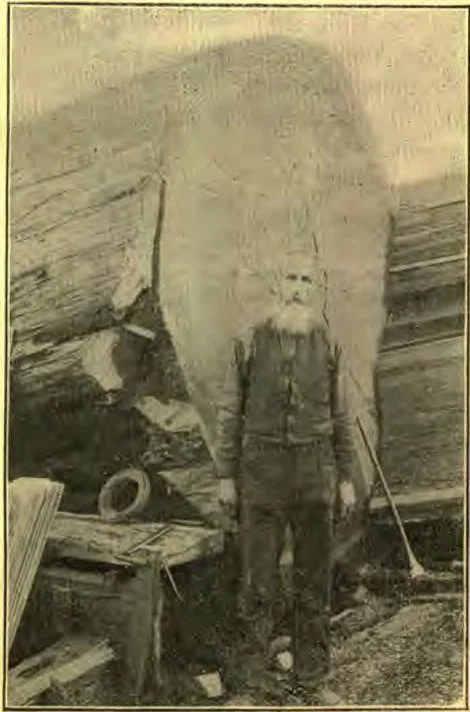
Seven miles west of Willits, California, two years ago stood this fine specimen of the redwoods of which I write. It was the property of Irvin Muir & Co. It stood on ground that needed no preparation to prevent breaking in its fall. Great care in felling these large redwoods has to be exercised at times to prevent breaking. A break would mean the loss of many dollars in ruined lumber or other material. This tree was over forty feet in circumference at the stump, and towered skyward two hundred forty feet. The bark on the tree was one foot thick. This left a body eleven feet in diameter of good timber to be worked up. Three days were required to saw it down. It is no easy matter to fell one of these giants of the forest. The stumps are often higher than a man’s head, and in order for the workmen to get up where they can work, spring-boards or scaffolding have to be used. A spring-board consists of a slab or plank, wide enough for a man to stand on, driven into a niche so cut in the tree as to hold the board firm without other support. On these the men stand and do their work. One who is skilled in the felling of these great trees commands high wages.
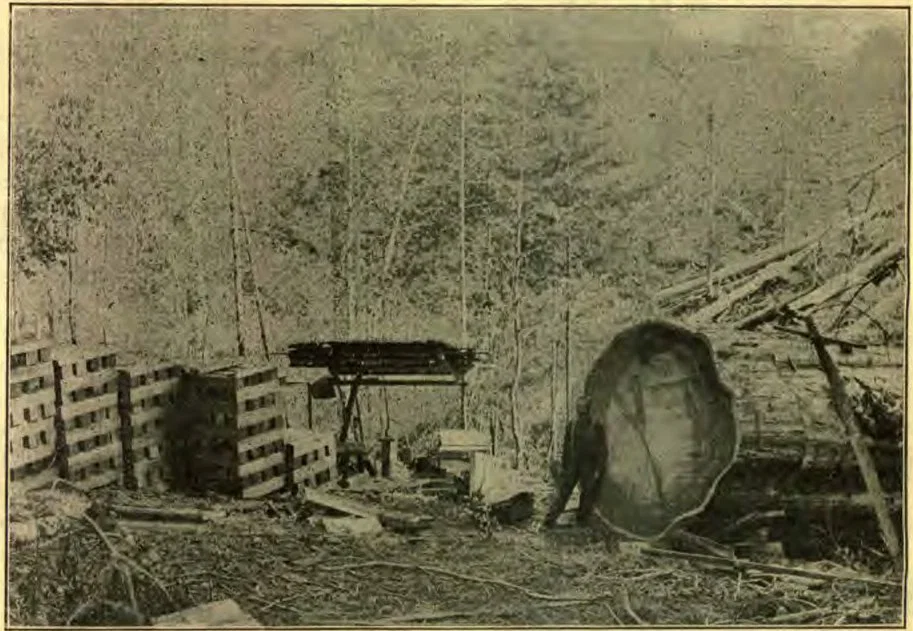
From illustrations on the first page an idea of the size of the tree may be gained, the gentleman standing by the tree in the picture being above the average height. In the smaller picture he is standing by a cut twelve feet from the stump, but in the larger one over one hundred feet up the body of the tree. In the left of this picture are a few piles of the 71,675 shakes that he made from the tree. Besides these the tree made 35,000 feet of lumber and 30 cords of wood. Twenty-six four-horse teams were necessary to haul the output of the one tree to market. The gross receipts for the material were $1,401; it cost $555 to work it up and take it to market, leaving $846 as the net worth of the tree.
This tree is larger than the average, but trees from six to eight and even ten feet in diameter are common. Occasionally larger ones are seen than that shown in the pictures. There is another species of tree here which produces trees of greater size than the redwood. It is the Sequoia family. This timber is not very abundant, but has given California her world-wide renown for large trees. I have measured specimens of this variety that ranged from seventy-five feet to one hundred ten feet in circumference. The only commercial use to which this timber has been put, so far as I know, is the manufacture of the bark into various articles which are sold as curios. This bark can often be secured two and one half or even three feet thick.
HENRY H. SCOTT.

Attitude of Jesus Toward the Sabbath

As noted in a previous article, the Sabbath was instituted at creation, before sin entered the universe. Six days were employed in the stupendous work of creation, and on the seventh day the Creator rested. And as Jesus was the one who made all things (Heb. 1:1-3), he of course was the one who rested, blessed and sanctified the Sabbath, and is, therefore, “Lord of the Sabbath day” given to man as a memorial of his creative power.
In this article we wish to call attention to how the Saviour regarded the Sabbath while here, clothed with humanity. Certainly, what he did, it is right for us to do. The question is not what man teaches, or what he does. Duty is not determined by majorities. We are warned against following a “multitude,” and trusting in “mighty men.” Ex. 23:2; Hosea 10:13. The word of God, as lived in the life of Jesus, is an infallible guide. Jesus was our example. Study carefully the following scriptures: “For I have given you an example, that ye should do as I have done to you.” John 13:15. “For even hereunto were ye called: because Christ also suffered for us, leaving us an example, that we should follow his steps.” 1 Peter 2:21. “He that saith he abideth in him, ought himself also so to walk, even as he walked.” 1 John 2:6. “Looking unto Jesus the author and finisher of our faith.” Heb. 12:2. “Look unto me, and be ye saved, all the ends of the earth; for I am God, and there is none else.” Isa. 45:22.
The Saviour’s example in reference to the Sabbath should be followed as closely as anything else in his life. He kept his Father’s commandments (John 15:10), so of course he kept the seventh day as the Sabbath. “And he came to Nazareth, where he had been brought up; and, as his custom was, he went into the synagogue on the Sabbath day, and stood up for to read.” Luke 4:16. “And when the Sabbath day was come, he began to teach in the synagogue.” Mark 6:2. “And they went into Capernaum; and straightway on the Sabbath day he entered into the synagogue, and taught.” Mark 1:21. “And it came to pass also on another Sabbath, that he entered into the synagogue and taught; and there was a man whose right hand was withered.” Luke 6:6. “And he was teaching in one of the synagogues on the Sabbath. And, behold, there was a woman which had a spirit of infirmity eighteen years, and was bowed together, and could in no wise lift up herself.” Luke 13:10, 11.
These texts, and others which might be given, clearly prove, as Luke says, that it was the “custom,” or practise, of Jesus to keep the Sabbath. On the seventh day, or Sabbath, we find him wending his way to the place of worship. He did this while a boy at home with his parents, and during the week he worked at his trade as a carpenter. He never kept Sunday. So far as the record shows, he never took the name of the day upon his lips, and nowhere has he left on record a commandment for its observance. Then why should the children of God keep this day, and disregard the one Jesus did keep while here? In keeping the seventh day, we can see the footprints of the Man of Calvary in the pathway ahead of us, and we should “walk, even as he walked.” Are those who keep the day Jesus kept doing wrong?—Certainly not. Then are those who keep another day, and violate the sanctity of the day he did keep, doing right?—Certainly not.
Some of the wicked Pharisees, when he was on earth, accused Christ’s disciples of violating the Sabbath upon a certain occasion. The Saviour stated, however, that they were “guiltless,” and that there was a law which regulated the observance of the Sabbath. “Wherefore it is lawful to do well on the Sabbath days.” Matt. 12:12. The only divine law ever given enjoining the observance of a Sabbath is the fourth precept of the decalogue, which says that the “seventh day is the Sabbath of the Lord thy God;” and this is the law the Master recognized as binding. It is still binding; for “all his commandments are sure. They stand fast forever and ever, and are done in truth and uprightness.” Ps. 111:7, 8. It is right to do only the Lord’s work on the Lord’s day.
And further: Jerusalem was destroyed in A. D. 70, or about thirty-seven years after the Saviour finished his ministry and returned to heaven. He gave to his people a vivid outline of this terrible national calamity, and told them just how to escape the destruction. Among other things he said, “But pray ye that your flight be not in the winter, neither on the Sabbath day.” Matt. 24:20. This shows conclusively that Jesus recognized the Sabbath as binding in the year A. D. 70, and so sacred did he regard it that his people were admonished to continually pray that they might not have to flee from the doomed city upon that day to save their lives. And surely it is as sacred and holy to-day as then. That the example and teaching of our divine Lord are in favor of the seventh day, or Sabbath, which he himself instituted at the dawn of creation, must be clear to all.
But some one may ask, What day would Jesus keep if he were on earth now, as he was over eighteen hundred years ago? Would he keep the first day or the seventh day of the week? The Bible tells us very plainly which day he would keep, and surely the day he would keep were he on earth now, is the day we should keep. We read, “Jesus Christ the same yesterday, and to-day, and forever.” Heb. 13:8. “For I am the Lord, I change not.” Mal. 3:6. “And, thou, Lord, in the beginning hast laid the foundation of the earth; and the heavens are the works of thine hands: they shall perish; but thou remainest, and they all shall wax old as doth a garment; and as a vesture shalt thou fold them up, and they shall be changed: but thou art the same.”
“Yesterday” covers all the eternity of the past, “to-day” covers the present, and “forever” the eternity of the future. Jesus has never changed. He is the same loving, compassionate Redeemer as when he healed the sick, stood by the bier of the widow’s son, or at the tomb of Lazarus. What consolation and comfort this affords to every Christian heart. And being unchangeable, were he on earth to-day, he would observe the same day that he did observe when he was on the earth. Now, as then, he would wend his footsteps to some church or place of assembly every seventh day. What was his “custom” then would be his “custom” at the present time.
And, dear reader, the Saviour is here now, by the presence of his Holy Spirit, and keeps in the hearts of his people his holy Sabbath. Shall we not yield our hearts to him, and observe every week the Sabbath that Jesus made, and kept when he walked the earth as a man, and would still keep did he now walk the earth clothed in humanity? G. B. THOMPSON.

What the Cross Implies in the Scripture

The cross implies various things in the New Testament. It is sometimes used as referring to the timber to which our Lord was nailed: He “became obedient unto death, even the death of the cross.” Phil. 2:8. Sometimes it means the trials incident to a Christian profession: “If any man will come after me, let him deny himself, and take up his cross, and follow me.” Matt. 16:24.
It is called the “cross of Christ” (Eph. 6:12), and the cross of atonement, for upon it Jesus died for the “sin of the world.” John 1:29. This doctrine was to the “Jews a stumbling-block, and unto the Greeks foolishness; but unto them which are called, both Jews and Greeks, Christ the power of God, and the wisdom of God.” I Cor. 1:23, 24.
In Scripture the cross is used in two ways, literally and metaphorically. Literally, it has reference to the instrument of capital punishment; metaphorically, it means the doctrine of atonement, or at-one-ment, because Jesus paid the penalty for our sins that we might be at one with him. Literally, it signifies the most ignominious of gibbets; metaphorically, the most glorious of truths. Literally, it was an accursed dead tree; metaphorically, it is the saving truth of God.
There is an old story which literally is not true, but as a symbol or metaphor is instructive. It is said that when the Empress Helena was searching for the true cross, men dug deep at Jerusalem, and found three crosses buried in the soil. Which one of these three was the veritable cross upon which Jesus died they could not tell except by certain tests. So they brought a corpse and laid it on one of the crosses, but there was neither life nor motion. When that same body, however, was brought in contact with one of the others, it lived.
The same is true of a poor sinner. When brought in contact with the Christ on Calvary, he lives; for Christ died to bring “life and immortality to light through the gospel.” 2 Tim. 1:10. And what is the gospel?—Good news. And what is the good news?—“God so loved the world, that he gave his only begotten Son, that whosoever believeth in him should not perish, but have everlasting life.” John 3:16. Thus we see the significance of the cross.
“The cross, it takes our guilt away, It holds the fainting spirit up; It cheers with hope each gloomy day, And sweetens every bitter cup.”
WILLIAM P. PEARCE.

If I Were You, My Boy

I WOULDN'T be ashamed to do right anywhere. I would not do anything that I would not be willing for everybody to know.
I wouldn't conclude that I knew more than my father before I had been fifty miles away from home.
I wouldn't go into the company of boys who use bad language.
I wouldn't get into the sulks and pout whenever I couldn't have my own way about everything.
I wouldn't abuse little boys who had no big brothers for me to be afraid of.—Selected.

The Something that Somebody Said

HEADACHES and heartaches, and “blue” days unending, Grief, petulation, remorse, and regret, Offtimes we suffer, the whole of them blending Into a union of worry and fret. Some for relief seek a potion from Bacchus, Through sleepless nights others toss in their bed. Ah, the lost faith, the vexations that rack us, All due to something that somebody said.
Many the morning, whose dawning is gladness, Warmed with faith’s sunshine, resplendent with hope, Grows through the afternoon clouded with sadness, Dark’ning with shadows the pathways we grope; Just because somebody, thoughtless, uncaring, Sly tittle-tattle and gossip has spread: Heavy’s the burden that many are bearing, All due to something that somebody said.
— Roy Farrell Greene.

The Wife of Lafayette

A GREAT undying interest centers around the name of Lafayette, and the story of his life is a theme of never-ending pleasure. A foreigner, a nobleman of most ancient descent, with vast estates at his command, his ardent worship of liberty led him to our shores to become the intimate friend of Washington. In no small degree he served to comfort and sustain the “father of his country” in his times of sorest trial. The part he acted in the council was an important one, while his deeds of valor lend a charm of chivalrous bravery to his list of eminent virtues.
Of his wife, the cultivated and beautiful Countess Anastasie de Noailles, we know less, but that which is known is highly complimentary to her character. Womanly excellence has rarely exceeded the kindliness, purity, and heroism of the Marchioness de Lafayette. Her disinterested devotion to her husband, and patient submission to the manifold privations which attended such devotion, identifies her name with that of her distinguished lord. Charles James Fox, alluding to the admirable twain, has observed: “Such characters will flourish in the annals of the world, and live in the veneration of posterity, when kings and their crowns shall have moldered in the dust.”
This noble woman was born of a distinguished family. The Chateau of Noailles, the cradle of the race, was built by her ancestor, Pierre de Noailles, before William the Norman conquered England. She was of high rank, and was a great heiress. When she was only fifteen years old, she was married to the young Marquis de Lafayette, who was also of patrician rank, and one of the greatest matches in the kingdom. He was only sixteen. The marriage occurred April, 1774.
They had seen each other very little before marriage; in fact, it was not their own doing, the whole thing having been arranged by their parents. Marriages among the nobility then, as now, were nearly always matters of bargain and interest, mutual love having very little to do with them. Of course, many such marriages must necessarily result unhappily, but in this instance the consequences were very pleasant and felicitous. The young couple loved each other with ardent and sustained affection, and their union of thirty-three years was unmarked by a single cross or repining word.
They had been three years married, and the young marchioness held in her arms their first child, that baby Henriette, who died during her father’s absence, when Lafayette kissed his wife farewell to leave France for America. She was his confidant; a married girl of eighteen—the very age of romance—she sympathized from the very first with his purpose, and always kept his secret.
We are familiar with the young hero’s career in this country. He won glory and honor here, while his wife grew pale and thin in her anxiety for his welfare. It was the talk of two worlds, this generous heroism of a patrician noble for a people fighting for their liberties. Once at a great party at Paris, in 1778, which was attended by Madame Lafayette and by Voltaire, the aged poet, recognizing the marchioness among the noble ladies, went and knelt at her feet, congratulating her upon the brave and disinterested conduct of her husband in America. It was a very complimentary act, and the marchioness received it with the graceful modesty so natural to her.
Lafayette was absent seven years, returning but once to France in the interim. When he returned for good at the conclusion of the war, as might be expected he was the hero of the hour. He and his marchioness were received at court with flattering attentions. The marquis was promoted to the rank of a field marshal of the French army, and Madame Lafayette became a maid of honor to the queen, Marie Antoinette.
The seven years that followed were the happiest of the marchioness’ life, living alternately at court or at Chavagnac, the old home of the Lafayettes in Dauphiny, and combining rural ease with the brilliancy of court life, the happy mother of three promising children, Anastasie, Virginie, and George Washington, possessing health, wealth, and the love of a queen, there seemed nothing wanting to her lot.
The French Revolution broke in upon and destroyed this almost idyllic happiness. Lafayette was a Republican, but he was not a Jacobin; he made himself suspected by saving the lives of the king and queen from the mob that had taken possession of Versailles, and as soon as Robespierre came into power, an order for the arrest of the marquis was issued. Arrest at that time was certain death. He fled, intending to take refuge in Holland, but was arrested by the Austrian government, and consigned to the damp and dismal dungeons in the citadel of Olmutz.
Meanwhile Madame Lafayette and her two daughters languished in prison at Paris, where they narrowly escaped the guillotine. After the principal instigators of the Reign of Terror had successively fallen, the prison doors of the city were thrown open, and the marchioness was restored to liberty. Under the assumed name of Mme. Motier, she journeyed to Vienna, obtained an audience of the emperor, and pleaded with singular eloquence for the restoration of her husband. “My hands are tied,” was the only and heartless reply to her entreaties. She then solicited a participation in her husband’s captivity, and this was granted. At the same time she was assured that her entrance to the prison was forever, but she hastened to join the marquis.
During twenty-two months, this heroic wife endured the horrors of captivity in the same cell with her husband. This apartment was nearly eighteen feet in length, and fourteen in width, with a miserable bed of rotten straw, a broken chair, and a worm-eaten table for its furniture. The want of wholesome air and decent food, and the loathsome dampness and filth of the dungeon, brought on an illness, and so alarming was her malady, that once she was thought to be at death’s door. When at last in 1797, the doors of the fortress were thrown open by command of Napoleon, and the carriage was brought which was to convey them to liberty, Madame Lafayette was so weak that she had to be carried to it.
The Marchioness de Lafayette will be revered so long as virtue and heroism command the merited respect and admiration of the world.
On their return to France the noble pair retired to La Grange, a fine old chateau near Paris, which the marchioness had inherited, and which ever after was the customary residence of the family. There they gave themselves up exclusively to the endearments of domestic life, the pursuits of literature and science, and the interests and improvement of agriculture. The noble and charming mistress of this beautiful home did not long survive her return. Dec. 24, 1807, Anastasie Marchioness de Lafayette, died. The disorders which she had contracted during her cruel captivity had proved fatal. She was forty-seven years of age. Her husband lived to mourn his bereavement thirty years.—Fred Myron Colby, in Wellspring.

An Honor to His Alma Mater

How often the education of the young people of the household means rigid economy and sacrifice on the part of the father and mother! They are the real heroes of the commencement season. Mr. Moody was fond of telling a story of a student who was an honor to his alma mater.
“There was once a boy in college, and he was about to graduate. He wrote back to the farm for his mother to come. She replied that she could not do so. She said her clothes were worn out, and she had no money to buy new ones for that occasion. She had already turned her skirt twice, and it was ragged on both sides. The boy said come any way. The poor old woman went in her best, which was not stylish.
“The commencement was in a fashionable church. The son was prouder of his mother than of his honors. He walked with her down the aisle to the center of the church, and escorted her to one of the best seats. There were tears in her eyes, and she burst out weeping for joy when her son pronounced the valedictory. The president pinned a badge on his coat. The young man left the stage and went directly to his mother. He took off the badge, and pinned it on her dress. There were tears in his eyes. Then he bent over and kissed her wrinkled face. The boy animated by that kind of pride will make a man who will be an honor to his country and to his God. Such a boy is the glory of our King. May his number increase until the shadows of his loveliness cover the whole world.”—Selected.

An Object Lesson

A FATHER told his son to set up some bricks on their ends in a line a short distance apart. “Now,” said the father, “knock down the first brick.” The boy obeyed. The fall of that brick made all the others fall too. The father then said, “Raise the last brick, and see if the others will rise with it.” They would not. Once down, they must be raised singly. The father now said, “I have given you this object-lesson to teach you how easy it is for one to lead others astray, but how difficult for him to restore them.”

Joplin, Missouri

My report is of the work of the Society during the first quarter of 1904. The membership was thirty, the average attendance thirteen, and the number of visitors forty. The lessons outlined in the INSTRUCTOR were used with much interest and profit. We met Sabbath afternoon at three o’clock. Very few reports were made, therefore no accurate record was kept of the work done. Some of the young people have had profitable experiences selling the Signs of the Times and the Life Boat. One barrel of clothing—one hundred ten garments—was sent to the South. Gospel cottage meetings were held, and a faithful few have done a good deal of missionary work in the sewing circle.
We are now planning to sell the special number of The Southern Watchman. Two of our number are attending a canvassers’ institute, preparing to enter the canvassing work for the summer.
BIRDIE CRUZAN, President, T. W. LEWIS, Secretary.

Directing and Encouraging the Youth Army

“We have an army of youth to-day who can do much if they are properly directed and encouraged.”

What Are the Opportunities for Work in the Cities?

(Concluded)
TENTH, in distributing literature, we have many available plans, such as rack work, wagon work, schoolhouse work, the envelope plan, the circulating library. In the rack work we have depots, hotels, barber shops, etc., in which to place racks kept full of reading-matter. We have often been refused the privilege of placing racks in depots, but we have the testimony that in many places where we were denied this privilege, it is now freely granted. So, let us take courage and go forth in faith. Next, the wagon work. Of course, this may apply to colporteur wagons going about to sing, hold meetings, and distribute literature, but papers may be placed in the wagons of farmers on days of special trade. These will, almost without fail, be read, as a farmer has quiet moments for reading and reflecting upon God. Next the schoolhouse work. We would suggest work at the nearest country schoolhouse where Sabbath-school or a Bible reading could be held for the farmers. As far as possible let us place our papers in the public library.
The envelope plan is an excellent one for the distribution of literature,—in some cases lending the precious pages, collecting and exchanging them weekly, in others giving them away. With this plan we have adopted the idea of the workers carrying with them note-books, and recording the names of those with whom special work should be done. These names are handed to the secretary, who calls for volunteers from the Society to take them in charge for a specified time, working for them either in the line of Christian Help work and Bible readings or in any wise way, then reporting weekly a correct account of the work done and the results. In this way the names are kept before the Society continually for work and prayer; thus it is a source of blessing to the whole Society.
Next comes the circulating library. Books of our faith may be collected from members by the young people until a complete library is obtained. We mean books that are now lying unused on the shelves. The city is then districted, a committee is placed over each district, and a superintendent over each committee to see that every house in the district is visited. Taking some books, we can go to the homes, and tell them we are trying to create a deeper interest in the study of the Bible, and have books to lend on certain subjects, naming the subjects. Tell them that we are lending the book for five cents, ten cents, or fifteen cents, according to the value of the book, and that the book can be kept a month for that price. Call at the end of the month, get it, and leave another one on a different subject. You can see that no one would take the book and pay the price who would not care to read it, and in this way our larger books can be placed in the hands of persons who desire to read, but are too poor to buy.
The chapter in “Great Controversy” on the Waldenses, and their methods, many of which we can carry out, is worthy of careful study. I entreat those who have read it to read it again, word for word. There we are told how by patient and untiring work, sometimes in deep, dark caverns of the earth, by the light of torches, the sacred Scriptures were written out verse by verse, chapter by chapter. They secretly carried with them copies of the Bible in whole or in part, as they went about selling their goods, and their hearts were uplifted to God for wisdom to present a treasure more precious than gold or gems. It was their greatest joy to give light to the conscientious, sin-stricken soul, who could see only a God of vengeance. With quivering lip and tearful eye, did they often on bended knees open to their brethren the precious promises that reveal the sinner’s only hope. Thus the light of truth penetrated many a darkened mind, rolling back the cloud of gloom. In secret places the Word of God was thus brought forth, and read sometimes to a single soul, sometimes to a little company who were longing for light and truth. Often the entire night was spent in this way. So great would be the wonder and admiration of the listeners, that the messenger of mercy was not infrequently compelled to cease his reading until the understanding could grasp the tidings of salvation. Often would words like these be uttered, “Will God accept my offering?” “Will he smile upon me?” “Will he pardon me?” The answer was read, “Come unto me all ye that labor and are heavy laden, and I will give you rest.” Would not each one be richly repaid if he could see a sin-sick soul grasp hold of Christ?
Our juniors are not to be slighted in this work of saving souls. There is much that they can do in the way of selling the Life Boat and Little Friend, running errands, carrying fruit and flowers to the sick and aged, piecing quilts, making scrap-books for missions, also binding INSTRUCTORS and Little Friends. In making scrap-books, cambric of different colors may be sewed into a book in which good pictures and Bible stories can be pasted. These may be carried to orphans’ homes. A year’s numbers of the Little Friend or INSTRUCTOR may be bound by placing them together with a strip of muslin about three inches wide at the back, and sewing this through. This leaves about one inch of muslin on each side of the volume to be pasted to pasteboard covers. Some nice design of paper can be used for the outside of the cover, and the cloth can be disguised by pasting plain paper on the inside of the cover. Glue a strip of leather at the back, and you have a durable volume that will carry much truth and cheer to the little orphans. Children may also raise flowers for the sick in the hospitals. Often a paper bearing precious truth can be given with a bouquet of flowers. Mission gardens can also be raised, the money earned in this way being used for the support of the work.
“Who will help us to garner in The sheaves of good from the fields of sin? With sickles of truth must the work be done, And no one may rest till the ‘harvest home.’”
BERTRAND PETERSON.
Continue reading: THE WEEKLY STUDY