Reference Study: “Christ’s Object Lessons,” chapter entitled, “Who Is My Neighbor?”
Suggestions in the Reference Study:—
The troublous question.
The relation of a true incident—the unfortunate traveler and his benefactor.
Truths unfolded by the Saviour.
Mistakes of to-day.
Ministry to the needy and suffering.
Heathen hearts lighted.
Present calls from humanity.
Service a school to fit one for courts of God.
The rejecting of a life of service causes eternal separation from Christ’s presence.
Full understanding of the lawyer’s perplexing questions.
Notes
“Among the Jews the question, Who is my neighbor?” caused endless dispute. They had no doubt as to the heathen and Samaritans. These were strangers and enemies. But where should the distinction be made among the people of their own nation, and among the different classes of society? Whom should the priest, the rabbi, the elder, regard as neighbor? This question Christ answered in the parable of the good Samaritan.”
The priest and Levite who were privileged to participate in the temple service, felt it beneath them to minister to an unknown sufferer by the wayside. But the Saviour of the world, heaven’s eternal King, immediately on coming down from the mount of transfiguration, where he had been enshrouded in ineffable glory, stooped to give the healing touch to the writhing demoniac, the most wretchedly loathsome of men. Read “Desire of Ages,” chapter forty-seven.
“If thou wilt keep my charge,” the Lord declares, “I will give thee places to walk among these that stand by,”—even among the angels that surround his throne. In this blessed companionship we shall learn, to our eternal joy, all that is wrapped up in the question, “Who is my neighbor?”
New Young People's Society Lessons on Paul
It is expected that in a week or two a series of new lessons for the Young People’s Societies will begin to appear in the INSTRUCTOR. These lessons will be on the work of the apostle Paul, whose stanch, faithful, untiring life of service must give new inspiration and practical instruction to every worker for Christ. Will not all the Societies study together this excellent series of lessons?
“Shao Wa-wa” or One of China’s Babies
By Bertha Loveland-Selmon
“SHAO WA-WA” in Chinese means small baby. This wa-wa was a boy baby, a beautiful little fellow, with long, black hair. He would have been welcome in many homes in China, for every family desires sons. Daughters are often unwelcome, and many sad stories of infant murder, or later, if permitted to live, of their sale into slavery or to a life of shame, are connected with the history of the little girl’s life in China. But Wa-wa came to a strange kind of home. His parents were very poor—so poor that their little one-room house had only cane mats for the roof. Probably from poor food and exposure, his two older brothers were already sick. So Wa-wa only added to the misery of the place. But he was strong, and seemed determined to live.
Then one of the brothers died, and this was more trouble; for poor people can not afford to bury their dead. Bodies of children, and especially of infants, are simply thrown outside the city, sometimes not even covered with earth. The crows and dogs are so many that they quickly dispose of the bodies. Mr. Tong, Wa-wa’s father, was like most of the people—a poor, ignorant man, and he thought evil spirits possessed his children, making them ill; so he became very angry, and taking the other sick one, a child of six years, he dashed the life out of him, and threw him outside the wall.
Little Wa-wa was now eight days old. His mouth had not been cleansed, and it became sore, and he refused to eat. His distracted mother concluded that he, too, would die, and she carried him up on the wall into a small watchtower, and let him drop a distance of twenty-five feet to the ground outside. We do not know why this did not end his life, but it did not. A goat shepherd herding goats outside the city found him crying, and came and told us that a small baby was crying outside the city. We went to see. We found the baby lying naked on the bare earth. The crows could not wait till the little one was dead; they had pecked a hole in its side, and torn one of its eyelids. Both wounds were bleeding, and Wa-wa was blue and stiff with cold when we carried him into our home. A bath and wraps soon warmed him, and he began to fight hard for life.
Strange to say, there were no bruises on the outside resulting from the fall. The crowd which had gathered by the time we reached him was quick to find out the place he came from, and the story already told. One woman recommended a preparation of ants for the little one’s sore mouth, and others had other remedies equally absurd. The crow-pecked wounds were soon filled with pus; but with constant dressing, backed by strong vitality of the child, they quickly began to heal. Wa-wa was stunned by his fall, and lay very quiet at first. After that he moaned a little through the night, and, to our surprise, was alive in the morning; but it was evident that pneumonia from injury was now his enemy. He breathed on through the day and most of the night, before he gave up the struggle which ended the little life.
Poor little Wa-wa’s history is only one of the sad incidents of Chinese life, which result from the ignorance and superstition of the people who “sit in darkness and in the shadow of death.” Where is the light? Is any of it hidden beneath a bushel? Are our lamps trimmed and burning, full of the oil of the love of Him who so loved that he gave himself?
BERTHA LOVELAND-SELMON, M. D.
The Orphans and Their Biscuits
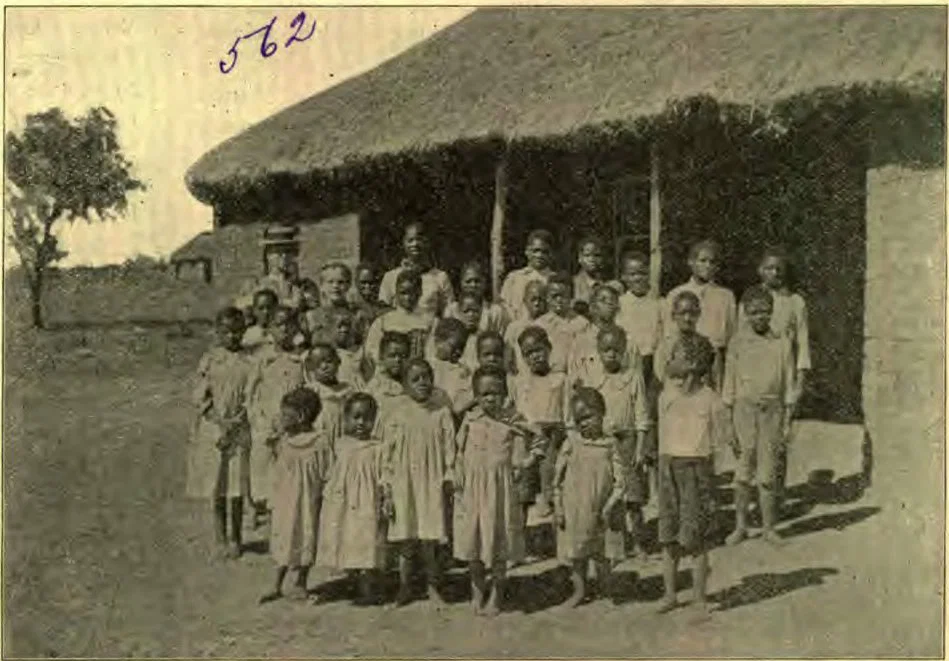
A GROUP OF AFRICAN ORPHANS
WHEN the people of Aniwa, one of the New Hebrides Islands, became Christians, the habits of morning and evening family prayer and of grace at meat took a wonderful hold upon them, and became a distinctive badge of the Christian.
This was strikingly manifest during a time of bitter scarcity that befell us. I heard a father, for instance, at his hut door, with his family around him, reverently blessing God for the food provided for them, and for all his mercies in Christ Jesus. Drawing near and conversing with them, I found that their meals consisted of fig-leaves, which they had gathered and cooked—a poor enough dish, but hunger makes a healthy appetite, and contentment is a grateful relish.
During the same period of privation, my orphans suffered badly also. Once they came to me, saying: “Missi, we are very hungry.”
“So am I, dear children,” I replied, “and we shall have no more white food till the ‘Day-spring’ comes.”
“Missi,” they continued, “you have two beautiful fig-trees. Will you let us take one feast of the young and tender leaves? We will not injure branch or fruit.”
“Gladly, my children,” I answered; “take your fill!”
In a twinkling each child was perched upon a branch; they feasted there as happy as squirrels.
Every night we prayed for the vessel, and in the morning our orphan boys rushed to the coral rocks and eagerly scanned the sea for an answer. Day after day they returned with sad faces, saying: “Missi, Tavaka jimra!” (No vessel yet.)
But at gray dawn of a certain day we were awakened by the boys shouting from the shore, and running for the mission house with the cry: “Tavaka oa! Tavaka oa!” (The vessel, hurrah!)
I arose at once, and looking through my glass, I saw that they were discharging goods into the vessel’s boats; and the children, when I told them that boxes and bags and casks were being sent on shore, shouted and danced with delight. As the first boat-load was discharged, the orphans surrounded me, saying: “Missi, here is a cask that rattles like biscuits. May we take it to the mission house?”
I told them to do so if they could; and in a moment it was turned into the path, and the boys had it flying before them, some tumbling and hurting their knees, but they were soon up and at it again, never pausing until it rolled up at the door of our storehouse. On returning, I found them all around it, and they said: “Missi, have you forgotten what you promised us?”
“What did I promise you?” I asked.
“Missi has forgot,” they whispered to one another, looking much disappointed.
“Forgot what?” I inquired.
“Missi,” they replied, “you promised that when the vessel came, you would give each of us a biscuit.”
“Oh,” I said, “I did not forget; I only wanted to see if you remembered it.”
“No fear of that, Missi!” they said, laughing. “Will you soon open the cask? We are dying for biscuits!”
At once I got a hammer and tools, knocked off the hoops, took off one end, and then gave each girl and boy a biscuit. To my surprise they all stood around, biscuit in hand, not one beginning to eat.
“What,” I exclaimed, “you are dying for biscuits! Why don’t you eat? Are you expecting another?”
“We will first thank God for sending us food,” one of the eldest said, “and ask him to bless it to us all.”
And this was done in their own simple and beautiful and childlike way; and then they did eat, and enjoyed their food as a gift from the heavenly Father’s hand.
We ourselves at the mission house could very heartily rejoice with the dear orphans. For some weeks past our European food had all been exhausted, except a little tea; and the cocoanut had been our chief support. It was beginning to tell against us. Our souls rose in gratitude to the Lord, who had sent these fresh provisions that we might love him better and serve him more.—From “The Story of John G. Paton,” by Belle M. Brain.
Hungry for Kisses
Two young girls had gone to the orphan asylum one Sabbath afternoon to teach in the Sabbath-school there as substitutes for regular teachers who were absent. One of them taught the infant class, and when the lessons were over, a little blue-eyed tot caught hold of the girl's dress, and, looking up, whispered pleadingly: “Please, teacher, won't you kiss me?”
“To be sure I will, you dear baby!” the girl cried, and, dropping down on one of the low benches, she drew the child close and kissed her again and again. In an instant the others swarmed about, boys and girls alike holding up hungry faces for kisses. The girl's eyes filled with quick tears as she looked into the eager little faces.
Her friend, who had taught an older class, stood at the door of the infant room, looking on, half-laughing, half-impatient.
“Do come along, Helen,” she called at last, and, as Helen gently put aside the little, warm, clinging fingers and joined her, the other girl exclaimed, with a touch of scorn: “I don't see how you could have all those mussy little things hugging and kissing you! See how they've tumbled your dress!”
Helen glanced down at her dress; it surely had suffered from the little loving hands, but her eyes were shining through a mist of tears as she gently answered: “You know they have no mothers to kiss them, Gertie.”
Somehow Gertie could find no answer for that, and as the two reached the street, Helen went on: “Did you notice Sadie Burns, the little brown-eyed thing with the blue veins on her forehead?”
“The one that clung to your dress to the last minute?”
“Yes, that was Sadie. The matron told me that one day when Sadie was sick, a lady who is very fond of her, and who often visits at the asylum, came to see her, and brought her a little puppy, which she thought would amuse her. Of course, the child was delighted with the puppy, and at last the lady said to her: ‘If you could have just what you want most of all for yourself, Sadie, what would it be?’ She thought the little thing would like the puppy, and she meant to give it to her, if the matron was willing; but Sadie put the dog down at once, and, stepping close to the lady, leaned on her knee, and looking up at her with those big, solemn brown eyes, she said: ‘I'd like most of anything to sit in your lap a few minutes just as if I was your own little girl.’”
Gertie turned impulsively to her friend. “I never imagined they felt so, Helen,” she said, remorsefully.
“They don't all, of course,” Helen answered; “but I know that some do, and I can not bear to think of little children going hungry for kisses. I can't give them mother kisses, but I do the best I can, even if my dress does suffer a little.”—Christian Endeavor World.
A Talk with Jesus
By G. B. Thompson
WOULD you not like to have lived when Jesus was here on earth, and had the privilege of talking with him, and hearing the loving words that fell from his lips? Many of the youth would, I know, and older ones as well. While this privilege is not theirs, yet, if desired, all may have a talk with him every day, through reading his Word. The Bible is the word of the Lord, and were Jesus on earth to-day, he would say the same heavenly and beautiful things that he said when he lived here. We can always have these precious words with us. At any time we can pause and have a little talk with the Master. Even when we walk by the way, like Mary of old, we can be learning of him.
When on the earth, as his cruel death on the cross drew near, his heart was drawn out to his disciples in this trying hour, and he gave them special instruction for that time, and talked to them about his death. Were he here now, among the things upon which he would give us special instruction would be that of his soon second coming, and the preparation necessary to stand through the dark hours of that time.
The Bible is a wonderful book. It is like no other book in the world. The more you read it, the newer it seems. It tells us of things past, things present, and of things to come. It contains truths so wonderful that the shining angels around the throne desire to look into the things which it contains. We are told so in 1 Peter 1:9-12. Look up this scripture and read it. And if angels who look into the very face of God are interested in the study of his Word, is it not wicked for us to neglect to study it? There is eternal life in this wonderful volume. Let it be your daily companion. G. B. THOMPSON.
Evening Reflections on Friends and Future Reunion
By Lillie George
Evening
WHAT can be compared to the evening? The sublimity and quietness that settles down upon nature makes itself a part of us. It is then one feels impressed, yes, inspired, by something nobler and grander. He would rise above his surroundings, and fly away to regions beyond. This he can accomplish in imagination, if not in reality. There is a balm in the air which soothes the ruffled feelings; a calm steals over one, and he is composed,— but only for a short time. There comes a yearning, a longing, which can not be satisfied. The inmost soul cries out for sympathy. It is not caused by lack of attention from those around—far from it; it is a grasping, a reaching after something one can not have. He feels keenly the absence of precious links which form the chain of life. The mind reverts to now distant friends of the past—distant in space, but not in thought. He longs to see them; since this is impossible, the mind marshals its forces, and a panoramic view of friendships passes before him, presenting each scene in the scale of importance.
One may thus spend a long time ruminating and digging up hidden joys and sorrows. While thus silently conversing with past associates, the evening has blended with her darker sister, Night. On awakening from dreaming, the bright assurance comes that though the friends of memory may be seen on this earth no more, there will be a happy reunion when Jesus assembles his children in the earth made new. LILLIE GEORGE.
Why Another Was Promoted
THE young people who are inclined to hold “luck” or a “pull” responsible for the fact that their business associates are advanced while they occupy the same position at the same salary, are invited to ponder the following incident related in Success:—
“I feel deeply hurt,” said a faithful and trusted clerk, “that you should promote one of my juniors right over my head. I do not wish to seem impertinent, but would very much like to know the reason.”
“What is making all that noise in front of the store?” suddenly asked the manager, without seeming to notice the clerk’s protest. “Please ascertain at once.”
“It is a lot of wagons going by,” said the clerk, when he returned.
“What are they loaded with so heavily?”
“They are loaded with wheat,” was the reply, after a second trip had been made to the front of the building.
“How many are there?”
“Sixteen,” was the third reply.
“Find where they come from.”
Ten minutes later the information came that all the wagons were from Lucena.
“Very good,” said the manager. “Now call John, whom I have promoted; then take a seat and listen.”
“Will you see what is the meaning of that rumbling noise in front?” he continued, when John appeared.
“It is unnecessary,” was the reply, “for I have already ascertained that it is caused by sixteen wagons loaded with wheat. Twenty more will pass to-morrow. They all belong to Romero & Co., of Lucena, and are on their way to Marchesa, where wheat is selling at $1.25 a bushel, while it only costs $1 at Lucena. The wagons carry 100 bushels each, and get 15 cents a bushel for hauling.”
“My friend,” said the manager, turning to the old clerk, “you see now why John was promoted over you.”—Selected.
Heard in the Street
What Was Said:
Our cook makes a lovely pudding.
She is the best of any of them.
Less we take a drive.
Thank you, I will be happy to go.
She sang two or three little German songs.
When Eleanor comes, she’ll liven things up.
You hadn’t ought to have told her.
When I first began, I was slow.
I’m in first-rate shape for work now.
Sposen he don’t come, what then?
I get so het up that I can’t hardly breathe.
Not as I know of.
He’s not a reliable party.
Did he say whether he could fill them orders to-day?
I never said nothing about it.
She’s the beautifulest girl in the city.
If you tease, you’ll stay to home next time I go shopping.
The whole of my rose-bushes died last winter.
I went for to get a new hat.
We are using karosene oil for fuel.
I haven’t got any money.
Can I go with you?
If it rains Tuesday, would I come?
’Tain’t no use to get mad about it.
How be you going to church?
She’s the most aggravating woman I know.
What Should Have Been Said:
Our cook makes a delicious pudding.
She is the best of them all.
Let’s or [Let us] take a drive.
Thank you, I shall be happy to go.
She sang two or three little German songs.
When Eleanor comes, she’ll enliven things.
You ought not to have told her.
When I began, I was slow.
I’m in first-class condition for work now.
Suppose that he doesn’t come, what then?
I get so heated that I can hardly breathe.
Not that I know of.
He’s not a trustworthy person.
Did he say whether he could fill those orders to-day?
I never said anything about it.
She’s the most beautiful girl in the city.
If you tease, you’ll stay at home the next time I go shopping.
All my rose-bushes died last winter.
I went to get a new hat.
We are using kerosene oil for fuel.
I have no money.
May I go with you?
If it rains Tuesday, shall I come?
It’s of no use [or useless] to get angry about it.
How are you going to church?
She’s the most irritating woman I know.— Selected.