There is no art about developing: it is pure science. Some amateurs look upon it as drudgery, and send their plates to a professional photographer to be developed; one who thus slights a part of the work will never have the success he might attain if he did it all himself.
Before closing the dark-room, everything should be in readiness to begin work. The fixing bath should be prepared, the developer mixed and in the tray, and the washing-box or miscellaneous tray filled with water; it will also be well to have a small vessel of water to use should an emergency arise. Often it is necessary to dilute the developer, or mix a fresh one; and unless you have water in the dark-room, you may have trouble.
After the dark-room has been closed, it is well to wait a few minutes before beginning to develop. When your eyes become accustomed to the dim light, you will be able to see much more clearly than at first. If your plate-holder contains an exposed and an unexposed plate, you must be careful not to get the wrong one. One side of the dark slide is always marked. This side should be turned in when loading the plate-holder; but when it is replaced after an exposure, it should be reversed.
Remove the plate from the holder, and drop it into the developer, film side up. Rock the tray quickly once or twice, to make sure that the developer covers the entire plate, else some spot may remain untouched. Sometimes an air-bell, or bubble, will form on the surface of the film. If this is allowed to remain for even a few seconds, it will leave its mark on the negative; for the part it covers will protect the film from the developer till it breaks. The rest of the plate will have such a start by that time that the protected spot will never “catch up.” But if the tray is rocked vigorously for a few minutes, there will be no danger from this source. The developer, flowing back and forth over the plate, will sweep away any air-bells that may form.
Some photographers rock the tray continuously while the plate is developing. This is advisable if pyro. is used, but it need not be done with any of the developers I have recommended, though it is well to rock the tray occasionally.
If the plate has had a normal exposure, it will soon begin to turn dark in the high lights,—the spots where the image of white or light-colored objects fell. The half-tones and the shadows will quickly follow the high lights; and all the detail of the negative will appear long before the development is complete. No definite rule by which to tell when a plate has been sufficiently developed, can be given. That is something you must use your own judgment about; and judgment, you know, must be acquired by experience.
The negative should frequently be examined by transmitted light; this is done by holding the plate between the eyes and the dark-room lantern. When the high lights are quite black, and the detail is only faintly visible in the shadows, the negative is generally ready for the fixing bath. With some plates the development is complete when a faint image of the high lights can be seen on the back of the plate, when examined by reflected light. After a little experience, you will have no trouble in125deciding upon the proper time to stop the development. If you are in doubt, it is best to err on the side of over-development, as that can be readily corrected.
It is impossible to tell how long it will take to develop a plate. That will depend on the brand of plates and the developer used, and on the subject photographed and the time of exposure. With a properly exposed plate and a normal developer, it should take ten or twelve minutes. If the plate has been exposed a longer or shorter time than it should have been, the time required for development will be increased.
To tell whether a plate has been over- or under-timed is often perplexing to the beginner. In an under-timed plate the high lights will appear quickly, and will be quite strong and black before the shadows can be seen at all. When the plate has received the right exposure, the high lights will develop first; but they will be not more than fairly started before the half-tones will begin to be seen. The shadows come next, and all will gain density in correct proportion. An over-timed plate, when placed in the developer, will slowly darken all over, and will show little or no detail until examined by transmitted light. If a plate is known to be over-timed before development begins, it may, unless too far wrong, be almost wholly corrected in development. Even after the plate is in the developer, and the first symptoms of over-exposure are seen, it may be greatly helped. More will be said on this subject at another time.
When the plate is developed, the back — the glass side — will have a dirty white appearance. The plate should be immersed in the fixing bath until all this white disappears. It is well to leave it a few minutes longer to insure thorough fixing. There is no danger of leaving it too long; and once the plate reaches the fixing bath, it is beyond danger of injury from light; so the dark-room may be fearlessly opened. After the plate is fixed, the chemicals must be washed out of the film by soaking it in water for three quarters of an hour. If you use a shallow tray, the water should be changed once or twice; but if you have a washing-box, this will be unnecessary. When thoroughly washed, the surface of the film should be carefully wiped with a roll of wet absorbent cotton to remove any particles of foreign matter that may adhere to it. The negative may then be placed in the rack to dry. Do not attempt to dry it in the sun or near a fire, as the film melts at a low temperature while wet.
Developing is to me the most interesting part of the photographic process. There is another kind of developing, in another science; and as I compare the two, I am surprised at their many points of similarity.
We carefully mix the chemicals that make our developer, pour them on the plate, and watch the result. If we have made no mistake, there comes forth a picture that delights, not only ourselves, but every one who sees it. God never makes a mistake. He never exposes us to temptation too long. His blessings always contain the right proportion of joy and sorrow, of hope and fear, of temptation and triumph; for he knows the needs of every soul.
When we have spared no pains to make our negative a success, and through some accident it turns out a failure, we are disappointed and sad. So when we receive God's blessings in vain, and under them develop an evil character, the hosts of heaven turn away in sadness, and the Saviour mourns, not for his wasted blessings, but for the sorrow that each disobedient child is bringing upon himself.
J. EDGAR ROSS.
DR. O. C. GODSMARK
By Dr. O. C. Godsmark
ASTRONOMICAL STUDY—NO. 4
Orion
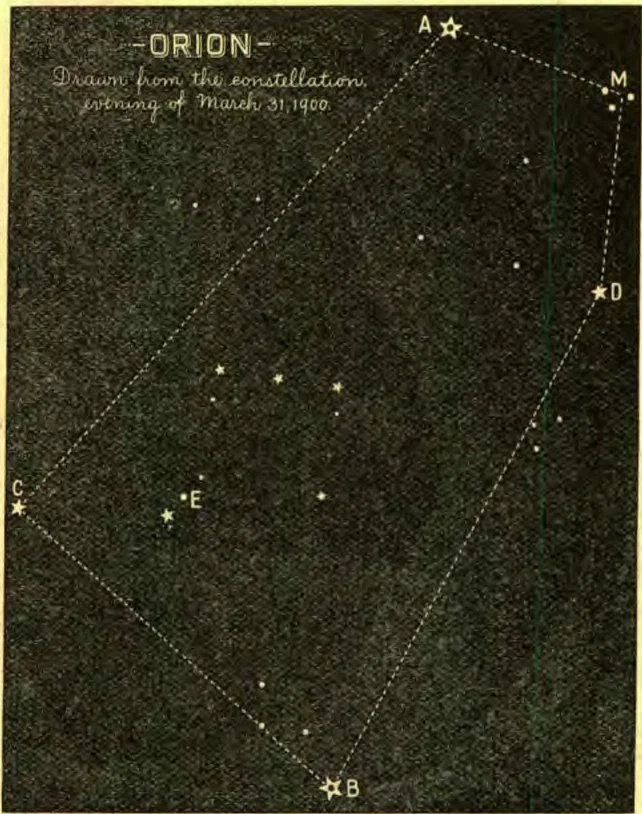
ORION, the most beautiful constellation of our northern heavens, is now the most conspicuous collection of suns to be seen, during the early evening hours, in our western sky. By noticing the accompanying illustration, no trouble need be had in definitely locating this remarkable portion of our field of study. We shall learn some very interesting facts regarding this special constellation before it sets too early in the evening to afford favorable observation. The Lord calls the special attention of his people to this constellation; the reason for this we shall better understand as we learn more about this subject. “Canst thou bind the sweet influences of the Pleiades [a small group of seven stars, known also as “the seven sisters,” lying a little north and west of Orion], or loose the bands of Orion?” asked the Lord of Job.
To the imaginative minds of the ancient astronomers, Orion was a gigantic being, bending upon one knee, holding in one hand the head of a slain lion, and in the other brandishing a large club, ready to meet the fierce charge being made upon him by the constellation Taurus, the bull,—whose flaming eye is the red or orange-colored star Aldebaran, lying still farther to the west. This worship of the twelve signs of the zodiac, mentioned in 2 Kings 23:4, 5 (please read), consisted of the most abominable heathen practices.
Orion is outlined by four principal stars and one group, as will be seen in the illustration, which shows the position of the constellation as it appears during April. “A,” Betelguese, at the upper left-hand corner, is a variable, orange-colored star, or sun, of the first magnitude; “B,” Rigel, at the lower right-hand corner, is also a star of the first magnitude; “C,” Saiph, a star of the second magnitude, marks the lower left-hand corner; while “D,” Bellatrix, also a star of the second magnitude, marks the upper right-hand corner of this remarkable constellation. The apex of the triangle, or head of the giant, marked “M,” is a beautiful cluster of lesser stars. Under the eye of our larger telescopes, this cluster becomes a bewildering blaze of glorious illumination. Near the center of the group is a line of three bright stars which, being nearly equidistant from one another, and, at this season, lying nearly horizontal, form a conspicuous part of the constellation; this is known as the belt of Orion. A little below, and forming a nearly perpendicular line with the constellation, hangs the sword of this mythical giant. This sword is composed of three stars, the lower one having a much smaller companion, which can be seen by the sharp eyes of our younger readers. The central star, marked “E,” is known as Theta of Orion. To every Christian who is looking for the soon coming of our Saviour to this earth again, this star marks an important point in the heavens; for it is here, we are told in that interesting little book, “Early Writings,” that the city of God will appear at the end of the one thousand years. To the naked eye, this star marks the location of what is known as the great nebula of Orion, which is so different from all other nebulae as to be a matter of much scientific investigation and comment.
In our next study we will spend the whole hour learning what we can of this interesting phenomenon. Compare the engraving with the constellation, and get the position of the different stars firmly fixed in the mind; for in a few weeks the sun will have reached a point, in his apparent eastward course in the starry vault, that will make actual observation of this group impossible before next fall, unless we sit up very late at night,—a thing we trust none of our class will do.
By the time the sun gives us that much-looked-for eclipse, on the morning of May 28, he will have passed so far toward the east in his yearly journey among the stars as to reach a point somewhat below and to the east of the Pleiades, or seven sisters, and to the west of Orion. It must be remembered, however, that as that eclipse is to take place in the morning, the portion of the heavens that we now study in the early evening will be in the eastern sky at that time of day. This seeming change in the direction of its location is due to the diurnal revolution of our earth upon its own axis, which simple problem will afford a pleasant hour’s study for some future evening.
DR. O. C. GODSMARK
GOOD-BY
By Minnie Rosilla Stevens
Good-by! for now our paths divide;
I leave you with a sigh;
But earthly joys all have an end,
And so we say, Good-by.
O raindrops! murmuring as you fall,
Your lonely voices tell
Of cloudy home you sadly left,
With many a fond farewell.
And gently, softly, pattering down
You weep in sympathy
With hearts that say Good-by to those
Whom they have loved to see.
But some fair day the sun will call
The little raindrops home
To some great, fleecy, snow-white cloud
Afloat in heaven's dome.
So as they patter softly down,
The voices of the rain
To us do whisper of a time
When we shall meet again.
Minnie Rosilla Stevens.
THE CROWN OF MODERN FICTION
By Frank Houghtaling
THIS is the double-column heading given to the article that told of an address by W. F. Stewart, in a leading church of Detroit, Mich., on a recent Sunday night. The subject was a popular religious novel.
Mr. Stewart says, in substance, that times are different now than they were formerly. Though novels were once looked upon as inventions of the devil, he declares that to-day nothing is doing greater good in the world. He further says that he questions the brilliancy of the intellect of the person who comes to him with the statement that he never read a novel. He gives the novelist a dignified seat by the side of the historian, and says that the Christian story is the crown of modern fiction. As proof of this, he calls attention to the fact that the ministry and the religious press quote and copy copiously from these “crowns.”
It is evident that what gives the novelist and his production their dignified position at the present day, is not the fact that they are any better than they were formerly; but that the people, by long reading of just such literature, have slid down to a low level in thought and conscience.
The “Christian” novel is one of the favorite instruments the devil uses to prepare the minds of the people for the conditions of society that exist in the last days. It weakens the intellect, takes up the time, and distracts the mind from doing the work God has given each one to do. It is written so entertainingly that the average novel reader will not pass it by, but will readily assimilate its false principles. There is just enough good in it to give it free passport into many Christian families.
There are no good novels. The devil mixes only enough good with his various schemes to get the well-meaning to partake of the poison he has hidden in them. The novel under discussion gives the revolting details of the base practices of Nero’s court, and paints in horrible pictures the suffering and martyrdom of thousands of Christians during his reign. Of course the author shows the sudden and violent end of the chief sinners, and the remarkable composure and fortitude of the Christians; but there is engendered in the reader no longing for the saving of souls.
A novel usually takes many pages to bring out a principle expressed in few words in the Bible. The novel is at least half bad. If you say you will take the good, and leave the bad, I would ask, How are you to distinguish the one from the other unless you first learn it from the Bible? And if you have already learned it, why spend so much time taking in thoughts, ideas, suggestions, and temptations that you must reject or overcome?
FRANK HOUGHTALING.
THE ENCIRCLING ARMS
The baby was taking his first steps, faltering and uncertain; but he was a very proud baby, laughing and crowing over his own achievement as he tottered across the carpet with his mother following, her outstretched arms surrounding but not touching him.
“He thinks that he is doing it all alone,” said grandfather.
“And so he is,” the mother answered. “I am not carrying him, I am not hindering him; my arms are only so close that I can catch him in a moment if he falls.”
So it is that we older children walk, and fancy often that we are going on our way alone. God does not hold us back as we turn in one direction or another. He does not carry us; step by step we must make our own way, but always his loving arms are close to uphold us if we fall. Sometimes we are proud of our strength and freedom, sometimes in our weakness we fear and falter,—but our changing moods never change the guarding care that enfolds us. Unseen, unfelt, the everlasting arms surround us, and we can not fall beyond their upholding strength and tenderness.—Selected.
THE FALL OF MAN
By M. E. Cady
ADAM and Eve, in their innocence and purity, were placed in the garden of Eden, not to idle away their time, but to improve it in dressing the garden and keeping it beautiful. Perfect harmony reigned throughout the earth. As we look about us now, we do not see the peace and harmony that are pictured in the word of God. What has brought about this great change? By reading the second and third chapters of Genesis we learn the reason for the present sad condition of things. God could have created Adam and Eve as machines, who could do nothing wrong; but such service is not pleasing to God, so he gave to man the opportunity of choosing between good and evil. Of the fruit of all the trees in the garden they were privileged to eat, except that of the tree of knowledge of good and evil. The tree of life, which was to perpetuate their existence, stood near the tree of knowledge of good and evil; and of its fruit they were allowed freely to partake. The simple test of loyalty which the Lord placed upon our first parents was that they abstain from the forbidden fruit. It seems to us like a very simple thing, yet we all know that when our parents or teachers ask us not to do this or that, we are curious to know the reason. This was the way with Adam and Eve.
The serpent, the most subtle of all the beasts of the field, was used by Satan, who, before he sinned, was called Lucifer, which means “the light-bearer,” to tempt Adam and Eve. After Satan sinned, he was not contented unless he was doing something to cause others to share his own fate. He influenced many angels in heaven to rebel against God, and then he went to other worlds to deceive their inhabitants, and lead them away from their Creator. As soon as God had finished his work in this world, Satan visited the garden of Eden, and tempted Adam and Eve to disregard the command of God with reference to the tree of knowledge of good and evil.
Eve was admiring the fruit of the tree of knowledge of good and evil when the serpent spoke to her, and told her that what the Lord had said about the effect of eating the fruit was not true; but that it would make her wise. It was not long before Eve was eating the fruit, and urging Adam to partake of it.
After they had disobeyed the command of the Lord, Adam and Eve felt guilty, and lost their peace of mind. When they heard the voice of God, they hid themselves instead of welcoming their Creator as they had always done before.
The penalty for disobeying the command of God was death. Adam and Eve had sinned, and the seeds of death were planted in their127being. With the curse of God resting upon them, they were driven from the garden of Eden. The earth was also cursed in consequence of the sin of our first parents.
Let us notice a few of the ways in which the curse of God has rested upon the earth on account of the disobedience of our first parents. First, the human family has degenerated so that instead of living nearly a thousand years, the average life of man at the present time is about thirty-five years. Man has greatly decreased in size and in vitality. Disease of every kind and description preys upon men and women everywhere. Secondly, the plant world is marred by thorns, thistles, and briers. The Lord told Adam that the ground should bring forth thorns and thistles, and that by the sweat of his brow man should obtain bread. Thirdly, the animal kingdom has degenerated, and the giant animals that lived in the days of Noah, have become extinct or much smaller in size. Not only has there been a physical degeneration; but a spirit of antagonism, quarrelling, fighting, and destroying of life prevails. All this is the result of sin. The earth itself suffers from the violence of earthquakes and volcanoes, and thousands of human lives are sacrificed by these visitations. Great tidal waves sweep across the ocean, and destroy whole cities and villages. The very atmosphere has in it the spirit of evil, as shown by the cyclones, tornadoes, and whirlwinds that visit the earth. Even the sun, which was appointed to be the ruler of the day, and to dispense life and blessing to the inhabitants of the earth, gives out intense heat, so that thousands of lives are sacrificed by what we call sunstroke. Truly we can understand the words of Paul, “The whole creation groaneth.”
M. E. CADY.
MERIT OBSCURES THE COLOR LINE
“We have a good creamery and dairy at Tuskegee,” said Booker T. Washington, who is president of that institution. “It is in charge of a colored man who is one of our most capable teachers. Under his instruction, classes of young men learn the best modern methods of dairy work.
“It came to our knowledge that the owner of a certain creamery wished to hire a superintendent. We had recently graduated a man who was thoroughly capable of filling the place in every way, but he was just about as black as it is possible for a man to be. We sent him on, to apply for the position.
“When he made his appearance before the owners of the creamery, they said: ‘A colored man? Oh, that would never do, you know.’
“The applicant for the position said very politely that he had not gone there to talk about his color, but about making butter. His hearers said it was out of the question to hire a colored man for the place. Our graduate still declined to talk about any color except butter color and similar details of dairy work. Finally, something he said happened to attract the attention of the owners, and they said he might stay for a two weeks’ trial, although they still assured him that it was out of the question for him to think of being hired.
“Well, the first week’s make of butter was shipped; and when the returns were received—would you believe it?— that butter had sold for two cents a pound more than any product ever before sold from that creamery.
“The owners said to each other, ‘Now, this is very singular,’ and waited for the second week. When that week’s product was heard from, it was found that the butter had sold for a cent a pound more than that of the week before—three cents a pound more than the creamery’s best record before our man had taken hold of it!
“This time the owners of the establishment did not say anything. They just put that extra and unexpected dividend into their pockets, and hired that colored man to run the creamery for a year. Three cents a pound on the price of the butter he could make had knocked every bit of color out of his skin, as far as they were concerned.”
A BUNCH OF VIOLETS
By Miriam E. Webber
'Twas a little hand that held it— A bunch of violets white; And a little face looked upward, Eyes full of tenderest light: “Take it, please, teacher,” and quickly Reached out the flowers clasped tight.
I stooped to take the treasure, And answered smile with smile; They were bruised, and bent, and broken, But the giver had no guile; As sweet the gift as simple; And, turning, I mused the while.
The flowers had no less beauty, Though crushed; for like a life That the winds of the world have driven Through cruel storm and strife, They shed a precious perfume, That o'er all around was rife.
As men count worth, so worthless The childish gift might be; But as showing her loving spirit, The lowly flowers to me Were dearer than gifts far richer From one less true than she.
Time: A. D. 31. Place: Sea of Galilee. Persons: Jesus, disciples.
QUESTIONS
1. What message had been sent to the disciples by the angel at the tomb? Mark 16:7. At what point in Galilee did Jesus choose to reveal himself? John 21:1. Who were present on this occasion? V. 2.
2. What suggestion was made by Peter? How was it received by the others? What success did they have? V. 3. At what time of day did Jesus come to his disciples? Why was his presence not regarded? V. 4.
3. By what question did the Saviour introduce himself? What reply was made? V. 5. What did he request them to do? What was the result? V. 6; note 1. Seeing this, what did John exclaim? What did Peter do? V. 7. What did the other disciples do? V. 8.
4. What did they find upon reaching shore? V. 9. What request did Jesus make? V. 10. Who was first in carrying out the request? What did he find in doing so? V. 11. What invitation was then extended to all? How were they entertained by Jesus? Vs. 12, 13.
5. At the completion of the meal, what question did Jesus address to Peter? What was Peter’s humble response? What commission did Jesus then give him? V. 15. In repeating the conversation, what change did Jesus make in the charge to Peter? V. 16.
6. When Jesus the third time repeated his question, what were Peter’s feelings? What did he say? What did he again receive from Jesus? V. 17; note 2.
7. Taking Peter to one side (see “The Desire of Ages”), what did Jesus privately say to him? V. 18. To what did he refer? V. 19, first part; note 3.
8. What did Jesus then command him? V. 19, last part. What did Peter notice as he obeyed? What did he say? Vs. 20, 21. What words of correction did Jesus then utter? V. 22. What misconstruction was placed upon his words? V. 23.
NOTES
1. This was the second time that Jesus directly commanded his disciples to let down their nets. The object of both occasions was to impress on their minds deep spiritual lessons concerning their relation to his work. On the first instance (see Luke 5) he closed the lesson with the thought, “From henceforth thou shalt catch men.” Just as, in obedience to his word, they had caught fish so abundantly, so, in obedience to that same word, they would catch souls for the kingdom of God. That was in the early part of Jesus’ ministry. Now, at the close, when about to leave them, he designs first to impress once more upon their minds the fact that they are to continue in the work previously given them,—that of catching men. At the first he had said, “Launch out into the deep;” at the last he commands, “Cast the net on the right side.” He who, in the fear of God, launches out into the very deeps of human experience, and casts his net on the right side of the ship of life, will find his efforts successful; he will have souls for his hire.
2. The second great object of this third meeting was to take Peter, who had so cruelly denied his Lord, and whom his brethren considered unfit for the gospel ministry, and reinstate him in the work of God. Three times he had denied Jesus, and three times the question came, “Lovest thou me?” In the presence of his brethren Peter confessed his sin and his love for Christ, thus removing, as far as he could, the reproach he had brought upon his Master’s service. And then Jesus gave to him the tenderest work that can be committed to mothers,—that of feeding the lambs and the sheep. By comparing this commission with the words of Luke 22:31, 32, it will be seen that Peter was now thoroughly converted, ready for his lifework. All his self-assertiveness was gone; and his work on the day of Pentecost, when three thousand were converted, shows that Peter, when changed, was a wonderful instrument in the hands of God for saving souls. Oh that we may be as truly converted, that we may know the same experience!
3. It is said by the Spirit of the Lord that Peter never forgot his terrible denial of Jesus, and was so humbled thereby that when his time came to be crucified, he requested to be fastened to the cross head downward, feeling unworthy to take the same position that Jesus had. He was therefore placed on the cross in that position.
Life and Work of DWIGHT L. MOODY
Official and only authentic edition. Written by his son, WM. R. MOODY, and IRA D. SANKEY, his lifelong associate and friend.
100,000 AGENTS WANTED AT ONCE. Liberal terms. Freight paid. Credit given. A golden opportunity for you. Outfit free. Write to-day.
P. W. ZIEGLER & CO., 324 Dearborn St., Chicago.
To Reach BATTLE CREEK
FROM
CHICAGO, BUFFALO, DETROIT, OR TOLEDO,
Purchase Tickets Reading over the MICHIGAN CENTRAL
“The Niagara Falls Route.”
A First-class Line for First-class Travel between Chicago and New York and Boston. Elegantly equipped through trains pass Battle Creek in each direction daily.
R. N. R. WHEELER, Ticket Agent, Battle Creek.
O. W. RUGGLES, Gen’l P. and T. Agt., Chicago, Ill.
TAKE THE Canadian Pacific Railway
for . . . CHATHAM, OTTAWA, MONTREAL, LONDON, GALT, QUEBEC, WOODSTOCK, TORONTO, BOSTON, PORTLAND, and
All points in New England, the Maritime Provinces, Great Britain, and the Continent.
Illustrated literature, time-tables, and full particulars, upon application to—
J. FRANCIS LEE, GEN. AGENT,
Passenger Dep't. 228 SOUTH CLARK ST., CHICAGO
Branch Offices: 76 Ottawa St., Grand Rapids, Mich. Room D, Chamber of Commerce, Cincinnati, Ohio. 315 Chestnut St., St. Louis, Mo.
Cincinnati Northern Railroad Co.
TIME TABLE NO. 3.
IN EFFECT SEPT. 24, 1899.
Trains Pass Battle Creek, as follows:
WEST-BOUND.
No. 21, Mail and Express ........................ 6.58 P. M.
No. 23, Accommodation .......................... 2.07 P. M.
No. 27, Local Freight ............................. 8.25 A. M.
EAST-BOUND.
No. 22, Mail and Express ........................ 8.25 A. M.
No. 24, Accommodation .......................... 1.45 P. M.
No. 28, Local Freight ............................. 5.30 P. M.
Direct connections are made at Toledo with all roads diverging. Close connections for Detroit and Cincinnati.
J. L. READE, Ticket Agt., Battle Creek.
B. R. SMITH, City Pass. Agt., 6 West Main St.
CHICAGO & GRAND TRUNK R'Y
E. W. Meddaugh and Henry B. Joy, Receivers.
CHICAGO & GRAND TRUNK R'Y.
Trains arrive and leave Battle Creek.
WEST-BOUND FROM BATTLE CREEK.
No. 9, Mail and Express, to Chicago 12.15 P. M.
No. 1, Chicago Express, to Chicago 9.00 A. M.
No. 3, Lehigh Valley Express, to Chicago 3.40 P. M.
No. 5, Pacific Express, to Chicago, with sleeper 1.10 A. M.
No. 75, Mixed, to South Bend 8.20 A. M.
Nos. 9 and 75, daily, except Sunday.
Nos. 1, 3, and 5, daily.
EAST-BOUND FROM BATTLE CREEK.
No. 8, Mail and Express, to Pt. Huron, East, and Detroit 3.45 P. M.
No. 4, Lehigh Express, to Port Huron, and East 8.27 P. M.
No. 6, Atlantic Express, to Port Huron, East, and Detroit 2.25 A. M.
No. 2, Leh. Exp., to Saginaw, Bay City, Pt. Huron, and East 6.50 A. M.
No. 74, Mixed, to Durand (starts at Nichols) 7.15 A. M.
Nos. 8 and 74, daily, except Sunday.
Nos. 4, 6, and 2, daily.
A. S. PARKER, Ticket Agent, Battle Creek.
Self-Pronouncing S. S. Teachers’ Reference Bible.
CONTAINS the celebrated Teachers’ Helps, comprising nearly 400 pages. Also a complete series of fifteen new maps.
Description. — Imperial Seal Binding, Tuck Edges, known as “Divinity Circuit,” Rounded Corners, Full Red under Gilt Edges.
We offer this Bible, post-paid, for only SIX NEW YEARLY SUBSCRIPTIONS at 75 cents; or TWELVE NEW SIX MONTHS’ SUBSCRIPTIONS at 40 cents.
We will also send it, post-paid, with the INSTRUCTOR one year for $2.25. For 20 cents extra we will stamp your name in gold upon the cover.