The Youth’s Instructor, Vol. 48, No. 16.

BEAUTIES OF SOUTHERN CALIFORNIA — I

The Youth’s Instructor

Apr 19, 1900

Review and Herald Publishing Company · Battle Creek, Mich. · Apr 19, 1900

BEAUTIES OF SOUTHERN CALIFORNIA — I
As we read this series of articles, we should remember that it is the beauties, and not the defects, that we are now to dwell upon. If this is done, we shall simply be brought to realize that the Originator of beauty, regardless of the traces of sin, has left some marks of his Eden handiwork in this extreme corner of his great vineyard.
If upon entering a garden that nature has profusely decked with her garb of flowers, we should mourn because of the entrance of sin, and continually look for its traces, the place would soon appear infested with the monster; the thorns would seem never so sharp, and the thistles never more prickly. But on the other hand, were we looking for the beauties, the defects would sink into their proper place in the background.
However, Southern California is by no means a garden of perpetual fruit and flowers.
South of Point Conception a range of mountains follows the inland turn of the coast; this range is met from the east by another mountain chain, and that by still others from the south, thus forming a natural fence around the greater part of this earthly paradise. The western side is protected from the dashing billows by a line of beautiful summer isles, which seem to echo the voice of their Creator, “Hitherto shalt thou come, but no further.” The land that is hemmed in by the mountains is a vast, dreary desert of sandy plains and barren mountains, seldom reached by the moisture-freighted clouds from the great Pacific. Travelers approaching the coast from the east are almost imperceptibly transported from this bleak, barren region, which knows neither song of bird nor the fragrance of flowers, into a valley radiant with perennial beauty.
This region is what is best known as Southern California proper. The fame of this part of the State, of which Los Angeles is the metropolis, and Santa Barbara and San Diego are the extreme northern and southern cities, reaches, one might almost say, to the ends of the earth. It is a land of perpetual snow—on the mountains twelve thousand feet high; and of eternal summer—in the valleys below. The climate is an element of value that is frequently placed in the background by the constant appeal to the senses. It possesses an annual mean temperature of about sixty-four degrees. During the summer months the temperature sometimes rises to a hundred degrees, and in the winter it may sink so low in certain localities as to give Jack Frost an opportunity to sway his scepter for a few short hours.
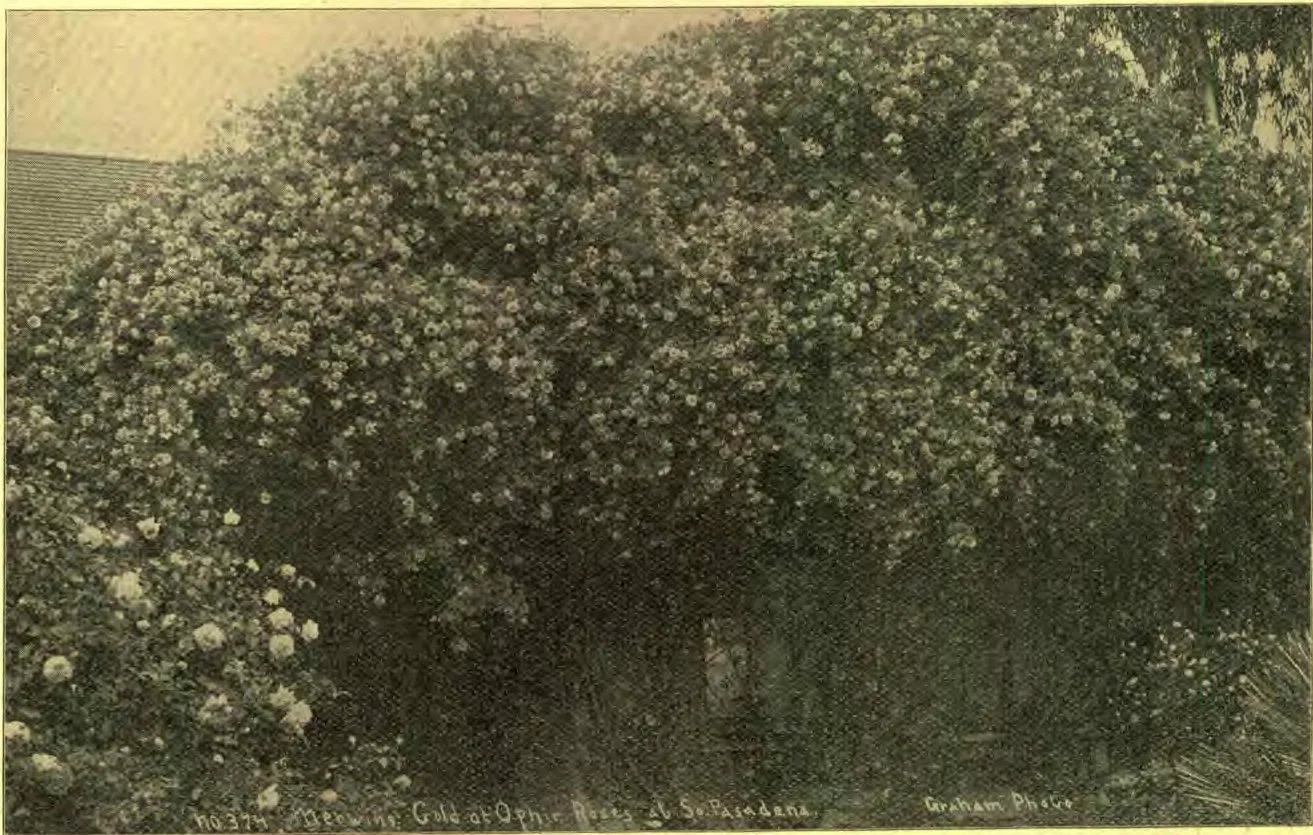
Southern California is a garden, in many corners of which flowers bloom continually. In some seasons we have a perfect riot of flowers. Calla lilies are cultivated by the acre, also carnations and roses, marvels of size, color, and perfume. In the illustration is shown a gold of Ophir rose-tree in full bloom. An estimate was made of the number of its blossoms, and it was found to have ten thousand roses on it at one time. Nothing was said to me about the thorns; it is not likely that they were counted. Could you have seen this tree, wrapped in its mantle of gold (some who live in Pasadena may have seen it), there would have been no room for a thought of aught but the beautiful.
This part of California depends largely upon fruits, grains, and the patronage of tourists for its prosperity. Having experienced three successive dry seasons, a failure of grain is expected this year; and where the irrigation is poor, fruit will not be so abundant as usual. Notwithstanding this, the tourists are flocking in by thousands, and the hotels and boarding houses are already filled with pleasure-seekers from the East. Twenty thousand is a fair estimate of the number who spent the winter months in this pleasure resort.
MRS. KATHLEEN WAGNER-GILMORE.

TREES THAT HELP SUPPLY US WITH FOOD

NONE of the trees with which I was familiar in Wisconsin are found in Raiatea, except the weeping willow, which is grown in a few private gardens. I have already mentioned the most important tree we have, the cocoanut. Other trees that help provide our food are the breadfruit, orange, lime, mango, avoca, island chestnut nut, guava, banana, papaw, or mummy apple, custard apple, mountain apple, and rose apple.
The breadfruit has leaves shaped much like those of the oak, only larger. There is no time here when all the trees shed their leaves; but the old, faded leaves fall to the ground every day. When we wish to use a fan, we can easily make one by picking up a breadfruit leaf, and trimming off the uneven edge. The stem answers for a handle. Though such a fan is not durable, soon becoming dry and brittle, and breaking to pieces, we can easily make another. The limbs of the breadfruit tree are far apart, and the bark is smooth, so it is a hard tree to climb; we frequently hear of persons falling from one, and receiving serious injury. Some of the fruit can be reached and pulled off with the aid of a long bamboo pole having a stick fastened diagonally across the end. This implement is called a row, and is much used in gathering fruit from high trees.
The fruit of the breadfruit tree is shaped much like a cocoanut, though larger. It is green outside, but a creamy white within. There is a small core in the middle, and the fleshy part outside the core—the part that is eaten—is two or three inches thick. It is vegetable in its nature, and not palatable eaten raw. Prepared by baking, boiling, or roasting, it tastes well enough; but I can not understand how any one can see in it such a resemblance to bread as some writers profess to. When first ripe, it tastes more like Irish potatoes than anything else. It comes the nearest to tasting like bread when it has become very ripe and soft; then it is like dough, and is made into a “poi,” which one might imagine to taste something like sweetened bread or bread pudding. When in this condition, the fruit is sweet, and has a strong odor, which is quite offensive to those unaccustomed to it. In time, however, most foreigners overcome their dislike for its peculiar flavor.
Nearly all are familiar with the orange, though many have never seen an orange tree laden with its beautiful, golden fruit. Though we have summer all the year round, we can not have oranges all the time; for there is a certain season for them. In this group of islands, oranges begin to ripen in February, and last until October, though there are often trees that bear out of the regular season. From April to the end of the season, we generally have all the oranges we can use, and many decay on the ground. Last August we sold from our school farm thirteen thousand oranges, at the rate of $1.25 a thousand, to be shipped to New Zealand. When the trees are in blossom, the air is filled with fragrance. Besides the glossy leaves, the branches are also covered with sharp thorns from one to two inches long, with points of a hard, transparent substance, and very strong. These thorns make excellent toothpicks. The natives use them instead of needles for piercing the ears. Fresh orange leaves are much used for making a native tea.
Lime and citron trees resemble the orange, except that the thorns are much smaller. The lemon used in the United States has not been introduced here, but the lime takes its place. For some time I could not enjoy the strong flavor of this fruit, but have grown accustomed to it now. Its juice is much used as vinegar, and some can hardly enjoy a meal without it. The juice is also used to whiten yellow hats, and unpainted floors. After a floor has been scrubbed with cocoanut husks, and well rinsed, lime juice is applied, with the result that it is much whiter than it would otherwise be. The use of the juice in this way is not an extravagance; for limes are so plentiful here that many decay, and we seldom have to buy them.
The citron looks like a lemon, only it is several times larger, and contains but little juice. The people here make little or no use of this fruit.
Another large fruit-bearing tree is the mango, which has a very dense foliage of long, narrow leaves. There are two mango seasons during the year; but the fruit is most abundant from November to February. As mangoes are very juicy, they help make up for the lack of oranges at this time. There are many varieties. One, called the peach mango, has a decidedly peachy flavor, and is considered one of the best varieties. Mangoes are oval in shape, and vary in size from those as large as a small peach to those as large as a good-sized apple.
Another useful tree is the avoca, or alligator pear. The fruit is shaped like a large pear, though I have seen some shaped more like a gourd with a long handle. The pulp seems to be quite rich, and merits the name “native butter,” which is sometimes applied to it. Those who do not have bread eat it alone as a fruit; but it is better eaten as a relish with bread. Salt can be added, according to the taste. It resembles a pear only in shape.
MRS. B. J. CADY.

BEREAN LIBRARY STUDY

Dan. 11:44, 45: “Thoughts on Daniel,” pages 281-292

NOTES ON LESSON 21

(April 22-28)
1. A Lesson on Turkey.—The week's study is the history of Turkey, spoken of in the prophecy as the king of the north. We can do no better than to give here a brief outline of the history of the Turks, leading up to that portion of their history which is the substance of the Reading Circle lesson.
2. In the Middle Ages.—The principal Asiatic nations that influenced history during that period were the Mongols and the Turks. These were races having their homes on the vast plateau of Middle Asia. One division of the Turkish race was called the Seljukian Turks, in distinction from the Ottoman Turks, so named from Othman, the founder of their empire.
3. Jerusalem Captured by the Turks.—In 1076 the Seljukian Turks captured Jerusalem. At that time a pilgrimage to the Holy City was the most popular of penances. Devout Catholics believed that to bathe in the River Jordan, to spend a night on Calvary, or to worship before the Tomb of tombs, would atone for the greatest sin; hence the paths of Asia Minor were thronged with those who were going to and fro on pilgrimages. These pilgrims were made welcome until the ferocious Turks conquered Palestine; then they were treated with every indignity that fanaticism could invent. In defense, all Europe seemed to rise as if by a common impulse, and there followed the period of the Crusades. Though these vast military expeditions failed of their direct object the obnoxious Turk being still left in possession of the Holy Land, the tide of Mohammedan conquest was no doubt checked.
4. The Turks in Europe.—In 1356 a body of the Ottoman Turks crossed the Hellespont, and gained a footing on European soil. Fifty years later, an army of two hundred and fifty thousand Turks besieged Constantinople, and battered its walls for fifty-three days, finally bursting through them. The flag of the crescent, emblem of Turkish power, then waved over the city.
5. The Turks Are Mohammedans in Faith, therefore a brief sketch of the founder of this pagan religion will be in place. Mohammed, or Mahomet, was born at Mecca about 569 A. D. Left an orphan at an early age, he became a camel driver. Afterward he married a very rich lady, and so had abundant time to indulge his fancy for meditation. At the age of forty, while musing at the mouth of a favorite cave, he claimed that the angel Gabriel visited him, and announced to him that he was the chosen prophet of God, and commissioned him to preach a new faith. Mohammed then renounced idol-worship, and proclaimed his message, the burden of which was, “There is but one God, and Mohammed is his prophet.” He was fiercely persecuted, and had to flee for his life. The new faith spread rapidly, and the leader soon found himself at the head of an army. His followers were fanatically devoted, and in their warfare displayed the greatest enthusiasm and bravery. Mohammed made known his doctrines in fragments, and these were written by his followers upon sheep-bones and palm-leaves. Abu-Bekr, the successor of Mohammed, collected the pretended revelations into the Koran, the sacred book of the Mohammedans. In a recent carefully classified list of the number of adherents to the various religions of the world to-day, the number of Mohammedans is given as one hundred and twenty-two million four hundred thousand.
6. An Interesting Interview.—In 1895, Elder A. T. Jones visited Europe; and the following account of a conversation he had while in Constantinople, is of importance in connection with our study. In his tract, “The Eastern Question,” he says: “In Constantinople, in September and October last, I met a reliable Christian man, who told me that in a conversation which he had with a Turkish judge, the judge told him that they expected, as the outcome of the dealings of the powers, that they would be dispossessed of Constantinople; that after that their capital would be Jerusalem; that against them there at last they expected the ‘Christian nations’ to come to fight; and that then Messiah and Mahomet would come. With the exception of Mahomet, this explanation, as stated by the Turkish judge, is precisely the thing that is predicted of this same time in the Scriptures of truth.”
7. A Few Questions.—Is it not a wonderful chapter? Does it not revive your faith, yes, and increase it, too, to read the accurate fulfillment of Daniel 11, in all its details? Can there be any failure in the events of verse 45, when all the forty-four verses preceding it have come to pass to the letter? Are you watching for indications of its fulfillment? Would not your friends and neighbors be interested in watching for the fulfillment of this verse, if they knew about it? Can not you tell them? Will you not tell them?

MY NEW NAME

Oh, joy! oh, bliss! for I shall see His face, And wear his blessed name upon my brow,— That name which stands for pardon, love, and grace, That name before which every knee shall bow. No music half so sweet can ever be As that dear name which he shall write for me.
Then, till I go to meet my Father's smile, I'll keep my forehead smooth from passion's scars; From angry frowns that trample and defile, And every sin that desecrates and mars, That I may lift a face unflushed with shame, Whereon my Lord may write his holy name.
— Selected.

APRIL STUDY OF THE FIELD

PART IV: “AMONG THE MAROONS:” “THE PAST YEAR IN HONOLULU;” “PROGRESS IN FIJI;” “PROGRESS IN BRAZIL”
(April 22–28)
1. Jamaica.—As this field will be treated in a series of articles in the Missionary Magazine, we have not touched upon it this week, further than the regular article for study. It may be of interest, however, to know that the last year’s report from this island shows two hundred and twenty-nine persons baptized, and one hundred more keeping the Sabbath.
2. First Work in Hawaiian Islands.—It is almost seventeen years since the third angel’s message was first carried to the Hawaiian Islands. Among the early laborers were Brethren Scott and La Rue, who engaged in colportage and missionary work. As a result several became Sabbath-keepers. Brother La Rue has since spent a number of years in China. Sister White visited Honolulu in the fall of 1891, while on her way to Australia. Although there but a short time, the vessel remaining only sixteen hours, she delivered a temperance lecture in the Y. M. C. A. hall. A number of workers have touched at these islands while on their way to other fields. Progress is reported, especially in connection with the school.
3. Latest News from Honolulu.—By many our school work in Honolulu is looked upon with peculiar interest, affording as it may an open door to China. Although this work has been retarded by the bubonic plague in that city, the greater part of the Chinese quarters being destroyed by fire, still the Chinese show a commendable interest in the school, and are pushing the erection of the new buildings as rapidly as possible. The outside work is almost entirely completed, and at the time of the last report, the workers were laying the floors and making window-frames. The following from a late letter from Prof. W. E. Howell, who has the school work in charge, will be read with interest: “In my letter to you a few days ago I said that I had about decided to return to the Coast till fall. When I was brought to the test of making preparations to leave, I could not. The Lord laid upon me a heavy burden to remain here, and I could get no peace till I decided to do so. Since then I have been happy in my decision, and in the work I am doing. I find rest in the consciousness that I am meeting the mind of the Lord in remaining here until he orders it otherwise. The field is not left entirely destitute. I have settled in a cottage near the new school, and have a class of our old boys coming every day for instruction. I am also taking lessons in Chinese. As I move about among the Chinese, they seem to appreciate my being here, even if I am not able to help them much. But I find much to do; the secretary of the Chinese consulate is getting somewhat in the habit of calling on me for help along some lines; the reform society, recently organized, has suggested giving me a column in a newspaper they are just starting, for instruction in health and the progress of the world’s events; one or two of the progressive Chinese societies desire me to lecture to them now and then. Some literature ought to be prepared to meet the present emergency, and I have partly written one leaflet, entitled, ‘What Do These Things Mean?’ Indeed, my whole time could be well spent outside the schoolroom. I hope we may some time have a girls’ school also. We have had requests for one for a year or two.”
4. Fijians without the Gospel.—Before the gospel was carried to the Fijians, they held many interesting traditions. “They believed they had originated from one pair of parents. They also told of a great flood that had inundated their world, when only eight persons were saved in a boat. They had a great festival to celebrate the ingathering of the fruits. They also believed in a second death. Their religion held them to a number of deities, one of which was the great presiding god, whom they worshiped in the form of a serpent. Connected with their religion was the most revolting type of cannibalism that the world has perhaps ever witnessed. At the building of a chief’s house, when the large posts were sunk into the ground, several men had to yield themselves, willingly or unwillingly, to be buried alive, clasping the posts of the house in their hands. At the launching of their big war canoes, men were compelled to lie down like so many stringers, and have their lives crushed as the heavy boats slid over them. Their bodies were then roasted and eaten. At their feasts, hundreds of persons were brought to the town and slaughtered like so many cattle. Polygamy was common. The chiefs might have from one to two hundred wives, the middle classes ten or twelve; while the lower class could not support more than one. The women did all the hard work. Girls were betrothed while young, and much unhappiness was caused by rival wives. At the death of the husband the wives were strangled. Infanticide was very common. When a child was weakly, or slow to recover from an illness, the mother, after an apparently tender caressing, would bring its suffering to an end by strangulation. The old and decrepit were likewise helped to depart this life. Instances are told of those who were burdensome being buried alive.” But the gospel has done much for this people. Fiji to-day does not present such a picture. As a race, the Fijians rank high physically. They are also far above many other island people intellectually. They are kind and hospitable, and will share their food to the very last morsel. Through the faithful efforts of the missionary, they have become enlightened. Cannibalism has been abolished, schools have been opened, and many have become Christians. The presentation of the third angel’s message has met bitter opposition, yet in no other island field has it made more rapid progress among native peoples.
5. Your Life-Work.—The choice of a vocation is a momentous question in the life of every young person. May it not mean even more to those who know the third angel’s message? The first thought that presents itself in making such a decision is, What obligation rests upon me that will in any way condition my choice? While we are deciding, let us remember that this life that we call ours is really God’s life; anew are we made debtor to him by every breath we draw. As a Father, he has a plan for the life of each child; and we are in his world—a lost world, to every nation, kindred, tongue, and people of which he has commissioned us to carry the closing message of mercy. Again we call him Master who has redeemed us from bondage and made us free in him. If he is indeed our Master, can we lay any plan that will not be pleasing to him? “Seek ye first the kingdom of God.” To-day there are fields white to the harvest. Where are the laborers? Can you answer?

Nature’s Garden

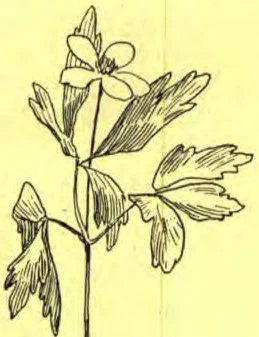
5—Wood Anemone, or Windflower
This plant is among spring’s early comers. It is called “windflower” because it comes in the windy season, and being short lived, its coming and going were formerly attributed to the wind. The leaves are characteristically wedge-shaped.
The flower is large, one inch broad, and slightly nodding. When it appears in protected nooks, it is a sure evidence that winter is gone. The blossom is white or tinted with blue.
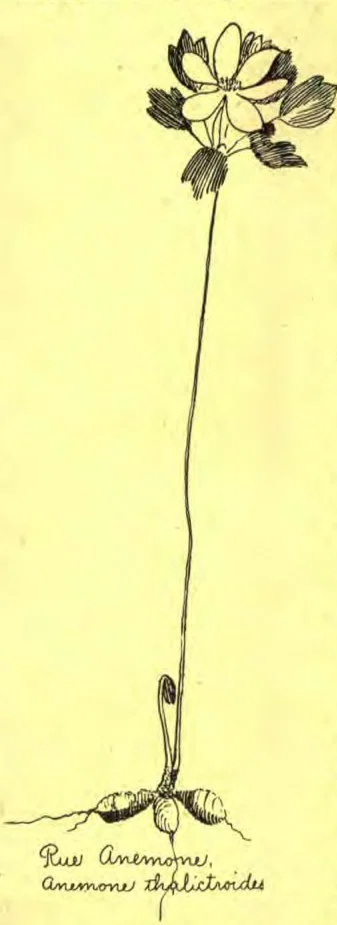
6—Rue Anemone
The rue anemone is similar to the wood anemone, and grows near it. But there is no need to confuse the two. The rue anemone bears a cluster of flowers, usually three, the central one developing first; while the wood anemone is one-flowered.
The leaves of the rue anemone are heart-shaped at the base; those of the wood anemone are wedge-shaped.
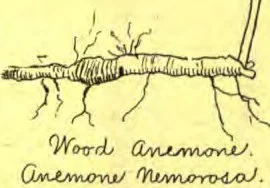
The wood anemone grows from a long root stock; the rue anemone from a cluster of tubers, like dahlia roots.
L. A. REED.

Restoration of the Temple of Ammon at Karnak

THE Temple of Ammon, at Karnak, in the Nile Valley, has long been regarded as one of the most notable ruins in Egypt. Something over a year ago work was begun on the ruins, with a view to restoring the famous temple, that men might have an idea of Egyptian architecture as it existed four thousand years ago. Excavation was being carried forward rapidly, when a lotus-shaped column eighty-eight and one-half feet in height gave way, and in its fall threw down six other columns, with the result that the work of restoration has received a serious check.

GEORGE BORROW—THE WORD MASTER

I AM sure the readers of the INSTRUCTOR would like to know something of this remarkable man. He was born in Norfolk, England, in 1803. His father was a Cornish gentleman, and an officer in the militia; his mother’s people were French Huguenots, who had been banished from their country by the revocation of the Edict of Nantes.
As a little child, George was quiet and somewhat reserved. He cared nothing for company, but loved to hide away in some wild, secluded nook, where he could sit and dream undisturbed.
The family were always on the move, as the regiment to which the elder Borrow belonged was often called from place to place,—now through England, then away to Scotland, and again to the green fields of Erin. This nomadic life was a great pleasure to the little boy.
One time when at Hythe, in England, he went into a building called a “pent-house,” close to the village church, and saw the great skull of some old Danish pirate lying on the floor. Though he was not afraid, he felt a kind of awe, which inspired him with curiosity to know something of the dead man and his people. He questioned the old sexton, and listened with rapt attention as he told the story of the Danes, of their piracies, and of the long struggle they made to gain a foothold on English soil. Afterward, when he grew older, he studied the old Norse language and its dialects, in order to learn all he could about the strange Danish people of the sexton’s story: he could not forget the great skull of Hythe. At Norman’s Cross he learned Latin grammar, and a little later entered the high school at Edinburgh. Here he kept on with Latin, and began the study of other languages, laying the foundation for an education that was, in afterlife, to be of great use to him, and, through him, to others. He also learned to speak in the brogue of Burns, much to the disgust of his father, who did not at all like the quaint, sweet language of the Scots.
He was now eleven years old, and had been two years in Scotland. The corps to which his father belonged was at this time called back to England, and its members were all sent home. A year later Mr. Borrow was sent to Cork with his men, and from there, far up into the country, where the regiment pitched their tents. It was a wild road that they passed over, and the language of the people was Irish-Celtic,—a strange, rough, guttural tongue.
It was a queer place for a school, but there certainly was a school, either in the camp or close by; for young George at once went to work to learn Irish, one of his schoolmates becoming his teacher.
Presently the militia disbanded, and the Borrow family came back to their Norwich home, where George learned French, Italian, and German.
But the boy loved the wild scenes of nature better than books; and when out of school, was off to the fields, fishing and hunting. He enjoyed athletic sports, too, and was very fond of horses. At a horse fair he met one day the son of an old serpent charmer, who had been his childhood friend when his people lived at Norman’s Cross, years before. Many a day when the old man was out searching for vipers, George tramped with him through the woods, to learn his art.
The elder Gypsy and his wife had been banished; but the son had been left behind, and had come to be looked up to by his tribe as a sort of king. George followed this Jasper Petulengro to his tent; and afterward made frequent visits to the Gypsies, that he might learn their language, and study their manner of life. His father and mother were much distressed at what they regarded as a foolish and reckless way of spending time. He was now almost a man; and in order to break up his wild life, they bound him to a lawyer in Norwich. Here, instead of bending his whole mind to the study of his law books, George translated ballads and poems from the Danish and Welsh, and devoted considerable time to reading. When his time was up, his father having died, he went to London to get his poetical translations published; but no one would touch them. He then tried other literary work, and finally wrote a story that brought him a little money. With this he left the city, and traveled a while as a tinker.
When he was twenty-two years of age, George Borrow was brought to the notice of the British Bible Society. The society wished to send a man to Russia to distribute Bibles through that country. Borrow was chosen. He went to Russia, lived there, mastered the Slavonian language, and afterward learned its Gypsy dialects. Now he was ready for work. He translated the New Testament into the Tartar-Manchu, and in 1835 it was published at St. Petersburg. After doing much more work here, he went to France; then back to Russia, through Norway, afterward working a while with the Tartars, the Turks, and the Bohemians. At last he made his way to Spain, and across into the Barbary States, scattering Bibles wherever he went.
It was a dangerous mission. Not one of my young readers would like to go over the road he traveled; but he never faltered, though he was thrown into half the jails in Spain during his sojourn there.
His outdoor life when young had made him strong. His knowledge of Gypsy ways in England helped him to become better acquainted with them on the Continent. At Norwich he had learned from the Gypsies both to shoe and tame horses; and this simple accomplishment was a passport to their favor. He easily made friends with them because of his knowledge of their language and manner of life, and went freely among them to gather the words that he needed to enable him to put the Gospel of Luke into their tongue, and also into the Basque language,—a language so hard to learn that Humboldt gave up the task in despair. It had no grammar and no books, yet George Borrow conquered it. He also brought out a version of the New Testament in the Spanish language, and translated it into many other tongues besides the Manchu, the Basque, and the Romany.
He knew “nearly every language of Europe and the East,” and was fascinating in conversation and powerfully eloquent as a preacher. “His frame was one of iron;” and in daring and intrepidity he could not be matched anywhere.
Of course this Bible missionary met with many strange adventures and wonderful escapes while he was working for the dear Heavenly Father, but we can not stop to tell you of these, as our story is already much too long. Our object has been to show you how God’s hand shapes human lives when they know it not, making of them just what he needs to carry out his purpose. S. ROXANA WINCE.
Continue reading: DEVELOPING