FOOTSTEPS were heard—a form darkened the door—some one entered—but Mrs. Pratt did not look up nor pause in her work. The sun had gone down, and twilight was gathering dimly. Mrs. Pratt leaned closer to the window that she might catch the fading rays, and a little while longer continue her work.
"Sarah!"
"Well?"
Mrs. Pratt did not turn nor look toward the speaker. Her voice was a low sad murmur.
"Sarah!"
The hand of the speaker now rested lightly on her shoulder.
With a quick movement and with some surprise in her manner, Mrs. Pratt turned herself from the window.
"Oh, Edward!"
Her voice choked and her eyes filled with tears.
"Sarah!" and Mr. Pratt seated himself beside his wife, placing his hand gently on her's as he did so, and looking earnestly and tenderly in her face. "Sarah, I have a little good news for you. Old Killigrew is dead."
"Dead!"
Light and shadow were blended on the face of Mrs. Pratt. Death is an awful thing, come in almost any shape it will, and in the case of a man like Killigrew it was awful in the extreme. Yet the intelligence caused a throb of pleasure in the heart of Mrs. Pratt.
"Yes; he fell dead about two hours ago, while standing behind his bar. He died with the toddy stick in his hand and a glass of whiskey before him. I wouldn't like to go into eternity with all the sins against humanity that lie on his conscience. The very thought makes me shiver."
And Mr. Pratt shuddered as he spoke.
"Is the tavern to be closed?" asked Mrs. Pratt, hope and anxiety blending in her voice.
"I saw Parker, old Killigrew's son-in-law, as I came along, and he told me that not another drop of liquor should be sold there while he lived. He means to farm the place himself. It's first rate land, though neglected and run down."
"Will he keep his word?"
"Parker? Yes, indeed. If he says a thing you may depend on his doing it. He has always been opposed to the old man's keeping bar."
"And what a curse to Ashdale that bar has been; oh, Edward!"
No wonder Mrs. Pratt was overcome by her feelings; no wonder she said that bar had been a curse. Ten years before as she stood beside her young husband, she had the proudest, happiest heart in Ashdale. Since then, alas! none were so humble and grief-stricken; for in that bar her loved and honored husband had trailed his manhood in the dust of a debasing sensuality.
Than Edward Pratt a kinder-hearted man could not be found. But he had neither a decided will nor strength of purpose. The current in which his lifeboat happened to be, usually bore him along; and even when conscious that it was gliding towards a dangerous sea, he opposed to it a slight resistance.
Very soon after their marriage Mrs. Pratt discovered in her husband a fondness for stimulating drink. She prompt, yet gentle and loving, rebuked him, accomplished all she had hoped to gain—the dangerous tempter was banished from their house. All would have been well from that time forth, had not the tavern of old Killigrew, the only one in Ashdale, stood directly on the way along which Mr. Pratt daily went to the store where he was employed as a clerk.
Often when returning home he would be in company with young men who never passed Killigrew's without a word with the companionable landlord and a taste of his well mixed liquor. It was not in the amiable and compliant Mr. Pratt to say "no" on these occasions.
Soon his wife became aware of the temptation that was in his way, and of his almost daily yielding to its enticements. She talked with him soberly, yet gently and lovingly as before. Her words aroused no impatience—no anger—no stubbornness, no self-will. He loved her too well to pain her with even a frown.
"I'll not darken old Killigrew's door again, if it troubles you, Sarah. I don't care for his liquor. As you say, it does me no good."
"I shall be so happy!" sobbed Mrs. Pratt, leaning her tearful face on the breast of her husband. "There is nothing else in life to trouble me."
On the next morning as Mr. Pratt was passing the tavern, old Killigrew—who if not behind the bar mixing up his tempting compounds, was sure to be at his door watching for his customers—called out:—
"Hey! Neddy, my boy! what's your particular hurry?"
"I'm a little late," replied the young man, evasively, keeping on his way.
"Stop, stop!" cried the landlord, "Here! Why my dear fellow, one would think you had the business of the world on your shoulders. A man should never be in too great a hurry to speak a word with an old friend. What's become of Philip? I haven't set my eyes on him for a week."
"The truth is," said Pratt, who now paused, "It is the opinion of his friends that he has been coming here little too often."
"Pooh! Nonsense! too often! I never saw him when I thought he'd been drinking too much. It's ridiculous! And he's silly enough to mind them? Well, well, if he thinks he's in danger he'd better stay away. He must have a weak head."
Killigrew spoke contemptuously. Pratt felt the landlord's sneering manner almost as much as if light effort to say "Good morning," and pass on without taking a drink at the bar.
"I wish this old man-trap was on the other side of Jericho!" he murmured as soon as he was fairly beyond the sphere of his dangerous attractions: "or that I didn't have to pass it three or four times a day. If old Killigrew lays hold of me after this fashion, I'm afraid my good resolutions are not going to be worth much. Oh dear! I wonder what good ever comes of this rum selling and rum drinking? As to the harm, one needn't go far to look for that."
Musing thus, Pratt went on his way. At dinner time, both in coming home and returning to the store he succeeded in getting past old Killigrew's "man-trap" without being hailed by the watchful landlord. But his good resolutions were not proof against the influences that assailed him in the evening. Later than usual he lingered at the store, in order to avoid, by so doing, the company of one or two young men who always stopped to drink at Killigrew's. He thought he had escaped them, but it was not so. They were in the tavern porch as he came along, and having taken their cue from the landlord (who was keen-sighted enough to see what had been passing in71the mind of Pratt, and feared to lose a customer) assailed him with influences that he had not strength of mind to resist. "Just to satisfy" them, as he said, he consented to drink a single glass. But that did not satisfy either them or the tavern-keeper. A second glass was almost forced upon him; then followed a third, which purposely made stronger than usual completed the overthrow of his reason.
Could those thoughtless young men have seen the ashen, agonizing face of the waiting, anxious wife, when her husband came staggering in that evening, they would not have boasted so gleefully of having "sent Pratt home as merry as a fiddler."
From that time the weak young man stopped almost daily at the tavern to drink. The temptation was in his way, and he had not sufficient strength of purpose to resist its allurements. This was continued for months, until, under the gentle, yet often tearful, solicitations of his wife, he again resolved to stand up firmly against the pressure of a current that was too steadily bearing him onward to the sea of destruction. And he did stand up firmly for a time. But in that contest the odds were against him. Old Killigrew saw the struggle that was going on in his mind, and took a wicked pleasure apart from his love of gain, in assailing the young man's good resolutions on every occasion that was presented. Sometimes after alluring him into his bar—either through personal influence, or by means of gay young men who frequented his house—Killigrew could not induce him to take anything but a glass of water. Oftener, however, he gained his purpose more fully, and maddened the young man's brain with his fiery potations.
And so the work went on. There was a pitfall in Pratt's way, and ever and anon he stumbled therein. Ah! if the pitfall could only have been removed. It served no use whatever; gave nothing to the common good; was a constant source of annoyance, injury, and loss to the people of Ashdale. It had been digged by Killigrew, and was always kept deep and dangerous by him, in order that he might profit by the weakness and injuries of those who weakly or unwarily stumbled over the half concealed brink.
"Why did not the people of Ashdale cause the pitfall to be closed up? Why did they not remove this man-trap?" is asked in a tone of surprise.
They had no power to do so, we answer.
"No power!"
You may look surprised, but it is even as we say. Killigrew had the law on his side.
"The law!"
Yes, for all you seem so incredulous. The law of the State in which Ashdale was situated, provided by special enactment, for the digging of just such a man-trap as the one maintained by Killigrew. And any person, not having the love of man nor the fear of God before his eyes, could by the payment of a few dollars into the State Treasury, obtain the right to make for himself such a pitfall in any highway or street in any village, town, or city in the Commonwealth.
"Preposterous!"
"It is true—alas! too sadly true. Witness the crowded jails, almshouses, and insane asylums; witness the crime, destruction, and squalid misery that rest like black clouds over all parts of that State where population clusters thickly—and those licensed man-traps are to be found by the score in every neighborhood. It is true, alas! too sadly true!"
But for this pitfall in the way all might have been well with Pratt; but his feet were always stumbling on its fatal brink. Steadily for nearly ten years, had he been going down, down, down; and at the period when he came home sober, for the first time in many months and announced to his wife the death of Killigrew, he was almost helpless in the hands of his adversary. All manly strength was gone when the temptation was before him. It was in vain that he went out in the morning strong in his purpose to keep sober through the day; the sight of Killigrew's tavern fired his appetite to a degree that left him no power of resistance. It was in vain that he started homeward in the evening, promising himself that he would meet his wife and children without a stain upon his lips. Alas! he could not bear onward against the whirlpool of desire that constantly encompassed him when he came within fatal proximity to Killigrew's.
Well might his sorrowing wife feel a thrill of pleasure in every heart fibre at the announcement of Killigrew's death. He had been doing an accursed work in Ashdale for years. Broadcast had been sown the seeds of anguish and desolation; and in her heart and home had many of these evil seeds fallen, taken quick root, springing up and bearing bitter fruit. Nor did she attempt to stifle this pleasure as unseemly, in view of the passage of a fellow mortal to his great account in eternity. She was glad the tavern keeper was dead—so glad, it was useless to affect concealment.
The promise of that hour did not prove vain. The tavern was closed, and Edward Pratt went daily to his business and returned home at evening a sober man. If, as was often the case, he felt the desire for stimulating drink he quenched the desire in a draught of pure cold water. Yet, even as he passed the old tavern stand, around which soon waved fields of ripening grain—the ground had run to waste before—he felt a desire to enter, but there was no bar there now, so the morbid desire was fruitless of evil consequences.
Thus it went on for three years. In that time, not a drop of anything intoxicating had passed the lips of Edward Pratt. How striking the change in all around him! Worn out furniture was renewed, abundance of good clothing for children as well as parents, gave an air of thrifty comfort. Cheerful, happy faces were seen, where before was sadness, pallor, want and tears.
Three years of sober industry! How, in that short time, had the wilderness been made to blossom as the rose!
One day, about this time, Mr. Pratt came home with a serious countenance and a dejected air. His wife noticed the change but said nothing at first—waiting until her husband should speak of what troubled him. He seemed to recover a little at the tea-table, and talked pleasantly, but, after supper, withdrew to himself, and sat most of the evening in deep thought, with his head resting on his bosom. Several times his wife, whose anxious attention was removed from him scarcely a moment, heard a low sigh escape from his lips. A little while before retiring he said to her, speaking abruptly and with something so strange in his voice that the sound caused a thrill to run along her nerves:
"Parker sold his place last week."
"He did! To whom?"
Mrs. Pratt spoke in a startled manner.
"To a man from Brockville, who is going to open tavern again."
If a heavy blow had fallen on the poor woman she could not have sunk down more gloomily. If a death pang had entered her heart, the groan from her lips could not have been more fraught with agony.
"He opens to-morrow," said Pratt, in a forbidding voice.
"Oh Edward!"
The unhappy wife arose, and moving to the side of her husband, flung her arms around him, saying as she did so—"Let us go from here."
"Where?" was responded gloomily.
"Oh, anywhere. Death and eternal destruction are opening at our feet. Come, come! Let us flee for our lives! Let us this hour. I will bear hunger, cold, anything that may come upon us so that we escape this evil."
"I have thought it all over, Sarah," replied the poor victim, sadly. "We cannot go anywhere and be free from the curse. The law sanctions the evil, and under the protection of the law it throws out its allurements everywhere. Oh, that I was strong enough to resist. Heaven knows how earnestly I have sought to overcome this fatal desire, but the moment I come within sight of the accursed tempter my whole being is inflamed. Reason is obscured; reason grows weak; and I fall under the luring gaze of a serpent."
Oh, what a night was that; spent watchfully in prayer and weeping—a night, the anguish of which years would fail to cover with the dust of forgetfulness! Morning dawned at length. To one condemned to die it scarcely had broken more drearily.
"I will strive to be a man, Sarah. I will look up for strength," said Mr. Pratt, as he pressed the hand of his wife and parted from her at the door. "Pray for me."
Tears were in his eyes as he turned away and her cheeks were wet. The voice of Pratt was not confident. He felt that he was too weak for his enemies.
And he was too weak. Evening brought him home with all his bright manhood obscured. One short month sufficed to do the work of ruin. Then his poor wife stood pale, tearless and heart-broken above his grave! He fell so low that he made no effort to rise again, and died in drunkenness and despair.
The poor widow was not long from his side; and now his children's home is the almshouse. The "man-trap" in Ashdale is open still. And for the privilege of scattering ruin and death around him the new owner pays the State fifty dollars a year; and the State takes the money with an eager hand, and seems to think the bargain a good one.—T. S. Arthur, in League Journal.
TEMPERANCE DEPARTMENT.
COLD WATER SONG.
Let others sing the ruby bright
In the red wine's sparkling glow;
Dearer to me is the diamond light
In the fountain's purer flow.
The feet of earthly men have trod
The juice from the bleeding vine,
But the stream comes pure from the hand of God,
To fill this cup of mine.
Then give me the cup of cold water,
The pure, sweet cup of cold water;
His arm is strong, though his toil be long,
Who drinks but the clear cold water.
The dewdrop lies in the floweret's cup,
How rich is its perfume now!
And the thirsty earth with joy looks up,
When Heaven sheds rain on her brow.
The brook goes forth with a cheerful voice,
To gladden the vale along;
And the bending trees on her banks rejoice
To listen her quiet song.
Then give me the cup of cold water,
The pure, sweet cup of cold water,
For bright is his eye, and his spirit high,
Who drinks but the clear cold water,
The lark springs up with a lighter strain,
When the wave has washed her wing;
And the steed flings back his thundering mane
In the might of the crystal spring.
This was the drink of Paradise,
Ere blight on its beauty fell;
And the buried streams of its gladness rise
In every moss-grown well.
And here's for the cup of cold water,
The pure sweet cup of cold water;
Unto all that live will Nature give,
But a drink of clear cold water.
-Geo. W. Bethune.
No wonder that the tender feelings of a mother are turned into a curse. A young lad, who had once been the pride of her heart in the innocence of his childhood, and the humble object of her prayers, whom she had so dearly loved and cherished, had, in his passage to manhood, in an evil hour, been led astray.
Than this, nothing more painful could occur, as the poor mother would now see the companion of her life, which I have known him to be, for him alone she had toiled, now blindly gliding into the very vortex of ruin—a slight, yet a sure path to misery.
Very often has she sat and covered her face with her hands to drink. The young man has been rebuked by her, and her heart has gained—though he has not returned to their home. Sometimes he has found time for a visit, but that has been the only time he has passed in that way along with his mother, and her store was always for his comfort.
Often have I seen him in company with the late lamented Mr. Killigrew, who was once an honorable landed gentleman of our vicinity. It was told by the venerable Mr. Pratt to me.
Soon after this, I was told that was the last day he was going to touch anything that was not soberly good. He spoke these words as if he were to be reborn—ness of spirit was the only pain he could not shake off.
"I'll promise," said he, "to let it trouble my heart no more than liquor."
"I sh"
THE WATCHFUL CHRISTIAN.
By Horatius Bonar
"And when these things begin to come to pass, then look up, and lift up your heads, for your redemption draweth nigh."—Luke 21: 28.
THE saints of ancient times were marked by this characteristic, that they looked for and hasted unto the coming of the day of God. I fear such a characteristic would not apply to us. There are multitudes calling themselves Christians—and it may be true Christians—who are not looking for and hasting unto the day of God.
It would be well, when reading the newspapers in the morning, if we were to interpret all things in their bearing on the approach of Christ.
1. Redemption. Redemption here means deliverance, which the church expects, which the Lord has purchased for her; deliverance which he is to bring when he comes the second time, without sin unto salvation. He has paid the purchase money for the final glory of his church, but she has not yet entered into that glory; the inheritance is still reserved in heaven.
2. The approach. It is something that comes nearer and nearer. You will say, This is a commonplace truth; why tell us that? But we forget its approach, and we need to be reminded of it. By our conduct we seem to imply that we are no nearer the kingdom, the glory, the resurrection, than we were 1800 years ago. Men may put it away from them as it were so far distant that it is not worth speaking about as an approach; but the Lord speaks of it as drawing nigh.
3. The signs of its approach. There are different kinds of signs—physical, material, and spiritual or immaterial. Earthly signs, heavenly signs; signs connected with man, with Christ, his church, his gospel, with evil, with good, with war, with peace; wars in the earth, and in the church itself error abounding; Satan making his most desperate efforts to turn this book upside down; the prince of darkness let loose against God, the cross, the Son of God, the gospel, the Bible. Are not all these signs? do they mean nothing? It is easy to mourn over the evils we hear of all around, but is a Christian man to stop there? Do they not tell that things are coming to a crisis? And is not the termination the coming of Christ himself? He comes to deal with man at the hight of his wickedness, and wickedness is ripening fast.
4. Our duty to mark these signs. Lift up your head as a conqueror when the battle is won—as a laboring man when his day's work is done, and he is going home to rest—as men who are now at the termination of all their struggles, and conflicts, and tribulations. It is a time of joy, not dolefulness; of singing, not of sighing. The Lord meant to counteract an injurious effect his words might produce, viz., despondency. Having predicted wars and rumors of wars and troubles, they might begin to despair, and to think, How shall we stand in the midst of all this tribulation and darkness? The Lord says, just at this very time, when matters are coming to the worst, though clouds and darkness are around you, you are on the edge of the very brightest day that ever dawned upon the earth! Mark the expression, "When they begin to come to pass, lift up your heads." And even though it may be said, "These are not the signs of his coming," yet they are beginnings of them, and the beginnings of them are to make us lift up our heads.
5. The joy that should fill us when we behold these signs. It is not merely a matter of duty, of obedience to a command, but of joy to ourselves. Surely these are words of gladness. And what are we to rejoice for? Our redemption draweth nigh; we are now going to enter into the full consummation of the promised joy. As we see these things we say, We are almost home, almost within the New Jerusalem, almost at the meeting with Christ, almost at the resurrection, almost getting hold of the things within the veil! This is no visionary joy; not the joy of fanaticism, of enthusiasm, but the joy of faith, the joy of hope, of God, of Christ. It is in his joy we are to be glad.
And if the bride is rejoicing at the prospect of meeting the Bridegroom to-morrow, is not the Bridegroom rejoicing much more? There is joy on his side no less than on hers, and it is into his joy that we are to enter. We lift up our heads as we see the Bridegroom looking down upon us.—H. Bonar.
BE PATIENT.
Be patient, oh, thou restless heart,
And in life's battle take thy part.
Be not cast down by all thy cares—
Remember, he must win who dares.
What though now your days be dark and dreary?
What though now your days be sad and weary?
All is not gloom and sorrow here;
All is not wintry, woe and drear;
Summer must come, and joyous May,
To cheer and brighten life's rough way.
Be therefore, strong, and of success be sure—
Be patient, hopeful, faithful—and endure!
—Every Saturday.
SERMONS.
By Baron Stowe
SERMONS are like guns. Some are large, others are small; some are long, others are short; some are new, others old; some are bright, others rusty; some are loaded, others empty; some are owned, others borrowed. Some are air-guns, some pop-guns, some of every size, from the pocket-pistol to the Paixhan gun. Some are charged only with powder, and make a great noise and smoke. Some send only small shot, that irritate rather than kill. Some carry heavy metal, that does execution. Some discharge chain shot, mowing down whole platoons. Some are wide-mouthed mortars, throwing only bomb shells. Some are duelling pistols, used only in controversy—vile things. Some go off half bent. Some flash in the pan. Some make a terrible fiz, the charge all escaping at the priming-hole. Some shoot too high, some too low, some sideways, and a few directly at the mark. Some aim at nothing, and hit it. Some scatter prodigiously. Some kick their owner over. Some are unerring; others always hit the wrong object. Some have too much wadding, and vice versa. Some are alarm guns; others are complimentary guns, used only for salutes on special occasions. Some are in a series, constituting a battery; others on swivels, made to turn in any direction. Some are useful, some useless, some dangerous. Some amuse, some frighten, some exasperate, some explode, some gain the victory. Very much depends upon the manner in which they are made and managed.
—Baron Stowe.
LONG PRAYERS.
By Talmage
We are confident that one reason for the long prayers with which we are sometimes afflicted in religious meetings is an incapacity to wind up. After the brother has been praying about long enough you see that he is trying to find "amen." He does not want to come too suddenly upon it, so he gradually makes that way; but he is like a Brooklyn ferry-boat aiming for the wharf when there is a good deal of ice in the river, and he backs in and out, in and out, at last reaching it with a blundering stroke. Many of the brethren in their prayers take one-third of the time to get started and another third to stop. Why not with your first sentence plunge into what you most want and stop when you get through without any circumgyrations? Men keep on after they ought to stop, because they do not know how to let down brakes. We have a recomendation to make. If any insolated "Amen" would sound abrupt at the time you want to close, do as the psalmist did when the prayers of David the son of Jesse were ended, exclaiming, "Amen and Amen!"—Talmage.
Overcoming a Fretful Disposition
It is a great misfortune to have a fretful disposition. It takes the fragrance out of one's life, and leaves only weeds where a cheerful disposition would cause flowers to bloom. The habit of fretting is one that grows rapidly unless it be sternly repressed; and the best way to overcome it is to try always to look on the cheerful side of things.
SYNOPSIS OF THE PRESENT TRUTH.
By Uriah Smith
NUMBER SIX.
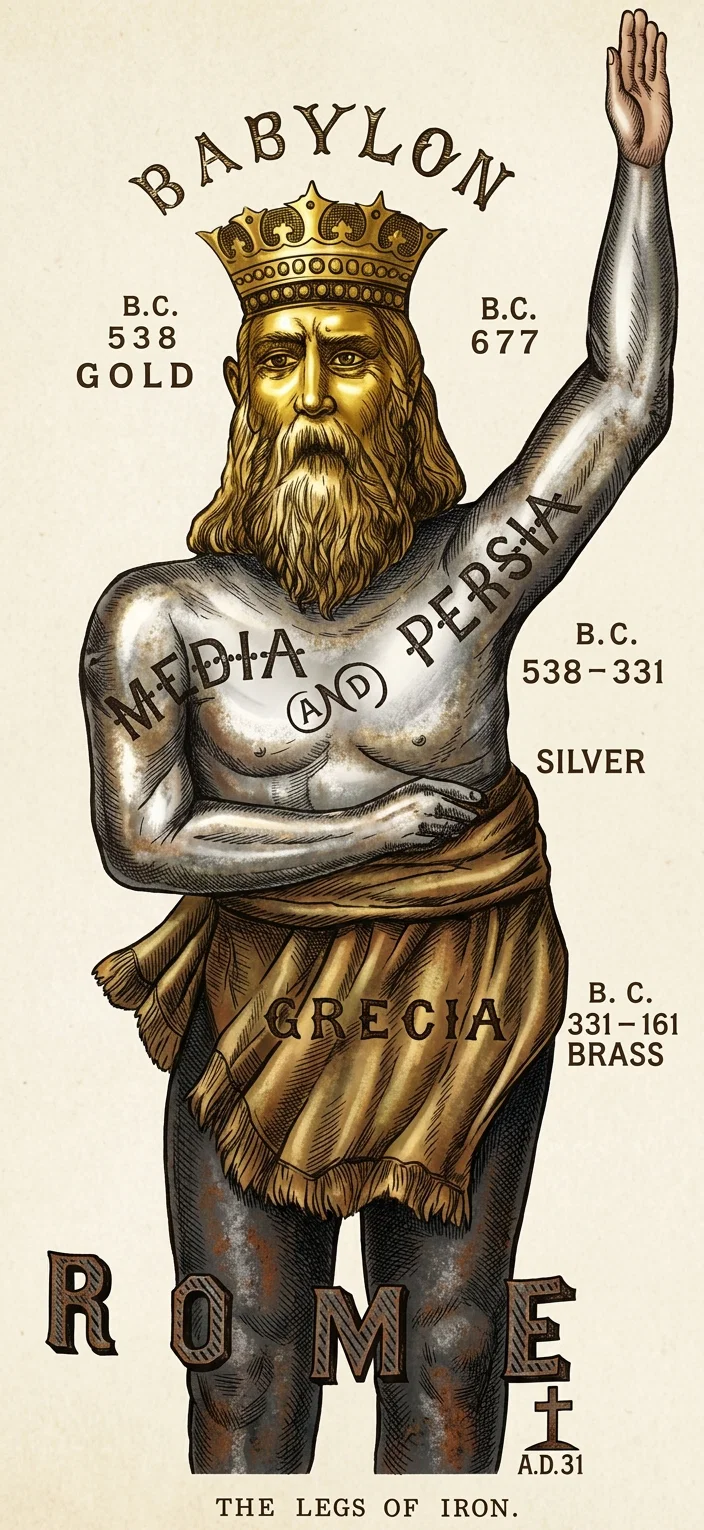
THE LEGS OF IRON.
The brass of the great image was followed by the legs of iron; and out of one of the four horns which sprung up when the great horn of the goat was broken, the prophet saw come forth a little horn, which waxed exceeding great. Dan. 2:40; 8:9. What power is designated by these symbols? Answer: The next great power that succeeded the empire of Grecia, as existing in its divided form under Alexander's successors; and that power was Rome.
Passing over, as already proposed, these divisions of the Grecian empire, the narrative of events is interrupted till we reach the year B. C. 161. Previous to this point it does not become necessary in the light of prophecy to notice particularly the power under consideration; for be it remembered that a power is not introduced into prophecy till it becomes in some way connected with the people of God; and here the Romans first assumed this relation. The Jews being grievously oppressed on account of their religion by the heathen, Syrian kings, Judas Maccabæus sent an embassy to the Romans, to solicit their aid, whereby a league was entered into between them of mutual friendship and defense. This was the commencement of the Roman ascendency over the Jews; and here we may place the termination of the third kingdom of brass, after it had borne rule from the battle of Arbela 331, one hundred and seventy years.
We pause to notice an objection which is urged against the position here taken. Papists, to avoid the application of the prophecy concerning the little horn to the Roman power, pagan and papal, have applied it to Antiochus Epiphanes, a king of Syria. And as it is no unusual thing for the Pilates and Herods of the land to make friends against the cause of truth, they have been followed in this application by the mass of those who oppose the Advent faith.
1. But who was this Antiochus Epiphanes? He was only one, the eighth in order, of a series of twenty-six kings that constituted the Syrian horn of the Grecian empire. How then could he, at the same time, be another remarkable horn?
2. If it were proper to apply the little horn to any one of these kings, it would be reasonable to suppose it would be the most illustrious; but Antiochus Epiphanes did not by any means sustain this character. Although he took the name of Epiphanes, that is, The Illustrious, nothing, says Prideaux, on the authority of Polybius, Livy, and Diodorus Siculus, could be more alien to his true character. For on account of his vile and extravagant folly, some thinking him a fool and others a madman, they changed the name of Epiphanes, The Illustrious, into Epimanes, The Madman.
3. Antiochus the Great, the father of Epiphanes, being terribly defeated in a war with the Romans was enabled to procure a peace only by the payment of a prodigious sum of money, and the surrender of a portion of his territory; and as a pledge that he would faithfully adhere to the terms of the treaty, he was obliged to give hostages, among whom was this very Epiphanes, his son, who was carried to Rome. This ascendency the Romans ever after maintained. Which, therefore, was the more notable power, the Romans who exacted tribute, or the Syrian kings who were compelled to pay it?
4. The little horn waxed exceeding great; but this Antiochus did not enlarge his dominion except by some temporary conquests in Egypt; which he immediately relinquished when the Romans took the part of Ptolemy, and commanded him to desist from his designs in that quarter. The rage of his disappointed ambition he vented upon the unoffending Jews.
5. The little horn, in comparison with the powers that preceded it, was exceeding great. Persia is simply called great, though it reigned over "an hundred and seven and twenty provinces." Esth. 1:1. Grecia, being more extensive still, is called very great; but how ludicrous and absurd, in view of the above facts, to apply the next power, which waxed exceeding great, to Antiochus, who abandoned Egypt at the dictation of the Romans!
6. This power was to stand up against the Prince of princes. The Prince of princes is, without controversy, Jesus Christ. Dan. 9:25; Acts 3:15; Rev. 1:5. But Antiochus died 164 years before our Lord was born.
U. S.
BATTLE CREEK SANITARIUM.
By John Harvey Kellogg
INSTITUTION FOUNDED, 1866.
4000 Patients Successfully Treated.
THIS INSTITUTION, for completeness of appointment, and extent of facilities, is unrivalled in this country. Its splendid arrangements for HEATING AND VENTILATION, together with special appliances for regulating the humidity of the atmosphere, makes this Institution UNEQUALED AS A WINTER RESORT FOR CHRONIC INVALIDS.
Even persons suffering with pulmonary difficulties do much better here than in Florida.
All known useful remedies for disease are employed, including Turkish, Russian, Vapor, Electro-Thermal Electro-Vapor, all kinds of Water Baths, Sun Baths, Swedish Movements, Electricity, etc., etc.
Terms very reasonable. J. H. KELLOGG, M. D., Medical Superintendent.
Address for Circulars:—SANITARIUM, Battle Creek, Mich.
GOOD HEALTH.
By Editor
For 1880.
THIS POPULAR JOURNAL enters upon its fifteenth volume with the most flattering prospects not only of a continuance of the prosperity which has attended it in the past, but also of a great increase of patronage, although it already enjoys
THE LARGEST CIRCULATION OF ANY HEALTH JOURNAL IN AMERICA.
The interest of the journal for 1880 will be greatly increased by a series of practical articles from the well-known pens of
ELDER AND MRS. WHITE.
Whose contributions in the past have done so much to increase the popularity and the usefulness of the journal.
A SPLENDID PREMIUM BOOK
Is offered to new subscribers. Address, for specimen copy:—