The Youth’s Instructor, Vol. 34, No. 52.

FLO'S QUEER REASON

The Youth’s Instructor

Dec 29, 1886

S. D. A. Publishing Association · Battle Creek, Mich. · Dec 29, 1886

FLO'S QUEER REASON.

“Now, Flo, kiss me twice; once is not enough. I want to be sure you are not angry.”
Flo’s eyes were too tender and blue, and her mouth was too gentle indeed, to give a bit of fear as to anger. She gave three kisses instead of two, but knew scarcely a word to say, for nobody had ever dreamed before of telling Flo that they had thought she might be angry.
“You see, Flo, I am not used to it,” began Helen the next minute. “I did not mean to say anything dreadful, and, at first, I thought you were quite in fun.”
Flo would have been glad to speak, but the words would not come, and her little friend’s effort to make everything comfortable again seemed for a moment only to leave her more troubled than before.
“You see, Flo, I did not think you were really saying prayers. Clotide never makes us say prayers in the day, only at night, and we just hurry over them to get to sleep. What made you think of saying prayers then, Flo?”
“I think it was because I was very happy,” replied Flo, troubled and embarrassed.
“What a queer reason!” said Helen, her wide-open eyes seeming full of questions.
“I only ran up stairs to thank God for giving me so much to make me glad.”
It was Helen’s turn to be silent. She was trying to straighten the matter in her own mind, so Flo seemed forced to go on.
“You know, Helen, we can hardly help telling him when we feel so happy.”
“I never did in my life say my prayers at such a funny time.”
“I do not know,” replied Flo. “Any time seems a right time, and I do not call it saying prayers. It is more like stopping a minute to speak to somebody who is always waiting to hear and have us remember that he is there.”
“But, Flo,” began Helen, “what could you have to say to him? Clotide has taught us every one just the right words to say in the prayers, and I never would dare to use any others. I would be quite afraid.”
Flo looked hard into Helen’s eyes to learn if she were quite in earnest. She was not certain that she understood correctly.
“But you speak to God in your own words when you want to ask him many things and to thank him?” she said earnestly.
“I never thought of it. We all just say Clotide’s prayers, which have everything in them, and that is the end of it.”
“Mamma has taught us all prayers, too, and we say them every night and every morning, but I would not be happy at all if I never said anything to God but these.”
“But, Flo, what could you have to say to God in the middle of our play?”
Flo looked embarrassed, but Helen’s words were spoken with earnestness, and she was looking hard into Flo’s face for the answer.
“I only wanted to say that I thanked him for giving me such a bright day for our Thanksgiving party, and for making mamma well again to enjoy it too, and for giving me such pleasant friends.”
“What friends?” inquired Helen absently.
“You and Madeline and the rest,” replied Flo.
“And did you speak about us and the clear day and a party? I never heard of such a thing in my life. How did you ever come to think of making such a strange prayer?”
“How can we tell him all the things that make us sorry or glad if we do not say just the words that come into our minds? And I do not think I would call it a prayer; it is like talking to mamma when I wish to thank her very much.”
Flo was distressed. What was there strange in telling into the ever-listening ear the things that made her glad? Had not her mamma taught her always that the Father who hears in secret is ever ready to listen to the whispered joys or sorrows of every child? What would she do so often when distressed if she dared not tell about her troubles, and whom could she thank for her pleasures?
“If you were very, very happy, you would not think it strange to go to your mamma and tell her, and thank her too,” argued Flo.
Helen was ready to admit this.
“Well, it is just the same with God. He has given me so much, and I am so happy, I just ran off, not thinking any one would miss me, to tell him about it.”
Helen looked earnest. And when she said her prayers that evening, and every evening, she found more to say to God than simply Clotide’s prayer, for there are always pleasures to return thanks for and many things to ask for when the heart learns that God is pleased with the earnest words of those who love him and gives the sweet return of gladness to those who speak often with him.—Christian Weekly.

THE GUEST.

“Because there was no room for them in the inn.”—Luke 2:7.
THERE is a gentle stranger drawing nigh to every dwelling, We cannot hear his footsteps fall so softly on the snow; And yet as he comes nearer, And his smile shines out the clearer, 'Tis no more the face of stranger, but a friend whom well we know.
He came at first an infant, and his rest was in the manger; For the inn was full of pilgrims on that wondrous Christmas night. But he stayed for love and duty, And to fill the world with beauty, Bringing perfect joy for sorrow, turning darkness into light.
How he loved the hearts he bought for is not told by bells or carols, But in more pathetic pictures of the garden, and the cross. Yet he came to bring us pleasures, And to make us rich with treasures, And he did not shrink from sorrow, or from poverty or loss.
Oh! the Lord is very patient, very tender and forgiving! Let us give him reverent welcome, let us worship him in song; Let us tell again the story Of his birth and life and glory, And pray that all the weary world may know his rest erelong.
—Marianne Farningham.

The Sea of Galilee.

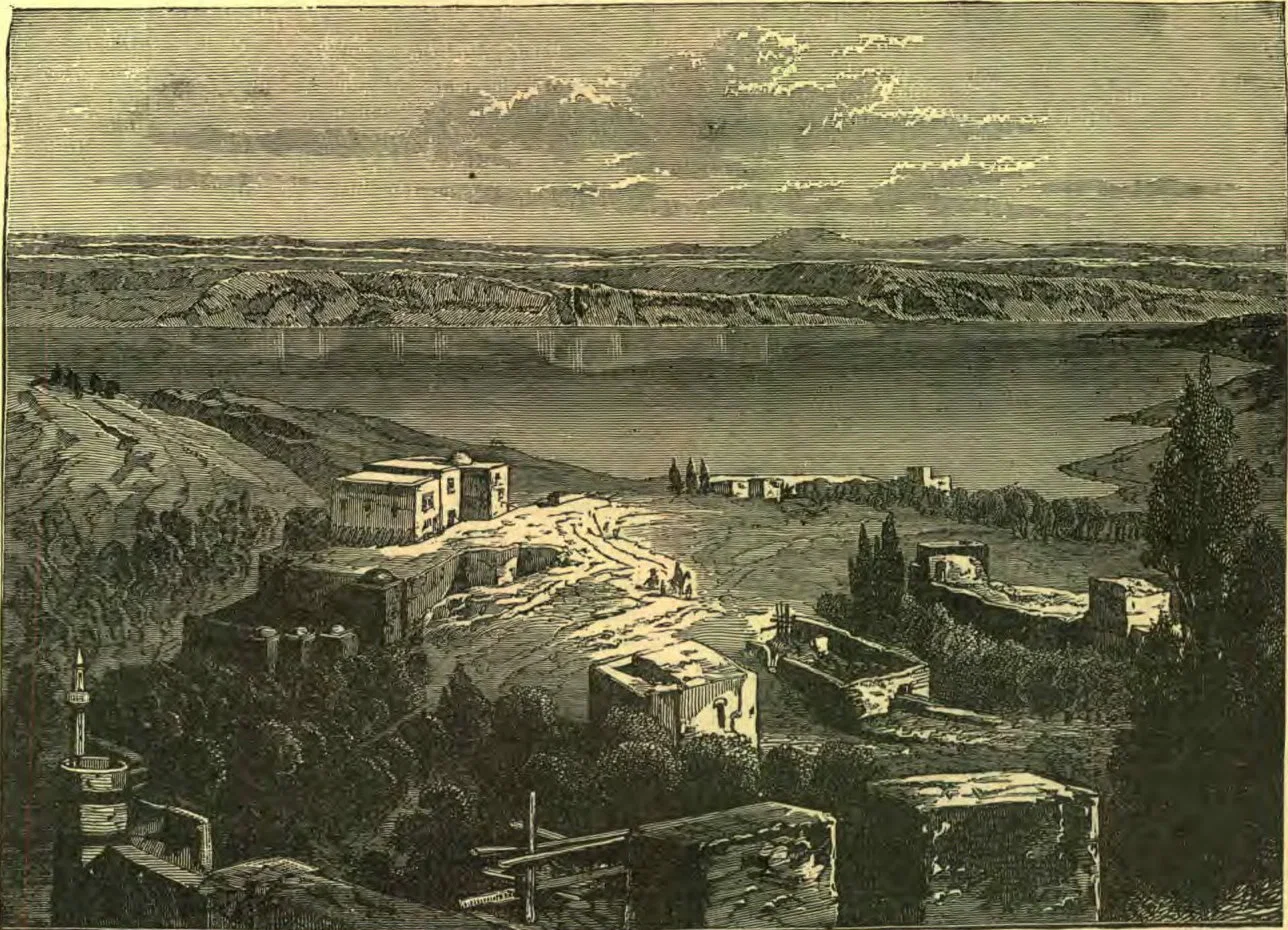
As the season returns in which we celebrate the birth of Christ, it is pleasant to recall the story of his life, and the places where he performed so many of his mighty works. Perhaps there cluster around no one spot so many sacred associations as are connected with the Sea of Galilee, of which our picture gives a feeble outline.
The lake is very regular, having no deep indentations or jutting headlands. In shape it is oval, some fourteen miles long and half as wide, its clear, sparkling waters reflecting the deep blue of an oriental sky. “The sight is very lovely,” says one traveler,—“a clear, blue expanse of water, . . . with the Jordan flowing in at one end, and out at the other,—a sparkling diamond suspended by a silver thread.”
To the east rises the high table land of Bashan, while on the west the waters are hemmed in by the more rugged hills of Palestine. Some travelers have complained of the tameness of the scenery around this lake, because it has neither the boldness of the Dead Sea nor the softness of our western lakes. But we can heartily agree with Mr. Prime, when he says: “I cannot imagine where those travelers have carried their eyes who have described the scenery of the lake as tame or uninteresting. The first great characteristic of it is the deep basin in which it lies. This is from three to four hundred feet deep on all sides except at the lower end, and the sharp slope of the banks, which are all of the richest green, is broken and diversified by the wadys and water-courses which work their way down through the sides of the basin, forming dark chasms or light sunny valleys. Near Tiberias these banks are rocky, and ancient sepulchers open into them, with their doors toward the water. They selected grand spots, as did the Egyptians of old, for burial places, as if they designed that when the voice of God should reach the sleepers, they should walk forth and open their eyes on scenes of glorious beauty. On the east the wild and desolate mountains contrast finely with the deep blue lake; and toward the north, sublime and majestic, Hermon looks down on the sea, lifting his white crown to heaven with the pride of a hill that has seen the departing footsteps of a hundred generations.”
At the northern end of the lake stood Capernaum, the city in which our Lord dwelt, and in whose vicinity he performed his mightiest works. It was on the shore of the lake that Jesus was walking when he saw the four humble fishermen, and called them from their nets to make them fishers of men. From a boat on these waters he often taught the people who crowded on its pebbly shores to hear the words of life. On the eastern side he fed the fainting multitudes with a few loaves and fishes. Once he walked on the waves; and again, he stilled the tempest.
And then we remember the time when “seven fishers, with nets in their hands, walked and talked by the seaside sands.”
“Seven sad men in the days of old, And one was gentle, and one was bold, And they walked with downward eyes; The bold was Peter, the gentle was John; And they all were sad, for the Lord was gone, And they knew not if he would rise,— Knew not if the dead would rise.
“The livelong night till the moon went out, In the drowning waters they beat about,— Beat slow through the fog their way,— And the sails drooped down with the wringing wet, And no man drew but an empty net; And now ’twas the break of day,— The great, glad break of day.
“‘Cast in your nets on the other side!’ (’Twas Jesus speaking across the tide;) And they cast and were dragging hard;
  • *
And when they had gotten close to the land, They saw a fire of coals on the sand, And with arms of love so wide, Jesus the crucified!
“’Tis long ago, yet faith in our souls Is kindled just by that fire of coals That streamed o’er the mists of the sea; Where Peter, girding his fisher’s coat, Went over the nets and out of the boat, To answer, ‘Lovest thou me?’ Thrice over, ‘Lovest thou me?’”
Yet withal a feeling of sadness steals over us when we remember that these scenes of busy life have given place to desolation and death; that instead of populous towns, ruins greet the eye; and that where the lake was once alive with fishing crafts, now hardly a boat is to be seen.
“Oh, how lonely are we As we walk by the sea Where the Master so often has trod!”
W. E. L.

Sea Tales: Catching Albatrosses Off New Zealand

SEA TALES.—NO. 9.

Our brig left New Zealand January 18th, and again put to sea, with only a moderate wind, which by midnight died out entirely; and so it continued to do for five days, after which it freshened, and we were able to gain a sufficient offing to clear the influence of the land, and bowl along merrily on our course. In leaving these islands, vessels are often delayed for weeks at a time by calms and contrary winds.
To while away the time, our captain one day got out his fish lines, and caught two very large albatrosses,—the largest yet seen. It seems odd to write of fishing for birds, yet they are caught with a hook, line, and bait, just as fish would be. A small piece of pork is put upon the hook, and the line thrown over. The bait skims along on the top of the wave, and the bird alights upon the water and seizes it. The bills of sea birds are hooked, as is an owl’s, and as soon as the bait is seized by the bird, the point of the hook fastens, generally, in the curve of the upper bill. The bird invariably holds on to the bait tightly, and thus helps to retain the hook in its mouth, and is drawn aboard, though sometimes its struggles make it necessary to put two, and even three men on the line. As soon as caught, the bird attempts to rise, but being dragged along, cannot clear the water. It therefore braces itself by spreading its feet and wings against the wave. This makes a heavy strain upon the line, which sometimes breaks under it, though very heavy “deep sea” line is used.
At about eight P. M. of the same day we passed Botany Islands and the Antipodes to the southward of them. The islands are supposed to be the last in east longitude, and because of this supposition, and the fact that as soon as 180° was sailed over, the brig would be homeward bound, or in west longitude, there being no farther degrees east, I could be pardoned for the assertion, at the time, that I had “just seen and passed the end of the world.”
We soon began to have strong gales and heavy seas again. The captain “lugged” sail heavily, but carefully. The brig was loaded with wool, and we were bound for London, England. All felt anxious to make a quick passage, as our brig was the first wooden vessel ever chartered to carry wool. A stock company, owning iron vessels, had always done the carrying. Owing to terrible hurricanes in the north Atlantic, and calms in the southern, there were no vessels in port when we arrived, and all the warehouses were filled with wool. Our captain received $8000 for carrying the cargo, which sum he thought would yield a better profit than carrying out to China a cargo of “stiffs,” as the sailors term them, and returning to the States with tea, as was the original intention. “Stiffs” are the embalmed bodies of dead Chinese, packed in all kinds of boxes and barrels, and sent home by relatives and friends for burial in China. The Chinese believe that their gods will not admit them into their heaven if their bodies are interred on foreign soil; hence the Chinese, although frequently compelled, for sanitary reasons, to bury their dead in this and other countries, embrace the first opportunity to remove the bodies, and forward them to China.
In the colonies it is not a very difficult matter to obtain a load to “ballast” a vessel, the cargo of stiffs being supplemented by a heterogeneous pile of boxes, barrels, tubs, and casks, filled with old iron, scrap tin, brass, lead, and zinc, which the Chinese send home in quantities. What it was all used for, or what was the value of such material in China, I could not learn. As much of the Chinese money is made of brass, I presume that material is valuable there.
In a few days the strain became too great for our royal, and it parted and was taken in. The same afternoon the jib top-sail burst, and the greater part went overboard. We were then left without two important sails, both of which we greatly needed to keep ahead of the heavy sea which broke over the brig and pounded against the quarter pretty loudly. The barometer began to go down, down, until it reached 29.00, and yet continued to fall steadily until it reached 28.75. In the north Atlantic this would be very low, and a hurricane would follow; but in the southern Atlantic the barometric changes seem to correspond with those of the extreme northern Arctic region. Sudden squalls would drop down upon us, and the order to “Stand by the top-gallant halliards” (have everything ready, and every man in his place, to let go or “cast adrift”) became monotonous from its frequency.
The brig rolled heavily, the cargo being too light to keep her steady, and one afternoon she gave a terrible lurch that sent the captain and myself out of our bunks, upset the captain’s bed, and landed me and my bedding on the floor. Several heavy seas struck the brig in the quarters and by my state room, making me a trifle nervous, as on the previous voyage a heavy sea carried away all the forward part of the cabin and the two forward tiers of state rooms. The sides of the “house,” or cabin, are built of 8x10 timbers, and the girders overhead of 10x12 pieces, yet the waves crushed them in as easily as if they had been straws. Some of the sailors were good helmsmen, while others were not, which is always the case, and it was due more to wild steering than anything else, that so many seas struck the vessel aft. The day we lost two sails was a remarkable one because from noon to four o’clock there were four beautiful and clearly defined rainbows, another at 6:30 P. M., and a sixth at 10:30 P. M., with the moon shining clearly.
W. S. C.

Discoveries About Self-Consciousness and Being Natural

It was not very long before I made two very useful discoveries: first, that all mankind were not solely employed in observing me (a belief that all young people have); and next, that shamming was of no use; that the world was very clear-sighted, and soon estimated a man at his just value. This cured me, and I determined to be natural, and let the world find me out.—Sydney Smith.

DO NOT GIVE UP.

THERE is a saying old, boys, But though so old ’tis true, And, lest you should forget it, I’ll tell it now to you. ’Tis this: If any task you have Which trouble costs, or pain, Don’t give it up the first time, But try, try again.
No; don’t give up, but this resolve: “However hard it be, And though it costs me hours of toil, ’T will never conquer me.” What has been done you sure can do; So now to work with might; And you will rise, when victory’s yours, The stronger for the fight.
—Selected.

MAORI CHRISTIANS.

One thing that lessened the influence of the missionaries among the natives, was the antagonism that existed between different denominations. The Lutherans and Methodists had missions established not far apart, and one mission would warn the natives against the other. The Lutherans would say that the Methodists were no church, because they wore no white handkerchief; while the Methodists in turn would say that the Lutheran religion was only a form and white handkerchiefs. Under these circumstances the Catholics came in with their crosses and pictures and discarded all other parties. The pomp of the Catholics had an effect, and they obtained a strong influence among the natives.
Notwithstanding all of these adverse influences, many of the natives have been enlightened by the gospel, and profess the Christian religion. Some of them have received the doctrine of the second coming of our Lord Jesus Christ. This information I received from those who are personally acquainted with them. They meet regularly and hold their conferences. I attended one of these gatherings a few weeks before I left New Zealand, and heard some of their testimonies. They expressed great thankfulness that they could agree in the worship of God. “But,” said they, “the white men have to discuss doctrines, and destroy one another, but the natives have no doctrines to discuss, therefore they have nothing to do but to love and serve the Lord.” They believe in Christ, and try to do his will.
The impressions made by an early missionary effort on the natives of the Sandwich Islands was very different from that of New Zealand. One of the first missionaries there was a white woman, and her spirit of sacrifice and unselfish toil to get them to appreciate divine things was greatly rewarded. From that time to the present, they have had the greatest regard for the white woman. When the natives would kill the men who came to their island, she was always treated with respect, and never in any case would they see her injured. It is the early impression made upon the natives that continues with them even after they have become civilized. When the natives have been aroused to wreak revenge upon the white man, with strangers they make no distinction; all that have a white skin share the same fate, as they believe that they are all of the same class. There was a time when the natives of New Zealand practiced burning the dead, but this is principally abandoned at the present time. Civilization has done much for them. Our friends who have embraced the Sabbath in New Zealand are intimately acquainted with many of them. Having never been known to take the advantage of a native in any way, they have gained their confidence and respect. We hope that in a short time there will be a paper published in the Maori language.
S. N. HASKELL.

The Way to Gain a Good Reputation

THE way to gain a good reputation is to endeavor to be what you desire to appear.—Socrates.

PARABLES OF CHRIST.

LESSON 16.—THE MARRIAGE SUPPER.

1. What is the wedding feast called that is described in Matt. 22? See verse 4.
2. What is the one called that is described in Luke 14? See verses 16, 24.
3. Since supper comes at the close of the day, what would it naturally represent in the parable?—Something that is to take place at the close of the world's history.
4. What is said about this supper in Rev. 19:7?
5. What is said about those that are called to this supper? Verse 9.
6. On what occasion did Jesus give the parable about the marriage supper? Luke 14:1.
7. What caution did he give in reference to those who might be invited to a wedding feast? Verse 8.
8. How might one be humbled who should neglect this caution? Verse 9.
9. What did he recommend as a proper course? Verse 10.
10. What principle did he then lay down? Verse 11.
11. What caution did he give to those who make feasts? Verse 12.
12. Why is it more blessed to feast the poor and afflicted rather than the wealthy? Verses 13, 14.
13. When will those who thus show mercy to the poor receive their reward?
14. What remark was then made by one who sat at meat with him? Verse 15.
15. How did Jesus then introduce another parable? Verse 16.
16. With what message did the lord of the feast send out his servant at supper time? Verse 17.
17. How was this call received? Verse 18.
18. Why could not the first obey the call? Same verse.
19. What excuse did the second make? Verse 19.
20. Why was it impossible for the third to heed the summons?
21. What are these excuses meant to represent?—The worldly-mindedness of those who slight the gospel call.
22. How was the master affected when his servants told him how his call had been received? Verse 21.
23. What order did he give? Same verse.
24. After fulfilling this order, what did the servants report? Verse 22.
25. How was the house finally filled? Verse 23.
26. What resolution was expressed by the master of the feast? Verse 24.
27. Where are these three calls represented in prophecy? Rev. 14:6-9.
28. To whom was the first of these messages chiefly addressed?—To the churches.
29. Since the churches mainly refused the first message, to whom was the second addressed?—To those outside the churches, and to those who were tired of the corruptions found within them.
30. What is the third message sometimes called?—The compelling message, or call.
31. Why is the term appropriate?—Because its appeals are so clear and forcible as to compel the honest in heart to obey.
32. How may this parable be regarded?—As a continuation of the one in Matt. 22:1-14, or at least as supplementary to it.
33. How does it supplement that parable?—By setting forth the three special calls to be given at the close of the dispensation.

NOTE.

The parable in Matt. 22:1-14; Luke 14:16-24, furnishes an important testimony on this subject. Matthew gives a particular account of the first part of this parable, but merely states in a word the final calls to the guests. Luke, on the contrary, omits the first part of the parable, but gives its concluding features with peculiar distinctness. We think the identity of the parable in Matt. 22, and Luke 14, will be seen by every one who will compare those scriptures together. It is evident that Matthew, by the calls to dinner, represents the calls which were made to the Jews at the first advent. It is to be observed that the general work of inviting the guests had preceded these calls. For these are a special announcement to those that had been bidden, that the dinner is ready. These we understand to refer to the work of John the Baptist and others at the time of the first advent. And we understand that the destruction of the city and people in the parable refers to the destruction of Jerusalem and the rejection of the Jews. The call to the dinner, proving of no effect, the king turns to another people. We understand this as we do the text in which our Lord tells the Jews that the kingdom should be taken from them and given to a nation bringing forth the fruit thereof. Matt. 21:43. This part of the parable, Matthew has given in a word, that the servants in obedience to the command of their Lord were enabled to furnish the wedding with guests. But Luke has taken up this portion with minute accuracy. The dinner indeed was past, and the people to whom it was offered were unworthy of sharing it as guests; but the purpose of the king was not to be made void. At supper time, says Luke, a message was sent forth to announce to those that had been bidden that supper was ready. We understand that this call to the supper is made to the Gentiles, and that it is in immediate connection with the second advent. For we think that none will deny that the supper of Luke 14:16 and that of Rev. 19:9 is the same. Thus we see that there was to the Jews the general work of bidding the guests, and the special call at dinner time; and that to the Gentiles there is the general work of the gospel in bidding, and then at supper time the special call to the marriage supper.
These three calls to the marriage supper [Luke 14:16-24] we understand to be the same as the three messages of Rev. 14:6-12. The first call to the supper is “at supper time,” and the first angel announces that “the hour of his judgment is come.” None will dispute the fact that the judgment and the marriage supper are in immediate connection with each other. Rev. 19:20. The three calls are not the general work of the gospel in bidding; they are made at supper time, that is, at the close of the day. And the three proclamations in Rev. 14, in like manner, are not the general work of the gospel, but special warnings addressed to the world as the great work of our High Priest is closing up.—J. N. Andrews.

A MONSTER SAFE.

While the description of the city of Edinburgh, Scotland, is fresh in your minds, you may read with interest that the largest safe ever manufactured is about to be set up in the premises of the National Bank of Scotland, in that city. We clip from an exchange the following description of this wonderful structure:—
“Its external dimensions are fifty feet long by twelve feet broad and ten feet high, and a careful computation shows that within it might be stored about 1,250 tons' weight of gold bullion, equal in value to $550,000,000. It is heavy in proportion to its size, weighing 100 tons. Its walls are believed to be thicker than those of any other steel room of similar proportion in use in the United Kingdom. With the view of insuring greater security than has hitherto been obtained, its walls are composed of a triple series of plates, similar to those which the firm have for many years used in the manufacture of bankers' safes. These plates are so toughened and hardened as to be practically impervious alike to the force of blows, leverage, and the cutting by drills. This 'compounding of the plates,' as it is termed, involved an enormous amount of drilling, no fewer than 1,000 holes being pierced in each section. Admission to the interior of this strong room is obtained by means of three massive doors, each seven inches thick, and weighing a ton and a half, but on the hardened steel pins on which they are hung they swing with the greatest of ease. Apart from the great thickness of compounded hard and milled steel plates in these doors, the principal feature they present is the patent diagonal bolt. These bolts, of which there are twenty in each door, shoot out from the edge of the door at opposing angles of forty-five degrees, and thus powerfully dovetail the door into the frame at either side. Thus any attempted wedging between the door and its frame simply tends to bind these bolts tighter into their holes.”
The fact that such strongholds are necessary to secure treasures against the bold attempts of burglars is sufficient evidence of itself that we have not yet reached the millennium.

FLOATING NEW TESTAMENT.

A PERSON of small faith might doubt that the great God notices so small a matter as the floating of a book upon the waters; but is it hard to believe that he who shapes the most trivial events for the accomplishment of the most good, should guide safely the book which should carry salvation to a heathen nation, as in the following instance?
“It was in the year 1859, that the first missionaries to Japan went out from America. Before that time, as far as could be ascertained, there was not one Japanese Christian; and though most of the people could read and write, until the year 1872 there was no open preaching, or teaching of God's word. All over the empire, in the streets, and along the highways, were notices posted up, declaring that any person who accepted the religion of Jesus would be put to death.”
“One day a Japanese gentleman of high rank, and also of much learning and education, was walking on the shores of the Bay of Jeddo. It was shortly after some English or American vessels (it is not known which) had left the port. As he passed along, he noticed a small object floating on the water, and sent an attendant to bring it. When it was placed in his hands, he saw it was a book, and a book that he could not read. From some Dutch traders, he discovered that it was a New Testament in English, and that it was believed, by many persons, to be the word of the only true God. He learned also from them that it had been translated into Shanghai, and at once procured a copy. Then, at the court of his prince, he sat down with five or six companions to study its character. The work of the Lord Jesus touched him as nothing else had done. In his own words: ‘I had never seen, or heard, or read of, or dreamed of, or imagined such a person.’”
“During many months, this study of the Bible continued. At length, hearing that a teacher had come to Nagasaki, a long way off, an interpreter was sent to him with questions, and explanations were returned; but uninfluenced by the living voice of any foreigner or Christian, that Japanese counselor and two of his friends were brought to believe in him of whom the Scriptures testify. They were baptized by a missionary, and, as far as is known, were the very first Japanese converts.”

THE EARTH-WORM'S WORK.

If we knew all the mysteries of the animal creation, doubtless we should find that many creatures which we have looked upon as cumberers of the ground, have very important missions to fulfill. For instance, scientists now understand that the common angle-worm, or earth-worm, which the boys have thought served only as bait for fishing purposes, fills a very important office in making the soil productive. The following paragraphs regarding this humble creature's work we clip from the Youth's Companion:—
“It is now known that, burrowing steadily in the earth, he does valuable work for agriculture. The little holes which he makes let in the air and light to damp places, and conduct to the roots of the plants the leaf-mold and surface accumulations of all sorts which these plants need for their nourishment. But more than this the worms bring to the surface the finely powdered earth which they consume in their burrowings, and scatter it over the soil.
“Two earth-worms, put into a glass vase eighteen inches in diameter, filled with sand covered with dry leaves, managed first to sink the leaves entirely beneath the sand, and then to cover the sand with a thin coating of humus, or mold. All this was accomplished in six months.
“One earth-worm will bring to the surface about seven grains avoirdupois of earth in a day. This is a very small quantity of earth, but if we multiply it by fifty-six thousand, the average number of worms to an acre, we have more than fifty pounds of earth raised every day.
“From the 9th of October, 1870, to the 14th of October, 1871, the worms upon one field in England brought up eight tons of earth, and in another field sixteen tons. A field in Staffordshire is covered annually by the worms with a deposit of earth nearly a quarter of an inch in thickness.
“By the slow toil of the earth-worms, rocks are buried in the ground and the surface of the earth is modified. It is chiefly their work which has buried the ruins of dead cities under the ground.”

INTERESTING PARAGRAPHS.

THE heir to the Hawaiian throne is known as Victoria Kawekiu-Kaiulani-Lunalilo-Kalaninuiahilapalapa—that is, “The Heaven-sent babe.”
THE true name of China is said to be Chumque, “the center kingdom of the world.” This term was by usage corrupted into Chinque, and from this word the Portuguese gave it the name of China.
A noticeable extravagance in dress at the end of the eighteenth century was the use of feathers of exactly the length of their wearer. As no carriage with a top to it could contain such a head-gear, a coach was contrived with a bottom like a well, in which the lady sat and looked out between the spokes of the wheels.
If a sheet of gold leaf is held up against the light, it appears to be of a dark green color; this means that the light is transmitted through the leaf. When it is considered that this leaf is a piece of solid metal, a better idea of the extreme tenuity of the leaf can be comprehended than by any comparison by figures; nothing made by the hand of man equals it in thinness. This extreme thinness is produced by patient hammering, the hammers weighing from seven to twenty pounds, the lighter hammers being first used.
THERE is, at Foochow, China, a bridge which is called “The Bridge of Ten Thousand Ages,” and is said to be eight hundred years old. The peculiarity of it is that the stone is used as if it were timber. Instead of arches, there are hewn stones, three feet square and over forty feet long, laid across the tops of the piers, and on these are laid flat slabs of granite to form the flooring. On each side of the bridge, throughout its whole length, are small shops. It is a quarter of a mile long, and has forty piers.

CHRISTMAS CAROL.

Happy bells of Christmas-tide Sound their gladness far and wide, Happy children hear once more The sweet story o'er and o'er: How the harps of heaven rang, How the holy angels sang, While around a wondrous light Made the midnight heavens bright, And the kneeling shepherds heard First on earth the blessed word Which to-day we sing again:— “Peace on earth, good-will to men!”
Strange the story, sweet and old, That at Christmas-tide is told: Bright there beamed a new-born star, Fell its radiance afar; Wise men watching for the light Saw it shining through the night; Silently it guided them To the Babe of Bethlehem, And the three wise kings of old Laid their precious gifts of gold, Gifts of incense rare and sweet, At the infant Saviour's feet.
This the story, sweet and old; And the glory it foretold Shines with radiance more bright Than on that first Christmas night. What shall we who know the way Bring before our King to-day? Gift of love as incense sweet We will offer at his feet, Gift of kindly word and deed To his little ones in need. Thus, while bells for gladness ring, Shall the happy children sing, Sing the angels' song again, “Peace on earth, good-will to men!” —The Child's Paper.
Continue reading: A CHRISTMAS STORY