The Youth’s Instructor, Vol. 30, No. 41.

THE CITY OF HARAN

The Youth’s Instructor

Oct 11, 1882

S. D. A. Publishing Association · Battle Creek, Mich. · Oct 11, 1882

THE CITY OF HARAN.

When Abraham left Ur of the Chaldees to go to a land which the Lord would show him, his father and others of his relatives went with him. He stopped with them in his journey, at Haran, a city of Mesopotamia, where he dwelt until his father died. Abraham, by the command of the Lord, then went on his way to the land of Canaan, but his brother Nahor remained at Haran. Years afterward, when Abraham would take a wife for his son Isaac, he sent his faithful servant, Eliezer, back to the “city of Nahor,” which is the same as Haran, to get a woman from among his own kindred; and the servant returned with Rebekah, the granddaughter of Abraham’s brother.
Years passed again; and the sons of Isaac, now grown to manhood, quarreled because of the stolen birthright; and the mother, Rebekah, anxious to shield her favorite son from the wrath of his brother Esau, sent Jacob away to her brother Laban, who still dwelt at Haran. (Gen. 27:43.) Here Jacob married the two daughters of Laban, and here he lived for twenty years, until he returned with his wives and children and cattle into the land which the Lord had promised to Abraham and to his descendants.
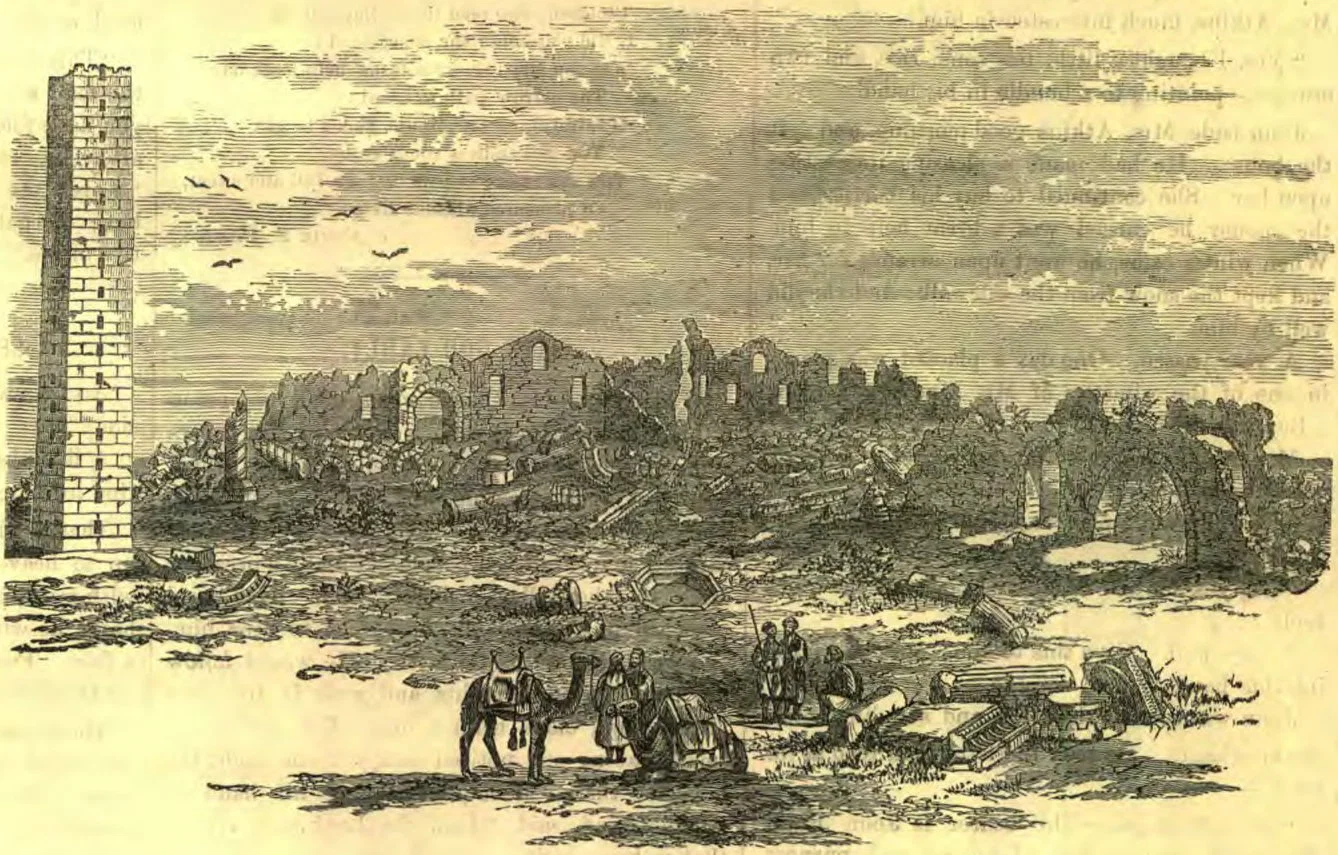
Haran was situated on a small stream which flows into the River Euphrates. It was in ancient times an important and flourishing city, and here were fought some famous battles in the days of old. But, like many other Oriental cities, it has gone to decay. Our picture shows all that remains of this once rich city. No one now lives in the place, but wandering Arabs frequently visit the spot on account of the delicious water to be found there. The tower, so conspicuous among the ruins, is seventeen and a half feet square at the base, and what remains of it is one hundred and two feet high. It may be seen by those traveling over the plain for fifty miles around. What it was built and used for is not known. The place is called Charran in the New Testament, and the Arabs still call it Harrán. E. B.

AUTUMN'S WORK

AND now comes Autumn—artist bold and free Exceeding rich in brightest tints that be— And with a skill that tells of power divine Paints a vast landscape wonderfully fine. Over the chestnut, cloth of gold he throws, Turns the ash purple, cheers with scarlet glows The lonely sumac, that erewhile was seen Clad in dull foliage of a summer green; Where daisies bloomed gives golden-rod instead, Stains every oak leaf with the darkest red, Sets all the woodbine's waving sprays on fire, And leaves them flaming from the cedar's spire; And clust'ring berries hangs he here and there, Some like the rubies, some as round and fair As pearls, some blue as sapphires, some as brown As the fast-fading leaves that rustle down Beneath the trees that gave them life, to die, Or else away with roving winds to fly. And when at last all's finished—hill and dale, Wildwood and field—he drops a misty veil Over the picture, and a few glad days The world looks on with wonder and with praise, Till faint and fainter all the colors grow, And Winter hides it underneath the snow. —Selected.

JOHN RAND'S WORD.

Mrs. Atkins was sitting in the library reading, when Bridget came to the door and said,—
“Please, ma’am, there’s a boy in the hall come to sell berries. He wants ter know if ye want ter buy any.”
“Yes, if they are good,” said Mrs. Atkins; and she arose and went into the hall. A bright-faced boy, with his clothes clean but well patched, stood there with a basket full of blueberries in his hand.
“What do you ask a quart?” inquired Mrs. Atkins.
“Ten cents, ma’am,” in a modest tone.
“Other boys are selling at eight.”
“I know it, ma’am; but, you see, these are a prime lot, extra good, and I think what is tip-top ought to bring a tip-top price, don’t you?”
“Yes, that is true,” smiling. “How many have you?”
“Just four quarts.”
“Very well, I will take them.”
The boy went into the kitchen, and Bridget brought a tin pan for him to pour them into. Mrs. Atkins opened her pocket-book to pay him.
“Four quarts at ten cents will come to forty cents,” she said. “I haven’t silver enough. Can you change a dollar-bill?”
“No, ma’am.”
“Then, you will have to call again for your money. Come this evening, after Mr. Atkins gets home.”
He looked disappointed, and a moment’s silence followed. Then, he said in a low, hesitating voice:—
“Lady, I do want the money very much now. Mother is sick, and I want to buy her something real nice to carry home. Lady, I am going right to Mr. Blake’s store. Would you mind letting me take your dollar-bill to get it changed there? I’ll be back in a half an hour, and bring you sixty cents.”
“How do I know you are honest? Many a boy would keep the money. I have never seen you before. How do I know you will bring back what is due me?”
“You have my word.”
“What is your name?”
“John Rand.”
Truth and honesty were stamped upon his face. Mrs. Atkins hesitated no longer. She put the dollar-bill into John’s hand. He started up the street. She returned to the library and took up her book again.
Nearly half an hour passed. Once more Bridget stood in the doorway, and said,—
“The boy who sold ye the berries wants ter spake with ye again.”
“Let him come in here.”
John entered the room, hot and panting, as if he had been running.
“Here’s your—money—sixty cents,” he said, catching short breaths.
“You’ve been gone a short time. You must have walked very fast,” said Mrs. Atkins.
“I told you I’d be back in half an hour, but I had to wait to see Mr. Blake. I found I was short for time, and I just put in and run.”
“Who has taught you to be so punctual?” asked Mrs. Atkins, very kindly.
“I’ve a good mother. I go to Sabbath-school. Mother says, ‘Religion’s free, and poor folks can always get that.’”
“She has taught you to keep your word well.”
“Mother says, ‘If a boy hasn’t money, he can keep his word.’”
“Did you buy what you wanted for her?” asked Mrs. Atkins, much interested in him.
“Yes, I bought a little tea, some rice, and two oranges,” pointing to a bundle in his hand.
John bade Mrs. Atkins good-morning, and left the house. He had made a pleasing impression upon her. She continued to buy his berries, and the money he earned was a great help to him. When winter came, he went upon errands for her, and kept the snow from the sidewalk; and she did well by him.
A year passed. One day a placard was placed in one of the windows of Mr. Montague’s store. “Boy wanted” was on it.
Mrs. Atkins heard of it, and sent for John to come to her house.
“Do you want a place in Mr. Montague’s store?” she inquired.
“Oh, yes, ma’am. Indeed I do,” was the quick reply.
“Very well. Give this to him,” putting a letter into his hand.
John was soon at the store, and standing before the merchant. He took the letter and read as follows:—
“Mr. Montague,—The bearer is John Rand. The little man is full of energy and purpose. You can depend upon his word fully. I am sure he will suit you. Truly yours, MARY ATKINS.”
“This is a good recommendation,” said Mr. Montague. He questioned John a little, was pleased with what he said, and agreed to take him into his store.
Five years have come and gone since then. John Rand is still employed by Mr. Montague. He is faithful, honest, and hard-working. He is well paid, and is happy, and is looking into the future with bright hopes.
My readers, you cannot value your word too highly. A boy or girl without money, who has lips that can be trusted, has capital everywhere.—Sarah P. Brigham.

God Honors Every Genuine Tear of Repentance

THE whole universe of God will crumble to pieces before God will overlook or despise one single tear of genuine repentance.

SEEK GOD EARLY

Written for the Instructor.

SEEK GOD EARLY.

When Dr. Adam Clarke was a small boy going to his father's school, reports came in the papers and in other ways of a new religious sect which was just then starting up, called Methodists. The Methodists of those early days were a very earnest, simple-hearted people. Finally a preacher came to the village where Adam lived, and preached in a barn. The boy went to hear him, and was very much interested. He would follow the preacher home nights, and walk in the good man's steps, close behind him. But he was so small that no one noticed him, till one night the preacher turned about, and laying his hand on Adam's head, said, “Lad, the Lord says, ‘They that seek me early shall find me.’”
The preacher then walked on, but Adam began to turn the words over in his mind something like this: “What does it mean by seeking the Lord early? Does it mean early in the morning? I get up early; but, no, it does not mean that; it means early in life. If the young seek him early in life, they shall find him; others may seek, and not find; but the young shall find.” He decided to seek the Lord, and this he did with all his heart. History tells us the result. God blessed him wonderfully; and he became an earnest, humble Christian, and an instrument in the hands of the Lord for doing a great and good work. This man was the author of “Clarke's Commentaries,” so familiar and so useful to every Bible student.
It would seem that God has special blessings for those who seek him in youth, before they have wasted years in sin and folly. “A flower when offered in the bud, is no vain sacrifice.”
J. R. Calkins.

THE BEST USE.

“My mother gave me a Bible for a gift last Christmas,” said a little girl, complacently, “and Aunt Lou gave Cousin Harry one at the same time. Just look at them now, and see the difference!”
Harry’s was a little worn. Its gilt edges were tarnished, and the newness was gone from the cover, but it looked as if it had been read very often. Here and there I saw pencil marks near favorite verses, and in one or two places it seemed as if tears might have fallen. Little Harry Gordon had become a Christian lately, and his Bible had evidently been very precious to him.
Minnie said triumphantly, after I had finished my look at Harry’s, “Now see mine!” She unfolded the tissue paper from it, and there it was, just as fresh and fair and uninjured as when it came out of the shop.
“I’ve never had it out of the drawer but once,” said Miss Minnie, “and that was to show to somebody.”
“Minnie,” said I, “if your father were away from home, and should send you a letter telling you just what he wanted you to do and be, would it be good treatment never to break the seal, and to lay it away in a drawer unread? Would it not, rather, be better to take it out every day and read it over and over, trying all the more each time to obey its injunctions?”
“Yes!” said Minnie, blushing and hanging her head, as she began to see my meaning.
“This is God’s letter to you, my love. Like the man who folded away his talent in a napkin, you have folded away your precious Bible. Hereafter, my child, use it as God wants you to. ‘Search the Scriptures, for in them ye think ye have eternal life, and they are they which testify of me.’”—S. S. Times.

SPEAKING TO GOD FOR US.

A CLASS was asked one day, “What is intercession?”
A little boy replied, “It is speaking a word to God for us, sir.”
That is what Christ does for us now he has gone up to heaven. Our prayers are poor, and mixed with much of sin, but if they come really from our heart, he will offer them up to his Father without a flaw. For Christ’s sake God will freely give us all things.
There was once a noble Athenian who had done the State great service, in which he had lost a hand. His brother for some offence was tried and condemned, and about to be led away to execution. Just after the sentence had been pronounced, the other came into court, and, without speaking a word, held up his maimed hand in sight of all, and let that plead his brother’s cause. No words could have been more powerful, and the guilty one was pardoned.
So, I think, if Christ did not speak a word for us, but only held up to his Father’s view that pierced hand, it would plead for us as we could never pray for ourselves. It is for Christ’s sake only we are forgiven, and made dear children of that blessed household above.—Youth’s World.

Living So God Would Be Pleased

Do nothing you will not like God to see. Say nothing you would not like him to hear. Write nothing you would not like him to read. Go to no place where you would not like God to find you. Read no books of which you would not like God to say, “Show it to me.” Never spend your time in such a way you would not like God to say, “What art thou doing?”

HONOR THE HOARY HEAD

Written for the INSTRUCTOR.

HONOR THE HOARY HEAD.

Ah, how well do I remember, When a little prattling child, How my silvery-headed grandsire, With his eyes so blue and mild, Would lift me gently to his knee, And in tones of tenderest love Talk to me of heavenly things,— Of the glorious home above.
I would gaze with rapt attention On that dear, old, wrinkled face, As he told me of the Saviour’s love, And the wondrous plan of grace. Those gracious lessons that he taught I have never yet forgot; And in this sinful heart of mine, Jesus a change has wrought.
Years rolled away, and the worn old man Had kept his armor bright; He fearlessly waited the grim approach Of Death, with its darksome night. “Sweet fields,” he cried, “beyond the flood, In living green, there wait; The Tender Shepherd will waken me, I shall pass through the pearly gate.”
We laid him away on the calm hill-side, Beneath the daisies’ bloom, And angels of God their vigils keep, Above his lonely tomb. With folded hands and brow of snow, We left him there to rest, After the journey of life was o’er, On green earth’s mother-breast.
Children, who read these simple lines, Do you honor the hoary head? Are you striving, with Jesus’ help, each day The narrow path to tread? If faithful, on fair Mount Zion’s height You will endless youth enjoy, You shall taste of joys that are full and sweet, Of pleasures without alloy.
ANNIE E. FIELD.

SCENES IN THE LIFE OF CHRIST.

LESSON 90.—THE PHARISEES CONFOUNDED.

Our last lesson closed with the marriage of the king’s son. The parable, however, was not all given in that lesson.
When the guests had assembled in the bride-chamber, the king came in to see them; and as he looked about, he saw there a man that had not on a wedding garment, and said unto him, “Friend, how camest thou in hither, not having on a wedding garment?” Now the man could not excuse himself, for the king had furnished wedding garments, and all the guests had to do was to put them on. It was a great dishonor to the king for a guest to appear before him without having on the wedding garment; so the king said to his servants, “Bind him hand and foot, and take him away, and cast him into outer darkness; there shall be weeping and gnashing of teeth. For many are called, but few are chosen.”
By this our Lord meant to teach a lesson to all Christians. By the word of God, the preaching of the gospel, and the influences of the Holy Spirit, we are all called to follow Jesus in this life, and finally to sit down with him at the marriage supper of the Lamb. But if in the Judgment it is found that we have not been transformed and made pure in character like our Lord, we shall be rejected as was the man who had not on the wedding garment. Then the Pharisees held a council together to see how they might entangle Jesus in his talk. When they had completed their plans, they sent out unto him some of their disciples, together with some of the Herodians. These messengers said to Jesus, “We know that thou art true, and teachest the way of God in truth, neither carest thou for any man; for thou regardest not the person of men. Tell us therefore, What thinkest thou? Is it lawful to give tribute to Cæsar, or not?” “Shall we give, or shall we not give?” But Jesus, perceiving their craftiness and hypocrisy, said unto them, “Why tempt ye me, ye hypocrites? bring me a penny.” And when they had brought him a penny, he said, “Whose image and superscription hath it?” and they said, “Cæsar’s.”
And Jesus said unto them, “Render to Cæsar the things that are Cæsar’s, and to God the things that are God’s.”
The Pharisees were disappointed at the result of this interview. They were very cunning in sending both Pharisees and Herodians to question Jesus on the subject of the tribute money. If Jesus had said that they ought to pay tribute, he would have offended the Jews; and if he had said that they ought not to pay it, he would have offended the Herodians, for they favored the Roman government. Thus they had laid a snare which they thought the Saviour could not escape; and when he so easily avoided their trap, and at the same time gave them a sharp reproof, they were so astonished and confounded that they went away and left him to himself.

QUESTIONS.

  1. With what did our last lesson close?
  2. What did the king do when the guests had assembled in the bride-chamber? Matt. 22 : 11.
  3. What did he notice as he looked about upon the guests?
  4. What did the king say to this man?
  5. Why could not the man excuse himself?
  6. Why was it regarded as a serious offense for a man to come into the guest-chamber without having on a wedding garment?
  7. What did the king order his servants to do with this offender?
  8. Who will finally be numbered among the chosen ones? Those who obey the call and prove faithful to their Lord.
  9. How are we all called?
  10. What are we called to do?
  11. Who will be rejected in the Judgment?
  12. For what purpose did the Pharisees hold a council?
  13. When they had completed their plans, what did they do?
  14. How did these messengers try to flatter Jesus, and make the people think they honored him?
  15. What question did they then ask him?
  16. What did Jesus perceive, as they spoke to him?
  17. By what question did he show them that their attempts at deception were in vain?
  18. What did he then ask them to bring him?
  19. What question did he ask them when they had brought the penny to him?
  20. What reply did they make?
  21. What solemn admonition did Jesus then give them?
  22. How did the Pharisees feel about the result of this interview?
  23. How had they manifested their cunning in sending both Pharisees and Herodians to question Jesus?
  24. What effect did it have upon these wily hypocrites to find that Jesus could so easily avoid the snare they had laid for him, and at the same time give them a sharp reproof?
  25. How did they feel reproved? They knew that they had not rendered to God the service that was due to him.

NEW-TESTAMENT HISTORY.

LESSON 104—JESUS BROUGHT BEFORE PILATE.

The long tedious night of anguish at last wore away, and morning dawned upon Jerusalem. Then all the chief priests, together with the elders, the scribes, and the whole Jewish council, called the Sanhedrim, after holding a consultation, proceeded to bind Jesus and lead him away to Pontius Pilate, the Roman governor. On reaching the Hall of Judgment, however, they were obliged to wait for Pilate; for they dared not enter the Judgment Hall, lest they should by that act be defiled, and thereby shut out from taking a part in the celebration of the Passover.
“Then Judas, which had betrayed him, when he saw that he was condemned, repented himself, and brought again the thirty pieces of silver to the chief priests and elders, saying, I have sinned in that I have betrayed the innocent blood. And they said, What is that to us? see thou to that. And he cast down the pieces of silver in the temple, and departed, and went and hanged himself. And the chief priests took the silver pieces, and said, It is not lawful for to put them into the treasury, because it is the price of blood. And they took counsel, and bought with them the potter’s field, to bury strangers in. Wherefore that field was called, The field of blood, unto this day. Then was fulfilled that which was spoken by Jeremy the prophet, saying, And they took the thirty pieces of silver, the price of him that was valued, whom they of the children of Israel did value; and gave them for the potter’s field, as the Lord appointed me.”
“Pilate then went out unto them, and said, What accusation bring ye against this man? They answered and said unto him If he were not a malefactor, we would not have delivered him up unto thee. Then said Pilate unto them, Take ye him, and judge him according to your law. The Jews therefore said unto him, It is not lawful for us to put any man to death: that the saying of Jesus might be fulfilled, which he spake, signifying what death he should die.” “And they began to accuse him, saying, We found this fellow perverting the nation, and forbidding to give tribute to Cæsar, saying that he himself is Christ a king.”
“Then Pilate entered into the judgment hall again, and called Jesus, and said unto him, Art thou the King of the Jews? Jesus answered him, Sayest thou this thing of thyself, or did others tell it thee of me? Pilate answered, Am I a Jew? Thine own nation and the chief priests have delivered thee unto me; what hast thou done? Jesus answered, My kingdom is not of this world; if my kingdom were of this world, then would my servants fight, that I should not be delivered to the Jews; but now is my kingdom not from hence. Pilate therefore said unto him, Art thou a king then? Jesus answered, Thou sayest that I am a king. To this end was I born, and for this cause came I into the world, that I should bear witness unto the truth. Every one that is of the truth heareth my voice. Pilate saith unto him, What is truth? And when he had said this he went out again unto the Jews, and saith unto them, I find in him no fault at all.” “And the chief priests accused him of many things; but he answered nothing. And Pilate asked him again, saying, Answerest thou nothing? behold how many things they witness against thee. But Jesus yet answered nothing; so that Pilate marvelled.” “Then said Pilate to the chief priests and to the people, I find no fault in this man. And they were the more fierce, saying, He stirreth up the people, teaching throughout all Jewry, beginning from Galilee to this place.”

QUESTIONS.

  1. When the long night of agony had passed, and morning had come, who held a council to see what should next be done with Jesus? Mark 15 : 1 ; Matt. 27 : 1 ; Luke 22 : 66.
  2. After holding a consultation, what did they proceed to do?
  3. How were they hindered on reaching the Hall of Judgment?
  4. Why did not the Jews enter the Judgment Hall? John 18 : 28.
  5. How did Judas manifest his repentance? Matt. 27 : 3.
  6. How did the chief priests and the elders answer him?
  7. What did Judas then do?
  8. How were the chief priests perplexed about the money that Judas left with them?
  9. What did they finally do with it?
  10. What was the field called where Judas hung himself?
  11. What prophecy did the chief priests fulfill when they bought the potter’s field with the price of the Saviour’s blood?
  12. When Pilate came out of the Judgment Hall to meet the Jews, what question did he ask them? John 18 : 29.
  13. How did they answer him?
  14. What did Pilate tell them to do?
  15. What objection did the Jews make?
  16. What accusations did they then bring against him? Luke 23 : 2.
  17. What course did Pilate then pursue? John 18 : 33.
  18. When Pilate had called Jesus into the Judgment Hall, what question did he ask him?
  19. By what question did Jesus reply to him?
  20. How did Pilate answer him?
  21. What explanation did Jesus make?
  22. What pointed question did Pilate then ask?
  23. How did Jesus avoid a direct answer?
  24. How did he then go on to further explain his mission?
  25. What inquiry did this call out from Pilate?
  26. How did Jesus meet the accusations of the Jews when Pilate again went out to them?
  27. What did Pilate then say to him? Mark 15 : 4.
  28. What caused Pilate to marvel?
  29. What did he say to the chief priests? Luke 23 : 4.
  30. How were the Jews affected by these words?

ENTERTAINMENTS NO HELP.

ENTERTAINMENTS do not, in the long run, help Sabbath-schools. The one thing that will make the school successful is good, wise, faithful teaching of the word of God. Once, in the army, a man was giving the soldiers something to drink as they passed by. One soldier asked,—
“What is it you are giving?”
“Hold out your canteen, and I'll show you.”
“Tell me first what you are going to put into my canteen.”
“It's ale, a stimulant. You need it.”
The soldier took a little Testament out of his pocket, and, holding it up, said: “No ale for me. This Testament is all the stimulant I need.”
The diligent study and faithful teaching of the word of God is all the stimulant needed to make the Sabbath-school prosper.

Labor for This Life and the Next

LABOR for this life as if thou wert to live forever, and for the other as if thou wert to die to-morrow.

The Power of a Kind Word

A WORD of kindness is seldom spoken in vain. It is a seed; wherever dropped, there springs up a flower,
Continue reading: ONE OF GOD'S ENGINES