The empire of Austria-Hungary contains about forty-seven millions of people. The field is polyglotte, and quite strongly Catholic. It is but a short time since we entered upon work here.
HUNGARIAN MISSION.—
We have divided Austria-Hungary into two mission fields; most of the work has been done in the Hungarian portion, which contains nearly twenty-one million inhabitants, of whom about four millions are Protestants. There are now one hundred and forty-two members in this field, among whom are represented the Hungarian, the German, the Servian, and the Rumanian nationalities. Their addition last year was thirty-three. We now have one ordained minister in the country, and will have six Bible workers, but some of these have just come from the school in Friedensau, and are rather inexperienced. Last year's income was six hundred and ten dollars in tithe, and the German Union must assist the field financially.
AUSTRIAN MISSION.—
Here are twenty-six millions of people. Thus far we have but one company. It is located in the Bohemian city of Prague, and contains twenty members. Last year Vienna was entered, and one Sabbath-keeper has been brought in there. Another interest is springing up near the German border, and several have been baptized. This year we have placed four Bible workers in the field, besides the ordained minister who is in charge. Last year's tithe was only one hundred and thirty-six dollars, so that the union has to carry this large field entirely.
BALKAN MISSION.—
This field contains the countries of Rumania, Bulgaria, Servia, and Montenegro, the so-called political storm-center of Europe. Thus far we have attempted no work in Servia and Montenegro. Our chief effort has been put forth in Rumania. Last year a church was established in the capital, Bucharest. We also have churches among the German colonists on the Black Sea. The total population of this field is twelve million five hundred thousand. Our membership is eighty-five. Last year's growth was seven, and the tithe was one hundred and twenty-seven dollars. This sum is inadequate to carry the workers there (two ordained ministers and two other workers), so that the German Union helps liberally with mission funds.
HOLLAND MISSION.—
In point of membership, this is the smallest field in the German Union Conference. Included in this field is the country of Holland, with about five and one-quarter millions of people, and the northern or Flemish part of Belgium; with three and one-half millions, so that in the entire field there are nearly nine million souls.
Thus far our work has been confined to Holland. Before the falling off in Holland, which took place in the spring of 1902, there were two hundred and forty members here, but one year ago there were only thirty-seven left. The field is now recovering, and its membership is fifty-nine; last quarter fifteen were added, and the tithe was eighty dollars. We now sustain one ordained minister and four other laborers here, and as the income is so small, of course the union must liberally assist with funds. Elder Klingbeil, who has fully united with us again, will open up the work in Flemish Belgium. On my way from Switzerland to the North England Conference, I passed through Brussels and Antwerp, for the purpose of becoming better acquainted with the situation there. Brussels has a population of three hundred and seventy-four thousand, and is quite a fine city.
The common people here use the Flemish, while the more highly educated speak French. Antwerp, from which I took passage to England, is one of the chief continental ports; it has nearly three hundred thousand inhabitants. Flemish is the language spoken here. Belgium is almost entirely Catholic, but there are quite a number of Socialists and infidels.
The German Union Conference has these large mission fields to financier and man; thus it is carrying the work in by far the larger part of Europe, and more than half of Asia. In addition to this we have lately decided to enter a new field.
GERMAN EAST AFRICA.—
This country is nearly twice as large as Germany itself, and has a population of six and one-half millions; about thirteen hundred of these are Europeans. The Lord has been opening up the way for us here in a wonderful manner. I had a personal interview with the governor last fall, and we now have his hearty personal invitation to come there; we have the written permission of the government to enter the field, purchase land for a mission, and enjoy the same rights and privileges that are accorded to all missionary societies. Of the nine societies now operating in the field, the Catholics seem to have quite a strong hold, and it is certainly high time that we step into this providential opening. The brethren in the German field have already donated two thousand dollars toward the opening of this mission, and in addition to this, the First-day offerings are to be kept sacred for this mission. During the first quarter, these offerings increased from one hundred dollars to about two hundred and fifty dollars. We expect that several workers will sail for East Africa this autumn. We certainly hope to have the co-operation of all our brethren in the States, but we look especially to our German-American friends for help. Nothing will prompt to greater liberality or bring more blessing to the people of God, than to live for others—to extend the gospel to those who are sitting in darkness.
GERMAN UNION.—
The actual situation at present is this: The four German conferences and the German-Swiss Conference, which contain only about three thousand Sabbath-keepers, are carrying on the work in their own fields for about sixty million people, and raised last year seven thousand dollars besides, for advancing the message among about two hundred millions more, who are found in the various mission fields of the German Union territory. The only assistance we receive is between two and three thousand dollars per annum, appropriated by the Mission Board. Nor should it be forgotten that the ship mission operating in the Hamburg harbor is also supported by the union.
God blesses us. Last quarter's report shows that there was an addition of four hundred and sixty-three in membership. This brings the total membership of the field up to 4,750. It should be remembered that not alone is the German Union benefited by this increase, for the American churches also reap some of the fruits of the labor here, as many of our brethren and sisters emigrate thither every year. Thus the German-American field can well afford to assist us with means, and now and then send us a good laborer, as they are actually increasing their membership through immigration.
The German Union tithe for 1902 was $27,000, and our offerings were about $4,000. For the first half of 1903, the tithe was $15,000. God blesses the cheerful giver.
OUR INSTITUTIONS.—
We have also seen God's blessing in our institutions. The publishing house in Hamburg has had quite a prosperous year. We printed 3,540,000 pages of books and tracts last year, and three quarters of a million of our periodicals. The book sales in the field amounted to $39,149,—the highest they ever were. And yet it is only God's Spirit that is holding the winds. We have lately seen on what a slender thread our liberty to circulate these publications hangs. One complaint by a certain city council has been sufficient to cause the circulation of a list of twenty-two of our leading publications to be forbidden to our canvassers for the coming year. We now need God's blessing, and wisdom from on high, in our attempts to have this decree revoked. It is to go into effect Jan. 1, 1904.
The International Tract Society, as such, has a capital of about twenty-five thousand dollars. With this, it publishes works in fourteen different languages. This capital has been gained through the self-sacrifice of our laborers, and by a careful management of our income and expenses. Including the property, the publishing house now has a value of about fifty thousand dollars.15
Our Friedensau institutions have also been blessed of God. We have over forty patients in the sanitarium; the business of the food factory is constantly growing; the school is becoming a mighty factor in educating much-needed workers. Of the one hundred ministers and Bible workers we now have, fully ninety per cent have been educated in this field; this holds true of the three hundred canvassers, nurses, and employees in our institutions. The value of such a school can scarcely be estimated, and yet all we have thus far is the dormitory, which cost, including the furnishing, about thirteen thousand dollars. The future dining room in the dormitory now serves as our schoolroom, accommodating about seventy students of various tongues and nationalities, and on the Sabbath this same room serves as a chapel for the students, the patients, and the employees of Friedensau. The room is not large enough to accommodate all. We have helped ourselves all we could, as we did not want to build any faster than the money was provided. The Friedensau property now represents a capital of about eighty-five thousand dollars; over forty thousand has been paid, and the rest of the money (save one mortgage of two thousand dollars held by the original owner) is covered by deposits of our own people. We have sold nearly six thousand copies of “Christ's Object Lessons,” and the material fund for the second edition—an edition of eleven thousand—was collected before the books came from the publishers. As soon as we can sell these, we hope to build the much-needed chapel, which will accommodate about three hundred and fifty, with four schoolrooms below.
It has taken the grace of God to enable our people throughout the field not only to sustain the work in their home conferences, but also to assist the work in other lands through their gifts and offerings, and to assist in the upbuilding of these institutions. Our late camp-meeting in Friedensau revealed the spirit that actuates the people. They are becoming thoroughly united, and are determined to go forward notwithstanding great difficulties, through the grace of God pressing the battle unto victory, and carrying the gospel to the uttermost parts of the earth.
Knowing the cramped financial condition of the Mission Board, we have told our brethren that we would not ask them this year for the five thousand dollars which they voted for East Africa, with the understanding, however, that whatever comes in specially to this mission will be applied on this appropriation; and we feel sure that there are those who will esteem it a privilege to help in the work in German East Africa, and the Mission Board will be glad to forward their gifts for this purpose. Let us all have a free and liberal spirit, and be of good courage. We are nearing the glad day of triumph.
A Missionary’s Experiences in Japan
By H. Kuniya
H. KUNIYA
JAPANESE THATCHED COTTAGES
FOR SOME time I had been planning to make a trip to the southern part of the country to visit interested readers of our paper, and friends with whom I have been corresponding. So on the 18th of May I started from Tokyo, making several stops on my way to Kyoto, the former capital of Japan.
From here I went to Tamba district, some miles to the northwest, to visit a friend. But I found that he had become interested in mesmerism, so I could not interest him in Bible truth. However, I learned of a number of Christian families not far away. This section is near the north coast, and very mountainous, so is seldom visited by missionaries. All these Christians made me very welcome, and at several homes they bought a copy of each tract and pamphlet that I had. One man, a physician, was especially interested. He bought my remaining supply of reading-matter for distribution, and also made a donation in money. He entertained me at his home, and invited me to return and make his house my home as long as I could stay and labor for the people, even for a month or for six months. I shall surely try to return.
When I had been in Tamba only two days, I received a summons from the military authorities calling me to a two weeks’ drill at Sakura, several miles east of Tokyo. This was quite a disappointment, but I had to obey or be liable to arrest. So I returned in time to reach the barracks by June 1, the appointed time. I had served out my regular time in the army years ago, before accepting the truth; but the authorities still require occasional periods for drill for all who have been in the service.
The drill began on Monday, so I had several days before the first Sabbath. What I should do about keeping the Sabbath perplexed me somewhat. Finally I decided to tell the officer in charge about it, and request permission to keep the Sabbath. I walked past the guard at the gate, who made no attempt to stop me. At headquarters the officer received me very kindly, and asked what I wanted. Upon hearing my request, he said, “I thought that Christians kept Sunday.” This opened the way to present the truth to him, not only about the Sabbath, but other truths as well. He seemed much interested; and before I left him, he gave me permission to remain off duty on the Sabbath, and requested me to send him a Japanese and a German Bible from Tokyo.
When Sabbath came, the other men missed me, and inquired why I was off duty. This gave me the opportunity to present the truth to them, and some seemed interested, while others mocked. I feel very thankful for the Lord’s special blessing during this experience.
There are many people all over Japan who are interested to know the truth; but there are very few workers to carry it to them. The workers in the other denominations are inclined to crowd into the cities instead of searching out the interested ones in the country districts. Even isolated believers are often left without help or encouragement. It is my purpose to search out and help such ones, also those who have never heard the gospel.
The Experience of One Church
By C. E. Bradt
Six years ago conditions prevailed in Wichita, Kan., which made the continued existence of any institution, however free from internal embarrassment, more or less precarious. The First Presbyterian church of that city was burdened with a debt of many thousands of dollars, with no assets of any particular value. Our members, though heroic and generous, had personal obligations and responsibilities which taxed them almost beyond the limit of their endurance. These circumstances made the problem of a bare existence as a church organization and the maintenance of the stated services of the church a great question. Indeed, such an existence had not been financially sustained for some years previous, and in consequence a floating debt, rising higher and higher each year, threatened to submerge the church and extinguish the lighted candlestick, or cause its removal. When added to this we look out, not upon a fair harbor in which we anchor for a time until the storm be past, but16upon the frowning cliffs and rocks of a large bonded debt of eighteen thousand dollars, for which the church had absolutely nothing to show as value received, and with which it had apparently nothing to grapple, we begin to appreciate the situation.
At this time the Lord appeared to the church as truly as he appeared to Paul of old, and said what he said to Paul, “Arise, stand upon thy feet: for I have appeared unto thee for this purpose, to make thee a minister and a witness both of these things which thou hast seen, and of those things in the which I will appear unto thee; delivering thee from the people, and from the Gentiles, unto whom now I send thee, to open their eyes, and to turn them from darkness to light, and from the power of Satan unto God, that they may receive forgiveness of sins, and inheritance among them which are sanctified by faith that is in me.” “Go ye therefore, and make disciples of all the nations, baptizing them into the name of the Father and of the Son and of the Holy Ghost: teaching them to observe all things whatsoever I commanded you: and lo, I am with you alway, even unto the end of the world.”
At this time the doctrine was preached that Christ had conditioned his presence and his almighty power, the Holy Spirit, upon the practical willingness of his people to obey the great commission. One January Sabbath,—a bleak, cold, gloomy day,—the pastor crossed the threshold of the church with this conviction in his heart, that their salvation as a church, financially and in every other way, depended upon their taking the little meal they had in the barrel and the little oil in the cruse and undertaking to feed the starving millions of heathen lands. The pastor as he went along the aisles of the church to the session room that morning, seemed to hear whisperings from the sacred precincts of the empty pews and the galleries in the church. The import of those whisperings was that the pastor had gone mad, that he had lost his mental balance, that he was about to make a fool of himself. But within there was a voice heard at every step, “Lo, I am with you.” And entering the session room, he looked into the faces of those godly elders whom he loved, and who loved him, and what he saw filled his eyes with tears. He turned his face to the wall to hide his tears, and there he saw the Son of God, and heard again the words, “Lo, I am with you.” That morning he delivered his message to the congregation, the message of Christ’s great commission to the church; and the Lord stood with him, and revealed himself to the people, and they saw the Lord Jesus, and that day they took for support a foreign missionary pastor. They closed that year with the floating debt removed, and the current expenses of the church met in full, a condition which the church had not enjoyed for ten years previous.
The next year they doubled their contributions for foreign missions, adding another missionary to the first one, also taking the support of a home missionary; and that year they removed the bonded debt, and closed the year with all current expenses met, and money in the treasury. I repeat that the success of the church in this particular was due to the church taking Jesus Christ at his word, and going with him by faith to preach the gospel, first to the uttermost parts of the earth. Jesus verified his promise to be with the church. The foreign missionary program of the church for the past five years has cost it upward of ten thousand dollars, with which it is supporting and has supported three foreign missionaries, about thirty native pastors, and is just now taking the support of a fourth American foreign missionary. Her average contribution is now about four dollars a member.
Now, this is not the only thing which has awakened comment in the minds of some. The church, by reason of this vision of Jesus Christ which infatuated her as she saw in him a world Saviour and undertook to go with him unto the uttermost parts of the earth, has been able also in the last five years to bring an equal amount for home missions—upward of ten thousand dollars, and place it upon the altar of the Lord for preaching the gospel in this land.
And this is not yet the most astonishing result of our seeing Jesus Christ. So was the church wrought upon by the sight of Christ going to the uttermost parts of the earth and asking his disciples to go with him, that she has been enabled out of what seemed her poverty to bring during the past five years about forty thousand dollars for preaching and establishing and maintaining the gospel in the city of Wichita. She is supporting now one of the largest plants doing business for God anywhere in the United States, with a pastor, an assistant pastor, two office assistants, a city missionary, a church of twelve hundred members,—about eight hundred of whom have united with the church in the past six years,—a mission church, three Bible schools, four young people’s societies of Christian Endeavor, four ladies’ societies, a men’s department with a men’s club, two boys’ clubs, a girls’ industrial school, a department for the study of the Bible in its institutional work, and a printing department, publishing thousands of pages of literature every year, and a missionary magazine.
This is the result of a true vision of Jesus Christ. We think sometimes that we see Jesus Christ when we do not see him. A true vision of Jesus Christ is to see him with his hands not only outstretched, but actually touching the unsaved with healing and saving power; with his face set toward the unsaved of the world, going to save the lost, seeking to save the lost. We do not see Jesus Christ always in the churches; we may get a glimpse of him, but if so, it is a glimpse of his back parts and not of his face. No man shall see God face to face, and live his old selfish life any longer. To see the face of Jesus Christ we must undertake to go with him to the uttermost parts of the earth, to give our lives, our all, to the preaching of the gospel to every creature. We must know what it is to sacrifice for that for which he gave every drop of blood in his body, and that for which the Holy Spirit has been poured out upon all flesh, and is groaning to-day, making intercession for us.—Rev. C. E. Bradt.
Mission Notes
The varied population of Hawaii makes it an interesting missionary field. The Orient has been pouring in its throngs until there are seventy thousand Japanese and thirty thousand Chinese. Besides these, there are Portuguese, Swiss, Danes, Norwegians, Belgians, Spaniards, French, Russians, Porto Ricans, and Africans, until twenty-three nationalities are counted—all needing the gospel.
One of the needs in New Guinea is industrial missions. Before their conversion the men engaged in war, while the little labor necessary for the production of food was left to the women. But now that war is abolished, the men are idle. The Christian who could go among these people and show them how to develop the resources of the country would open up an avenue that would mean the saving of many of the men. At present those engaged in commercial industry are largely traders, whose attitude is really antagonistic to Christianity.
There is no reason why the evangelization of this world should not be attempted and accomplished in our generation. If Ahasuerus could twice send out a proclamation to every subject in his vast kingdom, extending over five million square miles, and do it inside of a year, even with the slow “posts” of his day, what may not fifty million Protestants do, scattered from the rising to the setting sun, and from pole to pole, with the Bible translated into more than four hundred tongues; with steamships and railways that can carry us at from twenty to sixty miles an hour, and with all the new facilities for the work that make this the unique era of history? . . . The end of the age is drawing near. The earth is depopulated and repopulated thrice in a hundred years, and every second marks a birth and a death. Darkness and death are abroad, and we have the Light of life; a world-famine, and we have the Bread of life. God is calling, man is calling; the past is luminous with lessons, the future luminous with its possibilities. The church should dare great things for God, and hope greater things still from him! . . . As we confront this work, we need a new vision and revelation, both of opportunity and responsibility. If Christ is the light of the world, so is his church. The highest privilege of a believer is to receive, reflect, and transmit the glory of God as revealed in Christ through the gospel, which, practically, will never shine in the hearts of men except through believers as mirrors or transmitters of God’s grace.—A. T. Pierson.
Barbados
By Mrs. M. H. Honeywell
BRIDGETOWN.— For several months after our arrival I made very little progress in the work. Everything was new and strange, and some time was spent in getting acquainted with the city, the people, and their customs and habits.
The change in diet and climate affected me physically; the excessive heat had a very depressing influence upon me, and resulted several times in severe illness, until I almost determined to return to the States. Still I did not feel like giving up the battle, unless I was forced to do so. Each time I would decide to try it a little longer. The result is that I am still here, and I am glad that I am here.
I have found many interested ones who were glad to take up a systematic study of the Word of God. As a result, several have fully accepted the truth, and publicly united with us. One of these has developed into a good canvasser; and although she is uneducated, and can neither read nor write, she sells as many books and Bibles as any of our canvassers who have been in the work here for years. She has also sold one hundred copies of the Caribbean Watchman each month, and that is double the number any other canvasser has sold. The success she has is a wonder to all. Her own words—“It is not me, it is the Lord”—tell the story. Her face glows with happiness and peace, and she really enjoys the work.
Another interesting case is that of a woman and her two children, a son sixteen years of age and a daughter of fourteen, who accepted the truth through Bible work. The mother was educated in a Catholic school, having spent ten years in a convent. She was a member of the Anglican Church, but knew nothing of the experimental power of God to save from sin until the third angel’s message took hold of her, and made a complete change in her life. Like many others, she expected to be saved in her sins, instead of from them. Her son is canvassing, and we hope he may develop into a useful worker.
Surely, there is no place on this earth where it takes more faith to accept present truth than here on this little spot of land in the great ocean. At the very best, it is almost impossible for the majority of the people to get enough of the plainest food to sustain life; and when one accepts the truth, it is with the knowledge that the struggle for a mere existence will be much more difficult.
Although our little island is again free, after its long siege with smallpox and quarantine, the financial outlook is still dark, with no prospect of improvement.
Although in some respects this is an exceedingly difficult field to work, in others it is very encouraging. The people in general are willing to study the Word, and are friendly. Our own people are earnest and faithful, always ready to take hold in every way possible. When asked to do anything, they never make excuses, but the reply is always, “Yes, I will do the best I can.”
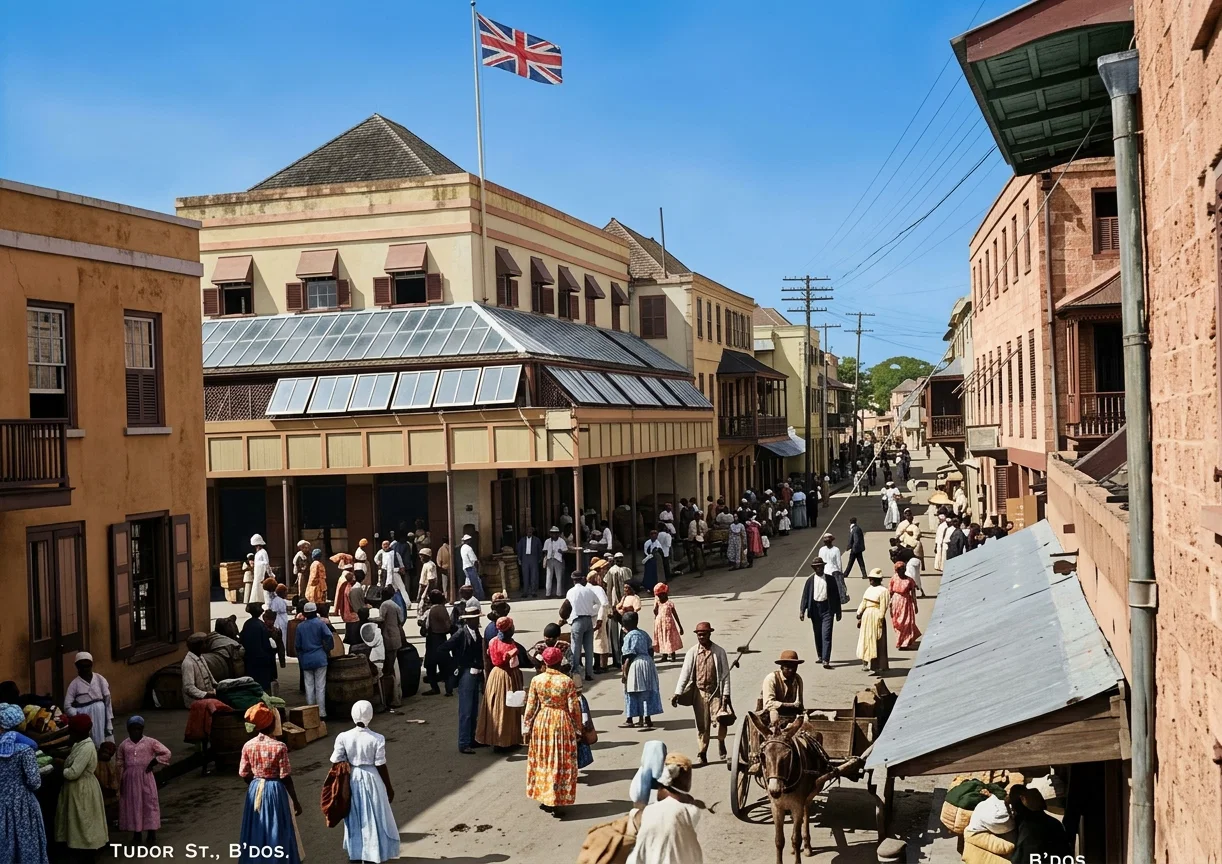
STREET SCENE IN BARBADOS
I never enjoyed the work more in any place than I have here. At present I have ten regular weekly appointments for Bible study, and could readily have more if I could fill them. I can not go out in the middle of the day when the sun is hottest, but use the morning and evening hours for outside work.
When walking about the streets under the burning rays of the tropical sun and in the blinding glare of the white streets, so weary that it almost seems that I am ready to faint, such precious promises as Isa. 40:31 and Ps. 121:5, 6, cheer my fainting spirit, and the blessed hope of the soon appearing of our Lord is indeed an anchor to my soul. Then comes the cheering thought from that good old hymn,—
“Wan' reaper in the harvest,
Let this thy strength sustain,
Each sheaf that fills the garner
Brings you eternal gain;
Then bear the cross with patience,
To fields of duty hie;
'Tis sweet to work for Jesus;—
There's resting by-and-by.”
I feel that I can not be thankful enough that I have the exalted privilege of working with Jesus. We are of good courage, praying to be kept humble and where God can use us every moment. Pray for us and the work here.
MRS. M. H. HONEYWELL.
British Central Africa
By Mabel Branch
CHOLO.—Our two school buildings are made of grass and bamboo poles, with grass roofs. The larger one will accommodate about one hundred persons, sitting close together. For school purposes it seats about sixty. This building is used as a church in pleasant weather, and also as a school for English pupils. Both buildings have dirt floors, which are infested with matakenya. The matakenya are small, shiny, black insects somewhat resembling the American flea. This insect burrows its way through the shoe and into the foot, where it deposits its eggs. If the insect and its eggs are not removed intact in a short time, the foot becomes infected. Sometimes the natives come to us with the toes and fingers both infected.
Occasionally snakes come out of the grass roof to view the classes in the schoolroom. Whenever one appears, the schoolboys drop books and slates, and lessons are suspended until it is killed. There is an opening about three feet wide all around the large schoolroom, through which the wind sweeps from all directions on windy and rainy days. There are no doors, and if we cover the openings with mats, no one is able to see, as there are no windows.
The smaller school building is used18for teaching the Manganja scholars, of which we have had two large afternoon classes. Many of the working people attend the afternoon sessions when their day's work is finished, most of them learning their own language.
The mission house is forty feet long by twenty-six and one-half feet broad, with a veranda eight feet wide around three sides of the house. Each end of the back veranda has been enclosed, and is called a room. One is used as a store-room. It is eight and one-half feet long by six feet broad. The other enclosure is used as a kitchen and pantry. It is thirteen by seven and one-half feet. A space of eighteen feet is left between the two enclosures for a back veranda. There are five rooms in the house. A dining room, twenty-one feet long and ten feet wide, containing no windows, passes through the center of the house, with two rooms on each side of it. This hall is used as a dining room, as a sitting room, as a bedroom when strangers need lodging, and in bad weather as a church; in fact, it is the court for general purposes. The front door of the dining hall is half glass, and on dark, cold days when the door must be shut, this is all the light we receive.
The other four rooms are each twelve by ten feet. The house is covered with corrugated iron, but this has been covered with thick grass, to keep out the sun's intense heat.
There is a great work to be done here. We have a very meager supply of books, slates, and pencils. We are all interested in our work, and trust that the seed sown will fall upon good ground, and bring forth much fruit for the Master.
MABEL BRANCH.
W. A. SWEANY
By W. A. Sweany
BRIDGETOWN.— We have followed the changes that have recently taken place in America with deep interest, and our satisfaction and joy are unbounded to see the pillar of cloud rising, and the people of God following it. Surely the events of the last few months are enough to thrill any one's heart. But how amazing and sad to think that any of our people can set themselves against the manifest providence of God!
The work continues to prosper here. Much of my time is devoted to work in new territory, with cottage meetings and Bible readings every day, besides constantly visiting and distributing literature. In the city and suburbs there are scores of really interested persons, with whom we can not possibly hold readings, our hands being already full. Our Sunday-evening congregations are almost entirely made up of the most intelligent people in the city. Some of these have long been observing the whole truth of God, but have not yet united with us, and others are interested and convinced. Some are joining us from time to time.
The Watchman is destined to be a potent factor for good in this field. We now use fifteen hundred copies each month in Barbados.
W. A. SWEANY
The North England Conference
By E. E. Andross
OUR annual conference was held in connection with our general meeting at Leicester, from July 31 to August 9. Leicester is a town with a population of two hundred and eleven thousand, situated near the center of England, in what is known as the Midlands. It is a very beautiful place, surrounded by what are called “allotment gardens.” The residents rent a small piece of ground, and raise their own vegetables and flowers. The fields are laid off in allotments, and separated by hedges, for this purpose. Many varieties of beautiful flowers are grown in these gardens. The people spend Saturday afternoons very largely in their gardens, caring for them, etc., through the summer season. Nearly everything is closed at one o’clock Saturday, except the shops.
We secured a beautiful field in the suburbs of the town for our meeting; and from the first, the Lord’s presence and guidance were quite manifest. Since others were to report the meeting, I will not enter into the detail of it, but will simply say that it was a source of great encouragement to all who were permitted to attend.
The interest among those not of our faith was good from the first. There were more than a thousand persons from the town in attendance at our closing service. The tent furnished us by the California Conference was crowded to overflowing, while several hundred stood on the outside. Several of the brethren went out on the other side of the grounds, and held an overflow meeting.
The meetings continued until the thirteenth of September. As a result a goodly number have taken their stand with us to keep the commandments of God and the faith of Jesus. The interest is still good, and we are expecting that the Lord will add to our numbers till we have a large church that will be a tower of strength to our work in this conference.
Dr. Sisley rendered efficient help by giving health talks in the tent three afternoons in the week, also by visiting among the people. Brethren Altman and Marchus and Brother and Sister Castle and Sister Cousins, besides the writer, have carried forward the work since the general meeting.
We have had another tent located in Manchester, with Elders Haughey and McCord in charge, assisted by Sister Bacon and Brother Ellis. About twenty-five have decided in favor of the truth. The tent has been taken down, as the tent season is past here. The meetings are being continued in a hall, and a good interest is reported.
Brother Parsons has been located at Hull for several months, where he has been carrying forward the work with considerable success. During June and July Brother Altman assisted him in a tent effort, with some results. At the time of our general meeting at Leicester the tent was needed, so it was taken down. Brother Parsons has since continued the work in Hull, assisted by his mother, who joined him from Southern California about the first of July. As a result, we now have about nineteen new Sabbath-keepers to strengthen the church in that town of two hundred and forty-five thousand inhabitants.
I have recently visited Leeds, where we have a good work started. Brother J. Brandt and his wife are working there, and the Lord is blessing their efforts. From there I went to Newcastle-upon-Tyne, South Shields, West Hartlepool, and Middlesborough. We have canvassers at all these places, and the Lord is blessing the labors of his faithful workers. Interests are springing up in all these places that demand Bible workers or ministers, but we are not able to furnish these laborers at present. The harvest is ripe, but the laborers are few. “Pray ye therefore the Lord of the harvest, that he will send forth laborers into his harvest.”
From Middlesborough I went to Hull, spending the Sabbath with the believers there; then I spent a short time in Grimsby and Ulceby, where there are a few faithful Sabbath-keepers. Brother Parsons will put forth an effort in each of these places during the coming winter, if the Lord wills.
I am now spending a few days with our workers in Manchester. We hope it will not be long before the company here will be ready for organization. Brother McCord has returned to Birmingham, where he will carry forward aggressive work through the winter, assisted by Sister Sanders in the Bible work. Elder Altman has located his family in Nottingham, and with the assistance of Sister Bacon as Bible worker, will start aggressive work.
The Lord is blessing Brother Gillatt and his faithful company of canvassers. Although they are but few in number, yet they are doing a good work. We have quite a number of faithful workers with the Present Truth and Good Health. Dr. Sisley is visiting among the churches and companies of the conference with excellent results. We are all of good courage, and are determined to do all we can to push forward this blessed message of salvation to a needy and glorious triumph. We solicit the prayers of all God’s people to this end.