1 “Zedekiah was one and twenty years old when he began to reign; and he reigned eleven years in Jerusalem; and his mother's name was Hamutal the daughter of Jeremiah of Libnah. 2 And he did that which was evil in the sight of the 3 Lord, according to all that Jehoiakim had done. For through the anger of the Lord did it come to pass in Jerusalem and Judah, until He had cast them out from His presence; and 4 Zedekiah rebelled against the king of Babylon. And it came to pass in the ninth year of his reign, in the tenth month, in the tenth day of the month, that Nebuchadnezzar king of Babylon came, he and all his army, against Jerusalem, and encamped against it; and they built forts against it round about. So the city was besieged unto the eleventh year of 6 king Zedekiah. In the fourth month, in the ninth day of the month, the famine was sore in the city, so that there was no bread for the people of the land. Then a breach was made in the city, and all the men of war fled, and went forth out of the city by night by the way of the gate between the two walls, which was by the king's garden (now the Chaldeans were against the city round about); and they went by the way of the Arabah. 8 But the army of the Chaldeans pursued after the king, and overtook Zedekiah in the plains of Jericho; and all his army was scattered from him. 9 Then they took the king, and carried him up unto the king of Babylon to Riblah in the land of Hamath; and he gave judgment upon him. 10 And the king of Babylon slew the sons of Zedekiah before his eyes; he slew also all the princes of Judah in Riblah. 11 And he put out the eyes of Zedekiah; and the king of Babylon bound him in fetters, and carried him to Babylon, and put him in prison till the day of his death.”
Golden Text.—“Ye shall seek Me, and find Me, when ye shall search for Me with all your heart.”Jer. 52:1-11.
Suggestive Questions.
(1) How old was Zedekiah when he began to reign? How long did he reign? What was his mother's name? V. 1. Note 1. (2) What is said of his reign? V. 2. Note 2. (3) What was brought about by his extreme wickedness and folly? V. 3. Same note. (4) What came to pass in the ninth year of Zedekiah's reign? V. 4. Note 3. (5) To what extent was the city besieged? Vs. 5, 6. Note 4. (6) In this desperate strait what did the city's defenders do? V. 7. (7) What was the result of the flight? V. 8. (8) To whom, and to what place, did they first take the king? What was the result of his trial? V. 9. (9) Upon whom was the sentence of death executed? V. 10. (10) What was done with Zedekiah? Notes 5 and 6.
Notes.
1. Zedekiah was a half-brother of Jehoiakim, who burned the roll which contained the warning of the Lord by Jeremiah. When Nebuchadnezzar king of Babylon took Jehoiachin, son of Jehoiakim, a prisoner to Babylon, he placed Mattaniah on the throne in Jerusalem, and changed his name to Zedekiah. Jeremiah of Libnah (a town some thirty miles southwest of Jerusalem) was not Jeremiah the prophet, who was “the son of Hilkiah, of the priests that were in Anathoth in the land of Benjamin” (Jer. 1:1), which was north of Jerusalem.
2. “Did that which was evil.”—The extent of the evil is told in 2 Chron. 36:16: “They mocked the messengers of God, and despised His words, and misused His prophets, until the wrath of the Lord arose against His people, till there was no remedy.” Jeremiah himself was put into a loathsome dungeon. All the punishment brought upon Zedekiah and upon Judah at this time was by the hand of Nebuchadnezzar, a heathen king, who was actuated by a spirit of revenge because of Zedekiah's rebellion. But Nebuchadnezzar was but the instrument in the hand of God to execute judgment for the rejection of His Word and the persecution of His messengers. Verse 3 says it was “through the anger of the Lord did it come to pass in Jerusalem and Judah.” When the Spirit of the Lord was withdrawn from him, he blindly rebelled against the king of Babylon, of whom he was but a vassal.
3. “Nebuchadrezzar” is said by some authorities to be the correct spelling of Nebuchadnezzar, which is commonly used.
4. “The famine was sore.”—By comparing verses 4, 5, and 6 it is seen that the siege had continued a year and a half. See the book of Lamentations (of Jeremiah) for description of the horrors of the siege.
5. “Put out the eyes of Zedekiah.”—This putting out the eyes of captives was a common practise in Assyria. An article in The Sunday School Times some time ago stated that “in one of the sculptures at Khorsabad, Sargon represents himself in person holding a prisoner by a thong attached to a ring passed through his under lip. The victim kneels before him, while with a spear he pierces his eyes. Others are held chained, and, with hooks through the lips, are held awaiting their turn. . . . It was especially in Persia that the cruel practise of blinding prisoners prevailed. In Turkey it was formerly the custom for a sultan, on his ascension, either to slaughter or blind his half-brothers, that he might have no rivals or dangerous persons near his throne. In modern Persia the shahs have invariably, even up to the present century, put out the eyes of all their brothers who did not escape to distant provinces in time to elude the cruel torture and its consequences. The shah before the present one was the first Persian monarch who was prevailed on to abandon the practise.”
6. Zedekiah imprisoned.—The record in this lesson is paralleled almost word for word in 2 Kings 24:18 to 25:7, but in a lesson scripture is added, what is not stated in Kings, that Zedekiah was “put in prison till the day of his death.” He was the last king of Judah. Of him the prophet Ezekiel said (chap. 21:26, 27): “Thus saith the Lord God: Remove the diadem, and take off the crown; this shall not be the same; exalt him that is low, and abase him that is high. I will overturn, overturn, overturn, it; and it shall be no more, until He come whose right it is; and I will give it Him.” This can not be the first advent of the Messiah, for He did not assume the kingship then (see John 6:15; 18:36, 37; Acts 1:7); but “when the Son of man shall come in His glory, and all the holy angels with Him, then shall He sit upon the throne of His glory” (Matt. 25:31).
BEASTS, BIRDS, AND FISHES
will delight the children. It is a volume of 126 pages and 363 illustrations with descriptive matter in connection with each cut. Price, 50c.
PACIFIC PRESS PUBLISHING CO.
Oakland, Cal.
Lessons by Mail on Medical Electricity or How to Use the Battery
By G. L. Abell
By Prof. G. L. Abell
Member of the Board of Directors of the Electro-Medical Society of San Francisco.
Learn how to use the battery and treat yourself. Many diseases are quickly cured by the proper application of electricity. The course embraces the treatment of every organ and part of the body. The lessons are written in plain language and are illustrated. Course, five dollars. Send for circular. Address,
PROF. G. L. ABELL, School of Chemistry and Electro-Therapeutics. 22½ Geary St., San Francisco, Cal.
Pianos and Organs at Lower Prices
Brother L. I. Sage, of Ventura, California, has opened a music house at that place, and has agreed to furnish pianos or organs to all readers of THE SIGNS OF THE TIMES, from Seattle, Washington, to San Diego, California, at a much lower price than outside dealers will furnish them, handling all grades of pianos and organs, and selling for cash or on easy terms.
Those desiring an instrument should correspond with him at once.
When you write, please mention the SIGNS OF THE TIMES.
ROMAN CANDLES
100-page monthly magazine on the evils of popery. One copy, 10 cents. One year, $1.00.
Address, “Roman Candles,” San Francisco, Cal.
When you write, please mention the SIGNS OF THE TIMES.
NOTICE TO CREDITORS.
By Josephine L. Jones
ESTATE of Eliza W. Mattingly, deceased.
Notice is hereby given by the undersigned Administratrix of the estate of Eliza W. Mattingly, deceased, to the creditors of and all persons having claims against the said deceased, to exhibit them with the necessary vouchers within four months after the first publication of this notice, to the said Administratrix, at the office of Sam Bell McKee, 957 Broadway, Oakland, California, which said office the undersigned selects as her place of business in all matters connected with said estate of Eliza W. Mattingly, deceased. JOSEPHINE L. JONES.
Administratrix of the estate of Eliza W. Mattingly, deceased. Dated Oakland, Nov. 1, 1898.
Sam Bell McKee, Attorney for Administratrix.
Healthful Delicious Nut Foods
EASILY and cheaply made in any household by the use of our complete equipment for grinding and emulsifying nuts. The production of our mills is unsurpassed. Full directions and a booklet containing many valuable nut food recipes, free with each mill.
NUTS
Shelled and unshelled, of all kinds at reasonable prices
For further information, catalog, price-list, etc., write to
JOSEPH LAMBERT
Battle Creek Michigan
When you write, please mention the SIGNS OF THE TIMES.
THE SOCIABLE TO DEACON PEASLEY’S.
By Priscilla Ann Baker
They’d ben havin’ sociables in an’ around Bean Blossom quite frequent fur a spell; but Baker an’ me hadn’t ben to none of ’em. We’re past our rompin’ days, and don’t go much o’ nights ceptin’ to meetin’ an’ sich. But when I took the butter up one mornin’ to Mis’ Peasley (she wus takin’ five pounds a week of me, at store price, too; fur she knowed mine wus alwus good) she got at me fur Baker an’ me to come to one to her house that night.
She’s a powerful hand at sich doin’s, Mis’ Peasley is. She said it wus to be a lunatic sociable an’ got me to promise we’d come; fur I don’t like to cross folks without a good reason fur it. Baker didn’t say much ag’in’ it, so we drove over. Bein’ a lunatic sociable we surmised ’twould be held in the dooryard; fur the folks would have a better chance to see Luna there than in Mis’ Peasley’s front room.
A CALIFORNIA GRIZZLY BEAR.
When we got to Deacon Peasley’s, there wusn’t no one in the dooryard and the hall wus empty too, so Baker rapped. (I never kin learn him to ring a door-bell.) When we went in, that house wus a sight! If Baker an’ me hadn’t had good broad minds, they’d a ben plum upset by the trimmin’s an’ goin’s on as wus there that night. The walls an’ pictur’ frames an’ doorways wus hung with strings of corn-cobs an’ big bows made outen coffee sackin’ an’ newspapers an’ red an’ yaller calico. Mis’ Peasley took my wraps, an’ we set down amongst the folks; fur there wus lots there, Parson Jones an’ most all of ’em, talkin’ an’ laughin’. We didn’t jine in very much, but jest set an’ studied out what they wus at; fur the young folks wus rigged out uncommon startlin’. One girl had ribbons an’ breastpins strung on thick, red an’ green an’ yaller on her hair, that hung in a braid behind, an’ a little bow of narrer pink with ends about a yard long, on behind fur a sash. Her dress skirt wus wrong side out, an’ her feet wus purty considerable in the way, havin’ on her pap’s carpet slippers. One young feller had on one leg of blue overalls an’ tother wus black an’ stuffed in his boot-top, an’ his coat wus decked out here an’ there permiscous like with tin tobacco tags. But it hain’t no use fur me to try to tell how they wus all fixed; but, as I said a spell ago, they looked oncommon startlin’.
All to onct I thought what they wus at, an’ says I, “Felix Baker, I do b’lieve they’re playin’ bein’ lunatics theirselves.”
An’ Baker stomped on the carpet an’ brung his hand down on his knee an’ says, “That’s the idy, mother; that’s it exactly.” An’ then after a minute, “But how’d you reckon Mis’ Bailey feels with her man in the ’sylum, an’ Hugh Brown with his wife, an’ their sisters an’ brethren a-carryin’ on so?”
“Wait, Baker,” says I, “we’ll talk ag’in. Now hain’t no time,” says I; fur I see Mis’ Peasley an’ some of ’em lookin’ at him kinder curius.
At that the Bean Blossom school-teacher sets down on a pumpkin that had three broom-sticks stuck into it an’ tied with green ribbon, fur legs, an’ begun playin’ on the pianner, “Wait till the Clouds Roll By.” It wusn’t long till he wus jinglin’ “Yankee Doodle” an’ “Auld Lang Syne” alternate, an’ after a spell he wound up with “Up in the Mornin’ Airly.”
Then Phil Dorris (a little fat feller that clerks to the shoe store) got up an’ begun tellin’ about settin’ a blue hen, like a Dutchman. He jest got to goin’ good when Rosey Phelps come out in the tother corner of the room an’ commenced speakin’ “Maclean’s Child,” an’ most d’rectly Mabel Jenkins walked right up to her, singin’ “Bye, baby, bye O,” over an’ over. Then that teacher, he went tearin’ acrost the room towards ’em both, a-renderin’ “Spartacus to the Gladiators,” an’ they all kep’ it a-goin’ fur a spell, an’ then kinder quit, one at a time like, with the folks all a-laughin’ like wild.
When they got done, they brought each one of us a dust-pan, with cake and crackers an’ cold beef an’ sass in tumblers, an’ lemonade in flasks, onto ’em. But I couldn’t choke nothin’ down but a swaller or two of lemonade fur thinkin’ of Mis’ Bailey an’ Hugh Brown an’ their troubles; so when they brought in a big copper wash-kittle full of apples an’ peaches, an’ begun handin’ ’em round with a long-handled spoon an’ the tongs, I says to Baker, “We’d best to go home,” fur I knowed if we didn’t I’d up an’ give ’em a speech as wusn’t onto the list, an’ I jedged I’d best not jest then.
Baker see how I wus feelin’, an’ so “All right,” says he, “jest what I wus thinkin’;” but I saw he put a piece of cake into his pocket as I started fur my bunnet.
“You ain’t goin’ now, be you?” says Mis’ Peasley.
“Yes,” says I, “I feel unusual bad, an’ I guess we’d best be a-goin’.”
We set out, an’ when we got to the edge of town, the light shone out so bright from Hugh Brown’s winders Baker stopped the team without hardly knowin’ it. I heerd that Ruth (who’s only fourteen, an’s had charge of the house an’ the four little ones13ever since her ma wus tooken ento the ’sylum) had ben havin’ chills an’ fever fur a week back, an’ I’d ben threat’nin’ to visit her, but hadn’t got to. But fur all my designin’ I felt conscience-struck when I see her a-layin’ onto the bed with her little patient face all red with the fever. Hugh set rockin’ with three-year-old Robbie in his arms asleep. Purty soon he got up an’ laid him by Ruth, kissin’ ’em both good-night, an’ then, lookin’ up to where a pictur’ of his wife took jest before they married hung on the wall, he knelt down by a cheer, the tears rollin’ down like a flood. Baker wanted to go in, but I says: “No, not to-night. They’ll know where we’ve ben. To-morrow I kin do somethin’ to he’p Ruthie, an’ he’s talkin’ to his best Friend now.”
(Concluded next week.)
PRISCILLA ANN BAKER.
WHY I QUIT.
By Frances E. Bolton
No, stranger, I hain't got no light.
I used ter smoke an awful sight;
But now I've quit. I've quit to stay,
So blow yer smoke the tother way.
How was it I quit? D'ye want to hear?
I quit I reckon nigh two year.
Though ’fore I quit I smoked fer twenty,
Fact is, my pipe was never empty,
Er ef it was, it was a law
Ter have a plug inside the jaw.
Ef it wasn't smoke, then it was chaw.
But once I saw ez an angel saw,
And so I quit.
Do you see this curl?
Well, when I quit, I loved a girl,
The sweetest, innercent bit of clay
That was ever molded woman's way,
More of an angel than a human,
More of a saint, sir, than a woman,
Leastwise I never saw her like,
And for her sake I quit the pipe.
Talk ter me?—No, she didn't need ter.
Her very presence killed the weed, sir.
I never felt so low and mean,
So pig-like, filthy, and unclean,
Ez when I stood within her room.
She seemed to fill it with perfume—
Kind ez an’ angel, an’ ez sweet.
The lily flower is hard ter beat,
Yet I’d hev touched a lily white
Quicker’n her. She flashed a light
Inter my soul, ’en then I saw
The beast a man is that can chaw
A dirty plug, and, what is like,
The smoker of a filthy pipe.
It came ter me that God made Eve
Out of first Adam’s side. D’ye b’lieve
I thought He’d hed ter a made from me
A creature of impurity,
And never could give such a dove
To such a filthy beast to love?
And, sir, I said, “Afore I ask her,
I’ll quit, I will.” O, what a task, sir!
I’d go a spell without, and then
Go back to waller in my pen.
I finally told her of my plan,
And asked her help me make a man.
She told me God’s help was the best,
Yet put a hope within my breast
That if I’d be a man, pure, straight,
Someday, perhaps, she’d be my mate.
I went away to prove my claim,
To overcome my manhood’s shame,
And just a year ago to-night
I went to see my lily white.
A hush was round the place. An awe
Fell over me before I saw
That crape hung from the door knob there,
And sobbing filled the quiet air.
They took me in; they made a space;
I looked on my dead darling’s face,
More beautiful than angels are.
A light fell on it from afar.
The smile she wore was not for me,
But for the Lord divine. You see
I knew that instant, ez ef told,
That love had made me overbold.
No, not for me in time. I stepped
Nearer her coffin’s side and wept,
And vowed, while gazing on her face,
To seek to Heaven for help and grace,
To purge away my guilt and sin,
To be the man I might have been.
So, stranger, grief is made more light,
Since Christ has come and made me white.
And some day in a world more fair,
I’ll meet my lily free from care,
No fume of pipe, no stain of sin;
I’ll be the man I might have been.
Not through my merit; I must hide
In Him she loved, the Crucified.
You know now why I keep no light,
Save from above. So, sir, good-night.
FRANCES E. BOLTON.
SMALL TIPPLING.
By David Paulson, M.D.
THERE are many who are interested in the great temperance reform who would be shocked if the suggestion should be given to them that they are in anywise indulging in stimulants. Yet it is a scientific fact that alcohol is not the only stimulant. There are numerous other stimulants that are just as much so in principle, and pave the way for the curse of the drink habit; and if it were not for the sowing of these, there could not to-day be such a harvest of intemperance.
All the leading medical scientific authorities are beginning to recognize this, and when social and temperance reformers fully grasp the fact that a man reaps what he is sowing, they will find that the temperance reform must begin at the tables. Dr. Alexander Haig, an eminent London medical authority who has been making profound study of this for years, says the following significant things in his valuable book recently published on this subject:—
As regards alcohol, I was much interested to hear it said at a dinner given by the Vegetarian Society of London a few years ago, that the adoption of a vegetarian diet was one of the best means for overcoming the craving for drink, for if this craving is in any way due to the mental conditions of discomfort produced by the circulatory disturbances of uric acid, this is just what I should expect.
Like morphine, cocaine, and alcohol, of which we have been speaking, meat itself is a stimulant, and this is the real cause of the difficulty which so many experience in giving it up. As regards nutrition there is no difficulty, for plenty of things can be found which will nourish the body quite as well or better than meat. Now meat acts as a stimulant in the same way that morphine, cocaine, and alcohol do so, by clearing the blood of uric acid. The uric acid xanthins, and salts it contains diminish the alkalinity of the blood, and for a time keep it clear of uric acid, but as in the case of the drugs, this is followed by a rebound, and then more meat or alcohol, morphine, or cocaine in its place, must be taken to prevent the resulting depression, and the use of the one stimulant leads to that of another, and the more they are used, the more uric acid will be retained, and the more they will have to be used in ever-increasing quantities to hold it back. At last a time arrives when further stimulation is impossible, and then there is an enormous rush of uric acid through the blood, with headache, melancholia, or uræmia as its results. Thus I have been told by a patient of mine whose daughter, among other good works, has a Home for Inebriate Women, that her own experience has taught her that flesh diet is the very worst for them, and she does what she can to tempt them away from meat, but she says, “You can really see joy in their faces if a large joint of meat is brought in,” just, I remark, as you would see joy in their faces if a keg of whisky was placed on the table. I also hear from the same source that if the craving for alcohol is overcome, that for meat goes also. It is stimulation that is wanted, not nutrition.
I would also point out that meat not only produces in this way a craving for stimulants to overcome the rebound from its own stimulation, but it also produces thirst, so that those who use it are driven to drink very considerable quantities of such fluids as beer, and thus introduce ever more and more of the stimulating acids and alcohol.
No doubt those who eat no meat have no stimulation, and the stimulation by meat or drugs is pleasant while it lasts; but this is far more than counterbalanced by the terrible depression that follows, and which, when too late, its victims make violent endeavors to escape from.
But those who have no ups have no downs, and so long as their blood is kept pretty steadily free from uric acid, their general health of function and nutrition is considerably higher than that of those who go in for constantly-repeated stimulation and think it strength.
As we shall see later on, the cerealeans and frugivora among mankind have both greater muscular energy and power of endurance than the carnivora, and we shall see why they have it, tho meat-eaters would fain persuade us that it is all the other way. No doubt all the stimulation is wrong, and we thus merely enjoy to-day by mortgaging to-morrow; and just as we may rise to-day a few inches above our normal level, so shall we fall to-morrow exactly the same amount below it; those who live on the uric-acid-free diet can alone have a steady, high level of function every day, and these never feel the want of any stimulation.
Dr. Haig’s own definition for a “uric-acid-free diet” is one which is free from tea, coffee, and flesh meats. The waste matter in meat, the caffein in coffee, the thein in tea, are all eliminated through the body as uric acid, and thus tend to increase the long list of troubles that the human family suffer as the result of the heaping up of these waste substances in the human system. It must be plain to every reader that all those who eat a pure food, free from these substances, will have no waste matter for the system to eliminate except what is actually produced by the normal work of the body; and God has made provision for the human organs, under normal conditions, to eliminate these sufficiently day by day so that we may be able to live without headaches, nervous disorders, Bright’s disease, and kindred evils which afflict man when once his system is overwhelmed with poisons created in the body by improper food.
David Paulson, M.D.
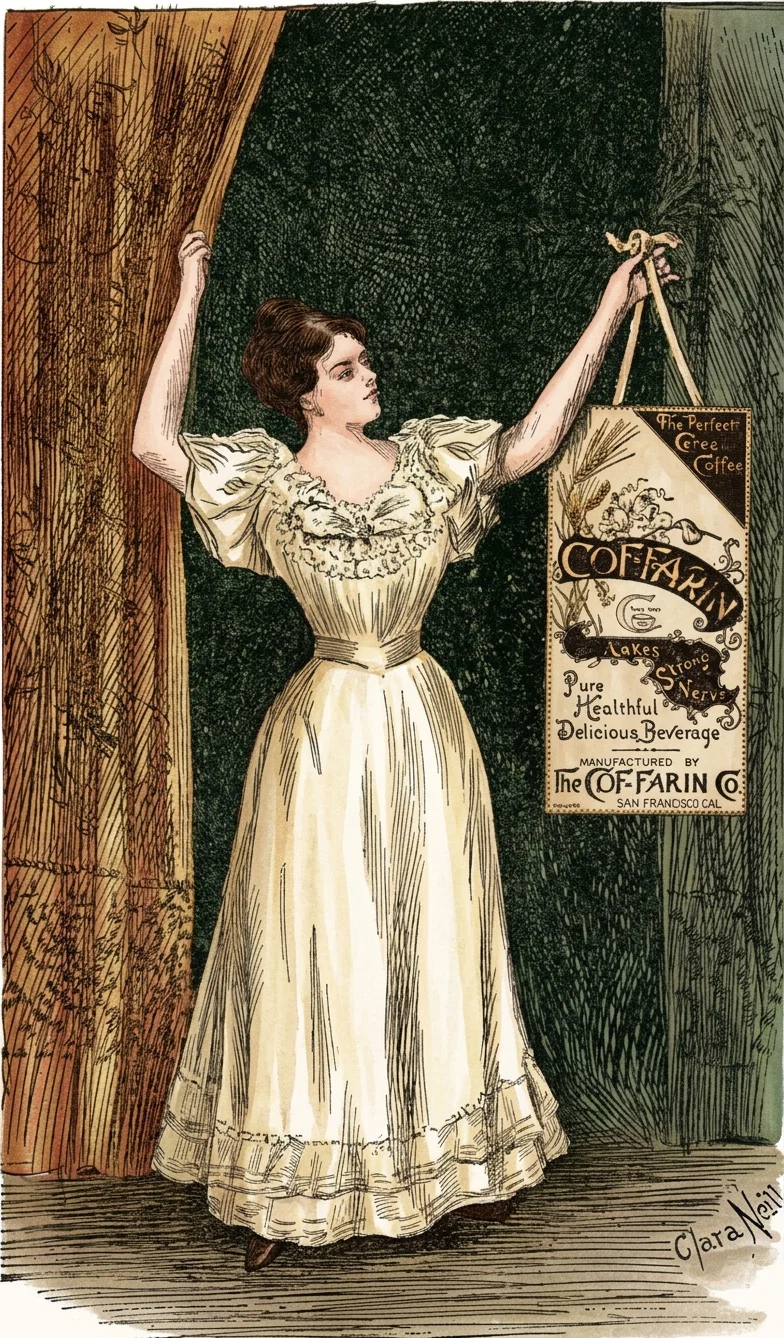
Perfect Cereal Coffee
Cof-farin
Pure Healthful Delicious
Makes Strong Nerves and Regulates Digestion
Fifty per Cent. Richer than Any Other Cereal Coffee Manufactured
Made from the Choicest Quality of California Grains and Fruits Exclusively
1½lb. Pkg. 25 Cents
Sold by All Leading Grocers
Agents wanted everywhere
The Cof-farin Co.
121 California St. San Francisco, Cal.
E. M. Morrison, Manager
DISTANCES WE WANT TO KNOW.
THE Baltimore Sun printed an interesting map, not drawn to scale, but showing the various distances between points of special interest, as follows:—
Yokohama to San Francisco, 4,500 miles.
Yokohama to Hongkong, 590 miles.
Hongkong to Manila, 630 miles.
Manila to San Francisco, 6,502 miles.
Hongkong to Hawaii, 4,800 miles.
Hawaii to San Francisco, 2,080 miles.
New York to Havana, 1,215 miles.
New York to Liverpool, 3,017 miles.
New York to Cadiz, 3,120 miles.
Key West to Havana, 90 miles.
Havana to Porto Rico, 1,040 miles.
Porto Rico to Cape Verde, 2,370 miles.
Cape Verde to the Canaries, 859 miles.
Cadiz to Canaries, 780 miles.
No Sin Is Little
I WILL account no sin little, since the least works out the death of the soul. It is all one whether I be drowned in the ebb on shore or in the midst of the deep sea.—Bishop Hall.
Work Without Communion With God
By Alex. McLaren
THIS generation is so busy working for God that it has little time or inclination for communion with God, and therefore much of its work is worthless.—Alex. McLaren.
News and Notes
International.—Advices from India state that serious plague riots occurred on the island of Cavery, Mysore, on November 18. The police fired upon the mobs and killed and wounded a large number. ......A Socialist conspiracy has been discovered among the students at Warsaw, Russia. Five hundred have been arrested and eighty exiled to Siberia, thirty of the latter being sent to perpetual banishment. Two hundred have been expelled from the universities......Thousands of persons witnessed the launching of the British battle-ship Formidable at the Portsmouth dockyard, England, on November 17. This war ship is the largest in the world, being of 15,000 tons displacement. She is 400 feet long, and when completed will cost about $4,800,000......The English, who are now in possession of Wei-Hai-Wai, have arranged for the enrolment of a battalion of 1,000 Chinese, to serve in the English army under English officers......The rebels in the State of Salvador are now said to be in possession of all but one district, and active war has been instituted. The object of the outbreak is to upset the Central American Federation......Italy has announced her determination to retain her sovereignty of Raheita, on the Red Sea, the point which Russia is said to be earnestly coveting......A most important treaty has just been completed between France and Italy, which comes as a surprise to all the rest of the continental powers, and is regarded as a significant international event. Since 1887 there has been more or less friction between these two countries, and Italy has shown considerable friendship for England. This treaty is regarded as removing the long-standing friction between Paris and Rome......England still continues to send large supplies of all kinds of war munitions to the Pacific and Atlantic ports of Canada, and the preparation of war vessels at those ports is still going on......Riots between opposing clubs at Seoul, Corea, recently, resulted in the killing of twelve of the rioters......The sultan of Turkey has ordered the closing of an orphanage at Boitung, which shelters the homeless victims of the Armenian massacres. The institution is managed by American missionaries. And both the American and British ambassadors are intervening in behalf of the orphans......Serious riots have been taking place during the week in Budapest, Hungary, in which students and members of the Diet have repeatedly come in conflict with the police. Two hundred persons were arrested on November 22. The rioting was the result of a clash between opposing factions in the lower house of the Hungarian Diet......Great precautions are being taken by the Chinese empress to prevent an extensive rebellion which is believed to be about to break out in various parts of the empire. Large quantities of arms and ammunition are being shipped into the provinces which are ripening for rebellion......The negotiations between the American and Spanish commissioners at Paris are believed to be drawing to a close. It is reported that Spain will yield to the American demands under protest.
Casualties and Calamities.—On the morning of November 17 the British ship Atalanta was wrecked on the rocks off the coast of Oregon, and all but three of her crew of twenty-seven were drowned. ......Eleven men were killed near Jersey City, N. J., on November 18, while repairing the railroad track. The laborers were unable to discern the headlight of the engine in the dense fog and smoke, and were mangled to death while standing on one of the tracks......Over 10,000 Japanese fisher-folk, on one of the northernmost islands of Japan, are now said to be facing almost certain starvation, owing to the total failure of their catch this season, following several successive years of partial failure......A severe and extensive snowstorm visited the Middle and Lake States on November 21, in several of the States severely interfering with railroad traffic and telegraph communication. The storm extended from Texas to Canada. The high wind by which it was accompanied did considerable damage on the Great Lakes......It is reported that the members of the Jesse expedition, which some time ago was lost at the mouth of the Kuskokwim River, in Alaska, while trying to make a landing were murdered by Indians and their bodies thrown into the sea......The Hotel Baldwin, San Francisco, Cal., burned on the morning of November 23, and a considerable number of persons are believed to have lost their lives in its destruction, tho definite information is lacking as these columns close. The Baldwin is one of the largest hotels in San Francisco, and is said to have cost $2,000,000.
Domestic.—John W. Keeley, inventor of the famous Keeley Motor, died at his home in Philadelphia, on November 18. Mr. Keeley claimed to have discovered the secret to the production of a powerful force through the instrumentality of musical tones. His secret, if he had one, died with him......The negroes of St. Louis, Mo., have petitioned President McKinley to recommend to Congress action looking to the protection of colored men in the South......The importations of gold into the United States during the past ten months have been greater than for the corresponding period of any previous year in the history of the country, amounting to over $143,000,000. The trade balance in favor of this country during that time is over $460,000,000......The steamship St. Paul left San Francisco on November 18 for Manila, with supplies for the troops in the Philippines, which included 20,000 Christmas boxes from the homes of the soldiers. Forty Red Cross women nurses also took passage on this vessel......The torpedo-boat destroyer Farragut, which was built at San Francisco, failed by a fraction of a knot to attain the required speed of thirty knots an hour, and has been rejected by the Navy Department, tho another trial may be given the vessel......President Iglesias, of Costa Rica, arrived at New York on November 22, and will pay his respects to President McKinley at Washington.
The Philippines.—Aguinaldo has instructed his representatives in Paris to demand complete independence, stating that otherwise the Filipinos will fight to the death......It is reported that the insurgents have captured the city of Iloilo. The Spanish also report a victory at Iloilo. The U. S. cruisers Charleston and Concord have been sent to that place for the protection of foreigners......Two of the Spanish gunboats which were sunk in the harbor of Manila on May 1 have been floated and will be added to the American squadron there......The island of Negros has declared independence and asked for an American protectorate.
Cuba.—Another revolt of Spanish troops took place recently in the province of Matanzas over the non-payment of wages long overdue......A large number of transport steamers have at last been chartered by the Spanish Government to use in the transportation of the troops now in Cuba, and it is expected that the island will be evacuated by the beginning of the new year......It has been ascertained that the Reina Mercedes, which was sunk in Santiago Harbor, is in good condition and can be raised with little difficulty. Work will soon begin upon her.
Fires.—Three four-story brick business buildings were partially destroyed by fire in New York City, on November 19. The loss is placed at $300,000. ......Fire destroyed a wholesale druggist establishment at Louisville, Kentucky, on November 19. Loss, $75,000......A fierce fire in the shipyards at New Brighton, Staten Island, on November 19, destroyed property valued at $400,000......Fire swept the town of Perry, Iowa, on November 21, destroying a large number of buildings. The loss is placed at about $500,000.