Your ShelfYour Projects

Review and Herald, Vol. 93, No. 27.

Christ the Great Healer
Earlier text: One Week’s Experience at La Plateria

Work in the Cities

In a most remarkable manner the Spirit of God is preparing hearts for the reception of truth. There are many in our large cities who are as honest and sincere as was Cornelius, and who are as diligently reading the Bible as was the eunuch. God has his eye on all such, and just as truly as he brought Cornelius and Peter together, and the eunuch and Philip, so truly will he bring together those who are today seeking truth and those who have truth to impart.
There are many standing on the threshold of the kingdom, waiting for an outstretched hand and a welcome. To the question, “Understandest thou what thou readest?” the eunuch replied, “How can I, except some man should guide me?” And he desired Philip that he would come up and sit with him. The place of the scripture which he read was this, He was led as a sheep to the slaughter; and like as a lamb dumb before his shearers, so opened he not his mouth.” The eunuch said, “I pray thee, of whom speaketh the prophet this? of himself, or of some other man? Then Philip opened his mouth, and began at the same scripture, and preached unto him Jesus.” As a result of this interview, the eunuch was converted and baptized, and “went on his way rejoicing.” It is a remarkable record; and yet today just as remarkable things are taking place. God has prepared the soil, and he that engages in this personal work, going forth with weeping, “bearing precious seed, shall doubtless come again with rejoicing, bringing his sheaves with him.” Results will follow when this work is performed in the fear of God and in the spirit of Christ.
One thing will surprise us as we take up this long-neglected work, and that is that there are so many honest men and women still left in this world. The world is bad enough, but it is not all bad. God still has in it many precious jewels. Everywhere we shall find men and women whose hearts God has touched.
One man in Pittsburgh whom we visited said, “I never went to church, but since I have been going to your meetings, something has taken place in my life. I cannot explain it. I want to relate something which very much impressed me. A few nights ago I had a dream. In this dream Jesus appeared and looked upon me, and said, ‘I have marked out the path before you; won’t you walk in it and be good?’” The man said, “I know I am a sinner.” We assured him there is hope for sinners, that Jesus came for the purpose of saving sinners from their sins. We then unfolded to him as best we could the plan of salvation in its simplicity, how God casts our sins behind his back and remembers them no more against us, that we stand before him as if we never had sinned, that he takes sin from us and in its place imparts his own righteousness, so that we now become servants of righteousness, and a new life begins.
As we talked, his friend, who was standing by chewing tobacco, became interested. He said he too wanted to lead a better life, but did not know how to get anything out of the Bible. Elder Ulrich talked to him about topical Bible study, and to show what he meant, we gave the two men a short Bible study on the second coming of Christ. “Can I get a book that will help me?” he inquired. Elder Ulrich called his attention to “Bible Readings.” He asked the price, and at once made out a check for the amount, with the request that the book be delivered at his shop. Both these men were under deep conviction, and I believe gave their hearts to God. Before leaving them, with uncovered and bowed heads we asked God’s special blessing on them and their families. Somehow it would not surprise us to see results from this interview in the kingdom of God. We did what we could. We planted the seed of truth, believing that God will watch over it.
This is only one case, but it is not an exceptional one. In every visit we are surprised that business men are so intensely interested in the prophetic page. One said, “I do not wish to find fault with my church or with the other churches, but really I get very little in going to these churches. Since coming to these meetings the Bible has become a new book.” As his wife sings in church, she has to go, but he attends our meetings, and his wife comes as soon as she can after she is through singing. He said he is getting the other men in the offices interested, and is bringing them one by one to the meetings. He was very grateful for reading matter.
I can see why God is now calling the members of the church to engage in personal work. He has gone before them and prepared the way. Give this work a trial, and see if this is not so, and “men shall call you the Ministers of our God.” The greatest joy and satisfaction is found, not in speaking to the multitudes, but in personal ministry. The various gifts have been placed in the church to fit its members to do this personal work. They exist “for the perfecting of the saints, for the work of the ministry, for the edifying of the body of Christ.”
D. H. KRESS.

Field Notes

THIRTY-TWO persons have recently accepted the third angel’s message in Dinuba, Cal.
ELDER G. W. ANGLEBARGER reports the baptism of seventeen persons in Denver, Colo. There are three new Sabbath keepers in Loveland.

Some Suggestions for Providing Facilities for Our Church Schools

THE importance of the work of the elementary school can hardly be overestimated. It is impossible for a teacher to do the work as it should be done without facilities with which to work. When we visit a well-equipped public school and see how everything that is needed to illustrate the lessons is provided, it makes us feel that we must find some way to provide the necessary helps for our schoolrooms.
In most cases our schools are conducted only at great personal sacrifice by members of the church. It is often almost impossible to raise money enough to pay the meager salary of the teacher and to provide fuel to warm the room. Then, although the patrons of the school may become deeply interested, it is often a difficult problem how to obtain the means to provide the necessary equipment for a good school. I shall mention only a few ways that have been successfully tried.
One church whose members felt that they could not possibly support a school, was so fortunate as to have among its members a woman who believed the maxim, “Where there's a will, there's a way.” Although she was not a mother, she felt a deep interest in all the children of the church, and she had the energy and ingenuity needed in that place. Being the treasurer of the board, she had an opportunity to know just how much “push” is required to carry the financial end of the school. Monthly pledges were obtained as far as possible, then she invented other means of adding to the school funds. She organized a sewing society, which pieced quilts and made various articles for use in the home. She solicited clothing from well-to-do people of the city, and some pieces of furniture were also given. These were sold. About sixty dollars was cleared for the benefit of the school.
Another church organized a sewing society, the children of the school turned their manual training into useful lines, both the children and the mothers making hand bags, iron-holders, pincushions, raffia work, etc. These articles were put on display, a price being attached to each, and once a month a sale was held. The sisters of the church contributed good hygienic food, and there was no trouble in selling everything for a good price to those who preferred to buy such articles rather than to make them.
A school established in the city of Washington, D. C., in the early days of church school work, demonstrated what can be done by the students themselves. Two of the older girls in the school led out in the work of artistic sewing. They made sofa pillows, tidies, dresser scarfs, centerpieces, and many other articles for home decoration. They went from house to house, showing their work and taking orders. In this way they cleared $125 for the school, besides developing in themselves a spirit of independence and a feeling of personal responsibility for the success of the school.
A rather unique plan was devised by a woman living in the country. She called in the boys of the school to help her, and together they started a soap industry. They made soft soap of a superior quality, and sold it to the neighbors, thus securing their permanent patronage. In one day they could make ten or twelve dollars' worth of soap. The boys felt very proud of their business, and took a great interest in thus providing money to carry on the school. It was their school, and they did not need disciplinary rules to keep them from doing anything that would hinder the work of the teacher.
A woman living near a large factory, where many young women were forced to eat cold lunches, won their gratitude, and at the same time obtained the much-longed-for means to assist the church school, by providing hot, nourishing soup at the noon hour, for a small price, which they were glad to pay.
We must not fail to mention the help which the children are so glad to give in selling magazines and papers. This is a good experience for them if their work is carefully directed by the teacher or by some older person; but great care should be exercised that the children do not receive harm by being sent out alone on the streets.
Children will find many ways to help when a wise teacher has aroused their enthusiasm by making them see the needs of the school. Instead of calling for a large sum to be raised, it is better to divide it into small sums. For instance, if a teacher having forty pupils wishes to raise ten dollars for a set of maps, she can say, “If each one of the children will earn twenty-five cents, we can get a nice set of maps.” This sounds much easier to the children than to tell them that the maps will cost ten dollars.
The teacher who loves her work will find many ways by which she can enlist the help of the parents and the children in making the schoolroom a place where the children will delight to stay, and where the work can be done in a way that will be pleasing to the Great Teacher, who loves the children, and has given to us such wonderful examples of the right methods of teaching.
MRS. CARRIE R. MOON.

Korean Industrial School

The following cheering note from Elder C. L. Butterfield, of Korea, will be of interest:—
“The closing exercises of the Soonan school were held the twenty-second of this month, when sixteen students were graduated. The school has been reported as doing twelfth-grade work; however, I do not feel that it is above tenth-grade. The tendency here is to run the grade up as high as possible in name, but I feel that we should grade according to the work accomplished. Nine young men and seven young women finished the course given. Three or four of the men will enter the canvassing work, one or two will act as secretaries, and the others will enter the ministry, going out on trial for a year or more. We are certainly glad to know that Prof. H. M. Lee will soon be here again to take up his work. School work, here as elsewhere, is a great factor in the gospel work.”
This report reads just like the reports of our schools in America. The students are preparing for definite work. We have come to measure the efficiency of our schools, in good part at least, by the number of students they send out into gospel work. Elder Butterfield's statement that our school work is an important feature of our forward movement is true for all lands, and will be until the message is finished. So let prayer and earnest effort be made for its prosperity.
FREDERICK GRIGGS.

The Japan Mission Training School

The Department of Education has recently received the following interesting report from Elder H. F. Benson, in regard to the school at Tokio, Japan:—
“The Japan Mission Training School has no special allotment of ground other than that occupied by the buildings. There is no ground for cultivation, as our compound contains only three and one-half acres. On this land we have four foreign homes, eight Japanese houses, the publishing building and offices, and the school. There is room for two more buildings, which have not been put up yet.
“The school is a two-story frame building 36 by 66 feet. The ground floor contains a chapel with a normal seating capacity of one hundred, four recitation-rooms, principal’s office, and entrance. The boys’ dormitory occupies the second floor, being divided into eleven rooms; a hall six feet wide extends the entire length of the second floor. Six-foot halls are required by law for all schools here in Japan. Each room has glass windows, affording plenty of light and sunshine. In the rear is a separate apartment used for the dining-room, kitchen, baths, etc.
“The average attendance this year is twenty-five. There are seven young ladies attending the school. The girls’ dormitory has not yet been built, so they are using a vacant Japanese house in the compound. A man and his wife, who are also students, have charge of the girls’ home. The students are given an allowance by the mission to cover their board, and each one is required to work three hours a day. They are given work in the printing office and about the compound. The preceptor’s wife has charge of the kitchen, and the students take their turn there very much as in the schools of the States.
“There is a good class of students in the school, and they will no doubt make efficient helpers for this summer’s work. The students and teachers are all of good courage, and an excellent spiritual influence prevails.”

Educational Department

FREDERICK GRIGGS     General Secretary
W. E. HOWELL     Assistant Secretary

The Ministerial Reading Course

We are receiving many good words from those who are pursuing the Ministerial Reading Course. Among them are the following:—
“I am in full sympathy with this Reading Course, and feel that no minister should be without it. I need it in order to do the best work. A workman must have the best tools if he is to do the best work. I am glad the Reading Course for ministers was started. To any one not taking this course, I would say that he does not appreciate his opportunities.”
“It seems to me that every year the Ministerial Reading Course gets better. While I have always enjoyed the books, I am getting more out of them this year than ever before.”
“As a member of the Ministerial Reading Course, I am sending a few words of appreciation. I am thankful for the arrangement of the course, and I enjoy reading the books. They have been a blessing to me both mentally and spiritually.”
“I have all the books from the first year of the course, and should be sorry to part with them, for they are just what I need to give me a larger view of the work that is before one who enters the gospel ministry, and to give me a deeper spirit of consecration and devotion.”
Some of our people who are not in the ministry are also joining us in this course. It is very helpful to any one. We have at the present time three hundred and thirty-nine enrolled, and look for many others to pursue this Reading Course, as it does not take long to complete it.
FREDERICK GRIGGS.

The Bible Year

Assignment for June 4 to 10

June 10: 2 Kings 7 to 9.

The Bible a Popular Book

“It is because it is made for the whole people; it is the book of the common people, and when they know it, they love it. The popularity of it is indicated by its sales and distribution. When, in the providence of God, Johann Gutenberg, at Mayence, invented the movable types, and used them first to print the Bible; and when Baron Karl Hildebrand von Canstein used the first stereotype plates, in 1712, to print the New Testament, so that the poor of Germany might have it, then God gave to his Book the first place among all books. And it has been kept there. There is no book of any kind—the classics or common fiction—which has sales equal to the Bible. Every year there are sold as many Bibles as the combined sales of ten of the most attractive novels.
The British and Foreign Bible Society—the great Bible society of the world—while in its first year issued 5,000 Bibles, and in its centenary year issued 6,000,000 copies. The three great Bible societies of the world sent out 9,000,000 copies in a single year. The estimated output for a century was 316,000,000 copies of the Scriptures. The figures are staggering. Thirty-four millions of copies were issued outside of England and America, showing that the English-speaking people are first in the work.
“It is interesting to note the distribution of Bibles among foreign nations. In a single year China receives 1,874,000; Japan, 187,000; India, 600,000; South America, 188,000; West Indies, 190,000; Africa, 186,000; Central America, 27,000; Mexico, 41,000; Philippines, 91,000; Burma, 16,000; Ceylon, 2,700; Korea, 30,000; Siam and Laos, 40,000; Oceanica, 18,000; Malaysia, 84,000. Our attention is called to the great fact that China purchased a larger number of the Scriptures than was purchased by all the Christian nations of the world in the first year of the last century. This means a new life for an awakening people.”—R. G. Seymour, D. D.

Post-Davidic Psalms

The four psalms in this week’s assignment were “written presumably by Asaph and others during the reign of Asa and Jehoshaphat. Asaph was a Levite, eminent as a musician, appointed by David to preside over the sacred choral services which he organized. He was celebrated in aftertimes as a prophet and poet. The titles of eleven of the psalms bear his name.”

First and Second Kings

“The books of Kings form but one book in the ancient Hebrew manuscripts. They give us the history of the death of David, the reign of Solomon, the divided kingdom, and the captivity.
“The truth of this history stands to-day beyond question. The contact with Assyria, Egypt, and Babylon is confirmed, supplemented, and strikingly illustrated by the cuneiform and other inscriptions. ‘Berosus, Manetho, Menander, and Dius, the heathen historians of these countries, join with the monuments in the support which they furnish to our author’s truthfulness and accuracy.’ . . .
“David, shortly before his death, made a declaration in favor of his son Solomon, who was placed upon the throne. Then began that brilliant reign for which David had made preparation by his wise policy at home, his conquests abroad, and the great store of material and treasure which he had accumulated. Solomon’s rule began and continued for a while in a blaze of glory, but the end was shrouded in clouds and darkness.”—H. T. Sell.

Shalmaneser and Jehu

A PAVEMENT SLAB.—Early in the reign of Omri, king of Israel, the power of Assyria began to increase. The first great king of this period was Assur-nasir-apli; and his son, Shalmaneser II, came to the throne in the closing days of the reign of Jehu. Hazael of Damascus, who obtained the throne of Syria by treachery and murder (2 King 8), is frequently mentioned in the records left by Shalmaneser. On an old pavement slab is preserved the record of an expedition against this Hazael by the Assyrian monarch. According to this account, Shalmaneser defeated Hazael in battle, killed his soldiers, captured his chariots and horses, destroyed his plantations and towns, and shut up the fleeing monarch in the city of Damascus. The inscription ends with the statement,—
“At that time I received the tribute of the Tyrians and Sidonians, and of Jehu the son [successor] of Omri.”
THE BLACK OBELISK.—Another interesting relic of that campaign is preserved in a small black stone obelisk, discovered by Layard in the great mound of Nimrud. The four sides of this obelisk are covered with pictures engraved in the stone, and above them are cuneiform inscriptions explaining their meaning. One of these pictures represents “a figure with marked Jewish features” kneeling before Shalmaneser; behind him are slaves bearing gifts. Over the group is this inscription:—
“The tribute of Jehu the Son of Omri, silver, gold, basins of gold, bowls of gold, cups of gold, buckets of gold, lead, a royal scepter, staves, I received.”

What the Women are Doing at Loma Linda

You will be interested in some of the things the women are doing here to help raise the money to build the Ellen G. White Memorial Hospital in Los Angeles.
At our fall council, when the brethren were burdened and perplexed over how they were going to forward the work of the medical college, a number of the sisters in attendance counseled as to how we women might assist. We knew that a hospital must be provided. A number of us waited on the brethren in council, and told them we had come to offer our assistance, and that we would raise the $61,000 to build and equip the hospital. They said they would be glad of our help.
We held a meeting and secured all the big pledges we could. Then we called a women's meeting and asked for suggestions as to how we should further proceed. Some one suggested that every woman in the North American Division give two dollars, and then the question arose as to how they would earn the money.
The following are some of the ways the money is being earned: Doing plain sewing, such as nightdresses, skirts, aprons, bed shoes, pajamas, and nightshirts for those who hire sewing done. Some also make iron-holders, boudoir caps, laundry bags, workbags, dresser scarfs, etc., for sale. Others can fruit, make jelly, preserves, salt-rising bread, cakes, marmalade, etc., which they sell. The Dorcas Society supplies quilts for $2.50. Still others sell milk, eggs, vegetables, etc. One sister who sold eggs told the woman who bought them not to pay her until she had two dollars' worth. She feared that if the money came in in smaller amounts, she would spend it. Now there is one of the secrets of saving money.
This enterprise brought a good spirit into the church here. Some could do more than two dollars' worth of sewing, and they would place the excess to the credit of some sister who was not able to do so much. We are also planning to make sheets, pillowcases, dish towels, napkins, dust cloths, etc.
The work we are doing has surely been a blessing to all of us. While we have had two floods lately, which were quite discouraging, yet our spirits have not been dampened, if the ground and the houses were.
We hope our sisters throughout the North American Division will do all they can to help build this hospital for the poor. We want it finished by September, when the school will open for next year. We have quite a sum collected, and shall soon send it to Elder W. T. Knox, the treasurer. MRS. G. A. IRWIN.

Medical Missionary Department

W. A. RUBLE, M. D. - - General Secretary
L. A. HANSEN - - Assistant Secretary
H. W. MILLER, M. D. - - N. Am. Div. Secretary

Treatment-Rooms Offered

THERE is wanted immediately either a buyer for excellent treatment-rooms or a competent nurse to take charge of the same and operate on shares. The location is good, in Logansport, Ind. The sudden death of the owner is cause for selling. For further information, write C. E. Garnsey, Wabash Valley Sanitarium, La Fayette, Ind.
One or two other propositions of a similar nature are offered through our Medical Department. Correspondence solicited. L. A. HANSEN.

Missionary Volunteer Department

M. E. KERN - - Secretary MATILDA ERICKSON - - Assistant Secretary MRS. I. H. EVANS - - Office Secretary MEADE MACGUIRE C. L. BENSON  - - Field Secretaries J. F. SIMON

Student Canvassing in the Lake Union Conference
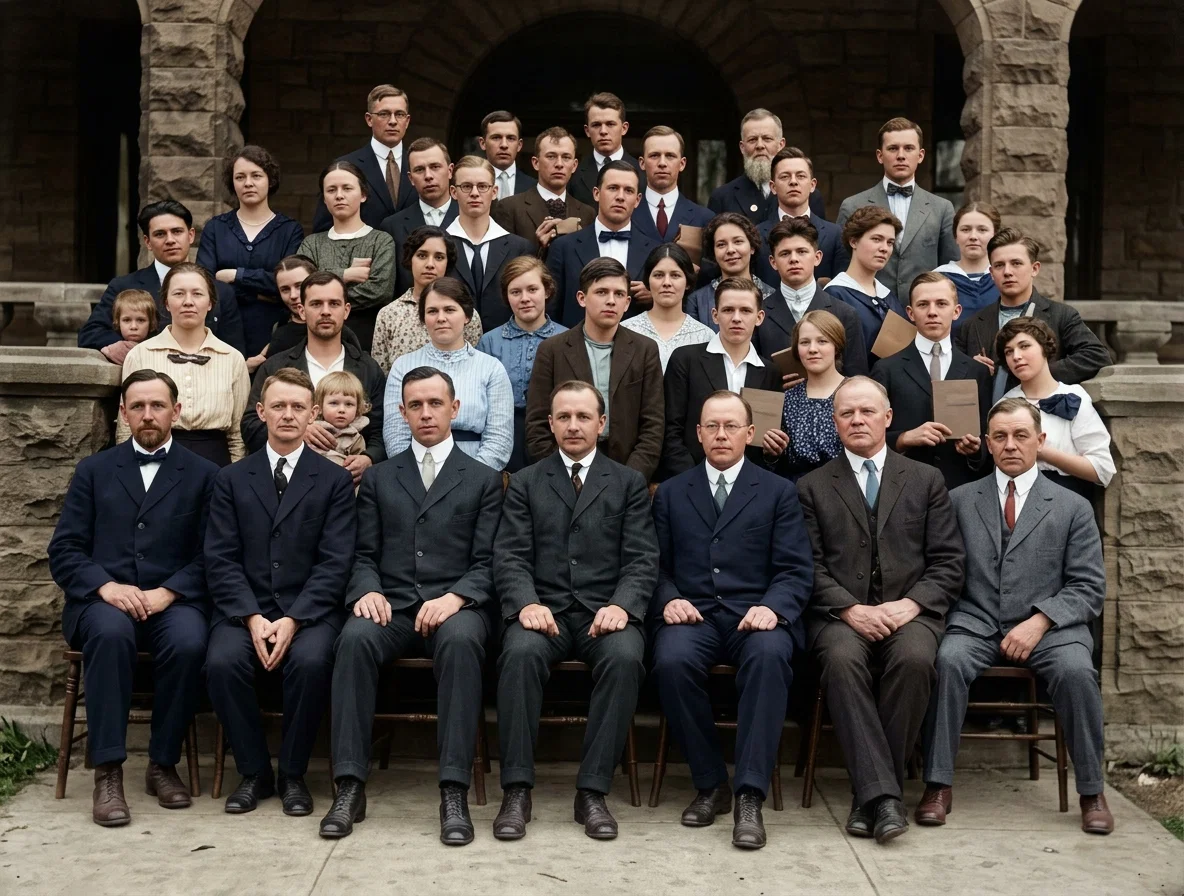
ABOUT ten years ago the plan was set in motion for students to be favored with an extra amount on their sales, in order to encourage them to get the practical experience of interesting people in the truths contained in the books. It took very some time to get the students fully to accept the idea that canvassing is a successful method of earning their way through school. But gradually, as a few met with success, and brought back to the students the precious experiences that they had had in the work, the conviction deepened, until now we find a large number of consecrated student canvassers. Last year about fifty-five went from Emmanuel Missionary College, and this year there will be more than sixty. Last year there were about twenty-five from the Swedish Seminary, and this year there will be thirty-five.
BROADVIEW SWEDISH SEMINARY STUDENT COLPORTEURS
EMMANUEL MISSIONARY COLLEGE STUDENT COLPORTEURS
We just closed an institute at Emmanuel Missionary College, and all the field secretaries of the Lake Union Conference were in attendance and took part in giving instruction. During the past year the students in the school had been under the instruction of competent leaders selected from among the students. They had held meetings each week, studying their books and Christian salesmanship, so that their success in the field is due to a good preparation under the blessing of God. J. B. BLOSSER.

A Little Press That Speaks in Different Languages

THE Philippine Mission job press was very busy last year, operating two shifts a day, and part of the time running all night. It has printed books and tracts in the Tagalog, Cebuano, Panayano, and Ilocano languages, besides our paper in the Tagalog. Our books show that $12,678.74 worth of literature has gone from our office. A little over two hundred dollars’ worth may have been returned by our agents, leaving more than $12,400 worth of books, tracts, and papers put into the homes of the Filipinos.
But what has this accomplished? Our Bible workers are kept more than busy following up the interests thus created. In the northern part of Luzon a man, after reading some tracts, walked two days to inquire of Elder Hay about the truth. Our tent meeting in San Pablo, where more than one hundred have been baptized, was started by our canvassers. At our last missionary meeting, one of our colporteurs said that in a certain town he was stopped by a policeman and questioned as to his work. The policeman seeing the canvasser’s book bag, said, “I infer from that bag that you are an optician carrying glasses.” Receiving an affirmative reply, the policeman asked to see the glasses. When he saw the books and Bibles, he said, “Why, these are books!” The worker replied, “Yes, but they are glasses for the souls of men. Many are in darkness, and these help them to see. The Bible is a light unto our feet. There are many people needing these to help them find the way into the kingdom of God.” After being shown these “glasses,” the policeman allowed the canvasser to go on his way in peace.
We have twenty-six Filipino and two foreign colporteurs at present in the field.
Last week I baptized two men from the town of Luta who had received the truth from our colporteurs. A Pampango, who recently accepted the truth, has translated four tracts into his native language. Thus a new tongue has been added to those in which is being proclaimed the message of the coming King.
L. V. FINSTER.

Publishing Department

N. Z. TOWN - - - - General Secretary
W. W. EASTMAN - - - - N. Am. Div. Secretary

Faith as a Mustard Seed

ONE Sabbath afternoon at our missionary meeting, I had given a short talk on the subject of faith. I had made special reference to the Saviour's parable of the grain of mustard seed, calling attention to the fact that though the seed was small, yet it had within itself all the elements of growth.
One of our Filipino sisters arose, and with sobs of gratitude to God, told her experience in selling Patnubay ng Katubusan, our native missionary paper.
She said that when she started to sell the December special, her faith was small, like the mustard seed; but as she worked and success came, her faith grew as the plant from the mustard seed, and that by the help of God she had been able to sell almost a thousand papers in about two weeks. W. E. LANIER.
Continue reading: The Colporteurs’ Summary for April, 1916