Your ShelfYour Projects

Review and Herald, Vol. 93, No. 27.

Christ the Great Healer
Earlier text: Kill That Enemy

One Week’s Experience at La Plateria

C. V. ACHENBACH
THE past week has been a very strenuous one here at the mission. There is a great deal of sickness at this time of year. I have been kept very busy. Last Sunday a call came for us to go six miles to see a sick person, and when we returned, another messenger was waiting for us, asking us to go nine miles to see three sick children. So altogether I rode thirty miles on horseback that day.
On Monday a messenger came from Puno, twenty-one miles distant, having a letter from the prefect, the highest official, asking us to come to Puno at once to see a woman who was sick. She had fallen from her horse and bruised her arm very badly, and the doctors in Puno were not helping her as she thought they should. I went, and did all I could to help her. The next day she felt much better, and had confidence that her arm would soon be well. Her husband is a prominent official in Puno, and we were glad for the privilege of getting acquainted with these people. He asked us in regard to our work, and seemed much interested in what we are doing for the Indians. He is very anxious for a teacher from our mission to teach his Indians. He has a large farm, on which one hundred and twenty families live; and when we told him that none of the Indians belonging to our church use alcohol in any form, he was much surprised. With few exceptions, everybody uses alcohol in Peru, and the Indians, especially, use much of it.
I hope that we shall soon be able to furnish a good teacher to this man in Puno. He is the alcalde of Puno (an administrative officer, a judge or mayor); and before we left, he gave Brother J. M. Howell a teacher’s license. Every teacher must have a license, and sometimes it is rather difficult to get it. We came home Tuesday, leaving our patient a great deal better.
On Wednesday a woman came to the mission crying, saying that her husband was very sick, and she wanted us to go at once to see him. We saddled our horses and rode five miles to see the man. We found three persons who needed attention.
Thursday one of our Indian boys and I went twelve miles to hold a meeting among the Indians. It was an interesting experience for me. I spoke on the subject of the new birth and the importance of the Word of God. After I had finished my sermon, I asked if any one had any questions he desired to ask. Immediately they began to ask questions about the state of the dead. We made that subject plain to them. And so they began to ask what good the burning of incense does, and also the crosses on the houses. Many families have crosses on their houses to keep away the hail. We explained that at the mission we have no crosses on our houses, and that we get no more hail than the rest of the people. They finally acknowledged that it did not keep the hail away. One man said that he was going to take the cross from his house.
Friday morning we went to see a sick family. Two of the children and the mother were very ill. Another child had died a few days before. All were suffering from dysentery of the worst form. We tried to comfort the father, and gave him some medicine for the sick ones. Before we left, we prayed with them, and promised to call on them again.
Altogether I rode one hundred and eighteen miles on horseback during the week. On Sabbath morning, the brethren and sisters came from all directions to attend the meeting. I spoke on the subject of proper observance of the Sabbath. Before closing the service, all pledged themselves to keep the Sabbath better than they had in the past.

In West Honan

O. J. GIBSON
It was my privilege this fall to visit three of our stations in the western part of Honan Province. With buildings under construction here at home, it was impossible for me to make other than a hurried trip, being able to stop but a day at each station.
The journey was made in a native cart, drawn by two small mules, tandem style. It was a slow process, but with a springless cart, and roads with deep ruts, I was glad at times that the speed was no greater. Thirty miles is considered a good day’s journey; twenty or twenty-five miles is the average speed; but with some persuasion and extra money, forty miles a day can sometimes be covered. However, to do this an early start must be made, and it is generally late before the destination is reached.
It was with difficulty that the native evangelist and I found a place to stop the first night, but after canvassing the village, we found a man who opened wide his doors, and we enjoyed the best he had to offer. He gave us his own private room. We were very grateful, and more grateful still that the room had an outside door, for the room was saturated with the smell of old wine. I slept on my cot, with my head in the doorway, glad for all the fresh air I could get, while the evangelist occupied the landlord’s bed.
We were up and on our way before daylight, reaching our first station between nine and ten o’clock. The believers there had been out of the city to welcome us the night before, and after waiting until late, had to return disappointed. We spent the remainder of the day with them, holding three meetings; and when we left, they were all of good courage. We have a primary school at this place, which is conducted in a very acceptable manner, with nine boys in regular attendance.
Next morning we left for a twenty-mile ride to the next station, arriving in time to get well settled for the night before darkness came on. As we planned to return again in two days, we only stopped overnight, leaving in the morning for a small country town ten miles distant, where we have an active little church with a growing membership and a small church school.
In the course of the morning I remarked to the evangelist that one trip with such a cart would suffice for a lifetime. The route was through the foothills, over roads which could scarcely be called roads, and in many places it was difficult to pass with the cart. One is very fortunate on such trips to be able to walk the greater part of the way, taking the cart for a change and rest. But after we had arrived at our destination, we felt well repaid for the effort. We received a warm welcome, held three meetings, and looked over a plot of ground which had been offered for a church building. The believers were very warm-hearted, agreeing to help to a considerable extent on the building. I am glad to say that we have just arranged to help them to the amount of twelve dollars gold. This may seem a trifling sum, but it will provide for the larger part of a sixteen-by-thirty-five-foot building.
After a night’s rest and a morning prayer meeting, also a good breakfast, we left, feeling much refreshed and of good courage, and well repaid for the trip.
Returning to Bau-An, we spent the remainder of the afternoon making ready for Sabbath. Our native Sabbath school secretary took charge of the Sabbath school, after which I spoke on the importance of distinguishing between the false and the true. All gave close attention. Believers and friends left the afternoon service feeling that God had especially blessed us as a people with the truth for these last days.
Two days by cart brought us home again, in good health, but looking some worse for wear. Of the eight days out, five were spent in traveling, covering approximately one hundred and twenty miles, thus averaging less than thirty miles a day. This trip afforded me a change, which I much enjoyed. Our workers’ Bible institute, which is just over, followed closely on our return, and we had only a limited time to complete preparations. The evangelists from two provinces met here, and a profitable month was spent in study and in outlining work. Nothing preventing, I shall visit our other stations in the spring.

Counsel from Returned Missionaries

A RETURNED missionary, forced home by ill health, was made acquainted with the experience of the workers who were sent out to follow up the work he had to lay down, and was requested to write to them. By a certain coincidence the letter written passed through the Mission Board office, with the request that it be read. It is so full of helpful encouragement, suggesting to the new missionaries some of the things learned by actual experience, that we are wondering if there are not other returned missionaries who could not likewise help their successors in bearing the burdens of the first year out, by passing back counsel as to dangers to be avoided, and pointing out things it would be well for them to do to preserve health and fortify their courage. No one can write such helpful letters as those who have been on the very ground, and know the conditions surrounding these volunteers at the front.

Divorce in South America

In the Missionary Review of the World appears this on “Divorce in South America”: “The Roman Catholic Church claims that, because of its influence, there is no divorce among the South and Central Americans. The very pertinent and no doubt accurate antidote to this statement, is made by Bishop Kinsolving, who has long resided in Brazil and is familiar with the social and religious life of South America. He says: ‘It is true; there is no divorce, for the simple reason that there is no need for it; nothing in law or custom or social sentiment forbids any husband from having just as many families as he pleases.’ The bishop affirms that where a Protestant church is started, improvement in social ideals soon becomes visible. Romanism itself begins quickly to take on a new complexion. ‘Wherever one of our churches is planted,’ says the bishop, ‘a new moral atmosphere prevails, and the priest himself begins to live a purer life.’”

The Privilege of Prayer

“I MUST talk with God,” said a tired mother to a guest, as she cleared away the last vestige of the midday meal. “That is my next duty, and my greatest privilege. I am sure you will gladly excuse me a little while, will you not?”
Her friend assented, and the mother went to her room, tired and heated with the duties of the day. She bathed, put on a loose gown, and lay down for a few moments to rest. When she arose, she dressed neatly, and sat down, her Bible in her hand, as if expecting a visit from some loving friend. She read for some time, then knelt in prayer. When, after a time, she returned to her guest, Mrs. Paull exclaimed, “How refreshed you look!”
“Yes, I am refreshed,” replied the mother, “both in soul and in body.”
“Tell me why you look so composed and so happy. Have you received good news?”
The mother sat down, and looking straight into the eyes of her guest, said: “Three years ago I gave my heart anew to God. Before that time I had been greatly discouraged. My health was failing. My duties, as you know, were increasing with my large family, and I had no heart to live and face the future. I had been a professed Christian for many years, but I had grown peevish, fretful, and faultfinding both with my husband and with the children. Nothing seemed to suit me. My own life was far from happy, and I made others as unhappy as myself. During this time a sister came to visit me. I noticed how different she was from me. She always seemed reconciled and contented. She spoke so cheerfully and hopefully of her husband and her children, of the church, and in fact, of everybody.”
“One day I said to her, ‘Tell me how you can be so contented and happy, with all your work and poverty.’ She looked at me for a moment, her eyes filled with tears, and she said, ‘Well, will you go up to my room and let me tell you?’ Of course I consented. When we were seated, she said: ‘I, too, used to fret and worry. The harder I worked, the crosser I grew. I felt ugly at times. I complained at my hardships. I scolded my children almost continually. My husband never seemed to please me. One time a minister came to our place and preached a sermon which greatly touched my heart. I do not remember now his exact words, but I resolved, while listening to his discourse, that I would get the victory over these things. Then and there I set apart one hour of each day to reading my Bible and prayer. I began at once, and I have never failed to meet God daily since that time.’”
“Then we knelt in a season of prayer together. It broke my heart to hear that woman pray. God showed me what a sinner I had been. There came to me an impression of my utter worthlessness. My supreme selfishness overwhelmed me. I cried to God with all my heart to save me from these failings, and he gave me a new experience. Never shall I forget the moment when I found my Saviour. I promised that sister that I would not allow any family cares to intervene, but would undertake to seek God daily.
“I have tried now for three years to lead a Christian life. This season of prayer has been the keynote to all the victories I have gained. Every day I spend an hour or more in meditation and prayer, always first letting God talk to me through his Word. Sometimes I feel God’s presence in the room in a very definite way. Then I talk to him. I tell him some of the promises which he has made in his Word, and ask him to fulfil these promises to me, and make them true in my life. I ask him for cleansing, that I may be purified and made clean. I place before him all my troubles, all my little worries, all my cares and burdens. If I have any special hurts or particular trials that are pressing me sorely, I make all these known to the Lord. Nor do I cease praying until the load is lifted, and I am reconciled to his will. I never come from this audience with God until I know that everything is right between us. He has all my burdens and understands them, and I have his peace and am in harmony with his will concerning me.”
Mrs. Paull sighed, and said, “Is that experience for all? Would God hear me pray if I talked to him as you do?”
The mother answered: “When I began this communion, I doubted as you seem to doubt. I wondered if God did hear me. Once, after a very earnest season of prayer over a severe perplexity, I said to myself, ‘I will watch and see if God answers this prayer. If he does, then I shall know that he hears me.’ But to my surprise the answer did not come. I was disappointed. I did not know what to do. I had made this case a test in my mind, and what I had expected did not come true. As I was brooding over this condition, it came to me like a flash of lightning, ‘You do not believe God. Until you truly believe, he cannot answer you.’ Then I began praying for faith. It did not come to me in any miraculous way, but by degrees. I tried to believe God. As I persisted in prayer, I learned to go from my room, and act as if God had done the thing. I left the entire responsibility with the Lord, but in all my actions and planning I sought to work on the side of God, with the understanding that he had answered me, and things were changed.”
“Now I never worry concerning any of our troubles, but trust the Lord to see that his will is fully accomplished. As a result of this experience my health has greatly improved. I enjoy almost uninterrupted peace. My whole life and the life of my family have been entirely changed. My children have found Christ, and my husband has given his heart to the Lord. I can only say that this daily season of prayer has done more for me and my family than anything else that I know.”
With brimming eyes, Mrs. Paull said, “Surely I, too, need this experience. Will you not help me to find it?”
Gladly the mother replied: “If you wish, we can go to my room now and have a season of prayer together. I count this privilege of prayer the greatest and most precious of all things that God has given to me. I would not part with it for anything that this world has to give. It has given me joy in the performance of every little household duty, and I now esteem it a pleasure to work for my family, and I feel that the very things that to me before were drudgery, are among the sweetest pleasures that God has given me.”
“I shall undertake to find this blessed experience in my own life,” Mrs. Paull concluded, “for surely I need it as much as you did before you found the Lord.”
MRS. I. H. E.

Conducted by Mrs. I. H. Evans, Takoma Park, Washington D. C

Assisted by Miss Lora E. Clement
Through the columns of this department, hints will be given on all matters pertaining to the home life. Short articles and letters are solicited from home makers, telling of their everyday experiences,—their joys and sorrows, their failures and successes.

WORTHIE HARRIS HOLDEN

Trust

WORTHIE HARRIS HOLDEN

There will be no “if” on the other side, No streams to ford, and no heaving tide, No desert wastes with their burning sand, No brambles thick in a fettered land, But undimmed and clear will God's plans unfold Where the crystal stream threads the streets of gold.
Here an “if” brings shiver of fright or fear, Here are brows perplexed and the falling tear, Yet e'en now, amid all our throes of woe, We can reach His hand, in this vale below. As he clasps us tight, we may safely tread, Though the way is dark and our joy is dead.
There's a peace that broods o'er the ills of life, There's a hope serene mid the world's mad strife, For we know the might of the Father's hand Though his thoughts we here may not understand, And the morning bright of the cloudless day Will reveal his love in our wintry way.
Portland, Oregon.

To Cook Rice

MRS. D. A. FITCH
The maid did not cook the rice in a manner to appeal to the gustatory sense of the family. Her method was to throw it into cold or hot water as might be most convenient, and let it boil or simmer as it might happen. The result was a pasty mess, often sticking to and burning on the kettle.
Becoming aware of her lack of success, and being willing to learn, she sought information from another. The recipe given was as follows: Have about eight times as much salted boiling water as there will be of rice. Slowly drop in the well-washed rice and keep it boiling until tender, then drain through a fine colander. With the rice still in the colander, dash over it a little cold water. This will keep the kernels from adhering. If much cooled, reheat before serving.

Chinese Method

If any one should know how to cook rice, surely it is the Chinese housewife. The following is said to be “the way they cook rice in China.” The recipe was contributed to the Christian Endeavor World by Harriet E. Clark:—
“First wash the rice, rubbing it between the hands in many waters, till there is no cloudiness in the water. Put the rice in an agate kettle, and pour on about two and one-half cups of cold water to one cup of rice, leaving in the kettle a space of about six inches above the rice for the steam which will cook your rice.
“Cover the kettle so tightly that the steam cannot escape, and let it cook very fast over a hot fire for about fifteen minutes, or until the steam smells strongly of rice. Do not lift the cover from the time you put it on until you are ready to use the rice. When the steam smells strongly of rice, set the kettle on the back of the stove, where it will be hot, but not hot enough to boil or burn. In about twenty minutes take off the cover, and you will find your rice perfectly cooked, each grain separate and tender, and white as snow. If any of the rice sticks to the bottom of the kettle, do not scrape it off, as this will not be fit to use.
“The Chinese do not salt their rice. If you want yours salted, as you probably do, put salt into the water in the beginning.
“Be sure to keep the kettle covered so tightly that the steam cannot escape, and do not lift the cover once until the rice is cooked. You will spoil your rice if you yield to the temptation.”

Care of the Baby

Teething

THE baby usually cuts his first tooth when he is from six to eight months old, and by the end of the first year has, ordinarily, six teeth. He should have twelve teeth at eighteen months of age; sixteen when he is two years old; and before the end of the third year, the entire set of twenty “milk” teeth.
The process of teething in a healthy baby cannot properly be held responsible for the illness commonly attributed to it. The first six teeth rarely give the baby any pain; but as the double teeth appear, there is occasionally at the same time a little disturbance, such as loss of appetite, and possibly evidences of slight indigestion, which may last for a few days. But if the disturbance is more serious than this, some other reason for it should be sought.
Teething takes place through the weaning period and during the second year, when mistakes in feeding are so often made which upset the baby's digestion, even if they do not make him seriously ill. On this account the teeth are often unjustly blamed for making the baby sick, when the real reason lies in the fact that he is overfed or improperly fed, or perhaps that the weather is very hot.
It must be remembered that excessive heat aggravates any ill the baby may have, and is quite sufficient in itself to make the baby sick. It is necessary in summer, therefore, both on account of the heat and because of the disturbances connected with weaning and teething, to take great care of the baby in all respects, and especially to feed him with great caution. Directions for feeding the baby are given in a pamphlet called “Infant Care,” which will be sent free to any one who asks for it, applying to the Chief of the Children's Bureau, United States Department of Labor, Washington, D. C.
The mother should never allow any one to persuade her to give the baby patent medicines, such as soothing sirups, to relieve the pain of teething. If they do relieve it, they probably contain opium in some form, which is much worse for the baby than the suffering. It is a safe rule never to give medicine of any sort to a baby, save that which is ordered by a doctor.

Care of the First Teeth

From the time when the double teeth make their appearance, the teeth should have daily care. For the baby a very soft brush is necessary, and the utmost care should be taken not to injure in any way the delicate tissues of the mouth when brushing the tiny teeth. After the baby has several teeth, the mother should see to it that no particles of solid food are left between them after the baby has eaten. If the first set of teeth is well taken care of, the second set will be healthier, and in addition the child will have been taught a good habit that will last all his life.
There is considerable variation in the time that the teeth first appear; but if the baby has no teeth by the time he is one year old, he should have medical attention to see if any disease is causing this unusual delay in the development of the teeth, or whether it is due to improper diet.

A Sermonette

MARTHA E. WARNER
Ten men and one woman were waiting to consult a very busy physician. The lady in the corner reading a magazine was soon forgotten, and the men began to talk freely of their own business affairs.
Strange as it may seem, each man had started his business career on a delivery wagon, but now all were in business for themselves, and as bakers, grocers, and butchers, all confessed to stomach trouble. After comparing diet lists, one man said: “Yes, we are all here for the same trouble; but I know you will agree with me when I say that women are the cause of it. When on the wagon, if you went into a house to take an order, and the woman was making cookies or doughnuts, she insisted on your eating one or two. Then the pie and cake! You couldn’t refuse, for you had to keep them good-natured or lose their trade; but oh, the quantities of these ‘good things’ I have thrown away when out of sight of the house!” The men unanimously agreed with the speaker, and the woman in the corner resolved that she would never again be guilty of assisting any young man in ruining his stomach.
A piece of pie or cake is worth only a few pennies, but these saved will mean dollars for missions. Try it and see.
Clintonville, Conn.

So Very, Very True

THERE are no idle words where children are. Things spoken in their hearing carry far, Producing fruit of evil or of good To our great future human brotherhood.
The word dropped lightly from our careless lips Into the fertile child mind seeps and drips, And intertwines with thought and impulse so It may decide the path some soul may go.
The eager child mind may not know it hears— The words may fall upon unwitting ears, But natheless the record’s graven deep; Subconsciousness a copy clear will keep.
So speak not thoughtlessly when They are by; Your words fall not on sterile soil or dry. Thoughts sown in plastic minds are carried far; There are no idle words where children are.
— Strickland Gillilan, in the Ladies’ Home Journal.

The Wife Is the Key of the House

“THE wife is the key of the house.”

When Women Should Rise

IN receiving an introduction to a man or woman, should a woman rise and remain standing until the others are seated?
The hostess, on any occasion, rises for an introduction, unless she is much older than those whom she is receiving. A man must always rise for an introduction. Under ordinary circumstances, a woman does not rise for an introduction either to a man or a woman, unless the person introduced is much older than herself or is particularly distinguished, in which case it would be correct to honor his or her presence by rising.— Woman's Home Companion.

Philippine Islands

The last year we baptized 235 persons in the Philippines. Our book and periodical sales for the year amounted to $2,678. Brother Wallace's house is completed, and he is moving in. We are having splendid meetings in connection with our two tent companies, and we hope to be able to double our membership again this year.
I have just returned from a motorcycle trip of seven hundred miles. I was glad to find a good work started in the Ilocano field. We have four or five young men who are having good success in selling our one Ilocano book.
We must have another ordained minister to help in the Tagalog field. To carry the general supervision of the field and look after the interests of more than five hundred people, is too much for one man. These ten companies must be visited at least once a quarter.
Many new converts are coming from heathenism and from Catholicism in ways so providential that their experiences are similar to those of the early apostolic church. One man one hundred and thirty-four years old was baptized and united with the church. This is a remarkable manifestation of divine power to break through superstition and change the current of one's life at such an advanced age.
A lad of fourteen years accepted the call to follow Christ, and for more than two years has remained true and loyal although for each service that he attends he is severely punished with the rod, deprived of the noonday meal, and compelled to sleep on the floor at night without covering. This boy expects to enter the training school at Manila when it opens, where he will receive a training in preparation for the Lord's work.
L. V. Finster.

The Alto Parana Meeting

At the close of the camp meeting in Montenegro, Rio Grande do Sul, Brazil, W. W. Prescott, O. Montgomery, and I took the train for Argentina via Uruguayana. Our Pullman was somewhat different from even the “tourist” in the States. The accommodations consisted of a plain board seat running the whole length of the car on each side, and another through the middle. But it had this advantage over the ordinary tourist in that the long board seat was there all the time, thus enabling one to lie down at any time that one’s dignity and the number of passengers in the car would permit.
Leaving Montenegro Sunday morning, March 5, we reached Paso Libres on the Argentina border Tuesday morning, traveling by day and staying at hotels at night. At Paso Libres Brother Prescott took the morning train for the south, en route to the sanitarium, while Brother Montgomery and I waited until evening for the train to take us north, to Villa Encarnacion, Paraguay, where the Alto Parana meeting was to be held. We found Elder J. W. Westphal and Brother S. Mangold and family on the same train.
Villa Encarnacion is a small town just across the upper Paraná River from Posadas, a thriving port town in Misiones, Argentina, where are the headquarters of the Alto Parana Mission. When I visited this field in 1909, the only means of reaching these towns was by boat, but now one can make the entire trip from Buenos Aires to Asuncion by train, in a first-class Pullman coach. A few miles north of Buenos Aires the train is taken across the Paraná River on a large ferryboat, and again at Posadas, where the line enters Paraguay. In 1904 when I made the trip from Villa Encarnacion across Paraguay to Asuncion, it took four days by stage to make the first seventy-five miles to the end of the railway line. But this is all changed now, and it is comparatively easy for our workers to travel from one part of the field to the other.
But these improvements for travel are not the only signs of advancement that one notes in this field. The third angel’s message is making progress also. In 1909 it was my privilege to attend in Villa Encarnacion the first general meeting held by our workers in Paraguay. About fifty of our people were present at that meeting, while at the meeting just held we were happily surprised to find a company of 120, besides children, or more than 150 in all. The superintendent reported seven churches and one company, with a total membership of 272 in this mission at present, the net gain during the past two years being about sixty. There are fifteen Sabbath schools, with a membership of 320.
The accommodations secured for the meetings and for those attending could not have been better. The brethren were able to rent an unoccupied hotel containing a large hall, a commodious kitchen with a new double cooking range, and sixteen living rooms. The house was built on the Spanish style, around three sides of a square, with a wide corridor, or porch, running all the way around on the inside. So we were protected from the hot sun during the day. That the rent for this building for five days was $1,000, will sound rather large to some of our brethren; but in United States currency it is only $25, which is very reasonable. Milk in Paraguay money costs $3 a quart, a small box of matches $1.70, and eggs $11 a dozen, and other things in proportion.
This was one of the most enthusiastic and interesting meetings that we have thus far attended in South America. The believers in this mission do not have so many such privileges as those in some other fields, and they indeed appreciated the meetings. The rapid progress of the work; the nearness of the end; the personal preparation needed to stand through the trying times just before us; and the responsibility of each in finishing the work, were especially emphasized during this meeting. There was a most hearty response from those present, and the determination expressed by nearly all to be more faithful, and to do more to bring others to the truth, is a good omen for the future of the work in this mission field.
The following resolution, which was enthusiastically discussed and unanimously voted, shows that the same spirit of devotion and labor for souls has taken possession of the believers in this mission as in the homeland and in other parts of the world:—
“Whereas, The times in which we live are urgent, and it is high time that God’s people arise and finish the work; therefore,—
“Resolved, That we do all in our power to give the message to the people in our field, by personal effort in visiting, holding Bible readings, and distributing literature.”
A resolution was also voted favoring the plan recommended by the recent union conference of raising eight cents a week for missions per member throughout the union. This will mean $3.20 for those of our brethren who have to use the Paraguayan currency. Resolutions were also considered and passed, urging the young people to take the Reading Course and to follow faithfully the plan of the Morning Watch.
The territory of the Alto Parana Mission now consists of the republic of Paraguay, the province of Corrientes, and the territories of Misiones, Formosa, and El Chaco in Argentina. Careful consideration was given to the question of how to reach the people in this field with our literature. Brother E. Villafane, who has done successful work in the southern part of Argentina, was chosen to take charge of the colporteur work in this mission. He brought with him from Buenos Aires 400 each of “The Great Controversy” and “The Coming King,” and with two others will begin work at once. Owing to the reduced value of the Paraguayan peso, or dollar, which is worth only two and one-half cents gold, the brethren have been tempted to believe that they are facing a crisis. But at the meeting they learned that there is no crisis with the Lord, and they are engaging in the work with new determination. As the workers in Paraguay have been obliged to sell the missionary paper for from $1.50 to $2, action was taken asking the publishing house to furnish the mission with 1,000 copies each month for Paraguay, on cheap paper, giving to the mission the benefit of the difference in the cost.
In the last general meeting of this mission two years ago, the Sabbath school offerings amounted to about $38 Argentine money. This year at the opening of the Sabbath the brethren voted to double the offering of two years ago. When the envelopes were gathered, it was found that the grand total amounted to $53.45 Argentine. When this was announced and it was asked how many were dissatisfied with the result, hands went up all over the room. So a hat was passed to relieve the consciences of those who were not feeling satisfied, with the result that the offering was soon raised to $77.25, a little more than double the offering of two years ago.
During nearly six years Brother Julio Ernst has done good work in this field as superintendent, but the hot climate has so affected his health that, on his request, at the recent union conference he was released. He was elected business manager of the industrial departments at the school and sanitarium in Argentina. Brother Santiago Mangold takes his place as superintendent of the Alto Parana Mission. The local committee has also asked the union conference for Arthur Westphal to engage in evangelical work, in place of Brother Luis Rojas, who is going to Argentina.
I was much interested in meeting the family that accepted the truth as a result of the Bible which a company of half-civilized soldiers took from a young man at the meeting which I attended in Villa Encarnacion six years ago. During that meeting the soldiers who were encamped in the town made all sorts of trouble, throwing brickbats, old bones, green oranges, etc., at the tent, and cutting the curtains with their long knives. One evening after the meeting several of them surrounded a young man, compelled him to accompany them some distance, and finally took his Bible from him. This Bible they took to the barracks, where it was kicked about from one to the other, no one daring to read it, until a sergeant became interested, and for $2 Paraguayan, bought it from the man who then had it. He at once began to read this Bible, and gave strict orders to the soldiers who cared for his quarters that nothing should happen to that book. In the meantime his wife also became interested, and soon they were both keeping the Sabbath. He took the Bible to Posadas to his mother and brothers, who also became interested. As the result, three brothers, one sister, and their aged mother are now in the truth. I met all except the mother at the meeting.
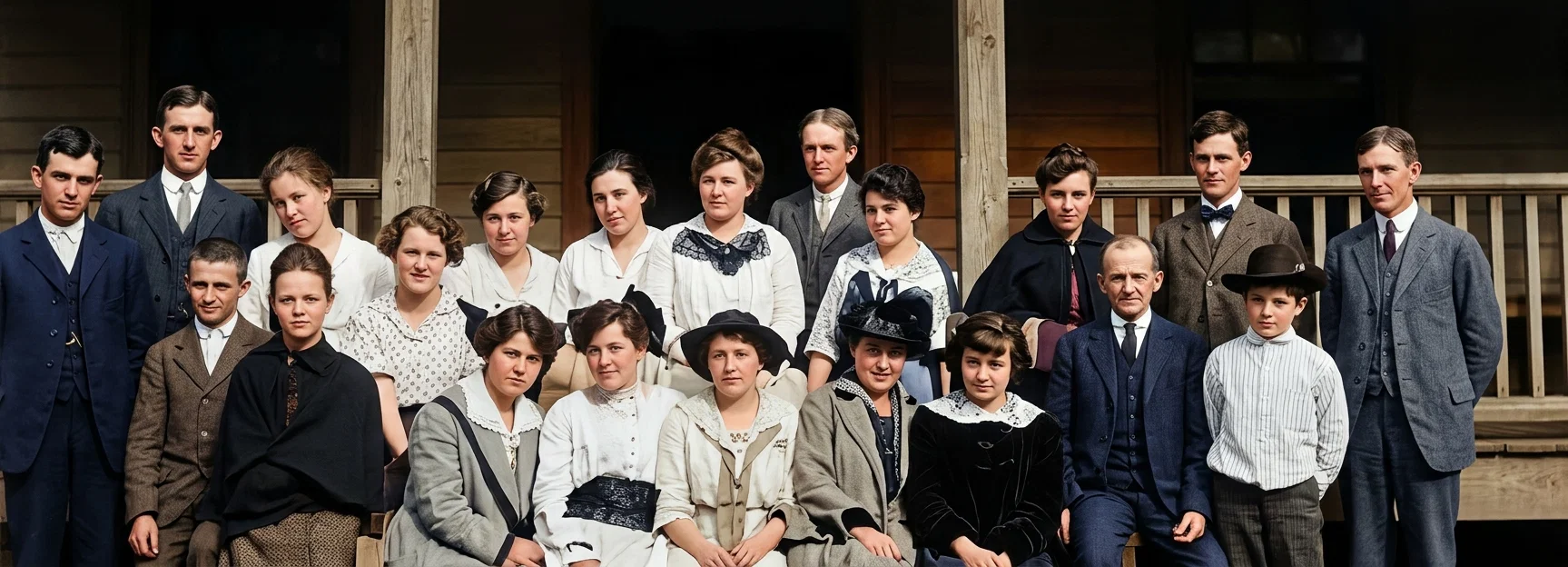
INDUSTRIAL SCHOOL AT HOMINY, N. C.
The believers in this mission field send their hearty greetings to our brethren in the north. N. Z. TOWN.

A Pioneer School

ON Sabbath, April 29, the church of Naples and a part of the Asheville church met with the church at Hominy, N. C., where Prof. and Mrs. E. C. Waller, Drs. H. P. and Alice Parker, and Brother and Sister Wm. Steinman are conducting an industrial school. This school is composed of twenty-one as fine young people as you often meet. They all seem to have a determined purpose to make themselves of real service to Christ. An excellent spirit prevails in the school, and prosperity is attending the work in a marked manner. Professor Jasperson and wife, of Michigan, have now united their interest with those already named, so as to strengthen the work. The need of additional buildings and appliances to do aggressive work is very apparent.
The purpose of our meeting was twofold: first, to become better acquainted was with one another’s work; and second, to study together what each can do to promote the great work before us as a people. The topic of the day was, “What Laymen can Do to Advance the Message.” A large number of the company entered into the study with real enthusiasm, and many practical thoughts for definite work were brought forward. All expressed themselves as having received a blessing from the day’s exercises.
H. J. FARMAN.
Continue reading: Work in the Cities