DURING a recent sojourn in Princeton, N. J., a visit was paid to the now famous Princeton Inn. Going to the clerk's desk, an inquiry was made if ladies were accommodated, as well as gentlemen.
"O, yes!" was the reply; "will you register?"
On entering the handsome parlor, a young blonde porter came in, and the following conversation occurred:—
"Is there a bar at the inn?"
"No, madam, only the grill-room, which was established and maintained for the benefit of the university students. There are tables, around which they sit and drink; they use loving cups and sing their college songs."
"What liquors are kept at the inn?"
"All sorts; but only beer is sold to the students. They come every evening, and stay until 11 o'clock, the limit of time specified by the inn proprietors."
"Do many students frequent the grill-room?"
"O, yes, a great number!"
While in Princeton, I met a gentleman who occupies an honored position in church and business circles, a resident of the town, who told me that the students often became so drunk at the inn that they had to be carried to their dormitories in wheelbarrows. He said: "You should see the drunkenness, however, after the special games—football and others. The students lie around on the campus in a state of complete intoxication."
There are over 1,000 students at Princeton University. About 300 are in the theological seminary. In the town there are three hotels with bars, and four licensed saloons, besides the illicit drinking establishments. No one is allowed to serve liquor in the dormitories at the university, but it is declared in the testimony of one who has had an opportunity of knowing, that it is done, and that some of the authorities are aware of it. The students have a custom of filling their dress-suit cases with bottles containing liquor, and taking them to their rooms. On returning one evening from a meeting at church in Princeton, a student was seen crossing a street carrying a satchel. A clash of glass was heard. The friend who was with me smiled and said, "There goes one of the boys now laden with bottles to be opened in his room."
The infection of drinking at the university has crept insidiously into the lives of some of the divinity students. A gentleman who was at the seminary thirty years ago returned last year to take a special course. He said the decline in spirituality was very marked—that there seemed no time for individual Bible study. He made the startling assertion that liquor is found in the rooms of the theological students. One of them, on being spoken to, became deeply offended and resented the interference.
The students of the university are continually seen drunk on the streets of Princeton. The professors can not say anything to the boys, because they drink themselves. The majority do; only a few abstain. Rowdyism among the students affects not only themselves but every boy and girl in the town, as the latter pattern after the students. This fact is seen in the homes and everywhere.
Several of the citizens of Princeton told me that the exposé made by the New Voice was true, but that "the half had never been told." Many Princeton people admit this, but they are afraid to say it except in private. They are quiet because their business depends on the university.
May God hasten the day when courage shall reign in the hearts of men, when those high in authority in Church and State shall count loyalty to Jesus Christ as the one thing needful in life. May the Father in tender mercy save the young men of our nation, for whom the older men have made it so "easy to do wrong."—Servilla Owens, in Union Signal.
THE laying of the corner-stone of a $500,000 Christian Science church in New York City recently is a significant reminder of the great spread of this new doctrine. Christian Science is one of the most ingeniously-devised deceptions that the world has ever known, and thousands are being swept into it. There is a clear, strong, beautiful, and helpful science of Christianity; but it is not in what goes by the name nowadays of "Christian Science." If you have only a surface or superficial knowledge of the Word of God, it will seem to you that Christian Science is founded on the Bible, and is in harmony therewith. But if you have a personal acquaintance with Christ through a deep and personal study of His Word, it is easy to see that Christian Science, so called, and the real Christianity are no more alike than day and night.
THE DARK SIDE OF A DARK CITY.
THERE is very little permanent good in presenting the dark side of this world, but the fact that there are many people who still believe that the world is rapidly getting better, and that an earthly millennium is about to dawn, makes it advisable to have some facts and figures which will have the same influence over such theories as a paper-weight has upon paper—they will hold them down, for in many cases it is apparently impossible to change the minds of such people.
There are so many regularly-licensed saloons in this city that, if placed side by side, they would make a solid wall of sin 51 miles long.
There are in Chicago, in one street, twenty-five saloons side by side, in a continuous row. There are in another street thirty-six saloons in a row, with only two breaks. In another street are thirty-four brothels in a continuous row, and still another has forty-nine brothels side by side, with only one break. There are so many regularly-licensed saloons in this city that, if placed side by side, they would make a solid wall of sin fifty-one miles long, and yet they all seem to do a rushing business. The light of the Gospel is indeed sadly needed in these dark places. Salt is most needed where there is the most corruption. May God help us to turn the search-light of truth on this dark and sin-cursed city, and scatter the immortal seeds of truth into every crack and crevice where they can find lodgment. DAVID PAULSON, M.D.
AT a speech to the army on the first of the new year, Emperor William reasserted his determination, in spite of all hindrances, to make the German navy as powerful as the German army. The emperor has met with much home opposition in his efforts to make Germany a great naval power. The burden of the army is sapping the industrial prosperity of the nation, and the people, already restive under the heavy taxation necessary to support the army, are looking with dark forebodings to the time when that burden shall be doubled to maintain a navy as effective as the army; for probably the most effective army in the world is that of the German nation; and from this the people can readily judge what kind of navy their ruler has in mind,—one that will rival that of England. Industrial discontent has been increasing rapidly throughout Germany during the last few months, as the plans for making Germany a "world power" at the expense of the laboring population have approached maturity, and Socialism has made rapid strides, in spite of all that is done against it. "Ripening, ripening, for the consummation," is being swiftly written over every nation of the world. C. M. S.
IS THE WORLD AT PEACE?
IN less than two years America has quadrupled her permanent army, added ship after ship to her navy, destroyed two fleets, has conquered one nation, and is at work on another on the opposite side of the globe, planting there for herself a thorn that will plague her to the end of her days. In this undertaking, several thousand men have been killed, or maimed and invalided for life, and the end is not yet, either locally or internationally; for the Philippines are but stepping-stones to Asiatic and European complications.
England, having recently reduced to a measure of quiet the troublesome tribes of Northern India, is now up in arms, with the mightiest force she has ever sent out, to whip the Dutchmen of South Africa. Thousands of her men have already gone down under the fire of the Boers, and the latter also are paying the price of war in the lives of those who have gone forth to fight. The Dutch in Cape Colony are threatening to rise against the English, and the South African natives are camping on the very frontier of rebellion. A few more British reverses and it is quite generally believed that the black men would be in open war. A great battle was recently fought in the Soudan, in which the Khalifa, the real leader of the Dervishes, was slain, one thousand of his followers killed, and several thousand taken prisoners.
One of Emperor Men-elek's generals is now marching with 10,000 troops for some objective point not made known; and French generals are enlisting and training African natives, with the evident intention of using them at some future time to checkmate England's plans in Africa. France and Brazil are now engaged in a dispute over the boundary between Brazil and French Guiana, and Brazil has sent war vessels to the vicinity of the disputed territory. France has also been threatening Siam, and joining the other powers in attempts to coerce China.
The century bids fair to go out with the countries of South and Central America in chronic rebellion. During the past year revolutions and insurrections have occurred in Colombia, Venezuela, Bolivia, Guatemala, Nicaragua, and Salvador, some of which are still in progress; and Chile and Argentina have been talking war during a good deal of this time.
Turkey has been massacring the Armenians again. Russia is continuing in Persia the intriguing for influence and concessions so irritating to England; and Germany, taking advantage of England's preoccupation in Africa, virtually forced a settlement of the Samoan question.
Japan and Russia have been and still are so rapidly and thoroughly preparing for eventualities in the Orient that much credence has been given to the repeated rumors of war being imminent between them. These two nations really expect a struggle, and are preparing for it. Even Norway and Sweden have been talking war and making preparations therefor; and money raised for the extension of railroads has been turned over to the military for forts and weapons.9There is much irritation between the French and English just now over their respective rights in Newfoundland waters. All the nations are arming and drilling as never before. The real watchword of the time is, "Prepare war," and they are doing it. And of that time the prophets have written, and that time—this present time—is the time of the end. But right in this time we hear the cry, "Peace and safety," which is in itself a sign of the end. Until Emmanuel shall come and reign in righteousness, peace and safety on this earth will not be. Study the question carefully; for eternal interests are involved in it. C. M. S.
INSANE FROM A JOKE.
By T.
THE Philadelphia Enquirer contains the sad account of a "joke" that resulted in the overthrow of a promising young man's reason. This young man was, according to the Enquirer, a brilliant young lawyer, in a city in New York State. He boasted of being utterly devoid of fear, and time and again fruitless attempts had been made to break his iron nerve. But a group of medical students undertook the thankless task, and he was foolish enough to allow them to experiment upon him. The Enquirer tells the story as follows:—
"In his city is a college of medicine. Some of his friends were students therein. Secretly they formulated their plan. When all was ready, a challenge was made and accepted. The terms were these: The lawyer was to enter the dissecting room of the college at 9 o'clock that night. He must be unaccompanied. A dim light would be burning in the room. As he entered, he was to be permitted one glance around the room. Then he was to proceed at once to the opposite side of the room, and take his seat with his back turned toward the entire dissecting room. At the end of every half hour he was to be permitted one glance around. This must continue until daybreak. No second look would be allowed until the half hour had expired.
"At 9 o'clock the young man entered the room. The fetid smell usual to the place greeted him. A lamp burned dimly, throwing its feeble rays on the dissecting table. On it lay a shrouded cadaver. The corners of the room were filled with gruesome shadows. But one look could be taken. The young man drew up his chair and resolutely turned his back to the room. The half hour passed. He raised his head and glanced over his shoulder. The eyelids of the cadaver seemed to raise and look at him. He could not give another glance to satisfy himself, and turned his face away once more. The next half hour passed slowly. The fetid odor seemed to increase. At last the time came again for the second look. Quickly he glanced over his shoulder. The head of the corpse seemed to be raising itself. The lamp gave a sudden flicker.
"The next half hour was an eternity. The surroundings, the silence, the indescribable odor, all combined to excite the young man's imagination to the highest pitch. At last the time for the third look came. He was sure now that the head was raised, the eyes wide open, looking at him.
"But only one look. Twenty minutes passed. A shriek was heard by the watchers outside the room. They rushed in. The young lawyer was insanely laughing and shrieking. The form on the dissecting table had metamorphosed itself into the chief of the students' clique. But the lawyer never again recovered his reason.
"As a last resort the victim of this terrible test was sent yesterday to a private institution in Philadelphia, there, if possible, to regain his reason. The affair was kept a secret, as all the participants came from excellent families."
If this young man had been a true follower of Christ, he would not have allowed himself to have been experimented on in any such way. And if by any chance he had been driven in among such "gruesome shadows," had he been a believer in the Bible, he would have known that no corpse could ever open its eyes or move in any way. The Word says, "The living know that they shall die; but the dead know not anything, neither have they any more a reward; for the memory of them is forgotten. Also their love, and their hatred, and their envy, is now perished; neither have they any more a portion forever to anything that is done under the sun." Eccl. 9:5, 6.
Ghosts, and hobgoblins, and the fear of a lifeless corpse, have no place in the minds of those who really and truly believe the Bible. Our education may have been to the effect that a dead man has an immortal spirit that survives his body, and that it may appear as a ghost in connection with his corpse. But the foregoing text is enough of itself to dispel all such notions, if we will but take it, and throw away our training in superstition. And what a grand freedom and peace it is when we are among "gruesome shadows" to have the positive knowledge with us that "departed spirits are a myth," and that the dead are peacefully at rest, and "know not anything"! T.
HE HOED CORN ON SUNDAY.
By T.
"In the Rome, Ga., city court Friday, J. F. Eaton, a Seventh-day Adventist, was found guilty of working on the sabbath. The evidence showed Eaton hoed and worked a corn patch one Sunday, months ago.
"The defendant justified his act by scriptural authority, contending that Saturday, and not Sunday, is the holy day. Sentence was suspended until January.
"The case will probably be taken to the Supreme Court."—Gadsden (Ala.) Tribune, Dec. 21, 1899.
The Seventh-day Adventists have taught for about half a century that this country of freedom would yet become a persecuting power. They have taught this because they believed that the prophecy of Revelation, chapter 13, verses 11 to 18, were their clear authority for it. The case mentioned in the foregoing paragraphs from the Gadsden Tribune is only one of many similar cases that have been brought to trial in different parts of the country.
Men must never forget that when religious liberty is taken from a people, their civil and political liberty always goes with it. The sentiments that now find such ready expression in this country in favor of imperialism, are simply an index to the fact that true religious freedom is leaking out of the souls of men, so that they are willing to subjugate their fellows in the distant islands.
The bitterest conflict upon the subject of both religious and civil liberty that the world has ever seen, is just before us. The principles of true liberty in Christ Jesus should be studied now as never before. Compromise and surrender will mark every one who does not take an intelligent and God-fearing stand for the right.
THE article in another column in regard to the "Drink Curse at Princeton" is most striking and significant in showing the depraved conditions of these times. Princeton is no worse (and perhaps not nearly so bad) than thousands of other places. And now how much longer do you think that a righteous God can permit such a condition of things to continue? He destroyed the world in Noah's time because of the gross wickedness; He destroyed the cities of the plain for a like cause. God's Word says that these were made "an ensample unto those that after should live ungodly." Then the destruction that God worked then will be wrought over again when the world reaches a like evil condition. All the prophecies show that this evil world is about to go down. Are you in the ark of safety, or are you still clinging to your life of sin, to be swallowed up in the coming destruction?
A RECENT New York World contains the following sentences, " 'Hark! the herald angels sing!' What a pity that their Christmas message of, 'Peace on earth, good-will toward men,' should be like 'sweet bells jangled, out of tune,' through the horrid discords of war!" And all who will receive God's Word may know that these "horrid discords of war" will wax louder and louder until their noisy din marks the assembling of all the armies of earth on the great battle-field of Armageddon. Men will continue to talk "peace and safety," just as the Bible says they will, but there is no more peace for this old earth. Every one should know this, and turn his affections from this world, which is passing away, and fasten them upon that world that shall abide forever.
A LITTLE three-year-old girl living in San Francisco, recently drank nearly a pint of whisky that she found in a room where she was playing, during her mother's brief absence. The child suffered indescribable agonies, and died in a few hours. The family were in the habit of drinking the whisky at their meals. Anything that has such a deadly effect can not be food, nor fit to be taken with food, or, for that matter, to be used at any time. If men would only adhere to the natural and happiness-producing laws of temperance that our heavenly Father has given, how much misery would be avoided!
It is reported that large numbers of men are constantly going from New York to The Hague, from which point they go to the Transvaal to join the Boers in their fight against the British. They reach the Transvaal via Delagoa Bay, passing through the adjacent territory that belongs to Portugal.
ON October 11 President Kreuger, of the Transvaal, cabled the New York World, in response to a communication from the editor, that "the republics are determined that if they must belong to England a price will have to be paid which will stagger humanity." About three months, only, have passed since Mr. Kreuger made the foregoing remark, and certainly England, as well as humanity in general, has been staggered at the price that is being paid. And that is what war means in these times. Men try to have us think that the implements of modern warfare have become so horribly destructive that armies will no longer face them, and, consequently, war must cease. But the Transvaal army, as well as the English, is armed with the best of the most modern equipments, and there seems to be no lack of courage on either side in facing them. When men go to war, they have already taken into account the strong probability of being killed. And then there is always the thought that if the enemy has destructive weapons, they, too, have weapons that are equally deadly, and so they madly venture on. This world will not have any more permanent peace. It will be wars and rumors of wars until the angry nations are driven by satanic fury upon the great and final battle-field of Armageddon. Men should be sure to stand with God now, so as to make no failure in avoiding the destruction of that awful time.
FOR the last few weeks much space has been given by the press to the evidence that an understanding amounting to an alliance has been reached between the United States, England, and Germany. But right in the midst of it a British cruiser seizes a German merchant steamer, under the charge that she is carrying supplies of food, men, etc., to the aid of the Boers. Such things are customary in war times, and the various nations expect that if any of their merchants undertake to send aid to a warring country, it is liable to seizure. And the merchant who takes the risk is the loser, and, except in some rare and special cases, the government to which he belongs has nothing to do with it. And even if the matter is taken up by his government, it is supposed to be in a friendly way, before a properly constituted court. But despatches from Berlin say that Germany has despatched two cruisers to Delagoa Bay to look into the difficulty. This does not look very much like an alliance. And if one has been seriously talked of, it shows that not very much is required to unsettle things again. The words of Scripture concerning this time are: "The nations were angry." Hence permanent and effectual alliances will be an impossibility.
DESPATCHES from London say that the Delagoa Bay question is liable to become acute. The British would like to blockade that port, and thus cut off all supplies of food and ammunition from reaching the Boers. But Portugal seems unwilling to do it so far, and, hence, England is confronted with the proposition of either allowing unlimited supplies to reach her enemy or else forcibly seize the bay. If Portugal was the only power England would have to reckon with in taking such a step of seizure, she would not be so fearful; but this might lead other nations to come in to take a hand, and no one would dare prophecy where the trouble would end. Peace has departed from this earth, and everybody ought to be able to see it. The world can not possibly stand much longer under existing conditions.
A GERMAN war ship has appeared on the scene at Port-au-Prince, Haiti. The authorities at Haiti are involved in a dispute with the German consul, and the people there are greatly alarmed over what is thought to be Germany's second attempt within two years to force the hand of the Haitian Government. The present contention is believed by the patriots of the island to involve the very existence of their right to self-government.
EVERY problem that is now confronting the world, whether it be social or political, will soon be forever settled. The glorious dawn of the eternal day is breaking. The second coming of Christ is right at hand. And when the Lord of glory comes, all evil will be forever destroyed. Are you ready for that glad time?
It is asserted that it will take the island of Jamaica fully one year to recover from the effects of the severe hurricane that swept her northern slopes on November 8. The storm raged for four hours, destroying most of the cultivation and property in its course.
Catholic Church Sunday Afternoon Used as a Polling Booth.
INTERESTING DEVELOPMENTS IN SOUTH AMERICA.
By J. Vuilleumier
WITH great pomp, the South American archbishops have returned from the Latin-American council held in Rome. This conference is supposed to be held every twelve years in one or the other of the papal provinces of Spanish America. But as the princes of the church could not agree as to where it should be held, the pope "obliged" the presidents of all the South American republics to send the highest dignitaries of their respective national churches to Rome. This word "obliged," quoted from a safe authority, shows the subjection in which these republics are to the papal see. It also shows the cleverness of the pope in using this form of proceeding to secure for the distinguished travelers the payment of their traveling expenses by their governments. The archbishop from Buenos Ayres received for his trip the round sum of 100,000 pesos, or 40,000 dollars.
This same prelate has returned with many tangible means of grace, so called, among which are some two thousand bones extracted from the Catacomb graveyards, which are to be sold or given away as the precious relics of this, that, and the other saint. What poor substitutes for the precious Word of God!
What were the deliberations of this council? Some vital matters to the Catholic Church in South America must have been considered; but of course everything has been kept very secret. A rumor, now confirmed by a leading Chilean paper, is to the effect that since the council closed, and as a consequence of it, the pope has taken the extraordinary determination to allow the South American priests to get married. La Tribuna, of Valparaiso, gives the entire text of the papal decree. It contains three points: (1) Ecclesiastical celibacy is not of divine origin, but was ordained by the early councils on account of there being too large a number of applicants for the priesthood. (2) These applicants are nowadays very scarce. And (3) the reason of this scarcity is the celibacy of the priesthood. For these reasons the pope decides to grant to the regular clergy, in these countries, the liberty of entering matrimony. The decree is dated from Rome, July 10, 1899, and will begin to operate on the 1st of January, 1900.
It must be, indeed, that the situation for the Catholic Church here is of the most critical character, for the pope and the council to have reached such a remarkable resolution. One obvious reason for it, if it is confirmed, is the terrible state of corruption of the South American clergy, and the incessant cases of scandal in which its members are implicated. It is a fact, also, that in South America educated men are almost completely estranged from the Catholic faith, or any faith at all. Freemasons are carrying on a silent but effective negative work, which may not prepare the way for the Gospel, but is a danger to Romanism. There is a steady advance of public opinion against the hierarchy, and in favor of Protestantism, caused by the circulation of the Bible and mission work. Evidently, there are grounds on the papal side to fear that secessions en masse will occur, as is the case now in Austria and Hungary.
In Buenos Ayres there is, at present, a minister of education and worship, Dr. O. Magnasco, who is seeking to introduce the Bible into the public schools. He has read a report on the matter before the Cabinet, in which he attributed the prosperity of Protestant nations to the reading of the Holy Scriptures.
Another encouraging feature which developed recently was the complete exoneration from all duties obtained from the Buenos Ayres customs on seventy-two boxes of Bibles sent by the American Bible Society to its agent here. Little by little the colporters of both the American and the British Bible Societies and the Protestant mission halls, Methodist and others, are making themselves felt in bringing about a liberal state of mind toward the Bible and the Bible faith.
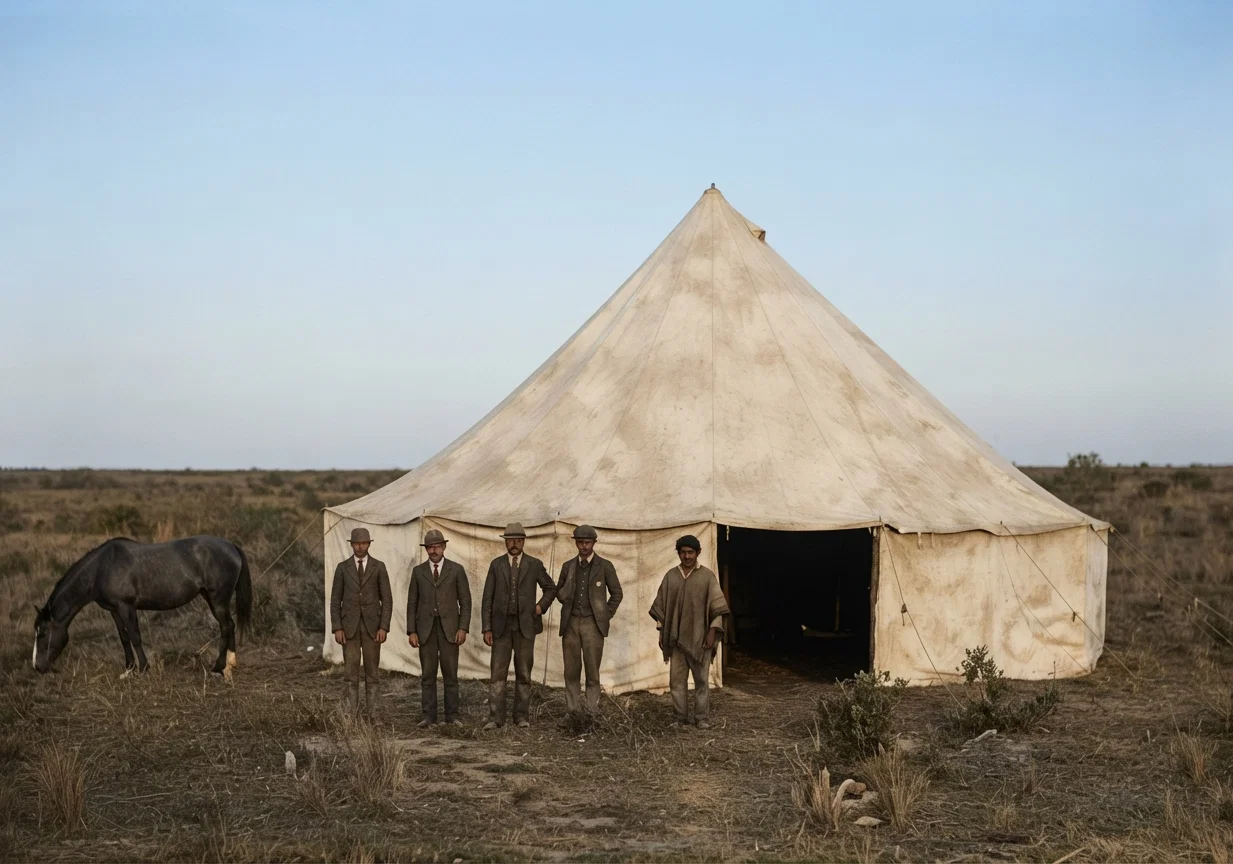
Our mission in these parts has begun to operate preaching tents. We have had one in this republic, and now we have another in the Uruguay republic, across the La Plata Bay. The introduction of this unique mode of evangelization in that republic was a success. It was pitched in three different places in the course of a few weeks. In one place the enemies of liberty and truth made a weak effort to put a stop to our meetings. The chief of police asked us in a confidential way whether we had any special privileges from the government to carry on this strange work. We told him we had none other, aside from our God-given liberty, than the constitution, and proceeded to show him the simplicity and beauty of the Gospel. He soon dismissed us, Brother Delearsy and myself. Strange to say, the constitution of Uruguay says very little about the religious rights of man. But liberty is in the air, and we thank God for it. Let us work while we may; for who knows how long that will be? J. VUILLEUMIER.
Buenos Ayres, November 8, 1899.
Gospel Tent in Uruguay.
HIS MISSIONARY BRANCH.
I HAD occasion to call upon a young business man in his office, not long since, and found him, as usual, "up to his ears" in work.
"Sit down a moment," he said, "and I will be at liberty."
"You are always working," I said. "How many hours do you put in each day?"
"Twenty-four," he replied, with a smile.
I presume my face expressed my astonishment. "Yes," he said, "I work ten or twelve hours here; the rest of the time I am working in the antipodes—by proxy, of course."
"I don't understand," I said.
"Let me explain," he returned more seriously. "When I was at school I became deeply interested in the mission cause. I determined to go out to China and work in the field. But my father died before my plans were fully matured. His business here was in such a state that no outsider—no man without a personal interest—could successfully carry it on. There were a mother, sisters, and younger brothers dependent upon the profits of the house. I was obliged to remain here.
"But I determined, nevertheless, to have a representative in the field, and I took up the support of a native preacher in China." Here my friend took down a much-thumbed map of Southern China and pointed out a certain town. "That is where my man is at work," he said. "He has formed a church and gathered a school. We have representatives of our business in several of the principal cities of the world. I call this our missionary branch.
"My man there is working while I sleep.11He is my substitute. In that way I work twenty-four hours a day—for the Master. I work here for the money to keep my representative working over there."
Now was not that a grand way for that young man to be a missionary? How many of you are beginning to do double duty in this way? If you give to help on a school, to support a scholarship, or to pay a teacher's salary, you too are doing missionary work somewhere else.—Mission Dayspring.
PRECIOUS RAIN-DROPS.
By Isaac Deeley
WHEN the heat of the day stills the husbandman's song,
And soft, cooling breezes come sweetly along,
Too seldom he thanks the kind Giver above,
Who fans his hot brow, in His infinite love.
When the corn-fields and meadows are moistened with rain,
Let a thanksgiving song rise with hallowed refrain
To the bountiful Donor of all that is good,
Who provides us with raiment, with health, and with food.
When the clouds He commandeth to rain not on earth,
When the springs and the fountains all cease to gush forth,
When the grass in the pasture is withered and dead,
When the harvest has failed us abundance of bread,
Shall we say it is chance, that no God rules on high,
Or that nature's laws govern the earth and the sky?
That prayers avail naught against her decree?
That nature is God, and what is, is to be?
Is this the sad plight in which mortals to-day,
Without God in the world, are groping their way?
No, no, there's a God, who withholdeth the rain,
To bring His lost sheep to His home fold again.
The clouds have been loaded with heaven's own hand,
And waiting to fall on the drought-stricken land;
But we failed to acknowledge His almighty power
To give or withhold in our desperate hour.
The worth of His gifts He would teach us to know,
The riches poured out in the rain and the snow.
If withheld for a time and no fruit doth appear,
No food for our cattle, no corn in the ear,
Let us praise Him for mercies received in the past,
When they crowded our pathway like rain falling fast;
Let us thank Him as never we thanked Him before;
He has given us much and still waits to give more.
Vienna, N. Y. ISAAC DEELEY.