WHAT MEN FORESAW AND FORETOLD TWENTY-FIVE YEARS AGO—
THIS SPIRIT OF HATRED WILL INCREASE UNTIL THE
COMING OF THE PRINCE OF PEACE
By JEAN VUILLEUMIER
No effects are without corresponding causes. Nor is there such a thing as accidents in history. The present war—the most frightful one in all ages—could never have occurred except plans and preparations for it had been made, not by one, but by all combatants.
SEEKING TO JUSTIFY THE WAR
One of the saddest things in connection with this fierce conflict is the efforts made by belligerents and neutrals, laymen and ministers, to throw the blame on the other side, and thus justify the conflict itself by calling God's blessing on the so-called righteous side.
This can only be done by entirely forgetting the political history of Europe during the last forty years, and it speaks ill for the future political and religious prospects of this world. If the most savage outbreak of violence and murder can be thus justified and exalted under the names of righteousness and liberty—as it is, on both sides—what can we expect for the near future?
To prove the above assertions, it will be sufficient to quote two men, a Belgian and an Englishman—both now dead—who wrote twenty-five years ago, and who were as well qualified as any one in Europe to speak intelligently on the situation there, and on the political future of the continent. What they predicted has exactly come to pass. In fact, there was no prophecy about it. They simply wrote what their common sense told them would inevitably come to pass.
EXPECTED IT FOR THIRTY YEARS
The first witness will prove that the present war has been a matter of almost daily expectation in Europe for about thirty years, and that there has been plenty of time for people to exercise what influence or what righteous indignation they desired in order to avert the coming conflagration. The article from which I shall quote was printed in the Forum for October, 1889, and was written by a Belgian, professor of political economy at the Liege University, the well-known Emile de Laveleye, author of important books, such as "The Actual Causes of War in Europe," "The Balkan Peninsula," "Luxury," etc. He says:
"Happy Americans, whose powerful republic spreads over a whole continent, without fear of encroachment, and, so to speak, without army or fleet, justly confident in your incalculable latent strength, you must find it somewhat difficult to understand that the states of Europe are ever arming, and ever on the point of disputing over a few provinces not equivalent to the territories which are every year cleared and brought under cultivation by your increasing population. At such a distance, you can not imagine how truly terrible and tragic the actual situation of Europe is. Never was there anything similar in the preceding centuries.
HOW ACCURATELY HE FORECASTS IT
"Every one is convinced that at any moment so horrible a war may break out, that all other wars, even that of secession in America, will be but child's play in comparison. The adversaries that we foresee obliged to take up arms, Russia and France on the one side, Germany, Italy, and Austria on the other, will bring seven millions of men onto the battle-field, with a reserve of ten millions. By means of the rapid concentration rendered possible by the railways, we shall witness, even during the first few days, two collisions, one in the east, the other in the west, in which three millions of human beings will be seen struggling together; for both sides will be endeavoring to crush their enemy under the attack of innumerable masses.
FORETELLS THE SLAUGHTER
"No strategist, not even Moltke himself, can foresee what such a conflict will be like. All we can say is, that the number of killed and wounded will, in one day, exceed that of an entire war of former times. Human blood will never have soaked the earth in such streams. And what is most terrible, this struggle is considered by all as inevitable; and we see now all the states, even the small and neutral ones, preparing for it. Every year, the European nations, pacific England, Switzerland, and Belgium included, apply millions to the construction of forts and ironclads, to the perfecting of arms, and increasing the number of cannons and men.
"France, for example, has surrounded her frontiers and her capital with a continuous line of forts and entrenchments. Germany has made Metz, Strasburg, Mayence, and Cologne into gigantic fortresses, which are absolutely impregnable. Italy fortifies her Alpine passes, her seaports, and even the 'eternal city' itself. Belgium is just now spending forty millions of francs in the construction of redouts with cupolas of steel, to close the passage by the Maas Valley. The war budgets are everywhere increasing in enormous proportions.
"Every now and then, an incident occurs which causes us to think that the moment of the decisive struggle is at hand. Now it is a French subject unjustly arrested by the Germans on the frontier; now it is Russia that, after having forced the prince of Battenberg to leave Sophia, sends General Kaulbars there to threaten the Bulgarians with the arrival of the Cossacks; again it is the abdication of King Milan of Servia that makes us fear Austrian intervention at Belgrade.
THEY GOT USED TO IT
"And it is under this continual menace of the most frightful shock of armies that our planet will ever have looked upon, that we live. And the most extraordinary thing is that we get used to it. We go about our business, our pleasures; we rush in crowds from all parts to the Paris exhibition, while each one says, It may be for to-morrow.
THE TWO MENACING QUESTIONS
"What are the questions which thus endanger the peace of Europe? There are two principal ones, well known to all,—that of Alsace-Lorraine, and the Eastern question."742Who can, in the face of these irrefutable facts, claim that the European war was "made in Germany," or in any other nation exclusive of the others, I care not which? Is it not ignorance or hypocrisy to make such a claim, when it is remembered there has been no adequate effort, on the part of any of these nations, or any church, to condemn, discourage, or counteract the mad war preparations made everywhere? These preparations called for a vigorous, incessant, and growing crusade on the part of the churches and of individuals; and as it was not done, all are equally responsible, and it matters very little now who pressed the button or lighted the match. Pacifist societies did some good work in this direction; but unfortunately, they did not deal with the root of the matter. They left out of their work the Christian principle which alone can eradicate war. They thought that diplomacy alone could cope with this climax of human selfishness.
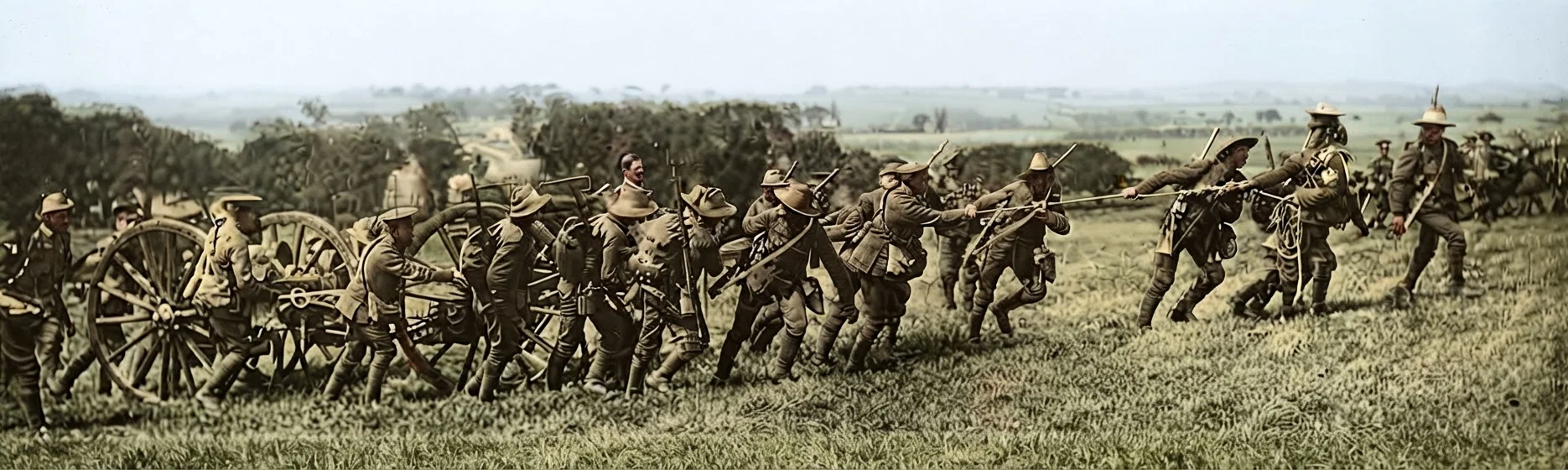
BRITISH TERRITORIAL TROOPS BRINGING A LIGHT FIELD GUN INTO POSITION
THE CATACLYSM WAS BOUND TO COME
These conclusions will become still stronger from an article which appeared in the September number of Harper’s Monthly for 1891, written by Mr. de Blowitz, for many years the distinguished Parisian correspondent of the London Times. He wrote as follows:
“I propose to sum up the observations which force themselves on my professional position, and to forecast and trace the future politics of Europe until the new cataclysm which is bound to happen, and which will again change its face. . . .
“To-day, as yesterday, or to-morrow, and for a long time to come, the situation of France and Germany forms the great subject of anxiety which is imposed upon the meditation of all European statesmen. . . . When the time comes, the battle-field, the fate of arms, can alone decide afresh the antagonism of centuries which separates the Gaulish from the Germanic race. . . .
NOT IN THE ATMOSPHERE OF PEACE
“Never will this question be settled in the pure and Christian atmosphere of peace. . . . No, peace is not concluded between the two nations. No, the era of combat between them is not over, and the sword is what must again and again decide, until the unknown time when a new morality shall govern the world, and when the God of peace shall be universally acknowledged. . . .
“On account of the jealous antipathy and anarchical division of the different political parties in France, making it impossible for the nation to be summoned or marshaled as one man around either the one of the other party, . . . it is not the republic which at this moment can declare war. . . .
MILLIONS AT THE FIRST SIGNAL
“At this moment, nobody would be taken by surprise. Neither power would have weapons of the existence of which the adversary was ignorant. Millions of men are ready to attack at the first signal. The weapons are furbished, the arsenals are full. It is nation rushing against nation. It is the supreme contest to decide whether Teuton or Frank shall henceforth govern Europe. And until one of the two has placed his knee on the breast of the other, the combat will not stop.
“Internal affairs will be settled afterwards. Here, the victorious general will be proclaimed emperor; there, colossal statues will be raised to the living emperor. Either, vanquished here, the general will disappear in the ruins of the republic, or, vanquished there, the Rhine will at last become a conquered frontier, the empire will crumble into hostile fragments, and the emperor of yesterday will sink into nothingness in the dry, sandy subsoil of Brandenburg.
“This is the second part of the bloody drama. The first is the combat itself, immense, terrifying, and so formidable that, as France, thirsty for revenge, does not embark in it, why should the young emperor do so? . . .
“Judging by the papers, Europe would appear to be enjoying the prospect of an indefinite period of peace, and the enormous armaments in which it is indulging would therefore seem to be acts of prodigality and madness. This is a mistake. Despite all that I have said, there is an inevitable event, which may happen to-day, to-morrow, in ten years, or even later — nobody knows — and which at once, imperiously, without there being any possibility of staving off or preventing it, will let loose war over the entire surface of Europe, and place the sword in the hand of all the great continental powers.
“I have frequently for two years endeavored to ascertain whether European diplomacy thinks of this event, whether it is weighing the imperative consequences, whether it is preparing for it. I have been amazed at seeing that among those who ought to scan the future, not one has fixed a steady eye on the mysterious horizon that conceals the thunderclap which must one day awake and startle Europe; and when, seeing them absorbed in their present task, I have pointed out to some of them the eventualities which will then arise, I have seen them shudder and draw back, as if terrified, from the problem which forced itself on their meditation, and which seems to me to have no other issue than war — war from one end of Europe to the other.”
This is what impartial observers saw twenty-five years ago. This is what we see with our own eyes to-day. Causes have their inevitable consequences. Selfishness begets hatred; and hatred, when nation-wide, begets war. Of recent years, causes for war in Europe have become more and more complex and pressing; first of all economic, then political and racial.
But each and every one of these causes could have been eradicated only by the power of the gospel of Jesus Christ working its principles of love, meekness, and unselfishness into the individual hearts. And only when a majority in one nation had thus become humble disciples of the Crucified, could that nation hope to escape the dire necessity of war.
But this has perhaps never occurred in the history of any nation. And the Bible nowhere promises that this will ever occur until the King of peace comes to reign. On the contrary, “evil men” are to “grow worse and worse,” until the end. The political panorama, according to prophecy, ends with Armageddon. And by present indications, we will be rushing toward it with greater momentum when this war ends, if it does end before we reach the last great war, the “war of the great day of God Almighty.”
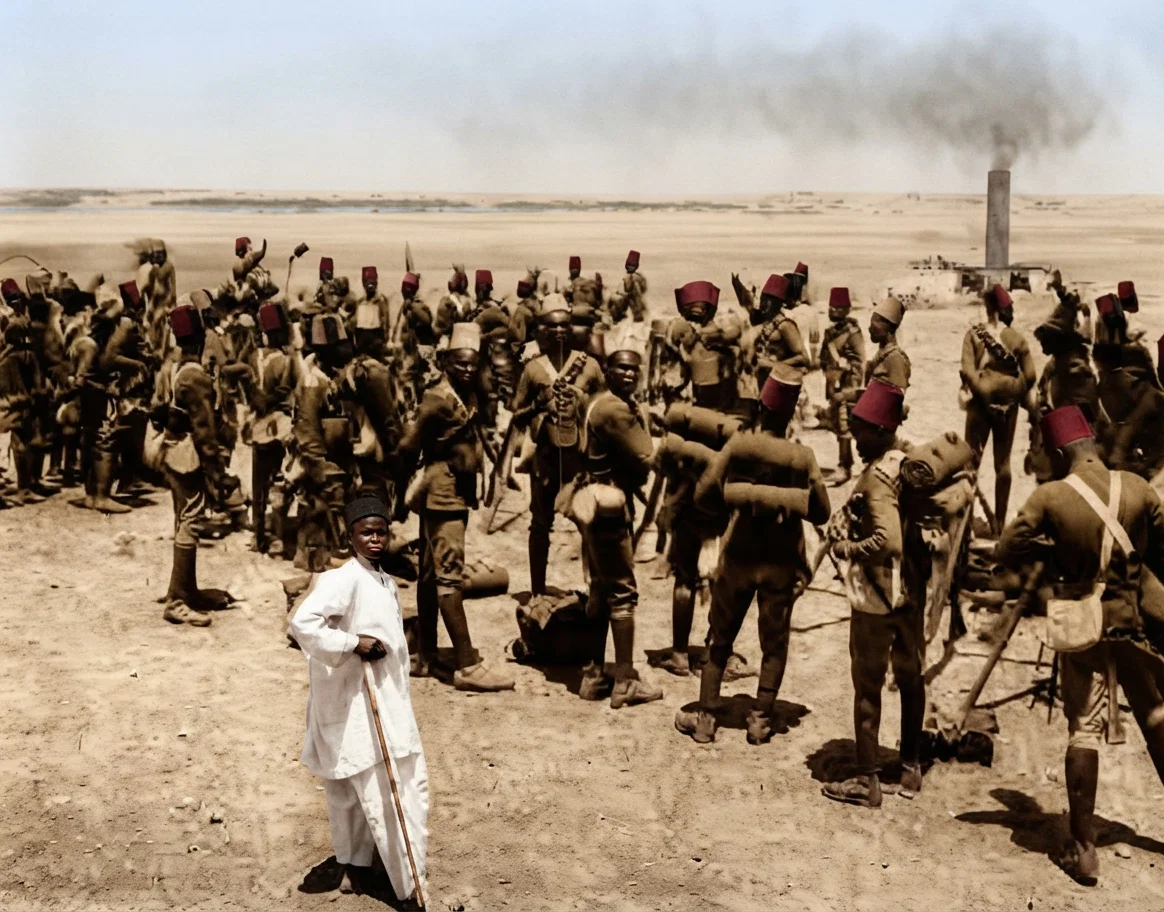
SUDANESE SOLDIERS THAT ARE TO FIGHT THE TURKS IN EGYPT
The Morning Is Dawning for Some—The Night Is Coming for Others—Which Class Will We Be In?
By T. E. Bowen
The Morning Is Dawning for Some—The Night Is Coming for Others—Which Class Will We Be In? By T. E. BOWEN
"The watchman said, The morning cometh, and also the night: if ye will inquire, inquire ye: return, come." Isa. 21: 12.
This answer of the watchman seems to be a contradiction, but it is not. The morning is coming, and also the night. And what is still further significant is that the one and same event brings both the morning and the night simultaneously.
The difference is not in the event itself. It is rather the two conditions of the people on earth that herald the coming morning or the terrible night. To one class, suddenly there comes a glorious morning, radiant with future prospects; while upon the other, the black night of eternal despair settles down, with no prospect of a future day.
This being true, this statement of the prophet at once becomes bristling with interest to every one of us, and no wonder he suggests that a spirit of inquiry will be aroused. The invitation is cordially extended to every sincere inquirer at that time to "come"—come to Jesus Christ for cleansing from sin, for refuge from the coming storm.
"THE MORNING COMETH"
To whom, then, is the watchman's word addressed when he answers, "The morning cometh"?
Evidently to the Christian. Not the hollow, cymbal-like sounding Christian, such in name only, but the genuine Christian. The true Christian has his eyes on his Lord. His Lord is now in heaven, and not on this earth, save by the influence of His Holy Spirit. That which is of the greatest interest to him is the movements of his Lord. He loves Him. He loves to do His bidding. As the eyes of the maid follow her mistress, and often all that is needed is a glance of the eye, or a movement of her hand to direct her, so the Christian is guided by his Lord. His heart yearns to be in close and still closer association with Jesus. No greater joy comes to him than the thought that the coming Saviour is near at hand. He prepares to meet Him by becoming like Him in life and character. He studies his Guide-Book, the Bible, to learn his Master's will. Knowing it, he loves to obey. To such the coming of Jesus as King of kings is as the breaking of the morning after a long, wearisome night of watching. To the Christian, then, events on earth, heralding the near advent of Christ, bring the morning.
THE NIGHT ALSO COMES
There are but two classes in the world—the Christian and he who in life is not. One has life, the other is without it. "He that hath the Son hath life: and he that hath not the Son of God hath not life." 1 John 5: 12. The worldling seeks for and obtains his pleasure in and from this world. His interests are centered here. He loves this present evil world. Here he thinks he finds his highest joy in permitting his passions to run riot as he gives to them loose rein. He sees little in a future life that attracts him. He is not anxious to have this present world pass away. To him the coming of the Lord Jesus Christ in power and great glory is the very climax of all calamities.
To such a one, that event, which brings to the Christian the glorious morning, ushering in eternal day, becomes the ushering in of an awful night, the blackness of which can now be only faintly comprehended.
THE DAY OF THE LORD
This day of the Lord, this time of calamity for the world, is mentioned by many prophets. They speak of it as "the day of the Lord." It is a time when God Himself arises out of His place and for a short time reveals His wrath against sin. He thus will justify those who have kept His law, while making known to all earth's inhabitants that the ruthless setting aside of God's holy precepts shall not go unpunished.
"And it shall come to pass at that time, that I will search Jerusalem [the judgments visited upon Jerusalem being typical of what will come at the end of the world] with candles, and punish the men that are settled on their lees: that say in their heart, The Lord will not do good; neither will He do evil. . . . The great day of the Lord is near, it is near, and hasteth greatly, even the voice of the day of the Lord: the mighty man shall cry there bitterly. That day is a day of wrath, a day of trouble and distress, a day of wasteness and desolation, a day of darkness and gloominess, a day of clouds and thick darkness, a day of the trumpet and alarm against the fenced [fortified] cities, and against the high towers. And I will bring distress upon men. . . . [Why? What for?]
"Because they have sinned against the Lord: and their blood shall be poured out as dust, and their flesh as the dung. Neither their silver nor their gold shall be able to deliver them in the day of the Lord's wrath; but the whole land shall be devoured by the fire of His jealousy: for He shall make even a speedy riddance of all them that dwell in the land." Zeph. 1: 12-18.
"Wo unto you that desire the day of the Lord! . . . the day of the Lord is darkness, and not light: As if a man did flee from a lion, and a bear met him: or went into the house, and leaned his hand on the wall, and a serpent bit him. Shall not the day of the Lord be darkness, and not light? even very dark, and no brightness in it?" Amos 5: 18-20.
THE PERTINENT QUESTION
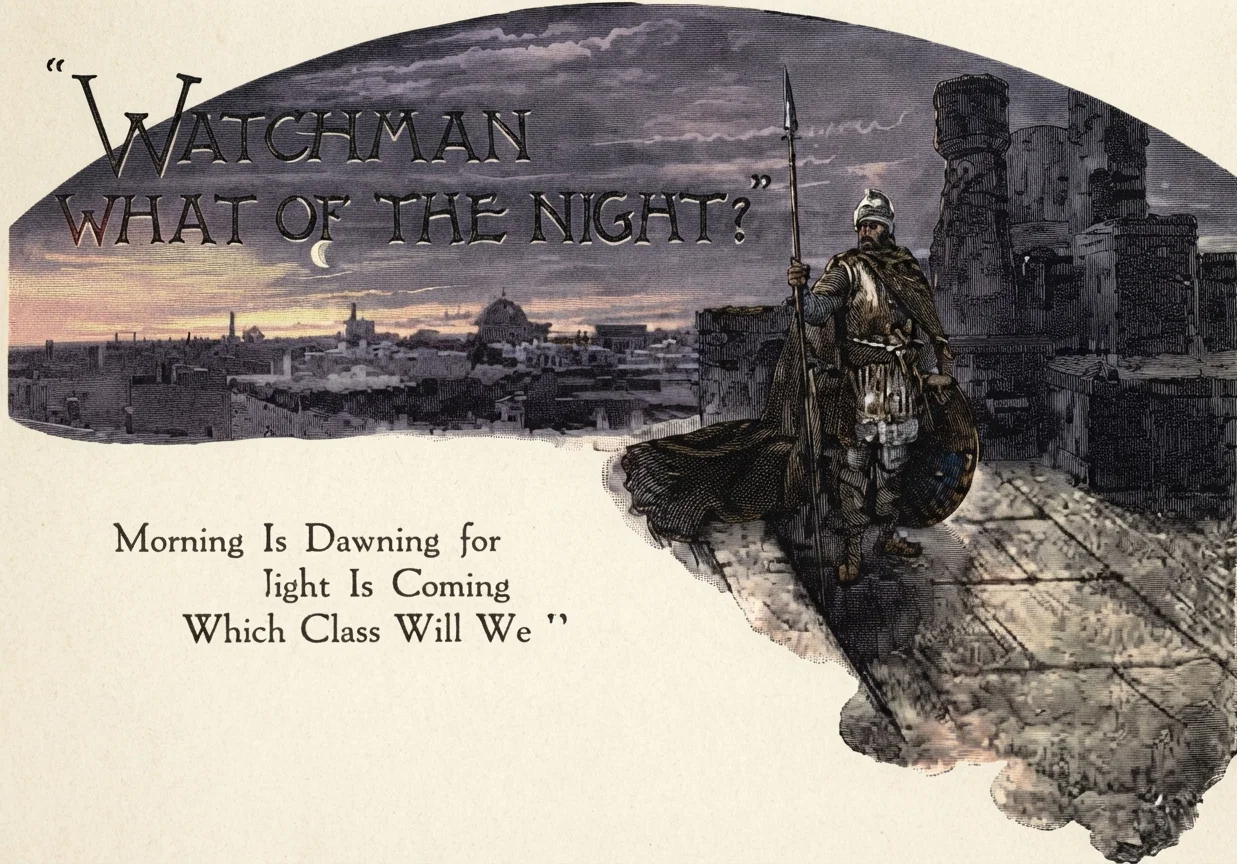
Therefore the question, "Watchman, what of the night?" becomes a very pertinent one. Is the night truly about over? Is the morning at hand?—Yes, the morning is near, and also the night.
Jesus made it clear that some people were having their good time now; that the selfish lovers of themselves, seeking for glory, honor, and praise of men, were getting all the reward they ever should have. Such had made the foolish choice of shutting their eyes to the home promised by the Lord in the world to come, and abandoning themselves to having a good time now. "Therefore when thou doest thine alms, do not sound a trumpet before thee, as the hypocrites do in the synagogues and in the streets, that they may have glory of men. Verily I say unto you, They have their reward." Matt. 6: 2.8
It all depends, then, on the sort of life each individual is living, to determine the answer to the question, "Watchman, what of the night?" It may be the morning that comes, or it may be the night.
PREPARED OR UNPREPARED, THE EVENT HASTENS UPON THE WORLD
The actual "day of the Lord" will eventually come suddenly to the whole world, as unexpectedly as the appearance of a thief in your house at night. Despite repeated warnings by messengers sent from God, in the face of repeated disasters, one following another with increasing horror, the world sleeps on. But some day the voice of mercy will become silent. Some day God's Spirit shall cease its warning entreaty, no more to invite the sinner to hide in Jesus. Sin's enormous total will finally reach that figure set by the Infinite Himself in the eternity of the past — and then the end shall come.
HOW USHERED IN
The end to earth's long day of gospel opportunity will come unobserved by mortal eye, alike to believers and unbelievers. After the door of mercy is shut, and the end of the world has come, in that the time of salvation is past, then the "day of the Lord" brings the terrible judgments of God foretold in Revelation 16. All this comes prior to the personal appearance of Jesus in the clouds of heaven.
How long it takes for these judgments to do their work in the earth, no one knows. This is not so important as is the fact that night will soon be on. Then there will be thousands upon thousands who will wake up to realize that they are lost. Eternal life will then take on aspects such as they never dreamed it could to them. What would they not now give for just one day to go to Jesus and repent of their sins! No, those days of opportunity are forever past. They have squandered them all in careless living or in absolute unconcern as to their eternal welfare. Jesus has now ceased His work as Redeemer. He pleads the merits of His blood no more. Thus it will be when the night comes to the finally lost.
THE WAIL OF THE LOST
The prophet foretells this night, and the wail that will then escape many lips. He records the words of those without God, without hope: "The harvest is past, the summer is ended, and we are not saved." Jer. 8: 20. These are among the saddest words found in the Bible.
Picture the crowds in Noah's day who have heard his warnings and entreaties, and who stand about the ark as a mighty angel descends and slowly swings together that ponderous ark door. The opportunity for going in is now forever gone. "Are we lost?" "Was Noah right after all, and we all wrong?" "Can it be possible that an actual flood is coming?" These questions no doubt passed from lip to lip as they looked anxiously into one another's pale face.
Brother, sister, the flood did come. Noah was right. A world was wrong. And a world perished, just as God said it would. Noah, by his faith and obedience, condemned the world. Jesus' faithful word is, "As the days of Noah were, so shall also the coming of the Son of man be."
The terrible war of Europe furnishes some idea of what will take place when earth's night comes on. Already God is withdrawing His Spirit from impenitent men. When it shall be fully removed, then earth's inhabitants will know how much they were indebted to Christ because of His loving endeavor to win them from the destruction to come.
Are you ready? Have you hidden in Christ, the sure refuge? Are you inquiring what mean the terrible things coming on the earth? This is well, but it will avail nothing unless you go to Jesus now, while mercy lingers, and confess your sins to Him, falling helpless into His loving arms, and there abiding. There only are you safe. But if there, you are safe. No power is able to pluck you out of those wound-marked hands. Him who thus "cometh to Me I will in no wise cast out," is Jesus' sure promise. Are you ready for the morning? "The morning cometh, and also the night."
Christian Science in Conflict with the Bible
By John H. Hartog
Assuming to Be Based on the Bible, It Glaringly
Contradicts What the Divine Book Says
By JOHN H. HARTOG
In a recent number of a society paper appeared a full report of an address delivered by a prominent leader in the Christian Science denomination. In glancing over this report, I noticed so many things which are in clear contradiction of what God's word says, that I took the time to answer a few of the items — just a few.
I read: "Truth being that which is, there can be no place where truth is not, where, for example, two times two do not make four. Therefore truth is omnipresent."
I might in the same way argue: Falsehood being also that which is, there can be no place where falsehood is not, where, for example, two times two does not make five. Therefore falsehood is omnipresent.
It must be patent to any sober person that my basis is fallacious, hence my deduction wrong. Yet on the explanation first quoted, is based the next decision, — that truth is God; and then the conclusion is jumped at, without the slightest proof, that God is without body, incorporeal.
God said to Christ, "Let US make man in OUR image." The result was Adam, a man of flesh and blood. Moses states that God wrote His law with His finger. Ex. 31:18. John the revelator tells us of how the Lord's eyes and feet look; also of His hair, white as snow. Rev. 1:14, 15. The Saviour was taken up in a cloud, and the angels told the amazed beholders that in the same manner He would come again (Acts 1:9-11); and we who look for His soon coming, therefore expect — and have a right to expect, for God's word says so — to see our blessed Saviour come in the body to receive His own. Over and over, the Bible proves that to claim that God is incorporeal is contradictory to the word of God, on which, however, Christian Science is supposed to base its argument.
IS MAN WITHOUT A BODY?
The conclusion that because the Bible says God is Spirit, therefore He is incorporeal, leads this writer to the deduction also that therefore man also is incorporeal.
It next leads to the confirmation of Satan's statement to the woman, that if she ate of the fruit, she would become immortal. God had warned her that she would die. Satan lied, and said, "Ye shall not surely die." That article declares that man is not mortal, that he is immortal. God's word states that only the Lord has immortality. 1 Tim. 6:16. Paul says, in Rom. 2:7, that God will give immortality to certain people. In 1 Cor. 15:53 he says, "This mortal must put on immortality." He is speaking of the resurrection. The aforesaid article makes Paul's statement absurd.
IS THE UNIVERSE SPIRITUAL?
Now the next statement in the article, continuing to build on that mistaken conclusion as a basis — the basis of an incorporeal God — concludes that the universe created by God must be like Him, therefore indestructible and spiritual. It gives no reason for its assertion that it "must be like Him," and contradicts the many Bible warnings that in the end the Lord will destroy the world by fire and make a new earth. How the Lord will destroy an indestructible world is a puzzle. Why all His warnings about the coming destruction, if it is not to be?
Another paragraph in the article says, "We do not have to experience death." But Heb. 9:27 says, "It is appointed unto men once to die." Rev. 14:13 speaks of "the dead which die in the Lord." 1 Cor. 15:22 says, "In Adam all die." And so on and on, proving over and over again that we do have to die. God Himself told the first man that if he disobeyed, he would "surely die," and after the fall He said, "Dust thou art [not, 'Spirit thou art,' but 'dust'], and unto dust shalt thou return."
Another statement in the article gives Christian Science, instead of the Bible, credit for one's "thinking rightly of God." This is putting Christian Science above the word of God.
One paragraph quotes Rom. 8:11 as speaking of "your mortal bodies"; but a paragraph on the previous page had just told us that we had no mortal bodies.
IS IT CHRISTIAN SCIENCE OR GOD?
The last paragraph openly avers that the credit for healing is due to Christian Science — to the truth which he, the Christian Scientist, knows; to the truth which he applies. The Bible, on the contrary, teaches that any one healed by prayer or faith owes it not to himself, but to the Lord.
It is affirmed that the Christian Scientist knows that disease and sin are but false, mesmeric states of consciousness. But God, through His servant Isaiah (Isa. 53:12), foretold that Christ would "bear the sin of many." John 8:7 tells of Christ's saying, "He that is without sin among you, let him first cast a stone at her." "And they which heard it, being745convicted by their own conscience, went out one by one, beginning at the eldest, even unto the last." 1 John 3:4 tells us that "sin is the transgression of the law" — not that sin is a false, mesmeric imagination. Peter says that Christ "His own self bare our sins." Paul tells the Corinthians (1 Cor. 15:3), "Christ died for" — what? For our "false, mesmeric states of consciousness"? — No, but for "our sins." Why? — That we might have "life everlasting." If we already had immortality, then died He in vain.
The last but one paragraph of the article quotes Mrs. Eddy as denying mortality; and the claim is made that we do not have to be sick, because God did not make us so.
But who made Job sick? Why did God permit Satan to touch Job with illness? Why does God's word devote a whole book to this illness of Job, if there is no illness?
THE TRUE REGENERATING POWER
To Christian Science is given the credit of regenerating a man; while God's word teaches that of ourselves we can do nothing, but that if we confess our sins, He is willing to forgive. Christian Science claims to bring man "nearer to God" by making him "better acquainted with his own selfhood." The Bible teaches that as we become better acquainted with our own selfhood, we will realize our utter unworthiness, and God's wonderful love, to give His only-begotten Son to redeem us. That is one reason why the book of Job was written; for when God made Job better acquainted with his own selfhood, he abhorred himself. And Job was a much better man than most of us.
The last paragraph attributes to Mrs. Eddy the discovery of the knowledge of the Christ teaching, in 1866. Yet Peter, in his second epistle, for instance, tells the faithful that they shall "neither be barren nor unfruitful in the knowledge of our Lord Jesus Christ."
It is said that Christian Science interprets the Bible so that it can be understood. Christ, on leaving, said that the Father would send us the Comforter, the Holy Ghost, to teach us all things. John 14:26. And the experience of untold thousands proves that no other help is necessary to comprehend clearly the apparent mysteries of the blessed Scriptures, which, without prayerful request for the Holy Ghost's guidance, seemed too mysterious and deep to fathom.
Another paragraph says, "Our Master fully demonstrated divine science in His victory over death." But He demonstrated instead that He was the Son of God.
DID JESUS DIE FOR US?
"His disciples believed Jesus to be dead . . . in the sepulcher, whereas He was alive," the article continues. Was He? What does the Bible, on which Christian Science is supposedly based, say? — Over and over it tells us that Jesus died for us; that He was dead in the grave; that as we are baptized, we are buried with Him, after having died with Him, and are resurrected with Him. If there was no death, then there was no resurrection. The entire plan of salvation is based on Christ's death. To remove this basis, removes the atonement, the resurrection, and by contradicting the Old Testament and the New, would rob me of all my faith in a risen and ascended Saviour, who died for me, and give me instead what? — A "key to the Scriptures" to prove them false! "And if Christ be not risen, then is our preaching vain, and your faith is also vain," says the apostle. 1 Cor. 15:14. "Now if Christ be preached that He rose from the dead, how say some among you that there is no resurrection of the dead? But if there be no resurrection of the dead, then is Christ not risen." Verses 12, 13. Thus says Paul. And Jesus Himself said: "I lay down My life." John 10:17. "I am He that liveth, and was dead." Rev. 1:18.
Finally, the closing paragraph says, "She [Mrs. Eddy] proved the Bible to be true." But the visions given to Daniel 2,500 years ago prove to me that the Bible is true and inspired; for the many things prophesied therein, which have all come true, including the remarkable prophecy as to when the Messiah would come and when He would be "cut off" (Dan. 9:25, 26), are more trustworthy proof to me than any conclusions based on the apparently simple basis that two times two is four everywhere, and that "therefore" there is no disease, no death, no mortal body, no living God on a throne, no heavenly sanctuary, no corporeal Saviour, nothing but a "false, mesmeric state of consciousness"!
I have no quarrel with that belief or other beliefs; but when a "society paper" gives three pages to put such arguments before its readers, many of whom are thereby led away from their faith in a real Saviour, I believe I am not uncharitable if I, simply as a believer in a God who does not lie, put some of God's sayings in juxtaposition to those of Christian Science.