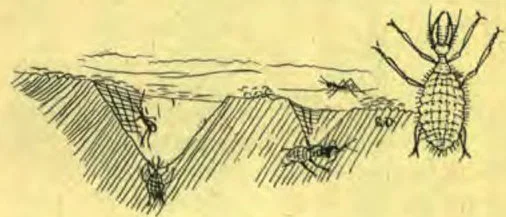
THE great tawny cat of the forest is not more cunning in his search for prey, nor more ferocious in the killing of it, than that little namesake of his, the garden ant-lion. Like the big lion, the ant-lion lives in dens, lies in wait for prey, and greedily drinks the blood of his victims. But he does more: he builds a trap, and in that trap catches his food.
Last summer, at the foot of a pear-tree, I found a whole family of these little lions, each living in a den of his own, and feeding on insects that were caught in his snare.
While observing them, I saw a snare made. The ant-lion began by marking out a circle in the earth about as large as a silver dollar. Then, walking backward, and digging with his tail, he dug other circles within this, throwing out the dirt by quick jerks of his head. Little pebbles, some as large as the insect himself, were balanced on his jaws, and with a quick spring of the neck, tossed several inches away. He continued this digging and tossing until a perfectly cone-shaped hole had been made, about an inch and a half deep. In the bottom of this he buried himself, leaving only his jaws protruding.
Presently, from a nest near by, came an ant, hurrying out to gather seeds. With his short-sighted eyes he saw nothing alarming in the little sandy hole, and so fell in, sliding part way down the side. This side was very poor footing at best; and now, from the bottom of the hole, came a blast of sand, thrown by the ant-lion’s head. Down, down slid the little climber, despite his best efforts, right into the cruel jaws. One snap—and he struggled helpless. The sharp, bony points sunk deeper and deeper, while the ant-lion drew his prey under the sand.
Small spiders, worms, and other insects are often thus taken in the snare, and eaten. But if some big, disagreeable bug, like the pinching-beetle, tumbles in, and the lion grabs it as usual by the leg, almost before he knows it, he finds himself drawn out face to face with a horrid stranger. Discovering his mistake, he appears to beg pardon instantly. At any rate, he hastens to withdraw, leaving the whole den at the newcomer’s disposal.
The ant-lion can live on a diet of one small ant a day; but if he can get them, he will eat a great many more. And the more he eats, the faster he grows, storing up energy and building-material for the great event of life—his metamorphosis.
By and by, when he has eaten enough, and grown big enough, he undergoes this change. As the ugly caterpillar becomes a beautiful butterfly, so the dusty little ant-lion changes into a wonderful winged creature, resembling the dragon-fly. Then he catches his food on the wing. The long, ugly jaws disappear; and as he dances in the sunlight, on fairy wings, only his best friend, the naturalist, will recognize in him the strange little digger of pitfalls.
EDISON J. DRIVER.
THE MESSAGE OF THE NEW YEAR
I ASKED the New Year for some motto sweet,
Some rule of life by which to guide my feet;
I asked, and paused. He answered, soft and low:
“God’s will to know.”
“Will knowledge then suffice, New Year?” I cried,
And, ere the question into silence died,
The answer came: “Nay, but remember, too,
God’s will to do.”
Once more I asked: “Is there yet more to tell?”
And once again the answer sweetly fell:
“Yes! this one thing, all other things above,—
God’s will to love.”
— Selected.
TELL IT AGAIN
OVER and over the cry is heard:
"Come and bring us the saving word."
Over and over the message rings
From the loving lips of the King of kings:
"Go and tell them, 'tis my command;
Go and tell them in every land."
And while one soul of the sons of men
Waits for the word from the lips or a pen,
We who have heard it must tell it again.
—Selected.
HAPPY NEW YEAR!
“Happy New Year!”
What a charm lies in the word “new”! We like new books, new clothes, new houses, and it is pleasant to make new friends.
Have you not often felt “in your heart,” a desire to do something that you knew was wrong, or not to do something that you knew you ought to do? It is possible for the heart to be so changed that we shall really love to do right. The Lord says that he will make us a “new heart” and a “new spirit,”—that, if we ask him, he will give us hearts that will love to do his will.
And for all his faithful children he is making many new and beautiful things. “Behold,” he says, “I make all things new.” We have often heard of the new earth, with its glorious capital city, the New Jerusalem. In that lovely home there will be a place for every one who has received a “new heart.” And remember that the new heart is given to all who really desire it.
Not only will those who have a new heart have a home in the New Jerusalem, but to every one of them will also be given a beautiful “new name;” and they will learn a sweet “new song” of loving praise to the One who has saved them, and taken them to live with him.
If we will take the new heart that he wishes to give us, and then believe that these other things will be ours because he has promised them, we shall surely have a “Happy New Year.”
THE VERSE ON THE SAMPLER
The little girl flung herself into a rocker, and thumped to and fro, moping and fretting. The old lady, sitting quietly with clasped hands, wore a smile. The little girl had a piano, a sewing-machine, books, pictures, bright eyes, and nimble feet. The old lady had an easy chair and a very large-print Bible.
“Grandma,” asked the little girl, “what makes you look so pleasant? I’m tired of everything; I’m just miserable!”
“I am thinking of my verse,” said the old lady, “a beautiful verse I learned when I was a little girl. I worked it on my sampler.”
“Oh, let me look at that sampler!” cried the little girl; and she soon found it, and the golden and the silvered head bent over the carefully folded package.
“I don’t wonder that your eyes are not good, grandma. Just see the tiny beads on that bag. I am going to count—twenty rows. Why, grandma! You sewed four hundred beads on each square inch of this fine canvas, and must have counted every stitch, to make all these lovely roses and forget-me-nots.”
“Yes, dear, we were taught sewing on Friday afternoons at our school, and I took the prize for the fine linen shirt I made for my brother—my dear brother, two years older than I.” Grandma’s voice grew very gentle; for, in those far-away days, a little brother and sister were polite to each other, and began a kindly affection that lasted till death.
The little girl knew all these things, but she liked to hear them again, so she recalled the old lady’s thoughts by asking: “Did all the girls have to make shirts?”
“Oh, no; most of them made fancy articles, but I wanted to do the fine stitching which was then the style for gentlemen’s ruffled shirt fronts. I wish I had that piece of work to show you. Here is the sampler, though, done at about the same time. I was eleven years old.”
Sixteen square inches it was, of brown canvas, well covered with stitches of various kinds, in varicolored silks. Around was worked a border of pink strawberries and green leaves. Within were two alphabets, and below these appeared grandma’s verse, in green, all the tiny letters worked carefully over a single thread:—
“Now, in thy youth, beseech of Him
Who giveth, upbraiding not,
That his light in thy heart become not dim,
And his love be unforgot;
And thy God, in the darkest of days, will be
Greenness, and beauty, and strength to thee.”
(Written by Bernard Barton, England, 1784-1849, a Quaker poet.)
Under this was the line, “Remember now thy Creator in the days of thy youth.”
“She was a wise teacher who made this selection for me,” said the old lady. “The precious words have gone with me through life, and I have proved them true, even down to the present day, when seventy-one years have passed, and I find myself more than fourscore. Oh, the goodness of God!”
The little girl reflected upon the sorrows which this dear old lady had borne, and some sense of406a need came into her young heart. She, too, would want God’s light and love.
“Grandma, I shall learn your verse,” she said. — Kind Words.
GRANDMOTHER’S SERMON
By Ellen H. Jewett
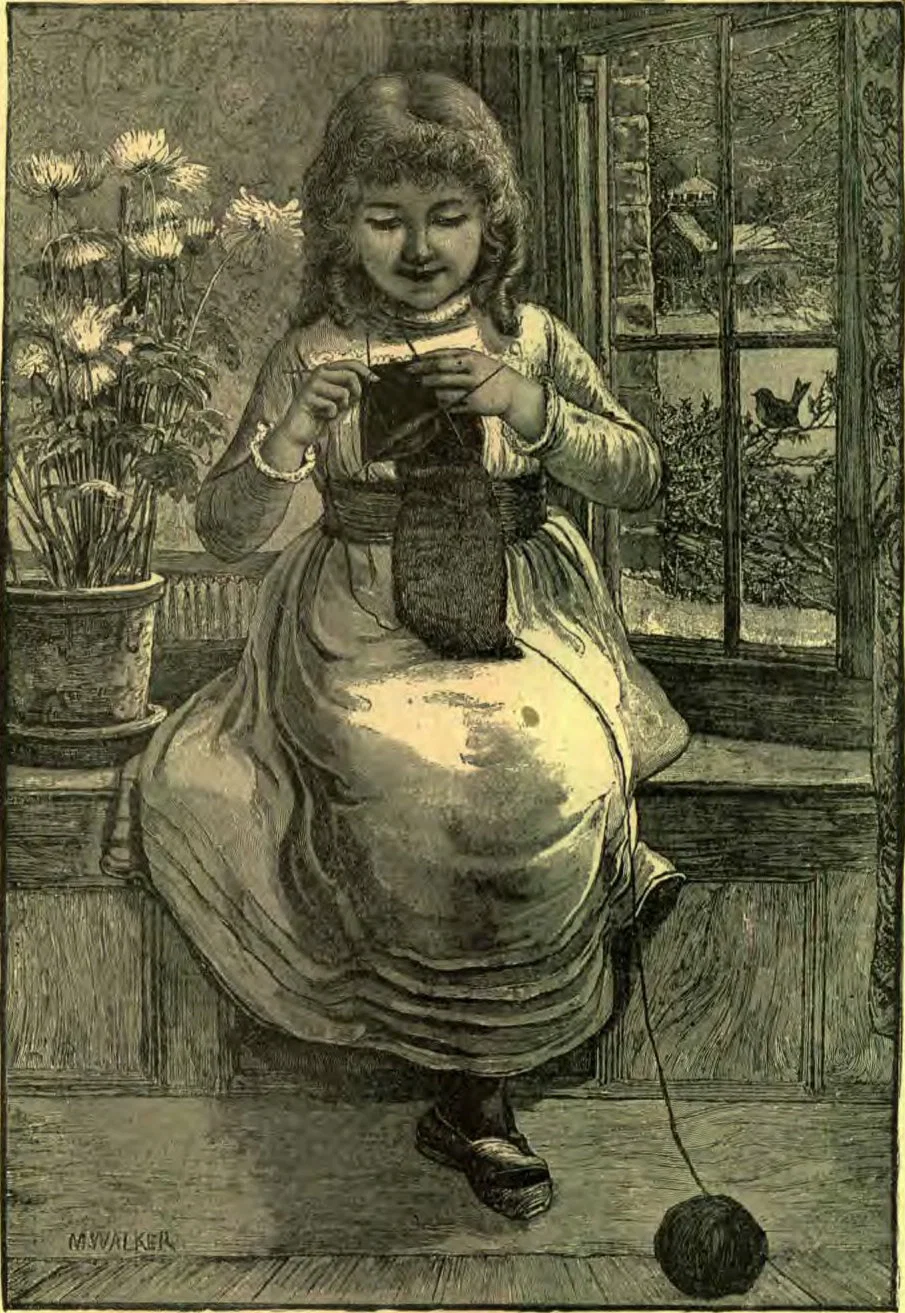
“Life is a stocking,” grandma says, “And yours is just begun; But I am knitting the toe of mine, And my work is almost done.”
With merry hearts we begin to knit, And the ribbing is almost play, Some are gay-colored, and some are white, And some are ashen gray.
But most are made of many a hue, With many a stitch set wrong, And many a row to be sadly ripped, Ere the whole is fair and strong.
There are long, plain spaces without a break, That in youth are hard to bear, And many a weary tear is dropped, As we fashion the heel with care.
But the saddest, happiest time is that We court, and yet would shun, When our Heavenly Father breaks the thread, And says that our “work is done.”
The children come to say “good night,” With tears in their bright young eyes, While in grandma’s lap, with broken thread, The finished stocking lies.
—Ellen H. Jewett.
“LIFE IS A STOCKING,” GRANDMA SAYS
HAPPY NEW YEAR
By Eliza E. Hewitt
Say it with a bounding heart,
Happy New Year!
Bright-winged birds will skyward dart,
Happy New Year!
Daily mercies wait for you,
Sweet flowers, fresh with morning dew;
Hopeful be, and pure, and true;
Happy New Year!
Say it with a loving heart,
Happy New Year!
Joy to other lives impart,
Happy New Year!
Keep a bright smile always near,
Let the voice ring out good cheer;
Let the helpful hand appear;
Happy New Year!
Say it with a grateful heart,
Happy New Year!
Never will God's love depart,
Happy New Year!
Has “Our Father” been your Guide,
Freely every need supplied?
Still will he be close beside;
Happy New Year!
— Eliza E. Hewitt.
BEREAN LIBRARY STUDY
Revelation 9; “Thoughts on the Revelation,” Pages 469-487
(December 30 to January 5)
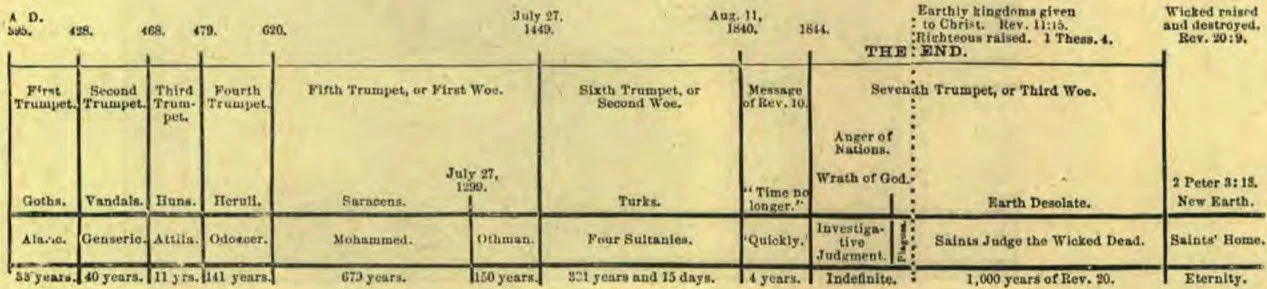
THE first four of the seven trumpets were fulfilled in the hordes of barbarians that poured down upon Western Rome. The church had become corrupt. The Lord represented their condition by the black horse in the third seal. The church at this time not only received the barbarians, but also accepted their pagan ceremonies, and incorporated them with the truth; from this combination the papacy arose during the sounding of the fourth trumpet.
Persia.—The Persia of Media and Persia, which was represented by the “breast and arms of silver,” the “bear,” and the “ram” of Daniel 2, 7, and 8, had passed off the stage of action many centuries before Mohammedanism arose. The Persia referred to as withstanding the rise of Mohammedanism is the restored Persian Empire, which came into power during the first part of the third century, and contended with the Romans for some time. It is the seventh of the kingdoms whose history is given in the “Seven Great Monarchies,” by Rawlinson.
Mohammedanism.—Mohammed was a false prophet who arose in the seventh century. The rise of his religion is commonly dated from 622 A. D., when the prophet fled from Mecca. This date is called the Hegira, by Mohammedans, who reckon from that date as the Jews reckon from creation, and Christians from the birth of Christ. For a little over five hundred years the Mohammedans were ruled by caliphs, but did not form an organized government. Mohammedanism spread very rapidly over Western Asia and Northern Africa, and penetrated into Europe.
The Mohammedans made strong settlements in Spain. For a brief sketch of their influence in Spain, read Chapter IV in “The Peril of the Republic.” The Mohammedans believe in the true God, but regard Jesus as a prophet of less power than Mohammed. Near the close of the thirteenth century the Mohammedans were organized, and a government was established, with Othman at the head. This was the beginning of the Ottoman Empire. The head of this government has ever been the high priest of this religion, holding the highest spiritual as well as secular authority in the nation.
Five Months.—Constantinople was the capital of Eastern Rome. This government is often called the “Greek Empire” to distinguish it from Western Rome, whose headquarters were at the old city of Rome. Eastern Rome, or the “Greek Empire,” was the eastern “third part” of the three divisions into which the Roman Empire was divided after the death of Constantine, in 337 A. D. After the Mohammedans were organized, and “had a king over them,” they began an attack upon the Eastern, or Greek, Empire, July 27, 1299. For one hundred and fifty years they continued to torment and harass the Greek Empire; nevertheless Greek independence continued until 1449 A. D.
The Second Woe.—The papacy was still busy with her bloody work; with an iron hand she was wringing the life blood from the very heart of the church. But God had not forgotten his people. Prior to this he had allowed the Mohammedans to torment the apostate church; but now from the horns of that glorious altar before the throne of God came a voice, saying to the sixth angel, “Loose the four angels which are bound in the great River Euphrates.” There were four principal sultanates of the Ottoman Empire,—Aleppo, Iconium, Damascus, and Bagdad,—situated in the region of the Euphrates. They had been held in check by the Lord; but now, like dogs let loose upon the prey, they soon captured Constantinople, and established their power on the ruins of the Eastern Empire. The same power that had restrained them also set a limit to their freedom. They were loosed for an hour (fifteen days), a day, a month, and a year. Prophetic time reckons a day for a year, which would make this period equal three hundred and ninety-one years and fifteen days. This period ended the eleventh of August, 1840, on which day was sounded the death-knell of Turkish supremacy.
The Seventh Trumpet.—The seventh trumpet, or third woe, is not mentioned in this chapter; but it came “quickly,” four years after the close of the sixth trumpet. It began sounding in 1844, and will continue to sound until Satan and all the wicked are forever destroyed, and woe and sorrow are eternally banished from the universe of God.
1. After Moses had destroyed the golden calf, what did he say to Israel concerning their sin? Ex. 32: 30.
2. When he appeared before God, what prayer did he offer? Vs. 31, 32; note 1.
3. What was the Lord’s answer? V. 33; note 2.
4. What command did the Lord then give to his servant? Ex. 33: 1.
5. What promises did he make? V. 2.
6. What did the Lord say he would not do? Why? V. 3; note 3.
7. At a later time, what did Moses say to the Lord about the command to lead the people to Canaan? V. 12.
8. What requests did he make in his prayer? V. 13.
9. What blessed promise did God then give to Moses? V. 14; note 4.
10. What was Moses’ reply? Vs. 15, 16; note 5.
11. What further promise did he then receive from the Lord? V. 17.
12. Strengthened by these promises, what did Moses now pray? V. 18; note 6.
13. What reply did he receive? V. 19.
14. Because no man can see God and live (v. 20), in what way was Moses’ prayer to be answered? Vs. 21-23; note 7.
15. On the morrow, when Moses again appeared before God, how did the Lord reveal himself? What did he do? Ex. 34: 5.
16. As the Lord passed by, what wonderful words did he speak? Vs. 6, 7; note 8.
17. How did Moses acknowledge God’s goodness? V. 8.
NOTES
1. When Moses came down from the mountain, and found the people wickedly worshiping the golden calf, he at once went to work to set things in order. To some people it might seem that he was severe and almost cruel. But his feelings were only against the sin, and not against the sinning people. He hated sin, but he loved his people. We read that his “anger waxed hot,” but it was righteous anger,—anger against evil, anger for the Lord’s sake. And just as soon as the sin had been put away, he showed how truly and deeply he loved those who had done wrong, by praying the Lord to blot his name out of the book of life rather than destroy the people. Moses had learned to love as God loves. And let us remember that those who love us best are the ones who will deal most faithfully with our sins.
2. God loves; his name is love; but still he is just. He can not wrong one of his children in order to save another. Every one must answer for himself. “Whosoever hath sinned” is the one who must suffer loss. No one will be lost because of another’s sin. “The soul that sinneth, it shall die.” But we may thank the dear Lord that though we have all sinned, there is a plan by which our names may be placed in the book of life, and forever kept there. In Jesus we may find forgiveness, and power to have all sin cleansed away. In him we may overcome sin, and to all such he says: “I will not blot out his name out of the book of life.”407
3. To all but Moses the Lord’s refusal to go with his people caused discouragement. But not so with Moses. It only caused him to pray all the more earnestly. Sometimes the Lord may seem to say to us that he will no longer go with us because we are rebellious. If so, let us only search out the sin, and pray on until the darkness passes away. God will never forsake us, so long as we have any desire to do right.
4. Though the Lord had said he would not go with his people, he now tells Moses that he will. “My presence shall go with thee.” Moses had seen that the reason why God would not go with them was because he could not. Their sins hindered the Lord; he can not walk with sin. And that was what the Lord meant. But when Moses and his people turned from their wrongs, and humbled themselves, then the Lord was willing and able to be their guard and guide—their all. Are our sins hindering the Lord’s blessing?
5. Moses felt, as we all should feel, that it is a shame for God’s people to live without the presence of God. It is better not to go than to go without God. Moses asked: “Wherein shall it be known here that I and thy people have found grace in thy sight? Is it not in that thou goest with us?” Oh, dear young friends, let us make sure that God is with us. He wants to be, and, if sin is put away, he will be, and we shall have “rest,”—rest from sin.
6. As Moses saw that God answered his prayers, his faith grew stronger and stronger, and finally he came to ask for that for which no one had ever before dared to ask. He asked to see God! At first he himself would not have dared to make such a request. But now his love and faith made him long to look upon the One who is so good, so kind. And the Lord was not displeased. He wants us all to see him. Now, it may be with us as it was with that man of God. As we trust God and find answers to prayer, our faith will grow, too. And in a little while our faith will lead us into the very presence of God in heaven. We shall soon see him as he is.
7. Just as Moses was hidden in a cleft of a rock, in order that he might see God, so we may be hidden in the Rock, Christ. In Jesus we shall be able to see God’s goodness and beauty here on earth, and by and by we shall see his face throughout all eternity.
8. The Lord “proclaimed,” or made known, his name. God’s name is his nature, his character. His name simply tells what he is. He is “merciful;” that is, it is natural for God to be merciful. He doesn’t have to try to be merciful, but he is merciful because he can not be anything else. He is just what he is. He loves to be merciful to sinners; he loves to treat them better than they deserve. He is gracious. He is long-suffering; he is abundant in goodness and truth. He keeps mercy for thousands. Can you tell why any one should ever doubt God’s love and tenderness? He is not angry with sinners, he is not angry with you. His great heart longs to do you good. He knows your weaknesses and sins, and for that very reason he loves you.
Religion Demands Our Whole Devotion
“RELIGION is either all or nothing; it can not be a mere incident of life. Either it is worthy of our supreme efforts, or it is not worthy of our attention at all. The very nature of Christianity forces us to the conclusion that it deserves our best talents, or else it deserves to be repudiated altogether.”
LET US BE PATIENT
By Frank Walcott Hutt
Let us be patient, you and I;
Let us, like watchful guardsmen, make
Our hearts a haven for the sake
Of those that drift, they know not why.
Let us be patient. Let us keep
Our watch-fires faithful as God's stars.
Whatever storm or shadow mars
The breadth of life's uncertain deep.
Let us be patient. Let men trace
No frown, no insincerity.
In skies of ours, that all may see
God's presence in his child's calm face.
— Frank Walcott Hutt, in S. S. Times.
CHICAGO & GRAND TRUNK R’y
E. W. Meddaugh and Henry B. Joy, Receivers.
CHICAGO & GRAND TRUNK R’y.
Trains leave Battle Creek.
WEST-BOUND FROM BATTLE CREEK.
No. 9, Mail and Express, to Chicago — 12.15 P. M.
No. 1, Chicago Express, to Chicago — 8.30 A. M.
No. 3, Lehigh Valley Express, to Chicago — 3.50 P. M.
No. 5, International Express — 2.15 A. M.
No. 75, Mixed, to South Bend — 8.30 A. M.
Nos. 9 and 75, daily, except Sunday.
Nos. 1, 3, and 5, daily.
EAST-BOUND FROM BATTLE CREEK.
No. 8, Mail and Express, East and Detroit — 3.45 P. M.
No. 4, Lehigh Express, East and Canada — 8.27 P. M.
No. 6, Atlantic Express, East and Detroit — 2.25 A. M.
No. 2, Express, East and Detroit — 6.50 A. M.
No. 74, Mixed (starts from Nichols) — 7.15 A. M.
Nos. 8 and 74, daily, except Sunday.
Nos. 4, 6, and 2, daily.
G. W. VAUX,
G. P. A., CHICAGO.
W. C. CUNLIFFE, Agent,
BATTLE CREEK.
BEST STORIES FROM THE BEST BOOK
By James Edson White
By J. E. WHITE.
In Four Languages: English, German, Danish, Swedish.
Begins with over fifty pages of charming “easy lessons,” including model nature studies for children, with fifteen beautiful colored plates and many pen-drawings. Concludes with about 150 pages of entertaining “Bible stories” from the Old and the New Testament Scriptures, with numerous full-page engravings and other artistic illustrations.
An Everyday Bible Companion for the Home,
Devotional and Practical,
Comprising Two Hundred Large Octavo Pages.
Styles and Prices in Each of the Four Languages: Heavy paper edition, cloth back and corners—75 cents; heavy paper edition, board cover—50 cents; thin paper edition, limp paper cover—25 cents.
“Best Stories from the Best Book” has been designed with special reference to the needs of the children. For this reason it has been profusely illustrated. The experience of years has fully demonstrated that immature minds need good illustrations to impress the truths presented in either oral or written lessons.
We have been instructed that for people of childlike minds “we should have issued books in so simple a style that a child might have understood them, for many of them are only children in understanding. Pictures and object lessons should have been used to present to the mind valuable ideas. Children and youth should have been educated in such a way that they could have been instructors and missionaries to their parents.”
The Bible stories have been prepared with special reference to teaching the truth. Many vital points of present truth are considered in a manner to cause a deeper investigation of these subjects from the Bible.
IN FOUR LANGUAGES. “Best Stories” is being carefully translated from the English into the German, Danish, and Swedish languages. The Author’s profits from the sale of this book will be used in behalf of the Southern missionary work.
1,000 Canvassers can earn $200,000 from the sale of 1,000,000 copies of “BEST STORIES FROM THE BEST BOOK.” The easiest seller ever prepared for little people. 750,000 copies of “Gospel Primer” have been sold. “Best Stories” will sell more readily. The prospectus shows all four languages and the three styles of binding. It, with printed description for agents, will be mailed, postpaid, to any address, for 35 cents. With this you can immediately begin work, taking orders in all these languages by only once passing over the ground.
This is an easy-selling canvasser’s “HELP.” Subscription book profits to agents. The English book now ready for delivery. The foreign edition will immediately follow.
Have received prospectus for “Best Stories.” I am more than pleased with it. I went out four hours Friday to sell World’s Outlook Signs and took the prospectus along. Got eight orders for the book—four at fifty cents, and four at seventy-five cents. My wife says she knows that I could take this alone and make good wages, and I believe it. Please mail me a couple more prospectuses. W. H. COFFIN. Seattle, Wash.
I have the prospectus of your new book. I am the church-school teacher. Have worked a little over an hour, and have taken eight orders. OLIVER CHAMBERLAIN. Frankfort, Mich.
I am well pleased with the make-up of the book, and will do what I can to push the sale of it. I prize it very highly as a help for the canvassers. W. F. SUBBER. Cherryvale, Kan.
I think “Best Stories” is one of the best books for children I have ever seen. It is so attractively laid off that most any child would be delighted to read its beautiful pages. JULIA P. LOWE. Edgefield, Tenn.
Am well pleased with “Best Stories,” and find that it meets with a ready sale. C. J. DART. Attalla, Ala.
Have examined prospectus of “Best Stories,” and think it will be a good seller,—better than “Gospel Primer.” As you may say, it takes one from the cradle to the grave. It fills a long-felt want. S. SISSON. Corydon, Ky.
Mrs. Akin, of this city, put in five and one-half hours last week on “Best Stories” and secured fourteen orders. The book is a fine seller. W. S. CLEVELAND. Jamestown, N. Y.
I think it will be a fine seller. W. L. MANFULL. Des Moines, Iowa.
The prospectuses came yesterday, and we all think them little beauties. I see no reason why thousands of these little educators can not be sold in the next few weeks. C. D. WOLFE. Charlotte, N. C.
I have just received the prospectus to “Best Stories from the Best Book,” and I can sound its loudest praise everywhere. My little girl said she could sell “that.” Well I think most anyone could sell that. R. H. THOMPSON. Waukomis, O. T.
I have taken sixty orders for “Best Stories” in five days. My brother, fourteen years old, has taken thirty-two orders. OLIVE B. HAGLE. Mendon, Mich.
Address your tract society, or the—
REVIEW AND HERALD PUB. CO.
BATTLE CREEK, MICH. CHICAGO, ILL. TORONTO, ONT. ATLANTA, GA.
HIS WISH FOR US
Again the time for “Happy New Year” greetings has come. On the first day of the first year of the new century, thousands of smiling lips will repeat the wish, “Happy New Year!” and other thousands will sound the cheerful echo, “Happy New Year!”
But how many will pause to think, when listening to these words from lips they love, of the faithful Friend who wishes for each one of them a “Happy New Year”? When God made man, he gave him everything that could in any possible way contribute to his happiness; nothing that the Lord could do to show his love for his children was left undone. But, after a little, sin entered: and since then unhappiness has had a large place in the world.
Still the purpose of Infinite Love was not thwarted. A Way was prepared to lead the sinning, sorrowful children of men back to what they had lost,—back to a home where there should be no sin, with all the grief and heartache that result from it,—a home where all will forever enjoy the purest and truest happiness. Would he have done this,—would he have taken our nature, lived as we must live in the world, be tempted as we are tempted, and endure such suffering and agony as we can never fully understand,—if he had not desired our happiness? And having done all this for us, do we not know, this New-year’s day, as we kneel to thank him for his love and care, and to ask him to be with us through all the days of the new, untried year, that he would have those days happy days for us?
It is a solemn thing to think of the year that is gone,—its wasted hours, fruitless plans, unimproved opportunities,—and of the experiences that may await us in the days to come. We can not tell what lessons our Father may have for us to learn in 1901; but since we know that his purposes toward us are only good, that he does not willingly grieve nor afflict the children of men, and that often in sorrow the sweetest lessons are learned, we can trust him fully, and take up the duties of the new year cheerfully.
“My presence shall go with thee,”—this is his word to every one of us to-day,—“and I will give thee rest.” May we, dear young friends, make this promise ours in its fullest and deepest sense: then, indeed, will the coming year be a happy one.
INTO THE LIGHT
A FEW years ago there was received into the Perkins Institution for the Blind, in Boston, a little boy who had lost both sight and hearing as the result of an illness when he was two years old. And as he could not hear, of course he could not speak; thus he was shut completely away from the bright, beautiful world, and from all expression of his thoughts — if, indeed, the poor little brain had any thoughts in that black and terrible time before Tommy Stringer came under the care of the institution already mentioned.
“It was a tremendous task that the devoted hearts there attempted,” says the Well Spring. “The pitiable body of flesh which came to them offered small hope. The boy was found to be as passionate as a little animal, tearing his clothes and screaming unrestrainedly. His mind was absolutely unreached — if he had a mind, and of that there were many who felt grave doubt. The only means that the child had of expressing himself was by a monotonous, fretful moan, which was not a cry, and which manifested neither pleasure nor pain. Though five years old, he could not walk upright, but crawled on hands and feet, and that backward; for sad experience had evidently taught him that his head was in danger when he moved forward.”
“Such was the child that the faith-filled teachers essayed to train into an intelligent boy. What could they do? How could they begin? With eye-gate and ear-gate barred, through what other sense could the child receive impressions, and thus education?”
“There are certain simple manual signs for letters, which are used generally by the deaf. These are formed on one hand, and, in the case of a few deaf and blind persons, are impressed into the palm. And thus a beginning was made with Tom. Day after day, and many times daily, there were formed into his hands the five letters, ‘b-r-e-a-d.’ Daily the uncomprehending boy received his bread with these curious motions of another’s fingers in his palm, and then the twisting of his own fingers into the form of the same letters. Week after week, month after month, the process continued. And one day, after three quarters of a year had passed, the chubby little hand, of its own accord, hesitatingly spelled out the letters ‘b-r-e-a-d.’ With that piece of bread the teacher knew that she had given the idea of speech to her charge. The victory had been won. At last it had been demonstrated that the child had an intelligent mind.”
As we read of this teacher’s effort to bring into this darkened child-mind a word that should be as a key to unlock the treasures of knowledge and enlightenment and happiness to him, it is impossible not to draw a lesson from her patient and persevering effort. In many ways how like this little unfortunate child are we — how blind to the beauties of God’s service, how deaf to his pleading voice, how dumb when it comes to expressing gratitude for his mercies! And how patiently and gently and faithfully he tries to teach us: over and over we are fed by his bounty, and guided by his loving hand — and still we do not, will not, understand. Still he does not give us up, nor become discouraged; great is his faithfulness. And just as the heart of that faithful, earnest teacher rejoiced over the first faint sign of awakened intelligence in the child under her care, so, and much more, does the Great Teacher rejoice when we, his children, begin to understand the lessons he would teach us — to understand, and to co-operate with him!
When Tommy Stringer had learned the meaning of one word, others were easily taught him, and he soon acquired a vocabulary sufficiently large to express his wants. The beginning thus made was carefully followed up; and now, at the age of fourteen, he is as well instructed as other boys of his age. He is, besides, gentle, lovable, and obedient — not at all like the savage little being who entered the school. In this change of disposition, no less than in the remarkable change that has taken place in his mind, he shows the result of the influence of those who have put forth such loving effort in his behalf.
And so, too, those who learn of the Great Teacher will, by daily contact and association, become like him, acquiring the matchless graces of his character.