Your ShelfYour Projects

Signs of the Times, Vol. 26, No. 37.

DELIVERANCE
Earlier text: VIOLENCE IN THE LAND

The Child of the Slums

DEMORALIZATION OF THE YOUNG MAN. No. 10.

[All rights reserved.]

The Child of the Slums.

COMING on further down the social scale, we reach the "child of the slums," sometimes fatherless, motherless, homeless; but occasionally so fortunate(?) as to have a lone domicile somewhere in the slums, which to him is known as "home." Many of these places known by that sacred term "home" you would hardly consider fit for human habitation. This poor boy, the product of the slums, is indeed to be pitied. What can we do to help him? What can be done to save him from a life of vice and crime? You can clothe him when he needs it; you can feed him when he is hungry; you can bring him to Sabbath-school and impart valuable instruction,—which seems to go in at one ear and out at the other. But there is a missing link somewhere in the poor boy's makeup, and to human appearance, you will never be able to accomplish much in your efforts to make him better until you have forged this missing link and put it in place.
Oliver Wendell Holmes once said that the time to begin to train a child's character is a hundred years before it is born. My experience in dealing with these boys of the street has often led me to seriously wonder if, indeed, heredity, perversity, and iniquity, did not conspire together a century ago to make these children what they are to-day. Hundreds of them seem to have been born almost without moral discernment. A brief study of child life in the slums of a great city will soon dispel all query and wonderment as to why these boys, when older grown, become such dissolute specimens and desperate criminals. How could it be otherwise when they are born, bred, and reared in an atmosphere of crime, vice, and iniquity? These poor lads, who, unless rescued, are to become in the future leeches upon society; and vagabonds upon the face of the earth, are in reality the end-product of generations of sin, vice, and crime. The ennobling influences of a Christian home and home life are as unknown to, and as far removed from, the child of the slums as if they existed only on another world.

Child-life Environment in the Slums of a Great City.

From the earliest dawn of reason, the boy of the slums is confronted with a panorama of evil, ever presenting its images of vice and iniquity before his young mind. You would scarcely think it necessary to speak of his having been demoralized,—for truly it seems as if "demoralization" expresses better than any other word his very character and the environment of his birth and subsequent life. You will work with his parents, if he has any, with but little success. They do not seem to be able to make use of even the facilities within their reach, that might tend to improve their condition. The only great hope of the future, in assisting a very considerable number of these children of the slums, lies in some plan whereby they must be transplanted from their native soil of vice and crime into one of purity and industry.
A short time ago, two philanthropically inclined gentlemen fitted up several of these squalid slum quarters with all modern conveniences, including bath-tubs, etc. A few weeks later these gentlemen paid a visit to their beneficiaries and were not a little surprised, upon entering the first place, to find the bath-tub used as a dumping-ground for the ash-pan. In the second home this utensil for personal cleanliness was serving a somewhat more practical use,—as a wash-tub in which the family washings, taken in as a source of livelihood, were being turned out. Careful inquiry elicited the fact that the tubs had never once been used for the purpose for which they were originally designed. This incident but serves to show that the remedy is not in supplying people from day to day with the things which they think they need, or we think they need, but in teaching them how to embrace present opportunities, how to transform failure into success, how to utilize to the best possible advantage that which Divine Providence has placed at their disposal.

The Orphan and the Newsboy.

The orphan, of course, is a subject of pity in the eyes of all, and the numerous benevolent associations, orphanages, and similar institutions scattered throughout the land, are evidence that at least a small portion of this class is being cared for. But the newsboy is a character that has received very little attention. Some of our large cities, it is true, have homes where these boys are given some care.
There is one lesson, however, which every boy and young man might learn from the newsboy, and that is the vital one of activity and industry, as well as individuality of thought and action. These traits of character are highly developed in the average street, or newsboy, because the getting of a livelihood is to him a real thing. It is provided neither by his imagination nor by interested parents. Many of these boys survive the terrible influences of heredity and early environment, and really develop into industrious and prosperous men.
W. S. SADLER.

HOW TO KEEP WELL.

IT is so much easier to keep well than to get well. The world is full of people, both men and women, who, like the woman in the Bible, have suffered many things of many physicians. They run after patent medicines, they fill up sanitariums and infirmaries, they catch at Christian Science, faith healing, and anything else that offers the least hope of relief from their ailments. Yet the majority of these people need never to have been sick if they had only followed nature's simple laws of health in the first place.
The body is a wonderful machine, so built as to do its work with the least possible wear and tear. It is created to run a certain length of time, and full provision has been made for the resisting of exposure and the repairing of accidents. The body will take care of itself, heal its own wounds and repair its own breaks if given half a chance.
A few simple rules, learned when young and firmly adhered to through life, will keep one well in the face of ordinary hard work and mental strain, and recovery from accidental exposure and unexpected strains will be short and rapid.
The first of these rules is, Eat plain, simple, well-cooked food at regular hours. There are a hundred and one diseases which make people lifelong invalids that are caused simply and solely by irregular habits of eating. Eating at irregular hours may overstrain the digestive organs and bring on all kinds of ailments of the stomach. To get into the habit of eating just enough and no more, at regular hours, of plain food, in reasonable variety, is the way to steer clear of these troubles.
Cleanliness is an important factor in the protecting of the health. Like any other machine, the body needs to be kept clean in order to work well. The weekly bath should not be neglected, but of almost equal importance are clean surroundings. The home, the cellar, the back yard, the place of business, even the streets, must be looked after, and each individual should bear his part of the responsibility of keeping them clean.
Ventilation is another important matter. To sleep in impure or insufficient air will cramp the lungs, vitiate the blood, and generally unfit the body for its next day's work, while continued sleeping in a poorly ventilated room will soon permanently weaken the lungs and heart and make one the prey of almost any kind of germs that may happen along. Have air in your sleeping-room if you have to break a window to get it.
Exercise and rest must be alternated. The rule of giving eight hours to work, eight hours to eating and recreation, and eight hours to sleep, is a good one. If you are robbed of one or two hours' sleep one night, make it up the next day or the next. Also, one day in seven one should have a complete rest and change. Religious worship is the best kind of change for the seventh day, because it brings into use a set of faculties not used during the week, and feeds the higher powers of the mind, which, in turn, sustain and strengthen the physical powers. A complete change of work is always recreation.
Of course one must have daily exercise in the fresh air. Accustom yourself to all kinds of weather, and go out every day, rain or shine. Walking is a good exercise, provided it is not all on a level. Going up and down hills gives variety to the scenery and calls different muscles into play. An occasional run is healthful. The bicycle is all right, provided it is not overdone, and the rider sits up straight, not curving the spine.
The method of dress must have its share of your sensible consideration. In winter it should be warm but not too heavy, and in summer cool enough to be comfortable. Clothe all parts of the body with equal thickness, and hang all its weight from the shoulders, and you have the ideal healthful dress. The tight corsets, heavy skirts, and insufficient covering on arms and shoulders, have made many a woman an invalid, and must be discarded by those who value their health. I do not quite believe that tight corsets and heavy skirts hung from the hips have killed as many women as the tobacco and drink habits have men, but they have certainly gone a considerable ways toward it.
Good health is a jewel committed to our care, to be carefully guarded and highly valued. To let it slip away from us through carelessness and ignorance is not only wrong, but the very height of foolishness, for without good health we are worth little to ourselves or to the world.
Health is catching. Health can be cultivated. We should be proud of our good health when we have it, be enthusiastic over it, and talk about it, that others may catch it and be helped by it. While you are young lay the foundation which will give you strength to withstand the attacks disease may make upon you in later years.—Eva Kinney Miller, in Christian Work.

STRONG DRINK.

THERE'S a drink that the whales, the walruses, the seals, Alligators, great turtles, white bears, and the eels All love to partake of before and at meals, Is it cider?—Well, no; it's cold water.
And the elephants, lions, giraffes, kangaroos, Hippopotami, tigers, the swift cariboos— The strongest of God's creatures a beverage use— A strong drink—is it beer?—No; 'tis water.
When the work horse, reeked with sweat, comes in at the noon, Hungry, weary, and craving more power as a boon, What will keep his strength up, and not once pull it down? Is it whisky?—O, no; it is water!
If the horse should drink whisky, 'twould soon make him sick, And the next time you brought it, he'd probably kick; If he only knew how, he'd launch out with a brick. He wants drink that is strong, like cold water.
Now if all the strong beasts are kept strong in this way By using cold water as their drink every day, Then the water is strong, and that none can gainsay. Drink no brandy for strength—drink cold water.
You attach a great wheel to the shaft of a mill; Would you run it with gin?—No; no such poor swill Does the work of this world. You just turn down the hill A volume of force—that's cold water.
Water carries the ships that weigh thousands of tons, And it gives them their steam for ten-thousand-mile runs, And it mauls the great rocks like a million of guns. If you want to find strength, take cold water.
Down it pours from the skies when the thunder roars out, And it hastens the day when, with song and with shout, The big harvest rolls wealth o'er the land, in and out. Is it liquor does this?—No; 'tis water.
Of course, liquor has strength of a certain mean kind; It can bubble and froth, and break down peace of mind; It is strong to breed hate, to destroy humankind. That is alcohol's strength—give me cold water.
Thank God for the beverage made by His hand, That is strong to spread roses and fruit o'er the land. Let us praise our dear Father for this present so grand, And for strong drink take only cold water.
THOMAS ROBERT WILLIAMSON. Oakland, Cal.

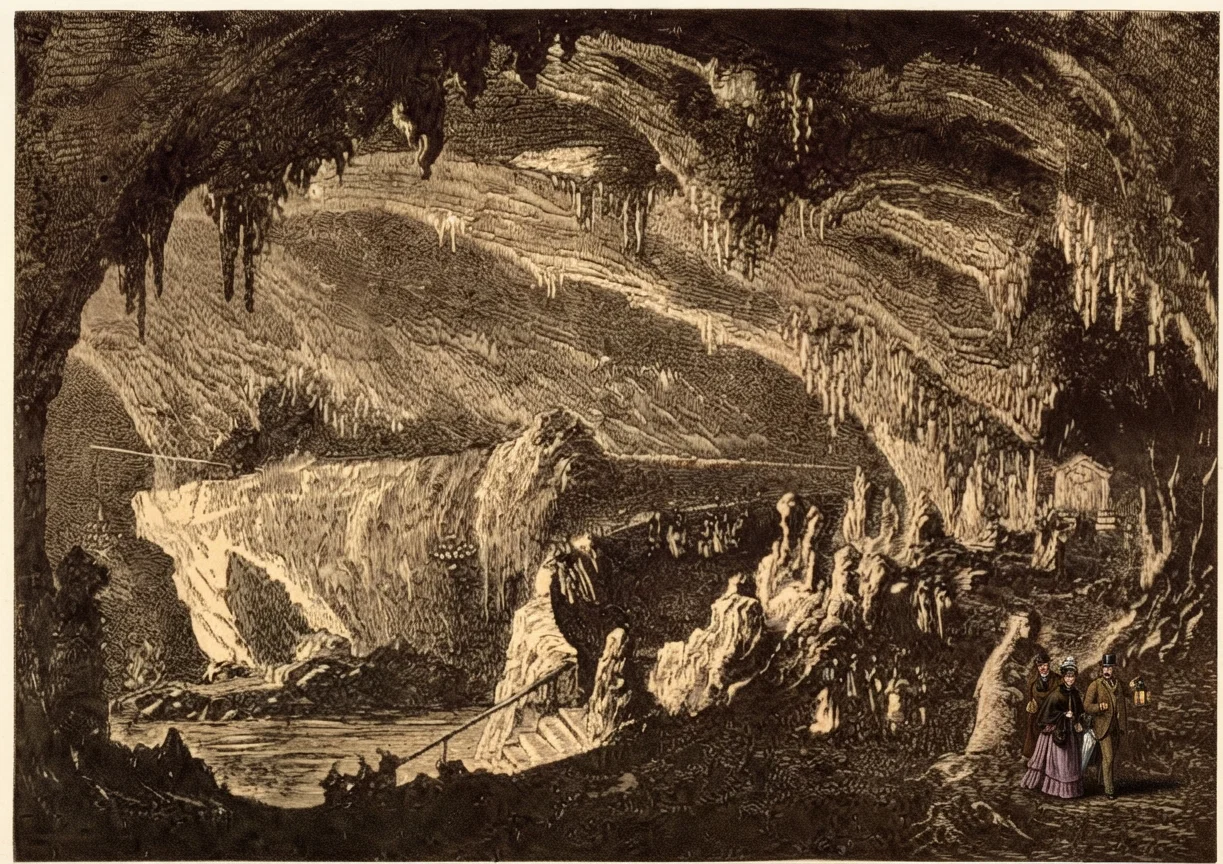
THE CAVERN OF ADELEBURG.

EVERY one has read more or less of the history of the ancient cave dwellers. This ancient race was composed of hunters and half savage human beings, but with an intelligence in many respects far surpassing what we might expect of those who were satisfied to inhabit such dwellings. The floors of many ancient caves are literally covered with, and made up of, rude implements and utensils which bear the mark of use. One such great cavern exists in Austria. It is called the Cavern of Adeleburg, and is almost as noted in the Old World as the Mammoth Cave in the New. Passing on from the caves of the old country, we find in the United States one of the largest caves in the world—Mammoth Cave, in Kentucky. It was the privilege of the writer not long since to visit both the Mammoth Cave and the caverns at Luray, Virginia. The former has often been described, and is really a wonderful cave; its great size fills one with awe, and leads him to wonder how so extensive a cavern could have been formed even during the centuries by the simple percolation of water. Luray, however, is much the finer, artistically, of the two, altho not so large.—Christian Work.
The Cavern of Adeleburg.

POWER FOR WITNESSING

READY OCT. 1

We know that many of our readers will be glad to know that the promised book on the work of the Holy Spirit, by A. F. Ballenger, is nearly ready for the market. This book does not treat upon theories as to what the Holy Spirit is but what it does, as shown forth in a consecrated life.
As one who read the manuscript said:—
"It is not a volume of resolutions but a book of acts"
It seeks to set forth in language impossible to be misunderstood the necessary preparation for a "Spirit-filled life." That this object has been fully met, probably its every reader will agree.
Good cloth binding; price, 75c

PACIFIC PRESS PUBLISHING CO.

OAKLAND, CAL. 9 Bond St., New York City 18 W. 5th St., Kansas City, Mo.

Political Speeches and Debates of Lincoln and Douglas 1854-61

There are portentous events in the political and social world of to-day. Men see this and believe they have in the principles laid down by Lincoln a way of escape from impending evils. Lincoln was never more exercised over the principles of human rights than during his public discussions with Douglas. His speeches and those of Douglas are here reproduced and form a veritable armory of Lincoln argument on this great question.
The book contains 555 pages, and is well bound in buckram cloth. Price, $1.75
A limited number in paper covers, 75c
A descriptive circular free

PACIFIC PRESS PUBLISHING CO.

OAKLAND, CAL.
29 Bond St., New York City 18 W. 5th St., Kansas City, Mo.

Usefulness Gives Value to Activity

EVEN the busiest person may be but a cumberer. It is usefulness only that gives value to activity. The beautiful and stately tree in the parable, which was declared to be a cumberer of the ground, and which the gardener was ordered to cut down as a cumberer, grew as luxuriously as any other tree in the garden, but it bore no fruit. It was therefore an evil where it was, for it absorbed the strength and sustenance of the soil which would otherwise have been taken up by the roots of the other trees. The humblest effort that accomplishes some good is worth more than the greatest show of energy that serves no useful or worthy purpose.—Lina Jeanette Walk.

LESSON XIII.—SUNDAY, SEPTEMBER 23, 1900

THE DUTY OF WATCHFULNESS.

Lesson Scripture, Luke 12: 35-46, R.V.
35 "LET your loins be girded about, and your lamps burning; 36 and be ye yourselves like unto men looking for their Lord, when He shall return from the marriage feast; that, when He cometh and knocketh, they may straightway open unto Him. 37 Blessed are those servants, whom the Lord when He cometh shall find watching; verily I say unto you, that He shall gird Himself, and make them sit down to meat, and shall come and serve them. 38 And if He shall come in the second watch, and if in the third, and find them so, blessed are those servants. 39 But know this, that if the master of the house had known in what hour the thief was coming, he would have watched, and not have left his house to be broken through. 40 Be ye also ready; for in an hour that ye think not the Son of man cometh. 41 "And Peter said, Lord, speakest Thou this parable unto us, 42 or even unto all? And the Lord said, Who then is the faithful and wise steward, whom his Lord shall set over His household, to give them their portion of food in due season? 43 Blessed is that servant, whom his Lord when He cometh 44 shall find so doing. Of a truth I say unto you, that He will 45 set him over all that He hath. But if that servant shall say in his heart, My Lord delayeth His coming; and shall begin 46 to beat the men servants and the maid servants, and to eat and drink, and to be drunken; the Lord of that servant shall come in a day when he expecteth not, and in an hour when he knoweth not, and shall cut him asunder, and appoint his portion with the unfaithful."
NOTE.—Read Luke 12: 35-59. This lesson may be used as a temperance lesson. The section includes all that the Gospels have to say about watching. Study Deut. 4:9; Prov. 4:23-26; Matt. 25:13; 26:40, 41; Rom. 13:11; 1 Cor. 10:12; 16:13; Eph. 6:13, 18; 2 Thess. 5:4, 6; Rev. 3:2, 3; 16:15.
Golden Text: "Watch and pray, that ye enter not into temptation." Matt. 26:41.

SUGGESTIVE QUESTIONS.

(1) In seeking the kingdom of God (verse 31), what is it necessary for the Christian to do? V. 35. Note 1. (2) What class of people are Christians to be like? Where had the Lord been? When the Lord of such servants came, what would they be able to do? V. 36. Note 2. (3) What will be the condition of such servants? What gracious act will the Lord perform for His faithful ones? V. 37. (4) During how much of the night is the servant expected to watch? V. 38. (5) What other illustration does the Saviour use in the lesson of watchfulness? V. 39. (6) Therefore, what admonition does the Saviour give His disciples? Why is this necessary? V. 40. Note 3. (7) What question did Peter ask the Lord in reference to this matter? V. 41. (8) In answering the question, whom did the Saviour introduce as a type of every Christian? What is the position of the steward? What is he expected to do? V. 42. (9) What does the Lord say of the faithful steward? V. 43. Note 4. (10) What will the Lord do for him? V. 44. (11) But what is it possible that the servant may say? Allowing himself to think this, what may he do? V. 45. (12) When will the Lord of this servant appear? What will He do to the unfaithful servant? V. 46. Note 5.

NOTES.

1. The girded loins.—An indication of watchfulness, and readiness for any emergency. The long oriental robe requires to be taken up and the skirt fastened under the girdle to allow freedom in walking or running. So the Christian must not allow any earthly entanglements to impede him in his mission. He must be ready to serve his Lord at a moment's notice. Your lights burning.—There are no dead lights on the ship Zion. When our light goes out, we have lost connection with Christ; we are no longer Christians.
2. When He shall return.—This is the second coming of Christ, not conversion; for the "men" mentioned are already servants. This is the time brought to view in Isa. 25:8, 9: "He will swallow up death in victory. . . . And it shall be said in that day, Lo, this is our God; we have waited for Him, and He will save us." Those who are faithfully watching at that time will sit down at heaven's table, and Christ Himself will serve them." Verse 37; Matt. 26:29.
3. Be ye also ready.—"God has always given men warning of coming judgments. Those who had faith in His message for their time, and who acted out their faith in obedience to His commandments, escaped the judgments that fell upon the disobedient and unbelieving. The word came to Noah. He obeyed, and was saved. The message came to Lot. He placed himself under the guardianship of the heavenly messengers, and was saved. Christ's disciples were given warning of the destruction of Jerusalem. Those who watched for the sign, and fled from the city, escaped the destruction. Now we are given warning of Christ's second coming, and of the destruction to fall upon the world. Those who heed the warning will be saved. The advent of Christ will surprise the false teachers." Desire of Ages.
4. That servant, . . . so doing.—The Lord has given a lesson on watchfulness. Now He shows that the lesson applies to all, by bringing in the idea of stewardship in answering Peter's question, and thus brings in also that other essential of Christian life, work. The steward who was "so doing," was giving to the "household" "their portion of food in due season." Waiting, watching, and working are the three characteristics of the Christian life.
5. In a day when he expecteth not.—He had not said that Christ would not come. He had not scoffed at the idea of His coming; but "by his actions and words he declares that the Lord's coming is delayed." In this way he influences others to sleep and imagine that the Lord is not coming quickly, and is thus in a measure responsible for their lack of preparation. His influence confirms them in their worldliness and stupor. But upon all such the day of the Lord will come as a snare, as a thief, bringing sudden destruction, from which there is no escape.

LESSON XII.—SABBATH, SEPTEMBER 22, 1900

REVIEW.

NOTES.

1. WE have now passed through two chapters. If they have been studied as they should be, it will be a delight to go back and revel in some of their richness. If there is any portion that does not stand clear and distinct in your mind, pay special attention to it. Do not go to guessing what it means, but fix the eyes of your mind upon it, through the Spirit, until it reveals its secrets to you. If an object is so far from you that its outlines are wholly indistinct, it is much more sensible and satisfactory to view it through a telescope, which will enable us to see it as it is, than to guess and wonder about it. Faith is the divine telescope which enables us to see the unseen. Faith comes by the Word. If we believe that the Word is light and life, we shall be willing patiently to gaze into its depths until our eyes can take in all its fulness.
2. IN this week, read these two chapters carefully and thoughtfully not less than twenty times. Some will be able to read (not repeat) them through without the Book. Such will find the most profit, for in the Bible we learn much from that which we already know best. Go carefully over every detail, and then take a general view of the whole. Study until with a single thought you can see the whole of the two chapters, just as with a single glance, if you have cultivated observation, you can see all the doors and windows of a house,—just as a woman at a single glance can take in all the details of another's dress.
3. READ again in their order all the lessons that we have had, with the suggestions, especially all the hints on study, and consider them inserted here. Concentrate your mind on the text, just as the one who would take a photograph of a portion of the heavens, fixes his eye upon a certain point, and holds the sensitized plate steady until the fathomless star-depths have left the impression of some of their treasures. There is nothing in the world like Bible study to strengthen the mind and develop power of concentration. Study the text, give yourself wholly to it, tarry long by it, and gaze into it; pray earnestly to God for light; and yield yourself and every thought to Him.
4. SINCE quite full questions on the text have accompanied every lesson, and these bring out every important feature, it is not thought necessary to ask additional questions in this review lesson. If you can give intelligent answers to all the questions in the preceding lessons, you will be able to make more of your own, and many more will suggest themselves to you; if you can not answer them, then your time can be fully employed on them now, without any new ones.

Outlines.

CHAPTER I.

1. The greeting. Verses 1-5.
2. Disaffection of the Galatians, its nature and cause. Verses 6, 7.
3. The false gospel and the true. Verses 8-12.
4. Personal experience. Verses 13-24.
The question at issue—the Gospel.
Glory to God or glory to man.

CHAPTER 2.

1. Holding to the truth of the Gospel: (a) The time; (b) wisdom in preaching the Gospel; (c) false brethren. Verses 1-5.
2. At the meeting in Jerusalem: (a) False teachers (Acts 15: 1, 2); (b) gathering of the council (verse 6); (c) testimony of Peter (verses 7-11).
3. No respect of persons: (a) Paul gained nothing from men (verse 6); (b) Paul's and Peter's missions (verses 7, 8); (c) apostles' hand of fellowship (verse 9); (d) remembered duty (verse 10).
4. Dissimulation exposed: (a) Peter's dissimulation, cause and effect, and reproof (verses 11-15); (b) how justified (verse 16).
5. Sin and its remedy: (a) What sin is; its result; its extirpation. See scriptures in lesson 10.
6. Crucified with Christ: (a) Christ not the minister of sin (verse 17); (b) personal application, effect of law on sinner (verse 19); (c) belief in Christ; (d) righteousness not by the law, but by Christ.

WHAT TIME IS IT?

WHAT time is it? Time to do well, Time to live better; Give up that grudge, Answer that letter, Speak that kind word to sweeten a sorrow, Do that good deed you would leave till to-morrow.
Time to try hard In that new situation— Time to build up on A solid foundation, Giving up needlessly changing and drifting, Leaving the quicksands that ever are shifting.
What time is it? Time to be earnest, Laying up treasure; Time to be thoughtful, Choosing true pleasure, Loving stern justice—of truth being fond, Making your word just as good as your bond. —Lend a Hand Echoes.

Luminous Name-Plates and Signs

Wanted.—Agents everywhere for luminous name-plates, signs, numbers. Readable darkest nights. Profits large. Sample case loaned. Right Supply Co., Englewood, Ill.

Local Manufacturer Representative Wanted

Wanted.—A man that can be trusted to represent a manufacturer locally. A permanent business to the right man. Reference required and given. Address, Robt. S. West, 65 Champlain Street, Cleveland, Ohio.

2,500 IN USE

Lambert's Nut Butter Mills

Are the original and only perfect nut grinders on the market, having stood the test of five years' general use. Ball Bearing, easily operated, make the finest kind of butter, warranted to give satisfaction.
Nut Butter is a valuable substitute for lard, cow's butter, and all animal fats, which are recognized to be injurious to the human system.
Guide for Nut Cookery, a most valuable book of 450 pages, given with each mill. We make roasters and blanchers too. Write to-day for special prices on all kinds of health foods, nuts, and machinery. Specialties: Spanish and Virginia varieties of shelled peanuts.
All orders promptly filled. Send to-day.
JOSEPH LAMBERT
336 W. Main Street Battle Creek, Mich.

Unawares

“YE DID IT UNTO ME.” “And He said, ‘The sin is pardoned, But the blessing is lost to thee, For, failing to comfort the least of Mine, You have failed to comfort Me.’”
Such is the closing verse of one of the two poems found in No. 54 of the Apples of Gold Library under the above title. They are very touching and very good. Price, 50c per 100.
PACIFIC PRESS PUBLISHING CO. New York City Oakland, Cal. Kansas City, Mo.
CHRIST AND THE SABBATH: Or Christ in the Old Testament and the Sabbath in the New, by Elder James White. Paper covers, fifty-six pages, sent post-paid for ten cents.
Address, PACIFIC PRESS, Oakland, Cal.

MORE

REMINGTON Standard Typewriters

are used in the twenty leading office buildings of San Francisco than of all other makes put together.
Remingtons, 413 All Others, 405
REMINGTON STANDARD TYPEWRITER No. 6
New Models Nos. 6, 7, and 8 (Wide Carriage).
WYCKOFF, SEAMANS & BENEDICT, { SAN FRANCISCO PORTLAND LOS ANGELES

Pacific Press Publishing Company

No. 1517 ORDER

Pacific Press Publishing Company

Cor. 12th and Castro Streets Oakland, Cal.
S. F. Office, 16 Crocker Bldg.
Oakland, Cal., May 5, 1900, United Typewriter & Supplies Co., 527 Montgomery Street, San Francisco, Cal.
Please send us via Be sure to send INVOICE AT ONCE, noting on it No. of this Order
Gentlemen:— This is to confirm our verbal order given to your Mr. Brown for the purchase of nineteen (19) new No. 1 Densmore typewriters.
PACIFIC PRESS PUBLISHING CO.,
MOONLIGHT ON THE RIVER

BOLTON & STRONG

Engravers of HIGH-CLASS PRINTING PLATES HALF-TONES, ZINC ETCHINGS COLOR PLATES, ETC.
510-512-514 Montgomery St. San Francisco, Cal.
*Illustrations used in the SIGNS OF THE TIMES are engraved by us*

The DENSMORE

Again at the Fore

The order of the Pacific Press Publishing Co. for NINETEEN NEW DENSMORES is a powerful argument : : : :
The ball-bearing DENSMORE is pre-eminent for light touch, high speed, good work and long wear : : : : : : : : : Send for circulars
United Typewriter and Supplies Co. 316 Broadway, New York Branches in Detroit, Grand Rapids and Principal Cities San Francisco, Cal., 327 Montgomery St. Kansas City, Mo., 714 Delaware Street

Instructions for Ordering.

1. REMIT by P. O. Money Order, Express Order, or Bank Draft on New York, Chicago, or San Francisco.
2. If paper money or silver is sent, register the letter.
3. Orders and Drafts should be made payable to the PACIFIC PRESS PUBLISHING CO., or to SIGNS OF THE TIMES.
Postage-stamps.—Please do not send postage-stamps, as they are liable to stick together, and are useless in this condition.
Foreign Money.—Do not send any.
Receipt.—No formal receipt is sent unless by special request. The address label on your paper will indicate the time to which your subscription is paid. In case of non-receipt of papers, or any other irregularity, please notify us immediately.
Expiration of Subscription.—All papers are discontinued at the expiration of the time paid for. Notification will be sent several weeks before date of expiration, thus enabling you to renew in ample time to secure unbroken files. Please be prompt, as we can not always furnish back numbers.
Change of Address.—When ordering change of address, please give both the old and the new address.
Important.—Use a separate sheet for SIGNS orders, separate for other papers, separate for books, for tracts, etc., and if you address the editor, use a separate sheet. All can be sent in one envelope, and the money all sent in one order, but write each kind of business on a separate sheet. In this way each order can be handed to the proper clerk and filled at once.
Articles Desired.—Those which set forth in the Spirit of Christ the great saving truths of God, short and to the point. It is better to treat one important truth clearly, in a short article, than many points vaguely in a long one. We desire no caustic, critical productions, which might minister to personal pride or pleasure, but can not save souls.
Continue reading: TO CONTRIBUTORS