Perhaps there is nothing in the line of wood-work that would interest the amateur more than wood-turning; for there are many things that can be made by this method of workmanship, such as household utensils, handles to tools, boxes, brackets, and useful trinkets of various sorts. When I was thirteen years old, I had a turning-lathe, on which I did a great deal of work. You may ask, “Of what use would be a turning-lathe without steam- or water-power?” —Well, there is a great deal of useful power in the leg and foot, if rightly applied. For a small outlay, you can make a lathe to run by foot-power.
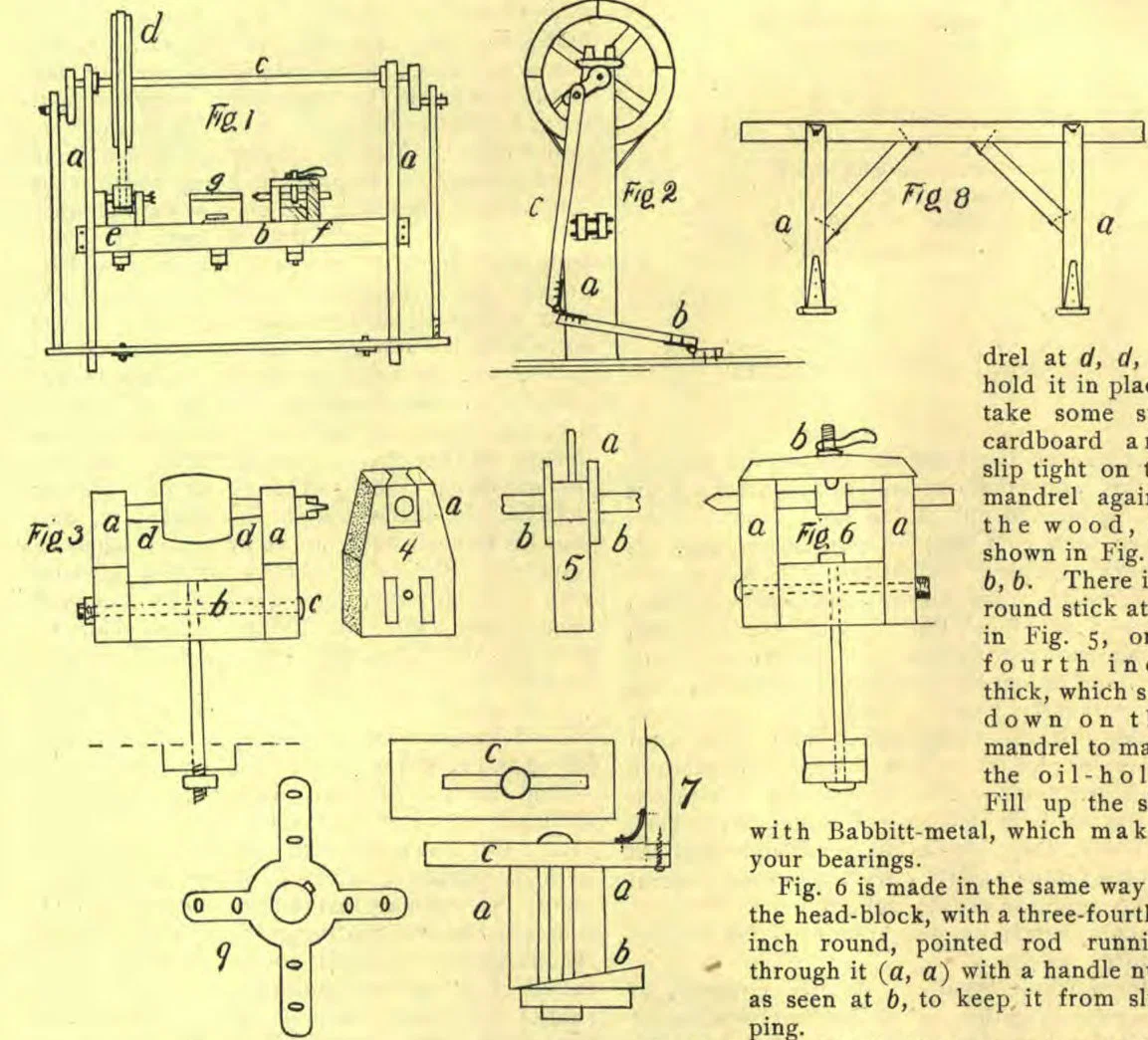
In this lesson I will illustrate some instruction about making such a lathe. In Fig. 1 you will see a lathe set up, like one I am building for myself. First, a, a, are two planks six feet long, twelve inches wide, and two inches thick. Beginning three feet from the bottom, these taper back to eight inches in width at the top, thus throwing the wheel farther back. Two planks six inches wide are shown at b. The top of these should be three feet from the floor. There are two of these, two inches apart, mortised through the two upright planks. Make the mortise five inches long, leaving a shoulder half an inch high on each edge of the six-inch planks; then insert two half-inch pins outside the upright plank, as seen in illustration, at the ends of plank, b, and in c, Fig. 2.
The main shaft, c, Fig. 1, is of one-inch round, rolled iron, seven feet long. Attached to it is the driving-wheel, d. To make the wheel, use two planks five inches wide, three feet long, one and three-fourths inches thick, halved together in the center. Bore one-inch hole through the center. Make the rim of two thicknesses of one and three-fourths-inch pine or whitewood plank, screwed or nailed together. Have cross-pieces one inch thick run through them. Break joints in the rim when you put them together. You should have a cast-iron piece called a spider for the shaft to go through. This is bolted on the arms of the wheel. See Fig. 5.
At e, Fig. 1, you will see what is called the head-block, in which are the shaft, called the mandrel, and the pulley, which hold in place the piece to be turned. The same is shown in Fig. 3. The tail-block is shown at f, and the rest, upon which to support your chisel, at g.
Upon each end of the shaft, c, is a crank with two pieces of hard wood running down to the treadle. (I will give you a picture of these cranks with the other patterns.)
In Fig. 2 you will have an end view of the upright plank, with wheel, crank, and rod, which should be about two inches wide in the center, and one and three-fourths inches at the ends. Attach these rods with T hinges, as seen at a, and at b, which is screwed to the floor.
In making the head-block (see Fig. 3), a, a are one and three-fourths inches thick, nine inches high, six inches wide, and taper to three and one-half inches at the top. In this figure, b is a piece of scantling three and one-half inches square, with a double tenon on each end, half an inch long, to go into mortises, shown in Fig. 4. These are held together with a bolt running through at c. Then the iron called a mandrel is centered in the place where it belongs. After putting something under the mandrel at d, d, to hold it in place, take some stiff cardboard and slip tight on the mandrel against the wood, as shown in Fig. 5, b, b. There is a round stick at a, in Fig. 5, one-fourth inch thick, which sets down on the mandrel to make the oil-hole. Fill up the slot with Babbitt-metal, which makes your bearings.
Fig. 6 is made in the same way as the head-block, with a three-fourths-inch round, pointed rod running through it (a, a) with a handle nut, as seen at b, to keep it from slipping.
In the next article I will give you description of Fig. 7, the patterns of casting needed for the lathe, with the crank attachments.
W. K. LOUGHBOROUGH.
CUSTOMS OF JAPAN.
JAPAN is a queer country; it is a land of contradictions and inversions. We prefer sweet fruit, they sour; they make saucepans of paper; we weep at misfortune, they laugh; we think white teeth beautiful, Japanese women varnish their teeth black; they put on the roof of a house first, and build the walls afterward; their carpenters draw the plane toward them; their horses’ shoes are of straw; their tailors, in stitching, point the needle from them; in their locks the keys turn from left to right; old men in Japan fly kites and spin tops, while the children look on; Japanese books begin where ours end; Japanese writers use paint-brushes, not pens, and write from top to bottom, from right to left; in Japan there are no lawyers, and Japanese doctors never make any charges or send in any bills; our mourning garments are black, theirs are white; their horses stand with their heads to the stable, and they mount a horse on the off side.—Lutheran Evangelist.
GRANDMA’S WEATHER-VANE.
“When the baby’s eyes are stormy,
With a pucker in between,
Grandma shakes her head, and murmurs,
She’s afraid ’t is going to rain.
“When the baby’s eyes are dancing,
Shining like two stars with fun,
Grandma smiles, and says she’s certain
We shall have a spell of sun!”
HOW JOHNNIE LEARNED TO WIPE HIS FEET.
“Did you wipe your feet, Johnnie?”
“No, mama; I forgot.”
“Run back and wipe them, then, please.”
“Yes, mama.”
There was a prolonged and energetic scraping and rubbing of two obedient feet on the rug.
“Mama, won’t you tell me why you have to wipe your feet every time you come into the house?”
“Yes, if you can not find out for yourself.”
Johnnie looked interested. Mama always let him find out things for himself when he could. He had found already that there was always a reason behind her commands, and he enjoyed hunting for it.
“Where can I begin?”
“Well, walk all around the rooms, and when you are near the beginning place, I’ll say, ‘Warm!’”
That was just like mama, and Johnnie knew he was going to have a good time. He went through the two parlors, but mama was silent. Johnnie was watching her over his shoulder, and hardly knew when he crossed the threshold into the library.
“Warm!” cried mama, suddenly.
Johnnie halted promptly, and looked all about him.
“Don’t look too high for the reasons of things,” said mama, with a smile, as Johnnie, not budging an inch, stood rolling his eyes up toward the ceiling.
“Warmer!” as the little lad began to look toward the floor.
“Oh, I spy!” said Johnnie, suddenly. And he picked up a cake of dry mud from the carpet. “I’ve found out, mama.”
“That is one reason; but there are others.”
“In the house, mama?”
“Yes, but you can’t see them just yet.”
“Why can’t I see them now, mama?”
Mama laughed, and gave Johnnie a kiss. Then she handed him pencil and paper.
“I will write a question on this paper, and you may have until to-morrow night to answer it: ‘What makes mud?’”
“Huh; that’s easy! Water and dirt.”
“Yes. Write it this way: ‘What makes mud? 1. Moisture. 2. Dirt.’ Write down everything that you see dropped and left on the sidewalk or in the street. If it is wet like water, put it under ‘Moisture;’ if not, put it under ‘Dirt.’”
“Oh, what a nice play!” Johnnie moved over to the window.
“Hello! here’s the sprinkler. Do you spell ‘water’ with an a or an o, mama?”
“W-a-t-e-r,” said mama, without a smile. She never laughed at Johnnie’s mistakes.
Presently the city carts came along to gather up the garbage. The barrels were heavy, and the men, to save lifting them, emptied the contents upon the street, and then shoveled it into the carts. They left a good amount behind them, however, and Johnnie became really excited, trying to write down all the different things he saw remnants of. Mama suggested that “garbage” would cover it all; so Johnnie, after much wrinkling of his forehead and twisting of his tongue, wrote “Gobblige;” for mama was called away just then.
The ashman came down the street, and he, too, tipped over the barrels, and shoveled the ashes into the cart—all but what blew away; for the wind was high, and a large part of every shovelful went flying all over the street.
Mama was gone a long time; but when she came back, Johnnie called her to the window. “I don’t know how to say things, mama. There are the sewer men cleaning out the sewers, and they spill the dirty stuff on the street. Then a wagon went by full of old bones and meat from the market, and some of that dropped from the cart. Then there are the horses, and dogs, and cats. I saw a dog go by with blood dripping from his ear; and the men spit on the sidewalk,—and O mama! I don’t think mud is nice; do you?” and Johnnie’s little nose was all puckered up with disgust.
“No, Johnnie.”
Mama smiled meaningly.
“Oh, I’ve found out already, haven’t I?”
“Yes, part of it.”
“What else is there, mama?”
“Draw two circles of the same size on your paper.”
So Johnnie brought the compass which mama had given him for a birthday present (they had so many circles to draw that mama taught Johnnie to do it scientifically), and drew two circles, each about one inch across.
“Put eleven dots in one. Just scatter them about anywhere. Now put two hundred dots in the other.”
“My, what a lot for that little circle!”
“Now suppose that every dot is a grain of dust. Would you rather breathe air with eleven grains of dust in it, or air with two hundred grains in it?”
“I guess the two hundred grains would choke us; don’t you?”
“That depends. Will you close the blinds to that front window, where the sun shines so bright?”
When the blinds were closed, mama hung a dark cloth over the window, and cut a little hole in it right over a crack in the shutters, so that the bright sunlight came through in a long pencil of light. Then Johnnie saw myriads of little dust particles, so small that he had not known they were there until the strong sun lighted them up.
“You see, Johnnie, the mud and the dirt brought into the house are ground up fine by our feet, and then set moving about in the air by the movements of people and the drafts through the room. The more mud brought in, the more dust for us to breathe. Now that you know what mud is made of, you can see that it is not very good stuff to take into our lungs.”
“O mama! you won’t have to tell me to wipe my feet any more. I am going to do it every time—if I don’t forget.”
Just then mama took a little red note-book from her work-basket, and wrote something in it. Johnnie thought she wrote down his promise. Mama did that sometimes, and had a queer way of letting Johnnie look over her note-book about the time when he failed to keep his word. To-day, however, she wrote: “Get a good microscope for Johnnie’s Christmas present. If he fails to wipe his feet, show him the dangers of dust.”
And that is the way Johnnie’s mother helped her boy to remember to wipe his feet.—Sunday-School Times.
A BIRD'S EAR.
Did you ever see a bird's ear? or have you wondered where it was, as you have seen him bob and twist his pretty little head from side to side when listening intently to some sound that aroused his curiosity?
In a beautiful book of his about birds, Mr. Ruskin says that “it is curious, considering how much, in one way or another, we are amused or pleased by the chatter or song of birds, that you will scarcely find,” in any bird-book, “more than a sentence, if so much, about their hearing; and I have not myself at this moment the least idea where a nightingale's ears are!”
To his question about birds' ears, a friend sent him this very interesting and satisfactory answer: “If you blow gently on the feathers of the side of a bird's head, a little above and behind the corner of the beak, a little below and behind the eye, the parted feathers will show the listening-place,— a little hole, with convolutions of delicate skin, turning inward, very much like what your own ear would be if you had none,—I mean if all of it that lies above the level of the head had been removed, leaving no trace. No one who looks at this little hole could fail to see that it is an ear.
“The feathers are so planted around a bird's ears that, however ruffled or wet, they can't get in; and perhaps they conduct sound. Birds have no need of ears with a movable cowl over them, to turn and twist for the catching of stray sounds, as have foxes, and hares, and other four-footed things; for a bird can turn his whole head, so as to put his ear wherever he pleases, in the twinkling of an eye.
“We may as well take the trouble first to look for, and then to look at, a bird's ear, having first made the bird like us and trust us so much that he won't mind a human breath upon his cheek, but will let us see behind the veil into the doorless corridor that lets music into the bird soul.”—Selected.
Notes and Comments
A Wonderful Gem.—A vase that has been locked up in the Cathedral of Genoa, Italy, for six centuries is twelve and one-half inches in diameter and over five inches high, and is claimed to have been cut from a single emerald. A local antiquary has tried to prove that this precious relic was one of the gifts of Solomon to the queen of Sheba.
An Aluminum Pencil for Glass.—The singular and unexplained property of aluminum of writing upon clean glass and porcelain, a property discovered by M. Charles Margot, of the Geneva High School, seems admirably adapted for decorative purposes. The burnisher and oil give the designs drawn with the aluminum pencil the luster and appearance of inlaid silver.
A Northern Experiment Station.—An agricultural experiment-station has been established at Sitka, the capital of Alaska, about two thousand miles north of San Francisco. During the twenty-three-hour-long summer days, vegetation matures quickly. Wild hay flourishes in the valleys, and it is thought that some of the more hardy cereals can be successfully raised there.
Significant.—“Never before were there so many millionaires gathered in one hall at one time,” said a late New York paper, in describing a convention of brewers. The Youth’s Companion adds this comment: “And now if we could assemble all the men whose beer-drinking has made these colossal fortunes possible, it would be quite as significant, and certainly an uncomfortably suggestive sight.”
The Pope’s Titles.—That power of which we read that he “exalteth himself above all that is called God, or that is worshiped,” finds its living representative in the pope, the head of the papacy. Here are a few of his titles: Vicar of the Son of God; Lion of the Tribe of Judah; Most Divine Head of all Heads; Holy Father of Fathers; Pontiff Supreme over all Prelates; Christ by Unction; Melchisedec in Order; High Priest; Key-bearer of the Kingdom of Heaven; Vicar of Christ; Sovereign Bishop of Bishops; Ruler of the House of the Lord; Physician of Souls.
A New Use for Electricity.—Thawing out the ground, which freezes hard as a rock to a depth of several feet, is one of the perplexing problems the miner in the far north has to meet. This has been accomplished, hitherto, by building bonfires to thaw out the frost; but as by this method only one foot of soil could be made soft enough to work in twenty-four hours, and eighty-five per cent. of the heat was wasted in the air, it was unsatisfactory. A patent device for thawing the ground by electricity has lately been sold, by which it is claimed that all the heat generated can be utilized, and one foot of frozen ground thawed out in an hour.
The Samoan Commission.—The men appointed to arbitrate on the disputed questions in the government of Samoa are now on their way to the islands, in a United States cruiser, which flies the flags of England, Germany, and this country. These commissioners have authority to assume full control of affairs on the islands, superseding all officials now there. They will make an effort first to restore peace; and will then investigate the cause of the trouble, and report thereon. It is to be hoped that their arrival may accomplish all hoped from it, that quiet may be restored, and that our missionaries there may have the privilege of carrying on their good work.
Telediagraphy.—This long name is used to describe the process of sending pictures over wires to places thousands of miles distant, much as messages are sent by telegraph. The instrument by which this is done is called the “telediagraph.” A few weeks ago, the first official test of the perfected instrument was made in the office of a large New York newspaper, when a picture was sent simultaneously to offices in Boston, Philadelphia, Chicago, and St. Louis, each of which sent a return picture. Although these sketches are somewhat crude, and need retouching, the test was regarded as a success, and several large dailies immediately added this wonderful electrical machine to their news service.
SECOND CIRCUIT THROUGH GALILEE; CHRIST AND THE PHARISEES AT CAPERNAUM
SABBATH-SCHOOL LESSON.—NO. 10.
(June 3, 1899.)
SECOND CIRCUIT THROUGH GALILEE; CHRIST AND THE PHARISEES AT CAPERNAUM.
Who invited Jesus to dine with him? Luke 7:36. Note 1. While Christ was eating in the Pharisee’s house, what beautiful act of love was done to him? Vs. 37, 38. What was the character of the woman? What did the Pharisee think of it? Divining the thoughts that were passing through the mind of his host, how did Christ lay the matter before him? Vs. 40-43. What contrast did he draw between the treatment he had received at the hands of the Pharisee and what the woman had done for him? Vs. 44-47; note 3. Repeat the Saviour’s words to the woman. Vs. 48, 50. What question was raised among the guests? V. 49. Where did Christ go next? Luke 8:1. What women accompanied him on these journeys, to care for the needs of the company? Vs. 2, 3. What remarkable cure was effected at Capernaum about this time? Matt. 12:22. What did the people say, on beholding this mighty work? V. 23. How did the Pharisees reply? V. 24; note 5. Give the substance of Christ’s reply? Vs. 25-30. What solemn warning did he utter with reference to those who should reject and blaspheme the Holy Spirit? Vs. 31, 32. How was the discourse interrupted? V. 38. What sign did Christ give these proud Pharisees? V. 40. What further instruction and warnings did he impart? Vs. 41-45; note 7. The rumor having reached Nazareth that Jesus was beside himself, what did his mother and brethren do? What did the Saviour say, on being told that they waited for him without? Vs. 47-50.
NOTES.
1. Simon of Bethany was accounted a disciple of Jesus. He was one of the few Pharisees who had openly joined Christ’s followers. He acknowledged Jesus as a teacher, and hoped that he might be the Messiah, but he had not accepted him as a Saviour. His character was not transformed; his principles were unchanged. Simon had been healed of the leprosy, and it was this that had drawn him to Jesus. He desired to show his gratitude, and at Christ’s last visit to Bethany he made a feast for the Saviour and his disciples. This feast brought together many of the Jews. There was at this time much excitement at Jerusalem. Christ and his mission were attracting greater attention than ever before. Those who had come to the feast closely watched his movements, and some of them with unfriendly eyes. —“The Desire of Ages,” page 557.
2. The ancient custom of the Jews was to sit at meals, having the legs crossed beneath the body. In Christ’s day the custom of the Persians, Greeks, and Romans, of reclining on cushions, had become common. Eastern hospitality, which allows open doors on all such occasions, explains the presence of the woman. When a feast is held to-day in Oriental countries, there is always a crowd of onlookers.
3. For the master of the house to meet his guest with a kiss on the cheek and to invoke a blessing upon him, was a formal welcome. This was always followed by water being brought to wash the guest’s feet. The head and beard were then anointed with fragrant oil, either by the host or by one of the servants. This last was a mark of special honor.
4. Beelzebub, the filth god. Mark says that they charged the Saviour with having an unclean spirit. The Phenicians assigned to this god the power to inflict diseases of all kinds. They implied that this unclean spirit had made Christ mad. See John 10:20. When this report reached his brethren, they went to take him home, because they said he was beside himself.
5. The Pharisees . . . did not themselves believe the charge they brought against him. There was not one of those dignitaries but had felt drawn toward the Saviour. They had heard the Spirit’s voice in their own hearts, declaring him to be the Anointed of Israel, and urging them to confess themselves his disciples. In the light of his presence they had realized their unholiness, and had longed for a righteousness which they could not create. But after their rejection of him, it would be too humiliating to receive him as the Messiah. Having set their feet in the path of unbelief, they were too proud to confess their error. And in order to avoid acknowledging the truth, they tried with desperate violence to dispute the Saviour’s teaching. The evidence of his power and mercy exasperated them. They could not prevent the Saviour from working miracles, they could not silence his teaching; but they did everything in their power to misrepresent him and to falsify his words. —Id., page 322.
6. Vast multitudes followed John, and seemed to be temporarily benefited by his ministrations. The old unclean spirit had for a time left the people. But inasmuch as they refused to let God’s Spirit come in and fill them, Jesus predicted that the old spirit, with others still worse, would return, and they would be worse than before. This was but to foretell his rejection by them.
For application of the diseased eye, see “Desire of Ages,” page 322.
What day and hour was Jesus crucified? Tell of his going to Calvary. Who accompanied him? How was he helped by a man and by women? How does the story open? V. 17. When the place was reached, what was done? V. 18. Describe the crucifixion. What was the superscription of his cross? V. 19. How could all read it? V. 20. Did this superscription suit the Jewish rulers? V. 21. Could they have it altered? V. 22. Describe how Jesus’ garments were apportioned. Vs. 23, 24. Does God notice such little transactions? V. 24. Name the four women who stood near the cross. V. 25. What man stood near? V. 26. How did Jesus commend one to the other? Vs. 26, 27. Where did Mary thereafter live? V. 27. What point did Jesus know he had now reached? V. 28. Explain what had been accomplished. What did Jesus then declare? V. 30. How did he die? V. 30.
NOTES.
1. Between the hours of 9 A. M. and 3 P. M., Friday, April 7, A. D. 30, Jesus was led to Calvary. In order to have a full understanding of the crucifixion, study Mark 15:22–37; Luke 23:33–46; Matt. 27:31–54. Each evangelist relates some incident not recorded by the others.
2. “As Jesus passed the gate of Pilate’s court, the cross which had been prepared for Barabbas was laid upon his bruised and bleeding shoulders. . . . Since the Passover Supper with his disciples, he had taken neither food nor drink. He had agonized in the garden of Gethsemane, in conflict with satanic agencies. He had endured the anguish of the betrayal, and had seen his disciples forsake him and flee. He had been taken to Annas, then to Caiaphas, and then to Pilate. From insult to renewed insult, from mockery to mockery, thrice tortured by the scourge,—all night there had been scene after scene of a character to try the soul of man to the uttermost. Christ had not failed. . . . But when, after the second scourging, the cross was laid upon him, . . . he fell fainting.”
3. Luke gives us the incident of the sympathetic wailing of the women, the only thing that brought forth a word from the patient sufferer: “Weep not for me, but for yourselves, and for your children.” In their reaping of the whirlwind, in the destruction of Jerusalem, from their sowing of the wind, on Calvary, he saw the fearful result of their rejecting him, and giving themselves over to the demons they had chosen.
4. History recognizes crucifixion as the most terrible mode of inflicting death. The body was fastened to the cross by nails or ropes while on the ground; then the cross was raised, and thrust violently into the ground. The torture can not be imagined, as, sleepless, exposed, feverish, racked, starved, suffering in every nerve, the victim lingered for days before death brought relief. Too little do we stop to realize the depth of love that could enable the Son of God to bear this death for us.
5. The darkness of Calvary was not without one ray of light for Jesus. That ray came through the penitent thief, who beheld his godlike glory of character, recognized his divinity, and believed in his coming kingdom. “To-day,”—the very day of his seeming defeat,—Jesus was enabled to say to the thief, “shalt thou be with me in paradise.” The kingdom was sure; the labor of love was not lost; and he who believed, in the day of seeming loss, should be remembered in the manifestation of triumph.
6. “Those who suffer from wounds similar to those inflicted by crucifixion, testify that after a time all other pains are forgotten in the terrible agony of an unquenchable thirst.”
7. “’Forsaken.’ Christ ‘drank the dregs of human woe,’ even tasting what the lost will experience when they are going into everlasting death. He finished the ‘purpose’ that had been ‘hid from times eternal,’ and gave up the ghost; for he had power to lay down his life.”}],
GARDENING FOR GOD.
By M. E. Olsen
SPRING has returned to us once more, bringing a train of blessings from the kind Father above. The springing blades of grass, the budding leaves and opening flowers, the joyous bird-songs that fill the air,— all tell of the love of God. Surely it is proper at this season, when all nature is attuned with praise to God, that man, the masterpiece of creation, should think seriously of his high station in life and the consequent responsibility resting upon him in relation to God and to his fellow men. The birds live not for themselves; their bright, cheery presence and tuneful songs do much to brighten our lives. The flowers do not selfishly retain their fragrance, but shed it forth freely, and the soft winds carry their sweet love-messages wherever they go. What a lesson for us! We, too, must not live for ourselves, but freely and generously share with our fellow men the blessings received.
The writer has read with interest the excellent articles by Arthur Hughes, on missionary gardening, and has thought that the INSTRUCTOR family might be interested in learning something about that branch of our missionary work which is largely supported by the proceeds of missionary farming and gardening.
It is an old saying that one half the world does not know how the other half lives. If those who live in the country, and enjoy the pure air, bright sunshine, and wholesome, nourishing food so easily obtained there, could realize, even to a slight degree, the unhappy, wretched life of families living in the slums, they would need no urging to engage in missionary farming and gardening; and instead of setting apart a small piece of ground, they would dedicate as large a portion as possible. If the country boy could realize the suffering and hardship undergone by some city boys of his age and under; if he could see the stuffy little room in some old tenement that the poor newsboy calls home; if he could see, as the writer did on one occasion, one of these same heroic little fellows take out a dry crust of bread from his pocket, and contentedly make his dinner of it, together with part of a banana that was so badly decayed that the dealer had thrown it away, he would survey with new thankfulness the rich blessings he enjoys, and the bounteous table spread for his benefit two or three times a day. But our country boys know little of the dark side of city life. When they go to the city, they see thousands of well-dressed persons on the streets, and show-windows glittering with attractive displays, and they go home with the idea that city life is a dream of pleasure. They see only the outside. It takes some experience and knowledge to get on the inside; but when one does get a view of the misery, and ignorance, and crime that abound in the dark centers, he will have an ever-growing sympathy for the poor victims.
Thousands of these wretched people live like cattle in a pen. They do not have the comforts of a good house-dog in the country. The children grow up in ignorance and vice. The father may be a drunkard, who, in his insane rage for drink, abuses his family dreadfully. The mother, with pale, wan cheeks and emaciated frame, sits in a corner, busily sewing to earn a few cents with which to buy bread for the half-starved little ones, whose hunger-pinched faces look, not on smiling fields and blue skies, but on dense smoke, dirty streets, and a foul back-yard, with a garbage-box and ash-heap. Sometimes it is sickness on the part of the breadwinner that brings on the poverty-stricken condition that compels persons to take up their abode in the slums; more often it is strong drink. But whatever the cause, the need is very evident, and our hearts can not but go out in tender sympathy for the poor victims.
M. E. OLSEN.
INSECTS AND REMEDIES.
By Arthur F. Hughes
II.
“Eternal vigilance the price,” of success in any undertaking, and especially is this true in gardening. A day’s neglect, and the whole crop is gone. To be successful with melons, cucumbers, etc., keep their leaves well dusted, on the under side, with the remedies recommended last week. When the beetle appears, an unceasing warfare must be continued until the last one has disappeared.
The brown squash-bug, or “stink-bug,” as it is commonly called, is an unwelcome visitor. It spends the winter under boards, chips, and in other protected places; and as soon as the squashes are up, it comes out to devour the vines. It lays its reddish-brown eggs in clusters on the leaves.
REMEDIES.—Hot water and kerosene are the only remedies that have proved effectual in destroying this pest; but as the vines are very tender, these remedies will often do more injury than the bugs themselves. The best and easiest way to get rid of them is to catch and kill them. Lay shingles or pieces of boards near the hills, and the beetles will gather under them. Brush the beetles into a pan or some other receptacle containing water; then pour scalding water over them. This beetle works on cucumbers and melons; but if this method is followed, its ravages can be checked.
THE SQUASH-VINE BORER.—Much of the injury attributed to this pest is traceable to the grub of the cucumber beetle, mentioned in the last article. This borer works at the base of the stem, so its work can be easily detected.
REMEDIES.—If the larva, or worm, has got into the root, make a longitudinal slit in it, and continue until the enemy is found. With squashes and other members of the same family, which take root at the joints, the ravages of the insect can be checked by covering two or three joints after the vines are about three feet long. If the parent stem dies, you will have two or three more that can be depended upon. The moth usually lays her eggs under the leaves; hence Paris green will do no good unless applied on the under side of the leaf. The simplest remedy is to put cobs or rags saturated with coal-tar, around the hills. The moth dislikes the odor of coal-tar, and will not lay her eggs where it is.
All reptiles, from the lizard to the toad; and all birds, from the screech-owl to the little wren, are the farmer’s friends. The thoughtless gardener kills the toads and snakes, either because he is ignorant of their value as insect-destroyers, or because they are not pretty to look at, forgetting that “handsome is that handsome does.” He kills the innocent robins because they eat a few cherries, forgetting that they live mostly on grubs and worms. He hunts the skunk, because he can sell its skin, ignorant of the fact that its value as an insect-destroyer is worth many times the price of its skin. He scatters poisoned corn to kill the crows, forgetting that the crow is one of the best grub-eaters. He traps and kills owls and hawks, never stopping to think that they live mostly on rats, mice, and ground squirrels, and do more good than harm.
London and Paris gardeners know the value of toads as insect-destroyers, and they are sold there for the same purpose that slug-shot is sold in the American markets. Put a toad in a hotbed that is infested with insects, and they will rapidly disappear. There is not an insect, no matter how hard its shell, or how obnoxious its odor, but will fall a prey to his voracious appetite. Learn who your friends are; then protect them.
Do not forget to rotate your crops. Radishes, lettuce, or string beans may be planted among melons and squashes, and will be out of the way before the vines have begun to run very much. Keep the ground well stirred around these vegetables. If you wish to have the lettuce form heads, thin it out, leaving the plants six inches apart. The beets may be thinned, leaving plants ten inches apart if you wish to have a late crop. The early ones may be thinned out and sold for greens. Radishes may be thinned when they are large enough to use.
ARTHUR F. HUGHES.
ONE UPWARD LIFT.
By Susan Coolidge
If you were toiling up a weary hill,
Bearing a load beyond your strength to bear,
Straining each nerve untiringly, and still
Stumbling and losing foothold here and there;
And each one passing by would do so much
As give one upward lift, and go his way,
Would not the slight, reiterated touch,
Of help and kindness lighten all the day?
There is no little, and there is no much;
We weigh, and measure, and define, in vain;
A look, a word, a light, responsive touch,
May be the minister of joy to pain.
A man may die of hunger, walled in gold;
A crumb may quicken hope to stronger breath;
And every day we give or we withhold
Some little thing that tells for life or death.
— Susan Coolidge.