The Youth’s Instructor, Vol. 37, No. 35.

A LIFE LESSON

The Youth’s Instructor

Aug 28, 1889

S. D. A. Publishing Association · Battle Creek, Mich. · Aug 28, 1889

A LIFE LESSON.

I HAVE read a legend, I know not where— The tale alone can I now recount— That away in the East, so famed and fair, In ages past was a marvelous fount.
Where'er a drop from this fountain fell, No matter how arid or hard the land, That drop would into a streamlet swell, With emerald banks on either hand.
And so the desert, long, brown, and bare, Where this wondrous water was scattered round, Was soon transformed to a landscape rare, And the sterile sands into fertile ground.
'Tis naught but a legend, strange and old, Yet if on the mythic tale you dwell, A lesson of value will it unfold, A priceless message of truth will tell.
We can make like this fountain our daily life, And the words we utter, the deeds we do, Shall be springs of good with the power rife To turn worthless lives into grand and true.
Thus round us ever, in blessing thrown, Our influence gracious shall God-like make The lives that only before have known The way which the weak and wandering take.
—Christian Weekly.

SOME USES OF STEEL AND IRON.

THE engraving on this page shows the famous works of Herr Krupp, which are located at Essen, in Rhenish Prussia. This is where the celebrated German cannons are made; also axles, tires, wheels, springs, engines, and numerous other useful articles. It is said that nine thousand men are employed in these works, which cover one hundred and eighty acres of land. It is no wonder locomotives are seen flying about the grounds in every direction, and that various telegraph stations are found in the buildings, by means of which each department may readily communicate with the outside world.
Round about this hive of industry are several pretty villages where workmen's families live, and where their children may attend school. The men themselves toil from early morn till late at night amid the ceaseless din and clatter of forges and blasting furnaces, and retire to their homes in the villages only when the weary labor of the day is done.
In one department of these iron works is a large steam hammer, capable of giving a stroke equal to the weight of one thousand tons. When one of the large cannons is to be forged, a huge mass of steel, from twenty to thirty feet long, heated to a white heat, and weighing perhaps thirty tons, is drawn from the furnace by a steam engine, and placed where the blows of the giant hammer fall on it. When the mass is pounded enough for the time, it is easily moved, or turned into another position by means of chains, which are connected with the steam engine.
When the proper shape has been given to the metal by the hammer, it is removed to another apartment, where it is placed in a mammoth turning lathe. Here the outside of the long mass of steel is shaved off, apparently as easily as though it were only a log of wood, making the steel look like polished silver. It is then taken to a powerful machine which bores out the center of the solid metal.
But there is still another process before the gun becomes “rifled.” This is done by cutting a number of grooves in a spiral direction on the inside of the gun, from one end to the other. These grooves are for the purpose of making the cannon ball, which is supposed to fit nicely in the gun, fly out with a rapidly revolving motion, which not only insures greater accuracy in shooting, but gives it more force in its destructive work.
These monster guns are made of the finest steel. If, in the process of making, the slightest flaw is observed in the metal, it is immediately discarded as unfit for the purpose. In some cases, even, these perfect guns are solidly wrapped in heavy steel coils to make them proof against bursting when under the sudden strain of a heavy charge of powder. Poorer kinds of steel are used for other purposes, such as the manufacture of steam-car rails.
One of the most important uses to which iron is put is that of making anchors,—
“Whose giant hand Will reach down and grapple with the land. And, immovable and fast, Hold the great ship against the bellowing blast.”
These are made of what is called “scrap iron.” The pieces of iron are beaten together into a large, solid slab, when it is placed under the heavy steam hammer, to be forged into the proper shape, and is then finished by hand. This is very heavy work, when the anchor is a large one, as the intense heat from it is hard to bear. Indeed, a man can remain by it only long enough to strike one or two blows with his sledge hammer, before he retires, for another workman to follow him, who in turn gives way for another. After the anchor is finished, it is sometimes tested by hydraulic power, to be sure it is strong enough to hold the ship for which it was made. One anchor made for the steamer Great Eastern weighed eight tons. J. O. C.

RESPECT YOUR PARENTS.

I sat under a tree in the park, reading a book, one warm summer day, and two boys, ten or twelve years of age, were playing together on a grass plat at a little distance. I knew them by sight well. One was Harry Waters, the son of a lawyer; the other, Timothy Graves, the son of a dry-goods merchant. Both were bright, intelligent lads, with fresh, young faces, and both were neatly clad. After a time, having tired themselves out with racing, and jumping, and wrestling, they threw themselves down upon the grass, under the shade of a tree but a few feet from where I sat, to rest and chat.
“I suppose you are going away before long?” I heard Harry say, questioningly, as they sat down.
Timothy shook his head. “No,” said he.
“No?” echoed Harry, surprised. “I thought you said a few weeks ago that you were going to visit your cousin in Clinton, this summer.”
“I did, but the old man thinks I had better go to school this summer,—you know it begins next week,—and make my visit next fall.”
“Who thinks so?” queried Harry, with a look of surprise on his fresh, round face.
Timothy laughed a little pompously. “Why, the old man, or the old gentleman, I suppose you think I should say, but I can’t always stop to be so particular.”
Still the look of surprise did not leave Harry’s face. “But what old gentleman do you mean?” he asked. “I didn’t know there was any at your house.”
Timothy shouted: “Ha, ha, ho, ho!” he cried. “A’n't we green, though? Why, I mean the governor, my boy, if you like that better. Now, do you know?”
“The governor!” Harry repeated slowly; “I have heard that young horse-jockey, Jack Jones, call his father that. Is it he you mean?”
“You are just right, it is!” Tim responded, slapping his knee, as he had seen other boys do.
The look of wonder on Harry’s face changed to one of unmistakable disgust.
“I would be ashamed to call my father any of those names,” he said.
Timothy laughed again, boisterously. “I suppose you would always say ‘my honored parent,’” he sneered. “Oh, yes, I know how girl-boys talk.”
“No,” said Harry, calmly, “I shouldn’t say that. I should say, my father, or just, father; but I would sooner always call him an honored parent than to use such words as ‘old man’ or ‘governor.’”
“Oh, to be sure, you would,” Tim responded, a little scornfully. “But, you see, as boys that are boys grow older, they get over such notions, and follow the fashion. The fashion is now, to say, the old man, or the old gem’man, or the governor. You can take your choice.”
“Well, it’s a low, mean fashion,” Harry cried, spiritedly, “and just fit for jockeys and loafers to follow; but a boy who has any self-respect, or any respect for his father, will never speak of him in that way, I know. I never would dare look anybody in the face, after I had spoken so of my father.”
“Oh, well, you’re green and spooney,” Tim said, disdainfully. “You’ll get over such girl notions, may be, unless you’re a regular muff. For my part, I think it sounds a great deal more manly to hear a fellow say the governor, or the old gem’man, than father or papa. That’s for girls to say.”
“And I’m very glad I’m girlish enough to keep from being a rowdy, then,” Harry said proudly. “I would sooner be called a muff, any time, than a rowdy, and that is what any boy is who calls his father the old man.”
Tim laughed with the air of affected age, as he sprang up from the grass.
“Oh, well, old fellow, we won’t fight over that,” he said; “you can say father all you please, and I’ll say the old man. Now, for another race.”
They were off like the wind, forgetting in a moment their little misunderstanding, and perhaps neither ever thinking of it again. But I did not forget it so easily. I determined to keep track of those boys, and I did. I left the city soon after, and did not return for ten years. One of the first questions I asked on returning was, “What has become of Harry Waters and Timothy Graves?”
“Oh, they are large boys now,” laughed my friend. “Harry was twenty-one a few days ago, and was admitted to the bar. He is an uncommonly fine young man, and his father is very proud of him. There is no young man in the city with finer prospects.”
“And Tim?”
My friend shook his head. “I can’t say so much for him,” he said. “I wish I could; but he’s a spendthrift and a ne’er-do-well. It is strange, too. He and Harry were brought up together, almost. Both had good, steady parents; they attended the same school, and had the same advantages. Yet Harry went up, and Tim down. He seeks loafers and rowdies for companions, and has almost broken his parents’ hearts with his conduct.”
“I knew it would be so,” I replied.
My friend looked up questioningly. “How did you know it?”
I told him the conversation I heard between the two boys ten years before. “I never knew it to fail,” I added, “when a boy has such firm and fine ideas of right and wrong as Harry had, and all his companions’ jeers only make him the firmer, he is sure to turn out well. And when a boy shows a preference for low things, and begins to talk about the old man, and affects the ways of loafers, he is pretty sure to grow up a miserable affair, unless some strong, healthy influence is brought to bear upon these inclinations.”
“True,” my friend said, “I always feel sorry when I hear anybody talking about the ‘old man’ when he means his father; and if boys only knew it, they always fall in the estimation of grown people when they do so. It is only loafers and rowdies who applaud them. And it is far better to win the approval of a true man or woman than a rowdy. But many boys fail to see it.”—Selected.

A BIRTHDAY PRESENT.

On the morning of my ninth birthday, I found lying on my pillow a Bible, with my name and these words inscribed on the fly-leaf: “My dear niece, from her loving Aunt Hattie, with earnest desires that she may ever love these sacred pages.” I was greatly delighted with my Bible; it had good type, with marginal references and strong calf-skin binding; and turning the crisp new leaves, I enjoyed much satisfaction in the thought that this was my very own.
It was soon decided that I should read my Bible through in course. Three chapters every day, and five every Sabbath, would complete it in one year; and I thought, “When my tenth birthday comes, I shall have read my Bible through.”
The daily readings seemed very pleasant for a time; but as children like to be told the truth, I will admit that sometimes the chapters were long, and I wished to be at play, and would omit reading, and say, “To-morrow I will read six chapters.” In this way my Bible was often neglected for days and weeks together, and I am sorry to say it took me three or four years to read my Bible through, and even then I had not learned to love the precious Book.
Many years have passed away, and dear “Aunt Hattie” is sleeping the last long sleep. She does not know how precious her gift has become to me. From its pages I learn of God’s great love, and of the beautiful home beyond, where our Saviour has gone to “prepare a place” for us.
There, if we are God’s obedient children, we shall see the blessed Jesus who died for us, and all the dear ones who have fallen asleep trusting in him. There will be no sorrow, tears, or pain, or death; but all will have the “Father’s name written in their foreheads,” and it will be their joy to serve him forever and ever.
I am sure this world contains nothing so precious as the blessed Book, in which God has revealed to us all these things; and if your kind parents or some dear friend should allow you to choose a present for yourself on your next birthday, you can choose nothing better than the Bible, God’s holy book of truth.
MRS. A. W. HEALD.

THE MAN WHO KNEELED DOWN.

An account of the early days of our country says that during the session of Congress, a gentleman residing in the city of Philadelphia, anxious to learn the chief of the strangers who had assembled from the several colonies, observed to Mr. Secretary Thompson that he had heard much of Mr. Washington, from Virginia, and would be glad to know how he could distinguish him. Mr. Thompson replied, “You can easily distinguish him when Congress goes to prayers. Mr. Washington is the man who kneels down.”
When the army was in a condition that caused great alarm, one of the soldiers was passing the edge of a wood near the camp, and heard low sounds of a voice. He paused to listen, and looking between the trunks of the large trees, saw Washington engaged in prayer.
One of Washington’s nephews relates that, having some dispatches for the General, he went to his private room with them. Before he knocked, he heard his uncle’s voice in prayer. He says,— “Knowing this to be his habit, I retired until I knew he had finished his devotions.”
Thus in obedience to him whom he called the “divine Author of our blessed religion,” Washington, in the retirement of his chamber, prayed to his “Father in secret,” and truly his “Father who seeth in secret” did “reward him openly.”
In Washington’s address to the people when he was chosen President of the United States, he says, after speaking of the victory the Lord had enabled them to gain, “Do we imagine that in days of peace we no longer need his assistance? I have lived a long time, and the longer I live, the more convincing proofs I see of this truth, that God governs in the affairs of men. And if a sparrow cannot fall to the ground without his notice, is it probable that an empire can rise without his aid?”
“The blessing of God, and that of a mother, be with you always,” were the parting words of his mother when he left her for the last time. And who can but believe that the omnipresent and omnipotent One regarded her benediction, as he does the prayers of all who put their trust in him?—Sel.

THE AMERICAN INDIAN.

PART III.—THE HOCKEAYUM AND THE TORTURE.

“Hock-e'-a-yum” is a Cheyenne word meaning what we express by the word “church,” which includes not only the edifice but all the ceremonies. The literal meaning of the word is the “lodge built of cotton-wood poles,” this being the distinction between it and the ordinary habitation made with cloth or skins. Those who take part in the exercises within the Hockeayum, are called Hockeatan, that is, “the people who make the medicine in the lodge of cotton-wood poles.”
A circular space of about twenty feet is roped off in the center for the dancers, and another around this of a few feet for the guards. Once a year the ceremonies took place, about one dancer being selected by the medicine chief for each one hundred Indians. At a given signal the dancers would enter the ring, and, fixing their eyes steadfastly upward on an image, blowing continuously on a whistle held in the mouth, and joining hands, begin the great “medicine dance.”
This is not an act of worship, but of divination, to ascertain if the tribe will be lucky or unlucky during the coming year. The will of the gods is ascertained by the effect the dance has upon the participants, who must tramp their weary round, without sleep, food, or drink, or leaving the circle a moment for any purpose, until the high priest declares himself satisfied, the time usually being four days. If no dancer drops dead during the continuance of the dance, the priest declares it to be “good medicine,” and a grand feast, with much rejoicing, follows. If a death occurs, there is no need to announce “bad medicine,” for the squaws set up unearthly howls, while woe and terror is shown on every face, and the tribe scatters as quickly as possible.
At the yearly Hockeayums, the youth desirous of being tested for the position of warriors would present themselves for torture. Physical endurance is considered a crowning virtue by an Indian. The medicine man takes them one by one, and passes a broad-bladed knife through the pectoral (breast) muscles, making two vertical incisions about two inches apart. Through these, horse-hair ropes are passed, as the muscle is lifted from the bone, and the end fastened to a wooden toggle, that will not slip through the wound. The other end is then made fast to some portion of the roof, and here the victim remains without food or water, until such time as his own efforts tear the rope free, or the softening of the tissues allow the rope to escape and drop him to the ground. Various other methods are in vogue, varying with the tribes. If an Indian gives expression to pain, or fails to endure the agony, he is condemned, called a woman, and made to do woman's work. If he endures to the end, he is held in high estimation by all the tribe, and is declared to be a chief.
W. S. C.

A LESSON.

A dying buttercup cried to the sun, “What am I good for? What have I done To make life worth the living? You hang aloft in the great blue sky, Lighting the world with your one big eye, And you—you are always giving; But I bloom here in the meadow grass; The babies smile on me as they pass, But my life will soon be done, alas! And what was the use of living?”
The sun looked down on the little sun That shone in the grass. It was only one Among a great many others. Said he: “It is wrong to thus despair; The great All-Father placed you there, You and your little brothers; He meant you should blossom there in the grass For the babies to smile on as they pass, Or to be in the bunches that each small lass Carries to tired mothers.
“God hung me here in the great blue sky To light the world with my one big eye, And show men how they’re living; But he put you down in the meadow lot. The earth is fairer than if you were not; Beauty and joy you’re giving. I must see to the work he has given me; You do what the dear Lord asks of thee; Then all will be as it ought to be, And life will be worth the living.”
—Kate Whiting, in Harper’s Young People.

HOW SHOT IS MADE.

The making of shot used to be a slow, tiresome, and costly process. Great bars of lead were pounded into sheets about equal in thickness to the diameter of a shot. The sheets were then cut into cubes, placed into a revolving barrel or box, and rolled until the edges wore off, and the cubes became spheroids.
Watts, who was a mechanic in Bristol, England, made shot in this way, and tried in vain to find a better. One night he dreamed he was out-of-doors, when it began to rain shot, and he had to make haste to get under shelter. When he awoke, he wondered what shape molten lead would take if it fell a distance through the air. At last he carried a ladle full of the hot metal to the top of a church steeple, and threw it down into the moat below. Descending, he took from the shallow water several handfuls of the most perfect shot he had ever seen. His fortune was made; and ever since then, shot has been manufactured by the easy and peculiar process of simply throwing the melted lead from the top of a high tower.

THE BABY IN THE CLOVER.

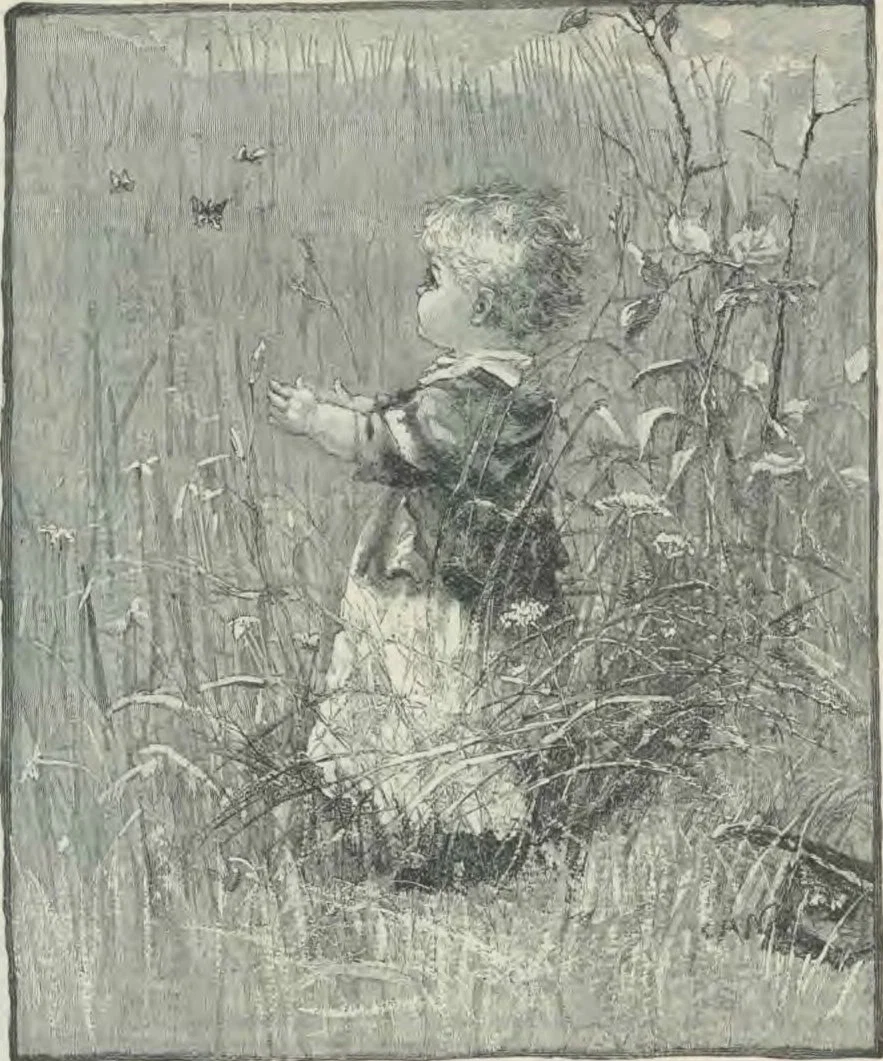
DOWN in the field all fragrant with clover, The birds and the bees and the winds sweeping over, There, with the blossoms and butterflies, Stands my baby with wondering eyes.
Over her bends the blue sky with its blessing, Round her the wind breathes with tender caressing; Baby and birds and butterflies, Over them all, the motherly skies.
All the wide fields is the clover perfuming, Everywhere fair, golden buttercups blooming, Nod and smile in the glad sunlight; Baby is wondering what makes them so bright.
Over her head flies a bobolink, filling All the sweet air with his musical trilling, Caroling loud in an ecstasy mad: Baby is wondering what makes him so glad.
Every thing fair in these fresh morning hours, Tall, waving grasses, the bees, and the flowers, Birds and blossoms and butterflies Come to my baby, a glad surprise.
Watching her standing knee-deep in the clover. With fond, loving glances I look her all over From the brown, silky hair, to the dear, dainty feet, And this is my wonder, what makes her so sweet? —The New Hampshire Journal.

THANK-OFFERINGS

YOU have read the story in the INSTRUCTOR of the little invalid girl who amused herself with her scrap-book,—pasting in new pictures and looking at the old ones, as she was propped up in bed. Probably none of you would like to change places with her, yet I verily believe she was happier than many children who can use their limbs freely.
Do you ask, “Why?”
Well, she was happier because she denied herself to make another happy. It has been proved over and over again that there is nothing like this to make people happy. I hope the INSTRUCTOR boys and girls have all tried it for themselves.
Have you thought what a sacrifice the little girl made in giving up her best treasure? Looking at it, and pasting the pictures into it, was all she had to make her forget her pain! It cost her a struggle to part with it, you may be sure; but when she knew of the sufferings of another little girl, she bade her mother take the book to her.
What then?—Why, her little heart ran over with happiness. The sacrifice brought such a blessing that she wanted right away to make another gift; for you remember she said at once, “Please, mamma, give me my thank-offering box, so that I can put in a penny; for I am so glad that I had something to give” to the little girl.
To whom did she give the second gift? It was not to the wounded girl, neither to some other child. She had learned what James says: “Every good gift and perfect gift is from above, and cometh down from the Father of lights;” and what John says: “A man can receive nothing except it be given him from heaven.”
So she wished to make a thank-offering to God, because she knew that it was he who had given her strength and the means to make a scrap-book to comfort herself so much, and then to give to another unfortunate one. Don’t you think the angels looked lovingly upon that child?
All the things that make you happy are from above. Did you ever think to count them up for one day? Life, health, home, friends, food, etc., etc., are all of God. What a debt of love you owe him!
In return for his mercies, do you ever show your love and gratitude by making him a thank-offering? Anciently, God’s people were taught to do so; and a full heart would cry out: “What shall I render to the Lord for all his benefits?”
The Lord “loves a cheerful giver;” that is, one that “hearkens to his voice,” and gives from a loving heart. To such he says: “Blessed shall be thy basket and thy store.” While they are dealing out with one hand, the Lord is filling the other.
You know he has promised to those who bring into the storehouse all their tithes and offerings, that he will open the windows of heaven, and pour out a blessing so great that there shall not be room enough to receive it. “Prove me now,” he says, and see if this is not so. His promises never fail.
Oh, those stingy souls who rob God in tithes and offerings, and who never think of making thank-offerings for the good things they are receiving every day! The Bible says there is that keepeth back, “but it tendeth to poverty.”
I hope the INSTRUCTOR boys and girls count up their mercies, “which are new every morning,” and put all just dues, and as much more as their love prompts them to, into their thank-offering boxes, that God’s servants may have means to send light and joy to those in darkness. All that do this will have the same spirit as the one who gave up her scrap-book to brighten another life. And let one who has proved the Lord say to you again that no one loses by dealing liberally with the Lord. M. J. C.

CHARLIE AND THE ROBIN.

Oh, if I were a little bird, How happy I would be! Perched all day in a shady tree; Or, down among the clover, Drinking up the dew. I'd be a happy bird; Say—would not you?
Not a single grammar lesson, Nor a word to spell; Funny green school-house Without any bell! A cherry for a luncheon, A blossom for a book, Dinner with the honey-bee Down by the brook.
“Oh, dear! What a jolly kind of life that would be! I don't see the use of studying, anyway. I wonder why we were not all born wise; or why we can't leave learning until we don't care to play; or else why we were not made like that robin out in the apple-tree, who hasn't a thing to do but fly and sing from morning till night.”
So said Charlie Heath, as he lay in mamma's easy-chair, in her pleasant sitting-room. Mamma thought he was studying his lessons for the next day; but he was really looking out of the window at the old apple-tree, which was white and fragrant with blossoms, and wishing all kinds of impossible things.
Finally he said, with a lazy yawn, “I believe I am getting sleepy; and a fellow can't study when he is sleepy. I wish I could go to sleep any time, like a bird.”
As he said the last words, he heard a queer sound in the apple-tree, which made him fancy he was being laughed at. Leaning his elbows on the window-sill, with his chin in his hands, he looked earnestly into the apple-tree. There was the robin, whose easy ways had seemed so nice to the boy a moment before. But now the bird had a different look;—he seemed provoked about something; his pretty feathers were ruffled, his beautiful red breast seemed redder than usual, his tail twitched and jerked, and his bright eyes snapped. Charlie fancied the robin was angry at him. As he looked at the lively bird, wondering what could be the matter, he heard robin say:—
“Nothing to do but to fly and sing from morning till night! Indeed! And how do you suppose I learned to fly and sing, if I didn't work for it? and what's more, I didn't fret about it, and wish all manner of things. I haven't any patience with you lazy human folks, who have such beautiful homes, kind friends, and chances of being happy and making others happy, and yet are always wishing for something different from what you have.”
“As for that song you were singing just now, there isn't a robin of my acquaintance who ‘perches all day in a shady tree;’ and as for ‘dining with the honey-bee, down by the brook,’ that is ridiculous. If I have any dinner, I have to work for it. If I try for a cherry or a berry, it is not very pleasant to have to watch for a chance to borrow one or two, with the risk of some one of your kind coming out with stones or a gun; or of being nearly frightened out of our feathers by seeing some terrible creature in the strawberry bed,—something I believe they call ‘scare-crows.’ They are just as frightful to us robins as they are to the crows. How would you like to get a dinner in that way?”
“And if we don't have a ‘single grammar lesson, nor a word to spell’ in our schools, we have other things to learn. We have to be taught how to tell quickly where the best worms are to be found.
“And what about our morning ‘service of song’? Don't you suppose our carols and anthems have to be practiced? Well, I should think so!”
“Oh, dear,” said Charlie, who began to feel quite uneasy, “don't be so angry, please. I didn't mean anything; and besides, I didn't suppose you'd hear; and then, too, I didn't know.”
“That's just what provokes me,” said the robin. “You ‘don't know,’ and yet you go on talking about things you don't know anything about, and then complain because you are asked to learn!”
Robin finally smoothed down his ruffled feathers, and said, good-naturedly, “Oh, well, I mustn't lose my temper on such a lovely day. But really, my young friend, you mustn't think we robins do nothing but play. We are really very busy. I am choirmaster to a large class of morning and evening singers. Then, too, I have a school for young robins, so that my time is all taken up, as you can see for yourself.”
“I never thought of all that before,” said Charlie. “I see that I shouldn't have any easier time as a bird than I do as a boy.”
But robin had a little more to say, about another mistake in Charlie's song.
“‘Funny, green school-house, without any bell!’ Indeed! When my robins have learned all there is to know about worms and bugs, and how to look out for bugs, etc., and when my class knows all its songs perfectly, we shall have no further need for schools and bells. But now we have them everywhere, the most beautiful chimes in the world.”
“There, I hear the bells for afternoon school now. I must go; for I think it my duty to be early as an example to my pupils. Don't you hear the bells?”
“No,” said Charlie, “I do not.”
“Stupid!” muttered Robin, and then, as if ashamed of his impatience, he said, “I don't suppose your ears were made as quick to hear as ours are. I'm sorry you can't hear the bells; they are so beautiful!”
“Tell me about your school-house and its bells,” Charlie ventured to say.
“My school-house is the big apple-tree at the end of the orchard; and the bells, don't you know them? Why! the apple-blossoms are the bells! It's really too bad that you cannot hear them. But you know the smell of the apple-blossoms, don't you?”
“Oh, yes, indeed!” said Charlie, glad to be able to prove that his sense of smell was good, even if he could not hear so well; “I should think I could smell the apple-blossoms, and I love them, too.”
“Well,” said the robin, “Can't you smell them more plainly sometimes than at others, say in the morning or evening, when the little breezes come dancing in at your window?”
“Yes, that's so,” said Charlie, glad to be on the right side again.
“Well, that's when the bells are ringing,” said Mr. Robin, “the apple-blossoms are not only sweet-sounding bells, but they are sweet-scented bells, too; and when they ring out morning and evening, and call us to our duty, they send their perfume on the air, and the little breezes carry it far and near. It is too bad you can't hear the bells, but I am glad you can smell their perfume.”
“Now please excuse me; I must say good-by, or I shall be late, and what an example that would be to my robins! and besides, we are learning a new song, and if you are up early enough to-morrow—say between four and five o'clock—you may hear it.”
“I hope you will excuse me if I have been impatient or impolite; for it is hard to have any one say, after all our work to please you girls and boys, that all we robins do is to play from morning till night. Now don't you think so yourself?” he said, putting his head on one side, with a saucy little nod, and looking at Charlie with one bright eye.
“Yes, I do,” said Charlie, “and I'll never say such a thing again. And I'll try to work hard myself, to please some one else, and I think I'll begin with mamma, for she's very anxious to have me study and improve my time. I've been lazy and mean, but I won't be so any more.”
“That's right! that's right! and I feel sure you'll keep your word; but I must go, or I shall certainly be late,” said robin, and spreading his wings with a soft little flutter, he was soon out of sight.
“Come, dear,” said mamma's pleasant voice, “it is nearly tea-time. I wonder how long my boy has been dreaming in my ‘Sleepy Hollow’ chair?”
“Dreaming, mamma? I don't believe I've been asleep!”
Then Charlie told her all about the robin's wise talk, and pointed to the very limb of the apple-tree in which the bird sat. Mamma listened in her pleasant way, smoothed his tumbled hair, and said something about a “dream,” to which Charlie answered, with a sigh, “Perhaps so.”
But for all that he never smells the sweet odor of the apple-blossoms, that he is not reminded of his little red-breasted robin friend, and hears over again his wise little talk. He even fancies he can hear the sweet music of a thousand silvery bells. I am sure I can say that he studies, and likes to study, and he is pleasing some one besides himself. Why?—Mamma, and besides her, the God whom mamma serves.—The Youth's World, adapted.

BEING BETTER THAN DOING.

In the long run, we can do more by what we are than by what we attempt; more by our characters than by our activities. To others, as well as to ourselves, there is inspiration and inducement in a noble or a lovely character. If we stop and consider what it is which has done most to shape our thought and our purpose in life, we shall see that it is some winsome and impressive character which has been uplifted before us, and which has drawn us by its pre-eminent attractiveness, rather than any precept or injunction which has been spoken to us by instructors. And as it is with ourselves, so it will be with others. Everything that raises our personal standard of thought and purpose, everything that brings us nearer to the stature of the completed one in Christ, increases our power for good, and makes us more and more a power in the world about us. When we crave the privilege of doing for others, it is well for us to realize the privilege of being for others, and for our Master, whose assurance to his loved ones is: “Herein is my Father glorified, that ye bear much fruit, so shall ye be my disciples;” not, that ye sow much seed, but that in your characters ye bear much fruit; “for the fruit of the Spirit is in all goodness and righteousness and truth.”—S. S. Times.

HOW TO MAKE MOTHER HAPPY.

“Why, mother, how bright and cheerful you look tonight! What has happened?”
“I feel very happy, my dear, because my little boy has really tried to be good all day. Once when his sister teased him, and he spoke quick and cross to her, he turned round a moment after, of his own accord, and said he was wrong, and asked her to forgive him. I believe I should grow young, and never look tired or unhappy again, if, every day, my little boy and girl were as thoughtful, unselfish, and loving as they have been to-day.”
Here's a great secret for you, little one. And now that you know how to make mother happy, may you keep her face always full of sunshine!—Sel.

SOMETHING TO DO ON A DULL DAY.

“Let’s make a little sunshine!” said Uncle Jack. “Make sunshine!” said Jennie. “Why, how you do talk!” said she, smiling through her tears. “You haven’t got a sunshine factory, have you?”
“Well, I’m going to start one right off, if you’ll be my partner,” replied Uncle Jack. “Now, let me give you the rules for making sunshine: First, don’t think of what might have been if the day had been better; second, see how many pleasant things there are left to enjoy; and lastly, do all you can to make other people happy.”—Sel.

Bible Verses as Candles for Our Feet

Bible verses are candles by which God lights the way for our feet. He does not wish us to walk in darkness, and he who takes the Book along does not need to do so.
Continue reading: TITHES AND OFFERINGS