Your ShelfYour Projects

Review and Herald, Vol. 56, No. 8.

RELIGION AS AN EDUCATING POWER
Earlier text: THE RESERVE FUND

MICHIGAN

Blaine, St Clair Co., Aug. 6.—We commenced meetings here July 18. Many who were bitterly opposed to the truth before we came, attend regularly. Several have decided to obey God, and as the interest is still good we continue our efforts here, trusting that the Lord will graciously turn the hearts of others to the truth. G. K. Owen.
Fenton, Aug. 3.—During the past week the interest in the meetings here has been encouraging. Last Sunday forenoon we organized a church of fourteen members. Others are keeping the Sabbath, who will soon unite with them. The present prospect encourages us to hope for better success than we at first dared to anticipate. We feel grateful to God for his presence and help, and to our brethren and sisters for their prayers. We believe you will still remember us in your daily devotions. J. O. Corliss. E. P. Daniels.
Tent No. 2, Cass City.—Several here have decided to obey the truth, and more are investigating. The church at Elmwood has been revived, and it now seems probable that the scattered ones will be united and built up together.
From the first there has been the most desperate opposition from the leading churches, several persons going from house to house and openly exhorting people to keep away from the tent. This, together with the frequent storms, and busy season of harvest, has greatly hedged up our way. It has rained eighteen days in succession, and most of the time the storm came just in time to prevent people from attending meeting. At least eight times the storms were so terrific as to prevent any service.
In this experience we have learned patient perseverance under difficulties. The blessings of brotherly love, union, and good courage, are ours. Our Sabbath meetings and seasons of prayer have been encouraging, and especially the fast-day Sabbath, which was one of unusual solemnity. M. E. Cornell. Wm. Ostrander.
Labor among the Churches.—Since our last report, we have labored mostly among the churches. Spent a few days at Wayland, and visited nearly every family in the church; also held meetings in the neighborhood of Bro. Moore’s, with a good outside attendance.
We next visited Gaines, where we organized a V. M. society, also an H. and T. society. We obtained many signers to the pledges. The outside interest was excellent.
We seldom enjoy better meetings than those at Spring Arbor. Many were moved to tears by the Sabbath discourse, and when opportunity was given to come forward for prayers, more than half of the congregation responded. Four or five made their first move in the Christian life, and many others made a new start for the kingdom. We also spoke on temperance to a full house.
We next labored six weeks with the church at Orleans, in a revival meeting. Until the busy season came on, our congregations were large, but they gradually fell off until the meetings were discontinued. A few, however, made a start in the divine life. Two were baptized and joined the church. We made between fifty and sixty pastoral visits, and feel that the meetings did some good.
At Fremont Center we organized a church of about twenty members, ordained an elder and deacon, and organized a T. and M. society. A Sabbath-school had previously been organized. The church is now in good working order; all the members have adopted the tithing system, and are taking our periodicals. Have visited them twice, and at our last visit seven were baptized. We have enjoyed some excellent meetings with them.
Have also labored with the little company at Twin Lakes. They were quite discouraged, having had no ministerial labor for eighteen months. We visited them twice, re-organized their Sabbath-school, which had gone down, and took a solemn pledge of them that they would keep up their Sabbath meetings in connection with their Sabbath-school. They were greatly encouraged, and we now hear good reports from them.
Have visited Potterville, our old field of labor, and as is usually the case there was a large turnout of our brethren from a distance. The yard was literally crowded with teams both Sabbath and Sunday, and the church was well filled with Sabbath-keepers. The business meetings on Sunday were well attended, and all took an active part in business transactions. Two were baptized, and altogether we had a very profitable time.
Have several times met with the churches at Wright and Ravenna, and have held encouraging meetings. We have also labored at Shelby, Oceana Co. This church has had no ministerial help for a year and a half. They were greatly encouraged by our visit. The Congregationalists kindly granted us the use of their church, and we had a large attendance from without, and a good interest seemed to be manifested. We hope soon to comply with an urgent request to return and labor there. On the whole, we are glad to report courage all along the line of our work. E. B. Lane. E. S. Lane.

OHIO

Leipsic, Aug. 6.—We have held thirty-three meetings here, and some have decided to obey the truth. Last Sunday the Disciple minister gave a discourse in opposition to our views in the forenoon, and the Methodist minister in the afternoon. Eld. Rupert reviewed the Disciple minister in the evening before a congregation of about seven hundred, and on Monday evening I reviewed the Methodist minister. This has increased the interest on the part of many to hear more on these subjects. Both ministers took the ground that the law of God was abolished. O. F. GUILFORD.

KANSAS

Ballard's Falls.—The interest in this place continues good. Seventeen have been added to the church, and besides these, two or three families are keeping the Sabbath. Yesterday there was an attempt made to disprove the Sabbath and bolster up Sunday. The effort was very weak, owing to an entire lack of Bible evidence. It was reviewed in the afternoon before about four hundred. Calls for labor are coming in from every side; one of us will probably fill some of these calls, while the other holds the fort under the canvas. Many are studying to know the truth, some of whom we trust will obey. We could labor to advantage in this county for the coming year. May the Lord give wisdom to move judiciously.
Aug. 2. JOSEPH LAMONT. L. D. SANTEE.

NEW YORK.

Cassville, Aug. 3.—Last Sunday the Baptist minister announced that he would preach on a very pleasing theme that day, and so introduced the immortality question. He advanced no new arguments in favor of man's natural immortality, but relied mostly on heathen mythology, and the fact that man was made in the image of God. His church are very much pleased with the discourse, and have generally united against us, and are using the stay-away argument. A few, however, who act independently, come to hear us, and generally agree that we have the truth.
We are now in the midst of the Sabbath question, and hope that some may be persuaded to obey.
T. M. LANE. J. Q. FOY.

EVERYTHING BUT REST.

When God at first made man, Having a glass of blessings standing by, “Let us,” said he, “pour on him all we can; Let the world's riches, which dispersed lie, Contract into a span.”
So strength first made a way; Then beauty flowed; then wisdom, honor, pleasure; When almost all was out, God made a stay, Perceiving that alone of all his treasure, Rest in the bottom lay.
“For if I should,” said he, “Bestow this jewel also on my creature, He would adore my gifts instead of me, And rest in nature, not the God of nature; So both should losers be.
“Yet let him keep the rest,— But keep them with repining restlessness; Let him be rich and weary; that, at least, If goodness lead him not, yet weariness May toss him to my breast.”
—George Herbert, 1593–1633.

MAINE

Clinton, Aug. 3.—Since our last report, the attendance has ranged from fifty to two hundred and twenty-five. Last Sabbath, July 31, was a good day for the cause here. Sixty-five testimonies were borne in our social meeting, and seven or eight kept their first Sabbath. The Lord gave us special help, for which we praise his name. How hard it is for people to yield to the authority of God's law, and what a great blessing they receive when they do so. As nearly as we can learn, the general impression in this vicinity is that we have the truth on the Sabbath question.
Brethren were here last Sabbath from Norridgewock, Somerset Mills, Cornville, Rome, and Hartland, which added much to the interest of our meeting.
J. B. GOODRICH. C. STRATTON.
Limestone, July 30.—Our report of the 26th inst. left us in conflict with the Methodist minister, Eld. E. B. Fletcher. He spoke Tuesday evening in review of Bro. Webber's discourse on Sunday evening; and at the close of his discourse he challenged us to debate this question: “Does the fourth commandment require of us that we keep the seventh-day Sabbath in an unbroken succession of weeks from the first Sabbath?”
We announced that we would review his discourse the next evening, as that was the way the contest was commenced. He said we were “backing down,” and dared not meet him in debate. He said that he had challenged our ministers, Bro. Canright, Corliss, and Webber, and they had not dared to meet him. We told the people that as he had spoken against us three times, and we had replied but once, we would review his discourse Wednesday evening, and debate his question Thursday, and they considered that a fair proposition. Bro. W. reviewed his discourse, and stated the facts connected with the challenge that he and Bro. Corliss received from Mr. F. at North Windham. Then, as Mr. Fletcher had admitted that the Sabbath was changed from the seventh to the first day of the week, Bro. Webber told the people that the point they wanted decided was, Has this change been made by divine authority? Some interrupted, exclaiming that that was what they wanted. We then read this resolution: “Resolved, That the Scriptures teach that the Sabbath has been changed from the seventh to the first day of the week by divine authority,” and on taking an expression of the people, to see if they wanted this question discussed first, three-fourths of the congregation voted for it, and not one against it. The Elder tried to evade the question, but we held to him, and he finally said that he did not believe there was any divine authority for the change; the Bible did not teach it, and he would not discuss what he did not believe.
One of Mr. F.'s friends, wishing to help him out, said that we dared not meet his question on “succession.” Bro. W. accepted, and arrangements were made for the debate, which was held last evening. The disputants were to speak fifteen minutes alternately, and the debate was to continue an hour and a half. The time came; the debate commenced. Bro. W. affirmed; Mr. F. followed, and he occupied just four minutes of his first fifteen minutes, and sat down. I held my watch in my hand while Mr. F. spoke. He seemed to be confounded. The debate continued an hour and ten minutes, and Mr. F. did not occupy twenty-five minutes of all the time that was allotted him. Thus ended the contest with a man who had boasted so much, and the truth has triumphed thus far. S. J. HERSUM.

THE SECOND ADVENT.

SAYINGS OF EMINENT MEN.

The following is from the Rev. W. Dalton, M. A., incumbent of St. Paul's, Wolverhampton:—
“Everything about us seems defiled and out of joint; there is a heaving of the sea of discord, which is felt to agitate and disquiet,—a sort of prelude of that fearful storm which will burst on the church just previous to its eternal calm.
“We have now to meet with sorrows and bereavements in this world of separation; we have now to weep and lament over the uprisings of the evil principle which we have inherited from Adam, and which struggles so hard against the heavenly nature implanted by Christ; all this we have now to meet, and therefore we have need of patience.
“Your Lord would have you learn this lesson daily, while yet he tarries in the heavenly sanctuary, and has not set out to take possession of his millennial kingdom. But then, he gives you the sweet assurance that the delay is short, and that very soon we shall behold him in his robes of majesty, attended by myriads of holy angels and glorified saints, proclaiming, with a voice of supremacy, that shall be heard to the utmost bounds of creation, ‘Behold, I make all things new!’”—Lectures during Lent, p. 106.
The Rev. J. W. Brooks, M. A., rector of East Retford, England, says:—
“The signs of the Second Advent in the state of the world at large are such as to impress my own mind with a deep persuasion that we are on the eve of events of immense—immense importance to mankind.”—Ib., pp. 109, 110.
“Though I distinguished only some few signs as in themselves cheering, yet, when considered as the tokens of our Lord’s approach, all are cheering; therefore he bids us, as in the text, when we shall see these things only begin to come to pass, to lift up our heads, because our redemption draweth nigh. And if the beginning of these things is calculated to inspire us with hope and joy, how much more their fullness! Yes; those things which are dark and appalling to the world—like the pillar and the cloud—will be as light and brightness to the saint, who, when all is roaring and raging and upheaving round about him, shall be ardently waiting for, but most surely expecting, and in the midst of it obtaining, deliverance from corruption, into the glorious liberty of the children of God.”—Ib., p. 152.

EVERY-DAY RELIGION.

A solid, substantial-looking woman was examining dress goods in one of our stores. Fabrics of every style and quality were thrown out upon the counter, and she examined them critically, one by one, until the dapper little clerk grew uneasy, and began to recommend various styles, hoping no doubt to hasten her in the choice. She paid no heed to him, but went on with her careful examination as before. At length she said,—
“Young man, I don’t intend to buy any flimsy stuff, nor any that is all shine, and no wear in it. I intend to have a dress that will bear good, solid, every-day use, and soap and water, when it needs it. I want a dress that will stand the sun without fading or a shower without frizzling-up, and if you’ll give me time enough, I’ll see if you have got any such thing here.”
I did not stop long enough to know whether she found a fabric that would endure so many severe tests, but her words set me to thinking. I thought, “We all need just that kind of religion that will stand the hard, every-day wear of life; that will not fade in the sun of prosperity nor ‘frizzle-up’ in the storms of sorrow and adversity; a religion that is no flimsy affair, but solid and substantial enough to use every day.
I began thinking over the various qualities of religion with which I was most familiar among our best-regulated orthodox people, and it proved a most interesting study. There was Bro. A——, whose religion is very conspicuous on Sundays and at the prayer-meeting. His prayers are fervent and full of feeling; his exhortations recount with unction his great attainments in the Christian life. He is distressed over the condition of the church and the world and the lack of piety and consecration in ministers and Christians. He is alive and earnest, hardly able to restrain his exalted emotions. But he somehow lives it all away with his Sunday clothes, for it doesn’t stand every-day wear. Bro. A—— at prayer-meeting and Bro. A—— at home are two different beings. His religion is not strong enough to keep him from making everybody miserable and unhappy about him. It will not stand a single test; it is only fit to be carefully worn on special occasions. No doubt Bro. A——’s religion is a means of grace to some, but to others it is a stumbling-block,—all sham and shoddy.
Bro. B—— rarely goes to prayer-meeting; when he does, he sits utterly silent through it all. We know he had a hard bringing up, fighting his own way as best he could, and that even now he has a host of besetting sins and temptations to struggle against every day that he lives. We tremble for him, knowing his weakness, knowing how slight a hold he has on his small hope in Christ, how strong a hold the world, the flesh, and the devil have on him. We sympathize with him, we pray for him; we bear patiently with many things we would not dare to excuse in ourselves. His religion is good as far as it goes, and it does help him over a good many hard places.
Bro. C—— has a good, solid, substantial article, that stands the wear and tear of life grandly. He has a quick temper, and it helps him to hold it in check. He has countless “thorns in the flesh,” and trials and hindrances on every side, and it helps him to be patient and cheerful under them all. He makes poor, stumbling little prayers, but they are genuine, and there is a true, tender depth to every word.
Sister D—— is one of the humblest, most unassuming women in the world. She has a little trembling hope in Christ, but feels altogether unworthy of his mercy. Sometimes in our ladies’ meetings she will venture a touching little prayer to her Saviour, that we all strain our ears to hear, because we feel sure it is going up to him from a full, loving heart. Her life is a sermon in itself. Never a word from her lips that could grieve or wound another, for she speaks with the utmost charity and tenderness of every one. She shames us all with her quiet forbearance and sweet submission in the midst of trial and great afflictions. Patient, cheerful, with a steadfast, loving trust in her Saviour, she is a living epistle, known and read of all. Oh that we all had a rich supply of such religion!
It is good to be peaceful and happy on Sunday; it is better still if Monday’s fret and toil, and worry of mind and body can be met with patient endurance and steadfast courage that will take us through, resting in God, doing and bearing all things in his strength. It is good to bask in the sunshine of Christian fellowship, and grow strong in the Lord by sweet communion with him; but it is better still to hold fast and steady, when almost overwhelmed by the stern duties and discipline of life.
It takes very little religion to make us simply happy; it takes a great deal to keep back hasty, unkind words, to make us patient with the steady grind of daily care when everything seems to go wrong; when everything seems to be against us. It takes a great deal when our best efforts for good are misconstrued; when men speak evil of us; when, do what we will, we are condemned. It takes a great deal of religion to hold still when God lays us in the furnace of sorrow or of pain, to see if there be any gold in us.
Is our religion good for every-day use? Does it stand every-day wear, growing stronger and dearer, an anchor sure and steadfast? God’s grace is sufficient for every need of every soul. We have only to go every day for an abundant supply. Yesterday’s grace will not do for to-day. It is like manna; we must gather it fresh every morning. Sustaining and cheering us as we go on, day by day, toward our eternal home, we shall find it at last giving us an abundant entrance into the city of our God.—Mrs. A. W. Curtis, in Advance.

MINNESOTA

Rochester, Aug. 4.—On the 19th of July we pitched our tent in this city, and our meetings opened favorably.
After the work was well started, in company with Bro. Fulton, I visited the brethren in Winona county, who embraced the truth last winter under Eld. Battin’s labors. We found a company here who have, without any help, passed through bitter opposition. We organized a church of seven members; an elder and deacon were elected and ordained. Their Sabbath-school is doing well. Others in this vicinity are deeply interested, and if this little company are faithful, we believe God will add many to their number.
On Monday we returned to the tent, and found the interest still increasing. The attendance is from two hundred to four hundred. There is deep feeling among the people, and as we glance over the congregation and see so many earnest listeners, we can but believe that God will bring out a people here who will keep his commandments and the faith of Jesus.
Here, as elsewhere, those who should be the light of the world are not only determined that not one ray of truth shall light up their own pathway, but are exerting all their influence to keep others away.
HARRISON GRANT.

IOWA H. AND T. SOCIETY.

The first annual meeting of the Iowa H. and T. Society was held at Des Moines, Iowa, June 3, 1880, at five P. M. The President in the chair. Prayer was offered by Eld. Hollenbeck. The Secretary’s report was read and approved.
Following the opening exercises, Eld. Butler expressed the deep interest he felt in the temperance work; he stated that we had no reason to be discouraged; that he believed God’s hand was in this movement, and it would go forward.
The Chair was authorized to appoint a Nominating Committee, which he did as follows: Noah Hodges, H. Nicola, and A. W. Millard.
On motion, the Society adjourned to call of Chair.
SECOND MEETING.—June 7, at eight o’clock P. M., Eld. J. O. Corliss gave an interesting temperance lecture, after which the Committee on Nominations submitted the following report: For President, Eld. E. W. Farnsworth, Mt. Pleasant; Secretary and Treasurer, Sarah Nicola, Richmond. These nominees were duly elected.
Adjourned sine die.
SARAH NICOLA, Sec.  E. W. FARNSWORTH, Pres.

Notes of News.

—Rome proposes to hold an International Exhibition in 1885.
—It is estimated that there are 2,589,172 Baptists in the world.
—An exchange says that Germany has a reserve war fund of $30,000,000.
—The Mormons entered Salt Lake Valley 33 years ago the 24th of last July.
—Great Britain derives an annual revenue of $45,000,000 from the opium trade.
—In Prussia there are 1,000,000 land-owners whose farms average 50 acres each.
—A recent storm has caused a serious inundation in Murcia, a province of Spain.
—The people of Guatemala are being entertained by a magnificent volcanic display.
—During the last week in July, there were 51 deaths in Havana from yellow fever.
—During the month of July, the public debt was reduced over five and a half million dollars.
—Negotiations between Russia and China have been opened, and hopes of peace are entertained.
—The population of Oregon has increased 90 per cent in the last decade, and is now 175,535.
—Dr. Tanner's long fast is producing fruit. A Denver man offers to fast 40 days for $8,000.
—The returns from the late election in France show a Republican gain of 184 in the Council General.
—Mr. Gladstone, Prime Minister of England, and Prince Bismarck, Prime Minister of Germany, are both reported ill.
—At the Exposition in Brussels this season, there is to be a Bible-stand, where portions of the Scriptures will be sold.
—Cardinal Manning says that “the Catholic Church is either the masterpiece of Satan, or the kingdom of the Son of God.”
—At Nijni Novgorod, Russia, on the 3d inst., 70 houses were burned. The fire is supposed to be the work of incendiaries.
—The recent earthquakes in the Philippine Islands have destroyed 320 lives, and every public edifice in Manila has been thrown down.
—The U. S. Consul at Sarnia reports that during the year ending with June last, over 77,000 emigrants crossed at that point from Canada into this country.
—The malarious districts of Algiers, Italy, and the south of France, have, it is said, been made healthy by the eucalyptus trees planted in these districts.
—An orphanage has been started in Detroit, Mich., on the plan of that conducted by George Muller, of Bristol, England. Lots for a site have already been donated.
—Even in benighted Africa there are 33 missionary societies at work, and the result of their labors thus far is 75,000 converts belonging to Protestant churches.
—The Bible Revision Committee have advanced to the book of Job in the work of revising the Old Testament, and three years more will be required for its completion.
—On the 16th of September, Boston will celebrate the 250th anniversary of its settlement, by a reception at Faneuil Hall, and on the 17th by an oration in the Old South Church.
—A late dispatch states that the decree for the mobilization of the Greek army was to go into effect Monday, Aug. 9. If necessary, every able-bodied Greek may be put into the ranks.
—On the night of July 31, four Germans were waylaid near Lake City, Minn., by three unknown robbers. One of the Germans was fatally wounded, and robbed of $40 in money.
—A proposition has been made to send a colporter with Christian literature among the people of Northampton, Eng., who elected Mr. Bradlaugh, an atheist, as their representative in Parliament.
—Protestantism is making encouraging progress in Spain. It is estimated that there are in that country at least 10,000 attendants on Protestant worship, and over 5,000 children in the schools.
—The brutality, filth, and ill-ventilation of the average Russian prison may be inferred from the fact that in one prison, to which are committed only those whose term of confinement is one year, the annual death-rate is 25 per cent.
—It seems that a love of flowers is sometimes dangerous. A boy in Cambridge, England, has recently been sentenced to 3 months' hard labor in the work-house for picking a rose and a spray of geranium. He was released at the end of a fortnight.
—Four of the notorious Bender family have been captured, the old man and his wife and his son and daughter; it now seems that there was a fifth one, a cousin to the young people. The story of their cold-blooded murders, as they tell it, is a fearful one.
—A dispatch from Constantinople, dated Aug. 4, states that an American missionary and his American servant were murdered near Ismid, while on the road to relieve the famished population. Two nomad Turks have confessed the murder, and been arrested.
On the 31st of July, a woman residing near Bradford, Steuben Co., N. Y., set fire to her home, and after watching the burning building till it was reduced to ashes, she went to the barn and hanged herself. She had been acting strangely, and it is supposed that she was slightly insane.
—The Chinese professor attracted a great deal of attention at the Harvard commencement. He wore a robe of bright blue silk heavily embroidered with gold, and the long cue and Chinese shoes, and during the more formal portion of the service was attended by a Chinese servant bearing his hat.
—The Philadelphia Public Buildings, when completed, will be surmounted by a statue of Wm. Penn, 36 feet high. The crown of his hat will be 535 feet above the pavement, making it higher than any other tower yet constructed, though that of the Cologne Cathedral will be a trifle higher when it is finished.
—Through the British Minister at Teheran, the Shah of Persia has notified Mr. J. L. Potter, American missionary of the Presbyterian Church, that he objects to Mr. Potter's giving religious instruction to Mussulmen, and that if he continues to do this he will not be permitted to reside there, and Mussulmen attending his meetings will be arrested.
—England is losing no time in sending reinforcements to Afghanistan. Her movements show that the recent defeat sustained there, though not so disastrous as at first reported, is yet sufficiently serious to call for prompt and energetic action, if she would retain her prestige in the East. In fact, it is more than hinted that Lord Beaconsfield's “policy” has involved England in serious difficulties.
—One of the most interesting meetings in celebration of the centenary of Sunday-schools in London was the gathering of 25,000 children in the grounds of Lambeth Palace. The Prince and Princess of Wales, the Archbishop of Canterbury, the Mayor of London, and other dignitaries, inspected the army of little soldiers, in their gala dress and with their beautiful banners.
—Perhaps we should prize books more highly than we do, if we were obliged to pay for them such prices as they cost a few centuries ago. In A. D. 690 the King of Northumberland gave 800 acres of land for a history of the world. In 1720 a Latin Bible was valued at $150, and two arches of London bridge could be built for less than $150. In those days, wages were so low that it would take 15 years to earn enough to buy a copy of the Bible.
—The removal of the Egyptian obelisk, Cleopatra's Needle, from its original site in Egypt to New York has been a very difficult task, requiring both political and engineering skill. The work of removal has been superintended by Lieutenant Gorringe of the U. S. Navy, and it is said that the expense of the undertaking has been borne by Mr. Wm. H. Vanderbilt. The obelisk is a single stone; it is 70 feet high, 8 feet square at the base, and 5 feet, 3 inches square at the top, and weighs 196 tons.

ENDLESS IMPRISONMENT.

THE following item clipped from a secular paper is suggestive:—
Wisconsin has tried imprisonment for life instead of hanging for over a quarter of a century, and the total number of life-prisoners received at the State Prison at Waupun, since its organization in 1853, is ninety-four, of whom fifty-four were convicted of murder, twenty-nine murder in the first degree, and eleven in the second degree. Of this number there have been discharged by Executive pardon, thirty-one; order of the Courts, eight; removed to the Insane Asylum, three; and six have died. Of those pardoned out, the longest term served was seventeen years, and the shortest service was two years and nine months. The directors of the prison, in their last annual report, allude to the fact that popular attention has been called to the expediency of restoring death as a punishment for murder in Wisconsin. They do not argue against the proposed change, but give their impressions of the horror of a life-imprisonment. They say the condition of most of the life-members is deplorable. Some of them are already insane; but, “however wild their delusions may be on other subjects, they never fail to appreciate the fact that they are prisoners for life. Others, not yet classed as insane, as year by year goes by, give only too conclusive evidence that reason is becoming unsettled. The terribleness of a life sentence must be seen to be appreciated,—seen too, not for a day or week, but for a term of years. Past experience leads us to expect that some of them will become insane in less than ten years, and all of them who live, in less than twenty.” The directors even go so far as to suggest to the Legislature whether life sentences should not be abolished and long but definite terms substituted therefor, thus leaving some faint glimmer of hope for even the greatest criminal.
This is certainly a serious objection to imprisonment for life,—the thought of it dethrones reason. One object of punishment is the reformation of the offender, but life-imprisonment makes its victims insane, and thereby defeats the design of punishment. But if life-sentence on earth makes men insane, what will sentencing them to eternal imprisonment in hell do for them? The directors of the Wisconsin prison, in view of the fact that life-imprisonment has such a deplorable effect, suggest its abolishment, thus leaving “some faint glimmer of hope for even the greatest criminal.” But in hell there is not even the “faintest glimmer of hope” for any one. There is only one sentence for all. The “greatest criminal” and the least criminal are alike cursed with the same eternal sentence, without the faintest glimmer of hope. Such a terrible doom, unless an eternal miracle prevents, must drive every one of its victims to insanity, and hell be a vast mad-house perpetuated by the might of the Almighty. Is it not amazing that sane men and women entertain such a diabolical view of the result of making man in the image of God?

Ordinary Notices.

“Blessed are the dead which die in the Lord from henceforth.” Rev. 14:13.
TAYLOR.—Died near Nashville, Mo., July 10, 1880, of inflammation of the bowels, William S. Taylor, eldest son of John Q. and Nancy J. Taylor, aged 13 years and 3 days. His sickness was short, but severe. His parents and brothers hope to meet him at the resurrection of the just. Remarks at the funeral by Eld. R. C. Thomas, U. B. minister.
E. B. POTTS.
HAMMOND.—Died in Wheelock, Vt., July 13, 1880, Sister Anna Hammond, aged 73 years and 11 months. She was sick about three weeks, of an internal abscess, upon the breaking of which her sufferings came to an end. She had been an observer of the Sabbath of the Lord for twenty-eight years, and her family and neighbors bear the unanimous testimony that she lived an exemplary Christian life. In her last illness she said, “If I had not prepared for the future before my sickness, I fear I could not do it now.” She expressed her confidence that she was ready, and said her anxiety was not for herself, but for her family. She leaves a husband and two daughters, three sisters, and a brother. May the path of faith and obedience, which she chose, look more inviting than before, and may their feet walk therein, that soon the family circle, now broken, may be united in the kingdom of our Lord. Funeral discourse from Ps. 17:15.
C. W. STONE.
WORTHEN.—Died in Charleston, Vt., July 1, 1880, Sister Mary V. Worthen, daughter of C. F. and Mary L. Worthen, aged 16 years, 1 month, and 5 days. Sister Mary was sick nearly a year, and during the last nine months, she was unable to speak aloud. Weeks ran into months, during which time her stomach did not retain for two minutes the least food taken.
As she drew near her end, with her hearing and sight nearly gone, but intelligent and hopeful in God, gentle whispers told of her trust in the Saviour, and her confidence that her rest in the grave would be short, and that she should awake at the voice of the Lifegiver to receive a crown of glory.
The funeral services were held in the F. W. Baptist meeting-house at Charleston, the use of which was kindly granted, the pastor of the church taking up an appointment of his own to favor us, and, being present, he participated in the solemn services.
A. S. HUTCHINS.
SCOTT.—Died of pulmonary consumption, at her home near Jeffersonville, Wayne Co., Ill., July 26, 1880, Sister Minerva J. Scott, in the thirty-sixth year of her age. Sister Scott embraced religion when about twelve years of age, and united with the Methodist Church. She remained a member of this church until 1871, when, under the labors of Eld. G. W. Colcord, she embraced the doctrines peculiar to the S. D. Adventists; in 1874 she united with the Keeneville church, of which she remained a consistent and acceptable member until her death. She bore her protracted sickness with Christian fortitude and resignation, and died in hope of a part in the first resurrection. A husband and four children mourn her loss. Remarks by the writer, from Rev. 14:13.
A. K. ATTEBERRY.
[Signs of the Times please copy.]

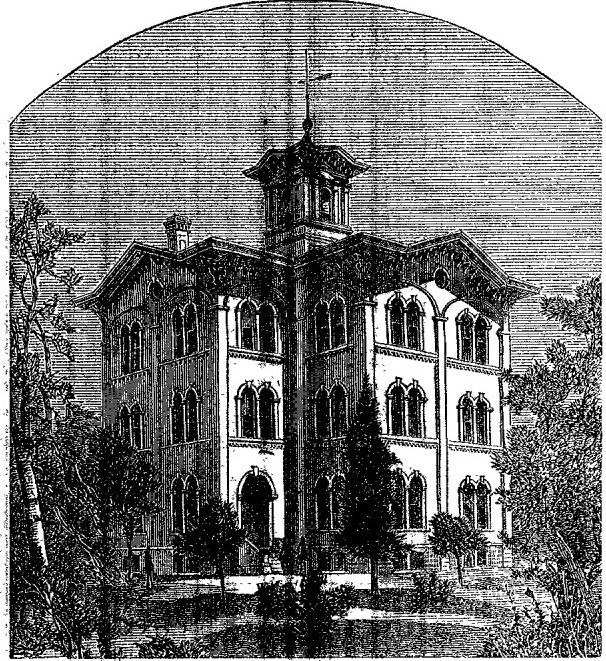
BATTLE CREEK COLLEGE.

A MODEL EDUCATIONAL INSTITUTION, COMPRISING FIVE DEPARTMENTS.

Nearly 500 Students Enrolled Annually, Coming from 32 States and Territories.

DEPARTMENTS.

I. DEPARTMENT OF THE ARTS AND SCIENCES.

This includes a Classical Course of FOUR YEARS and an English Course of three years, each with its Preparatory Course of two years.

II. NORMAL DEPARTMENT.

This includes a Teachers' Course of FOUR YEARS, and a Model School. The course in this department includes all the branches required for a first-class certificate in any State. Professional instruction in Didactics is also given to those in this department who are expecting to teach.

III. COMMERCIAL DEPARTMENT.

This includes instruction in the following topics: Book-keeping, Business Correspondence, Business Forms, Business Penmanship, Commercial Law, Banking, and Telegraphy. The common branches are also pursued in connection with the topics given above; also, French and German.
There are two sessions daily—afternoon and evening.
The courses in this department are of varying length, and the tuition ranges from $5.00 to $30.00.
Superior advantages for those desiring to prepare themselves for Tract and Missionary Secretaries and Librarians. (Send for special circular.)

IV. DEPARTMENT OF THEOLOGY.

This department has a course of three years, which includes, besides the usual common branches, Geology and Greek.

V. DEPARTMENT OF HYGIENE.

This department has a course of one year. It is designed for those who desire to obtain accurate and scientific information on all subjects pertaining to the preservation of health, together with a fundamental knowledge of anatomy and physiology, and a practical acquaintance with the nature and ordinary treatment of common diseases.

THE FACULTY

numbers fourteen members. They are all men and women of experience and critical scholarship.
The majority of the students are young men and women of true moral worth. Their influence over the unstable is highly restrictive and salutary, making it comparatively easy to maintain the most rigid discipline.

EXPENSES.

Probably there is no other College in the United States where a thorough education can be obtained at so small an expense. A system of clubbing, which has become very popular among students, enables them to secure excellent board at $1.10 a week, exclusive of lodging, which costs 50 cents to $1.00 more. The annual expenses of each student, including all but traveling expenses and clothing, need not exceed $113.00. A full descriptive Catalogue will be sent free, upon application.
Address BATTLE CREEK COLLEGE, Battle Creek, Mich.
Continue reading: REVIEW AND HERALD PUBLISHING HOUSE