THE incarnation of Jesus Christ, the Son of God in human flesh, is surely one of the deep things of God, which, though we cannot understand, we may still believe. The unbeliever scoffs at the idea, and says that it could never be; but at the same time there are open evidences of its truthfulness that no candid person can deny, making the way of faith more reasonable and logical than the way of doubt and unbelief, and furnishing the strongest kind of evidence that what the Scriptures tell of Christ’s miraculous conception is the truth. It was claimed, both before and subsequent to Christ’s birth, that he had no earthly father; that the power of the Holy Ghost overshadowed his mother; and that she, still a virgin, was with child.
Under such circumstances, and in relation to such statements, one would at once say that if it was not true,—if the child was begotten in the natural order, like all other children,—then we might expect that that child, for whom so marvelous a history was claimed, would be nothing more than an ordinary child; and that he would not greatly affect the people of his own or of subsequent generations. On the other hand, it might be reasonably premised that, if the claim put forth in regard to this child was true,—that a virgin bore a son by the powers of God alone,—then that child would not only be remarkable, but would be the most remarkable person ever born into the world, and his life would leave an impress upon the world that would last while time should endure. All this might reasonably have been promised from the very beginning.
What has been the result? Which one of these premises has time proved to be true? Jesus was born, and by common consent, with only a few exceptions, there was laid upon him the shame of illegitimacy. Indeed, the infidel takes delight in laying it upon him, even now! He had no wealth or social position to give him power in the world. His reputed father, probably regarded with contempt that he should believe so improbable a tale, was a poor carpenter, working for his daily bread. He lived in an obscure portion of the earth, away from the great marts of trade and centers of influence. So Jesus grew to manhood. After a few years of teaching, mostly confined to people of the humblest ranks of life, he was accused of crime, and put to death as a criminal.
But this was not all. If his life-work and influence had then come to an end, it might have been said that the claims made for him were untrue; but the events of a few days succeeding his death convinced his disciples that he had risen from the dead. With that belief they went out with such enthusiasm and power as the world had never seen, to preach that the crucified but risen Christ was the Saviour of the world. The unlettered Galilean fishermen whom Christ had taught on the mountain, near the sea, and by the wayside, manifested a wisdom and a power that were irresistible. Laws, fetters, scourgings, dungeons, torments, and all the learning and power of the age, could not stop them, or hinder souls from hearing and believing their words. The faith of the crucified and risen Saviour went everywhere. It seemed to be just the thing for which the world was famishing. Empires fell before it, and the world recognized that a teacher had appeared, such as had never before been seen.
Not only did the religion of Christ spread with great rapidity, but it has been lasting. No other person occupies such a position in the world’s thought and hope as he. Beside him, all other teachers are small. In character, in teaching, in influence for the uplifting of humanity, none approach him. His words, spoken to simple fishermen and peasants, are still the hope and promise of youth, the strength of manhood, and the comfort of age.
The words that he spoke, though he spoke so low,
Across the long, dim centuries glow,
And we know them one and all,—
Aye, know them and love them all.”
We can read them from childhood to age, and never tire of them; and we are ever discovering in them some fresh charm or new beauty, that thrills the heart and helps us toward a better life. No one can deny these facts. Many of the most learned Jews of to-day, who still reject the claim that Christ was the Messiah, regard him as the greatest teacher Judaism ever produced,—greater than Moses, Ezra, or Isaiah,—the glory of Israel. These facts, so open and known to all, prove that the highest hopes of Christ that could have been based upon a belief that he was a miraculous child—the “Son of the Highest”—are fully met. Had he accomplished nothing in influencing either his own or succeeding generations, would it not be regarded as sufficient evidence that the claim made for him was groundless?—Certainly it would. Then as surely as this is true, his actual life, more perfect in itself, and lasting and growing in influence and power throughout the ages since, is sufficient evidence that Jesus Christ was and is the incarnate Son of God, the Saviour of the world. Here is a solid basis for faith: that the record of him is true; that all power is given unto him in heaven and in earth; and that, believing, we may have life in his name.
WHAT KIND OF REVELATION?
By Wm. Cochran
BY WM. COCHRAN.
(Fairbanks, Ariz.)
I AM living in a community composed mostly of Mormons, and to do them justice, I must say that many of them are honest Christians. In conversation with more than one of the prominent members of that church on the subject of the Sabbath, they have told me that at some time in the past their prophet, Joseph Smith, had doubts about the validity of the change of the Sabbath, but when he took the matter to the Lord, the answer to him was that for the present it made no difference; or, in other words, they are not required to pay any attention to the demands of the fourth command.
The above fact reveals to every Seventh-day Adventist, and to all others who believe in the immutability of the law of God, the nature and source of that much of Mr. Smith’s revelation, and which must seriously affect the standing of the whole system. I will not attempt to show the inconsistency of such a concession, nor is it necessary to do so; but it may be well that the above fact should be published to the world. I have written a letter to the editor of the Deseret News, Salt Lake City, on the subject, asking him or any one to harmonize said revelation with the words of Christ; but I presume that it will not be answered.
I am isolated from my former brethren, but I wish them to know that I am still trying, by the goodness of God, to do what I can in defense of the truth.
PASSING EVENTS AND COMMENTS.
By T.
How Near Heaven?—Last week we mentioned the death of Theodore A. Havemeyer, one of the great Sugar Trust princes, whose fortune has reached more than ten million dollars, besides several palatial residences. Five hours before his death, he was received into the Catholic Church, a privilege to which he was certainly entitled, and no one need blame him for that. In the newspaper accounts, we learn that his wife has ever been an ardent Catholic, and has succeeded in bringing her children up in the same faith. “With superb liberality he had supported and endowed many Catholic schools. His money had helped the path of many a devout lad to the priesthood. But somehow he had always stopped short at the snapping of the slender ties that bound him to the Baptist faith, in which his forefathers had lived, and in which he had been brought up. Now as he lay dying, his eyes rested meaningly on his wife. ‘Die in our faith,’ she whispered. ‘I should like to rest with you and with my children,’ he responded. ‘If it pleases, let it be so. I guess I shall be as near heaven one way as another.’”
In his last conclusion he was undoubtedly correct. Snapping those slender ties at the last moment, or joining the Catholic Church, or any other church, did not alter his standing before God. In order to die the death of the righteous, let us live the life of the righteous.
The Evils of Matrimony.—A New York magistrate has created no small comment by refusing to marry a couple who applied to him to perform the ceremony. He said: “I must decline. I don’t care to discourage you, but in my experience on the bench, I see too much trouble in married life. I never will perform a marriage ceremony. Go to some minister.” Another magistrate, when asked his opinion in regard to the refusal, said, “Magistrate Cornell was absolutely right. When I see a marriage, I simply see two misguided people taking out a license to quarrel and fight the rest of their lives. I never see a bride and groom coming out of a church, without asking why a beneficent Providence had not interfered to save them. No one who has not sat on the police bench can appreciate how much of the sum of small selfishness and intolerance and hatred can be infused into the marriage relation.”
These words have a very pessimistic savor, and will be rightly regarded as being pretty strong. But we will bear in mind that they were spoken by men who see the bad side of human life. It would not be strange if police justices should become somewhat morbid in their view of social conditions; and yet they speak from actual knowledge.
Send Them to the Preacher.—Another chapter in the matrimonial question is opened up by that suggestion of the magistrate, “I will not marry you; go to some minister.” They were pretty sure not to be repulsed there. There would be no unnecessary questions asked, and no trouble would be borrowed for the future. If the man carries a fee in his pocket, there is but little doubt as to the attitude of the minister. For, “If I don’t marry them, somebody else will;” and the saloon-keeper’s argument carries the day, sweeping away any compunctions of conscience that may desire to assert themselves.
Why should not a minister of Christ’s gospel be as conscientious in these matters as a police magistrate? Why should he not seek as earnestly to avert calamities and forestall sin and misery? Why should his sense of propriety, his regard for mankind, his fear of God and the Judgment, be silent in the presence of a marriage fee? It is true that ministers are apt to be poor, wife wants a new dress or hat, and this would come in, O, so nice! Yes; but think beyond those things. Think of society, think of the prevailing corruption and crime against God and man covered by the cloak of a marriage ceremony. Think of children to be born, of wretchedness and squalor; and if the minister cannot with confidence present the case to God, and send the couple away with a heavenly benediction which the circumstances anticipate, then let him deal faithfully in the matter, and wash his hands in innocency. The readiness with which ministers of the gospel (so called) open the gate to sin and sorrow in unholy marriage, is a blight upon the present generation.
Catholic Conversions.—The Catholic papers are, in a quiet manner, rejoicing over the numerous accessions to their ranks from other churches, especially from the Episcopalian, or Anglican, Church, and lately we had occasion to note a rather extraordinary defection of an active worker in the Salvation Army to the Roman Catholic ranks. There is not the slightest reason for doubt that in many respects the church at large is drifting Romeward. Occasionally prominent members take a start of the prevailing tendency, and make a short cut for the Roman communion. There are also individuals who realize this tendency, and who are exerting their influence in the opposite direction. A prominent Catholic paper of recent date, speaking of this subject, says: “Very little is said of the conversions, the clergy, for good reasons, being averse to making any stir over them; nevertheless they go on. And one circumstance—not the least important—destined to help in the movement is the course of teaching of conspicuous Protestant ministers like Minot J. Savage, Lyman Abbott, and Heber Newton, who seem bent on destroying faith in Christianity. People who stop long enough to reflect that they have souls to save, and who realize what is in progress in the Protestant world, not only in this country but in centers of thought abroad, naturally turn their eyes toward the only ark of safety—the Catholic Church.”
The reason stated above is a cogent one, and explains why so many people are looking about for some better state of things. They see the church to which they have held allegiance drifting away from its primitive standard. They see the Bible discounted, and they know not whither they are drifting; and naturally reach out for something better. It is a sad thing that any should be compelled to go back to the church of the Dark Ages for help and comfort. T.
FORTUNE-TELLING
By M. E. K.
The number of persons who get their living, and often a very good living, by making shallow-minded and credulous people believe that they can tell their fortunes, and disclose to them the future of their lives, has not apparently diminished since the days when the astrologers of Babylon pretended to know so much, and really knew so little. A glance at the advertisements in a city daily paper will reveal the fact that there are many persons who advertise to diagnose disease, from a lock of hair sent to them in a letter, and to prescribe a remedy. The writer once met a man who had purchased and taken many bottles of medicine prescribed on the strength of this hair diagnosis, and who probably kept right on doing so; for,—
“Faith, fanatic faith, once wedded fast
To some dear falsehood, hugs it to the last.”
Various other things equally absurd are practised, and all these sharp tricksters seem to get enough patronage to keep them in the business. The advertisement and sale of magic belts, magic charms, love potions, and the like, convince one that, though we live in the last days of the nineteenth century, many people, in their minds, are in Babylon, or still farther back.
It may be that among them there are some who predict a double deception, deceiving themselves as well as others, but this cannot be true of the majority. A professed fortune-teller may be safely put down as a wilful deceiver, whose sole object is to secure money from his ignorant victims, and whose trade flourishes in proportion as he is able to deceive others. Sometimes, though not very often, the tables are turned, and the fortune-teller is the loser. Lately a fortune-teller in Cincinnati had a call from three men who expressed a desire to have their fortunes told. While she was telling one his fortune, the other two knocked her senseless, and then they robbed her. The event proved that they knew her fortune better than she did theirs; for they took away with them five thousand dollars in money and jewels, which she had probably stolen from others in a more decorous, but no more honorable, way than they had robbed her.
The paper describing the occurrence said she was robbed while she was “reading the future.” Upon this point, two suggestions might be made: First, if she could read the future, she ought to have discerned their purpose when they came in: and second, It is better to know less of the future, and to have one’s money in safe-keeping, than to be able to know so much of the future, with no protection for the present. It requires no fortune-teller to venture the prediction that she will keep close watch of her money after this; and while pretending to tell the future of people’s lives who come to patronize her, she will try to know more about what they are doing at that same time. M. E. K.
SOUTH AMERICAN REVOLUTIONS.
By M. E. K.
Brazil and Uruguay are not the only South American countries that are indulging in the expensive folly of a revolution. Ecuador is now doing the same. Revolutions in South America come with almost the same regularity that spring cleaning comes to the staid people of the more northern countries. Like the revolutions in Brazil and Uruguay, the revolution in Ecuador is a religious rather than a civil revolution. Ecuador has granted some slight degree of religious liberty to her subjects, and the priests are alarmed, and have succeeded in stirring up a body of ignorant and superstitious people to oppose the present government. After a late battle between the soldiers of the government and the rebels, over thirty priests were found among the rebel dead.
This is the secret of many of the South American revolutions. There is an irrepressible conflict in all those countries between the Liberals and the Catholic Church. That same conflict was once waged in Mexico, and the seizure of Mexico by France and the setting up of the empire of Maxamilian were accomplished only through the influence of the Catholic clergy. The reaction against the Catholic Church in Mexico was very strong because of its support of the foreign invader. Since then the church has been severely dealt with, and deprived of many of its previously enjoyed emoluments; but it is slowly regaining its prestige, and should a way open before it fully to regain its power, another Mexican revolution, after the fashion of those now raging in Brazil and Ecuador, would soon materialize. Neither the Liberals nor the Catholics will yield unless compelled to, and the prospects are that in the future, as in the past, revolutions will prevail in all the Latin republics of the western hemisphere, and that peace and war will succeed each other, if not with the regularity of the seasons, at least with their unfailing certainty. What a pity it is that nations should be thrown into war again and again by those who, professing to be followers of the Prince of Peace, prove by their works that they know not what spirit they are of!
M. E. K.
How to Study the Child: Forms of Speech
By S. M. I. Henry
HOW TO STUDY THE CHILD.—NO. 8.
BY MRS. S. M. I. HENRY.
(Sanitarium.)
As was stated in the last paper, before education can be properly begun, it is necessary to know the mental constitution of the child. To this end the forms by which he expresses his thought should become matters of careful investigation, that his teachers may know not only what, but how, to teach, and what to avoid.
In the last article, I referred to those expressions which take form in action. In this one we will consider those which take form in speech. How does he talk? Is he quick, or slow? This will usually indicate corresponding brain action, although there are exceptions. When he resorts to gesticulation, you may know that he thinks faster than he can speak. If he stammers and repeats, you may know that his brain is, for some reason, delinquent, the cause of which may more than probably be found in weak heart action, or irritation of the sexual organ, if not in secret vice itself. The style of speech is of importance in our study. When he has anything to tell you, how does he tell it? In a simple, straightforward manner, without embellishment and explanation? Does he begin at the point of chief interest, and go through to the end, keeping one thing in mind? or does he start at the end, and work backward, through many a twist and turn, to what should have been the starting-point? If you are anxious to know all that is involved in his statement, are you obliged to call him back from irrelevant things, and hold him to the main point by force of many questions? Does he indulge in imaginary flights or fanciful statements, so that you scarcely know whether or not his word is to be depended upon?
Of course he asks questions, but how? In a direct manner, revealing at once what he is driving at, or in an almost endless cross-question series? What does he ask about? The causes of things, or their uses, and the ends for which they exist? Does he question most about people, or things? About things that are plainly visible, or the hidden, the minute, the mysterious? Does he try to answer his own questions, or wait for your reply? Does he seem to ask questions for the purpose of drawing out your answer, or simply to hear himself talk? Is he easily satisfied with the answers given? or does he try to verify them afterward? This, by the way, will largely depend on how his first questions have been received.
These small and apparently insignificant points indicate certain individual mental characteristics which should be recognized in the child’s education, if he is to be brought up to his best. To treat the child who is slow of speech, and the one who is quick, just alike, would be unjust to both; to expect them both to do the same work in the same routine, would bring trouble all round. To give the imaginative child the same training that would suit the one whose observations are confined to material things, would expose him to the danger of becoming a liar and dishonest. To misunderstand and ignore the little questioner, and trifle with his questions, or give him answers which he will learn sometime are not true, is to run the risk of his losing confidence in you and faith in God.
He should be studied in his social nature. Nothing is more important than to know how to educate those impulses which send him out among others of his kind, or determine what his associations will be. In many Christian homes this part of the child’s nature is wholly unrecognized. It is left like a smoldering fire all through the formative period, unknown, unguarded, to break forth by and by in recklessness, if in nothing worse. If recognized at all, it is too often with criticism, cold-hearted contempt, and ridicule at everything by which it seeks to express itself; and when the time comes that it must utter itself, it is almost sure to be with undesirable results. In the average home the boy and the girl approach puberty with no understanding of their own bodies, and what life involves, nor yet of their mutual relations. All that they do know they have learned from other children, who, like themselves, are ignorant and undisciplined. They must meet, must associate, must both know soon the powerful influence which each exerts over the other, and which will certainly draw both toward purity or impurity as time goes on. It is the greatest injustice and wrong to leave them to experiment in social matters.
The mother especially should become so thoroughly acquainted with her boy and girl, so know how to read the messages which the awakening social nature sends out to its appointed teachers, that there can be no misunderstanding between them. If she cannot read and understand this sign-language of the soul, others will; and the child will be exposed to evil by the very means which God intended should be for his protection.
He should be studied with reference to his mental appetite. Books, next to “folks,” constitute the principal part of his environment, and he will very early make them his friends for weal or woe. He can have no means of knowing the good from the bad until he is taught, and no one can teach him who does not know into what channels of thought he is likely to be drawn, and what style of reading-matter will prove the magnet. So in this, as in other things, he must be the teacher of his teachers. Those who would lead him must discover what will best hold his attention, and what will produce the best results as thought food in character building.
Last, but first and always, the child should be studied with reference to his spiritual nature; whether or not he is of quick and ready faith; whether or not he has within him the principles from which obedience grows; because it is upon the principle of obedience that faith must feed. In what manner does he receive the statements which are made in God’s word? What portions of the word of God interest him most,—the marvelous, or the common? It is a great help to the mother who would do the very best for her children as they grow older, and the world begins to take hold of them, to have kept a record of early experiences with them,—the manner in which each has received spiritual truth, and manifested his childish faith, and when and how doubtful questionings began. Many things will arise which can be much better understood and met if reference can be had to these beginnings of character. They will always furnish at least a ground, common to the mother and growing child, where the most tender memories will abide, and from which, influences may be gathered by her which may hold the boy or girl in some crisis where evil seems stronger than good.
This number closes the papers on “How to Study the Child,” and next week we shall begin with, “Studies in Child Culture.”
NECESSITY OF AIM IN EDUCATION.
By Frederick Griggs
BY PROF. FREDERICK GRIGGS.
In the ordinary concerns of life the men who are successful are those who have a definite purpose in view, and endeavor to have every effort which they make, count toward the attainment of that purpose.
No work needs to be better understood than the education of the child. Here, if anywhere, should there be a clear, definite aim,—not one that is narrow, but one that is broad and comprehensive,—for is not the child to be educated for two worlds, and so educated that he will use this world only as a means of attaining the one which is to come?
Is it not true that the child is generally sent to school that he may learn to read, write, cipher, and, later on, to study history, literature, and science; in short, that he may acquire a fund of knowledge, and receive an intellectual training, which he will want to use when he is older? Is it not likewise true that the majority of teachers and parents are following established customs in what is taught the child, and the manner in which it is taught, without as serious thought as to what he is to do with the knowledge which he is thus obtaining as the case demands?
If it is true that the principal aim is utilitarian,—that he will want to use this knowledge when he becomes a man,—and that what is taught, and the manner in which it is taught, are largely determined by custom, then it must be that the best aim is not plainly conceived by those who have the education of the child in charge; for clearly the school work of the child ought to be of such a nature as to benefit him as a child, in the formation of character, so that when he becomes a man, every act of his life may have a good motive. In order to do this, children cannot be run through school as through a machine, because each child is of a different nature and temperament, and must be dealt with accordingly. I repeat: the correct aim of education cannot be clearly conceived when the effort is to have a mass of information acquired which may be useful later in life; but instead, the studies of the child must be of such a character as powerfully to affect all his motives.
Perhaps no nation or people has illustrated the value of a definite aim more perfectly than did the Spartans. Situated in the southern part of Greece, in an open country, it was necessary for them to develop a race of warriors, in order to insure their existence as a nation. Accordingly, the chief characteristic in a child’s development was the physical element. He must also be brave, and possess a strong love for his country. The child’s training for a soldier began at birth. He must be strong and robust (all children who were weak were killed), and all his home-training was conducted with reference to his duties as a soldier in after life. The state took full control of the education of the child when he was seven years of age, and continued it311until he was eighteen, when he entered the army, and began his duties as a citizen. The boys ate at public tables, in company with older men, who directed their conversation, and in consequence, the Spartan youth held the aged in great esteem. His food was plain but substantial; his bed was of coarse rushes which he gathered from marshy places; and his clothing was light during the cold weather as well as the warm, for he must become inured to cold and heat, and know no fatigue. His exercises consisted of running, leaping, wrestling, and spear-throwing. What mental training he received was chiefly of a martial order, such as the committing to memory of portions of poems by Greek poets, descriptive of the valor and victories of his ancestors, etc. Nor was this training confined to the boys alone, but extended to the girls, who were to become wives and mothers of these sturdy Spartans. They had many exercises similar to those of the boys, often mingling with them in their exercises, and vying with their sturdy brothers for the honors of the game. One of the strongest points in their system of education was what was known as “boy love.” This made it necessary for every man to select some boy, and to take an especial interest in his development, encouraging him by every available means to become a useful citizen.
We all regret that such perseverance in the attaining of a clearly defined aim should have been expended upon one so devoid of the elements of higher life; and yet this aim, so faithfully met, did develop many elements of a sturdy and virtuous character. But the lesson is obvious,—first, the aim should be clearly conceived, and then every effort should be put forth to attain it.
As I have thought of the success of this people in maintaining an aggressive independence for so long a time as the result of their systematic education, I have been led to ask several questions with reference to our own educational work: If this people strove so earnestly and systematically to win earthly honor and existence, should not an equally earnest and systematic effort be shown by us to win eternal honors and eternal existence? Should we not all clearly understand the aim of education, and know something of how all work, both in and out of school, should be related to it? If there was a necessity for “boy love”—the care by Spartan men for children not of their own households—among this people, who apparently knew but little of the spirit of true love, is there not an equal necessity for the same care by a people who wish to give to the world an example of sincere devotion to a cause of truth?
THE WORK THAT LIES NEAREST.
By Minnie Embree
I planned how my life might be useful
In working abroad for the Lord:
I would first go away to some college
And learn a great deal of his word;
Or go to some good sanitarium,
And learn how diseases to treat;
Then out in the world I might lecture
On how we should dress and should eat.
I would like to go far to the southward,
Where we learn of there being such need
Of people, with love for the Master,
To teach the poor Negroes to read.
Yet just where I am I am needed;
At home there are duties to do;
And I haven't the money sufficient
To take me to college, and through.
But I find there is work all around me;
For just a few blocks from my door,
Lives an old, almost blind, colored woman
I ought to have read to before.
Shall I wait for the way to be opened
For me to the helpless to go,
When here they are brought to my doorway
For help in my power to bestow?
And, near me, at least one poor woman
Has fallen to sickness a prey;
Some aid I may possibly give her,—
Why wait to go farther away?
And yet my fond hopes are not blasted;
Of going abroad I still think;
Hoping some time on health I may lecture,
I'll first clean my own kitchen sink.
— Minnie Embree.
(Tahiti, Society Islands.)
By Mrs. B. J. Cady
THE SOCIETY ISLANDS.—NO. 2.
BY MRS B. J. CADY.
(Tahiti, Society Islands.)
As with many of the South Sea Islands, the Society Islands are also each surrounded by a coral reef, the lagoon within the reef usually affording a calm, quiet harbor. The islands are mountainous in the center, but have some level land along the beach, where the natives make their homes. Though there is plenty of good land in the valleys and upon the hills, they dislike the monotony of living alone, and so build their houses close together, mingling together in a way that would be very obnoxious to many exclusive people of the United States. The mountains are not bare and rocky, but are covered with verdure. Oranges, limes, bananas, pineapples, and other fruits grow wild here. The land is very fertile, but mostly uncultivated.
We are about eighteen degrees south of the equator, and the heat would be very depressing at times if it were not for the ocean breezes. Though we have no real winter, we have much cold wind from the south during the months of May, June, and July, and sometimes feel uncomfortably cold during that time. However, we would not at all consider it cold then if it were not that our systems have become so accustomed to the heat which we experience at other times. There is but little variation in the length of the days here. On our longest day, the 21st of December, the sun rises at 5:30 A. M., and sets at 6:30 P. M.; and on the 21st of June, our shortest day, the sun rises at 6:30 A. M., and sets at 5:30 P. M. So, though having everlasting summer, we do not have those nice, long summer days which we used to enjoy so much in the temperate zone.
For years the most valuable product of these islands has been cocoanuts, and many tons of “copra,” the dried meat of the nut, are shipped to Europe every year to be used in making cocoanut-oil, etc. The nuts are also shipped to other countries. The raising of vanilla has of late become quite a popular industry in Tahiti, and is a profitable employment; for there is always a good market for vanilla at a high price.
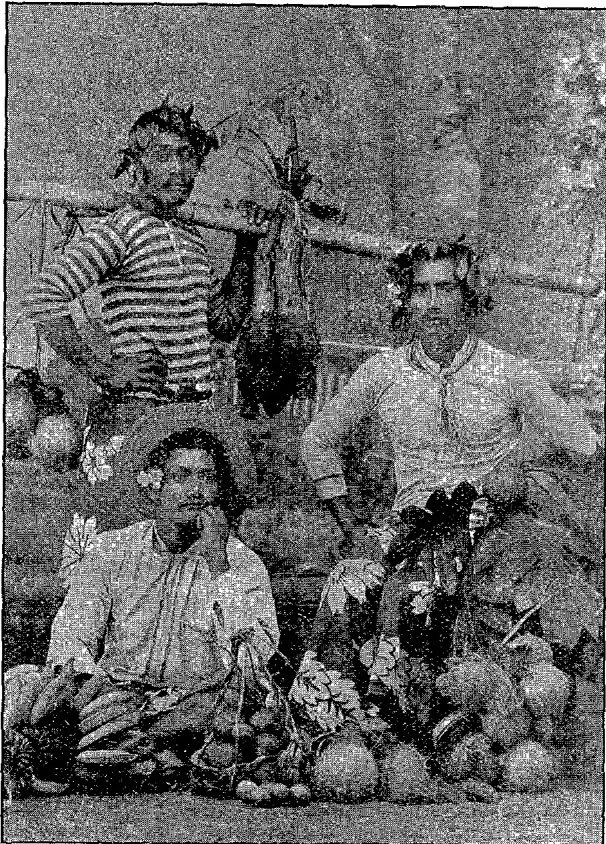
MEN AND PRODUCTS OF TAHITI.
All the most common tropical fruits and vegetables grow here. Oranges, bananas, and pineapples are sometimes shipped to New Zealand, as there is a regular steamer line between there and Tahiti. Limes, mangoes, guavas, alligator pears custard apples, mummy-apples, and rose-apples are found here, also the breadfruit, though that is more like a vegetable than a fruit. We occasionally find a grape-vine, planted by some white man, and grapes do very well here, though they are seldom cultivated. Yams, taro, sweet potatoes, and the plantain, or wild banana, are the most common vegetables. Irish potatoes do not thrive here, but are shipped in, and sold by the pound at a high price. We have melons, and corn grows well in this climate, though it is too warm for wheat and other grains. Some green garden vegetables, such as onions, leeks, cucumbers, lettuce, string-beans, etc., are cultivated by the Chinese; but much labor is required in their cultivation, so the natives never try to grow them.
Sugar-cane seems to be right at home in this climate. There are several mills in Tahiti which make molasses, brown sugar, and also rum. Formerly, cotton was extensively raised, but the price of cotton is so low now that even that which grows of itself is not always gathered. A large amount of flour is shipped in from California and New Zealand, and the bakers, who are mostly Chinese, find that making and selling bread is a very profitable business. Nearly all white families buy their bread, and a woman who makes bread for her own family can rarely be found. When the natives have the money, they buy bread, and many use it every day.
There are many Chinese here in Tahiti, and their energy and thrift are quite a contrast to the slow, inactive lives of the natives. They have many stores in Papeete, and as the natives think that they sell goods cheaper than the white merchants do, they give them most of their patronage. There are but few white people in the other islands, and at Tahiti most of the white people are in or near Papeete. The French people are largely government employees, but few of them being engaged in any business enterprise. The business men are nearly all of other nationalities.
The current coin is Chilean, a dollar of which is worth only about half as much as an American dollar. French money is used for government purposes, but is not so common as Chilean. We have to pay more for clothing here than in the United States; but as cotton clothing is mostly worn, and not much is required in this warm climate, one can clothe himself well at less expense than in the States. All groceries are also more expensive here; for they must be shipped in from some other country. If a person is situated so that he can raise his own fruit and vegetables, he can live at much less cost than where he has to buy these foods. The native vegetables and fruits are raised with but little labor.
PIE-PLANT—IS IT HARMFUL?
By D. A. Fitch
BY MRS. D. A. FITCH.
(Battle Creek College.)
In answer to several inquiries concerning the properties of this very commonly used article, I would say that science as well as the experience of many persons, teaches us that it is not the harmless thing we once supposed it to be. With this, as with many acid fruits, the fact that so much sugar is required to render it palatable is a serious objection. There are, however, other reasons why pie plant should not be much used. It contains malic, oxalic, and tannic acids. Study encyclopedias, and you will find the authority for this statement, and if you do not there find the effect of these deleterious substances when taken into the system, you will find it in medical works or from honest, well-informed physicians.
No doubt the use of pie-plant is the cause, either direct or remote, of many stomach and bowel disorders.
Some acids are prejudicial to starch digestion, and since so much of our food is comprised of starchy substances, it might be well to observe from cause to effect, seeking to use those articles which will best build up and carry on the functions of the body.