O happy house! where thou art loved the best,
Dear Friend and Saviour of our race,
Where never comes such welcome, honored Guest,
Where none can ever fill thy place.
O happy house! where thou art not forgot
When joy is flowing full and free;
O happy house! where every wound is brought,
Physician, Comforter, to thee.
Until at last, earth's day's work ended,
All meet thee in that home above,
From whence thou camest, where thou hast ascended,
Thy heaven of glory and of love.
— Karl J. P. Spitta.
Dependable Young Folks
“You needn’t worry a mite,” said Mrs. ——, when her niece fretted for fear the boy she had engaged to take a parcel to the five-o’clock train would be late. “John is a dependable boy, and he’ll be here.”
“But boys of thirteen are so heedless,” lamented the young woman. “I wish I had found some one more reliable.”
But the words were scarcely out of her mouth when the boy arrived, and the parcel was delivered in time. “I always keep my word,” he said, in answer to her many cautions. “Of course, I might fall and break a limb, but you need not worry at all.”
I really do not know where boys and girls just entering their teens received the reputation for being wholly untrustworthy. Some of the best, and brightest, and most trustworthy boys and girls I know, are hovering around that age, but still I hear people say you can’t put dependence in them.
Just a few weeks ago a girl gave up a chance to go to a picnic, in order to stay at home and take care of the baby, because her mother had a headache. Does that look like heedlessness? And only last year a boy of fourteen sat with his hand under the spout of a gasoline can holding it shut till his mother reached home. He was stiff, as well as cramped and tired, but he was afraid to let go. No one was near, and if the oil had escaped, it would have set fire to the building, for a wood fire was playing in the shed, and by accident a big lad broke the spout to the heavy can. He ran away in fear, but the plucky little lad held on and saved the house from destruction.
“If you are anything in the world,” a mother used to say to her boys and girls, “be reliable. Be sure that people can depend upon you, and you can not fail in life. And above all things, be faithful in the little things.”
And do you know the little things are the hard ones? If we do them well, we may rest assured that when the big ones come, we shall know all about managing them. A boy who longs to dash into a burning building and rescue a child from death, almost shed tears when his mother asked him to weed the onion bed last week. You see dashing into the building would take only a few minutes, and he feels sure he would get out all right, but it takes pluck to work faithfully when the sun is doing its best to scorch his back.
But the boys and girls who can be depended upon now are the ones who will be the successful men and women by and by.—Selected.
I Can Take Care of Myself
THIS is the favorite answer of the heady, high-minded, and reckless, who propose to disregard good counsel and follow the devices of their own hearts. A young man, when warned against strong drink, says, “I am able to take care of myself.” But it is frequently the case that before the end of his career, he needs two or three policemen, a number of sheriffs, constables, lawyers, judges, jailers, turnkeys, and sometimes a hangman, to take care of him. He is by no means as independent as he supposes.
A girl says, “I can take care of myself.” She goes from her quiet home, plunges into the whirl of some great city, spends everything she can earn for vanity and folly, perhaps starves in a garret or dies of consumption, when she might, in her quiet country home, have lived a happy and useful woman, a blessing in the world, and blessed and honored by all around her.
“I can take care of myself,” says a business man, when, riding on the tide of prosperity, he oppresses the poor and needy; but by and by financial troubles come, and he finds himself straightened and borne down into the whirlpool of bankruptcy and disaster, and all his bravado is gone.
“No man liveth to himself.”
Neither men nor women are able to defy their fellows, or to reject the friendship or disregard the sympathies of their kind. We all of us need something with which we can not supply ourselves. We are dependent on others for a thousand friendly offices, and it is well for us to acknowledge our dependency, and also to listen to the counsels of those who advise us for our good. “Pride goeth before destruction, and a haughty spirit before a fall.” He who claims that he can take care of himself is very likely to be poorly cared for, and to require much more assistance than those who are less self-confident, and more willing to accept the counsel of their friends.—The Christian.
German East Africa
By A. C. Enns
A. C. ENNS
We left Kisumu the last of May, Brother Raessler and I, to find an opening for a new field of labor. We arrived at Shirati the next day, but found that all the country next to Shirati is infested with the sleeping-sickness plague. Several sanitary officials have themselves been infected, and two British physicians have died this year of it. The German authorities have been working ever since it appeared, but as yet have been unsuccessful in their efforts to stop the plague. A certain district has been placed under quarantine by the government. The fly (glosina palpalis) which carries the disease is found in a certain marsh tree which grows in the water only.
BROTHER ENNS AND HIS MUGANDA LANGUAGE TEACHER
But as we were anxious to get a station as near to the lake as possible, to make transportation cheaper, we decided to take the country south of the Mara River, which is healthful, except for malaria. By shutting out the mosquito at night, so avoiding infection, this disease can be almost entirely avoided.
The next day, June 2, we took a small sailboat and went to Nyanangi, south of the Mara River. The small boat costs only five dollars, or single loads of one hundred fifty pounds, twenty cents. We made an eight-day march, looking over the country. We found two excellent sites, one in Majita, near Bukerewe Island, on the mainland, and one in Buzanaki. On the latter site we decided to build. As Majita will naturally be the center, or head station, later, I decided first to help Brother Raessler to get started.
We have finished building a primitive schoolhouse, forty-five by forty-five feet; in one end of which I have my room, and in the other the school. Brother and Sister Raessler live in a straw hut. We now have half the sun-dried brick ready. The roof we expect to cover with corrugated iron.
Since arriving at “Bursegwe,” which name we have adopted for our mission station, we have had some interesting experiences. First the chief’s sons came with a drill as soldiers that is known only in the German army. They presented front, and in a chorus said, “Tamekuja Bwana Mwalim” (We’ve come, Mr. Missionary). “Well, what is it you want, my sons?” I said. “We want to learn to read, during which time we want to live with you.” “Well, but you can not appear before me again naked [all were entirely nude], nor so dirty.” After a moment of quiet, as they evidently were struck with my firmness, they began to get uneasy. Finally they took breath and asked: “But what shall we do? We have no clothes. Shall we wear skins of goats?” “No, indeed! don’t appear in goat-skins. Buy clothes, and keep yourselves clean.” “But we are too small to hoe and plant our own fields, so we can sell peanuts and buy clothes. And mother’s field is not enough to eat and sell also.” “All right, I am building a school, for which I shall have need of
thatch and sticks. You may work for me until my school is finished, which will be enough to pay for your clothes” (consisting of a white jacket, and a piece of American cloth to tie about the loins). “But how many days will we have to work?” “Twelve days, if you work all day fast.” “Ndie Bwana Mwalim” (Yes, Mr. Missionary), was the answer in a chorus, and with considerable satisfaction off went the whole squad, keeping step as well as they could, which was not faultless.
The next day not only the chief’s sons, but also about thirty others came, asking whether they might now start work. They carried thatch, while the grown people built the grass hut and the school. From day to day the number increased. The girls also began to come, and we soon had quite an army of little folks at work. In two weeks we finished our grass hut, my schoolhouse, and one hut for my personal boys (the one who does the cooking, the wood and water carrier, and the one who looks after my room and does the washing and ironing and dish washing), and also a kitchen for Brother and Sister Raessler.
When all was finished, I had to leave for Shirati, to make arrangements concerning the land for the mission station, and to buy provisions, and also to get all the tools for the expedition out of the customs, consisting of about one hundred fifty loads of eighty pounds each, in boxes. Brother Raessler went to meet Sister Raessler, who was planning13to arrive in Shirati by June 26. I had told the children that I would bring the clothes with me when I returned.
In the evening I could hear their conversation, which invariably was about my return and the clothes I would bring with me. ‘The Bwana Mwalim will bring each of us clothes. I wonder if they will be large or white. What will we wash them with?’ ‘O,’ said one, ‘they must be washed with soap and water.’ ‘Yes, but where will you get it from?’ ‘And then we shall learn to read and write, and to make doors and windows,’ said another, ‘and do blacksmithing,’ ‘and to sew our own clothes, and to read the Word of God, and to pray. O, there are so many things, and such peculiar-shaped instruments, how nice they all are made! O, the Warunga [Europeans], how they can make everything, and all this they want to teach us! Shall we be able to learn all this?’
It is inspiring to listen to the harmless, childish talk. Indeed, if we will not turn and become as little children, we can in no wise enter the kingdom of heaven. How beautiful are the feet of those preaching peace and salvation! and how beautiful is the work of preaching peace, knowing that the present constantly increasing spirit of strife will soon be over, and eternal peace reign supreme.
When we returned to the station, it was dark; so after the boxes had been placed under cover, all had to go to bed, after we had evening worship. The next morning all were to appear, the grown people for work and the children for school. At eight o’clock school began with fifty children present, fifteen girls and thirty-five boys, ranging all the way from eight to eighteen years of age. The number constantly increased, until now I have about eighty, all from the one district, Bursegwe. There are about eight districts with independent chiefs, most of which are larger than Bursegwe, which can easily be worked from this station, under one or two European workers, by starting out-schools in all these districts. Then there are eleven tribes, each having a different dialect, which would have to have mission stations of their own.
Our mission, Bursegwe, consists of the territory east of Lake Victoria and south of the Mara River, with twelve tribes, having a population of about one hundred twenty-five thousand. I expect that either Majita, or one of the missions in Ururi, will eventually have to be the center. Each will be a center for part of the stations in the inland back of them. We can figure on two stations in Ururi, next to the lake shore, taking their water-supply directly from the lake, and one in Majita, also next to the lake. These will always be accessible by sailboats. Perhaps we shall be able later to procure one of our own. A medium-sized one costs about four or five hundred dollars, but I think by chance one could be secured for a little over half that amount. One would pay for itself in one season, carrying peanuts to Shirati. A boat takes about one hundred loads at seventeen cents each. The trip can be made in a day and a night. During the season these boats go continually. Then we would save all our own transportation expenses from Shirati to the mission, such as carrying cotton, which we expect to raise in order to cover at least part of the running expenses of the mission. Cotton does very well here, and the government is giving us sufficient land to cultivate, so that we are in the most favorable circumstances to be able to start several stations with less means than we otherwise could.
I have finished preparing a tract in Muganda on the Sabbath, and another on the second coming of Christ, which will be sent to Hamburg to be printed. These will come out, I hope, the last of the year.
Bursegwe, Post Shirati.
Two Ways of Praying
“THERE are two ways of praying. One prays to get what he wants, and the other to know what God wants him to get.”
A Warning Against Immodest Fashions
THE Osservatore Romano, the newspaper organ of the Vatican, utters a timely and vigorous criticism of prevailing fashions in woman's dress. It says: “All the present-day fashions are designed to excite the passions. They are the shipwreck of virtue. Cleanse these unholy wardrobes. Rid them of their dresses which make the wearer's guardian angels weep. Let your wives and daughters make their own clothes rather than wear dresses which grieve the Holy Spirit and the Father of Truth.” Who will say there is no need of such condemnation and warning?—The United Presbyterian.
A Canvassing Trip in the Philippines
By R. A. Caldwell
R. A. CALDWELL
HERETOFORE my country trips have been limited to towns easily accessible to Manila. This time I planned to go almost to the terminus of the railroad, which is, however, no great distance. Moreover, I made a detour which brought me in touch with a number of towns some distance from the railroad. This side trip took me over eighty miles or more of roadway. When seeking a place to stay overnight, I usually tried to reach a town that had an American teacher. These towns are poor and small. Even the municipal buildings in some places are incomplete, and the market-places frequently resemble a group of pig-pens. It was in these towns that cholera found many victims last year. The larger towns near the line have lately been provided with good drinking water by the means of artesian wells. Many of the towns have a few Protestants, and in several ways Catholicism has lost many of its members.
One Sabbath I had several talks with school-teachers, and read to them from the Bible about Christ’s return to the earth; I also read the commandments, with which they were very unfamiliar. The same day I saw two funerals of little babies. Infant mortality is very great. No coffin was brought into requisition, not because of poverty, I understand; for a priest had been engaged to march in one of the processions, at a cost of ten dollars; but because in these isolated places it is the custom. The little things were carried on a small chair, and were gaily dressed, and so were in harmony with the women and children mourners, and the noisy band. The older people were unceremoniously wrapped in a mat, which in some cases is reserved for further use.
Some of the experiences of this country trip were quite unique. It was instructive in many ways. These people are ignorant to a greater extent than the city people. The country where I went is near the Igarotte tribe, and I noticed a number of men leading a string of dogs on their way to the hills. These creatures are bought from the possessor for a quarter, and sold to the consumer for a dollar or more.
One stage of the trip was over a road that was impassable to the ordinary passenger vehicle. A springless conveyance of two cumbersome wooden wheels, with bamboo body and light palm covering, is not the most comfortable carriage. I greatly admired the little Indian ox with its sleek sides and pretty head, especially when passing bravely through difficult places. Many times the water was over the wheel tops, and of course over the bottom of the cart. On such occasions I had to carry my hand baggage on side tracks of higher elevation. It was a slow journey, though at times we had good roads and made good progress. I reached the town before Sabbath, and had a good rest. On Sunday I canvassed the few families who could read Spanish. While here, I met a young Spaniard who obtained “Desire of Ages” in Singapore four years ago, and well remembered me. At this place no vehicle could be obtained, so I hired a pony, and started out at 4 P. M. for the next town, a distance of about eight miles. When half-way, it began to rain, in no half measure either, so I arrived at the teacher’s house at dark in a sorry plight, and my grip, which was to arrive by the carrier who was to take the pony back, did not show up until late the next morning; hence I had to accept my host’s hospitality in more ways than one.
This tour occupied almost three weeks. The expense item was very heavy, but as the number of orders totaled two hundred thirty-four dollars, it was quite satisfactory, with such a book as “Patriarchs and Prophets.”
Just here I wish to say that I have been impressed as never before that this work is God given. For a canvasser to have much success in a language with which he is entirely ignorant, and among strange people, clearly shows—which should encourage the young and inexperienced worker—that the success of the work depends not upon the ability of the canvasser, but upon the Lord, and like his grace and mercy, is inexhaustible.
Christian University Planned in West China
The American Baptists, the Friends of Great Britain, the Methodist Church of Canada, and the Methodist Episcopal Church are said to be uniting in an effort to erect at Chentu, in the province of Szechuan, West China, a great Christian university. Colleges are to be maintained by the different denominations mentioned above, to act as feeders for the university, which is to be a joint affair.
Christ’s Life-Giving Sunshine
By Rev. Henry W. Little
WE can close out the sunshine from our homes by blocking up the windows. The sun shines all the same. So we can also refuse to admit the sweet, life-giving sunshine of Christ’s presence and sunshine into our lives, but he shines forth, the light and joy of souls, all the same.—Rev. Henry W. Little.
British New Guinea
By S. W. CARR
S. W. CARR
While staying recently at a plantation about one hundred fifty miles east of Port Moresby, I had the opportunity of visiting several villages in a lakatoi. The Papuan lakatoi consists of two or more canoes lashed together and boarded over. The sail is large and peculiarly shaped, and is made of native mats; all ropes are native made, and seem to be as strong as the machine-made article, and similar to it.
TREE HOUSE IN BRITISH NEW GUINEA
Sometimes one end of the boat is the bow, sometimes the other, and at each tack the large flat piece of wood, about seven feet long and eighteen inches wide, which acts as the rudder, is dragged to the stern, and there secured and manipulated with a pole by the steersman. After a few hours' sail in this strange craft, we ran up a small river to a native village to purchase food. The village was new, and consisted of seven houses grouped around the eighth, which was the largest of all.
This was the dubu, or men's house, and no woman is ever allowed to enter. Here, too, the lads of the village are initiated according to native custom into manhood, and remain there for from three to twelve months without being allowed to see any woman during that time. In the semi-darkness of this building, I soon had a number gathered, and with the aid of an interpreter was able to tell them the old, old story of the cross. With what interest they listened as the story was told in Motuan and interpreted into their dialect! How strange it all seemed to them — God in heaven, his Son sent to earth as a little child, his life of good words and works, his cruel death, his resurrection and ascension, and the promise of his soon return! Exclamations of wonder escaped their lips, especially when the resurrection was mentioned. How could such a thing be possible? All knelt in prayer to hear from the lips of the misineri a fervent petition for a Father's blessing upon the words spoken in weakness, and that the darkened minds of the hearers should not long remain in heathen ignorance.
The day following, the same story was told to a gathering on the beach near another village, and was listened to with the same interest.
One's heart goes out to them in their darkness and ignorance. There is no missionary, white or black, along seventy miles of coast, and none inland. Apparently this was the first time that any of those present had heard the gospel. The life of government also dominates, has not yet full control, for during our stay in Dedele to
The Christian’s Experience
By G. Campbell Morgan
TEMPTATION is a common experience of man. The Christian man is more keenly conscious of its power than the man of the world. It often happens that in the experience of the soul newly yielded to Christ this fact causes great perplexity; and it may be well, by way of introduction, to say one or two words concerning it.
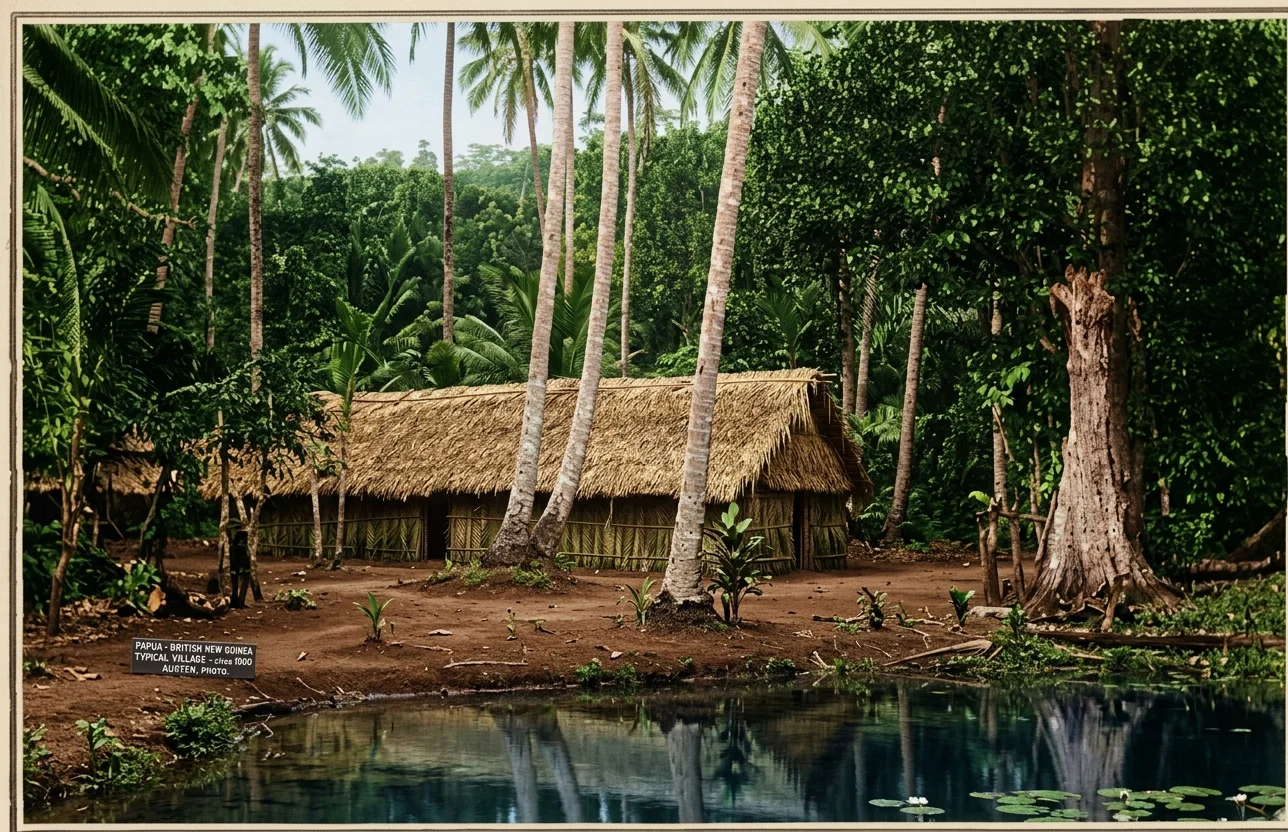
A TYPICAL VILLAGE, PAPUA, BRITISH NEW GUINEA
Why is it, the young Christian, especially, often inquires, that since I yielded my life to Christ, I have been more tempted than ever? The explanation always lies in the very fact of that surrender. Directly the human soul ranges itself on the side of Christ, it becomes peculiarly the object of enmity on the part of Satan and his emissaries. The devil is ever busy attempting to spoil God’s fairest work, and to prevent the perfecting of the life received in the mystery of the new birth.
Another reason arises out of the very nature of the Christian life. With the new life there has come a new consciousness of evil, and a new sensitiveness in its presence. Temptation which came yesterday, but was hardly appreciated, comes again to-day, and it is felt in all its force. It is well to remember this. The holier a man is, the more acutely conscious he is of temptation. The stronger a man is in all his moral fiber, the more does temptation appeal to him. It is not the weak man who feels the real force of temptation, for he yields resistlessly to it. It is not the impure man who suffers under temptation, for his moral fibers are no longer sensitive, and the suggestion of evil brings no pain. But the man in whom there has begun to move and thrill the pure, strong life of Christ, the man whose spirit is dominated by the Holy Spirit, he it is who feels the full force and pain of temptation. That thing was temptation to me yesterday, ere I had met the Christ; but there was no pain in it, no strain, no tug, only a willing yielding. But when I yielded myself to him, a new force came into my life, ennobling and purifying, and when temptation comes, there is now resistance; my consciousness of it is keener, not only because the enemy is more earnest in his attack, but because my sensibility is greater. Let me say to the young child of God who is troubled by temptation: Take heart. Be of good courage. The man held fast in the grip of vice knows nothing of the pain of temptation. Take heart, and know that your sensitiveness to temptation is sure evidence of the new life, the new purity and power working dynamically through your personality.—Rev. G. Campbell Morgan.
Courage in Religious Work
It takes courage to maintain our religious work and faith. Our work in the church and out of it is often so burdened with discouragements that it takes the heart out of us, and we feel like giving up the struggle. To be patient and persevering in these circumstances, to keep our temper cool and our zeal warm, to work with unreasonable men and yet be reasonable ourselves, this tries one's soul as surely as the opposition of open and armed enemies. And yet we must at times contend earnestly for our faith itself. Open infidelity is not so dangerous an enemy to our faith as the subtle pessimistic spirit of the world that may envelop us in a gray mist of doubt and discouragement.—Western Recorder.
Volunteers Wanted
“VOLUNTEERS are wanted on the battle plain,
Soldiers brave are falling ne’er to fight again.
Who will take their places in the deadly fray?
Who will march with Jesus to the front to-day?”
The Campaign Program
By A. J. S. B.
THE special second Sabbath program of October 9 is now in the past. The next item on the program is the special preparatory meeting to be held in each church Sunday, October 31, for the purpose of assigning territory to the16members, drilling them on the REVIEW canvass, and giving other necessary instruction.
Campaign week opens November 1. On that Monday morning let all able-bodied Seventh-day Adventists take a good-sized bundle of the REVIEW and start out, bright and early, to visit the neighbors, friends, and townspeople in their assigned territory, leaving a copy of the Missions REVIEW with each family, and soliciting liberal donations for our foreign missions.
On Tuesday, Wednesday, Thursday, and Friday following, let the good work be continued, each member putting in at least a second full day's work for foreign missions. On these four days let all unfinished or abandoned territory be thoroughly canvassed.
Finally as a fitting conclusion of the week's effort, the General Conference Committee recommends that on Sabbath, November 6, a missionary rally be held in each church, opportunity being given to the workers to relate their interesting experiences. This will doubtless prove to be the best Sabbath service of the entire year.
If, in some churches, the special REVIEW and other campaign supplies do not arrive in time, it is recommended that such churches appoint one week later, or November 6-13, as their first campaign week, holding their special preparatory meeting Sunday, November 7, and proceeding the remainder of the week as previously outlined. A. J. S. B.
Statement of the 1908 Thanksgiving Fund to October 1, 1909