Pacific Press Publishing Company · New York · Mar 12, 1896
THE BIBLE, PROTESTANTISM, AND THE PAPACY.
The two distinguishing features of Protestantism are the supremacy of the word of God and the right of private judgment.
So closely connected are these principles that the latter is only the logical result of the former; for the word of God being the supreme tribunal, the church itself must be judged by it, and even the most humble of the people have the right of appeal to it.
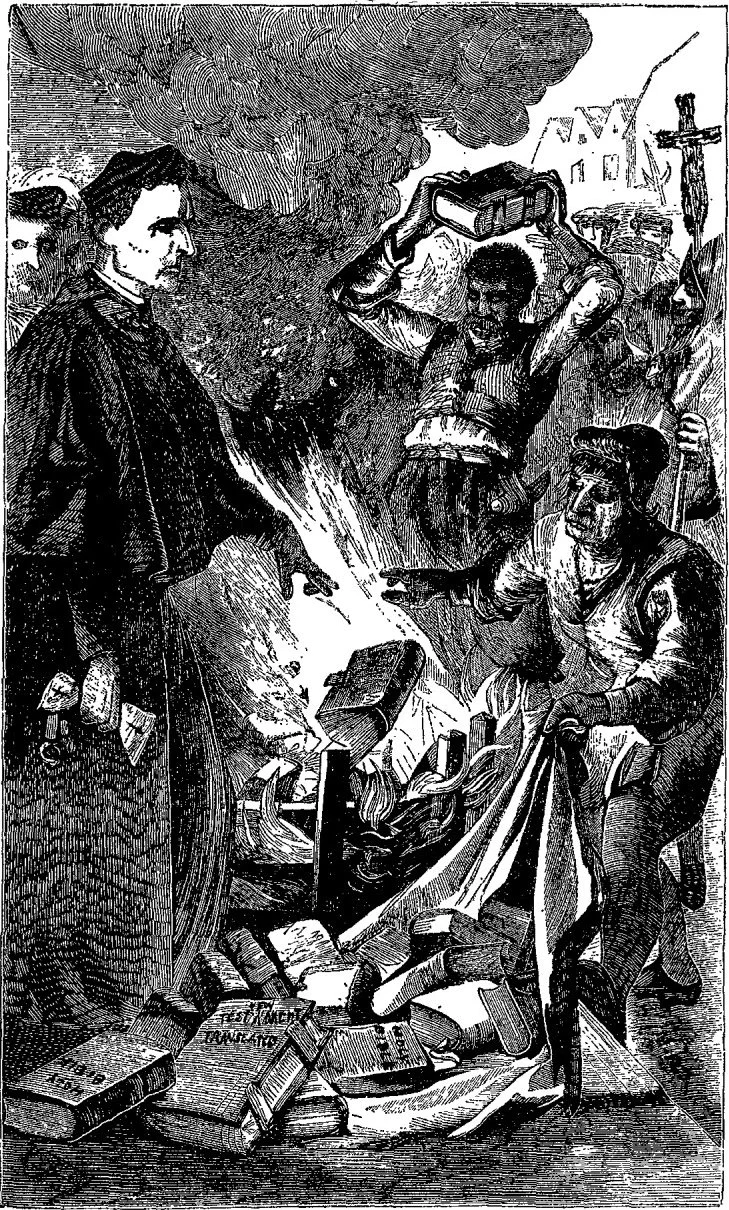
Archbishop Tonstall Burning Bibles in London, 1530.
“The Bible, I say, the Bible only,” writes Dowling, “is the religion of Protestants. Nor is it of any account in the estimation of the genuine Protestant how early a doctrine originated if it is not found in the Bible. . . . The consistent and true-hearted Protestant, standing upon this rock, ‘the Bible and the Bible only,’ can admit no doctrine upon the authority of tradition.”
In that grand protest from which springs the very name of Protestantism, the German princes, rejecting tradition together with papal and imperial authority in all spiritual matters, declared thus for the word of God: “Seeing . . . that this Holy Book is in all things necessary for the Christian, easy of understanding, and calculated to scatter the darkness: we are resolved, with the grace of God to maintain the pure and exclusive preaching of his only word, such as it is contained in the biblical books of the Old and New Testaments, without adding anything thereto that may be contrary to it. This word is the only truth; it is the sure rule of all doctrine and of all life, and can never fail or deceive us. He who builds on this foundation shall stand against all the powers of hell, whilst all the human vanities that are set up against it shall fall before the face of God.”
In this protest the Reformers assert not only the supremacy of the divine word, but the right of private judgment, for, “he who builds on this foundation shall stand.” This is as true of a single individual as of ten thousand, for no matter how large the number in the aggregate, every soul builds for himself, and must stand or fall for himself. “The soul that sinneth, it shall die. The son shall not bear the iniquity of the father, neither shall the father bear the iniquity of the son; the righteousness of the righteous shall be upon him, and the wickedness of the wicked shall be upon him.”
“The principles contained in this celebrated protest,” writes D’Aubigne, “constitute the very essence of Protestantism. Now this protest opposes two abuses of man in matters of faith: the first is the intrusion of the civil magistrate, and the second the arbitrary authority of the church. Instead of these abuses, Protestantism sets the power of conscience above the magistrate; and the authority of the word of God above the visible church. In the first place, it rejects the civil power in divine things, and says with the prophets and apostles: We must obey God rather than man. In presence of the crown of Charles the Fifth, it uplifts the crown of Jesus Christ. But it goes farther; it lays down the principle that all human teaching should be subordinate to the oracles of God.”
As the fundamental principles of Protestantism are the supremacy of the word of God and the right of private judgment, or what is the same thing, the right to have and exercise a conscience in matters of faith, so the distinguishing features of the Papacy are a denial of the sufficiency of the divine word and of the right of private judgment. In fact, both are bound up in one, for if, as the Papacy insists, the individual must take his faith from the church, he must accept his conscience, ready-made, from the same source. Obviously, whatever militates against this in the least degree, must be regarded by the Papacy as harmful; hence papal opposition to the reading of the Scriptures by the people.
That this opposition to the Scriptures is real and not imaginary is evident from the writings of Roman Catholics themselves. “It is not necessary,” says a standard Roman Catholic authority, “for all Christians to read the Bible. . . . Parts of the Bible are evidently unsuited to the very young or to the ignorant, and hence Clement XI. condemned the proposition that ‘the reading of Scriptures is for all.’”
“These principles are fixed and invariable, but the discipline of the church with regard to the reading of the Bible in the vulgar82tongue has varied with varying circumstances. In early times the Bible was read freely by the lay people, and the fathers constantly encouraged them to do so, although they also insist on the obscurity of the sacred text. . . . ‘Now dangers came in during the Middle Ages. When the heresy of the Albigenses arose there was a danger from corrupt translations, and also from the fact that the heretics tried to make the faithful judge the church by their own interpretation of the Bible. To meet these evils, the Councils of Toulouse (1229) and Tarragona (1234) forbade the laity to read the vernacular translations of the Bible.’”
“Pius IV. required the bishops to refuse lay persons leave to read even Catholic versions of Scripture unless their confessors or parish priests judged that such reading was likely to prove beneficial. During this century, Leo XII., Pius VIII., and Pius IX., have warned Catholics against the Protestant Bible societies.”
“The church,” says Cardinal Gibbons, “is the only divinely-constituted teacher of revelation.”
“Now the Scripture is the great depository of the word of God. Therefore, the church is the divinely-appointed custodian and interpreter of the Bible. For her office of infallible guide were superfluous, if each individual could interpret the Bible for himself.”
It appears from this, as before remarked, that the Roman Catholic Church opposes the reading of the Bible because it tends to develop independence of thought and action, and is in itself a negation of the claim that to “the church” is committed the faith and even the very consciences of all men.
It is true that the Papacy says, “A man is always bound to follow his conscience, even if false and erroneous. . . . Nor can any injunction of any authority, ecclesiastical or civil, make it lawful for a man to do that which his conscience unhesitatingly condemns as certainly wicked.” But this does not mean that the Roman Catholic Church recognizes the supremacy of the Scriptures or the right of private judgment.
Says Cardinal Gibbons: “The church is indeed intolerant in this sense, that she can not confound truth with error; nor can she admit that any man is conscientiously free to reject truth when its claims are convincingly brought home to his mind.”
And again the cardinal says: “A man enjoys religious liberty when he possesses the free right of worshiping God according to the dictates of a right conscience, and of practicing a form of religion most in accordance with his duties to God.”
As already seen, Rome, through her popes and councils, forbids her children to read even her own version of the Scriptures, except under such restrictions as forbid the right of private judgment. Our illustration shows how Rome prevented the reading of the Bible in London in the era of the Reformation. Tyndale had given England the New Testament in the language of the people, but Henry VIII., upon whom Leo X. had bestowed the title, “Defender of the Faith,” was bitterly opposed to the reading of the Scriptures.
“The bishops,” says D’Aubigne, “led the attack. ‘We must clear the Lord’s field of the thorns which choke it,’ said the archbishop of Canterbury to Convocation on the 29th of November, 1529; immediately after which the bishop of Bath read to his colleagues the list of books that he desired to have condemned. There were a number of works by Tyndale, Luther, Melancthon, Zwingle, Oecolampadius, Pomeranus, Brentius, Bucer, Jonas, Francis, Lambert, Fryth and Fish. The Bible in particular was set down. ‘It is impossible to translate the Scripture into English,’ said one of the prelates.—‘It is not lawful for the laity to read it in their mother tongue,’ said another.—‘If you tolerate the Bible,’ added a third, ‘you will make us all heretics.’”
In this matter “Rome had every reason,” remarks the historian, “to be satisfied with Henry VIII. Tonstall, who still kept under lock and key the Testaments purchased at Antwerp through Packington’s assistance, had them carried to St. Paul’s churchyard, where they were publicly burnt. The spectators retired shaking the head, and saying: ‘The teaching of the priests and of Scriptures must be in contradiction to each other, since the priests destroy them.’”
It was thus Rome opposed the Scriptures 366 years ago, and she uses the same tactics yet when she can. Only a few weeks since we printed in these columns the facts concerning the burning of forty-seven Bibles and fifty Testaments in Bahia, Brazil, no longer ago than last June by order of a Roman Catholic vicar. And everybody knows Rome’s undying hostility to the reading of the common version of the Scriptures everywhere. The Douay or Catholic version of the Scriptures is never printed without notes; thus even where Rome permits the reading of the Bible, she first injects into it the poison of tradition and the vagaries of the so-called Fathers of the Christian Church.
But as we said before, the opposition to the reading of the Bible comes not so much from enmity to the Scriptures themselves, as from the papal principle of the denial of the right of private judgment. It is of no avail for people to read a book which they cannot understand, and which they have no right to understand for themselves. It follows that to permit the reading of the Scriptures is to invite independence of thought and of action in matters of religion. The man who reads the inspired declaration, every man “shall give account of himself to God,” feels that he has an individual responsibility toward God which no other man can discharge for him; and reasoning is not necessary to convince him not only that he has the right of private judgment, but that it is his duty to exercise that right in the fear of God; but this Rome can never admit, for to admit it is to abdicate the throne of spiritual dominion which she has usurped, and to which she owes her power over the nations.
LETTING DOWN THE BARS.
[Bible Echo, Melbourne, Australia.]
THE demand on the part of many styling themselves Protestant, that the state should teach religion in its schools, opens the way for a counter demand from the Roman Catholics that the state should bear the expense of all the secular instruction given in their schools. And one demand is as consistent and can be urged with as much propriety and with as much force as the other. And this latter demand is being urged. A Catholic deputation, which waited on Lord Salisbury the first week in December, declared that Roman Catholics would never rest until the whole expense of the secular education of their schools was borne by the state. When Protestants begin to mix up secular and religious affairs, and demand the assistance of the state in teaching religion, they are letting down the bars, and they must not be surprised if others follow where they have led the way.
A WORLD-WIDE DIFFERENCE.
THERE is a world-wide difference, and much more than that, between man's law and the law of God.
This difference may not be apparent in the wording of the laws, as they are compared one with the other; but it is none the less real.
For example, the law of God says, “Thou shalt not kill,” and “Thou shalt not steal.” Man's law also specifically forbids killing and stealing. But man's law against murder, even though expressed in the exact language of the sixth commandment, is not God's law. It is not a reënactment of God's law. It falls as far short of that law, in its breadth and depth and purpose, as man falls short of God.
God's laws are not only prohibitions, but they are promises. With the command, God also gives power to perform it. Man could not possibly keep God's law by his own power; his very nature is contrary to it. “The carnal mind is enmity against God; for it is not subject to the law of God neither indeed can be.” God must supply the power necessary for the fulfillment of his law in man, if ever any man is to keep it. And he does this by the power of the life of Christ.
That plan and that power are set forth by the apostle Paul in the words, “I am crucified with Christ, nevertheless I live; yet not I, but Christ liveth in me; and the life which I now live in the flesh, I live by the faith of the Son of God, who loved me, and gave himself for me.” Gal. 2:20. Christ lives in the believer; his life is the life of Christ; and that life is now, as it ever has been, in perfect harmony with God's law.
Thus the law of God is not a measure of man's power towards God, but of God's power toward man. It is a promise of what God will do for every individual who will come unto him by faith. That law operates by God's own power, and not by the power of man.
In brief, the law of God commands love to God, and love to man. It requires us to love God with all the mind and strength, and our neighbor as ourself. But who can love by his own will? “God is love,” and “love is of God.” God must supply the power by putting love—which is putting himself—into man's heart.
God's law deals with the heart. An evil thought is a violation of his law. “The word of God is living, and powerful, and sharper than any two-edged sword, piercing even to the dividing asunder of soul and spirit, and of the joints and marrow, and is a discerner of the thoughts and intents of the heart.” Heb. 4:12.
Man's word—man's law—on the other hand, cannot rise above the level of man's own human power and wisdom.
Man can neither reënact nor enforce the law of God. God's law says, “Remember the Sabbath day to keep it holy.” Man also has83made a sabbath “law,” which commands the observance of the first day of the week. But it is with this law as with his laws against murder, theft, or adultery,—it is not the law of God. Yet in making it, man assumes to reënact and enforce the Sabbath law of God, since the Sabbath is an institution pertaining solely to man's relation to God.
It is proper that human laws should forbid murder, theft, adultery, etc., in order that men may live in the enjoyment of their natural rights. But of the Sabbath God says, “And hallow my Sabbaths; and they shall be a sign between me and you, that ye may know that I am the Lord.” Eze. 20: 20. The Sabbath being a sign between God and his people, it cannot properly pertain to any other relation than that between God and his people. It cannot pertain to the relations between human beings.
Since therefore man's word is infinitely below God's word, in power and wisdom and truth, and it is infinitely beyond man's power either to make a sabbath as God did or to reënact or enforce the law of God, and since the Sabbath is God's distinctive sign between himself and his people (because it points him out as the Creator and therefore the true God) man's sabbath law is nothing else than a most daring piece of presumption. And quite in keeping with its character as such is the fact that it contradicts the law of God by setting up the first day of the week instead of the seventh, as the Sabbath.
It ought therefore to be speedily removed from every civil code in which it has found a place.
FALSE STANDARDS OF RIGHTEOUSNESS.
Low standards of righteousness are a characteristic of the times in which we live. Speaking of this age, the Apostle Paul wrote to Timothy: “This know also, that in the last days perilous times shall come, for men shall be lovers of their own selves, covetous, boasters, proud; . . . having a form of godliness, but denying the power thereof.” 2 Tim. 3:1–5. The world is full of religious formalism and phariseeism, but there is little seen of the power of godliness.
Low standards of righteousness always pertain to religious formalism. And a low standard of righteousness is a false standard, just as formalism and phariseeism are false standards of religion. And because of these low standards of righteousness, which do not reach above the level of formalism, many people are deceiving themselves with the idea that the world is growing better.
In this country we hear much about “civic righteousness,” and we also see much that illustrates the meaning of the term. We also see an increasing effort being made, especially by the forces of the religious world, to set up this “righteousness” in the place of soul righteousness, and to lead people to put their trust in it. We see legislators being influenced to believe that by the manufacture of such “righteousness” they are making the people better, and saving the nation from divine wrath. All this is a dangerous delusion.
For example, we notice some comments of the New York Independent, of February 13, on some of the evils lately suppressed by law in this country, under the heading, “The Passing of Pugilism.” The statements of the Independent, besides carrying much influence in themselves, represent the ideas held by a prominent, if not a large, class of the American people.
“There is now,” says the Independent (italics ours), “no inch of soil in the United States where prize fighting can be legally carried on. Congress passed a bill last week, and the President promptly signed it, which makes it a crime in the District of Columbia, or in any Territory of the United States, or in any strip of country under Federal control, to hold a prize fight. This is a final victory for good morals and humanity over a species of entertainment that has come to rank with bull fights and other degrading sports.”
“The time was when the prize fights were considered a very choice kind of amusement for the general public. . . . But the public standard of morality is so much higher than it used to be that prize fighting has become as intolerable to the public conscience as dueling, the lottery, and other forms of vice. No clearer proof of this could be asked than the entirely successful efforts by the governor of Arkansas and the governor of Texas in preventing the threatened encounter last year.”
Now the simple truth is that the “public standard of morality” in the days of our ancestors when pugilism was not prohibited in this country, was not only as high as it is to-day, but much higher. Ask the white-haired survivors of those earlier times if there was then any such carnival of murder, riot, robbery, arson, lust, and general immorality as is heralded by the newspapers of our land to-day. They will answer, No. Ask them if the house of God was desecrated by church lotteries, fairs, theatricals, and ridiculous shows, as it is to-day, or if infidelity found utterance in the pulpit then as it does to-day? They will tell you, No.
As to recently-enacted laws against pugilism, it is almost too well known to need mentioning, that the actuating motive of such legislation was mere policy, and not a horror of the thing prohibited. Each State wishes to be considered as respectable in the public eye as any other State. One State does not wish another to say to her, What is not good enough for me is good enough for you. Even Mexico, while allowing and encouraging the bloody and brutal bull-fighting exhibitions, forbade the proposed pugilistic encounters as strictly as they were prohibited in the United States. The higher “public standard of morality” did not figure in the matter at all.
The Independent continues: “It is a good time to point out to those who think the world is going to the bad, . . . that they misread the signs. There is a whole series of indications going to show that the moral tide is rising instead of falling. There was a time when some of the people of this country looked with more or less tolerance on the slave trade. Within a generation millions of our citizens have defended slavery. . . . The slave trade in the world has been almost entirely broken up; all of the continents except one are practically free from slavery.”
It is true that there is now no place in our country where an individual of the negro race can be legally held in involuntary servitude; but alas, that form of slavery is not the only one by which it is possible for men to oppress their fellow-beings. There are multitudes of white slaves in our land to-day, made so by human rapacity, greed, lust, and conscienceless use of power. There are hundreds of thousands of unfortunates in the lower stratum of society as it exists in our great cities—not to mention the “submerged tenth”—condemned by human selfishness to a slavery as cruel and as hopeless and as real as any that this country ever knew. And while this state of things continues, and is growing worse, as it is to-day, it is useless to point to the abolition of negro slavery as evidence of a rising tide of public morality. Had it not been for the terrible convulsions of the body politic in the civil war, that feature of American life might not yet have been eliminated from our land.
“We have also,” continues the Independent, “banished the lottery. That was a form of iniquity which seemed to be deeply rooted in one of our States; but in one of the most brilliant contests ever waged against wrong by an aroused conscience, it was finally and forever defeated and banished from the soil of the United States.” The history of that contest is, however, very much like the history of the contest against pugilism. There is very good reason to believe that conscience had far less to do with the banishment of the evil than had the policy of conforming to the common standard of respectability.
We are further told that, “It is in the last decade that the Mormons have surrendered polygamy as an article of their faith and have promised henceforth to respect the conscience of the country. There will be an end to the abomination in form as well as in fact when men who have contracted such marriages have passed away, they having agreed meanwhile to be the husband of one wife only.”
This is again a most misleading fact in its bearing upon the question here considered. For of the three forms of polygamy known to society in this country, there can be little doubt that the one suppressed was less evil than the others. Open polygamy as formerly practiced in Utah has been prohibited; but secret polygamy, in which only one of the parties concerned is granted the name of wife and the privileges of that relation, is practiced in every part of the Union, and by a far greater number of people than were ever participants in the polygamy of the Mormons. This fact cannot be questioned; nor are our legislators themselves, many of them, guiltless upon this point.
The third form of this evil has been termed “consecutive polygamy,” and this has the sanction of our courts of law. It is seen where parties who have entered into the marriage relation, separate upon some one of the many slight grounds recognized by our courts as legally sufficient, and reënter the same relation with other parties. The fearful prevalence of this “consecutive polygamy” is a widely recognized fact, and one which has led to a strong agitation in our country for more stringent laws regulating marriage and divorce. And while it does prevail, as it does to-day, it is useless to point to the suppression of Mormon polygamy as a victory of public morality.
The Independent also refers to the victories recently gained in the fight against “gambling;” but here again we may be misled. For the worst form of gambling remains unsuppressed, in open and bold defiance of law and public sentiment. Gambling with dice and cards has been to some degree suppressed; but what has been done to suppress gambling in its higher and more “respectable” and more ruinous forms? We allow men to gamble with and “corner” the necessities of life, not only to their own ruin, but to the loss of millions of others, whom they plunge into poverty and suffering. And it is a serious question whether this may not lead ere long to a social revolution which will drench the land with blood.
It is a great mistake to imagine that immorality can be suppressed, or righteousness established, by human law. The seat of immorality, or of righteousness, is the heart; and that no human law can reach. We must, of course, have laws against those evils which84are destructive of human rights; and it lies within human power to enact and enforce laws which will protect the people in the enjoyment of their rights, to a great degree. But such laws do not make men moral, and are not designed for that purpose. They can create an outward appearance of morality, but the whited sepulchres to which the Saviour likened the Pharisees, had a good outward appearance. The Pharisees were very moral in outward appearance.
When men mistake the outward appearance of morality for the thing itself, they are in a position to become the victims of the worst deceptions, and to commit the gravest errors of legislation from which mankind has ever suffered.
SUNDAY AND THE SALOON.
A SMALL pamphlet, entitled, “Summing up Against the Sunday Saloon,” has been “written for the Church Temperance Society,” by “Col. B. F. Watson, Chairman of the Legislative Committee.” We have been favored with a copy of this pamphlet, and find in it statements which call for notice in the columns of the SENTINEL.
The author divides his subject into a number of topics, under the general heading of “ ‘Local Option’ as to the Enforcement of the Ten Commandments in ‘Cities of the First Class.’ ” At the outset he notices the fact that a bill was recently introduced into the New York Legislature, entitled, “An Act to provide for submitting to the electors in cities of the first class, the question, Shall spirituous liquors, wines, ale, and beer, be sold on Sunday between the hours of 1 P. M. and 10 P. M.?” He then begins his attack by saying, “The majority of those voting in a first-class city is empowered by this bill to decide for the State, that such city may desecrate Sunday by publicly carrying on the most offensive and dangerous traffic in the list; that such city’s vote may suspend from operation, within its limits, a State law by which the entire State outside of its limits is fast bound. In effect, this would enable a favored locality through its own option to secure not only the monopoly of desecrating the ‘Lord’s day,’ but the unconstitutional monopoly of selling spirituous liquors seven days in the week while the rest of the State is restricted to six days.”
This much is sufficient to show the standpoint from which the pamphlet is written. The author argues for legislation against the Sunday saloon, to prevent “desecration” of the “Lord’s day;” in other words, he wants irreligion put down by the civil law,—which means that the majority shall suppress by law everything that may be contrary to their religion. As already noticed, he states the issue as being “local option as to the enforcement of the ten commandments in cities of the first class,” although, as shown elsewhere in this week’s SENTINEL, the law of God cannot be enforced by human power.. Nor is it proposed by any class of citizens to vote on a question of local option in such a matter.
Coming to the second division of his subject, the author says, “The issue is, Shall divine commands be defied and the policy of the Republic reversed?” Bearing in mind that the question under consideration is wholly one of the enactment and enforcement of a civil law, it is evident that the real issue raised is, Shall religious observances be enforced by civil law and the policy of the Republic reversed by any scheme which aims to compel people in things pertaining to religion.
Under this topic the author notices the fact that “surrender to the saloon is not only capitulating to a notorious law-breaker, but is also a craven attempt to propitiate a traffic whose fruits, gathered during only six days of the week, are fully three-fourths of all the crime and pauperism which pile up our taxes, which endanger and pollute our streets, and by which the hearts of helpless mothers and wives are wrung.” And this being so, as it unquestionably is, how can Christian men and women be willing to surrender to the saloon by legalizing it on six days of the week? For the Sunday prohibitory law sanctions two things: it sanctions Sunday as a day different in character from other days of the week; and it sanctions the saloon, by giving its traffic legal protection during six days of the week.
Legal Sanction for a Law-breaker.
Think of it! “a notorious law-breaker” given legal protection in his business six days in every week! “A traffic whose fruits, gathered during only six days of the week, are fully three-fourths of all the crime and pauperism which pile up our taxes, which endanger and pollute our streets, and by which the hearts of helpless mothers are wrung,” is given legal sanction for six days in every week! Why is not this “notorious law-breaker” outlawed and shut up like other law-breakers? Or if not shut up, why at least should it be recognized and its nefarious business sanctioned, during six-sevenths of each week? This murderous thing is recognized and sanctioned and clothed with respectability as a law-abiding institution, in order that special recognition may be given to Sunday as a sacred day! For were it not for the supposed sanctity of Sunday as the divinely-appointed rest day, it would never have been proposed to legalize the saloon by a Sunday “law.” And there is no other visible source from which legal sanction for the saloon could be derived, with the support of the best classes of American citizens.
In other words, but for this desire to legalize Sunday on the part of so many well-meaning but mistaken citizens, who largely constitute the class from which alone real opposition to the saloon can be derived, this death-dealing institution would be left like other institutions, to stand upon its own merits; and having no merits of its own, its eventual fall would be a matter of reasonable hope. The opposition of the better class of citizens would not have a ground of compromise upon which they cease to wage the battle, leaving the saloon to emerge victorious from its fight for life, invested with a borrowed respectability as a Sunday-observing and law-abiding institution.
The people are now saying to the saloon, You may exist and go on with your business, if you will keep Sunday. And this is just what will be said erelong to the people themselves.
The author of “Summing Up” goes on to say that “saloon opening abolishes the sacred Sunday”—not a very stable institution, surely, if it can be abolished thus easily. It is not so with God’s Sabbath, for though heaven and earth should pass away, God’s word and his sacred institutions which rest upon it would still stand fast.
Scripture and Reason against Sunday.
He then takes up the question, “Is Sunday hallowed by divine authority?” After stating the position of those who contend for the observance of the seventh day, he says: “On the other hand, the contention of Christians generally has always been that it nowhere appears that the Sabbath day of the fourth commandment, or prior to it, was the seventh day of the week, as time is now divided; that the essence of the commandment is, that after six days’ work, the next, the seventh, should be sacred as a day of rest, because God himself hallowed such a day or period of rest, by himself resting thereon after the six days of creation.” But can any person tell how God’s rest day could have been any other than the seventh day of the week when it was his division of time into periods of seven days, at the close of creation, that made the week? For the week originated in no other way than by the act of the Creator in instituting the Sabbath, after having worked six days in making the heavens and the earth.
Again, who does not see that hopeless confusion would result from a practical application of this “seventh-part-of-time” theory, each man resting whenever he might choose after seven days of labor. In such a state of things there would be as many sabbaths as there were days in the week; and thus God’s commandment would defeat itself, since the whole idea of the Sabbath is that the day is set apart—“sanctified”—from other days. Who will dare charge God with being the author of confusion, and with giving a commandment which annuls itself? If man finds it necessary to have one day of rest for all alike, did not the Omniscient see that necessity when he gave the Sabbath to mankind? Is it left for man to correct an error on the part of the Almighty!
But—stranger yet if possible—our author proceeds to say that “the fourth commandment, in this sense, adopts Sunday”! In the sense of not commanding the observance of a particular day, but only of one day in seven, the commandment adopts Sunday! A profound statement, truly, upon which comment would be superfluous.
An Unsound Maxim.
In the third division of the subject the author asserts that “whether Sunday is or is not sacred by divine authority, it is decreed by immemorial law.” But can the “immemorial law” of man set aside the eternal law of the Creator? He cites the fact that “aside from the question whether or not Sunday supersedes the Sabbath, or shares with it divine sanction, it is, as a day of rest and worship, invested with the sanction of human law from the time of the first Christian emperor Constantine to the present,” and adds, “To this general proposition, then, to this universal custom eighteen hundred years old, reënforced by that imperative law of nature which demands stated periods of rest from labor, . . . the stubborn soul must submit, and may do so gracefully by adopting as its own the maxim, ‘Vox populi, vox Dei.’”
Not only is this the “graceful” way of acquiescing in such a thing, but it is the only way; for the only support the Sunday institution has, is the idea that “the voice of the people is the voice of God.” But this “maxim” is most untrue. “Let God be true, but every man a liar.” Rom. 3:4. When the Saviour rode into Jerusalem, the voice of the people said, “Hosanna to the Son of David!” but less than one week later, in the same city, the voice of the people said, “Crucify him!” This illustration reveals the exact amount of truth that this maxim contains.
This suffices to show the nature of this new weapon added to the Sunday armory, and the amount of dependence that can be placed upon it. It is like all the rest that have been85manufactured for the Sunday cause. The “Church Temperance Society” will certainly fail in its mission if it fights the battles of its warfare with the boomerangs of error. Let the temperance forces insist upon the outlawing of the saloon, as the nature of its business demands.