The Youth’s Instructor, Vol. 37, No. 26.

SHEPHERD LIFE

The Youth’s Instructor

Jun 26, 1889

S. D. A. Publishing Association · Battle Creek, Mich. · Jun 26, 1889

SHEPHERD LIFE.
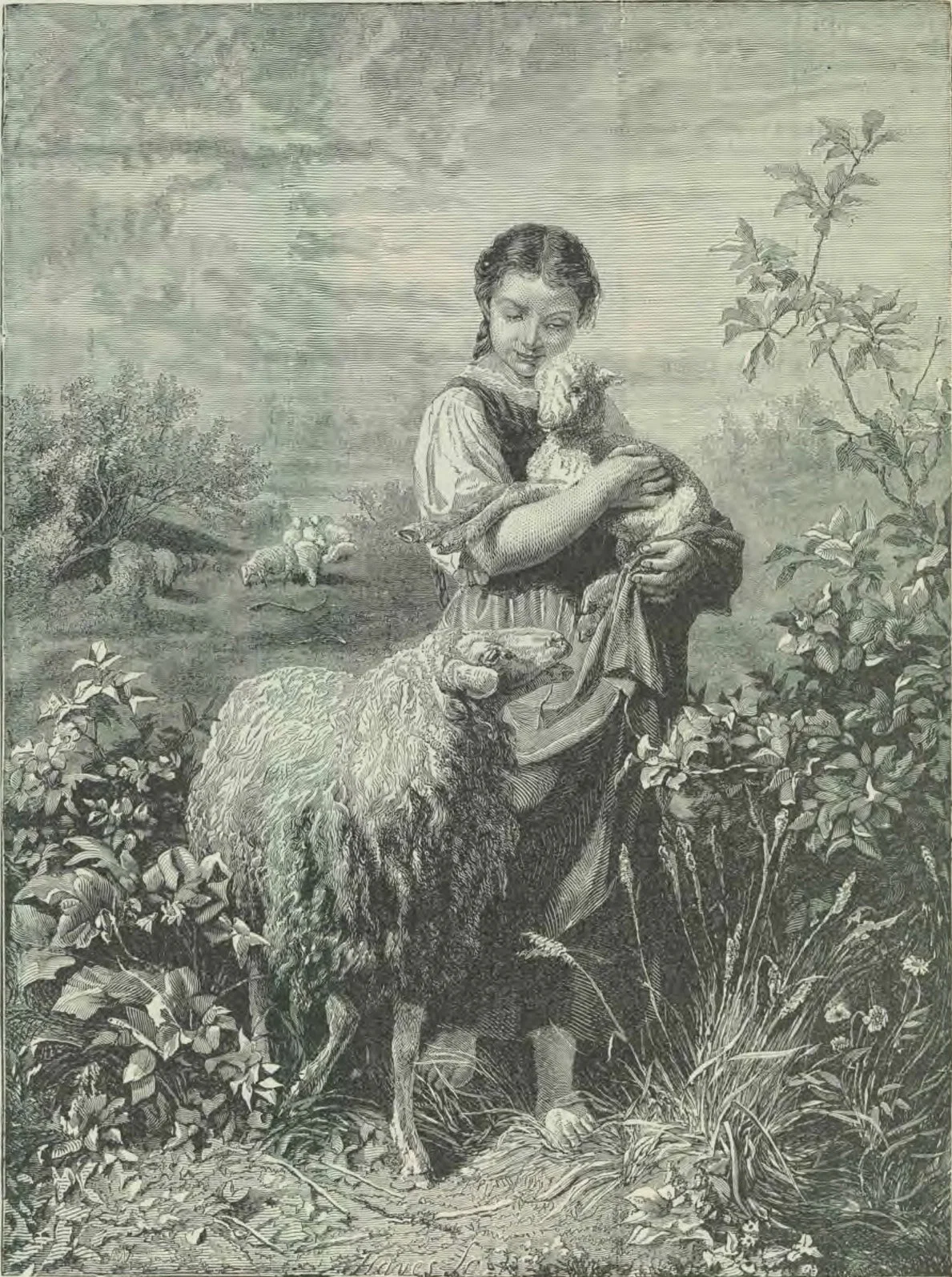
“Is it true, auntie, that girls sometimes have the care of sheep? There is a hint of this in what I have just been reading,” said Jennie Myers, as she laid down the book she was perusing.
“Why, Jennie,” said her aunt, Mrs. Brainard, “have you forgotten that away back in Bible times Rachel kept her father’s sheep, and that other daughters in those days did the same work? In some Eastern countries it is still a common practice to place the care of the flocks in the hands of girls; and they usually make careful, tender shepherds.
“Besides the care of the flock, the modern shepherdess improves every opportunity when the sheep are quiet, to knit and sew for the family at home, or to add a few pence to the scanty home-purse.”
“I don’t see how they can do that,” said Jennie, “if the duties of a shepherd require such constant watchfulness as is represented in the Scriptures. I would like you to tell me some particulars of Oriental shepherd life; for I know very little of the Scriptures save what I have learned during the few months I have been staying with you.”
Said Mrs. Brainard, “How closely the flocks need watching, depends upon the extent of territory allowed them for pasturage, and upon certain other circumstances that I shall notice as I try to portray in a little word-picture some of the characteristics of shepherd life.”
“In Bible times the wealth of the people consisted largely in flocks of sheep and goats, which were allowed to roam over the deserts and uncultivated parts of Palestine. For these flocks shepherds were employed, because the animals were continually exposed to dangers of some sort. In the forests were wild beasts, to which they were a prey, as well as to the robbers which infested the country. Further than this, they were liable to suffer from thirst or want of feed, if, perchance, they should wander far into the desert. In the mountainous districts they were in danger of falling from some high cliff or rocky ledge. There is probably no other animal so dependent upon the care of man for its well-being as is the sheep.
“The shepherd girls of to-day do not have the evils to contend with that those did anciently. They are given smaller pasture lands, over which wild beasts do not roam, and their surroundings are made favorable.”
“The faithful Oriental shepherd remained with his fold through the night, either in buildings prepared to protect them from the cold; or, during the warm season in some sort of inclosure made of thorns, etc. Then as now he made use of a long rod, with a crook at the end, which he placed around the shoulders of the sheep and guided them as he pleased. In the morning he led them forth from the fold by going before them and calling them by name.
“Oriental shepherds have names for the principal ones of their flocks, the same as men do for their horses and dogs. These the sheep learned, and when called by their own shepherd, would at once approach him. But they would flee from the voice of the stranger.
“Porter describes as follows a scene he witnessed among the hills of Bashan, to show the readiness with which the sheep of a large flock will recognize the shepherd’s voice:— ‘The shepherds led their flocks forth from the gates of the city. They were in full view, and we watched them and listened to them with no little interest. Thousands of sheep and goats were there, grouped in dense, confused masses. The shepherds stood together until all came out. Then they separated, each shepherd taking a different path, and uttering, as he advanced, a shrill, peculiar call. The sheep heard them. At first the masses swayed and moved as if shaken by some internal convulsion; then points struck out in the direction taken by the shepherds; these became longer and longer, until the confused masses were resolved into long, living streams, flowing after their leaders.’”
“Have you noticed, Jennie, that the Scriptures contain many beautiful figures, in which reference is made to some scene in shepherd-life? For instance, those in possession of large flocks of sheep employed various grades of shepherds, the highest being styled rulers, or chief shepherds. So in the church of Christ,—those who are given the charge of the church upon earth are entitled under shepherds, while Christ himself is the Chief Shepherd.
“The Saviour is the good Shepherd, who ‘calleth his own sheep by name, and leadeth them out. And when he putteth forth his own sheep, he goeth before them, and the sheep follow him; for they know his voice. And a stranger will they not follow, but will flee from him,’ etc.
“Sheep are inclined to wander from the fold, giving their shepherds great anxiety until they are secured. The faithful shepherd will sometimes lose his own life in his attempts to rescue the wanderers. So the good Shepherd seeketh to recover his sheep who wander into the by-paths of sin. For his sheep he sacrificed his life. ‘And when he shall appear,’ his own sheep will ‘appear with him in glory.’ May you, dear Jennie, help to number the one fold, under the one Shepherd.” M. J. C.

WITHOUT HIM.

Afar in that land of wonder, Where diamonds and gold are found, Where summer is brightly shining The beautiful year around, They never have heard the story, How the dear Lord Jesus came, And scarce would they stop to listen, Should you chance to speak his name.
And out in the sparkling ocean, There are isles forever green, Where the sun shines on in glory The towering palms between; But, oh, how my heart is aching, For all the poor children there, Who, taught by their heathen mothers, Bow low to idols in prayer.
They have birds with plumes like flowers, And flowers fragrant and gay, While fruits are waiting in plenty To drive sharp hunger away; But all that beautiful story Of those who on Jesus call, And freely eat the bread of life, They never have heard at all.
What is their summer and sunshine, And all their riches untold? Better the story of Jesus Than all of their diamonds and gold; Then speed far over the ocean, And bear, in its beauty and light, This news; for surely without it The sunniest day is night.
—The Well-Spring.

A ROYAL LESSON.

George III., king of Great Britain, though he was not popular with our grandfathers, who rebelled against him, was nevertheless, as kings go, a very good man. Many stories are told of his reverence and great regard for religious matters. At his coronation, after the crown had been put upon his head, the two archbishops came to hand him down from the throne to receive the sacrament. His Majesty told them he would not go to the Lord’s Supper with the crown upon his head; for he looked upon himself, when appearing before the King of kings, in no other character than in that of a humble Christian. The archbishops replied that although there was no precedent for this, it should be complied with. Immediately the king put off his crown and laid it aside, and then desired that the same should be done with respect to the queen. It was answered that her crown could not be easily taken off, to which the king replied, “Well, let it be reckoned a part of her dress, and in no other light.”
The queen was for awhile greatly pleased with her royal adornments; but after a time she grew tired of them, and on one occasion she gave to Miss Burney, who waited upon her as maid of honor, a striking testimony as to the little abiding pleasure to be found in pomp and display.
“The queen told me,” said Miss Burney, “that at first, when she became the queen of George III., she was struck with admiration of her splendid jewels and ornaments; but the feeling soon passed away.”
“Believe me, Miss Burney,” she said, “it is the pleasure of a week or a fortnight at most, and to return no more. I thought at first I should always choose to wear them; but what with the fatigue and trouble of putting them on, and the care they required, with the fear of losing any, believe me, in a fortnight’s time I longed again for my earlier dress, and wished never to see them more.”
This shows that Queen Charlotte was a very sensible woman. It is the part of true wisdom to seek for happiness in things which are not mere glitter and show, but which are solid and useful and everlasting.
Another story is told of the king, showing his regard for religion.
When the king was repairing his palace at Kew, one of the workmen, who was a pious character, was particularly noticed by his Majesty, and he often held conversation with him upon serious subjects. One Monday morning the king went as usual to watch the progress of the work, and not seeing this man, inquired the reason of his absence. He was answered evasively by the other workmen; but at last they acknowledged that not having been able to complete a particular job on the Saturday, they had returned on Sunday to finish it, which this man refusing to do, he had been dismissed from his employment.
“Send for him back immediately,” said the king. “The man who refuses doing his ordinary work on the Lord’s day is the man for me. Let him be sent for.” The man was accordingly replaced, and the king showed him particular attention ever after. It was upon this or a similar occasion that the good king uttered these memorable words: “I, a defender of the faith, and suffer any man to be discharged for his religion!”—Classmate.

NEW AGRICULTURAL INDUSTRIES.

About twenty years ago, in two or three of the southern counties of Michigan, the cultivation of peppermint developed into a very popular enterprise; and fields where formerly had waved a rich growth of grain, soon presented long, parallel rows of what had previously been considered a road-side weed.
The plants are set out like strawberry vines, and require similar care; and the mint, when mature, is cut the same as is hay, and then hauled to the still, of which there is one for every few mint farms, where the oil is extracted. This sells at present for about two dollars per pound, wholesale, having decreased in price fully two-thirds during the first few years of its production in these counties, where about one-half of the entire supply for the world's market is now obtained. Catnip and spearmint are also cultivated there, though on a much smaller scale.
Cranberries, originally the product of otherwise worthless marshes, meet such general favor that the demand in the markets has come to exceed the supply furnished by the voluntary growth. Noting this fact, a few enterprising farmers in Massachusetts have proceeded to meet the demand, to their own financial betterment and the satisfaction of epicureans, by engaging extensively in the cultivation of cranberries, producing fruit quite superior to the wild, and at lessened prices. Thus, while thrifty farmers at large endeavor to plow a little closer each year to the ponds and streams which render portions of their land comparatively valueless, these few specialists would fain turn all their fields to marsh land.
Another agricultural enterprise which has gained marked prominence within a few years, is the cultivation of celery, for which land is utilized that had previously been deemed incapable of tillage. Low land, too wet to plow, is now turned up by the spade, and its rich, black soil made to produce an excellent grade of this favorite relish. In some localities the small patches of available land scattered over a few square miles, produce dozens of carloads daily.
To the young people, who are accustomed to seeing farms devoted principally to grain, a novel scene might be presented by the tracts of land adjacent to large cities, where frequently many acres are planted to one particular variety of vegetable,—it may be cucumbers, or asparagus, or cauliflower, or cabbage,—which the proprietor furnishes to the city dealers; or the crop may be designed for some large canning establishment, and consist of sweet corn, peas, beans, or small fruits.
One specialty of these gardeners, which may justly be accounted new to agriculture, is the tomato. You may know some older persons who can tell you how they used to have a few tomato plants in their flower gardens, the fruit of which they called “love apples,” but supposed to be unfit to eat, some even thinking it poison.
Perhaps your fathers will agree that the tendency is now, more than formerly, to specialties in farming. While the plan of “general farming,”—that is, the apportioning of land among the various crops desired for home consumption,—still prevails, there are also many farmers whose land is devoted almost exclusively to—perhaps onions, or, haplessly, hops, rye, or oats, for the breweries or distilleries. We may also see vast farms given entirely to pasturage for cattle, and raising hay for the same.
In some localities, also, the ordinary crops have given way to flax, cultivated specially for the seed, from which is produced much of the oil used in paints; and a beautiful scene the fields present during the short season of blossoming, with the tiny blue blossoms spread thickly over the even surface of the grain.
Though the farmer does not now divide his land among so many crops as formerly, the number from which he may choose, to suit his convenience, the adaptability of his land, or the market prospects, is becoming much more varied, owing to the introduction of products from other latitudes, which the Department of Agriculture is designed to encourage.
In pioneer times, because of the meager market, each farm was of necessity made to produce food, fuel, clothing and lights—and, mayhap, tobacco—for all its occupants. In those old times, our grandfathers, besides felling the timber, and burning or hauling it, grubbed and tilled the land, also caring for the stock, preparing the firewood, and acting as carpenter, blacksmith, and cobbler; while our grandmothers spun and wove the flax and wool, braided the straw hats, dipped the tallow candles, and turned ashes and meat-scraps to soap.
But now, with facilities for the exchange of products, there is no longer a need for this diversity of production, and the farmer, with means—mechanical and financial—for experimenting with diverse seed, may venture a new crop, in the assurance of finding market for whatever his effort shall produce, and the hope of increased profits. Hence it is that you can mention numerous crops which have but recently been introduced into your locality,—possibly millet, or field peas, or sweet potatoes,—as well as an equal number of farm implements which have, within a few years, come to facilitate agricultural industries.
MRS. ADA D. WELLMAN.

WHAT WINS?

THE world has full many a hero: Go read what those heroes have done, And you'll find that though oft they were baffled, They kept up their courage, and won. They never lost courage in failure, Giving up, as the weak-hearted will, But said, “We will try, and keep trying, And conquer all obstacles still.”
And this they have done the world over. Their tasks were accomplished at last By often-repeated endeavor. The young oak may bend to the blast, But it springs to its place when it passes, And grows to new strength every day, And in time it stands firm in the tempest Whose wrath whirls the tall pine away.
Defeat makes a man more persistent, If the right kind of courage is his; He determines to conquer, and does it, And this is what heroism is. Strive on with a patient endeavor: The steadfast of purpose will win. Defeat comes to-day; but to-morrow May usher the grand triumph in.
—Eben E. Rexford.

Vegetable Flannel.

As the old lady said when she heard that astronomers had weighed the sun, “What won't they do next?” Vegetable flannel is a textile material now being largely manufactured in Germany, out of pine leaves. The fiber is spun, knitted, and woven into undergarments and clothing of various kinds.
In the hospitals, penitentiaries, and barracks of Vienna and Breslau, blankets made of this material are exclusively used. One of the chief advantages is that no vermin will lodge in them. The material is also used as stuffing, closely resembling horsehair, and is only one-third its cost.
When spun and woven, the thread resembles that of hemp, and is made into jackets, spencers, drawers, and stockings, flannel and twill for shirts, coverlets, body and chest-warmers, and knitting-yarn. They keep the body warm without heating, and are very durable. The factories are lighted with gas made from the refuse of these manufactures.—Sel.

The Value of Good Manners

Good manners are among the greatest charms a person can possess, and everybody should cultivate them, especially young people. They are something money cannot purchase, for there is only one way of obtaining them, and that is by habitual practice. We know a good mother who used to say: “Always use good manners at home, and then when you go among strangers, you need never be alarmed; for it will be perfectly natural to be polite and respectful.” This is true, and we have always thought that the best and easiest way to do anything right was to get into the habit of doing it right. Hardly anything is of more consequence than good manners and politeness in a boy or girl. Politeness costs nothing, and is at the same time of the greatest value.—Selected.

Three-Thousand-Year-Old Egyptian Almanac in the British Museum

“An almanac three thousand years old, found in Egypt, is in the British Museum. It is supposed to be the oldest in the world. It was found on the body of an Egyptian. The days are written in red ink, and under each is a figure followed by three characters, signifying the probable state of the weather for that day. Like the other Egyptian manuscripts, it is written on papyrus.”

Nobody: A Poem About Lost and Broken Things

Nobody.

“Nobody broke it! It awaked itself. It was clear way up on the topmost shelf. I—perhaps the kitty-cat knows!” Says poor little Ned, With his ears as red As the heart of a damask rose.
“Nobody lost it! I carefully Put my cap just where it ought to be (No, ’t isn’t behind the door), And it went and hid. Why, of course it did; For I’ve hunted an hour or more.”
“Nobody tore it! You know things will Tear if you’re sitting just stock-still! I was jumping over the fence— There’s some spikes on top, And you have to drop Before you can half commence.”
Nobody! Wicked Sir Nobody! Playing such tricks on my children three! If I but set eyes on you, You should find what you’ve lost! But that, to my cost, I never am like to do! —The Poet and the Children.

SHUFFLE, THE BABY ALLIGATOR.

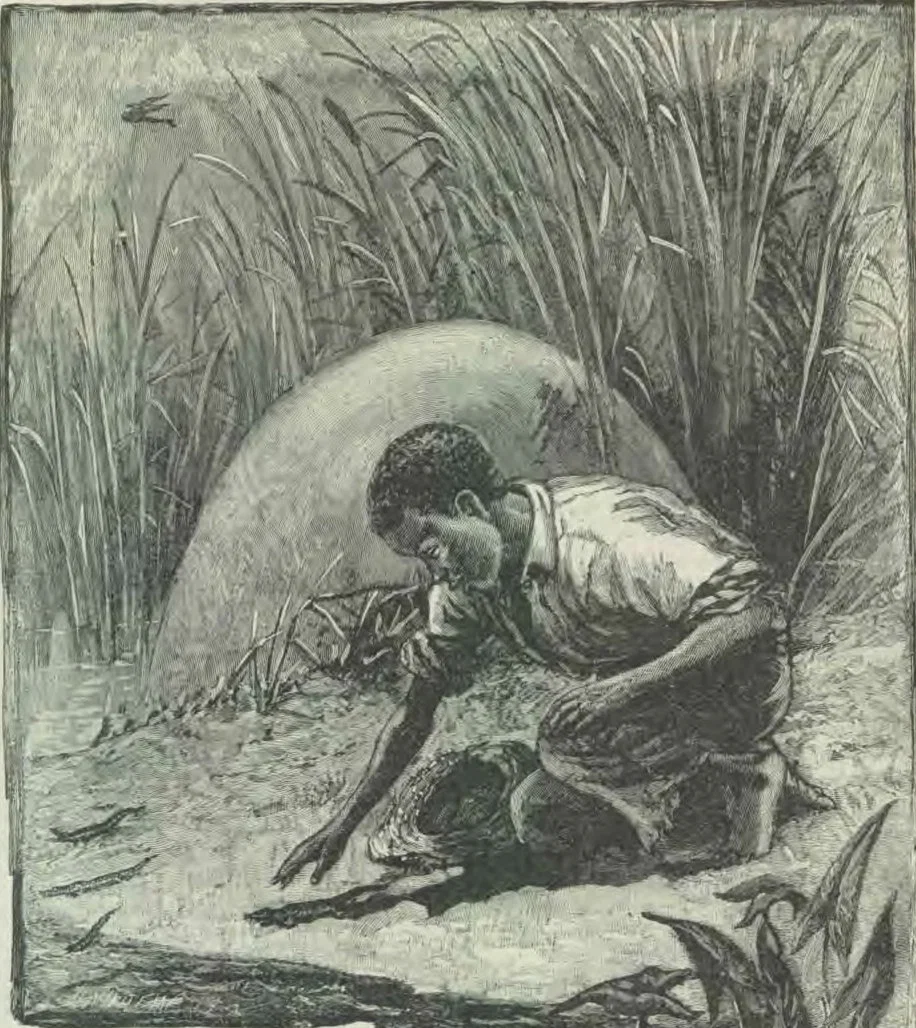
A QUEER name for a baby! But this baby was an infant alligator. One of the “Pike-nose family,” and a native of Florida. Mamma alligators build their nests among tall reeds by the banks of rivers or shallow ponds. The nests look like small tents. First, mamma alligator makes a circle on the ground, and then smooths over this circle. As soon as it is hard, she packs on it as many eggs as she can crowd together. They are larger than a hen’s egg, and have very hard shells. Then comes a second mud floor, a little smaller than the first, and more eggs. And so on until the peak of her house is reached, and there is no more room.
Sometimes a hundred eggs are in one house. Mamma alligator keeps careful watch over them. She fights if enemies come near. Baby alligators follow the mother in water, just as ducks swim out after their mothers.
When baby alligators lie on the shore in the sunshine, they whine and yelp like little dogs. At first they are not very strong. If large birds peck at them, or ugly turtles poke them, they cry out for the mother.
One day a mamma alligator went off fishing, and a black boy caught one of her babies. It was about six inches long. He sold the little creature to a lady. Master Pike-nose slipped about the house easily, but was awkward running on the ground. So, in fun, he was called Shuffle. He had a small bath-tub for his home. There he was happy, and every one petted him.
One day Shuffle was missing. Oh, what hunting there was! All the boarders looked through closets and under beds and sofas.
Nothing was heard of Shuffle all night.
Little Daisy Fenn, waking early, peeped through the bars of her crib.
“O mamma,—see, the paper is moving!” she cried.
“In the fire-place,” added Jack. “See, see!”
“Ha, ha, I see his nose,” said mamma, now wide awake. Master Pike-nose popped out, quite as much surprised as any one.
It did not take long to catch the rogue and put him into his bath-tub home. “Just to think of it,” said all in a breath; “we all slept in the room with an alligator,—a free alligator!”
“And nobody was hurt,” added Jack. “That’s the funny part of it.”
Shuffle was a very small eater. A bit of raw beef, the size of a pin-head, fastened to a quill, was given him. This was all he wished for a day, and sometimes he would not eat even that. Old alligators go whole days without food.
In the spring, when Jack returned to his Northern home, he brought Shuffle with him in a box, a present from the landlady.—F. P. Chaplin.

Changing Babies.

On a bright, warm day, Susy carried her baby brother out to the great farm-yard. It was a very pleasant place. A large barn stood at one side of it, and near this was a poultry-house. The chickens, ducks, and geese used to come out of it to stray about the large grassy lot. And in one corner was a nice clear pond.
Susy knew she should find many pretty things out here, and that baby would like to see them too. She walked around till the little pet got sleepy, and laid his head on her shoulder. Then she carried him to a long, low shed, where the sheep and cattle were fed in winter. There was some hay in a manger; she laid him on it, and sitting beside him, sang softly. This is what she sang;—
“What will you give, What will you give, For my little baby fair? Nothing is bright as his bonny blue eyes, Or soft as his curling hair. “What will you bring, What will you bring, To trade for my treasure here? No one can show me a thing so sweet, Anywhere, far or near.”
“Moo, moo-oo!” said something not far from Susy. “You think that’s so, do you?” And Madam Jersey Cow looked very doubtfully at baby. Said she, “Can he kick up his heels, and frolic all over the yard?”
“Why, no,” said Susy, “he can’t walk yet.”
“Ah; how old is he?”
“Nearly a year old,” said Susy.
“Nearly a year! My child walked before she was two days old!” The cow gave a scornful sniff, and walked off without another look.
“Baa-aa,” said an old sheep, walking up with a snow-white, downy lamb. “Let me see. He is a nice little thing, sure enough. But has he only two legs?”
“That’s all,” said Susy.
“Then mine is worth twice as much, of course. If you had two babies, now, we might make a bargain. But he seems to have no wool?”
“No, ma’am,” said Susy, “but see what pretty curly hair he has.”
“I don’t think I would wish to trade, thank you,” and she and her lamb trotted away to eat grass.
“Quack! quack! quack! Let me take a look,” and Mrs. Duck flew up on the edge of the manger.
“His feet don’t look as if he’d make a good swimmer,” she said, looking at baby’s pink, dimpled toes.
“Oh, he can’t swim at all,” said Susy.
“Good-by,” said Mrs. Duck. “All my darlings can swim.”
“Chip! chip! chip!” was the next sound Susy heard. From its nest in an old elm tree which stood near, a robin flew down, and perched on the end of a pitchfork. She turned her head from side to side, gazing at baby in a very wise way. “What can he sing?” said she.
“Oh, he can’t sing at all yet,” said Susy; “he’s too little.”
“Too little!” exclaimed Mrs. Redbreast. “Why, he’s tremendous! Can’t he sing, ‘Fee-fee-filly-filly-weet-weet?’”
“No, no,” said Susy.
“All my children sang well at four months. Has he little red feathers on his breast?”
“No,” said Susy.
“I shouldn’t like to hurt your feelings, but you see how much I should lose on an exchange, and I’m sure you would not wish that.”
“No, I shouldn’t,” said Susy. And Mrs. R. Redbreast flew away.
“Cluck! cluck! cluck!” “Peep! peep!” Mrs. White Leghorn Hen came along with her downy chicks. No wonder she fussed and fumed and cackled at such a rate, Susy thought, with twelve babies to look after!
“I haven’t much time to look,” said the hen, “and I should hardly be willing to trade. Can your baby say ‘peep, peep,’ when he’s hungry?”
“When he’s hungry, he cries, but not ‘peep, peep,’” said Susy.
“I see his legs are not yellow, either, so I’ll bid you a very good afternoon.” Off she went, ruffling her feathers, and clucking and scratching till Susy laughed aloud.
“I don’t wonder you laugh,” purred something near her. Susy turned in great surprise. There, at the other end of the manger, in a cozy corner, was her old gray cat. That wasn’t all. There were three little kits,—a white one, a black one, and a gray one. Susy had not seen them before, and she fondled them lovingly.
“She’s so proud because she has twelve!” said Mrs. Puss, looking after Mrs. W. L. Hen. “Now I think a small family is much better—three, for instance. Don’t you think three enough?”
“Indeed,” said Susy, “I think one’s enough, if it’s teething.”
“Mine never have trouble with their teeth. And perhaps I can never teach your baby to purr, or to catch mice. Still, I believe I’ll take him, and let you have one kitten, as I have three.”
“Oh, no; you don’t understand me,” cried Susy. “I don’t want to change at all. I’d rather have my little brother than anything else in the world.” But Mrs. Puss took hold of him, as if to carry him off. Baby gave a scream, and then Susy—awake! Then she looked around with a laugh as she thought of all she had seen and heard in her dream, since she had sung herself to sleep beside the baby.
Madam Puss sat by a hole, watching for rats. There wasn’t a kitten anywhere. Mrs. Hen was fuming and cackling and scratching harder than ever, but Puss did not seem to care whether she had twelve chickens or a hundred. The calf was feeding quietly by its mamma, and the sheep and her lamb lay under the old elm. And up in the branches Susy could hear Mrs. Redbreast teaching her birdies to sing.
So then Susy ran up to the house, and found supper waiting.
Baby held out his arms, and was soon on his mother’s lap, as happy as could be. Susy looked at him, and said: “God has made everybody and everything love their own babies best, hasn’t he, mamma?”
“Yes. We would rather take care of our baby than any other, wouldn’t we?” “Yes, indeed,” said Susy. And as she rocked the baby’s cradle that night, she finished her little song this way:—
“Nothing will do, Nothing will do; You may travel the world around, And never, in earth, or sea, or air, Will a baby like him be found.” —Sydney Dayre.

TITHES AND OFFERINGS.

LESSON 2.—COVETOUSNESS.

1. What is more than food and raiment? Luke 12: 23.
2. What assurance does Christ give that we shall be clothed? Verse 28.
3. Why would he not have us live in careful suspense regarding the necessaries of life? Verses 29, 30.
4. Of what does he exhort us to beware? Verse 15.
5. What parable is given to illustrate covetousness? Verses 16–20.
6. How does this parable show the covetous spirit?
7. What kind of men was Moses to select for responsible positions? Ex. 18: 21.
8. Is the same instruction brought into the New Testament? 1 Tim. 3: 1, 3.
9. What spirit should characterize a bishop or elder? Titus 1: 7, 8.
10. With what class of sins is covetousness placed? 1 Cor. 6: 9, 10.
11. Should Christians fellowship those who are covetous? 1 Cor. 5: 10, 11. See note.
12. How does God regard a covetous man? Ps. 10: 3.
13. Should it be so much as named as becometh Christians? Eph. 5: 3.
14. What other commandment is broken by a covetous man? And can such ever enter heaven? Verse 5.
15. What is one of the ways in which covetousness manifests itself? 2 Peter 2: 2, 3.
16. How will the preaching of God’s word affect such persons? Eze. 33: 31, 32.
17. What is the characteristic sin of this world? Jer. 6: 13.
18. When does this text especially apply? Verses 14, 16, 17; 1 Thess. 5: 2, 3; 2 Tim. 3: 1, 2.
19. What is the difference between a righteous and a covetous man? Prov. 21: 26.
20. For what did David pray? Ps. 119: 36.
21. What promise is made to him who hates covetousness? Prov. 28: 16.
22. To what does the apostle exhort God’s people? Heb. 13: 5.
23. What is the grace of our Lord Jesus Christ? 2 Cor. 8: 9.
24. What is the difference between the grace of Christ and covetousness? Ans.—The grace of Christ gives all, and covetousness takes all.

NOTES.

Heb. 13: 5 reads: “Let your conversation be without covetousness.” The word conversation did not mean when the Bible was translated what it now does. It is now generally used to denote verbal intercourse between persons, familiar talks, etc., whereas it formerly meant, “behavior, conduct, deportment,” and that is what it means in the above passage. The Greek word translated conversation in this text is tropos, and is defined by Bagster as “mode, manner, way;” “turn of mind or action, habit, disposition.” And this is the meaning that the word conversation has in every place where it occurs in the Scriptures, with the exception of Phil. 1: 27 and 3: 20, in which texts it means citizenship. But these meanings take nothing from the word as applied to our verbal intercourse or the words which we speak; for “way, manner of life, behavior,” certainly include our words.
Covetousness is an unlawful desire. It is classed among the worst of sins, for it is directly opposed to every principle of the gospel of Christ. The plan of salvation rests wholly on Heaven’s gift to man. It was a gift of infinite love, and was at an infinite sacrifice. When there is one single prompting of that spirit in the soul, it so far makes men unselfish and generous. The two spirits are as far apart as heaven and hell, as light and darkness. No man possessing the spirit of covetousness is fit to bear any responsibility in a work so sacred as that which is laid in such an infinite cost. Every attempt to advance it by such a person would only mar the work. Our efforts are weakened by such a spirit. It paralyzes the greatest effort. But the smallest act and the feeblest effort clothed with the spirit of appreciation of the gift of Heaven, has a power beyond description. It conquers Satan every time, and only works good. God would have his people despise covetousness, and cultivate the opposite spirit.
In 1 Cor. 5: 11 we are told not to keep company or even eat with certain characters, and among others are mentioned covetous persons. The keeping company is walking in church-fellowship, and eating is at the communion table. No stronger language could be used to show how God regards that sin. The tenth verse shows that we will have to mingle with them in this world as long as we are in it. But to take them into Christian fellowship is contrary to the principles of this gospel of Christ.
Mankind are naturally selfish, but the grace of Christ is unselfish. It is a heavenly plant, growing only in that heart which has been renewed. It is a jealous principle, and will admit of no rival. It makes a lovely character, admired by all. It cannot live without action, and every act increases, strengthens, and extends it. The unconverted heart cannot originate or produce this plant of heavenly growth, which lives and flourishes only where Christ reigns. If this spirit of unselfishness is nourished, it will prove an evergreen. Its branches will not decay; its leaves will not wither. It is immortal, eternal, watered continually with the dews of Heaven.
But covetousness is the reverse of all this. It withers the soul; it dries up every liberal feeling; paralyzes unselfish emotions; prevents every generous act, and while it may say, Yes, yes, to the opposite principles, there is nothing that can move the individual to action. This is covetousness. It should be hated as we would hate poison, and dreaded as we would dread the bite of a deadly viper. It should not be so much as named among saints.

Nellie's Gift

Did you ever want anything awful bad, and then have it come? Then you know how I felt when that package came from my auntie in New York, and I opened it and found a pair of real silk mitts. Jack said they were just “splen-dor-if-ic,” and Jack's my brother, and he knows. I had wanted some for ever so long; but I didn't say much about it, 'cause when you live in a little cuddled-up house, and your papa has to buy bread and shoes for so many, the money all flies away before it gets around to what little girls want.
I don't know how auntie found it out unless Santa Claus told her, and it wasn't near Christmas time, either. They were such pretty brown mitts. Tilly Jones said they were just the color of my hands, but I didn't care for that. Little hands will get brown when they weed the garden beds and do so many things. I looked at them 'most a hundred times in two days, I guess, and then it came Sabbath. Wasn't I glad! I put them on and walked to church, just so. Jack said I held my paws like a scared rabbit, but I didn't ever see a rabbit with mitts on.
It isn't right to think too much about what you wear when you go to Sabbath-school, and by and by I didn't; for we had such a good Sabbath-school I forgot everything else. A missionary man told all the folks about some poor little children away off; how the fire had burned down their school-house, and they hadn't any nice houses, or clothes, or anything; but they were trying so hard to get along and to learn; and he said what was given to those little ones was just the same as giving to Jesus. Think of that! Just the same as giving to the dear Christ Child! I just supposed everybody would give. Why, some of the folks are worth as much as ten dollars, or a hundred, and yet that basket stayed 'most empty.
I did wish I was rich, and all at once I remembered the poor widow in the Bible. I'd read it that very morning, how she had given her two mitts, every living mitt she had: it said so. So I slipped mine off, and dropped them into the basket, and I was glad, if my throat did choke all up. But pretty soon, when that basket was carried up, the gentleman picked them right out. “Has any little girl lost her gloves?” Nobody said anything, and he asked again: “Did any little girl drop her gloves into the basket by mistake?” It was awful still in that room, and I thought he was looking right at me, so I had to say something. “It wasn't a mistake,” I told him; “I wanted to help, and hadn't any money, but I knew how that woman in the Bible gave her two mitts, and so—” Then those folks all laughed hard, and I felt as if I'd like to drop right down through the floor.
I knew I had made a big mistake, but I couldn't see what; for if m-i-t-e-s don't spell mitts, what does it spell? 'Course I cried, but my teacher put her arm right around me, and whispered, “Never mind, little Nellie;” and she stood up and said, with her voice all trembling: “Dear friends, this little girl has given her greatest treasure; have we older ones done as much?” Some way, the money just poured into that basket after that, and the missionary looked gladder and gladder. They brought my mitts back to me, and my teacher said she would show me how to get some money to give. But oh, how full that basket was! And when that gentleman counted it, his eyes grew all wet, and he said softly (though I didn't know what he meant), “A little child shall lead them.”—Selected.
Continue reading: EDDIE'S TEMPTATION