The Youth's Instructor, Vol. LI, No. 49

The Creation of Light

The Youth's Instructor

December 8, 1903

Review and Herald Publishing Assn. · Washington, D. C. · December 8, 1903

The Creation of Light

Part I
IN the beginning the earth was without form and void, and darkness was upon the face of the deep. Then amid the darkness, God spoke. This was the entering of that word which gives light. Ps. 119: 105, 130.
God said, “Let there be light: and there was light.” This was the dawn of earth’s first morning. And as the light sprang into existence, as it divided the light from the darkness and illumined the chaotic world, it was but light from the Word that spoke it into being. Its power is the power of the word. Its life is the life of the word. Its manifestation then, and through the ages since then, is the manifested energy of the word.
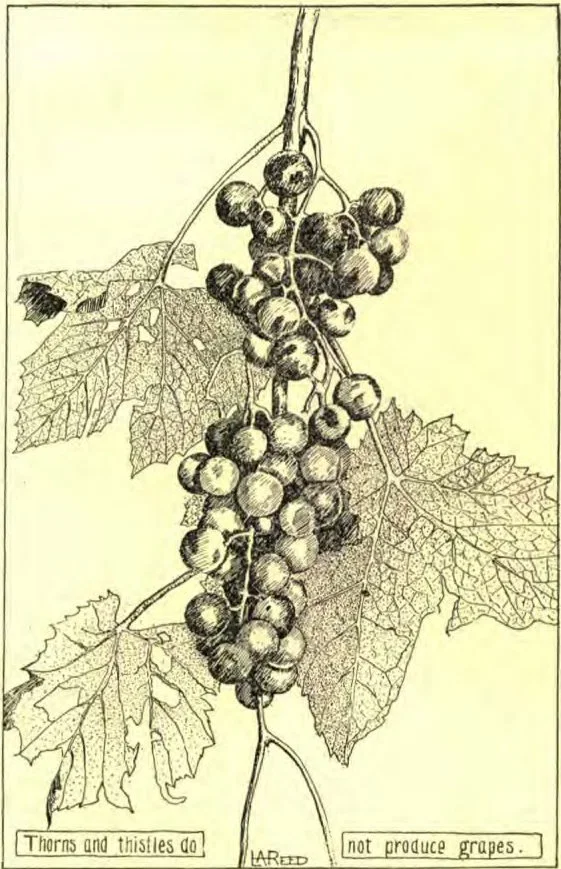
It is self-evident that like begets like. The universal testimony of all experience teaches us the great law of conformity to type. Something does not come from nothing. Only life begets life. Thorns and thistles do not produce grapes. The mortal begets only the things of mortality, and the Spirit begets ever the things of the Spirit.
Anything which does not possess a given quality can not impart that quality to something else. Like begets like. The gospel is built round this great truth. By the fall Adam lost his righteousness; therefore he could not impart righteousness to his children, but, instead, he imparts his own sinful flesh. “As is the earthy, such are they also that are earthy.”
But Christ has perfect righteousness, even the righteousness of God, and to his children he imparts this righteousness. Since he has no sin, it is evident that he can not impart sin to his children. “As is the heavenly, such are they also that are heavenly.”
Light came into being from the word of God; and since like begets like, this light which is begotten by the word must partake in all its qualities of the nature and character of the word from which it came. The word gives to light that which the word has to give. Hence light must be like the word, and, furthermore, light is a revelation, or manifestation, of the word: it is a portion of God’s word made visible!
It follows from this that a study of light in its full sense must be a study of the word of God. A study of the nature of light is a study of the nature of the word; a study of the character of light is a study of the character of the word.
Consequently, he who studies light only for light’s sake,—and this is the only way it is studied generally,—is not studying it for all that it is worth. He who has seen no farther than this has not seen, by any means, so far as he ought.
It is well to study light; it is well to study it carefully, scientifically, to learn all we possibly can about its many wonderful properties. But above all things, we should not stop in our study of light until we there have found a revelation of God. Sometimes we can with difficulty see wherein light reveals the character of God and of his word. But even then we should continue our study of light, knowing that in time we shall see farther; that sooner or later, behind every property of light, we shall be able to see the love and the goodness of God.
Many books are given to a study of light for light’s sake, but I know of none that are given to a study of light for the soul’s sake. But if you will follow patiently, I think we shall find in the sunbeam some marvelous revelations of God’s own wondrous character. L. A. REED.

On the Colorado Desert

Thorns and thistles do not produce grapes.
IN the extreme southeastern portion of California, between the San Jacinto and San Bernardino Mountains, lies the Colorado Desert. This desert is from twenty to ninety feet below sea-level, and was covered with water at no very remote period,—probably as an extension of the Gulf of California. Myriads of small shells, with other peculiarities of the soil, show that the land was once inundated. Besides, the “water-line” is plainly visible on the rocks at the foot of the mountains. On these rocks are peculiar formations, resembling coral in a crude state. But the finest specimens are rapidly disappearing under the relentless hand and hammer of the tourist.
Though there are stretches of barren desert sand, there is a species of vegetation which flourishes in places. The mesquit (a species of acacia) grows with almost tropical luxuriance out of the dry soil, its roots extending deep into the earth, whence it derives its moisture. Dense groves are formed by these trees, which, ere the woodman’s recent ax disturbed, neither man nor beast could penetrate. These trees, like the acacia, bear pale-yellow, brush-like blossoms, developing into the mesquit bean, which furnishes food for the native Indians and their ponies. Until within the last four years, the mesquit tree comprised the only vegetation, and the Indians the principal inhabitants, of this valley. But since that time the discovery of artesian water has developed many oases,—turned dry ground into water springs, and caused the wilderness and the solitary place to be glad, and the desert to rejoice and blossom as the rose. “And there he maketh the hungry to dwell, that they may prepare a city for habitation; and sow the fields, and plant vineyards, which may yield fruits of increase.”
Not long ago the writer spent three months in this desert valley. The climate is quite bracing in winter, but oppressively hot in summer. The winds, which are an almost daily occurrence, form the most unpleasant feature of this low region. Gathered in our shaky little cabin at night, during one of these storms, our voices faintly heard above the roar of the tempest, the sand sifting through cracks, filling the air, and covering even our persons and the papers we tried to read,—the dinner bell from its pole outside tolling dolefully at intervals,—it was dismal indeed. Sometimes these sand-storms arose while we were seated at dinner. Although doors and windows were quickly closed, sand and the fine, ashes-like dust, soon covered both dishes and food, and filled our eyes as well as our mouths.
These storms do much damage to the crops, for which the farmer has sacrificed almost every comfort, and spent untold labor in planting and irrigating. But we will endeavor even in this forbidding clime to think on things that are lovely. Sunrise on the desert is beautiful to see. The wind is now stilled, the sky clear, and the air balmy. The big, round orb rises out of the broad, sandy waste, and casts its pleasant early beams across the green alfalfa fields. A little later we gladly seek shelter from its bright rays.
The homes of the settlers are usually primitive, often consisting of a tent, a brush shed, or perhaps the friendly shelter of a large mesquit tree, with well-secured tent for refuge from the wind. Yet the hearts of these people are as large as the canopy of their outdoor dwellings, and their hospitality equal to both. Their rude environment causes them to throw aside the usual conventionalities and affectations of society, and heart speaks to heart, without reserve or unnecessary apology.
We drove to the “water line” one day, and it seemed like being on the ocean beach. As we searched for a place to spread our lunch, we saw a green tree not far away, the thick shade of which looked inviting after our hot ride. But what was our surprise, on a nearer approach, to find upon the tree not a single leaf—though it bore, like the “last rose of summer, left blooming alone,” one yellow blossom resembling the jasmine. The body and branches of the tree were smooth, and a bright-green, and the multitude of tiny green twigs caused the shade which attracted us .
One of our party rode the Indian pony to a distant cliff, and returned, bringing branches from a tree of still another variety, bearing lovely pink flowers.
The extreme heat of the advancing summer, with the thermometer reaching from one hundred and twelve degrees to one hundred and fifteen degrees, warned us that we would better “go inside,” in desert parlance; that is, return to civilization and home. So, providing shade for our wagon, both to exclude the sun and to admit the air, we packed our camping supplies, and started, traveling toward the northwest, driving four horses over the hot, sandy desert. It was necessary not only to avoid driving in the hottest part of the day, but also to make connection with the watering-places on our route, which are few and far between; for many a traveler has perished miserably for lack of water on this desert.
The first place to which we had been directed was marked on the map “Indian Wells.” We looked long and anxiously for the approach of a town, or at least an Indian village, with numerous wells of water. But what was our chagrin, when we reached the place indicated, to find a solitary well by the roadside, in the midst of the most dismal and desolate desert that can be imagined. We camped where many others had camped before us, and at daybreak were up, and started for Palm Springs, eighteen miles away. After a hot, tedious drive, with the thermometer at one hundred and nineteen degrees, we reached the place, which is truly an oasis in the desert. It is named from the few large palm-trees which grow there.
Here we were directed to the public camping-ground, where was a wide-spreading tree, under which we ate our dinner and rested. A cool mountain stream gurgled past, affording refreshment for man and beast. Later we plodded on, for we must reach the next watering-place, twelve miles distant, that night. The wind rose, and O! how it blew the coarse sand against our faces, and flapped the canvas “sails” of our wagon. And in that strange, desolate region, the gale blowing furiously, darkness settled down upon us long before we reached the oft-searched-for little stream, the White Water, which marked our camping-place for the night. Not far from where we halted, the dark, snow-crowned mountains rose, tall and majestic. The sky was overcast, but the vivid and frequent lightning revealed our surroundings, and the thunder reverberated through the desert valley, while the wind continued to blow with full force. Through the wind and darkness, a single token of distant civilization came to relieve the intense loneliness of the situation,—the whistle of a train. The tired horses supplied with food, and with water from the brook, the boys betook themselves to a bed on the sand, while the feminine portion of our company, fearful of scorpions and chameleons, sought a place of repose in the wagon, first commending ourselves to the care of Him who “maketh the storm a calm.” And exhausted nature slept, in spite of the untoward surroundings. Morning broke, revealing a scene of lonely grandeur. The wind had ceased; but from out the cloudy sky a few drops of rain spattered upon our sandy breakfast table.
I wandered to the little brook, which came from away across the valley, fed by mountain snows. Close beside it, a single rare flower flourished. Truly, “in the wilderness shall waters break out and streams in the desert.” As I watched that crystal stream, rippling over the sands at my feet, the words flashed through my mind: “His love like a stream in the desert will flow.”
The remaining twenty miles of our journey across the desert passed without special event. When at Beaumont, having really left the wilderness behind, our eyes were hardly prepared for the beauty revealed by the rising sun. Our road wound down a long canon, luxuriant with the foliage of early June in Southern California. The morning mist was just rising from shrub and tree and mountain. It seemed to the desert travelers like a glimpse of Eden. So will it be when we leave this sin-cursed earth, and enter the paradise of God. Here we turned to the south, and journeyed over hill and vale, until we came in sight of the “gem valley” of San Pasqual. And soon our own dear home greeted our longing eyes, the late yellow oranges still hanging on the trees awaiting our arrival, the air fragrant with the perfume of many flowers. Here we were welcomed by dear, glad-voiced loved ones, confirming the conviction that “there is no place like home.”
-FLORENCE WHITE JOHNSON.

Island Missions in the South Seas—III

The Conversion of Tahiti

At the time of Pomare’s conversion, the islanders of Eimeo began to arouse, and offer themselves for instruction. This was followed closely by word that the natives at Tahiti, too, were inquiring the way, and missionaries were sent to see whether the joyful news could be true. Labor in that island had been apparently fruitless for sixteen years; but when God’s time to favor the work in Polynesia came, he began it in such a way as to turn all the attention to himself; for it came at a time when war had driven all the missionaries from the island, and cut off all communication. We are indebted to Dr. A. T. Pierson for the facts concerning the next fifteen years, wonderful ones indeed in the history of missions.
Two native servants, formerly employed in the missionaries’ families, had, unknown to them, received favorable impressions, and had united together for prayer. They had been joined by others; and when the missionaries returned to Tahiti, they found a number of praying people, and had little to do but encourage and strengthen the work thus begun.
These years of fruitless and apparently hopeless toil had almost determined the London Missionary Society to abandon the work in Tahiti. But one minister pleaded for the mission. He declared that he would rather sell the clothes from off his back than give up the work in the islands. He proposed that a special season of prayer for divine blessing be engaged in. Such a season was observed. Encouraging letters were written to the missionaries, and while the vessel was on her way to carry these letters, it was passed in mid-ocean by another vessel bringing to England the idols that had been rejected by the people, and bearing the good news that the people were seeking God.
One of the two natives who had begun to call upon the Lord in prayer while the missionaries were driven away from Tahiti, was named Tuahine. The other, impressed by some remarks from Pomare, went to inquire of Tuahine, who had lived for some time in the missionaries’ families, and they retired to a secret place, to talk and pray. After a little while, several young persons united with them; and this little band, without the guidance of any missionary, determined to abandon idols and the wicked practices of their countrymen, and worship Jehovah. As Christianity spread, Tuahine rendered much assistance to the missionaries, directing inquirers, teaching in schools, and translating the Scriptures, sometimes spending from eight to ten hours a day in this work.
A chapel built under the direction of Pomare in Eimeo was opened for worship July 25, 1813 and the next evening thirty-one natives cast away their idols, and their names were written among the disciples of Jehovah. Shortly after, the number had risen to above three hundred, embracing, among others, a priest, who led in the burning of the idols.
Meanwhile at Tahiti persecution drove the native Christians to the woods and lonely valleys at midnight for prayer. One young man suffered martyrdom, and another bore a lifelong scar in testimony to his fidelity. The year 1815 was the most remarkable that had been known in Tahiti. A plan was laid to destroy all Christian natives on the island, and they fled for their lives to Eimeo, where much time was spent in prayer, July 14 being set apart as a special day of fasting and prayer for deliverance. Soon after, two chiefs from Tahiti came to Eimeo, urging the Christian chiefs who had fled to return. The invitation, however, was a mere cover for a plan to destroy the king, Pomare, and his friends. A battle followed, in which Pomare and his army were victors. Instead of killing his enemies, as had been the custom in the past, the king decided to destroy their idols, and the multitude stood astonished, both at the helplessness of their gods and the strange course of their enemies. This opened the way for the gospel to be carried more extensively in Tahiti. As the missionaries returned, they found the people busy in destroying maraes, and building little chapels. They were very anxious to learn to read. Family prayer became common, and secret prayer was often engaged in by the natives. The missionaries could scarcely get any rest, so continually were they besieged with inquiry. During this time sixty-six chapels were erected, in which the people assembled four times each week.
A printing-press was now brought to the island of Eimeo, and polished stones upon which the heathen worshipers had knelt before their altars, were dug up and placed where God’s word was to be printed. The first book printed was a spelling-book, and Pomare was permitted to aid in setting up the first page, and to strike off the first impression. This was the beginning of the spreading of the knowledge of God from isle to isle by the power of the printed page. Other books followed, that which was appreciated the most being the translation of the Gospel of Luke into Tahitian. While this book was on the press, the natives often constrained the printer to stop his work to explain to them what they read. So impatient were they for the book, that they could not be persuaded to wait until it was bound. However, they did not suffer these precious volumes to remain in their own homes long without proper covers. Five men from Tahiti came to the island for copies of the Gospel, and so fearful were they that some one might anticipate the object of their visit, and buy up all the books, and they be compelled to return without any, that they did not go into any house to lodge. As soon as they received the copies of the precious Gospel, which they wrapped in bark and put in their bosoms, they set sail for Tahiti without having taken food or drink during their stay in Eimeo.
The next step was the organization of a missionary society, of which hundreds of natives became members. Then a large chapel was erected. It contained one hundred and thirty-three windows, twenty-nine doors, and was seven hundred and twelve feet long and fifty-four feet wide, two hundred and twelve feet longer than St. Paul’s in London. As no preacher could speak loud enough to be heard from end to end of the chapel during the whole sermon, three pulpits were placed in it at intervals, with a minister in each. Six thousand persons thus joined in singing God’s praise in this new place of worship, and three sermons were preached simultaneously.
This was the beginning of a work which was to fit these natives for the last message which God had committed to his people.
BERTHA HOOVER

A Parable

EARLY one morning two men, walking along the dusty highway, chanced to spy a book lying by the roadside. The place was remote from any dwelling, and the way was unfrequented by many travelers. Both men stopped when they saw the book. The question arose in the mind of each, “Where did it come from?” After some thought, one of the men said, “See how beautiful and clean the binding is. No dust from the road has clung to it, nor are there any marks upon it of the heavy dew last night. The road has not been traveled by any one since yesterday. There can be but one explanation,—an angel from heaven brought the book, and placed it in the road that we might find it.”
“Not so,” returned the other. “That answer does not satisfy me; for while you were speaking, I have been examining the road more carefully, and I have discovered faint traces of steps. Clearly, some person has been here. It is a beautiful book, as you say, and we ought not to leave it in the dust.”
The first speaker was not pleased with the way his fellow-traveler had received his argument, and he replied somewhat shortly, ridiculing the thought of any one’s having been along the road before them that morning. One argument was answered by another in quick succession. Every moment the debate became more heated, and the two men were in danger of coming to blows.
LAUGHING JACKASSES
LAUGHING JACKASSES
While each was speaking with excited gesture, in his endeavor to prove to the other that he was right, a third traveler approached them. He was carrying a heavy load, and had found the way hot and dusty. Coming up to the two men, he stopped to watch them. They had closed with each other now, and the struggle was one of physical force. The dust in the air was so thick that the stranger did not see the book lying where the others had found it. He called to the men, inquiring the cause of the trouble. They stopped their struggle long enough for each to explain his position. “The book,” said the stranger, “what book?” They pointed to where it lay, sadly soiled, and nearly covered with the dust they had raised. During this interruption they had stood glaring at each other, and now they rushed together again, each with the determination of proving himself right.
The stranger, seeing that interference was useless, turned to the book. He picked it up and examined it. The language was one he understood, and he fell to reading. The farther he read, the more interested he became. He seated himself upon a stone by the roadside, and was soon too deeply immersed in his reading to notice what was passing around him.
For an hour the man with the burden sat reading. Then he rose to go. Such a strange sense of rest had come to him that it seemed as if he must have lost his load. He had not been so refreshed since he had started on his journey. Looking around, he found that he was alone. The sounds of high words and sharp strife, borne faintly to his ears by the wind, told him that his two strange acquaintances had gone, leaving the book with him.
The man with the burden looked at the volume in his hand more carefully, but found no name in it,—nothing, in fact, that revealed the owner. Then he reasoned with himself: “Those men did not want the book. They were interested only in deciding the question where it came from. I want the book. Never in all my life have I had anything affect me as this has.” Forgetful of the burden he carried, eagerly scanning the open page, he continued his journey,—Sunday-School Times.

The Laughing Jackass

“WHAT a queer name!” is the exclamation from many readers as this heading is first noticed. You doubtless begin at once to wonder what kind of creature has received such a title. In all probability the patient donkey is the first thing brought to mind, especially if you have ever heard him bray.
In the northern part of London is a great public common known as Hampstead Heath. It is reserved for the common people as a picnic resort and playground. In one place in it there can always be seen a row of donkeys, saddled and bridled, and awaiting patronage by the little folks who visit the place. Occasionally one of the animals will stretch out his neck, and make such an outlandish noise that many people with good cause might regard him as well qualified to be named the laughing jackass.
But strange to say, the creature properly known by that name is not a four-footed animal at all, but a bird.
“A bird!” I fancy I hear from many voices; “it must be a queer bird to have such a name as that.”
Yes; it is a strange bird, and it is found in the place where so many curious birds are found; that is, in the southern hemisphere.
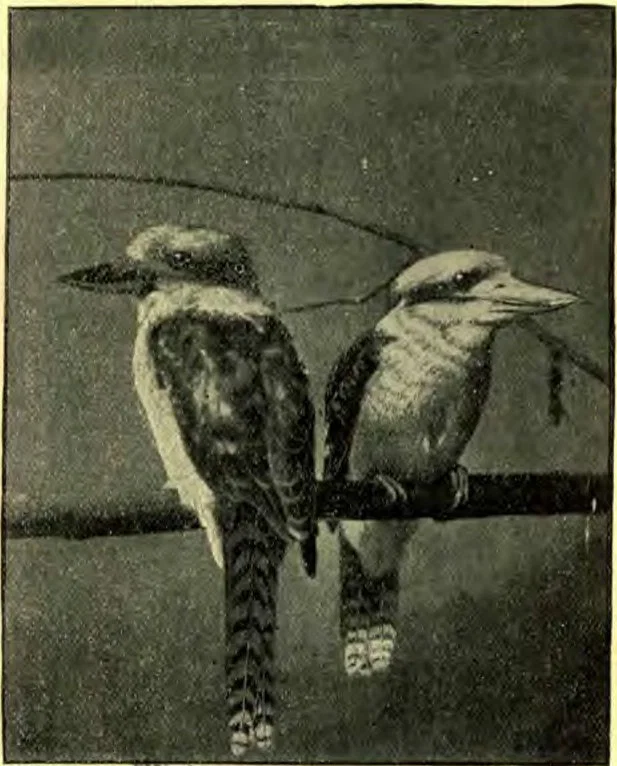
The laughing jackass is an overgrown kingfisher. His home is in Australia. He is as large as a crow, but his head is much larger than a crow’s head; and his bill is very long, and abnormally developed.
The accompanying photograph shows a pair of these birds. A look at them is enough to make one laugh, but that is not the origin of their name. It comes from the noise of the birds themselves.
Imagine, if you can, taking a very early walk on a hot, dry summer morning in December or January, the months having the longest days in Australia. You are entirely alone, and do not expect to see or hear any one. A few mud larks, or perhaps a pair of saucy magpies, may be chattering about; but these are the only living things you have yet noticed. Suddenly, in your immediate presence you hear, apparently from half a dozen voices, the most unearthly, idiotic peals of laughter imaginable. You are much startled, and look about to see the persons who, thus unannounced, rudely disturb your morning reverie. After some searching, you see a bird like one of those in our picture, sitting demurely on one of the highest limbs of a near-by gum tree. Unless you have previously formed his acquaintance, you can hardly believe that the sounds came from him. But it is even so. He is the laughing jackass.
One of these birds can make noise enough for half a dozen boisterous boys, and two can equal a score. This bird is a great enemy to snakes, which, in Australia, are almost without exception very poisonous. For this and other reasons he is protected by the state.
One peculiarity of this bird is that his laugh is often very annoying. He may be near you, and you not know it; but if you happen to slip in the mud, get caught in a sharp shower, or lose your hat in the wind, he is quite sure to burst out in unrestrained laughter, as if to mock you.
One day an American minister in Melbourne was going on his bicycle out into the country on a pastoral visit. A strong wind was blowing from the north, bringing its usual accompaniment of dust and oven-like heat from the desert interior.
The minister had passed the metropolitan area boundary, and was fairly out in the country, when one of the tires of his wheel suddenly flattened as a result of the intense heat. He turned around, and walked back to the first suburban repair shop; and although it was a holiday, and all the shops were closed, he found the proprietor, and persuaded him to open his door and repair the tire.
Then he started on his journey again; but he had only gained about half a mile more than the scene of his first breakdown when a similar accident occurred to the other tire. Just at that instant, from a great gum tree over the fence, came exulting, mocking peals of laughter from one of these birds.
It was enough to try the patience of even a minister.
H. E. SIMKIN.

L. D. SANTEE

Forebodings

WHEN the joys of springtime have found you, And the rose yields its sweetest perfume; When sweet flowers blossom around you, Wooed by tenderest kisses of June; When the earth and its scenes are so pleasant, With the light of the sun over all,— Then live in the joys of the present, And dread not the gloom of the fall!
When the youthful and fair are so comely, And life is a beautiful page, Dream not of their faces as ugly, With the lines and the wrinkles of age. Deem not that the friends that now love you Will ever prove false, or grow cold; For heaven is bending above you With a love that can never be told!
Let us live in the spring with its gladness, Let us gather life's beautiful flowers, Let us dread not some oncoming sadness, Nor the gloom of the gathering showers; Let us fear not the sable of sorrow, And dread not the threatening rod; But, taking no thought for the morrow, Leave all in the keeping of God!

L. D. SANTEE

Story-Telling

Who can tell a story? Now my friends in the ’teens and the twenties will decide that this question is meant for babes and nurses. And the maiden and the young man will declare that they have more important business to do than to tell stories, though perhaps neither would admit a lack of time to read them. Well, you banish yourself from good company when you scorn the role of story-teller.
I remember reading, a short time ago, this incident about the great historian Macaulay. When his History of England was first issued, a gentleman in the suburbs of London decided that the book was too good to be enjoyed alone by himself, so he arranged with a large number of his poor neighbors—working men of every trade—to come to his house on certain evenings, when he would read to them Macaulay’s history. Every one of them came regularly, and listened with absorbed interest. When the book had been finished to the last word, a big Scotchman rose, as spokesman for the whole company, and moved a vote of thanks to Mr. Macaulay for having written a history which the common man could understand and be interested in. Wherein, asks his biographer, after relating the incident, lay that enthralling power of the historian?—It lay in his consummate ability as a story-teller; for Macaulay was a genius in the telling of stories.
There is a long roll-call, besides, of illustrious story-tellers in the Bible: Moses, the world’s greatest statesman; David, the peerless poet; Samuel, who laid anew the foundation of Israel’s educational system; Jotham, who changed the history of Israel by a story told in unwilling ears from the side of Gerizim; Ezra, the leader and chronicler of the Restoration; Isaiah, Jeremiah, Ezekiel; Jesus, who taught as never other man taught, and largely by story.
I was in a Young People’s meeting the other day, when the leader proposed the following exercise. She began to tell a Bible story, in realistic fashion, leaving out names of persons and places, but describing them. The first one who recognized the story might interrupt, and if correct in his surmise, might, the story being finished, tell one himself on the same plan. It was a test to every one of his knowledge of Bible lore, and it set many heads to thinking.
At a later meeting we were talking of the cultivation and the use of the faculty of story-telling. Every one whom God has given an opportunity to know his truth, is responsible for the telling of it. We need practise in the manner of telling it. The Bible stories are meant to give us our first exercise in the telling of God’s truth. Who can preach the gospel before he can tell the story of the cross? Can you tell it as well as Matthew told it? If you have read it, and thought about it, and lived upon it, and acted it, then you can tell the story; then you can be a co-worker with all the messengers of salvation.
This Young People’s Society has taken up the work of story-telling. It is not always to be conducted in the same way, but always, in whatever manner it is done, it is to tend toward the grand result of making us earnest, expressive, and happy story-tellers. Story-telling is a study in itself,—a study of science and art in language,—but the greatest principle of both the science and the art may be, and must be, learned by the beginner; that is, to be living the story, for you will tell only what you are, in whatever you say.
Every story which does not impress itself upon the mind, which does not leave its burden of truth and life there, is but puncturing holes in your memory and your intellect. The story which simply intoxicates the mind and leaves no impression, or only a bad impression, is making a sieve of the mind. Besides, because it never is reproduced, it is destroying the precious power of expression, and making of you—shall I say it?—an imbecile, which in the end means an idiot. Without giving you a list of good stories or of good books, let me give you the principle in accordance with which you may exercise your own power of choice: read and tell only those stories, that biography, that history, which will make you the noblest man or woman that God can see possible. Distinguish between God’s stories and the devil’s stories. Not all God’s stories are in the Bible; but you may make a good beginning if you start there, and long before you are through with them, you will be far ahead of most people.
Cultivate the power to tell stories. Tell them to your companions, tell them to older people, tell them to those who do not know God. Learn the Bible stories; they have a wonderful power of strengthening the mind and the character. The next time I see any of you, I may wish to hear all the facts that cluster about— The arrows that were shot from a window. The asses whose straying led a man to the kingship. The rolling of a stone from the mouth of a well. A blind army led into a hostile city. A little boy crying in the harvest field because of a headache. A swarm of bees in the carcass of a lion. An angel appearing to a man behind a wine-press. A man, a woman, and a baby fleeing at night through the southern desert. A sick man let down on a litter through the house-top. A young man asleep in a window during preaching. A scene of shipwreck. A lone man walking across the dry bed of a piled-up river torrent. A Sabbath-day vision on a lonely isle.
A. W. SPAULDING.

THE WEEKLY STUDY

The Elements of a Great Reformation

The Courage of Convictions

Scripture Study:—
We will not prepare your Bible lesson in detail this week, but will ask you to look up examples of men who have had convictions and the courage to carry them out. Note the result to the cause of God in each case. You will readily call to mind the experiences of Elijah with Ahab, Joseph in Egypt, Daniel and his fellows in Babylon, and many others. Do your best to work up a good lesson. The experiences of Daniel and his fellows in Babylon are of special interest.
Parallel Reading:—
“Great Controversy,” Chapter XI.
As illustrations of this subject, review in your mind many examples of courage which we have observed in our study of the Reformation; such as,—
Wycliffe’s reply to the friars.
The trial of John Huss.
Luther at Augsburg.
Luther before the diet at Worms.
The protest against indulgences.
Burning the pope’s bull.
In our reading this week we have “one of the noblest testimonies ever uttered for the Reformation.” Study the reading with great care; for it is one of the most important and interesting of this series.

To the Leader

This lesson may well be presented by two persons, each occupying from fifteen to twenty minutes. Let one give the Bible study, and the other the strong points and paragraphs in the reading. Or if you prefer, the Bible study can be given by several, each presenting one illustration of the subject. The parallel reading may also be divided, and several take part in the presentation.

Lesson Notes

Convictions are of little use to us unless we have courage to carry them out. In fact, if we set them aside, they become a worry and terror to us. But, on the other hand, when the tender, well-trained conscience points the way, if we have courage to act, God can work with us, and there will be results.
“Have not I commanded thee? Be strong and of a good courage; be not afraid, neither be thou dismayed: for the Lord thy God is with thee whithersoever thou goest.” Joshua 1:9.

Be Glad of Rain

Is it rainy, little flower? Be glad of rain. Too much sun would wither thee; ’T will shine again. The clouds are very black, ’tis true, But just behind them shines the blue.
Art thou weary, tender heart? Be glad of pain; In sorrow sweetest things will grow, Like flowers in rain. God watches, and thou shalt have sun When clouds their perfect work have done. —Mrs. Butts.
Continue reading: Joplin Young People's Society Activities and Mission Work